web analytics
Categories
Alice Miller Child abuse Emigration / immigration Hojas Susurrantes (book) Infanticide Liberalism Psychohistory Racial studies

My challenge to Alice Miller’s fans

A few years ago I parted ways with my former friends: the fans of the late Alice Miller, who claim to side the abused child during conflicts with their parents. It always bothered me that these people were incapable of honestly discussing my interpretation of Psychohistory, which main finding is that non-western cultures treat their children worse than we westerners do. If my former friends truly sided the child, they would make an effort to approach Psychohistory either to refute my interpretation of it, or, conversely, to use the findings of Psychohistory to expand their worldview.

The do neither. And the question is why.

It is my belief that present-day westerners are plugged in a thought-controlling matrix. It all started right after the Second World War with a barrage of ubiquitous, malicious propaganda directed against Germany. The truth is that, whatever sins the Germans committed during the war, the Allied forces surpassed them in times of peace, from 1945 to 1947 (see e.g., my excerpts of Hellstorm).

The same goes with the Jews and their holocaust. When Hitler became chancellor a Jew named Yagoda, the chief of the Soviet Union’s intelligence agency, killed more civilians than the later killings attributed to Himmler, and precisely for ethnic reasons. Never before had an entire white nation been ruled mostly by Jewry, and just see what happened in Russia. Hitler and the Nazis merely reacted against such killing.

These historical facts move me to think that Germany continues to be dishonestly demonized by an ongoing, twenty-four hours a day campaign of enumeration of her crimes. Demonized I say because the comparatively larger crimes of the Allies have been hidden from the public view in the soft totalitarian System we are living in.

I call this socio-political scheme a mind-controlling matrix, a prison for the white mind. Not only the crimes committed by the Allies are taboo. As an unwritten law, after the Second World War race studies also became forbidden in the mainstream media and the academia—with the exception of the continuing demonization of the Reich and, through intellectual fads of “historical grievances,” even the entire West. And not only the previous, perfectly respectable field of racial studies is now considered beyond the pale. An entire school of charlatanic thought, Boasian anthropology, has become axiomatic in the academia. Presently it is considered heretical to state the obvious: that there are cultures more primitive than others. Just one example: academicians are not even allowed to condemn the Amazonian tribes that still bury their children alive.

For the sake of using a handy word, let us call “liberalism” the religion that the leftist elites have been imposing on us after the Second World War. It is the perspective that comes after this knowledge—the exposé of a new civil religion that has been imposed upon the white psyche—what explains why I have distanced myself from my former friends. Consciously or unconsciously, these people are liberals first and child advocates second. Their true religion is liberalism, and egalitarianism, not child advocacy. If they prioritized child interests, they would side the children in cases of parental abuse among non-Caucasian immigrants, who, according to the data collected by Psychohistory, are more serious abusers than white families.

They do nothing of the sort. The sole mention of “race,” “inferior cultures” or “psychoclasses” freaks them out they and shun any frank discussion on the subject.

In other words, the followers of the late Alice Miller are deceiving themselves. Despite claims to the contrary they do not always side the children against their surrounding culture, even in cases of mind-destroying parental abuse (think of the surviving offspring after watching how their parents buried their little sister alive…).

If you are a Miller fan and believe I am wrong, you are invited to challenge my interpretation of Psychohistory.

I predict that this challenge will fall on deaf ears. By experience I know that Miller’s fans are no men of honor. They are too coward, and dishonest, to discuss Psychohistory’s most relevant finding: the grim consequences for child interests after the ongoing, massive non-white immigration in their respective countries—at the same time that the peoples of European origin, including my former friends, are refusing to breed.

Categories
Francis Parker Yockey Heinrich Himmler Liberalism Philosophy of history William Pierce

On Himmler

Cited in my last post:

The decline of a people’s culture is always the result of race mixing and a decline in racial quality…

While reading Heinrich Himmler’s insightful text the thought came to my mind that American white nationalists have been trying to reinvent the wheel. Why so many of them haven’t studied the literary output of the National Socialists, starting with the Reichsführer?

I tell you why: Liberals have produced a virus for the white mind so strong that we just can’t say that, as Himmler did in the text I reproduced yesterday, “destroying Jewry will remove the final cause that led to the decline and fall of Europe and its culture.”

My italics and I would add that, as a vaccine for the white mind against the liberal morality, we have been recommending the transvaluation of values. Himmler said:

It is equally false to think that cultures, like individual organisms, follow the laws of growth and decline; that every culture must eventually perish. History provides many examples of peoples that endure for millennia, reaching ever new levels, as long as they maintain their racial purity.

This passage says something that William Pierce and Arthur Kemp would say decades later in their histories of the white race (talking about reinventing the wheel…!).

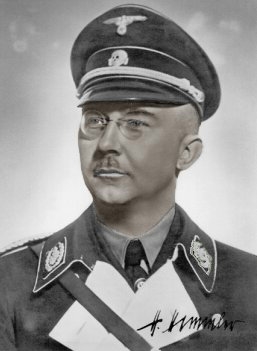
Heinrich_HimmlerI find it amazing that a German politician in the 1940s got it right while Oswald Spengler and Francis Parker Yockey—idealized intellectuals in the white nationalist scene—got it all wrong.

The message of Himmler, Pierce and Kemp is that, if you keep you gene pool intact through a very strong group surviving strategy, your people won’t decline even with millennia.

Once again a world of appearances collapsed, which had concealed from our eyes the true nature of humanity… A new epoch is coming, one perhaps even more revolutionary than that resulting from Copernicus’s work. Ideas about humanity and peoples that have endured for millennia are collapsing… The Nordic spirit is struggling to free itself from the chains that the Church and the Jews have imposed on Germandom.

But precisely the moment when the old sky started to fall apart and the Aryan to awaken the Anglo-Saxons, so sinfully committed to the old paradigm, did everything in their power to defend it by means of genociding their awoken ancestors… If their lands now burn with rioting blacks and Muslims after the dollar crashes, shouldn’t we start calling the societal collapse poetic justice?

Let Himmler live at least within our hearts.

Anno Hitleris 68!

Categories
Individualism Liberalism Protestantism

Individualism

by Dominique Venner

Europe since earliest antiquity has always been ruled by the idea that each individual is inseparable from his community, clan, tribe, people, city, empire, to which he is linked by a bond more sacred than life itself. This unquestioned belief, of which the Iliad offers the oldest and most poetic expression, took various forms. Think of the worship of ancestors for whom the city owed its existence, or the loyalty to the prince who was its visible expression.

The first threat was introduced by the individualism of early Christianity. The idea of a personal god emancipated men from the hitherto unquestioned authority of ethnic gods of the city. Yet the Church itself reimposed the idea that the individual will could not order things as it pleased.

Yet the seed of a spiritual revolution had been sown. It reappeared unexpectedly in the religious individualism of the Reformation. In the following century, the rationalist idea of absolute individualism was developed forcefully by Descartes (“I think, therefore, I am”). The philosopher also made central the biblical idea of man as the master and possessor of nature. No doubt, in Cartesian thought, man was subject to the laws of God, but God set a very bad example. Unlike the ancient gods, He was not dependent on a natural order anterior and superior to him. He was the single all-powerful and arbitrary creator of all things, of life and nature itself, according to His sole discretion. If this God was a creator free of all limits, then why not man, who is made his image, as well?

Set in motion by the scientific revolution of the 17th and 18th centuries, this idea has no known limits. In it lies what we call “modernity.” This idea assumes that man is his own creator and he can recreate the world as he pleases. There is no other principle than the will and pleasure of each individual. Consequently, the legitimacy of a society no longer depends on its compliance with the eternal laws of the ethnos. It depends only on the momentary consent of individual wills. In other words, society is legitimate only as a contract resulting from a free agreement between parties who are pursuing their own advantage.

Still, despite this individualistic and materialistic logic, we have long maintained communal ties of birth and fatherland and all the obligations these imply. These ties have been progressively destroyed across Europe in the decades following World War II, while the triumphant consumer society arrived from the United States. Like other European countries, France has gradually ceased to be a nation (based on nationality, common birth) to become an aggregate of individuals united by their pleasures or the ideas they have of their interests. The former obligation to “serve” has been replaced by the general temptation to “serve oneself.” This is the logical consequence of the principle that founds society solely on human rights, thus on each individual’s interests.

And now, before our eyes, this repulsive logic faces a revolt from the depths. We are witnessing the unexpected awakening of all those who, through atavistic reflexes, feel deep down that unquestionable ancestry is what make a clan, a people, or a nation.

(Excerpted from a Counter-Currents article)

Categories
Christendom George Orwell Liberalism

Auster’s principal discovery

Lawrence_Auster

Today during my peripatetic soliloquies in my daily walk, I realized that I have failed to transfer into textual form one of my most recurrent soliloquies about the current totalistic paradigm. But first I would like to drop a few lines about the previous totalistic paradigm for the white peoples.

The original Latin text that Catholics used to listen during the traditional Mass—:

Credo in unum Deum,
Patrem omnipoténtem,
factorem cæli et terræ,
visibílium ómnium et invisibílium…

—is called Nicene because it was adopted in the Council of Nicaea in 325 AD (a city that changed its name after the Turkish occupation). The Nicene Creed has been normative not only for the Catholic Church but for the Orthodox Church and many Protestant denominations.

Latin was a language designed for uttermost clarity. When the tenets of Christianity became under direct attack by the end of the 18th century, the Enlightenment philosophers, some of them recently emancipated from the Jesuits’ indoctrination, knew exactly the doctrinaire content of the principles they were taking to task.

The situation today is exactly the opposite, I have told myself during so many soliloquies. One of the reasons why contemporary whites have been unable to challenge the new paradigm that began to be formed after the Enlightenment, called “liberalism” by Lawrence Auster and which reached its peak in our times with the American hegemony over Europe, is that the liberal axiom has never been stated explicitly by its proponents. The situation reminds me the Aristotelian concept of the enthymeme with its unstated assumption that must be true for the premises to lead to a conclusion.

The late Auster discovered that liberals were suppressing a crystal-clear, Nicaean-like statement of their major premise. Their Non-discriminatory principle is unstated and simply taken as axiomatic: something akin to the Orwellian world where the State controlled thought by means of controlling the peoples’ language. In Auster’s own words, “No one in today’s society, including conservatives, feels comfortable identifying this utterly simple idea, because that would mean opposing it.”

Unlike Latin, Newspeak is a language designed for uttermost unclarity. This means, of course, that in order to reverse the totalistic belief system that presently controls the white psyche, one must first identify the liberal axiom before the dissident, post-Enlightenment philosopher is even able to discuss it.

In other words, if we listened the liberal axiom with the same frequency that, as a child, I listened the Nicene Creed every Sunday during the Mass, the first step to disabuse whites from the paradigm that is destroying the West would have been taken.

Categories
Kevin MacDonald Liberalism Obituaries

Lawrence Auster (1949-2013)

Lawrence_Auster

Larry Auster died today. Although we had strong discrepancies in the past, the West’s Darkest Hour owes Auster some of its central ideas.

MacDonald’s recent article about Auster gives the impression that the good professor also forgave Auster’s gross insults against MacDonald because, just before dying, Auster seemed to disabuse his readership by making known a hidden chapter on the Jewish Question that very well could have been published at The Occidental Observer or The Occidental Quarterly.

Controversies aside, perhaps Auster’s most important discovery was the explicit enunciation of the Non-discriminatory principle that, implicitly, rules the West today: the quintessence of liberalism.

I sincerely believe that every pro-white advocate should be aware of that principle.

Categories
Feminism Friedrich Nietzsche Islam Islamization of Europe Liberalism Sex Twilight of the idols (book)

Atheist scum

Unlike Nietzsche and other nineteenth-century critics of Christianity, today’s atheists are scum. A single example will illustrate my point.

Atheist Richard Dawkins, who has appeared in talk shows arguing that homophobia is bigotry, claims to be an evolutionary biologist. But Dawkins has never dared to take seriously the most elemental biological law of evolution regarding the future of his people: to grow and multiply—not even when whites are flagrantly violating that law and heading toward extinction.

The following is a brief exchange between Dawkins and a Palestinian Muslim. Keep in mind my recent post on Pride & Prejudice and Will Durant’s words, that Nature “sees that a nation with low birth rate shall be periodically chastened by some more virile and fertile group”:

Muslim: Fix your women.

Dawkins: Fix your women! That’s not my business; that’s my women’s business.

Muslim: No, no! It is your business. When you take your women and dress them like whores in…

Dawkins: I don’t dress women! They dress themselves!

Muslim: I know but you allow it as a norm to let women on the street dressed like this. What’s going on with your society? What’s wrong with the…?

See the video of this exchange here. Dawkins could not tolerate more cognitive dissonance and, as you can see in the video, he simply faded out the audio of what the Muslim was trying to tell him.

Unless a white revolution reclaims Europe, the Muslims will teach the feminized western males of Eurabia how to grow a pair again, especially regarding our treatment of women. How sad that the Muslims have to teach us what we already knew when, unlike the atheists of today, we took the laws of biology very seriously.

This is Nietzsche’s critique of licentiousness under the guise of liberty taken from Twilight of the Idols, chapter “Skirmishes of an Untimely Man,” section 41:

Freedom which I do not mean.* In times like these, abandonment to one’s instincts is one calamity more… Today the individual still has to be made possible by being pruned: possible here means whole. The reverse is what happens: the claim for independence, for free development, for laisser aller is pressed most hotly by the very people for whom no reins would be too strict. This is true in politics, this is true in art. But that is a symptom of décadence: our modern conception of “freedom” is one more proof of the degeneration of the instincts.

(*) Adding a “not” Nietzsche is quoting here a popular German verse from a Max von Schenkendorf poem titled Liberty.

Categories
American civil war Americanism Egalitarianism Emigration / immigration Free speech / association Liberalism Tom Sunic

Review of Sunic’s book

by Mark Farrell

Homo Americanus: Child of the Postmodern Age (BookSurge, 2007, with a foreword by Kevin MacDonald).

In today’s politically correct world, very few authors dare to criticize what is wrong with society. Despite the First Amendment, it is often political suicide to realistically recognize what is occurring, and may even cost one’s job in some cases, if not more. Dr. Tom Sunic is one of those brilliant and fearless individuals who defies the politically correct ban, and he has written an astounding book that all fans of freedom should take the time to read.

Who is Dr. Tom Sunic, you might ask? He is a man of many talents, whose credentials are impeccable. He obtained his doctorate in political science at the University of California. He is fluent in Croatian, French, and German, and has had articles published in various publications in these languages, as well as several books. He has worked as a US professor, and was also a diplomat for Croatia for some time. He is no lightweight in either the political or intellectual establishment. And yet he dares to speak the truth about the destruction of the West, and doesn’t cringe when mentioning the perpetrators largely responsible for America’s ongoing transition to third-world status. It should come as no surprise that America’s most brilliant psychologist, Professor Kevin MacDonald, has written the foreword of Dr. Sunic’s book, for Dr. Sunic is a man to be admired: He is one of those brave-hearted and brilliant souls who dares to stand up to be counted among those who recognize America’s reckless nature. He unapologetically speaks the truth of where this once mighty nation is heading: on a one-way, broken roller coaster—downhill and fast.

In Dr. Sunic’s most recent book, Homo Americanus, he tries to define just “who” is the American man, and what the American man believes. Dr. Sunic’s views are very interesting and somewhat refreshing, as he has lived under one of the former communist nations and knows firsthand how totalitarian governments infringe on personal liberties; and he doesn’t hesitate to point out what some Americans already realize—namely, that we too are having our rights torn asunder by the politically correct crowd who stop at nothing to destroy the last vestiges of liberty in America. In a chapter of Dr. Sunic’s book, “Americanism and Anti-Americanism,” he comments on America’s new fangled Orwellian Society in terms that describe its politically correct policies to limit free expression:

Admittedly, every epoch has its dominant ideas, and each ruling class in every country on earth is never too eager to discard its founding myths and replace them with other myths that may be seen as factors destabilizing for its political survival. Likewise, the dominant ideas at work in modern Americanism are often hailed by the ruling class and its court historians as “self-evident.” Questioning the veracity of that self-evidence can cause serious troubles for an intellectual heretic and can even lead to the signing of a death warrant to their intellectual career. For instance, challenging the principles of American democracy or probing critically into the legacy of antifascist victimology must be strictly avoided. These prohibitions are not officially on display in America; they just constitute a public no-entry zone. An author or a politician who ventures into one of these forbidden fields is at best shrugged off as a crank by the masters of modern American discourse or labeled as a “prejudiced” person. At worst, he can end up in prison. In most cases, however, he will find himself cut off from academic discourse and political debate, which in effect means that he is intellectually sentenced to death.

Indeed, an increasing number of Americans seem to suffer under the politically correct rules of debate. One needs only to look at such individuals as the Ph.D.-level chemist Germar Rudolf, who was deported from the U.S. and ripped from his American wife and child for having dared to write his doctoral dissertation on a politically incorrect topic in Germany years prior, where he was imprisoned after being deported. The same can be said of Ernst Zundel, another victim of thought crime who was also ripped away from his wife in the hills of Tennessee and shipped to Europe for having dared to venture into politically incorrect territory by questioning some of aspects of history. Of course, while it’s political taboo to discuss such things, it is unlikely either would have been deported if they weren’t white. In today’s Great Society, that is undoubtedly the greatest crime—being white—and trumps all others.

Sunic touches on the topic of white guilt that has plagued America for far too long. In his chapter, “E Pluribus Dissensus: Exit European Americans,” he describes some of the logic used to keep southern whites in a constant state of guilt and self-hate, and how similar actions have been used elsewhere as well:

The end of the antebellum South can serve as a laboratory for studying the guilty feelings that European people have been subject to in early postmodernity. The social malady consisting in self-hate started in America after the Civil War, only to be re-enacted a hundred years later all over Europe and postmodern America. In early postmodernity, Europe and America participated in the same joint guilt trip that can only be atoned by financial gifts and excuses to non-Europeans… Every opposing viewpoint was labeled by the liberal North as “hostile to freedom,” similar to the smear campaign of modern Northern successors against authors who criticize globalism and Americanism.

Dr. Sunic also breaks the social taboo of commenting on those people who call themselves the “Chosen Ones” for their involvement in changing the racial make-up of the US. For instance, after the Senate defeated the recent immigration bill, which would have changed the status of over 12 million illegal aliens, one of the first to cry about this was the exclusively Jewish organization known as the Anti-Defamation League (ADL) of B’nai B’rith. The ADL then put forth an article arguing on the illegal immigrants’ behalf. Such comments further prove Dr. Sunic’s many statements:

The process of Americanization seems to be enhanced by the rapid growth of multiracial society, which has always had strong supporters among Jewish intellectuals in America who have never hidden “that making of the US into a multicultural society has been a major Jewish goal from the beginning of the nineteenth century” [citing George Sunderland].

While Russia further distances itself from the Soviet apparatchik, we in America are slowly drifting that way, Dr. Sunic notes. If we in America are not too timid to take a hard look at reality, we must admit that America’s laws discriminate against whites in the name of “equality,” and America’s white citizens are often afraid to even voice dissent against such ridiculous policies for fear of being socially stigmatized, just as it was the old Soviet policy to stigmatize the families of those who criticized its similar policies. As a result of such policies in America that discriminate against whites, it is causing our universities and companies to significantly lower the bar in an effort to have a racial make-up that is reflective of the population. Testing and skills can no longer be used as the main criteria for entrance, as America’s educational institutions and companies become increasingly dysfunctional—similar to society itself in America.

As time progresses, such policies will undoubtedly put America further behind in the world, and will eventually lead to third-world status unless something is done. As the economy slowly withers, there is no real need to ask ourselves, “Why?” It is but a matter of time when wide-scale non-white riots like those that have occurred in all of America’s cities from time to time occur again; the real question remains whether America will be able to quell such riots. All it will take is a major, sudden drop in the economy, or perhaps the media’s focus of an isolated incident such as the Rodney King case of ’92. In the concluding chapter of Sunic’s book, he seems to point out this self-evident truth that all Americans see but most fail to openly recognize:

The egalitarian appetite, once observed in communist Homo sovieticus, is well under and under a new name in America and in Americanized Europe. American ideology will gain more prominence in the future, as egalitarian dynamics and wide-spread advocacy of permanent economic progress gain momentum. Once, when inequality was considered something natural, as it was in the antebellum South, or prior to the American Revolution, then even the crassest sign of inequality did not offend the observer’s eye. By contrast, when everybody is declared equal, even the smallest dose of inequality becomes unbearable. “The desire for equality becomes more and more insatiable as equality increases,” noted De Tocqueville. Consequently, as the American system becomes more and more economically opulent, even the slightest economic crisis, resulting in a small drop in living stands, is bound to cause social discord and political upheavals.

Dr. Sunic’s views are refreshing and well worth reading. His book should be required reading for all college students, and it is a tragic shame that it is not—yet, at least. Consider purchasing a copy of Homo Americanus: Child of the Postmodern Age for yourself, and ask your local librarian to order a copy as well.

Categories
Axiology Conservatism Democracy Egalitarianism Enlightenment Evil Individualism Liberalism Universalism

Egalitarianism is evil

Or:

Equality, the immovable object that stands in our way


Now that I am following Tom Sunic in that an egalitarian mindset is behind the empowerment of the Jews, the article “Moral Barriers to White Survival” by Alex Kurtagic published in American Renaissance (reproduced below) makes much sense, in spite of the fact that Kurtagic has been very reluctant to blame Christian axiology directly. He rightfully blames Enlightenment values though, but does not go as far as the European New Right which seems to perceive the root of our woes in our parents’ religion.
Kurtagic

Many race realists are frustrated by liberal resistance to empirical truths. They would like to think that any rational person will study the facts, reflect upon them, and modify his beliefs accordingly—not immediately, of course, nor without a healthy measure of skepticism, but surely over time. Yet, as I have often said, in discussions of race and race relations “the facts” are not as important as we would like to think, because when choosing sides on this topic people are motivated primarily by non-factual considerations. In this essay I will explore the reasons why liberalism, though rooted in the scientific revolution and coming from the rationalist and empiricist intellectual traditions, has proven so impervious to the science of race.

Any facts or arguments that are brought into a discussion about race and race relations are nearly always subordinated to social considerations. Some of these are the need to be liked by family and friends; the desire to be liked by those one likes and admires and by whom one wants to be liked and admired; the need for social status; and ethnic identification. These considerations, because they are important sources of essential human needs, may cause the same set of data to be interpreted by people in radically different ways, including ways that fly in the face of evidence and make no objective sense.

We have an obvious example in the liberal/Left’s assertion that race has no biological basis, when the senses tell us otherwise and there is even race-specific medicine. A liberal/Leftist is committed to a moral system that deems equality an absolute moral good, and in a Western society, his status, particularly among whites, depends on his being considered morally righteous. Therefore, he will readily accept convenient data but dismiss inconvenient data or make it conform to his requirements. Those who accept this convenient data are embraced by whites in Western societies as morally sound, while those who accept inconvenient data are marginalized as moral defectives.

Such bias is not exclusive to liberalism or the Left; it is everywhere. What changes according to ethnic identification and cultural context is the value assigned to a morality based on universal abstract principles: For whites in the West this is very important, for other groups, in the West and elsewhere, it is less so, as their moral systems tend to be particularist and ethnocentric rather than universalist—the good is what is good for them.

In Western societies, whites who hold unconventional views, even views that fall outside liberal morality, are not exempt from such bias either.


Critique of pure empiricism

Race realists are a product of modernity and Enlightenment philosophy. They realize that humans are motivated by moral and ethical sentiments rather than reason, but, at the same time, they act as if knowledge, understood as empirical evidence processed by reason, ought to be the basis for morality. In this sense they are the diametrical opposite of their opponents, for whom what ought to be determines what is.

Put in more simple terms, race realists forget that knowledge does not come into being in a moral vacuum. On the contrary, knowledge is sought and acquired by individuals committed, a priori, to a given moral code, and this knowledge is interpreted, disseminated, and then used in accordance with a moral code.

Liberal morality

The dominant moral system in the West is liberal morality. To understand this system we need to understand the structure of liberalism.

In liberalism, the historical subject is the individual. The individual is the measure of all things. The idea behind liberalism is to “liberate” the individual from anything that is external or transcendent to him, such as faith, tradition, and authority. The transcendent implies hierarchy: subordination of the individual to something higher. Absent this higher something, one is left only with the individual, and without faith, tradition, or higher authority, an individual becomes like any other individual. Thus, equality.

When individuals are equal, they have an equal claim to a slice of the pie. Thus the ideal type of government becomes democracy, in its most radical form. Concurrently, where there is equality, what applies to one individual applies to all equally, everywhere and always. This means universalism.

The abandonment of the transcendent leads to a worldview that is entirely secular, rational, and material. The way to happiness then becomes material increase, pursued by rational means. This results in production, consumption, and economics. It becomes necessary to produce and to find ways to maximize production. Individualism, equality, democracy, universalism, secularism, rationalism, materialism, and economism constitute the foundations of liberal morality.

Not all of these values have equal importance. Two of them—liberty and equality—are privileged above the others, and have produced two strands of liberalism in modern times. The strand that favors equality incorporates the Marxist critiques of liberalism formulated during the 19th and 20th centuries; this is the dominant strand of liberalism today.

The strand that favors liberty is closer to Classical Liberalism, and its purest expression is libertarianism; this represents an important oppositional view within liberalism. It is important to note, however, that both strands regard equality as an absolute moral good. In liberalism, in both its dominant form and its main oppositional form, the moral goodness of equality is taken for granted and stands beyond discussion or criticism. Liberal morality considers the questioning of the goodness of equality a serious moral defect.

Liberal morality therefore deems race realism an evil because race realism asserts the essential inequality of man. In this way liberal morality puts race realism outside the realm of acceptable discourse, and race realists outside the realm of civilized society.

Critiques of liberalism and its effects

During the 19th and 20th centuries, liberalism was subjected to critiques, from both the Left (Marxism) and the Right (Fascism/National Socialism). Liberalism, Marxism, and Fascism/National Socialism are the three primary ideologies of modernity. Fascism and National Socialism were defeated by Marxism and liberalism in 1945, and Marxism was defeated by liberalism in 1989. Of the three ideologies of modernity, only liberalism survives.

Fascism and National Socialism fell into discredit after the war and, due to their being inegalitarian ideologies, became shorthand for evil. Marxism was partially absorbed by modern liberalism because of its egalitarian morality, thus tipping modern liberalism even more heavily toward egalitarianism. As a result, modern liberalism is distinct from classical liberalism.

The triumph of liberalism has, in turn, made it invisible. Russian theorist Alexander Dugin claims that it has long since ceased to be political, and has gone on to become a taken-for-granted practice. We have certainly seen liberals branding critiques of liberalism as “ideological” without any sense that their own worldview is ideological.

Opposition of liberty and equality within liberalism

The triumph of liberalism, and the triumph of equality within liberalism, has meant that now, even liberty is subordinated to the requirements of equality. As communism and the multicultural experiment have demonstrated, liberty and equality are incompatible, so the ever-greater pursuit of equality results in the ever-greater erosion of liberty. A commitment to radical equality results in the proliferation of laws, state surveillance, police enforcement, prosecutions, incarcerations—and bureaucracies to administrate all of the above, and higher taxes to pay for all of it.

This is nowadays always justified with the argument that unlimited freedom leaves the field open to “fascism” (i.e., inequality), and that liberty must be curtailed in order to protect, guarantee, and maximize equality. We end up with a circular argument, then, whereby equality is good because it increases equality.


Immovable object?

Therefore, the single biggest impediment to the cause of Western man in the West is not lack of knowledge about race, but lack of a moral justification for valuing whiteness and everything it entails. Obviously, to value whiteness gives it a special status, which means inequality. In liberal morality, it is not acceptable to recognize whiteness, because it is a category that exists above the individual, and the individual is supposed to be the measure of all things, a tabula rasa, equivalent and interchangeable with any other individual.

In addition, modern liberalism incorporates a Marxist historiography in which whites are an oppressor class and people of color an oppressed class. This is explicitly the historiography of the postcolonial theory that is taught in Western universities, which privileges the voices of the colored “oppressed.” These voices subject whiteness and the West to radical deconstruction and criticism. Whiteness is, in fact, allowed recognition only when it is linked to oppression; in any other context, a black person has the specificity of his blackness, but a white person has the unspecificity of being simply a human, who is no different from or more special than anyone else.

Thus, belief in the moral goodness of equality is the seemingly immovable object that stands in the way. If politics is the art of the possible, then any campaign predicated on values outside the perimeter of what is morally acceptable—i.e. outside liberal morality—will not be politically possible.

The cause for Western man requires a fundamental shift in consciousness that would begin with a thorough discrediting of the notion that equality is a moral good. Until this has been achieved, ethnic politics privileging whiteness in the West will go nowhere, and it will remain easy for the liberals to shut down debate with the simple expression of outrage and name-calling.

Time horizons

Critics of this view may object that while it may be true that a change of politics will require a change of moral system, the time necessary to achieve this is too long and no longer available to us.

This objection assumes that challenging liberal morality is an entirely new project that must begin from zero. In fact, liberal morality, like all ideological moral systems, is merely a transient phenomenon, whose present dominance conceals the long tradition it once successfully challenged. Since ancient times and until the more recent part of the modern era, Westerners have considered quality more important than equality. Consequently, there is a vast philosophical canon to draw from, recover, reinterpret, and adapt to the modern world. Indeed, this has been the project of the European New Right, and The Fourth Political Theory, by Dugin, is an important contribution to this effort that outlines possibilities for a way forward, though any fourth political theory towards a post-liberal West would necessarily need to be home-grown and have a uniquely Western formulation.

The objection also partakes, inadvertently, in liberal cosmology, which conceives historical processes as linear progressions. In fact, as communism demonstrated, when power changes hands, the transition is not incremental but abrupt, with dissent gestating almost invisibly at first, under the surface, before growing exponentially, achieving critical mass, and producing a sudden change in state. This is also the way transformations occur in nature and the universe.

Liberal morality will eventually collapse. The question in the West is whether it will give way to another, autochthonous morality or to the morality of our conquerors. If the former, historians of the future will probably not see us as a rupture, but as yet another reinvention of European man within his wider metacultural tradition; they are likely to see liberalism as a political-moral-philosophical paradigm that came and went, the way others had come and gone before. Historians of the future may mark the periods of history differently from us, and by tracing the origins of our ideas, may decide that this reinvention was the culmination of a process that had begun centuries before.

Conservative commentators, such as Pat Buchanan, blame the multicultural society in the West on the Frankfurt School of Social Research and other such Freudo-Marxist subversion, and place the watershed moment of social transformation in the 1960s. Mr. Buchanan is, however, a liberal, albeit of a more classical or archaic sort than his critics, who are also liberals. We can trace the origins of the multicultural society much further back, to the Enlightenment, of which the United States (but not the colonies out of which it was organised) is an expression. European New Right intellectuals and historians trace it farther back still, to Christian metaphysics, which sees all men created in God’s image, with salvation available to all.

The question in the West is how much territory we will lose before we can successfully discredit liberal morality. Curtailing those losses will require the artificial precipitation within liberalism of a moral and intellectual crisis that puts current morality on the defensive, generates doubt and loss of confidence in its principles, and leads eventually to panic, overreaction, and loss of credibility. The speed at which this can be achieved depends on complex factors, not to mention a measure of good fortune, but modern technology enables us to communicate and disseminate ideas more rapidly, more widely, and more cheaply than ever before.

Theory into practice

In any movement there are five planes of operation: the intellectual, the strategic, the organisational, the activist, and the man in the street. The first four are the movement proper and the latter is its target, which can be divided into three categories: the committed, who cannot be persuaded either for or against; the persuadable, who are the primary target for recruitment; and the conformist, who is apolitical and will follow whomever looks like a winner.

The activist will be useless, even counter-productive, unless his message and his arguments are informed by a sound, appropriate, and articulable moral theory; unless he is organised to operate credibly and effectively; and unless his organisation has strategies that can translate abstract theory into a pragmatic, results-oriented program of action.

The discrediting of liberal morality will need to be a process that begins with theoretical tracts and ends with protests, sit-ins, strikes, boycotts, and a pattern of establishment compromises and capitulation. The general theory will need to find its way into an endless barrage of narrowly defined, single-issue, winnable campaigns. It will be up to each individual to decide his preferred tactic and field of operation, based on his own strengths, weaknesses, experience, and areas of expertise. In this sense the opportunities are endless.

In the battle for the West the main obstacle in the Anglo-American world has been its aversion to theory. Anglo-Saxon man is pragmatic by nature, not given to philosophical speculation. He prefers to deal in the concrete and the factual. This problem is compounded by the fact that the United States—the world’s dominant power—is an Enlightenment project, whose founding documents were formulated by classical liberals in accordance with their philosophy. United States institutions may have fallen into the hands of hostile elites, but the liberal values of liberty, equality, democracy, and progress remain strong, and are, in fact, exploited by these elites to advance their interests. Theory is important. A way around this is to focus on morality, because Anglo-Saxon man is deeply preoccupied with morality.

The breakthrough will have been achieved when homo equalis is filled with deep feelings of shame when he is confronted with his own beliefs.

Caveats

The destruction of liberal morality will cause the collapse of liberalism. However, the collapse of liberalism will not necessarily mean that the individual values that comprise it will henceforth all be beyond the pale. It may be that not all of liberalism is bad and some of its constituent parts can be repurposed within a different set of value relations. If so, they will not be recognized as part of liberalism.

Also, while theory is important, this does not mean that everyone reading this should become a theoretician. For the Marxist, his theory is everything, but the anti-racist thugs who disrupt conferences and other events, while a product of Marxism, are unlikely to have ever read Marx, for they can hardly read their own names.

Final words

Ultimately, the problem of race realism is reducible to a single idea: that it is not the facts, but how people feel about the facts. The barriers that have limited or prevented the communicability of our proposition will only start to fall away when the value of whiteness can be expressed in righteous tones.


___________________________


See also The liberal axiom,”
which could be used as a corollary to Kurtagic’s piece.

Categories
Feminism Homosexuality Jane Austen Liberalism Marriage Pride & Prejudice Roger Devlin Sex Who We Are (book) Women

Europe’s vagina

I had posted this entry on February 5 but want to repost it so that it may be read along with my previous entry on Nietzsche’s very traditional views about what used to be our most sacred institution before Western man committed racial suicide: Marriage.

The subject of the virtual abolition of Marriage is, to my mind, more important than the Jewish question. Those who want to know why are advised to print Roger Devlin’s article “Sexual Utopia in Power” and study it carefully.


During pre-Christian times Nordics began emigrating in wave after wave heading south. The original Romans, themselves the descendants of one of these waves, would later refer to the German-Scandinavian area as vagina gentium, the womb of white nations. Also, the land which ultimately comprised Russia ought to be hugely significant for white nationalists because it included the Caucasus area, the original source of the “Indo-European” (Caucasian) peoples.

What pained me the most while reading both William Pierce and Arthur Kemp’s stories of the white race is that Europe’s vagina was closed and raped into the Asiatic gene pool in the course of the Asiatic invasions. After those interminable invasions that lasted centuries the Caucasus area ceased to be the womb of the Nordish peoples. “It was perhaps the single most important racial genocide in history” wrote Kemp.

The aggressor was external of course. But during my lifespan I have witnessed the destruction of whites by whites themselves on a scale no seen since the Mongolian invasions. With reproduction levels below the minimum relacement of 2.1 per family, we, not the Huns or Genghis Khan’s hordes, have closed the womb through the so-called sexual liberation movement, feminism, the pill, the legalization of abortion, the empowerment of women, mixed marriages, and the destigmatization of lesbianism and male homosexuality.

It is my hope that, after the dollar crashes and Western society falls into utter chaos—and, thanks to the laws of social entropy, ethno-states are formed at both sides of the Atlantic—, Roger Devlin’s dream to reinstitute heterosexual marriage will become reality.

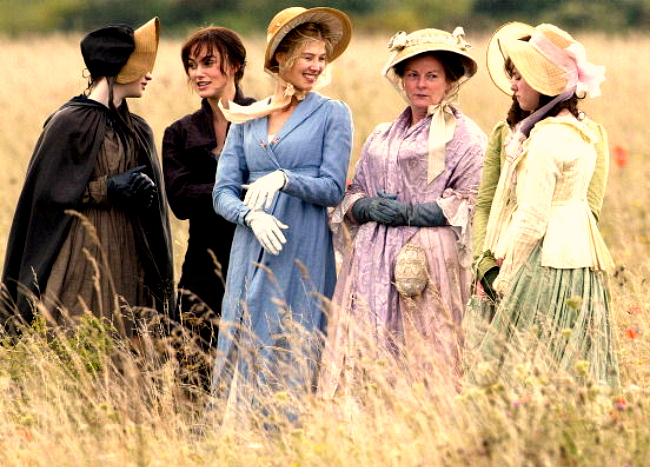
pride-and-prejudice 2005 film

If our civilization is under the grip of liberal mores, especially the belief that non-discrimination on race and gender is the highest moral value, when values are transvaluated back to Austen mores our women will be having six or more kids.

If whites are to survive as a people the vagina gentium must be reopened, whether our spoiled women like it or not…

Categories
Friedrich Nietzsche Jane Austen Liberalism Marriage Pride & Prejudice Roger Devlin Sense & Sensibility Sex Twilight of the idols (book)

Nietzsche on the institution of marriage

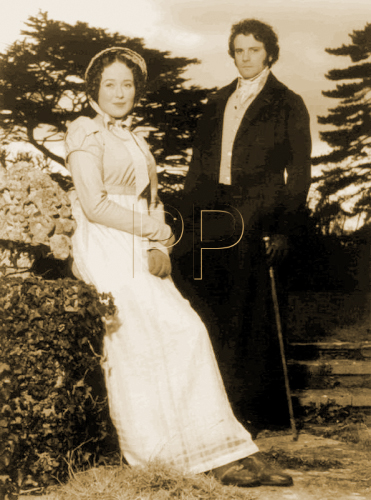
F. Roger Devlin’s views on marriage made a fairly deep impression in my worldview. So deep in fact that nothing has aroused more my emotions in the last few months than watching over and over both the British television series of Pride and Prejudice as well as the 2005 movie adaptation of the same novel, together with the well-known 1995 adaptation of Sense and Sensibility: the classics of Jane Austen.

Presently I cannot stand a single minute of TV or Hollywood. Indeed, while imbued in the feeling that today’s West is like a Gomorrah that has to be burned to the ashes, these adaptations stir my soul to such degree that the stories’ conclusions—old-time traditional marriages—move me almost on the verge of tears.

It must come as a surprise that the anti-Christian Nietzsche maintained, like the Christian Devlin, a quite traditional view of marriage until the very end of his intellectual life. The following is a passage from section 39 of “Skirmishes of an Untimely Man” of his 1888 book Twilight of the Idols:


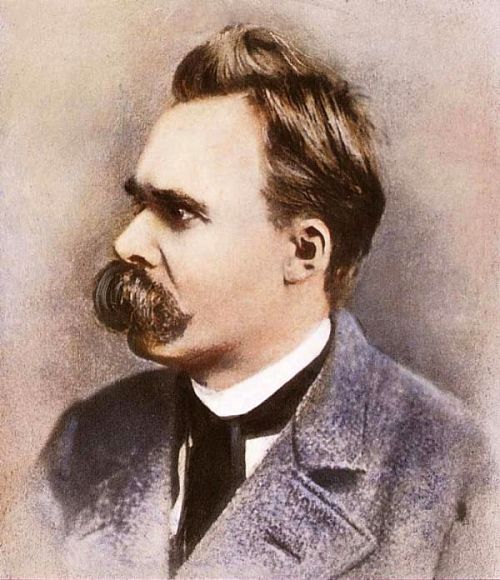
Friedrich_Nietzsche

39.-

Our institutions are no good any more: on that there is universal agreement. However, it is not their fault but ours. Once we have lost all the instincts out of which institutions grow, we lose institutions altogether because we are no longer good for them. Democracy has ever been the form of decline in organizing power: in Human, All-Too-Human (I, 472) I already characterized modern democracy, together with its hybrids such as the “German Reich,” as the form of decline of the state. In order that there may be institutions, there must be a kind of will, instinct, or imperative, which is anti-liberal to the point of malice…

The whole of the West no longer possesses the instincts out of which institutions grow, out of which a future grows: perhaps nothing antagonizes its “modern spirit” so much. One lives for the day, one lives very fast, one lives very irresponsibly: precisely this is called “freedom.” That which makes an institution an institution is despised, hated, repudiated: one fears the danger of a new slavery the moment the word “authority” is even spoken out loud. That is how far décadence has advanced in the value-instincts of our politicians, of our political parties: instinctively they prefer what disintegrates, what hastens the end.

Witness modern marriage. All rationality has clearly vanished from modern marriage; yet that is no objection to marriage, but to modernity. The rationality of marriage—that lay in the husband’s sole juridical responsibility, which gave marriage a center of gravity, while today it limps on both legs. The rationality of marriage—that lay in its indissolubility in principle, which lent it an accent that could be heard above the accident of feeling, passion, and what is merely momentary. It also lay in the family’s responsibility for the choice of a spouse. With the growing indulgence of love matches, the very foundation of marriage has been eliminated, that which alone makes an institution of it.

Never, absolutely never, can an institution be founded on an idiosyncrasy; one cannot, as I have said, found marriage on “love”—it can be founded on the sex drive, on the property drive (wife and child as property), on the drive to dominate, which continually organizes for itself the smallest structure of domination, the family, and which needs children and heirs to hold fast—physiologically too—to an attained measure of power, influence, and wealth, in order to prepare for long-range tasks, for a solidarity of instinct between the centuries.

Marriage as an institution involves the affirmation of the largest and most enduring form of organization: when society cannot affirm itself as a whole, down to the most distant generations, then marriage has altogether no meaning. Modern marriage has lost its meaning—consequently one abolishes it.