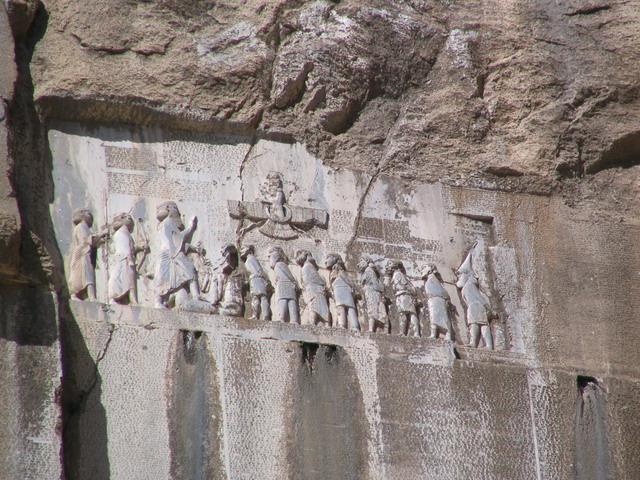
One of the earliest epigraphically attested reference to the word
arya occurs in the 6th-century b.c.e. Behistun inscription.
Moreover, it was not only with the initiates of the Forbidden City of Lhasa (and perhaps with the Dalai Lama himself) that the spiritual elite of the SS Order—which was that of a new traditional civilisation in the making, if not currently in gestation—sought contact. To my humble knowledge, there were also similar meetings in India: meetings that few people in the West suspect, quite apart from the political conversations that may have taken place with certain Hindu leaders, such as Subhas Chandra Bose, in India and Germany before and during the Second World War.
______ 卐 ______
Editor’s Note: With the benefit of hindsight, it is relatively easy to see that this esoteric search was a fool’s errand. Given what happened in real history, what the Nazi elite ought to have studied was already written in the German language. I refer to the texts by Nietzsche that we quote at the appendix to the masthead of this site (pages 84-90, here).
Now that Christian axiology has reached its apex, albeit in secularised form, it is clear that Evil, with a capital ‘E’, always came from Judeo-Christian ethical injunctions in secularised form.
It is not that the 21st-century priest of the sacred words is feeling superior to the Nazis of the previous century. Rather, they lacked the perspective that we have so far. For example, what we said last November about the evangelist Mark, who invented the fictitious figure of Jesus just after the Romans destroyed the Temple in Jerusalem, is something that no German Nazi ever thought of.
The exegesis of the New Testament had to develop to the degree that it has developed today—and I am referring to the non-existence of the historical Jesus—for us to realise that the whole New Testament thing was, from the beginning, a very subversive text aimed against Rome (this is very clear in the last book of the Bible).
There was nothing to be looking for in Tibet or India. The Third Reich would have done well to take New Testament studies where Richard Carrier has recently taken them. But as the Irish commenter Gaedhal said on this site, American racialists are even more primitive than liberal Christians in that they don’t even want to know that the New Testament has been subjected to rigorous scrutiny since the German Enlightenment (cf. what we have been saying about Reimarus). Apparently, I am the only one who has pointed out these studies in the racialist forums of the new century. But let’s move on to Savitri….
______ 卐 ______
Since 1935, a cultural magazine, The New Mercury, had been published in Calcutta, very ably edited by Sri Asit Krishna Mukherji, in collaboration with Sri Vinaya Datta and some others. The Fuhrer’s speeches, of which the official press, both in English and Bengali, reported only excerpts, were spread in extenso, especially if they were, as was often the case, of interest beyond ‘politics’. One of them, which particularly caught my attention at the time, was on the subject of ‘Architecture and the Nation’. But the said journal also published studies on everything that could tend to bring to light a deep, non-political connection, going back very far and very high, between the traditional Hindu civilisation as it has never ceased to exist, and the traditional Germanic civilisation, as it had existed, long before Christianity, and aspired to be reborn. These studies revealed in their authors, in addition to the indispensable archaeological erudition, serious knowledge of cosmic symbolism. Several of them were, needless to say, centred on the Swastika.
 They seemed to show, indirectly, the exceptional character of a great modern state which recognised as its own a sign of such universal significance; engraved it on all its public monuments, and printed it on all its banners. At the same time, they suggested the aspiration of this great State to renew contact with the primordial Tradition, from which Europe had already detached itself for centuries, but of which India had kept the invaluable deposit.
______ 卐 ______
Editor’s note: Let me clarify this matter a little more. All this searching for India’s Aryan roots is good. What was wrong is not seeing the Christian enemy next door: the Anglo-American slaves of Judeo-Christian ethics, who would murder this revived Aryan baby through the Hellstorm Holocaust (read Tom Sunic’s Homo Americanus). In other words: the priority should have been to know their fanatic enemy, the Judaized Anglo-Americans, and looking for the Aryan roots should’ve been a secondary matter. Savitri continues:
______ 卐 ______
I have no evidence that the Ahnenerbe played any part in the publication of the New Mercury. This seems to me all the less likely as this special section of the SS was itself only founded in 1935, the same year as the said magazine. But I know that the latter was at least partly financially supported by the government of the Third Reich. Germans, and representatives—German or not—of German firms in India were supposed to subscribe to it. And at least one of them, to my knowledge, was recalled to Germany, having been dismissed from the direction of the branch which he governed for years, for having refused to do so and declaring that ‘this new-style propaganda’ (sic) did not interest him.
The founder and editor of the periodical, Sri A. K. Mukherji, remained in close contact with Herr von Selzam, the German Consul General in Calcutta, as long as he remained in that post. And this official representative of Adolf Hitler gave him, on the eve of his departure, a document addressed to the German authorities, in which it was specified in no uncertain terms that ‘no one in Asia had rendered the Reich services comparable to his’. I saw this document. I read it again and again, with joy, with pride, as an Aryan and a Hitlerite, and as the wife of Sri A. K. Mukherji. I have already alluded to it in these reflections.
I can’t say whether or not the services referred to therein went beyond the rather narrow confines of Sri A. K. Mukherji’s activities as editor of a fortnightly, traditionalist journal, both Hindu and pro-German. It would seem that they had outgrown them, for the journal had lasted only two years; the British authorities having banned it towards the end of 1937, shortly after the definitive ‘turning point’ in the evolution of British policy towards the Reich. In any case, I didn’t know Sri A. K. Mukherji personally at that time: his name only evoked, for me, the existence of the only magazine of distinctly Hitlerian tendencies that I knew in India. But one thing leads me to believe that his knowledge of esoteric Hitlerism, i.e. of the deep connection of the Führer’s secret doctrine with the eternal tradition, was in no way comparable to the vague impressions I might have had on the same subject. In the very first conversation I had with him, after having had the honour of being introduced to him—on 9 January 1938—, less than two years later, he was destined to give me his name and his protection, and asked me incidentally what I thought of Dietrich Eckart.
I knew that this was the author of the famous poem Deutschland erwache, the fighter of the very first days of the Kampfzeit, who died a few weeks after the failed putsch of 9 November 1923 at the age of fifty-five: the comrade to whom Adolf Hitler had dedicated the second part of Mein Kampf. I was still unaware of the existence of the Thülegesellschaft, and was therefore far from suspecting the role that the poet of the national revolution had played with the Führer.
I enthusiastically displayed my pitifully little erudition. My interlocutor, who had rendered, and would soon render, to the Third Reich (and later to its Japanese allies) ‘services comparable to those of no other’, smiled and moved on to another subject.
 Contrary to widespread belief [in the American racial right], political sycophancy toward Israel—including its fellow travelers among millions of fervent Christians awaiting the coming Apparition of Jesus—is not the result of a violent ideology imposed by a handful of Jewish conspirators.