obstacle to the survival of our race is Christianity. Even with all their malice and cunning, the Jews would pose no real threat to the race were it not for their Christian collaborators.”
—William Pierce
obstacle to the survival of our race is Christianity. Even with all their malice and cunning, the Jews would pose no real threat to the race were it not for their Christian collaborators.”
—William Pierce
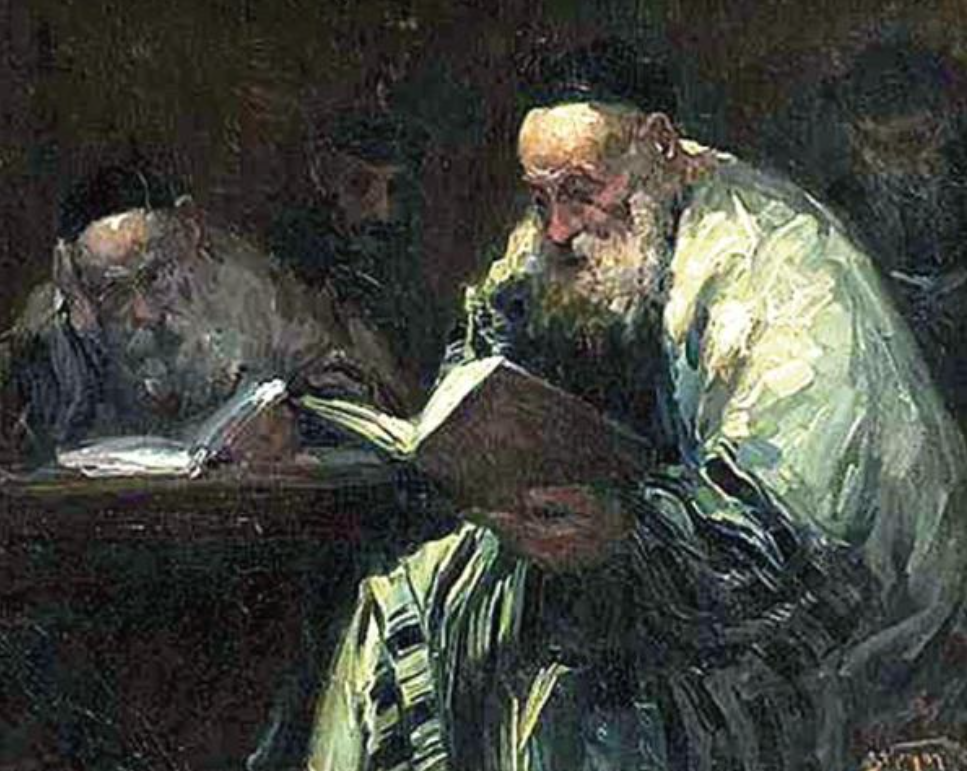
Talmud Readers by Adolf Behrman.
Below, selected quotes from Adam Green’s 2026 book The Jesus Deception: A Mystical Midrashic Myth:
______ 卐 ______
What is Midrash?
Midrash is the ancient Jewish technique of interpreting, elaborating, and even rewriting scripture to uncover hidden meanings, resolve contradictions, or apply old texts to new contexts. It is not merely commentary…
This bringing together of widely separate scriptural references and deriving meaning and scenarios from their combination was the secret to creating the early Christian message… Jewish midrash was the process by which the Christian recipe was put together and baked into the doctrine of the divine Son who had been sacrificed for salvation.
Talmudic Scholar Dr. Daniel Boyarin explains in his book The Jewish Gospels how the New Testament is a product of midrashic mythmaking which was commonplace tradition in second temple Judaism:
The Gospels use perfectly traditional, midrashic ways of reasoning to develop these ideas and apply them to Jesus. Indeed, in the Gospels these ideas (Suffering and rejected Messiah and Son of Man) have been derived from the Torah by that most Jewish of exegetical styles, the way of midrash. That the Messiah would suffer and be humiliated was something Jews learned from a close reading of scripture in precisely the style of classically rabbinic interpretation known as midrash…
That Paul and the Gospels used Midrash is not contested. Even Christian authors agree Paul was incorporating Midrash…
The concept of Midrash is crucial for understanding early Christianity. The New Testament writers were themselves Jews [emphasis by Ed.], steeped in this tradition of scriptural interpretation. When they portrayed Jesus, they used midrashic techniques, re-reading the Hebrew Bible to learn of his life, death, and mission. This is why so much of the Gospel narrative appears to “fulfill” older texts: the evangelists were not simply recording biography but crafting a theological portrait using the interpretive art of midrash, just as their Jewish contemporaries did the Dead Sea Scrolls, in the Talmud and Kabbalistic and apocryphal texts.
Below, selected quotes from Adam Green’s 2026 book The Jesus Deception: A Mystical Midrashic Myth:
______ 卐 ______
Judaism for Gentiles
There was a dilemma inherent in Jewish prophetic expectation: all nations were to worship the God of Israel, but they were not expected to become Jews or follow the full set of commandments given to Israel alone. God had established a covenant with His people, commanding them to keep a distinct law. Yet the scriptures also envisioned a future where Gentiles would turn to the God of Israel and be gathered into His dominion. The resolution to this theological problem ultimately manifested as Christianity, a new religious path that allowed Gentiles to honor the God of Israel without becoming Jews. This new faith evangelized to the Gentile world, but without requiring circumcision, a kosher diet, or Sabbath observance.
A pivotal turning point in legitimizing Gentile inclusion can be found in Acts 15, where James publicly approved Paul’s mission to the Gentiles. James declared that Gentile converts did not need to fully adopt Jewish law, but should instead follow a simplified set of commands: abstain from food sacrificed to idols, from blood, from meat of strangled animals, and from sexual immorality. This decision allowed Christianity to spread beyond ethnic Judaism while maintaining a theological link to Jewish tradition.
It is my judgment, therefore, that we should not make it difficult for the Gentiles who are turning to God. Instead we should write to them, telling them to abstain from food polluted by idols. from sexual immorality, from the meat of strangled animals and from blood. For the law of Moses has been preached in every city from the earliest times and is read in the synagogues on every Sabbath. —Acts 15:19-21
Scholars and theologians have often noted that these requirements closely mirror the Noahide laws found in rabbinic literature. By establishing a shared moral baseline, the early church fashioned a form of Gentile adherence that echoed Jewish ethics without requiring full Torah observance.
Paul reminded the Jerusalem Council that Gentiles were turning to the God of Israel, and this had been God’s plan from the beginning:
Brothers, you know that some time ago God made a choice among you that the Gentiles might hear from my lips the message of the gospel and believe. —Acts 15: 7
The apostles themselves testified that God confirmed this mission by signs and wonders among the nations:
The whole assembly became silent as they listened to Barnabas and Paul telling about the signs and wonders God had done among the Gentiles through them. —Acts 15:12
The Gospels, too, record Gentiles praising the God of Israel directly:
The people were amazed when they saw the mute speaking, the crippled made well, the lame walking and the blind seeing. And they praised the God of Israel. —Matthew 15:31
The earliest New Testament author, Paul, made his entire identity about being the apostle to the Gentiles. He repeatedly claimed this special mission had been entrusted to him by God: “I am talking to you Gentiles. Inasmuch as I am the apostle to the Gentiles, I take pride in my ministry” (Romans 11:13). He insists, “God, who set me apart from my mother’s womb and called me by his grace, was pleased to reveal his Son in me so that I might preach him among the Gentiles” (Galatians 1:15-16), and again, When they saw that I had been entrusted with the task of preaching the gospel to the uncircumcised, just as Peter had been to the circumcised… they gave me and Barnabas the right hand of fellowship when they recognized the grace given to me” (Galatians 2:7, 9). Paul’s focus on the gentiles continued in the Gospels with the Great Commission: “go and make disciples of all nations, baptizing them in the name of the Father and of the Son and of the Holy Spirit” (Matthew 28:19). The Gospels even symbolized this worldwide mission by sending out seventy disciples (Luke 10:1), echoing the traditional Jewish reckoning of seventy nations of the world (Genesis 10). In every strand of early Christian thought, the endgame was the same: to bring the Gentiles into acknowledgment of the God of Israel and his Messiah.
Judaism did not defeat Rome with armies, it subdued Rome with Jesus [emphasis by Ed.]. Jerusalem could not defeat Rome with a political Messiah in this world, but they could falsify a ‘prophecy fulfilling’ myth of a crucified messiah with a spiritual victory over Satan in the celestial world. Christianity was not the miracle of divine revelation, it was the natural product of a people oppressed, divided, and desperate. The scriptures had the ingredients. The times demanded a solution. And theology became the chosen tool.
It took three centuries of incremental theological infiltration and slow growth before the Jesus cult took root, and Constantine adopted Christianity as the religion of Rome, supposedly to unify the empire. At that point, Christians made up only about ten percent of the population, and the shift was an unpopular, top-down decision. Yet within a few decades, paganism was outlawed, Christianity was enshrined as the state religion, and the Jewish Messiah had triumphed over the pagan pantheon of Rome.
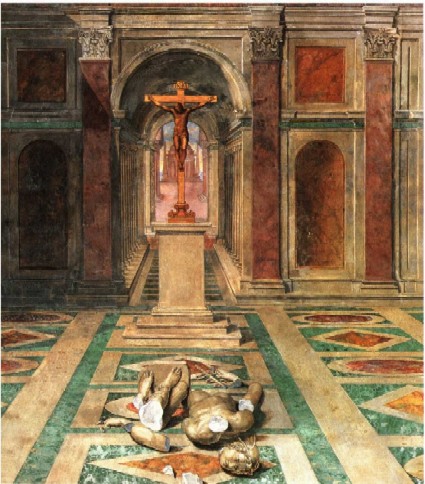
What began as a Jewish sect proclaiming a messiah went on to spread Torah based messianic Judaism across the world. Today, nearly half of humanity bows to the God of Israel. Jesus was a Jewish solution to the Pagan problem.
Editor’s note: Those American racialists who feel uncomfortable tipping their hats to the ideas of an English translation of Eduardo Velasco’s essay on Judea vs. Rome, the “masthead” of The West’s Darkest Hour, because the author is a Spaniard, should at least read a book on the same subject but written by an American of pure Nordid blood.
Below, selected quotes from the third chapter of Adam Green’s 2026 book The Jesus Deception: A Mystical Midrashic Myth (bold type and underlined words in the original Kindle edition):
______ 卐 ______
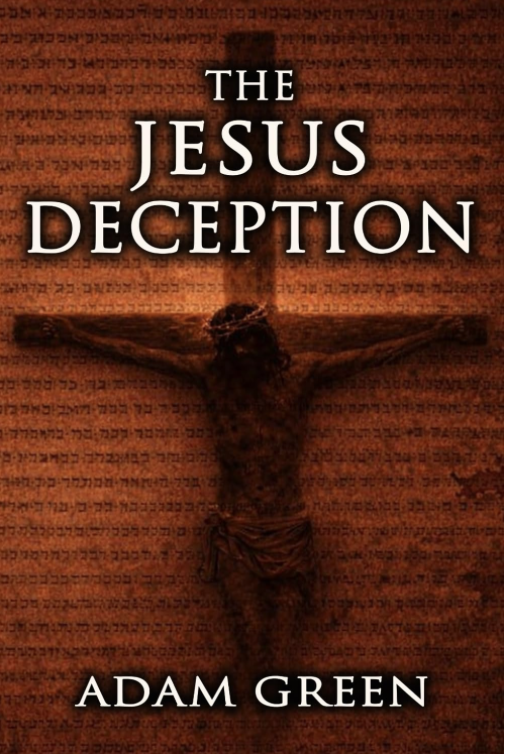 Christianity arose within a volatile and deeply divided Second Temple Jewish society. Apocalyptic expectations, political oppression, and theological creativity created fertile ground for reinterpretations of prophecy and scripture. What emerged was a new religion, based not on historical events, but on a mythologized spiritual triumph…
…crushed by defeat after defeat and staring down the colossal war machine of Rome, would recognize that the dream of a conquering messiah was no longer a realistic hope but a near impossibility. As Dr. Richard Carrier in The Historicity of Jesus explains,
The traditional messianic hope (of a conclusive military victory over all of Israel’s neighbors) was a doomed hope, and that would have been obvious to at least some Jews.
Out of this despair grew a new vision: a messiah who would be spiritually victorious over Satan and the Gentiles.
Our struggle is not against flesh and blood… but against the spiritual forces of evil in the heavenly realms. – Ephesians 6:12
This messiah did not need to raise an army or rule from Jerusalem. His triumph took place in a heavenly celestial realm that could not be disproven or verified…
The framework for a Messiah who conquers not with armies or weapons, but with words and teachings, was already present in the Jewish scriptures. A likely source of inspiration for the Christian reimagining of the Messiah as one who “rule the nations with word of his mouth” occurs in the pre-Christian Greek Text, Psalms of Solomon:
Behold, O Lord, and raise up for them their king, the son of David, at the time which you chose, O God, to rule over Israel your servant. And gird him with strength, to shatter unrighteous rulers, and to purge Jerusalem from nations that trample her down to destruction. To drive out sinners from the inheritance in wisdom and righteousness, to rule over the nations with the word of his mouth… He will be pure from sin, in order to rule a great people, to rebuke rulers, and to break sinners by the strength of his word. He will not rely on horse, rider, or bow, and he will not multiply for himself gold and silver for war, nor will he collect hopes for battle in a multitude of people. – Psalms of Solomon 17:23-25, 32-33
Dr. Carrier summarizes,
Though the Psalms describe this messiah in the manner of a military conqueror (e.g. 17.21- 26), it is still somewhat circumspect, saying ‘he shall destroy the godless nations with the word of his mouth’ (17.24, 17.35-36) and that he will use no weapons or armies (17.33)… like all Jews, proto-Christians would have been searching this scripture (and others) for secret messages about the messiah… It’s certainly not improbable to see in the Psalms of Solomon a prediction of a metaphorically victorious messiah, who uses no armies or weapons but conquers solely through the power of his words (in other words, his teachings)…
Text like these provided the perfect template for inventing a messiah who triumphed not by armies and swords, but by words, scripture, and theology. Rome destroyed Jerusalem with earthly weapons, but Jerusalem was victorious with a spiritual weapon [Editor’s Note: This is the essence of Eduardo Velasco’s essay].
Pacifism as Strategy, Survival of Fittest
Christianity’s nonviolence was not merely a moral principle. It was a calculated strategy for survival. Jewish militant groups like the Zealots and Sicarii provoked Roman wrath and were inevitably crushed by its military dominance. A messianic movement that presented a conquering king would have posed an obvious threat and been destroyed without hesitation. But a peaceful, pacifist, hidden messiah who reigned in visions and revelations and triumphed in the heavens rather than on the battlefield would fly under the radar of Roman authorities.
As Richard Carrier observes, this strategic pacifism gave the movement a survival advantage over more militant sects:
By avoiding mass territorial action (and focusing instead on spiritual combat), they avoided armed conflict and thus survived, by gaining more converts over a wider area than were lost to sporadic persecutions. This may have been a lesson learned from observing the fate of other movements. But natural selection alone would determine it: agitative cults would be wiped out, leaving more pacifist cults to dominate the market… A non-existent messiah (whose lordship and victory were known only spiritually and thus never a worldly militaristic threat) would thus have an enormous competitive advantage at these earliest stages.
Messianic movements that provoked Rome were crushed while Christianity adapted and spread. It offered a savior who could not be killed and a kingdom not of this world. Unlike the rebels who took up arms, this movement promoted obedience and submission and appeared harmless. Its scriptures command, “Submit yourselves to the emperor,” “Render unto Caesar what is Caesar’s,” and instruct believers to be compliant, obedient “slaves.” Over time, this approach led to a far more enduring conquest transforming the spiritual and ideological foundations of the empire itself. It was not through violence or rebellion, but through a religious warfare strategy, that the Jesus movement sought to overcome Rome. Jesus effectively Judaized the minds of Rome implanting the God of Israel and His messiah within the Empire.
Pagan Rome once conquered Judea, its emperors defiling Jewish temples with their idols. Yet in time the tables turned: the pagan temples were eventually emptied of their gods and rededicated to the messiah of Judah. The empire that had enslaved the Jews became an unwitting vessel propagating Jewish theology, its heart and soul penetrated by the very faith it once sought to suppress.
While some Jews expected the messiah to crush Rome through military force and acts of divine judgment, what ultimately succeeded was something far different, a theological creation that spiritually conquered the empire. Rome eventually bowed in reverence to the God of Israel, accomplishing the prophetic vision. The pen turned out to be mightier than the sword.
Below, selected quotes from the second chapter of Adam Green’s 2026 book The Jesus Deception: A Mystical Midrashic Myth:
Convincing the world that God chose one group of people to receive and speak with the authority of the one true God is no small feat. It elevates the Jewish people to a divine holy status, granting them immense religious cultural influence. Everyone who believes in Jesus and biblical prophecy is ultimately trusting in the legitimacy of the authors, placing their faith in the authority of ancient prophets and their God…
This vision of global religious submission is not subtle. The scriptures repeatedly declare that the nations will abandon their gods, destroy their idols, and fear the God of Israel…
All nations, all peoples, and all flesh are compelled to bow before the God of Israel. The imagery is not compassionate or benevolent; it reeks of domination. The nations are humiliated “licking the dust at Israel’s feet,” “trembling in fear of the Lord,” and trampled into submission as a “footstool beneath his feet.” [Green references these Biblical verses] Far from a vision of a universal utopia, these prophecies present a tyrannical dystopia of a global world order forged in fear, and absolute subjugation.
Fear…! When I lived in Spain, I learned that some older people feared eternal damnation. This is something that younger generations of Christians cannot understand, as the era of terrifying children with eternal fire is over. Because I was raised in the old-fashioned way, like those Spaniards I was the victim of an internal persecutor (fear of eternal torture) after my father abused me. I recount the details in the final chapter of my book.
This vision is not metaphorical. It is a theological program, a forecast of universal subjugation to the God of Israel. The prophets do not speak of religious tolerance or coexistence, they predict a singular religious future where every tongue glorifies Yahweh, and every nation bends the knee. This prophetic agenda forms the theological foundation of Judaism and sets the stage for Christianity to carry this vision to the Gentile world under the guise of fulfilled prophecy…
In one of the more remarkable prophetic passages of the Hebrew Bible, the Book of Isaiah envisions a time when Egyptians themselves will offer worship—including incense and sacrifices-to the God of Israel. This vision appears in Isaiah 19: 19-21, where it declares: “In that day shall there be an altar to the Lord in the midst of the land of Egypt, and a pillar at the border thereof to the Lord. And the Lord shall be known to Egypt, and the Egyptians shall know the Lord in that day, and shall do sacrifice and oblation.”
This prophecy envisions not merely the acknowledgment of Yahweh by foreign nations, but a full liturgical participation-altars, oblations, and vows offered within the geographic territory of Egypt itself. The theological implications were profound. Egypt, long cast as the archetypal enemy of Israel and symbol of bondage, is here transformed into a future sanctuary for Yahweh’s name. This vision would likely serve as a template for first century Jews looking for answers to their Roman occupation…
Judea against Rome! Those who haven’t read the masthead of this site, authored by a Spaniard, should read it now.
This prayer reflects the same triumphalist theology found in Christianity. The language of false gods being exterminated and all people accepting the yoke of Yahweh’s kingdom is a demand for global theological submission to the Messiah of Israel who will rule the world and establish an eternal kingdom in Jerusalem.
Let’s be honest with what we’re actually looking at. The prophecy found in the Bible is not some innocent spiritual mystery. It is a political tool disguised as divine insight. It is a plan for global religious domination, cloaked in the language of revelation. The prophets of Israel did not merely speak for God. They laid out a strategy. A plan to convert, conquer, or erase all competing gods, traditions, and belief systems. Yet for all its boldness, modern scholarship rarely confronts the nature of biblical prophecy head-on. Secular academics tiptoe around it, treating prophecy like a benign religious curiosity rather than the blueprint for global conquest. Why? Because to expose prophecy as a mechanism of psychological warfare and geopolitical ambition would shake the foundations of Western religious identity…
The prophecy agenda is not simply about what will happen. It is about what must be made to happen. And Jesus was the weapon forged to advance the plan…
Jesus prophecy
The scriptures and prophecies reviewed in this chapter formed the prophetic foundation that created the environment that birthed the Jesus myth. As we will explore further, the Hebrew Bible offered a vast reservoir of imagery: the Suffering Servant, the Son of Man, the Branch of David, the Rod, the Scepter, and the Star. These messianic motifs were woven together to fabricate a conquering redeemer destined to spiritually subdue the nations. Out of this prophetic framework emerged a new theological weapon: the mystical, midrashic Messiah named Jesus.
What began as a Jewish apocalyptic fantasy of global submission to Yahweh became the Christian gospel of the kingdom of Christ. Prophecies from Daniel, Isaiah, Zechariah, Psalms, and many more were reconfigured into Jesus, who would rule from Zion with the rod of his mouth and have dominion over the nations. Prophecy was not just a belief system; it became a strategic tool. Christianity spread not merely as faith, but as the execution of a Jewish apocalyptic blueprint, a sophisticated form of theological warfare masquerading as universal salvation. With billions of Gentiles now worshipping the God of Israel through the fabricated figure of Jesus, prophecy was fulfilled not by divine intervention, but by deliberate design…
The story of Jesus is a masterpiece of literary fiction. The Bible foretold that the Gentiles would one day worship the God of Israel. Christianity brought that vision to fruition. The nations believed in the prophecy, and by believing, they fulfilled the prophecy. Jesus is a mythical figure, crafted from scripture by Jews seeking to theologically conquer and spiritually subjugate the nations of the world.
And again, Isaiah says, “The Root of Jesse will spring up, one who will arise to rule over the nations; in him the Gentiles will hope.” – Romans 15:12
The motive behind this fabrication was domination. The goal was to destroy idol worship and impose a one-world religion under the subjugation of Yahweh. Christianity, which would become the dominant faith in much of the world, became the instrument for this agenda.
To fully understand how this prophetic vision materialized into Christianity, we must now step back and examine the historical and theological context from which it emerged. The next chapter will explore the social, political, and religious landscape of the Second Temple period. This was the environment that gave birth to apocalyptic Judaism, militant messianism, and the yearning for divine intervention through a promised redeemer. It is within this volatile context of Roman occupation, priestly power struggles, sectarian fragmentation, and prophetic expectation that the seeds of the Jesus deception were sown.
Bold type in the original Kindle version.
Editor’s Note: On The Occidental Observer, Kevin MacDonald has published an article by Laurent Guyenot on what we have been calling here “the Christian question” or “the Christian problem,” from which I quote only the final paragraphs:

Christianity introduced into the operating system (the dominant cognitive paradigm) of Roman society two trojan horses that both gave the Jewish nation a decisive selective advantage: it taught Gentiles that, by virtue of their divine chosenness, the Jewish nation was uniquely qualified to remain distinct, separate, and in many ways privileged; and it has taught Gentiles that, contrary to the Jews, they have no ethnic identity of any spiritual value. On the one hand, it has been assumed that the Jews are one nation and will be saved collectively at some point, and on the other hand, it has been affirmed that nationality is irrelevant for the Gentiles, since their salvation is strictly individual. The Jews can continue to sacralize the purity of their blood, while Gentiles are told every Sunday that only the (Jewish) blood of Christ will save them. Christians has given a handle to the Jews for driving them to their doom.
Seen in this light, Christianity surely looks like a Jewish conspiracy. But it is not a conspiracy in the traditional sense: rather, it is a Jewish group evolutionary strategy.
occupied the Pentagon
This is what Colonel Lawrence Wilkerson said a few days ago (YouTube clip here).
Colonel MacGregor has
clearly expressed the stark
truth about Israel.

Netanyahu and Trump share a kiss on West Bank wall mural.
The term dormition refers to the Eastern Christian tradition of a miraculous “falling asleep.” But Dominique Venner once used it in reference to his dream of Europe awakening from the catalepsy that has afflicted it since the end of WWII.
Remember that I named my book printing endeavour Daybreak Press when the PDFs of the featured article were available in print (I was deplatformed), in reference to the dawn we long for. Paradoxically, regarding the awakening from the Aryan dormition after 1945, we could say:
Blessed be Bibi and his lackey Trump!
It is well known that Jewry always overreaches itself. But thanks to this pair of idiots, this time the overreaching has reached the breaking point to such an extent that in this video a neo-normie like Scott Ritter says things like:
• “…it is Israel in its totality the most dangerous threat to peace and security in the world today”
• “the Middle East has been infected by a cancer that is, you know, the American-Israeli posture, and that cancer has to be excised”
• “you have to call a spade a spade, and right now the United States is facilitating the genocide that Israel committed against the Palestinians… Lebanon… Iran… We have seen evil, we know what evil looks like and it’s time for the world to collectively work to eradicate this evil”
• “Donald Trump has completely sold American interests to the state of Israel, 100%”
• “The number one threat to American national security is the state of Israel, straight up”
• “Israel is a parasite on the global community. It exists to suck the lifeblood out of the world solely for its benefit”
• “Israel is nothing more than a genocidal state wrapped into a tiny piece of territory with meaningless biblical reference”
• “[This biblical reference] is what, of course, Christian Zionists believe: Mike Huckabee, Ted Cruz and others, and we are exposing the perversion of their thought. So this war in many ways is a clarifying moment”
• “It is time to be brutally honest about everything… Because the people are tired of the lies.”
P.S. of March 6: Ritter used to support Israel before the genocide in Gaza.
interview – 10

This is the final episode of Joel Webbon’s interview with Nick Fuentes.
I’d like to report that these past few days I’ve spent my time watching a huge number of YouTube commentators, both English and Spanish speakers, discussing the war between the US and Israel against Iran.
They’re all normies, of course, and while I’ve been very critical of Fuentes in the previous nine instalments of this series, I think I should say that all YouTubers are normies (incidentally, Fuentes has been banned in YouTube). Although critical of Donald Trump’s blunder in Iran, YouTubers don’t understand the basics. Even those who think with the utmost clarity, like John Mearsheimer, co-author of the book that exposed the Jewish lobby, are still normies in that they fail to see the forest. So-called geopolitical commentators, like Pepe Escobar, are more ignorant than Mearsheimer, as they don’t even understand the Lobby’s huge influence in the US government.
Unlike all the normies whom the System allows to criticise on YouTube the blunder Trump committed by obeying Bibi, Fuentes does get the JQ. But even if we disregard the CQ, the difference between Fuentes and us is abysmal.
For example, Fuentes recommends that young people hide their POV because the System would ruin their carreers if they didn’t, and he suggests that young people silently march within institutions. Compare this advice with ours: to be inspired by The Turner’s Diaries to create a Fourth Reich in the future. Not to be violent for the moment, but to wait for the collapse of the System.
Alex Linder once said that our faith can only be preached after the collapse.
Neither Webbon nor Fuentes seem to know that their country will face the collapse of the dollar, and even less so the energy devolution that will unfold over about a century: something that Pepe Escobar, who so admires Asia, also doesn’t know. Pepe believes that international business will continue as usual for the rest of the century (in reality, the decline in oil will bleed the System dry).
My strategy is very different from Fuentes’s: to create a Syssitia where priests of the sacred words can live together to establish a healthy Männerbund, with rituals like the images I posted on “Neutron”, and wait for the collapse so that a very well-defined doctrine of our faith can be preached among the noblest Aryan men throught the internet.