web analytics
Categories
Real men Sparta

Syssitia

The Priests of the Sacred Words are a monastic order of men who have transvalued Christian values ​​to the values of Greco-Roman times.

Unlike Christian monks, all of our our priests are married.

Male children are raised by the women until the age of six or seven; after that, their upbringing is entirely the responsibility of the father.

Categories
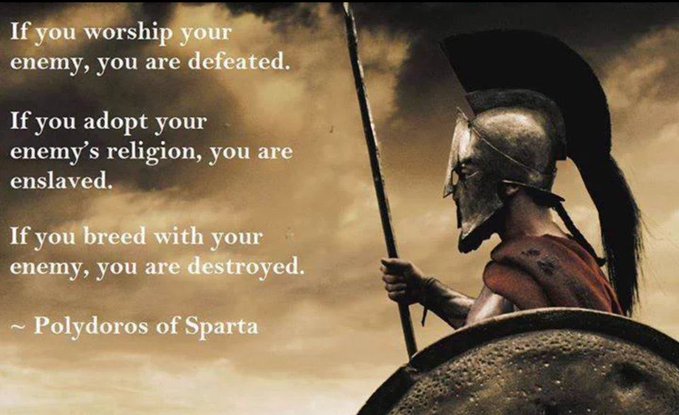
Quotable quotes Sparta

Polydoros

Categories
Kali Yuga Sparta

Football

The fact that Donald Trump was present yesterday in a stadium watching the American football final, or that Emmanuel Macron was present at the final of the last FIFA World Cup—both football finals featuring teams with a huge number of blacks—, is a symptom that we are suffering the darkest hour for the white race (which the title of this site designates with the euphemism ‘the West’).

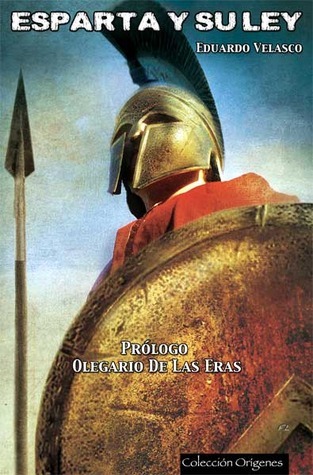
What a difference from those times when only pure Aryans attended the Olympics! This was before a Christian emperor banned the Olympic games (‘resumed’, centuries later in the Christian Era, admitting people of colour). Those who haven’t read our abridged translation of Eduardo Velasco’s essay on Sparta should read it now.

Categories
Sparta

Evropa Soberana, backup 3

Click here

Categories
Sparta

Spartan break

Note of September 5:

I have used most of the text that used to be on this post for an introductory article about Evropa Soberana’s essays on Sparta and the Vikings in the forthcoming PDF of The Fair Race’s Darkest Hour.

Categories
Nordicism Schutzstaffel (SS) Sparta

Nordicism and National Socialism, 12

Wolfgang Willrich, unknown man.

Thanks to an acute sense of the law that governed the origin of their species, peoples like the Spartans resorted in their selections to the same principles of inflexible severity originally prescribed by Nature, and this even after having reached more hospitable territories. Other peoples of the Nordic race, like our German ancestors, naturally obeyed the biological laws that governed the creation of their species.

Notebook of the Schutzstaffel (SS) No. 7 of 1942. The biological sense of the selection. The habitat produces a certain kind of selection. Drawn from ‘The SS Order’, OSS I.3.2.

Categories
Ancient Greece Athens Painting Philosophy Plato Sparta William Pierce

The Story of Philosophy, 6

The Republic

The last words of Will Durant in the previous entry of this series: ‘Let us study The Republic’. But in this post I will not quote any passage from Durant’s book. I will give my opinion on this classic work that bequeathed us historical Greece.
In the first place, it must be recognised that the race of the ancient Greeks was of the Nordic type. In The Fair Race there are two articles on the subject, one written by a Spaniard and another by an American. Since then civilisation has metamorphosed so much, especially in axiology, technology and demography, that what Plato wrote could only be valid after the extermination of all non-whites, as William Pierce put it at the end of The Turner Diaries. Sorry, but the Greeks of the ancient world were physically beautiful, says the article of the mentioned Spaniard. Hence, in our technological times with a demographic explosion that, because of Christianity, reversed the beautiful values of the classical world, only in an ethnically cleansed Earth what the ancient Greek philosophers discussed could become germane again.
The tragedy of the Aryans reminds me of the meaning of the One Ring in the tetralogy of Wagner, a symbol that Tolkien would pick up in his novel. It has been Aryan greed what blinded them to the fact that using non-whites as capital was suicide in the long term. That is the moral that emerges from the stories about the white race of William Pierce and Arthur Kemp. But even from the 19th century some Americans felt the danger, as shown in the paintings of Thomas Cole. A world with the destroyed Ring means, in many aspects, a return to the small cities: the subject matter not only for Plato but for Aristotle. For the latter, a Greek city should not exceed ten thousand inhabitants…
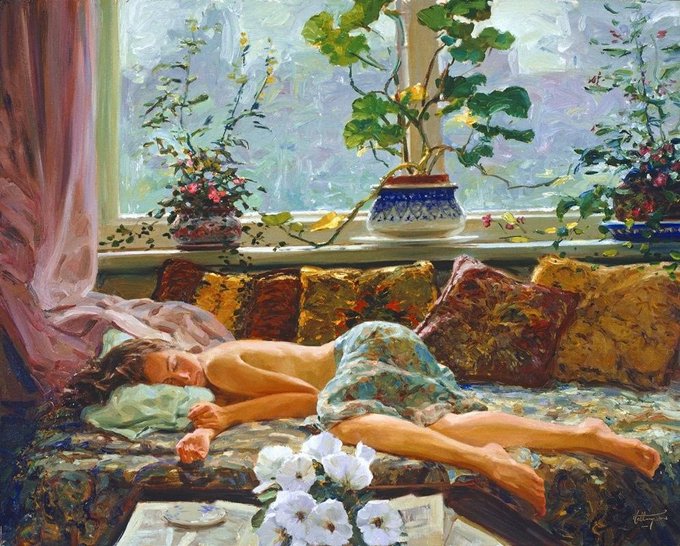
That is precisely the moral of my books in Spanish: after so many hells in ‘the Black Iron Age’ as I said as a teenager, I propose a return to the Shire so to speak. For the same reason, if there is something that hurts me when I see the sites of white nationalists, it is that they are cut off from their European past. I have spoken on this site about music, but not much about painting. The following is the oil canvas by Claude Le Lorrain (1600-1682) that appears at the top of my Facebook page:

On my most recent trip to London I saw some splendid canvases of Le Lorrain’s paintings in the National Gallery. Outside of London and the madding crowd, some English aristocrats of past centuries took Le Lorrain as a paradigm to mould their extensive lands, and even some buildings in the countryside. Some of this can even be seen in the movies of this century. In this very beautiful film of 2005 for example, when Mr Darcy declares his love to Elizabeth, I could not contain my admiration for that place: it seems to be taken from a canvas by my favourite painter (watch the last ten seconds of this YouTube clip)! Who of the contemporary racists has such contact with their visual past?
A true racist should reject any image of pop culture sold to us by American Jewry. But going back to Plato. Let us suppose, just suppose, that the white race will emerge alive from the coming apocalypse and that, in an Earth already without Orcs and (((Sauron))), they would reconstruct white civilization. In an unpopulated land and with only a few small cities, like the one seen in the painting above, the question would arise as to what kind of government is desirable. In this world, the survivor could be asked about Plato’s magnum opus, something like a second chance or a fresh start for the West. So let’s expose our views about the philosopher.
The first thing I could say is that the distortion that is taught in the academy about the classical world is such that we would have to change the title of The Republic for the simple fact that it is an invented title. The original in Greek was Politeia, whose translation would be ‘regime or government of the polis’, that is to say how to govern a small city-state. The title The Republic falsifies the mind of Plato already from the cover of the book we see in bookstores, inducing the popular notion that the author was an utopian. He was nothing of the sort. Politeia was the recipe of Plato to remedy the bad governments he saw in ancient Greece. His starting point had been the examination of the Greek cities of his time, not of a hazy future but the four regimes of Greece: timocracy, oligarchy, democracy and tyranny.
Imagine a world à la Lorrain in which only whites inherit the Earth. The bookstores, this time with imprimaturs that do not admit anything from Semitic pens, would show Plato’s main work with the original title… But that does not mean that we should consider the disciple of Socrates a provider of laws, a new Lycurgus. At this stage of the historical game it is obvious that Plato did not see, nor could he see, the iniquity of the world; of men, of the Jewry that would invent Christianity, and the catastrophic industrial revolution.
For example, Plato does not speak of the need to keep Nordic blood pure, at least not with the lucidity the Nazis had. The closed polis of the Spartans complied more with the laws of nature than the open polis of the Athenians (in this Durant was fatally wrong). But not even the Spartans knew Pierce’s formula: to maintain an Aryan culture one must maintain the Aryan ethnicity: and that can only be done by exterminating or expelling all non-Aryans.
Plato’s missteps go further. Above I complained that the typical racist of today has no internal contact with the world of the great masters of painting. Another common ailment in those who have abandoned Christianity is that they keep infectious waste that puts the Aryans at a clear disadvantage compared to the Jewish quarter. One of these residues is the belief in post-mortem life. He who believes this doctrine will not fight as much in this life as the Jews are currently fighting, insofar as they believe they will have a second chance (either in the afterlife or reincarnated).
Jews do not masturbate their minds with unearthly hopes: one of their enormous advantages before us. But to be fair to Christianity I must say that even before Christianity Plato already masturbated his mind, and the minds of his male pupils, with such fantasies: what I have called in this series the root of the baobab. In fact, Plato finishes his great work sermonizing us: if we stick to what he says and believe in the immortal soul, we will be happy:

Thus, Glaucon, the tale has been saved, and will be our salvation, if we believe that the soul is immortal, and hold fast to the heavenly way of Justice and Knowledge. So shall we pass undefiled over the river of Forgetfulness, and be dear to ourselves and to the Gods, and have a crown of reward and happiness both in this world and also in the millennial pilgrimage of the other.

As I observed in a previous entry, during the savage destruction of most of the books of the classical world by the Judeo-Christians, it survived a work that many consider a precursor of the Christian doctrine of the human soul. The Republic, to use the falsified title, is anachronistic in many other ways. In addition to his post-mortem masturbations, what is the point of praising Plato when he did not oppose the incipient miscegenation of Athens with the greatest possible vehemence?
Unlike every rabbi who practices intuitive eugenics, Plato did not even leave offspring. He was not a husband or father. In his case, no good genes passed to the next generation (where his sperm ended, I dare not speculate). Moreover, he believed that in his republic women could perform the same functions of the male, even the highest. Compare the feminism of this philosopher of 2,400 years ago with what the Orthodox Jews of New York teach today: they educate their women to behave like little red riding hoods!
Whoever complies with the laws of Nature survives and who violates them perishes. At present the Jews fulfil them and the Aryans violate them. The white race will not be saved unless it makes a destructive criticism of much of what passes for ‘wisdom of the West’, starting with the Greeks.

Categories
Athens Philosophy Sparta

The Story of Philosophy, 3

The context of Plato

In 490-470 B. C. Sparta and Athens, forgetting their jealousies and joining their forces, fought off the effort of the Persians under Darius and Xerxes to turn Greece into a colony of an Asiatic empire. In this struggle of youthful Europe against the senile East, Sparta provided the army and Athens the navy. The war over, Sparta demobilized her troops, and suffered the economic disturbances natural to that process; while Athens turned her navy into a merchant fleet, and became one of the greatest trading cities of the ancient world. Sparta relapsed into agricultural seclusion and stagnation, while Athens became a busy mart and port, the meeting place of many races of men and of diverse cults and customs, whose contact and rivalry begot comparison, analysis and thought.

This is the common way among normies to see Sparta unaware that, unlike the Athens that was in process of miscegenation, thanks to the closed, collectivist society of the Spartans (and apparently the Thebans), they kept the Aryan race for centuries to such a degree that the beautiful female Spartans did not need makeup. Durant here inverts the values so to speak. But we must understand that secular neo-Christians like Durant share the ethnosuicidal, universalist ideals of the Christian. Regarding the first philosophers, Durant adds:

They asked questions about anything; they stood unafraid in the presence of religious or political taboos; and boldly subpoenaed every creed and institution to appear before the judgment-seat of reason. In politics they divided into two schools. One, like Rousseau, argued that nature is good, and civilization bad; that by nature all men are equal, becoming unequal only by class-made institutions; and that law is an invention of the strong to chain and rule the weak. Another school, like Nietzsche, claimed that nature is beyond good and evil; that by nature all men are unequal; that morality is an invention of the weak to limit and deter the strong; that power is the supreme virtue and the supreme desire of man; and that of all forms of government the wisest and most natural is aristocracy.

Here it is clear that the weed of egalitarianism appeared without Judeo-Christian influence, although in the days of Athenian youth it was easy to purge weeds.
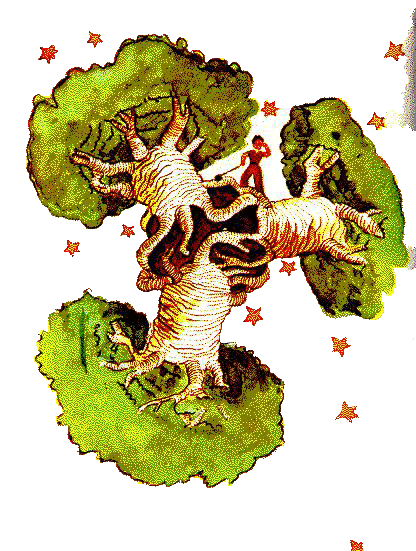
Since I was a child I liked Le Petit Prince, where the little blond had to constantly be weeding his planet, so that the weed would not grow in baobab as happened in other neighbouring planets. When I was in Grammar School and read the story of Saint-Exupéry, everything I saw in movies and television seemed like positive messages for the West and the race of little blonds. I never would have imagined that the weed would grow in my lifetime until the planet split in pieces.
Now there were some terrible seeds on the planet that was the home of the little prince; and these were the seeds of the baobab. The soil of that planet was infested with them. A baobab is something you will never, never be able to get rid of if you attend to it too late. It spreads over the entire planet. It bores clear through it with its roots. And if the planet is too small, and the baobabs are too many, they split it in pieces…
Children, I say plainly, ‘watch out for the baobabs!’

Categories
Miscegenation Nordicism Philosophy of history Sparta Who We Are (book) William Pierce

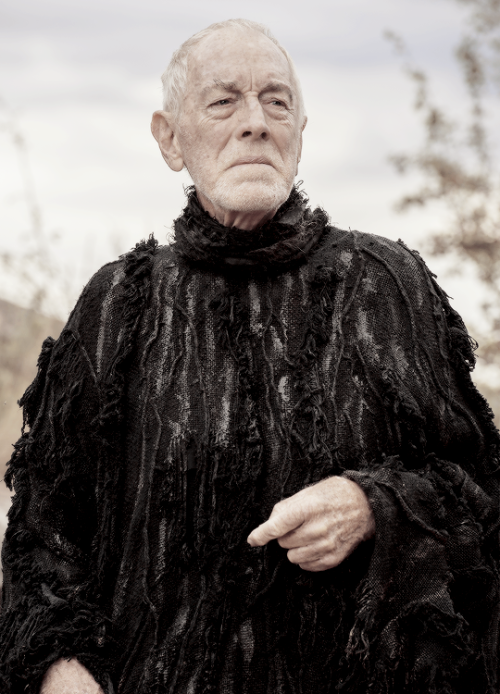
Three-eyed raven, 3

Indented paragraphs are taken from Who We Are by William Pierce:

The Dorians of Laconia organized the Peloponnesian population in a three-layered hierarchy. At the top were the citizens of Sparta, the Spartiates, all of pure Dorian blood, ruled by their kings. At the bottom of the social structure were the Helots, or serfs, consisting of the aboriginal Mediterranean elements as well as many of the conquered Achaeans of mixed blood. No Spartiate could engage in trade or practice a craft. The Perioeci handled all their commerce, and the Helots provided all their other needs…

It is easy to imagine the Spartiates, upon their arrival in Laconia, surveying the moral decadence and the racemixing which had made the Achaeans such an easy conquest for the Dorians, and then instituting a carefully designed program to safeguard themselves from a similar fate. For a time this program succeeded; the moral character and the racial quality of the Spartiates remained famously high. But ultimately it failed in both regards…

They should have done what the Hebrews did with non-Hebrews in Canaan: exterminate them all. And this is still the problem with white nationalism today. American WNsts are not even willing to recognize that in an ethnostate the citizen of the Aryan Republic should not be allowed to marry, say, a Sicilian American. In a true Aryan ethnostate that conquers North America, mudbloods should not even have the right to reproduce. WNsts are committing ethno-suicide as they are reluctant to scientifically define the subject of who is really white. (See the article in The Fair Race, “The new racial classification”.) Pierce continues:

The Spartiates never succumbed to racemixing, but they did succumb to their own lifestyle. They would have been well advised to eliminate the Helots of the Peloponnesus and the Mediterranean population of Crete altogether and to establish a purely Dorian peasant class in those areas. Then they may well have been able to practice a successful eugenics program, maintain their moral health, and have a stable population too. But, of course, they did not have the advantage which hindsight gives us.

The other Hellenic tribes did succumb to racemixing. Their populations did not suffer the decline in numbers which the Spartiates did, but they suffered a decline in racial quality which resulted in their extermination, perhaps more slowly but just as surely—and less cleanly.

Note: The above quotations of Pierce’s book are contextualized in The Fair Race’s Darkest Hour (available: here). If life permits, next Tuesday I will comment on another passage from the same visionary chapter on Greece coming from the pen of the American ‘Raven’.

Categories
Abortion Adolf Hitler Miscegenation Philosophy of history Sparta Zweites Buch

Zweites Buch, 2

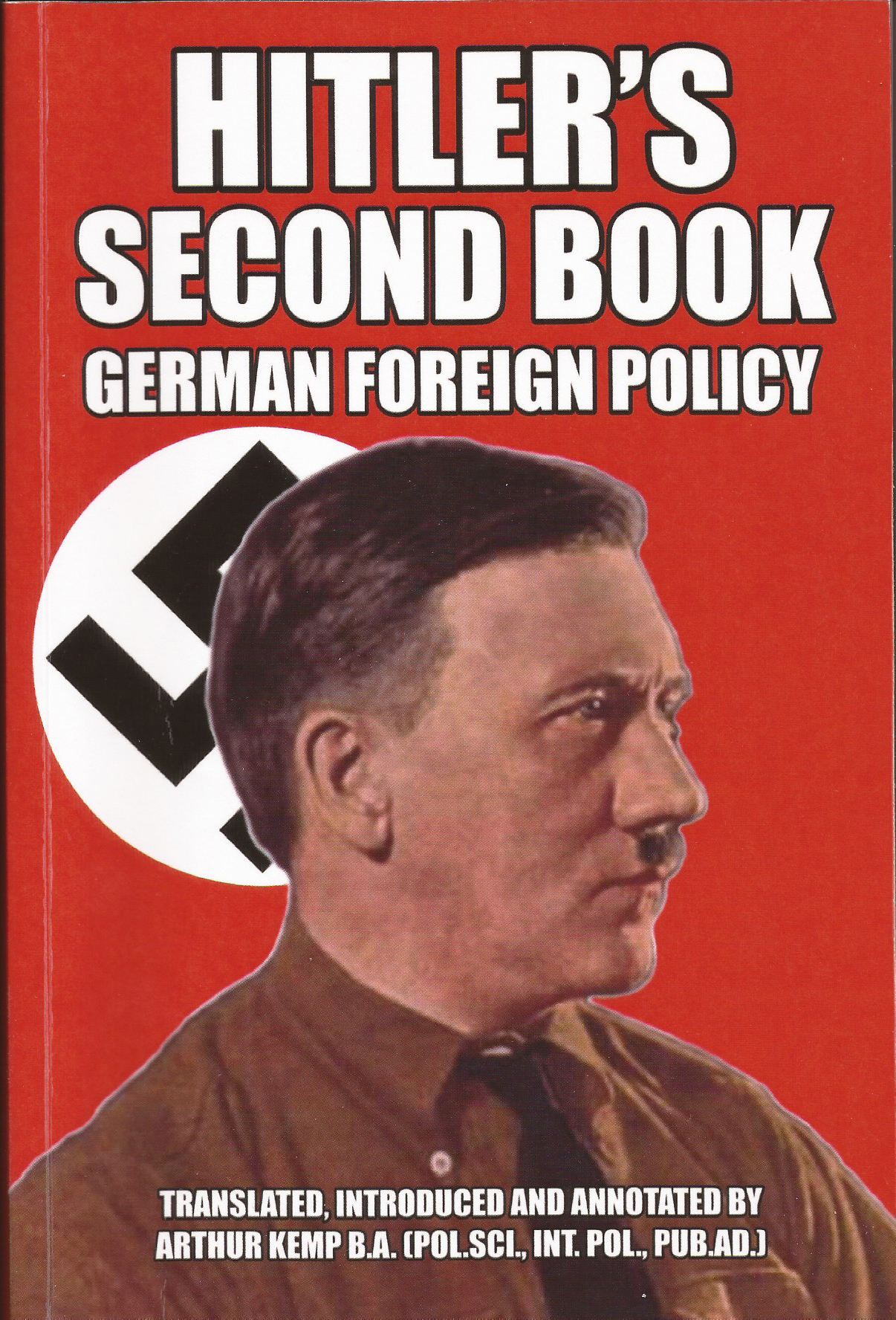
Excerpted from “The Necessity of Strife,” Chapter 2 of Hitler’s Second Book. The whole chapter includes these subjects: Territorial conquest is necessary for a people’s security and healthy growth—Morality of conquest: no one owns any part of the Earth—Birth control eugenically unsound—Spartan exposure logical—Emigration sacrifices best elements—Increase in productivity of no help competitively—Export trade vanishing as other nations modernize—Necessity of strife.
 
A Folk’s struggle for existence is first and foremost determined by the following fact: Regardless of how high the cultural importance of a Folk may be, the struggle for daily bread stands at the forefront of all vital necessities.

In general, the merely material interest will rise in exact proportion as ideal spiritual outlooks are in the process of disappearing. But the bread which a Folk requires is conditioned by the living space at its disposal. A healthy Folk, at least, will always seek to find the satisfaction of its needs on its own soil. Any other condition is pathological and dangerous, even if it makes possible the sustenance of a Folk for centuries.

The increase of population can be balanced only through an increase, that is, an enlargement, of living space.

Yet the regulation of the relation between population and territory is of tremendous importance for a nation’s existence. Indeed, we can justly say that the whole life struggle of a Folk, in truth, consists in safeguarding the territory it requires as a general prerequisite for the sustenance of the increasing population.

The sword was the path breaker for the plough. And if we want to talk about human rights at all, then in this single case war has served the highest right of all: it gave a Folk the soil which it wanted to cultivate industriously and honestly for itself, so that its children might some day be provided with their daily bread.

For this soil is not allotted to anyone, nor is it presented to anyone as a gift. It is awarded by Providence to people who in their hearts have the courage to take possession of it, the strength to preserve it, and the industry to put it to the plough.

Hence every healthy, vigorous Folk sees nothing sinful in territorial acquisition, but something quite in keeping with nature. The modern pacifist who denies this holy right must first be reproached for the fact that he himself at least is being nourished on the injustices of former times.

Finally, The present distribution of possessions on the Earth has not been designed by a higher power but by man himself. Anyone who would banish this struggle from the Earth forever would perhaps abolish the struggle between men, but he would also eliminate the highest driving power for their development…

The rule of six thousand Spartans over three hundred and fifty thousand Helots was only thinkable in consequence of the high racial value of the Spartans. But this was the result of a systematic race preservation; thus Sparta must be regarded as the first Völkisch State. The exposure of sick, weak, deformed children, in short their destruction, was more decent and in truth a thousand times more humane than the wretched insanity of our day which preserves the most pathological subject, and indeed at any price, and yet takes the life of a hundred thousand healthy children in consequence of birth control or through abortions, in order subsequently to breed a race of degenerates burdened with illnesses…

The present day European dreams of a living standard which he derives as much from the potentialities of Europe as from the actual conditions prevailing in America. International relations between nations have become so easy and close through modern technology and the communication it makes possible, that the European, often without being conscious of it, applies American conditions as a standard for his own life.

Regardless of how, for example, the land is distributed in Germany, whether in large or in small peasant holdings, or in plots for small settlers, this does not alter the fact that there are, on the average, 136 people to one square kilometre. This is an unhealthy relation. It is impossible to feed our Folk on this basis and under this premise. For the distress is not the result of a wrong kind of land distribution, say, but the consequence of the inadequate amount of space, on the whole, at the disposal of our nation today.

The more pure capitalist interests begin to determine the present economy, the more the general viewpoints of the financial world and the stock exchange achieve a decisive influence here, the more will this system of branch establishments reach out and thus artificially carry out the industrialisation of former commodity markets and especially curtail the export possibilities of the European mother countries. Today many can still afford to smile over this future development, but as it makes further strides, within thirty years people in Europe will groan under its consequences.

Since all great nations today are industrial nations, the so called peaceful economic conquest of the world is nothing but the struggle with means which will remain peaceful for as long as the stronger nations believe they can triumph with them, that is, in reality for as long as they are able to kill the others with peaceful economics. For this is the real result of the victory of a nation with peaceful economic means over another nation. Thereby one nation receives possibilities of survival and the other nation is deprived of them. Even here what is at stake is always the substance of flesh and blood, which we designate as a Folk.

The danger to a Folk of economic activity in an exclusive sense lies in the fact that it succumbs only too easily to the belief that it can ultimately shape its destiny through economics.

A special danger of the so called peaceful economic policy, however, lies above all in the fact that it makes possible an increase in the population, which finally no longer stands in any relation to the productive capacity of its own soil to support life.

This overfilling of an inadequate living space with people not seldom also leads to the concentration of people in work centres which look less like cultural centres, and rather more like abscesses in the national body in which all evil, vices and diseases seem to unite.

Above all, they are breeding grounds of blood mixing and bastardisation, and of race lowering, thus resulting in those purulent infection centres in which the international Jewish racial maggots thrive and finally effect further destruction.

Precisely thereby is the way open to decay in which the inner strength of such a Folk swiftly disappears, all racial, moral and folk values are earmarked for destruction, ideals are undermined, and in the end the prerequisite which a Folk urgently needs in order to take upon itself the ultimate consequences of the struggle for world markets is eliminated.

They have no strength to break the chains of the enemy, and no inner value with which to bear their fate with dignity. Once they believed they could live, thanks to their peaceful economic activity, and renounce the use of violence. Fate will teach them that in the last analysis a Folk is preserved only when population and living space stand in a definite natural and healthy relation to each other…

Politics is the art of carrying out a Folk’s struggle for its earthly existence.

Foreign policy is the art of safeguarding the momentary, necessary living space, in quantity and quality, for a Folk.

Domestic policy is the art of preserving the necessary employment of force for this in the form of its race value and numbers.