web analytics
Categories
David Irving

The Führer’s monologues (vi)

A detailed discussion of the content of Hitler’s monologues can be dispensed with in this context given the extensive recent Hitler research. However, even in the context of a brief sketch, references to facts that belong to the secured state of knowledge cannot be avoided.

First and foremost, Hitler bears witness to himself in his discussions, especially during the long evening and night hours when he spoke his thoughts ‘into the impure’. The man who was at the zenith of his power, who dominated large parts of Europe and directed the deployment of his armies in Russia, who could look back on a series of steady successes lasting more than ten years until the crisis of the winter of 1941/42, undoubtedly possessed high intellectual abilities. With his present knowledge in the field of military affairs, armament and technology, he always made a strong impression on those around him. This was no less true for problems of art and especially history and politics. On the other hand, he showed much less interest, as a long-standing confidant confesses, in questions of the ‘humanistic field of knowledge’.[1] Thanks to his extraordinary memory and remarkable knowledge of literature, Hitler achieved insights and findings in specialised fields that commanded the respect of many experts. He was usually superior to them in his ability to grasp the core of a problem immediately and to reduce complicated relationships to a simple denominator. Above all, Hitler not only knew but, according to the testimony of Grand Admiral Raeder, ‘formed views and judgements from it that were often remarkable’.[2] He was able to think in large contexts and was in many respects far ahead of his advisers, for example on the question of motorizing the German army.[3]

Hitler’s monologues at his headquarters bear witness to these abilities only to a limited extent. Examples are his terse remarks on questions of environmental protection, the warning against the consequences of unrestrained exhaustion of the earth’s reserves of raw materials (Monologue 1), the demand for better utilisation of the countries’ natural resources (15, 16), or even the realisation, by no means common at the time, that the automobile would overcome borders and link peoples together more strongly than before.

For Hitler, motorisation was an important step ‘on the way to a new Europe’ (2). The correctness of these and other insights are not affected by the fact that he hindered this development through his policies. Knowledge, worldview and political practice collided.

The extent to which the ‘Führer and Reich Chancellor’ was aware of this tension will not be clear. Even during his monologues at the Führer’s headquarters, he never forgot the necessary restraint regarding his intentions and plans. Even in the smallest of circles he did not betray any secrets, did not reveal doubts or uncertainty. At no time did he weigh up the pros and cons with his advisors before making major decisions, nor did he make it clear what the motives were for his actions in concrete political and military situations.

Heim’s notes testify to Hitler’s great self-control, but also his suspicious reserve. The guests at the table were given no indication of the information coming from Germany and abroad, how the German people reacted to the sacrifices and deprivations, and what repercussions the severe crisis of the winter of 1941/42 had on the population of the occupied territories and the allied states. In general, Hitler’s thoughts were far more on the past or the future than the present. With great willpower, he repressed the problems and worries of everyday life at the dinner table and acted as an attentive host, casually talking about Bruckner and Brahms or appropriate nutrition or reporting on events or figures from the early days of the NSDAP.

In this behaviour, however, another trait of Hitler’s becomes visible. He was not a political pragmatist who concentrated on solving the issues of the day, but the representative of a world view that he wanted to help to achieve victory. That is why he looked to the future, especially in times when a lot was coming at him. Convinced that he knew the ‘eternal law of nature’ (117) and that his mission was to help it come to fruition, he made great efforts to free himself from burdens and difficulties, to defy resistance and often even facts that did not fit into his concept. He knew very well the limits imposed on human action, but believed that through energy, especially through an unshakeable and uncompromising belief in his mission, he could push them far out and force people as well as powers under his spell.

Hitler was convinced that the epoch of the bourgeoisie was over and that the bourgeois nation-states would not survive the war. In his opinion, in the world war of the present day, they would inevitably disintegrate—since they lacked inner strength and a unifying force—and the vital and unconsumed layers of the nations would then strengthen the camp that fought with particular determination and faith. Just as National Socialism had prevailed in the internal political struggle against far superior forces of the parties and the means of the power of the state, so it had to assert itself in the war with the utmost determination and readiness to believe. Not the superior weapons, but the more devout fighters would ultimately bring about the decision.

On 27 January 1944, Hitler very clearly and firmly told the field marshals and commanders that it was precisely this devout readiness of each soldier that mattered. ‘It is completely unknown to many’, he declared, ‘how far this fanaticism goes, which in the past moved so many of my party comrades to leave everything behind them, to allow themselves to be locked up in prisons, to give up a profession and everything for a conviction… Such a thing has only happened in German history in the time of the religious wars, when hundreds of thousands of people left their homes, farm and everything and went far away, poor as church mice, although they had previously been wealthy people—out of a realisation, a holy conviction. That is the case again today’.[4]

There is no doubt that the National Socialists had an advantage over the bourgeois parties of the Weimar Republic because of their readiness to believe and devote themselves. And Hitler certainly helped his party overcome defeats and serious crises by never giving up, showing confidence especially in difficult situations and thus lifting his followers. Part of his strength lay in this steadfastness and belief in his mission (32). In the same way, Hitler also tried to convey to the German people during the war the feeling of superiority and the conviction of final victory. This undoubtedly succeeded to a great extent, as long as the expectations did not contradict the realities. In the long run, however, willpower and strength of faith were not enough to withstand the growing pressure of the war opponents. Among the concrete power factors on the opposite side that became more and more apparent was the internal stability of the Soviet Union, the efficiency of the Red Army and the economic strength of the country, the unity and willingness to resist of the British population, the industrial potential of the USA, the will of the nations of Europe conquered by Germany to live and to be free.
 

______ 卐 ______

 
Note of the Editor: Free? Western nations today are slaves of an ethno-suicidal religion spawned by the Allies right after WW2!
 

______ 卐 ______

 
It cannot be assumed that Hitler failed to recognise these realities, as his statements in the Führer’s headquarters would lead one to believe. Even in the conversations in his inner circle, he did not lose sight of the psychological effect of his words. Remarks such as that the Americans are ‘the dumbest people imaginable’ (82), assertions about England’s growing difficulties (81, 88) or Germany’s perpetual superiority in weapons technology (84) were intended first and foremost to strengthen the self-confidence of those around him. He felt it necessary to counteract the sober assessments of the situation by his political advisers, who, in his opinion, inhibited the momentum of the soldiers and the population through their restraint and caution. Hitler was convinced that he had only achieved so much thanks to his ‘mountain-moving optimism’ (79).

More fundamental importance is attached to the statements on questions of domestic policy and worldview. The leader of the Third Reich was a bitter enemy of the revolution with its egalitarian and democratic driving forces. In his opinion, it was destructive and its bearers belonged to the negative selection of the people. Again and again one finds the assertion that the judiciary had nurtured criminality during the First World War, that in 1918 it was only necessary to open the prisons and already the revolution had its leaders (18, 52, 60). In other contexts, however, the achievements of the revolution are praised. It did away with the princes (20), broke up the class state, challenged the monopoly of the educated and propertied bourgeoisie and thus opened up opportunities for advancement to empower people from the lower classes (26, 50, 56). Sometimes even credit is given to the revolutionaries. Given the ‘stupid narrow-mindedness’ of the Saxon bourgeoisie, for example, the influx of workers to the KPD in that country was very understandable (13), just as communists like Ernst Thälmann generally elicited much more sympathy from him than aristocrats like the Austrian Prince Starhemberg (13), who had even taken part in the 1923 putsch in Munich in his entourage.

In all this, however, Hitler left no doubt in his discussions about how closely he felt bound to the nation-state tradition of the 19th and early 20th centuries and intended to complete what had been developed and propagated before him in the way of large-scale concepts and imperial ideas. However, he was convinced that he would only achieve this goal if he could rely on a broader, more powerful and more vital support class. The bourgeoisie and the old ruling classes seemed unsuitable for this. In unusually harsh terms, he criticised the former German ruling houses as well as the ruling princes of Europe (9, 20, 55), the nobility, the officer corps (13,28,31), the diplomats (121), civil servants and lawyers (14,48,130), the intellectuals and scientists. Again and again, the bourgeoisie in toto is accused of half-heartedness, cowardice and incompetence (13,20). The capitalist system is not spared either (15). ‘The economy’, Hitler declared bluntly, ‘consists everywhere of the same scoundrels, ice-cold money-earners. The economy only knows idealism when it comes to workers’ wages’ (39).

Well-known representatives of German industry and some bourgeois experts who heard such and even harsher statements by Hitler considered him a radical zealot or even a Bolshevik in disguise.[5] This view, however, does not get to the heart of the problem any more than the opposite view, which wants to conclude from words of appreciation for entrepreneurs and praise for the efficiency of the German economy and its promotion that Hitler was dependent on these circles. In these monologues there is no evidence that Hitler wanted to serve the interests of capital. He did not bind himself to any class, he hardly took into account the interests of certain groups and strata. In the National Socialist state, classes were to be eliminated and thus all the forces of the people were to be set free, and all sections of the population were to be given opportunities for advancement and activity. All groups were to be united in the Volksgemeinschaft, the national community a new higher unit.

However, since in the National Socialist Volksgemeinschaft the rights and functions of the social groups were not finally defined, nor were the NSDAP and its branches assigned any clearly defined tasks, it functioned as long as everyone derived advantage from it and saw part of their interests and demands realised. As the demands grew, there were signs of fatigue, resignation and communal refusals. Hitler increasingly found himself criticising state organs (107), civil servants (41, 59), judges (130, 177), party leaders and ministers for being too lenient towards individual and group interests. However, as long as there was still a basic consensus among the majority regarding the goals for which they were fighting, the state and party leader imposed his will unchallenged in all decisive questions.

That this succeeded so unreservedly was undoubtedly due to the dynamism that the leader of the NSDAP had unleashed in Germany. He did this based on the realisation that in times of social upheaval, economic and political change, authorities and institutions reacted too slowly and sluggishly, that experts in all fields had insufficient answers and solutions to offer, and that as a result of the confidence in the state and its organs was severely shaken. If unconventional methods were practised in such situations, if alternatives were developed with unused forces, then these would receive an advance of confidence from the outset. Hitler built on this. Through the establishment of special offices, the granting of special powers and special orders, the National Socialist regime gained a remarkable momentum, initially even a momentum that lasted in some areas into the first years of the war.
However, this process also caused considerable difficulties. A seemingly endless chain of competence disputes and rivalries developed, leading to friction, disorganisation and, in many cases, failure. Hitler, to secure the support of all forces for the speedy implementation of his plans, triggered this dynamic and held on to the system even when the disadvantages became openly apparent. David Irving concludes, therefore, that he was far from being the all-powerful leader and that his influence over those directly under him diminished, especially under the extreme stresses of war.[6] This thesis is correct insofar as Hitler’s will did not always and in all areas penetrate to the lowest state and party organs, and was also interpreted and understood differently due to a lack of ideological unity in the party. In the monologues presented here, he complains about the failure of the SA leaders (79), the high-handedness of individual Gauleiters, and the inadequate implementation of his orders. But it is wrong for Irving to conclude that the conduct of the war so absorbed Hitler’s strength and concentration that he left the areas of domestic and occupation policy to his responsible ministers and confidants, especially Himmler, Goebbels and Bormann. The reader of these monologues can convince himself of the opposite.

Without him, the Führer and Reich Chancellor believed, Germany could pack up (79), and important decisions had not been made (32). Hitler was also convinced of his indispensability at his headquarters; he was excellently informed and did not fail to intervene wherever he thought it necessary. He criticised clumsy formulations in an editorial by Reich Minister Goebbels, registered events in individual districts, paid attention to the promotion of the arts, forbade attempts at administrative simplification in the war, ordered the shooting of the arsonist of the ‘Bremen’, supervised and reprimanded the judgements of German courts, took note with indignation of the sermons of the Bishop of Münster. As the minutes of the Speer Ministry meetings and many other testimonies show, Hitler allowed himself to be informed down to the last detail and made his own decisions, especially in domestic matters. No one knew better than he that the war could only be fought if a majority of the people followed it, or at least accepted the inevitable. For this very reason, he devoted extraordinary attention to the tasks of domestic policy, especially domestic security.

Even more important is another consideration. Hitler waged the war because it was the consequence of his worldview: the living space of the German people was to be conquered and secured for many generations. He spoke about this very forcefully again and again in his headquarters. Only this gain of land would create the prerequisite for solving the social question. By offering each individual the opportunity to fully develop his abilities, the National Socialist programmer hoped to reduce or eliminate the tensions and rivalries in the community (140). In this war of worldviews, Hitler did not lose sight of the goals for which he was waging it. The most important was the consolidation of National Socialist supremacy in Europe and the expansion of German influence in the world. General questions of occupation policy in East and West, as well as cooperation with allied states and peoples, belonged in this context. In Hitler’s view, German rule could only be secured if it succeeded in winning over as many people of ‘Germanic blood’ in the world as possible (125). The prerequisite for strengthening one’s nationality, however, was the repression and elimination of all those who were considered inferior and alien to the community: Jews, Slavs, Gypsies and others. Finally, it was a question of suppressing the influence of those circles that did not recognise war as the ‘law of life of peoples’, that did not want to accept the ‘right of the strongest’ in social coexistence, nor race and descent as criteria in professional competition: Christians, Marxists, pacifists. In these areas Hitler never delegated responsibility, but reserved every fundamental decision for himself. Irving’s assertion that Hitler was not informed about essential measures precisely in this area, which was central to him, cannot be substantiated. An analysis of the monologues points’ in the opposite direction.

_____________

[1] Heinrich Hoffmann, Hitler, wie ich ihn sah. Munich-Berlin 1974, p. 160 f.

[2] Erich Raeder, Mein Leben. Vol. 2, Tübingen 1957, p. 110.

[3] Fritz Wiedemann, Der Mann, der Feldherr werden wollte. Velbert and Kettwig 1964, p. 102.

[4] Excerpts from this speech can be found in the appendix to the collection of Bormann’s Führer Talks.

[5] Walter Rohland – Bewegte Zeiten. Erinnerungen eines Eisenhüttenfachmanns (Memories of an Ironworks Expert). Stuttgart 1978, p. 82 reports on a statement of displeasure by Hitler during a meeting. Afterwards he had declared, ‘If only I had destroyed the entire intelligentsia of our people like Stalin, then everything would have been easier!’

[6] David Irving,. London 1977, p. XV.

Categories
Degenerate art Film Vikings

The Northman (film)

Today I was about to continue translating the preface to the most authoritative edition of Uncle Adolf’s monologues when I came across this recent paragraph by Kevin MacDonald on the film The Northman:

The deep question is how such a violent, hierarchical culture developed eventually into the highly egalitarian Scandinavian cultures we see today. My short answer is that the Indo-Europeans dominated a far more egalitarian hunter-gatherer majority and that the latter eventually came to dominate the area—a theory spelled out in Individualism and the Western Liberal Tradition.

It occurred to me that that paragraph alone merited saying that Scandinavian cultures today are betrayed by the malware bug of neochristian ethics, and especially by the ravages of civilisation and even more so the bourgeoisie lifestyles. Remember the essay in On Beth’s Cute Tits (pages 103-107) where the author compares the Yang culture of the chimpanzees with the yin culture of the bonobo apes. The yin empire of the new totalitarians in Scandinavia is a result of the brave new world (also remember Bolton’s essay on Yockey).

But before posting my reply to MacDonald, I thought I’d better go and see the film, which I did; especially since several pundits on racialist forums have been speaking out about this American-British drama, directed by Robert Eggers: a Viking story set in early 10th century Iceland.

Even before I had finished watching the film a few hours ago, I told myself that it wasn’t good, despite the critics’ acclaim. Anyone who wants to preserve the Nordic race can only see in The Northman one of those typical American films with a huge series of strident scenes: the kind of stridency that has become very fashionable in recent decades, a truly degenerate cinema.

Given that the American director wanted to do something different and has complained that pro-white advocates have become enthusiastic about TV series about Vikings, that should be enough to make us realise that we are dealing with an ethno-traitor. In Eggers’ film we see the Berserkers burn a Russian village hut with women and children inside at a time when, apparently, these Russians were still as white as the Berserkers; and before that expedition they killed, as if they were just serial killers, a father and son who were travelling on a ship very close to theirs.

I am no expert on the history of the Berserkers, but if these two scenes aren’t based on accurate historical facts, the film represents a Black Legend against the Vikings: part of the ongoing media defamation of the untainted white world of yore with a drop of mud blood. I also found the role of the ‘Viking’ bitch played by Nicole Kidman, a mother who is killed by the main protagonist, to be a smear on real Viking motherhood.

The Northman is pure Hollywood when we get to the love affair between this protagonist and a slave girl played by the same actress from Netflix’s The Queen’s Gambit. Given that both the protagonist’s behaviour with his mother and his blonde mistress isn’t based on historical fact, but on Hollywood dramatization, I am surprised that those who claim to defend the memory of the Northmen fail to see these distortions.

In fact, a priest of the fourteen words shouldn’t go to the movies. As I said, I made the exception because of the film reviews not only in The Occidental Observer but in other important racialist forums. Of the movies filmed in the present century, I would only recommend Artificial Intelligence (2001), the first Lord of the Rings (released the same year), Pride and Prejudice (2005), Apocalypto (2006) and Spotlight (2015), although the opening scene of A.I. contains a bad message. The fourteen-word priest must be a purist when it comes to raising pure Scandinavian children, like the child actors who appear in The Northman.

This image is not from the film that can currently be seen in the theatres of Gomorrah. Anyone who wants to learn about the Berserkers from the pen of a white supremacist should read pages 453-477 of The Fair Race’s Darkest Hour. Unless you have superhuman kidneys to filter the good from the bad, it is a blunder to watch the propaganda of the cinema billboard.

Categories
Abortion Racial right

Byzantine discussions

about Roe v. Wade

In the Spanish language, the expression Byzantine discussion means a useless discussion in which each side can never succeed in proving its assertions to the opposing side. It is equivalent to the expression ‘discussing the sex of angels’, as this was the subject that the Byzantines were discussing in a serious way when the Ottomans laid siege to Constantinople, and this fact is considered to be the closest origin of the expression Byzantine argument. Not only the Byzantines, but also in Europe the medieval nominalists considered it weird that there could be a single thing existing in several places at the same time. By contrast, the realists held that all instances of green are held together by the relation of participation or imitation, but this relation cannot be explained.

In other words: without rejecting the theological presuppositions of Christianity, white intellectuals wasted their intellect in completely useless discussions, and precisely because of their inability to apostatise from their religion.

The same can be said today when we look at the forums of white nationalism. On the hot topic, Roe v. Wade, one of the leading nationalists on the Christian side said yesterday: ‘Some White Nationalists would do almost anything except convert to Christianity and have kids to return to those demographics. Human sacrifice sure isn’t moving the ball’. His secular counterpart, who in my eyes is a typical neochristian, wrote in his webzine: ‘I believe that White Nationalism is completely consistent with respecting the rights of other human beings. We can’t just murder millions of people because it is convenient. That may be fine for liberals, but the New Right occupies higher moral ground’.

Higher moral ground, really? I will still dedicate this day to finish correcting the syntax of the third book of my trilogy in Spanish, which I will start translating into English when I can. I believe it can greatly help noble whites (not the ignoble ones who say things like the above) to save their race by abandoning all vestiges of Christian ethics, which includes the ‘human rights’ of the French revolutionaries.

Note that, for the Nazis, abortion of Aryans was forbidden and only abortion of non-Aryans was legal. The Christianity and neochristianity of the white nationalists discussing the implications of Roe v. Wade these days is patent in that they are incapable of thinking like them. Not for nothing does the Spanish section of this site now advertises four books of which three are openly anti-Christian: Evropa Soberana’s which was originally published on a now-censored blog; Ferdinand Bardamu’s which was originally published on this site (Bardamu disappeared and his email no longer works); and Catharine Nixey’s, the only one published by a regular publishing house.

But in my books I go further. If we follow in the footsteps of the leading philosopher of a post-1945 National Socialism, Savitri Devi, we would no longer even think as the Nazis thought about abortion in public before the Second World War. Now our values system must emulate what Himmler said in private regarding his Master Plan East. American racialists, whether Christian or secular, are light-years away from this way of seeing things. We need young people who are capable of shattering the Tablets of Stone currently followed by both Christian and secular racialists in America.

Categories
Racial right Schutzstaffel (SS)

SS vs. WN

On racialist forums some reproduce the statistics of Jews in the US compared to Jews in, say, Weimar Germany pretending, by that simple comparison between two countries and two eras, to understand why America is in such bad shape.

But that’s not a very scientific way of thinking insofar as, I understand, there are comparatively few Jews in Norway, and the ethno-suicidal liberalism of that country is as delusional as that of the US.

While I agree with both Nazis and white nationalists that Jews shouldn’t live in the West, it seems to me crystal clear that the root aetiology of Aryan decline must be sought in a factor that explains both Norway’s liberalism and, say, the miscegenation that occurred south of the Rio Grande when the Inquisition prevented avowed Jews from migrating freely to the New World. (A film shot in Mexico about what the Inquisition did to Jews in the city where I live can be seen: here.)

The root aetiology, Christian ethics, has so permeated the white mindset that even secular white nationalists like Greg Johnson use Christian pity to suggest that we should side with the main victims of the recent war: the Ukrainians. And if that’s not enough, Johnson flatly speaks of Ukrainians as ‘white’, as if the images we get from the war don’t show them as mudbloods. Just compare Johnson’s pity, who in 2010 was still talking about Jesus in his San Francisco church, with the SS piece I included in The Fair Race:

Racial differences

Races differ not only in their natures, but also in their values. Some races have great creative gifts; others over the centuries never raise themselves above the most primitive level. Think of the fruitful plains of the Ukraine, and imagine what German industry and German ability could have done with them! Compare them with the sandy soil of Mark Brandenburg. The smallest village there displays a culture that towers over Bolshevism’s model cities and collective farms.

Caption: A Russian Village in the fertile Ukraine,
a German farm on land wrested from the sea.
The environment does not form people…
…people form the environment.

The accomplishments of the Nordic race are the highest of any race in Europe. This is shown in many splendid cultural monuments, not only on European soil, but also deep in Asia and Africa. The investigations are at an early stage, but we already know that there is hardly a nation in North Africa, the Near East, Iran, India and as far as Turkistan that does not show wonderful evidence of Nordic cultures. It must fill us with pride that in our own homeland, in Germany, culture has bloomed in unbroken lines for more than 5000 years, created by people of our blood, our nature, our ancestry.

Until Christian ethical injunctions in secularized form are seen as the primary aetiology of the current value system, many white nationalists will continue to blame Aryan decline solely on the Jew. If someone wants to be a monocausalist, let him be monocausal!: but please regard the Christian problem as an epiphenomenon of the Jewish problem.

Categories
Monologe im Führerhauptquartier

Monologe im Führerhauptquartier, 15

Führerhauptquartier

8. 1941, abends H/Fu.

Wenn man, wie Rußland, sein Land abschließt, dann nur, um keinen Vergleichs- Maßstab zu geben. Stalin mußte in den baltischen Ländern den Bolschewismus einführen, weil das Leben dort seiner Besatzungs-Armee einen unzuträglichen Vergleichs-Maßstab bedeutet haben würde; zunächst wollte er es gar nicht.[1]

Wir wollen Deutschland so gestalten, daß, wer zu uns kommt, von seinen Vorstellungen geheilt ist. Auf zwingen will ich den Nationalsozialismus aber niemandem. Wenn einer sagt, die anderen blieben ja doch Demokraten, gut, sie sollen unter allen Umständen liberale Demokraten bleiben; die Franzosen zum Beispiel sollen ihre Parteien behalten, je mehr Sozialrevolutionäre Bewegungen sie besitzen, desto besser für uns; es ist schon ganz recht, wie wir es jetzt machen: Viele Franzosen werden sich nicht danach sehnen, daß wir Paris verlassen, sie sind ihrer Verbindung mit uns wegen den Vichy-Franzosen verdächtig; wie Vichy umgekehrt vielleicht nicht ungern sieht, daß wir in Paris sitzen, weil man mit revolutionären Bewegungen zu rechnen hat.[2]

Bei der endgültigen Gestaltung der Wirtschaft werden wir darauf achten müssen, daß die animalischen Bestände an Umfang zunehmen. Sehr wichtig sind 400 000 ha Gummipflanzen zur Deckung unseres Bedarfs.[3]

Die Ausnutzung der Wasserkräfte ist bei uns auf Grund der Macht der privatkapitalistischen Interessen noch ganz in den Anfängen. Die Großwasserkraft muß sich in erster Linie an die Großabnehmer, die chemische Industrie zum Beispiel, halten.

Im übrigen wird aber geradezu prämiert werden müssen die Gewinnung jeder Pferdekraft im Stil unserer früheren Mühlenkraftnutzung: Das Wasser rinnt, man braucht sich nur eine Stufe zu bauen und hat, was man braucht, während die Kohle eines Tages zu Ende geht, ist das Wasser immer neu da. Das kann man alles ganz anders auswerten als jetzt. Man kann Stufe hinter Stufe bauen und das kleinste Gefälle nutzbar machen, erhält dabei einen gleichmäßigen Wasserablauf und man kann bombensicher bauen. Das neue Fischer’sche Verfahren ist eine der genialsten Erfindungen, die je gemacht worden sind.[4]

Norwegen muß für uns einmal eine Elektrizitäts-Zentrale werden für Nord-Europa. Dann haben die Norweger endlich einmal eine europäische Mission zu erfüllen. Wie es in Schweden ist, weiß ich nicht. In Finnland geht es ja leider nicht.

Wenn alle unsere Städte das Münchener Faulschlamm-Verfahren zur Gas-Gewinnung ausnutzen würden (12% vom normalen Gasbedarf werden in München damit gedeckt), so machte das etwas Ungeheueres aus. In der Welser Heide kommt das Gas aus der Erde: die Stadt Wels ist davon geheizt; ich würde mich nicht wundern, wenn dort eines Tages auch Petroleum erschlossen würde.

Aber die Zukunft ist sicher: Wasser, Winde, die Gezeiten; als Heizkraft wird man wahrscheinlich Wasserstoffgas verwenden.

machte das etwas Ungeheueres aus. In der Welser Heide kommt das Gas aus der Erde: die Stadt Wels ist davon geheizt; ich würde mich nicht wundern, wenn dort eines Tages auch Petroleum erschlossen würde.

Aber die Zukunft ist sicher: Wasser, Winde, die Gezeiten; als Heizkraft wird man wahrscheinlich Wasserstoffgas verwenden.

___________

[1] Im geheimen Zusatzprotokoll zum deutsch-sowjetischen Nichtangriffspakt vom 23. 8. 1939 war die nördliche Grenze Litauens zur Grenze der Interessensphäre Deutschlands erklärt worden. Lettland und Estland fielen in den Interessenbereich der UdSSR. Die Regierungen der baltischen Staaten sahen sich in der Folgezeit gezwungen, dem sowjetischen Druck nachzugeben und Verträge abzuschließen, in denen sie den Sowjets Flotten- und Flugzeugstützpunkte einräumten. Im Juni 1940 nutzte die Sowjetunion die außenpolitische Konstellation zur Aufhebung der Souveränität dieser Staaten. Am 15. 6. 1940 gab die litauische Regierung ihre Zustimmung zum Einmarsch der Roten Armee, am 17. 6. rückten sowjetische Verbände in Lettland und Estland ein. Ende Juli war die Umgestaltung der Staaten in sozialistische Sowjetrepubliken vollzogen. Philipp W. Fabry, Die Sowjetunion und das Dritte Reich. Stuttgart 1971, S. 95 ff., bes. 145 ff.

[2] Nach dem Waffenstillstand, der nach der militärischen Niederlage Frankreichs mit Deutschland geschlossen wurde und am 25. 6. 1940 in Kraft trat, blieben drei Fünftel des französischen Staatsgebiets (vornehmlich die Nord- und Ostprovinzen und ein breiter Streifen der Atlantikküste) mit der Hauptstadt Paris von den Deutschen besetzt. Das unbesetzte Frankreich wurde durch eine Demarkationslinie vom besetzten Gebiet abgetrennt. Die Regierung Petain verlegte ihren Regierungssitz am 1. Juli 1940 in den Badeort Vichy.

[3] Weiter unten, Dok. Nr. 19 und 29, spricht Hitler jeweils von 40000 ha Anbaufläche für Gummipflanzen

[4] Das im Kaiser-Wilhelm-Institut für Kohleforschung 1926 entwickelte Fischer-Tropsch-Verfahren.

Categories
PDF backup

WDH – pdf 429

Click: here
Categories
Child abuse Daybreak (book) Sponsor

My trilogy

Of my trilogy written in my native language the first two books are, once again, available to the public as announced on my site Hojas Eliminadas. I am checking the syntax of the third one before publishing the revised edition, which will be out in May, so I won’t be very active on The West’s Darkest Hour this weekend.

As for most of the English books on the sidebar, they have been under review by Antelope Hill Publishing for a month now, and I can only wait for a ruling. I can’t re-release them to the printer who, for the moment, has accepted the first two of my trilogy in Spanish because I would risk having my account closed. (Those two books in my trilogy already republished don’t deal with racial issues, but how very abusive parents destroy the mental health of their children: another of society’s taboo subjects.)

Antelope Hill is not a self-publishing platform like Lulu, but a publishing company like the others, although it dares to publish racialist themes. Therefore, our movement urgently needs a print-on-delivery service that doesn’t deplatform us at the slightest infringement of political correctness. But as always, that requires a wealthy sponsor.

Categories
Free speech / association

Twitter

On Ann Coulter’s account I just responded to the question by another woman, ‘What’s the Biggest Lie you were sold by society, previous generations, the media, or our leaders?’:

That the Nazis were the bad guys in the movie and the Allies the good guys. They hid from me the Holocaust that the Allies committed after 1945 (link).

Will free speech really come to Twitter?

Categories
Kriminalgeschichte des Christentums (books) Merovingian dynasty Monarchy

Christianity’s Criminal History, 144

 
The fall of Brunhilda and the first peak in the Christianisation of the idea of kingship

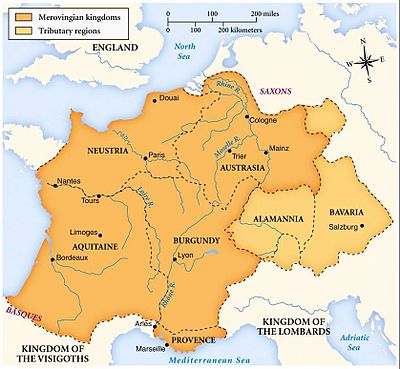
(Left, pen drawing from the earliest manuscript of the Chronicle of Fredegar which is believed to depict Eusebius and Jerome, 715 AD.) On the death of Childebert II, he was succeeded by his two sons: Theudebert II (595-612) in Austria, and Theuderic II (595-613) in Burgundy. Brunhilda was the first to rule in the name of her grandchildren, who were still minors, and who only gradually began to intervene in the struggles with the royal house of Neustria after they had reached majority.

In Burgundy, of which she soon became the true ruler, she continued the struggle against Chlothar and, to take revenge on her Austrian enemies, instigated Theuderic against his brother Theudebert of Austria, who, she kept repeating, was not the son of a king but of a market gardener. As late as 600, the two brothers had jointly inflicted a heavy defeat on Chlothar II, who was then only sixteen years old, and had sacked his kingdom, reducing it to a narrow coastal strip around Rouen, Beauvais and Amiens. And still in 602 they had jointly fought the Basques and ‘with God’s help’ had subjected them to tribute.

But afterwards they fought each other fiercely and bloodily. The Chronicle of Fredegar recounts that

never since time immemorial had the Franks or any other people fought so fiercely. Such was the deadliness between the two armies that, where both sides began the battle, the corpses of the dead had no place to lie, but the dead were so crowded together among the other bodies that they stood upright as if they were alive. But Theuderic, with the help of God, defeated Theudebert once more; and the vassals of Theudebert during their flight from Zülpich to Cologne were put to the sword, covering the ground in stretches. On the same day Theuderic came to Cologne and seized all the treasures of Theudebert.

In Cologne, where the Franco-Burgundians entered, Theuderic had his brother tonsured and then cut off his head and annihilated his entire family. ‘Even a very young son of his was grabbed by the foot by order of Theuderic and beaten against a rock, until his brains fell out of his head’, says the Chronicle of Fredegar.

It was the end of one of the innumerable purely Catholic fratricidal wars.

The victor then attempted to seize control of the whole of Gaul and immediately advanced on Neustria. But when he was at the height of his triumph he died unexpectedly, still in his youth, in the year 613. His sons were also killed by Chlothar II of Neustria. But not his godson Merovech, whom Chlothar imprisoned in a monastery, but ‘whom he continued to love with the same affection with which he had taken him from the sacred font of baptism’ (Chronicle of Fredegar).

On the death of Theuderic in Metz, Brunhilda immediately had his eldest son and great-grandson, Sigibert II, who was about ten years old, proclaimed king of Austrasia and Burgundy. But the Austrasian grandees betrayed her. Led by the glorious ancestors of the Carolingians, the two traitors, the steward Pepin of Landen and Arnulf—the future saint and bishop of Metz—, went over to the side of Chlothar II. And after the high treason of the Austrian aristocracy, the queen was also abandoned by the feudal lords of Burgundy under the steward Warnachar. They had decided it beforehand ‘and of course both the bishops and the rest of the great lay lords, according to the contemporary chronicler… resolved not to let a single son of Theuderic escape, but to kill them all and then annihilate Brunhilda and to promote the sovereignty of Chlothar’.

This sealed the queen’s ruin, the exclusion and even the elimination of the Austro-Burgundian branch of the Merovingian dynasty, as well as the triumph of the nobility over the crown.

Brunhilda’s army deserted without resistance. She fled to the Jura and tried to sneak into Burgundy, but at Orbe (in today French Switzerland), by Lake Neuchatel, she was taken prisoner by the Frankish steward and handed over to her nephew.

Chlothar, as God-fearing as he was cruel and thoroughly ecclesiastical-minded, and who as the first Frankish king compared to David, whose ‘piety’ the Chronicle of Fredegar exalts, was a ruler who granted the clergy new rights and abundant donations, guaranteed them freedom of episcopal elections, exempted them from all the burdens of ecclesiastical property, was ‘clement and full of kindness to all’. The queen consort of Chilperic I, Fredegund, subjected her to torture for three days in the year 613. (Note of the Ed.: queen Brunhilda of Austrasia was Fredegund’s sister-in-law.) This happened when Brunhilda was already almost septuagenarian; she then had the soldiers ride her on a camel, and finally tied by her hair, one arm and one foot ‘to the tail of the wildest steed’ and dragged her to death, until ‘her limbs were torn off one after the other’ (Chronicle of Fredegar). Her bones were burned. And her offspring were also eliminated up to her great-grandchildren, with the sole exception of Prince Merovech, Chlothar’s godson.

(Left, Brunhilde is dragged to her death.) But a modern researcher writes: ‘It was precisely under this ruler that, as can be clearly demonstrated, the Christianisation of the idea of the king reached its first peak’ (Anton).

Pope Gregory had miscalculated. It was neither Brunhilda nor the Austrian branch that emerged victorious from these massive atrocities: the victor was the Neustrian Chlothar II, to whom Gregory had sent only a single letter of his 854 letters that have been preserved. In 614 the king convened a national synod in Paris which marked the beginning of the national Frankish Church, independent of Rome for a century.

Categories
Conservatism Feminism Liberalism

On Agustín Laje

Here we can watch Nicolás Márquez and Agustín Laje in their video yesterday discussing Laje’s new book.

Agustín Laje Arrigoni (born in Córdoba in 1989) is an Argentine writer, political scientist and lecturer. He is co-author of El Libro Negro de la Nueva Izquierda (The Black Book of the New Left) and author of the recently published book La Batalla Cultural: Reflexiones críticas para una Nueva Derecha (The Cultural Battle: Critical Reflections for a New Right).

Laje is the founder and president of the Fundación Libre, a conservative think tank. In Latin America he has been labelled an ‘ultra-right-winger’ by various media. Remember that Latin America subscribes to the egalitarian madness of the West, but since miscegenation has already been consummated here, there is little talk of race, hence racial issues are not discussed by Laje. Although his remarks have been labelled homophobic by the Spanish-speaking MSM, Laje subscribes to the liberal paradigm of ‘let him live’ regarding lifestyles, and only rejects third-wave feminism, not the first two waves. Despite this, Laje calls himself a paleolibertarian, anti-feminist and opposes euthanasia, abortion and homo marriage.

Given that La Batalla Cultural has just been published by HarperCollins, it’s perhaps worth saying that Laje quotes a writer as his conclusion: “Todo lo bueno de la civilización occidental, desde la libertad individual hasta el arte se debe al cristianismo” (‘Everything good in Western civilisation, from individual freedom to art, is due to Christianity’). Obviously, like racialists north of the Rio Grande, Laje is ignorant of the history of Christianity even though Catherine Nixey’s book, which we have been quoting here, has been translated into Spanish.

I have already said a couple of things about Laje on this site, albeit casually (here and here). But I would like to say something else. In the last-linked post I said:

Compared to the neighbouring country to the north, I consider Latin America the continent of the blue pill. There is nothing in MSM that resembles, say, Tucker Carlson. One has to search social media to find the voice of an Argentine, Agustín Laje, and his YouTube channel: a kind of Latin American Tucker who in the Spanish-speaking MSM would be inconceivable.

I mention this only because the experiences I have had with racialists in the UK and US concerning Latin America have been surreal. When I spoke to Jez Turner in London, for example, he asked me if there were no nationalist movements in Latin America. His question left me cold, because any nationalism in this part of the continent is preached based on a consummated miscegenation—never based on Aryan preservation! Also, when I corresponded with Tom Goodrich, I noticed that he had an infinitely naïve view of Latin Americans. He told me that, unlike Americans, they would give me juicy donations here. The truth is that, in all the years I have received donations, I haven’t received a single cent from a Spanish speaker!

I’ve already written about these things in my review of David Duke’s trip to Mexico seven years ago. But I am still surprised that English speakers haven’t realised that there is no such thing as a red-pilled activist in this part of the continent. Not a single one. They all sleep in the matrix that controls us. Still, if I read Laje’s new book that is turning into a bestseller, I will be reviewing it in the Spanish section of this site (although it is the Catholic Laje who should read Nixey’s book).