web analytics
Categories
Conspiracy theories

Conspiracy idiots

I didn’t plan to say anything about the September 11 attacks in 2001. But this comment at Counter-Currents today—:

I don’t see how anyone can look at the evidence and determine anything other than the US government was involved in the attacks. I was very reluctant to come to this conclusion but Ryan Dawson and James Corbett have proven this beyond a reasonable doubt I believe.

—moves me to remind visitors that 9/11 conspiracy theories have been debunked beyond reasonable doubt (see e.g., some videos here and this year here).

Categories
PDF backup

WDH – pdf 321

Click: here
Categories
Catholic Church Christian art

Mind control of all whites

The multiple appearances of Jesus to his people after the resurrection appear treated by the hand of Duccio di Buoninsegna in his Maestà of the Cathedral of Siena.

When Duccio, who was born in the 13th century, painted The Incredulity of Thomas credulity reigned all over medieval Europe. It was inconceivable to the European mentality that all of the gospel passages that can be seen in the Maestà paintings originated in literary fiction out of the pen of Semitic writers of the late first century. The grip that the Roman Catholic Church had over the European mind was absolute.

Categories
Maxfield Parrish Nordicism

If everyone is blonde who needs hair dyes?

Another Spartan law with racist connotations was to prohibit hair dyes. In the rest of Greece dyes were common, as were blonde wigs, the methods of hair bleaching and the elaborate and extravagant hairstyles like those of Babylon or Etruria (and later in decadent Rome). At one stage of the devolution, when the original native breed in Greece was being diluted by miscegenation, the dyes and the concoctions for hair bleaching were highly prized, especially among women. The same would happen in decadent Rome: Roman wigs were made with the golden hair taken from female German prisoners.

In Sparta the influx of foreigners was jealously limited. It was only possible to visit Sparta for pressing reasons. Similarly, the very Spartans were rarely allowed to travel abroad, and even the slave trade was banned. This was motivated by the interest of the elite that its core would not be corrupted by the softness of foreign customs. The Spartans undoubtedly were great xenophobes.

(Passages from one of Evropa Soberana’s essays in The Fair Race’s Darkest Hour.)

Categories
Christian art New Testament

How the myth developed

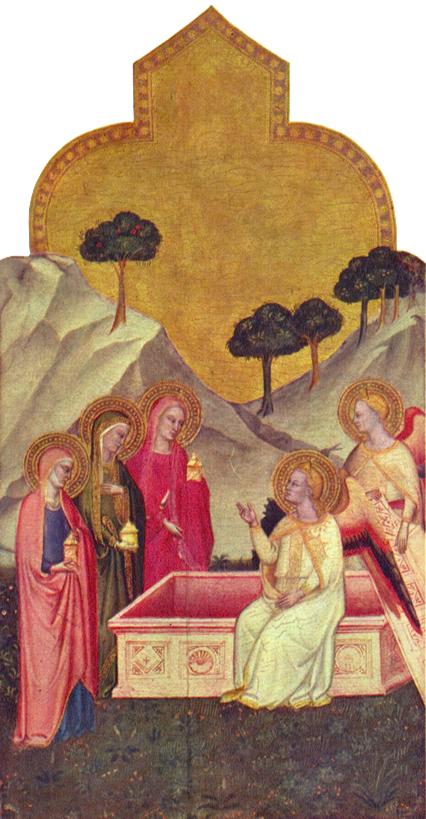
Next to the already empty tomb, this Italian work by Andrea Orcagna (1370, preserved in the National Gallery of London) shows a dialogue between a couple of angels and the three Marys.

In the earliest gospel, Mark (16:5) describes that the women enter the tomb and meet ‘one young man’.

A later evangelist, Matthew (28:2), who used Mark’s gospel, embellished Mark’s literary fiction a little further. He changed the ‘one young man’ to an ‘angel’ that arrives during an earthquake and rolls the stone away.

Luke and John, who wrote their gospels even after Matthew, add another angel to the story that greet the women. So there are two angels now, like the blond ones represented by the delicate paintbrush of Orcagna. (I really love how medieval painters used the pink colour…)

Categories
Ancient Greece

The most famous

There was a latent rivalry between the Ionian people of an Athens influenced by Asia Minor, and the Dorian people of Sparta directly influenced by their Nordic heritage, who never stopped being governed by anything but their ancestral tradition and their popular consciousness.

Except for Athens, which saw herself as the best, all other Hellenic states reserved their admiration for Sparta, seeing it as a shrine of wisdom and justice: the true repository of primitive Hellenic tradition. Sparta was always the most famous and respected city among the Greeks. They always resorted to her to arbitrate interstate disputes, and most of the times they not even had to resort to force: Sparta sent an ambassador to which everyone would voluntarily submit, like a divine envoy.

(Passages from one of Evropa Soberana’s essays in The Fair Race’s Darkest Hour.)

Categories
Christian art New Testament

The empty tomb

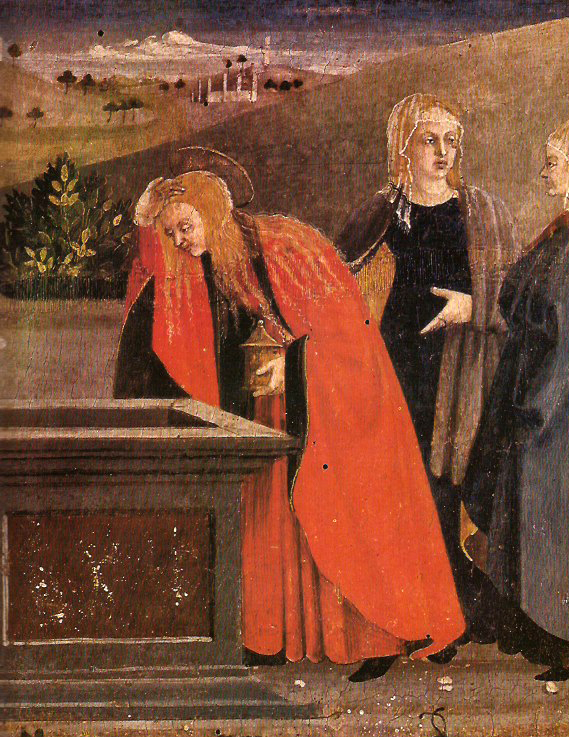
For Christians, the empty tomb is the great proof that the Jew they worship had risen. In this detail from The Polyptych of the Misericordia that a disciple of Piero della Francesca painted in the 15th century, the women ‘prove the truth’ of the central miracle in Christendom.

Today’s Christians do not seem bothered by the fact that the oldest texts of the New Testament, seven Pauline epistles, do not mention the empty tomb at all. Obviously, the story was invented after Paul by the gospel authors.

Categories
Ancient Greece Aryan beauty Classical sculpture

Physiognomy

The Greeks, and particularly the Spartans, studied ‘physiognomy’ to interpret the character, personality, and ultimately the soul of an individual based on physical features, especially of the face to the point that ugliness in certain Greek states was practically a curse. It was also believed that beauty and a willingness of the features should be an expression of noble qualities necessary for a beautiful body bearer, if only dormant. The creators of the Greek statues made them with that knowledge of the human face and the perfect proportions in mind, and therefore represented not only a beautiful body but also a beautiful body carrying a beautiful soul.

The blind rage with which the Christians destroyed most Greek statues indicates that they greatly feared what they represented, because in them the Hellenes fixed and settled, once and for all, as a goal and template, and ideal: the human type that Christianity would never be able to produce.

(Passages from one of Evropa Soberana’s essays in The Fair Race’s Darkest Hour.)

Categories
Christian art Jesus Racial right Romulus

The resurrected Jew

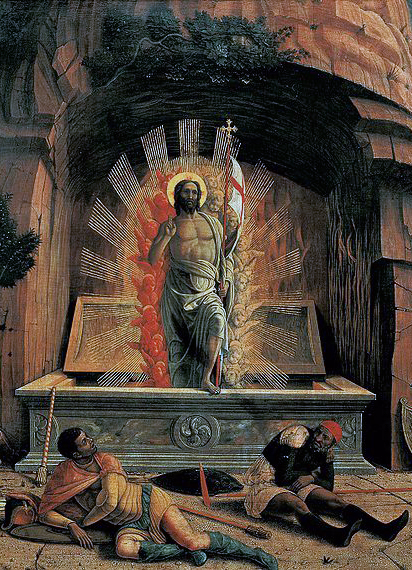
With the characteristic symmetry of the Renaissance, Mantegna composed this Resurrection in which the resurrected Jew is the luminous axis of the scene (see the complete painting: here), surrounded by the heads of red angels on his right and white angels on his left.

Always keep in mind that the doctrine of the Resurrection was plagiarised by the Jews who originated the Christian sect. They simply used the story of the founding hero-God of the Romans: Romulus. The idea of those who wrote the New Testament was simply to use the mythological biography of the white God to convince the Romans to better worship the god of the Jews.

The parallels between the old Romulus and the new Jesus invented by the rabbis are so obvious that a few are worth mentioning: Both are sons of God; their deaths are accompanied by prodigies and the land is covered in darkness; both corpses go missing; both receive a new immortal body superior to the one they had; their resurrected bodies had on occasion a bright and shining appearance; after their resurrection they meet with a follower on a road from the city; a speech is given from a high place prior to the ‘translation to heaven’; there is a ‘great commission’ or instruction to future followers; they physically ascend to heaven and, finally, they are taken up into a cloud.

Every single Westerner has heard the story that these rabbis concocted about Jesus. But who knows the original legend, that of the Aryan hero-God Romulus?

Judea’s victory over Rome is complete even among those racially conscious Christians who mistakenly fancy themselves as anti-Semites.

Categories
Athens

The supremacy over Athens

At this point, we must address the issue that will certainly be around the heads of many readers: the comparison Sparta-Athens. What city was better?

Often we are told that Athens represented the artistic and spiritual summit of Greece and Sparta the physical and warrior evolution. It’s not as easy as that. We must start from the basis that it is a great mistake to judge the development of a society for its commercial or material advancement. This would lead us to conclude that the illiterate Charlemagne was lower than anybody else present, or Dubai the home of the world’s most exalted civilisation…

Thus we come to the important subject of art. It usually happens that it is a common argument to vilify Sparta. The Spartans used to say that they carved monuments in the flesh, which implied that their art was a living one: literally them, and the individuals that composed their homeland.

But Sparta also had conventional art as understood in the present. It was famous throughout Greece for its music and dance (of which nothing has survived), as well as its highly prised poetry that has come to us fragmented. Its architects and sculptors were employed in such prestigious places as Delphi and Olympia, and imposed a stamp of straight simplicity and crystal clarity in their works.
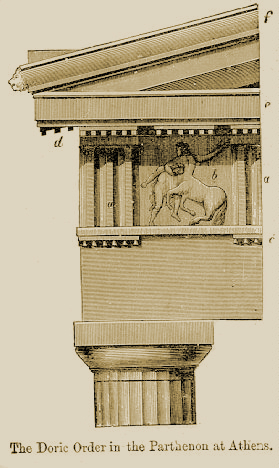
The best example of this is the sober Doric style, a direct heritage of Sparta that became a model not only for countless temples throughout Greece, as the Parthenon in Athens itself, but also for the classic taste of later Europe that has endeavoured to continue the legacy of Greece and Rome.

(Passages from one of Evropa Soberana’s essays in The Fair Race’s Darkest Hour.)