web analytics
Categories
Alice Miller Autobiography Child abuse Film Hojas Susurrantes (book) Holocaust

Nobody wanted to listen, 3

Offended by casual acquaintances

Some would say that Gerardo, from whom I would also distance myself, didn’t tell me anything about my manuscripts because, as a relative, he didn’t want to commit himself. But there have been other filmmakers who have nothing to do with my family and who behaved worse when I brought up the subject of what happened to me as a teen.

In 2003 I used to go to some get-togethers of filmmakers, all of them older than me, who met at noon on Sundays at the Cineteca café in Mexico City. One of those Sundays Elsié Méndez, Fernando Gou and his wife [none of them swarthy by the way] offended me in such a way that I didn’t visit again those gatherings that I hadn’t missed since I met them. Elsié was infuriated by my feelings of outrage at the abuse of minors: she felt threatened. But laughing at one’s suffering during puberty, which she usually does in social gatherings, is a way to avoid pain and to mourn behind walls. As Miller has said, that was the nonsense Frank McCourt did in Angela’s Ashes, which even before I discovered Miller irritated me. In his autobiography McCourt never spoke out against his parents or the culture that tormented him. Rather, and like Elsié, he laughs at his past: and precisely for laughing at the tragedy of his childhood he has been applauded in a world steeped in poisonous pedagogy. I confess that what irritated me the most about Angela’s Ashes when it was released were the reviews I read when I lived in Houston: they praised the author’s non-judgmental stance.

Contrary to popular belief, laughing at extreme parental abuse doesn’t cure the internal injury that the abuse caused. The diametrically opposite heals: crying. The raucous anger at the aggressors with which I used to express myself in the gathering is also curative. Miller has said that if Sylvia Plath had written aggressive letters to her abusive mother—remember my Letter—she wouldn’t have had to commit suicide. I lost years of my life by not prosecuting my parents and their society, as I do now. Before I found a knowledgeable witness to guide me into the forbidden territory of healthy hatred, the guilt complex kept me from getting ahead in life. It took entire ages for me to denounce the cruelty of my parents. But in our world it is very common that it’s not cruelty towards children that causes anger, but the denunciation of that cruelty.

For example, seeing my anger at my parents, both Elsié and Mr. Fernando jumped on me to protect their parents from their unconscious anger. Like everything belonging to Alcoholics Anonymous, Mr. Fernando has avoided thoroughly confronting the figure of the father. In Neurotics Anonymous, which I had attended only once twenty years earlier, I witnessed the victim publicly venting out in free associations. I don’t object to this catharsis, but both groups completely omit the elementary: devising social engineering scenarios to eliminate domestic violence towards the child who, already grown up, takes refuge in drinking or neurotic defense mechanisms to mitigate his pain. Part of this pedagogic attitude, understood as ‘educating’ the victim (‘poisonous pedagogy’) instead of social engineering, can be illustrated by the question that Rocío, Fernando’s wife, asked me about my parents:

‘Have you forgiven them already?’

This woman, whose nose was broken by her father, reversed reality with her question. Her negative photographic vision has to do with the false feelings of guilt that prevent us from putting the criminal father on the dock. Whoever is not under the influence of poisonous pedagogy asks the natural question and directs it to the aggressor, not to his victim: Have you already asked your daughter for forgiveness? Society not only ignores that unilateral forgiveness is impossible; not only does it not penalise parental abuse but, seeing the reverse reality, it turns its weapons against the victim who complains about the unredeemed parent. We can already imagine what effect it would have to ask a Russian Gulag survivor if he has already forgiven Stalin’s willing executioners while they still believe they did the right thing.

If the filmmakers of the gathering reflected on the films that they comment on Sundays, they would realise the absurdity of their position. Consider the documentary S-21: La Machine de Mort Khmère Rouge by Rithy Pahn, shown at the Cineteca itself. In this shocking testimony a survivor of the genocide of the 1970s in Cambodia tells the camera that while some dupes speak of forgiveness and forgetfulness, it is not possible to do so while the executioners of two million Cambodian civilians, including young children, not only are not sorry. They don’t even acknowledge that they made a mistake! The same can be said of unrepentant parents who are not aware that they have harmed their child. Unilateral forgiveness is so artificial, feigned and illusory that, at the time when I argued at the Cineteca, Mrs. Rocío didn’t visit her father, who was dying of cancer. But yes: she and her friends demand unilateral forgiveness from me. The ‘Have you forgiven them already?’ tacitly implies that Rocío had unilaterally forgiven her father, something she didn’t do in real life. Commenting on the heated discussion that Sunday, Pancho Sánchez, the author of several film books who presides over these gatherings, told me alone that those who say they have no resentment towards their aggressors were hypocrites.

That impossible forgiveness that a society blind and deaf in psychological matters demands in unison is one of the main features of what Miller calls poisonous pedagogy, and it will be a subject to which I will have to return later. Nowadays, when I openly express my resentments towards my parents—as in the gathering of film fans—I am unable to take it out on others. If I had been given a lesson at school against an absorbing mother’s behaviour, perhaps I would have made contact with my feelings and not wanted to spill them on Elvira [recounted in the previous section]. But school, society, including my educated relatives, see to it that those feelings never surface. But they are there, in the psychic core and eventually they erupt either against the aggressor in the form of an accusatory epistle—a direct and healthy hatred—or against substitute objects: a displaced and insane hatred.

I must clarify that in a meeting with other film fans at the Cineteca my testimony was very well received, and even a lady encouraged me to ‘get it all out’ as the best therapy. It was only at the table that gathered some individuals who had been mistreated in their childhoods when resistance arose. Like my sister Korina, they did this to avoid feeling their own pain. The only way to convey the intensity of the emotions in the discussion that day is to quote my personal diary, even if I have to correct the syntax and rewrite some passages in addition to omitting some insults (not all). Bear in mind that the films that I saw then were pure anti-German propaganda filmed by Jews: something that, as we shall see in The Grail, I didn’t know at the time.

October 26, 2003

Today the damaged ones attacked me. Some of the things I heard were beyond incredible: ‘You have to blame yourself for everything that happens to you; otherwise you have no power over your life’. Elsié believes that she has a power that she doesn’t have. And Fernando the same.

When I came up with my favourite arguments to refute them, suitable arguments for moviegoers—Sophie’s Choice, a movie that everyone saw, and the girl raped by her father—the incredible happened: the victims were blamed. Elsié commented: ‘They are already thinking about how it was possible that they went like lambs to the slaughterhouse’. That is to say: there are no culprits. Regarding Sophie, they denied my thesis that the only thing she could do was what she did: commit suicide. As to the other case, they said that the girl could perfectly rebuild her life as an adult. In other words: no people are destroyed.

Fernando was more aggressive. When I said that only those who get to the core of pain pull the dagger out of their hearts and that the approach of those in Alcoholics Anonymous was epidermal, he replied that I was ‘arrogant’, and that Alcoholics Anonymous was about ‘reducing the ego’ in the sense of not seeing your pain but that of others. This is just the opposite of my autobiography, which, while I see things like the Gulag, the starting point is my own life. The way Fernando spoke of the ego was like saying that you have to forget in order to forgive.

Pancho, the only one who was not a victim of beating at puberty, didn’t attack me. Reason? He lacks an idiotic defence mechanism that I unintentionally triggered with my observations. Now I will have to stop seeing them because I see that, with that mental block, a genuine friendship couldn’t prosper. I’d have to go just to listen and shut up when the victims are blamed, something I’m not willing to do. The funny thing is that I unwittingly provoked them so that Rocío and Elsié would talk about the most horrendous stories of parental abuse in their lives. Even Fernando said that when he told his father that he wanted to study oratory, he replied: ‘You stutterer are not good for that!’

All three, damaged. Fernando, remember, was an alcoholic for many years. He was extremely pissed off that I said I had found the dagger in my heart—the internalised parents—and the way to pull it out, and that I doubted Alcoholics Anonymous, analysts, and psychiatrists could pull it out (‘arrogance’). The one who surprised me the most was Elsié, because on another occasion she had understood Fernando’s repression about his pain and today she changed sides. When I mentioned the case of Sor Juana, everyone came out that she, not the archbishop and Miranda, was the winner! I told them about Juana’s self-immolation and they said that the world remembers her. This reasoning is so stupid that it is not worth refuting.

Octavio Paz wrote a great book about how an archbishop and a confessor cornered Juana de Asbaje.

A real pandemonium of the status quo reaction was triggered today by my attackers. In a soliloquy that I just threw on the street, I realised that the hatred towards the victim—reminiscent of Dr. Amara, the psychiatrists, and the serial killer Miller speaks of—is because they cannot bear the pain of having been themselves victims. Not wanting to see their total helplessness, they come out with ‘I’m over it’, ‘You have to forgive’, ‘You have to forget’ and so on. The worst thing is when they repeat the social clichés, the most nefarious of all, like the one that those stagnated in life haven’t wanted to get out of their victimising stance. I tried to refute them with the case of the Eschatology cult [see the first article in Daybreak] in which I was and chess: that only when I wasn’t aware of the role my parents played did I get stuck and was a looser. That made Fernando angry, who told me things that hurt me, and Elsié and Rocío supported him.

But here’s their story…

Elsié was married when she was almost a child and her abusive father told her: ‘Just one piece of advice: always say yes to your husband’. Already married she cried and cried and didn’t know why. She had two horrendous marriages in which she was beaten. She repeated the patterns of a battered woman with her husbands, she couldn’t get rid of them: something had her ass hooked to them. Rocío’s father broke her nose at age twenty because she dared to confront him with a ‘Why?’ when her father told her ‘You won’t speak to that boy again’ (Fernando). When his father got home, all her siblings shit out of fear. He always beat them undeservedly. They continued with their public confessions but the essential is understood: they told horror stories and cannot see another victim who now wants to make a literary career on the subject. It is painful for them and for Fernando who, although he didn’t say many things due to male circumspection, it is clear that his father crushed him.

The funny thing is that both Rocío (‘have you forgiven them yet?’) and Elsié (credulous of psychoanalysis) and Fernando (credulous of Alcoholics Anonymous) have as a defence mechanism the New Age bullshit that one is ‘the arbiter of one’s own destiny’. Everything has to do with not facing the pain: especially the pain that impotence in childhood was total: the opposite of the lies of the New Age. Ah! I had forgotten to say that Elsié came out with a BS similar to that of Arnaldo Vidal about his brother Juan Carlos, who told me that ‘it made him very comfortable to be sick’. Elsié told me that David Helfgott wanted to stay as a child.

Juan Carlos Vidal, an acquaintance of my family and grandson of the famous Victor Serge, became a mentally-ill lad because of the behaviour of his parents. Helfgott also became ‘schizophrenic’ for the same causes. The filmmakers knew the latter case very well from the movie Shine. The grotesque thing about their position is that if I took them to an asylum, they would say that all diagnosed as schizophrenics found it very comfortable to stay as children.

That’s why Elsié and Fernando get hooked into victim-blame philosophies like psychoanalysis and AA: it is their defence mechanism to believe that they had more power than they actually had. Remember, Caesar, how twenty years ago it bewildered me in Neurotics Anonymous when they talked about ‘selfishness’, and that because of that ‘selfishness’ the poor devils who went there were in bad shape. Whoever presided over that place blamed herself and the rest of the group for their emotional state. I never imagined when I left in the morning that this would be the last day that I go to the gatherings at the Cineteca. The way Elsié and Fernando spoke today was to repeat the social slogans that ‘negative thinking’, mine supposedly, hurts; and rosy glasses heal. And by the way, two of Rocío’s sisters didn’t marry and don’t see their father.

There’s something esle. Both Elsié and Rocío had helping witnesses: their own siblings. But they condemn those who didn’t have them: Caesar, Helfgott, Sor Juana. Also, they don’t want to see that there is a stark difference between the pain of a woman like the one in the movie Sophie’s Choice—I used this example many times—and other pains. Fernando got pissed off and said that the pains cannot be compared. Neither he nor Elsié know that there is a limit of resilience in human pain. If that limit is crossed, the mind breaks down.

In the section on Shine of my previous book I spoke about the latter: an argument that I brought up in one of the previous gatherings but that Mr. Fernando ignored.

Their ravings—that Sor Juana emerged triumphantly; blaming Helfgott, and denying that only suicide could detonate Sophia’s mountain of pain—are clear proof that my arguments were devastating. They had to come out really crazy when I put them on the defensive. Another thing. If someone comes to Alcoholics Anonymous in trauma, the worst thing they can tell him is that he has to ‘get down on the ego’. His damage is in the ego, not in an inflated ego as Fernando believes, but in a wounded ego. The climax of yesterday’s psychotic breakdown were Elsié’s words: ‘You have to blame yourself’ for everything that happens to me in order to ‘have control over life.’

The New Age doctrines are so absurd that they would even lead us to blame the passenger victims of a plane crash. It is so unnecessary to spend ink in refuting them that I better continue with my diary:

Another breakdown: when I mentioned the example of Auschwitz Rocío jumped up claiming that the prisoners in concentration camps had control in some way, meaning that those who survived were the good guys. It is this type of psychotic breakdown in the face of my arguments that makes it unjustified to return to sit at their table. But yes: I will nail them in my books…

October 28. I’ve been thinking more about what happened on Sunday and discovered a thing or two. Both Fernando and Elsié are in cults. I was ignorant of it, so I didn’t realise that saying that Alcoholics Anonymous therapy was ‘skin deep’ was going to cause anger and rage from the cultists. Likewise, when I spoke of Sophie’s pain, they came out with the idea that ‘pain can be an incentive for life’. As if any pain and Sophie’s were the same!, who was made to choose, in front of her children, which of them went to the gas chambers: the fateful ‘Sophie’s choice’.

As I said, what bothers this trio the most is the impotence in the face of evil and the criminal will of the Other. In order not to feel their pain (‘blame oneself’, ‘reduce ego’, ‘forgive’, ‘pain can be a spur for life’) they insulted me. Elsié, it hurts me to say it because at the time she hurt me, told me that self-pity was the worst, and that one had to get out of that victimising position. I felt very bad when, following that line, these idiots blamed the prisoners of the concentration camps. And by the way, Fernando’s bilious zeal when speaking of the ‘Higher Power’, an entity that is instilled in them in Alcoholics Anonymous, was very similar to my old father’s zeal when speaking of God. It is clear that it is the zeal of a cultist.

A few words about self-help groups in general and Alcoholics Anonymous (AA) in particular are worth it. In short, it is not enough that some people are willing to listen to our problems, even our deepest demons, as is done in such groups. The victim of abuse must have an enlightened witness: someone who doesn’t come up with idiotic defence mechanisms in the face of tragedy. Now, the difference between the hearing of an enlightened witness and a simple audience such as Alcoholics Anonymous is abysmal. I know a subject who was in AA whom I had to distance myself from because, although he overcame his alcoholism, he displaces hidden anger on his friends. Likewise, there are AA people who transfer their alcoholism to bulimic behaviour, or become addicted to gambling because their psychic damage was never addressed. They are called ‘dry alcoholics’. The dry guy I distanced myself from, for example, once he got over his alcoholism took refuge in chess. He never processed his pain. Divorced and with two small daughters living with their mother, this mature man displaces his anger on others. Alcohol is a balm for pain that the mind is unable to process. Alcoholics Anonymous will have saved him from that false balm, but not from his pain.

Mr. Fernando got very angry when I said that AA therapy was skin deep. But that is exactly what these types of therapies are. Only the enlightenment that comes from an ‘accomplice witness’—a better translation than ‘knowledgeable witness’, one of Miller’s terms [she wrote in German]—along with writing about our lives, can result in true psychological healing.

The key to the keys, Caesar, is that you cannot argue with people who blame the victims of the concentration camps. Exercising such violence to reality hides an infinite aversion to the fact that there is Evil in the world and that we have no control over the evil acts of others. But I’m going to leave these people alone. It’s already eighteen pages of my diary. It’s so sad that I can’t make friends in a world like this…

Remember that, in those days, those movie fans and I watched Hollywood films and knew nothing about the malicious anti-German propaganda or the Jewish question. Independently of that, the disagreement at the Cineteca hurt me in such a way that I promised myself that this would be the last time I would behave cordially with those who, in the future, offend me with poisonous pedagogies. During the 2003 discussion I was still reticent to speak out all of it. I didn’t respond to the filmmakers as vehemently as, alone, I did in my diary, but rather respected social conventions. But respecting them leaves the offended with an irresistible desire for revenge, as we will see in the next few pages.
Categories
Autobiography Child abuse Exterminationism Hojas Susurrantes (book)

Nobody wanted to listen, 2

‘Normal people’

Not all my close friends are as primitive as a pastry chef who, like a balm, tries to spread whipped cream to his existential pain. In my adolescence there was a time when Hector Covarrubias and my father commented on the wonders of 2001: A Space Odyssey at the house in Palenque. As I said in the narrative section, the film culminates with the return to Earth of a man turned into an overman to eradicate Neanderthalism. Arthur Clarke himself suggests this at the end of the novel, which Hector had read. Of my relatives, Hector was considered the most intelligent in the family and as a teenager I visited him, being impressed by his clear and transparent rationalism. The lectures on physics he gave me individually in 1977 had moments as lucid as I would later hear on Carl Sagan’s shows. But Hector was blinded about the conflict with my parents. He didn’t see the dysfunction in our family even when, because of the seventh circle of hell at home, he saw me completely broken. His house was an Enlightenment room as long as we touched on the topics of science, rationalism, and the criticism of magical thinking. The problems of the soul were forbidden. Instead of seeing my family problem, he repressed the whole thing and looked me down. He disowned the nephew who most admired him…

Hector was already a married man with daughters when I stopped visiting him in the early 1980s. But I have also been offended by relatives younger than myself. When my first cousin Octavio read my Epistle to the mother in 1990 he commented to me: ‘My view of your parents is changing!’ I remember those words very well while, sitting and reading it absorbed, he had the manuscript on the desk. However, some months later he spread the gossip with my father that I could publish it. Octavio had been the closest of my intelligent cousins, but like years later with Pablo, I felt very hurt by his behaviour and I distanced myself permanently from him. Something not so grotesque happened with my cousin Carmina when I visited her at her house, next to Hector, our uncle. When I made a sheepishly critical comment on parental abuse, my cousin jumped, ‘You think your parents are demons’. I don’t know why she reacted like this. I suppose that from other relatives she was familiar with my ideas. It was the last time I visited her. Hector, Octavio and Carmina are sophisticated people. But their reactions were typical cases of extreme dissociation before the most elemental psychological reality.

Gerardo Tort filmed De la Calle, a film about homeless children in Mexico City. He is one of the two cousins Korina referred to in her letter of advice and scolding. Surely my cousin Gerardo could hear me, I thought. I had read an approximation of the script for his film before the script reached its final elaboration, and I gave him my opinion. What would be my surprise when Gerardo didn’t comment on a draft of my first two books, nor would he do so in subsequent years. And he didn’t tell me anything even though, on one occasion when I ran into him on the street, I brought up the subject of the manuscript I had given him. Not even a filmmaker my age, with whom I had talked about so many things against the established order in the past, could hear my story. Gerardo can bring his guts to the camera into the sewers where street children live. But he doesn’t have them to listen to his cousin about what happened in one of the Tort families. My sister would say that those who act like this ‘are normal people who run away from problems; they are not interested and cannot do anything about it’. I’d say they are Neanderthals—exterminable Neanderthals indeed, as I will argue elsewhere.

Categories
PDF backup

WDH – pdf 360

Click: here
Categories
Autobiography Child abuse Hojas Susurrantes (book)

Nobody wanted to listen, 1

One of the problems with translating fragments of a book is that you lose context. Strictly speaking, the ten chapters that I will translate from Hojas Susurrantes (Whispering Leaves), pages 378-430 and 443-444, can only be well understood after having read the previous three hundred and seventy-seven pages.

However, when I recently reviewed the syntax and edited that text, which I had not reread for several years, I realised that those pages were understandable if I translated them. Similarly, Day of Wrath (see the sidebar) contains translated pages 472-634 of my Hojas that, even in isolation from the rest of the book, make perfect sense.

So here is the first of ten instalments of pages 378-430 that I’ll be translating this month. It begins with some anecdotes that happened in 1976…


______ 卐 ______


NOBODY WANTED TO LISTEN

Hurt by my loved ones

In the most difficult moment of my life, my seventeen years, I fled to the house of San Lorenzo with my grandmother. A few days later there was a meeting at her home. Besides grandma Mecho there was also my grandma Yoya; I remember Aunt Esperanza and also Aunt Elsa: my father’s sisters-in-law, and I think my Aunt Mercedes was also there. As I tell in Letter to mom Medusa, at that time my character was extremely self-conscious because of what my parents had done to me. But despite my inhibition, I plucked up my courage and threw a comment on the table that was intended to reveal the tragedy at home. At that time they had just released One Flew Over the Cuckoo’s Nest and I projected myself into the stuttering lad who commits suicide at the end. My mother, still at a distance, continued to harass me: now through the infamous Dr. Amara. In the film it is mentioned that the lad had a possessive mother. I projected myself because, just as in the movie the villainous nurse was an ally of his mother, that doctor was an ally of my mom. Thus, at dinner with my aunts discussing the film, in a moment of unusual courage I said to my grandma Yoya:

‘There are mothers like that with their children!’

I meant that there are mothers who destroy their children as in the film. Although I don’t remember my exact words, I said it not only with great emotion, but with immense anguish. When I write these paragraphs I have to get up from my desk to walk around in the modest study in which I live. The memory touches me so painful fibres that penetrate so deep in my being, that I need a little peripatetic comfort before I sit down again to write. Yoya perfectly got what I wanted to say, and what I am about to tell is what hurts me.

Here is a minor who, for mysterious reasons for her aunts and grandmothers, runs away from home to take refuge with his grandma. This boy is patently distressed, self-conscious, and in great stress when speaking. He makes a herculean effort and, using a movie, tries to talk about his own drama. Instead of his anguished comment marking the beginning of some serious communication with the family, Yoya, who has said that I was her favourite grandson, immediately turns to Aunt Esperanza with the words:

‘But Blanquita and other mothers aren’t like that, right?’

Yoya repeated the question (‘Oh no, of course!’ Esperanza answered) and mentioned my mother’s name in the second or third repetition. My grandma originally used my absent Aunt Blanquita to avoid mentioning my mother directly; and she meant that if these things happen in other families, never in ours.

The pain of which I speak has to do with the fact that it is this sort of axiomatic deafness, this root disbelief, this anti-empathy towards an extremely anguished boy who desperately needs a friendly ear, that destroys a life.

Anyone who has been the victim of their parents to the level that I was, suffers a panic that undermines his mind when, to boot, no one shows the least compassion; that is, when the kid lacks what Alice Miller calls ‘a helping witness’. I didn’t have a single person to comfort me when I was being attacked by my parents. On the contrary, the family and my friends put up incredible resistance (and let’s not talk about the analyst). As Jeffrey Masson wrote on page 17 of his anti-therapy pamphlet, ‘Whenever our own truth is denied, ignored or invalidated we experience the greatest fear we can ever know: the threat of the annihilation of our self’. For those who haven’t been victims of parental beating, it is impossible to imagine how the universe falls; how the sky breaks and the stars collapse when the child has absolutely no one who wants to hear his story.
 

After the turbulent years

If as a teenager it was a miracle that I made up my mind to denounce my parents, in my twenties I managed to do it more frequently. In the 1980s my adolescent agonies were distant. Years had passed and I was much more emotionally robust. So I criticised my mother in various conversations.

Hearing my criticisms in a conversation alone with Godmother at her cozy flat, whom I had dreamed of when I was very little in that beautiful dream in which she approached me happily dancing [a dream recounted in the previous section], she raised the palm of her hand as a sign of please stop my dear! In my late twenties her lack of empathy didn’t cause me the terrible panic I had suffered as a boy with the psychoanalyst. But it hurt me in such a way that I stopped talking to her for a long time: something that no relative had dared to do. Godmother, the sister closest to my grandma Yoya, was a respected figure in the family because as she stayed single she acted as a counsellor to the relatives. But like the deaf analyst, the family counsellor was unable to listen to any accusations about the parents, despite the fact that on one occasion she commented to me ‘If you could see what they come to tell me here!’

On another occasion, and also in the 1980s, my uncle Beto did something similar. He was the one who had rented us the house in Ermita, the place of my first memories, and with whom Elvira herself had worked after her stay in Palenque [recounted in the previous section]. When Uncle Beto heard my criticism of my mother, he raised his eyes to the ceiling as a sign that I had crossed the line into forbidden territory. Although Uncle Beto, Godmother and Yoya’s younger brother, didn’t enter into an argument about something so important to me, I didn’t get angry or stop talking to him. Not long after he would die. But the unspoken message from my great-uncles, grandmother, and analyst was the same: they weren’t willing to listen to something that touched parents.

It could be thought that only that generation of people wasn’t prepared for this type of revelations. Neither is mine. Not even my younger brother allowed me to communicate my views to him.

In 1998, without any inhibition and with a fully developed intellectual capacity, in a restaurant I quoted to Pablo some passages from a treatise by Silvano Arieti. The tract showed how paranoia was due to the stalking mother of his young female clients, and these passages surprisingly portrayed the delusions of one of our sisters. In a gesture that I felt rude, my brother closed the Arieti book that I had on the table between us. That aborted discussion marked the beginning of a total and absolute estrangement with my brother.

Pablo, the fifth of my siblings, at thirty years old didn’t want to know anything about the dark side of our parents because he wasn’t abused as a child. But the incredible thing is that I’ve also been hurt by my battered sisters when I wanted to communicate my findings. Since Genevieve follows me in age—the photograph in which she and I embrace as children is a treasure in my heart [photo that appears in the previous section]—she is the one I feel closest to. But by introjecting our mother’s paranoid vision of me since her teens, a phenomenon that Theodore Lidz once called folie en famille, Genevieve distanced herself from her older brother: something that has hurt me deeply. The only time in my life I asked to speak to her about the family, she refused. And when I put the manuscript of my Letter to mom Medusa on her bed a few days later, she returned it to me without having read it: a gesture that, like Pablo’s, naturally offended me.

From my family Genevieve has been the only one who has distanced from me of her own free will due to the discord that our mother sowed (‘… she took you out of the family and turned the whole world against you with pure lies’, my sister Korina wrote me in her own handwriting about our mother when I had gone abroad [an already quoted sentence in Letter to mom Medusa]). I would distance myself from others because of their lack of compassion, or in the case of Korina herself, because of her lack of empathy. As seen from the quote in this paragraph, Korina was the only one who made deep emotional contact with my adolescent tragedy. However, my sister believes that the family tragedy shouldn’t be made public, and has vehemently maintained the social convention that it is wrong to bring up the subject with others.

Humanity ignores that communicating one’s own tragedy to someone is essential to settle accounts with our past. Humans, in general, see reality backwards. For example, instead of trying to understand my autobiographical mission, throughout my adult life Korina has treated me with sobering attitudes. This is very ironic because in my family only she developed great compassion for me (which is why I had thought to dedicate my first book to her) and also because our mother martyred her. But Korina refused to read the manuscript of the Letter that I planned to dedicate to her when I lived with her and her little son. Even after I left her home, and despite my pleas for her to stop meddling in my confessional passion, she continued to bother me. Like the rest of humanity, Korina has a fear of radical soul surgery. For her, my initiative to speak out about my findings in family psychology isn’t intelligent behaviour: it is foolish behaviour before which the sister, assuming the role of a new mother, reprimands the memorialist. I quote the crucial passages from the last of her epistolary scolds without adding ellipsis between unquoted passages:

Caesar:

The other time I spoke with one of the Tort cousins and he told me that you had sent him part of your book and that it’s not the first time you do this. I know you want the whole world to read it or something like that since you worked so hard on it and it’s your life and what my parents did to you and all that, and believe me I understand you. But what you don’t understand, Caesar, is that people don’t like problems, let alone problems as big as yours, and even less if they are about the family. Also, think that even if people read it, that’s not how the world is going to be fixed, Caesar, that’s not how the Revolution is going to do you justice. The damage is done and only you can fix it.

And just think about this, I say in good faith Caesar, once more. People don’t like problems. If I weren’t your sister and I knew you, the third day you arrived and told me this, Caesar, I would dump you because what you don’t understand is that not all people in the world are therapists or psychiatrists or psychoanalysts and we don’t want to hear about problems, let alone such serious ones. We are normal people who run away from problems. We are not interested and cannot do anything about it.

If you need to get it out of your head, go with someone to tell them as many times as you need, and I’m not talking about a therapist, maybe a friend or someone who wants to hear from you. Remember when you told me that a married couple who had lived in a concentration camp [a fictional film: Left Luggage], that the lady no longer wanted to hear any of that afterwards because it hurt her a lot, but that it was good for the husband to talk about it because he took it out, it was like his therapy.

Well, if you understood that, I don’t know why you don’t understand that reading your book hurts me and a lot of people in the family.

Korina

My sister thinks that reading the book I was going to dedicate to her would hurt her. The truth is that my work would shine a light in her dark mind by understanding what happened in our family. Dark, I say, because she was the one I was talking about with my younger brother about her paranoid delusions: obvious delusions for all her distant friends and close friends. (To give just one example: once Korina told me, crying with extreme anguish and expelling me from her house, that I was part of a plot led by our mother to put poisons in her food.) Furthermore, Korina is wrong in believing that ‘the world won’t be fixed’ if others read my tragedy—or hers—and she also errs that ‘only one can fix’ the damage caused by parents. Like the rest of humanity, my sister is seeing things backwards, in a photographic negative. I don’t want to get my past out of my head. I want to get it into others with my writing. Taking it off leads to psychoses, like hers. Instead, making people aware of the hell caused by parents like ours prevents them.

‘We are normal people who run away from problems; we are not interested and cannot do anything about it’. What Korina and humanity see as normal, in my eyes is the behaviour of a very primitive dude, a Neanderthal. If my sister were correct that it’s healthy not to talk more about the problem, as she advises me in a paragraph that I omitted from her letter, she herself wouldn’t suffer from delusional ideas. On the other hand, I don’t suffer from the slightest mental disorder, not even addictions; but the aforementioned cousin that Korina mentions in her letter did (he once confessed to me and my brother that he was addicted to cocaine). The accepted wisdom in our society is what Korina believes: that burying a tragedy is the correct mental practice. I never tire of repeating it: repression and denial are the royal road for crime and mental disorders.

Korina, who watches soap operas and doesn’t like reading, reproaches me in her letter that ‘I want everyone to read me’. She ignores that we have an obligation to listen to the tragedy of the brother because only that can heal his soul. But at seventeen I didn’t need everyone, just one person. To take the most dramatic example that comes to mind: If, dismayed by my attempt at communication, Yoya would have called me to speak privately during that 1976 family dinner, she could have saved me. A single friendly ear would’ve led me on the right path in life. I wouldn’t have sought my salvation for so many years in stupid cults that alienated me and prevented me from pursuing a career. Although I didn’t respond to my sister’s letter, I can do so in an open letter: What hurts, Korina, isn’t digging up the past, but hiding it under a mountain of cakes. It seems to me that in Left Luggage the adult was the man, and the mental infant, his wife; and it is the man who scolds her for her childish defence mechanism, the pastry. But you, who try to avoid the mourning over our parents in inane distractions, are the one who thinks you are the adult. How daring of you to scold the digger as if he, not the pastry chef, were the child.

In other words, I’m not the one who should change. My family and relatives, Korina and company, are the ones who have the obligation to emerge psychically. Jung saw it clearly: enlightenment isn’t achieved by imagining figures of light (which Korina has tried for decades). It is achieved by analysing our darkness, our own shadow.

Categories
Quotable quotes

Pau’s quote

‘Cómo es necesaria la humildad para reconocer los propios errores’ (How humility is necessary to recognise one’s mistakes).

—Letter from Paulina, page 443 of Hojas Susurrantes.

Categories
Alice Miller Child abuse Hojas Susurrantes (book)

Nobody wanted to listen

Six months ago a woman told me in the comments section of this site (one of the essays I included in Daybreak):

I read [Alice] Miller 30 years ago in an attempt to understand and resolve a history of abuse and tyrannical Christian teaching. I gave up because confronting my own past would have meant destruction of much on which my life has been built.

I am still unwell, but in advanced age am finally confronting the catastrophic link between the tortured son on the cross as a model for forgiveness and the cruel parent who demands forgiveness, who links pain and love.

Cesar you are a lone voice in a noisy world, but some of us are listening.

Soon I will begin to translate some chapters of the section ‘Nobody Wanted to Listen’, the second part of My Childhood, the third of my eleven books.

In order not to leave the reader in the dark, I would like to remind him or her that only the first of my eleven books has been fully translated into English. Day of Wrath only translates most of the fourth book, and in Daybreak you can read a couple of articles, ‘On Depression’ and ‘From the Great Confinement to Chemical Gulag’ that give an idea of what I say in my second book.

As Elenka told me half a year ago, this is a topic we all shy away from. It confronts us with the core of our pain. But feeling that pain again is the royal road to the healing of those of us who have been harmed by our families.

Categories
Americanism Democracy Racial right

Conservanda est / delenda est

I am busy reviewing the syntax of my third book and am tempted to include here a few translated chapters from it when I finish it. We’ll see…

I had promised myself never to criticise the alt-right folk again but yesterday I saw a few minutes of the recent debate between Richard Spencer and Styx: one is going for Biden, the other for Trump. Since the priest of the 14 words abhors democracy even more than Plato, I found it so grotesque that I decided to change the subtitle of this site.

British Paul Johnson starts A History of the American People, which I read, with these words: ‘This work is a labor of love. When I was a little boy, my parents and elder sisters taught me a great deal of Greek, Roman, and English history, but America did not come into it…’ Of course: American conservatives loved Johnson’s book.

Like almost all white writers Johnson is a race traitor. A priest would start his story about the US with these words: ‘This work is a labour of hate…’ Why? It’s already surmised in my Daybreak and it was yesterday when I changed the subtitle from ‘Only the transvaluation will save whites’ to ‘America delenda est’, which resonates with one of the earliest subtitles of this site: ‘Gens alba conservanda est’, the white race must be preserved.

Categories
Theology

On ‘horribler’ theologians

Instalment 129 of Deschner’s work, that recounts the brutalities committed by the first Christian king that ‘united’ the Franks, ends with these words: ‘As long as history is viewed in this way, as long as it remains outside of its moral valuation and the vast majority of historians continue to crawl before such hypertrophic beasts of universal history with respect, reverence and admiration… history will continue to unfold as it does’.

As we saw in instalment 129, what is most striking is how the theologians’ prose idealise such Christian beasts. There is no question about it: Christianity’s criminal history may be horrible, but the theologians can sometimes be horribler

Postscript:

Remember Arthur Kemp’s magnum opus:

Clovis’ most significant deed was his conversion to Christianity in 496 AD—without this conversion it is doubtful that Christianity would ever have taken hold on the European mainland. He initiated the practice of converting White pagans by the sword when he invaded the Visigoth Empire in 507 AD, causing them to flee south into Spain.

But Deschner wrote of most of them as ‘Arians’, i.e., non-trinitarian Christians. I’ll need to read more sources to know who’s right.

Categories
Franks Kriminalgeschichte des Christentums (books) Merovingian dynasty

Christianity’s criminal history, 129

For the context of these translations click: here


CHAPTER 2

CLOVIS, FOUNDER OF THE GREAT FRANKISH EMPIRE

‘One of the most outstanding figures in universal history’. —Wilhelm von Glesebrecht, historian

‘And it is certain that he knew himself to be a Christian, and a Catholic Christian, something that is manifested over and over again in the various performances of his reign’. —Kurt Aland, theologian

 
The Rise of the Merovingians

The original land of the Franks, whose name was associated at the beginning of the Middle Ages with the concepts of ‘brave’, ‘audacious’ and ‘daring’, was in the Lower Rhine. These people, which lacked a unitary leadership, arose probably from the coalition of numerous small tribes throughout the 1st and 2nd centuries c.e., between the rivers Weser and Rhine. They are mentioned for the first time just after the first half of the 3rd century, when they fought fierce struggles against the Romans that would continue throughout the 4th and 5th centuries. The Franks settled on the right bank of the river and then breached the Roman line of defence of the Rhine, which some had probably already overcome before by infiltrating the border region. They advanced on Xanten, that the Roman population had evacuated towards 450, having occupied it later by the small Frankish tribe of Chatuarii. They then entered the territory between the Rhine and the Moselle; the Franks took Mainz and Cologne, a city that, on occupying it definitively around 460, became the centre of an independent Frankish state, immediately on the left bank of the great river. Little by little they annexed more territory. During the first half of the 5th century they conquered the city of Trier four times and the Romans recovered it as many times, until in 480 it became definitively owned by the Franks. The number of its inhabitants, from about 60,000 in the 4th century, dropped to a few thousand in the 6th century.

The invaders founded small Frankish principalities in Belgium and northern France, each subject to a kinglet or little king. As early as 480 the entire Rhenish region between Nijmegen and Mainz, the Maas territory around Maastricht, as well as the Moselle valley from Toul to Koblenz, belonged to the Frankish territory. The Romans allowed the Franks to settle on the condition that they rendered certain military services as foederati (allies) and they became their most loyal comrades in arms of all Germans, although they were generally torn apart amid fierce tribal strife. But in the end it was the Merovingians who bid for all of Roman Gaul…

King Childeric died in 482. Almost twelve hundred years later, in 1653, a doctor from Antwerp discovered his tomb at Tournai, endowed with such wealth and sumptuousness that it far surpassed the more than 40,000 tombs of the Merovingian period uncovered by archaeologists. At the death of Childeric in 482 he was succeeded by Clovis I (466-511), aged sixteen and apparently an only child. Allied with different sister tribes, Clovis expanded the Salic territory around Tournai, which was insignificant and reduced to a small part of northern Gaul in Belgium Secunda, though he continued the plunder, assassinations and wars, increasingly widespread over the regions from the Roman province to the left bank of the Rhine.

Such attacks reached first as far as the Seine, then as far as the Loire and finally as far as the Garonne, bringing the Gallo-Romans under the rule of the Franks. Even then, that was called ‘having the Franc as a friend, and not as a neighbour’.

Such a bellicose people, over which the reputation of disloyalty also floated, was attractive to the Christian clergy from the beginning. The Arians, and even more so the Catholics, sought to win over their leader. In fact all the notable princes of that time in the West were Arian or heathen. Thus, as soon as Clovis was appointed King of Tournai, he was addressed by the Bishop of Reims, St. Remigius, a man of ‘eminent science’ and resurrector of the dead, according to the praise of Bishop Gregory who simultaneously highlights both traits…
 

A great bloodbath and the first date in the history of the German Church

Clovis soon passed from Soissons to Paris, which became the most important city and, at least since the 7th century, the true epicentre of the Frankish kingdom, in which almost all the Merovingian kings are also buried…

The Alemanni (or Suebi), first named in 213, had emigrated from the Elbe region and probably by the end of the 2nd century had made themselves strong in the Main region through various incorporations of German emigrants and soldiers. The name ‘Alemanni’ would mean what anyone who knows some German can still understand today: all males (alie Manner). The Alamanni, who were pressing on the Rhine and the line of fortifications on the frontier of the Roman Empire, broke in 406, accompanied in part by Vandals and Alans, dispersing through Gaul and Hispania.

When they tried to advance north-west from there, they clashed with the Franks, and in particular with the Francorans, who dominated the Moselle region. They had already allied with the Burgundians in 475 against the Alemanni, without clearly prevailing around 490 in a battle near Cologne, where the local kinglet Sigobert was wounded in one knee. Reason enough for Clovis to attack: in around 496-497 the Alaman king of unknown name died on the battlefield of Toibiacum. Clovis advanced into the German territory of the right bank of the Rhine and annihilated a good part of its still pagan inhabitants.

It is true that a decade later, around 506, they rose again; but again they suffered a bloody defeat, probably near Strasbourg, the Alaman king dying in battle again. Pursued by the Franks, they fled south to the pre-Alpine regions: Raetia Prima (province of Chur) and Raetia Secunda (province of Augsburg): territories under the influence of the Ostrogoth king Theodoric, who restrained his brother-in-law Clovis and who settled to the fugitives in Retia, Pannonia and northern Italy. But in the southern part of the Rhenish Hessen, in the Palatinate and the basins of the Main and Neckar the Alemanni were victims of the direct arrogance of Clovis. And from there the Franks later spread eastward to the Saale, the Upper Main and almost to the Bavarian Forest…

King Clovis had himself baptised in Reims with great pomp and with the assistance of numerous bishops. According to some, it ran annus 496-497, according to others 498-499; while according to some researchers, who put the war against the Alemanni in 506, we should think of the years 506-508. ‘It is the first date in the history of the German Church’ (Kawerau). Curiously, the event is linked to a great bloodbath and constitutes one of the most important events of the early Middle Ages.

The baptism of Clovis was a great feast. Streets and churches sparkled with their ornamentation. The baptismal church was filled with a ‘heavenly fragrance’, to the point that the attendees believed they were transferred ‘to the pleasant perfumes of paradise’.

Clovis was venerated as a saint in France.

Gregory of Tours refers that the king ‘advanced to the baptismal bath like a new Constantine’, and the comparison is terribly accurate, ‘to purify himself in the clean water of old leprosy and the dirty stains, which he had from ancient [pagan] times’. And Remigius, ‘the saint of God’, spoke to him with eloquent words: ‘Sigambrer, meekly bend your neck and worship what you burned and burn what you worshiped (adora quod incendisu, incende quod adorasli)’.

Who was this saint, who so arrogantly incited persecution, as did his colleague Avitus in his time? St. Remigius, like most of the prelates of that time (and not only of then), was of ‘illustrious’ lineage, and already at the age of twenty-two promoted to bishop of Reims. His older brother, Principius, was also bishop (of Soissons) and a saint too (their relics were to be burned by the Calvinists in 1567). Remigius, the apostle to the Franks, preached Catholicism to pagans and Arians with fervent zeal, something that clearly developed a ‘radical war’ (Schuitze), in which, according to a council of Lyon, ‘smashed the altars of idols everywhere and vigorously spread the true faith with many signs and miracles’…

Catholic Clovis made his own converts, pagans or Arians, so that the entire house of the Franks ended up being Catholic. Henceforth, a close ‘alliance between monarchy and episcopate’ (Fleckenstein) was created. The princes of the Church occupy the position of honour in the surroundings of Clovis and exert the maximum influence over him, especially Avitus and Remigius. And naturally the clergy are generously rewarded with the war spoils of the Merovingian. He rewards the prelates with largesse and splendour through foundations and donations of land… Since then ‘monarchy and church acted together for the further spread of Christianity’ (Schultze)…

From the research that we have today, it can well be argued that in reality the conversion of Clovis was a political, as that of Constantine had been before. Unlike the other Germanic peoples, the king and his people accepted Catholicism because it provided in advance a link between the conqueror and the Gallo-Romans who were subjected or who were to submit; linkage that did not occur in the rest of the Germanic kingdoms. Clovis, a sympathiser of the Church from an early age, became a Catholic to subdue the Arian Germanic tribes and win over neighbouring Gaul more easily with his strong majority of Roman Catholics…
 

Are we to free ourselves from a moralistic assessment of history?

After Clovis had won the war against the Visigoths with the help of the Francorans, between 509 and 511, the last years of his life, he achieved royal dignity over them. In any case, it forced the fusion of the Francorenan tribes with the Salian Franks.

He first instigated Chlodoric, son of King Sigobert of Cologne, to get rid of his father. ‘Look, your father has grown old and is limping with a crippled leg’. Sigobert ‘the Lame’, a former companion of Clovis, had limped since the battle of Toibiacum against the Alemanni, in which he had been wounded. At the hands of a hired assassin the prince eliminated his father in the beech forest. Through a delegation, Clovis congratulated the parricide and through it, he crushed his skull. The German historian Ewig describes all this with an elegant expression, too elegant we would say, of ‘diplomacy of intrigues’. After the double act, Clovis went to Cologne, the residential city of Sigobert, solemnly proclaimed his innocence in both crimes and, joyfully welcomed by the people, seized the ‘kingdom and the treasures of Sigobert’ (Gregory).

Then he fell on the Salian kings, with whom he was related. Such was the case, for example, of a Frankish king, Chararic, who had not once fought against Syagrius. With tricks Clovis seized him and his son. Later he locked them up in a monastery, had their hair cut off (the tonsure was a sign of the loss of royal dignity), forced Chararic to be ordained a priest and his son a deacon, and after having them beheaded he took over their treasures and kingdom.

Another relative, King Regnacar of Cambrai, his first cousin, was defeated by Clovis after having won over his entourage with a great amount of gold, which later turned out to be fake. After the battle, he mocked Regnacar, who was led into his presence in chains and who in 486 had helped him in the war against Syagrius: ‘Why have you humiliated our blood to that point and allowed yourself to be put in chains? You’d be better off dead!’ And he smashed his head off with an ax. They had also arrested Richar, the king’s brother: ‘If you had helped your brother, we would not have taken him prisoner’, Clovis rebuked him and killed him with another blow. ‘The named kings were close blood relatives of Clovis’ (Gregory of Tours). He also had their brother, Rignomer, liquidated in the vicinity of Le Mans. ‘Clovis thus strengthened his position throughout the Frankish territory’, to quote again the historian Ewig, thus summarising the existing situation.

The victims of Clovis’ consolidation of power throughout the Frankish territory were, it seems, several dozen Frankish cantonal princes. The tyrant had them murdered, seized their land and wealth, without ceasing to complain that he was alone:

‘Woe to me, now I find myself as a stranger among strangers and none of my relatives could help me, if calamity befalls me!’ But this was not meant because he was sorry for their death, but by cunning, in case perhaps there was still someone he could kill.

Such is the comment of St. Gregory, for whom Clovis was a ‘new Constantine’, and who embodied ‘his ideal of the ruler’ (Bodmer) and to whom he frequently appeared ‘almost like a saint’ (Fischer). Without shame the famous bishop adds:

But day after day God brought down his enemies before him and he increased his kingdom, because he walked with a right heart in His presence and did what was pleasing to His divine eyes.

This, as the context shows, also applies to Clovis’ murders of relatives. All is holy in the extreme, even the extreme crimes!

Such, then, was the primus rex francorum (Salic law), the king who ruled following to the letter the words of St. Remigius at his baptism: ‘Worship what you burned and burn what you worshiped’. Such was the Catholic king, that no longer tolerated any pagan vestige, although he commanded almost like an absolute tyrant and was bursting with hypertrophic brutality and rapacity, showing himself cautious and cowardly in front of the strongest and mercilessly crushing the weakest; the king who did not back down from any treachery and cruelty, who waged all his wars in the name of the Christian and Catholic God; the king who, with a sovereign power like few others and at the same time as a good Catholic, combined war, murder and religious piety, who ‘began his Christian reign with all premeditation on December 25’, who with his booty built churches everywhere, then he splendidly endowed and prayed in them, who was a great devotee of St. Martin, who carried out his ‘wars of the heretics’ against the Arians of Gaul ‘under the sign of an intense veneration of St. Peter’ (K. Hauck), and whom the bishops at the National Council of Orleans (511) exalted as ‘a truly priestly soul’ (Daniel-Rops).

That was Clovis. A man who, hearing the passion of Jesus, seems to have said that had he been there with his Franks, no such injustice would have been committed against the Lord. In the words of the old chronicler, he was as ‘an authentic Christian’ (christianum se verum esse adfirmat—Fredegar). And as the current theologian Aland also says: ‘And it is certain, and again and again he manifests it in the different performances of his reign, that he felt of himself as a Christian, and certainly a Catholic Christian’. In a word, that man who made his way ‘with the ax’ to climb the absolute rule of the Franks—as Angenendt graphically puts it—was no longer simply a military king, but thanks precisely to his alliance with the Catholic Church became the ‘representative of God on earth’ (Wolf). A man who, in the company of his wife St. Clotilde, finally found his last resting place in the Parisian Church of the Apostles, which was later called Sainte Geneviéve, when he died in the year 511, just turning forty: a great criminal, devious and ruthless, who established himself on the throne and, according to the historian Bosi, ‘a barbarian, who civilised and cultivated’.

The theologian Aland qualifies Clovis as akin to Constantine and euphemistically says that both were men of power, violent sovereigns and believes that justifiably: ‘Such rough times could only be controlled by such men’. But is it tough times that make tough men? Or is it not rather the other way around? One and the other are intimately united. And already St. Augustine had corrected the stupid accusation of the times: ‘We are the times; which are we, that’s the way the times are’. Aland wants to leave open the question of whether Constantine and Clovis were Christians:

Because both the sons of Constantine and Theodosius were rulers, of whose Christian confession there can be no doubt, and yet committed perfectly comparable acts of blood. If we want to understand them, we must free ourselves from such a moral assessment of history. Well, who among us whose people have a history of 1,500 years behind under the sign of Christianity, can say that he is Christian? Luther speaks of Christianity, which is always being made and which is never finished.

The Merovingian chroniclers glorify Clovis mainly for two reasons: for his baptism and his many wars. He became a Catholic demolishing and depredating everything around him he could destroy or prey. And thus, from an insignificant territorial principality, he created a powerful German-Catholic imperium, sealed in France the alliance between the throne and the altar, and became the chosen instrument of God who day after day struck down his enemies before him— :

because before God he walked with an upright heart, doing what was pleasing to His eyes.

—according to the enthusiastic praise of the bishop, St. Gregory.

As long as history is viewed in this way, as long as it remains outside of its ‘moral’ valuation and the vast majority of historians continue to crawl before such hypertrophic beasts of universal history with respect, reverence and admiration… history will continue to unfold as it does.

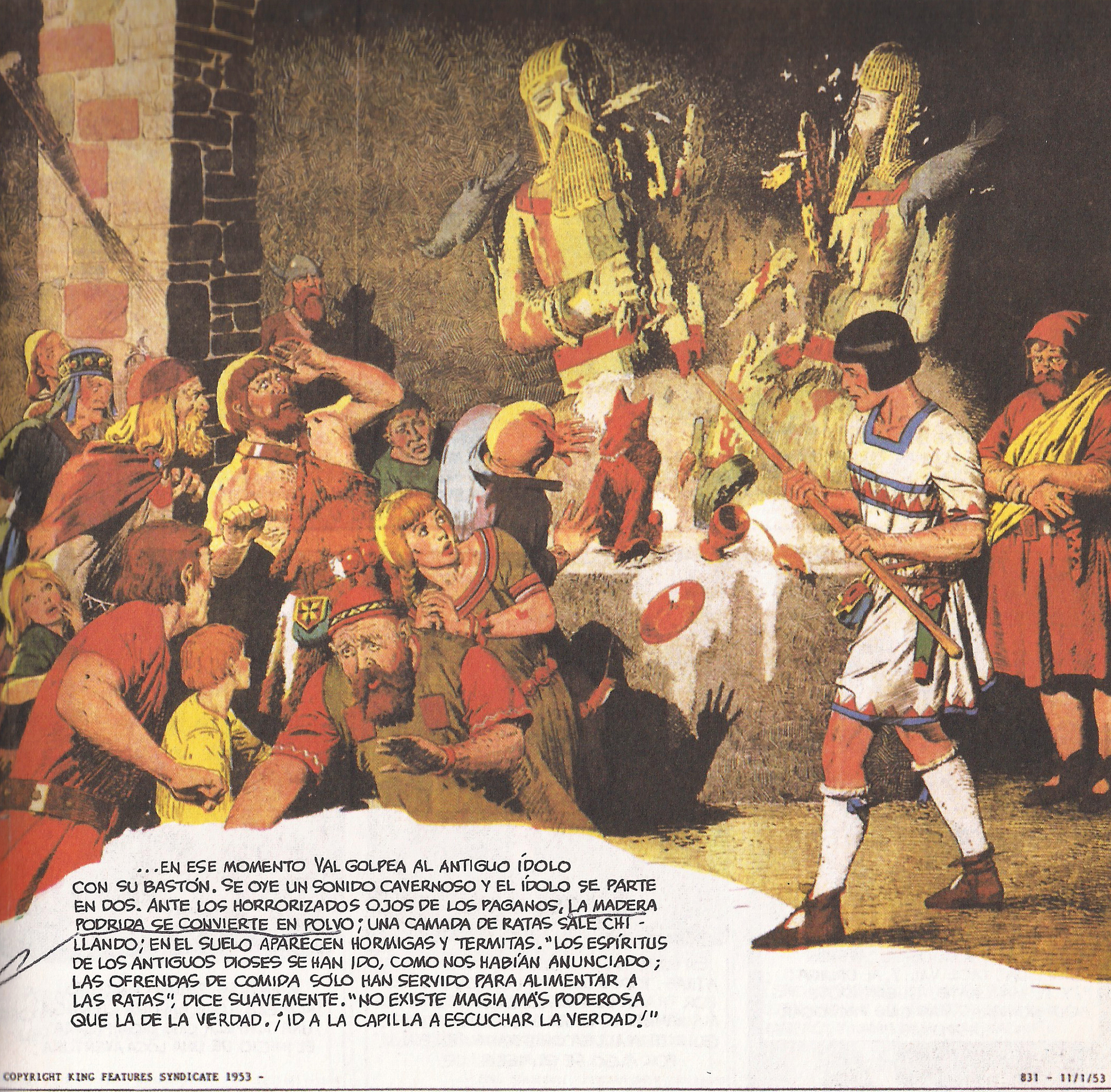
On ‘Prince Valiant’

With regard to Vol. IV of Christianity’s Criminal History that deals with the Christian destruction of Germanic paganism, back in 1970 I used to see the illustrations of Prince Valiant that appeared in the newspaper on Sundays, translated from English into Spanish. At that time I was a child and knew nothing of the catastrophe that the conversion of the ancient Germans had represented for the mental health of Europe.

Above we see Val, the hero of the fanciest Sunday comic strip of yore, destroying the image of one of the old Gods and saying ‘Go to the chapel to hear the truth!’ With his art Hal Foster (1892-1982), the creator of Prince Valiant, thus contributed to perpetuating the falsehood that the destruction of the religion of Aryan Gods and its replacement with the Hebrew god was good for the West.