web analytics
Categories
Adolf Hitler Final solution Table talks

Uncle Adolf’s table talk, 78

the-real-hitler


27th January 1942, evening

The Jew must disappear from Europe.


The Jews must pack up, disappear from Europe. Let them go to Russia. Where the Jews are concerned, I’m devoid of all sense of pity. They’ll always be the ferment that moves peoples one against the other. They sow discord everywhere, as much between individuals as between peoples.

They’ll also have to clear out of Switzerland and Sweden. It’s where they’re to be found in small numbers that they’re most dangerous. Put five thousand Jews in Sweden—soon they’ll be holding all the posts there. Obviously, that makes them all the easier to spot.

It’s entirely natural that we should concern ourselves with the question on the European level. It’s clearly not enough to expel them from Germany. We cannot allow them to retain bases of withdrawal at our doors. We want to be out of danger of all kinds of infiltration.

Categories
Liberalism Otto von Bismarck Wikipedia

Liberalism, 10

Spread of liberalism

Abolitionist and suffrage movements spread, along with representative and democratic ideals. France established an enduring republic in the 1870s, and wars in the United States ensured the formation of a nation and the abolition of slavery in the south. Meanwhile, a mixture of liberal and nationalist sentiment in Italy and Germany brought about the unification of the two countries in the late 19th century. Liberal agitation in Latin America led to independence from the imperial power of Spain and Portugal.

In France, the July Revolution of 1830, orchestrated by liberal politicians and journalists, removed the Bourbon monarchy and inspired similar uprisings elsewhere in Europe. Frustration with the pace of political progress in the early 19th century sparked even more gigantic revolutions in 1848. Revolutions spread throughout the Austrian Empire, the German states, and the Italian states. Governments fell rapidly. Liberal nationalists demanded written constitutions, representative assemblies, greater suffrage rights, and freedom of the press. A second republic was proclaimed in France. Serfdom was abolished in Prussia, Galicia, Bohemia, and Hungary. The indomitable Metternich, the Austrian builder of the reigning conservative order, shocked Europe when he resigned and fled to Britain in panic and disguise.

eugne-delacroix

(The iconic painting Liberty Leading the People by Eugène Delacroix, a tableau of the July Revolution of 1830.)
 
Eventually, however, the success of the revolutionaries petered out. Without French help, the Italians were easily defeated by the Austrians. With some luck and skill, Austria also managed to contain the bubbling nationalist sentiments in Germany and Hungary, helped along by the failure of the Frankfurt Assembly to unify the German states into a single nation. Two decades later, however, the Italians and the Germans fulfilled their dreams for unification and independence.

The Sardinian Prime Minister, Camillo di Cavour, was a shrewd liberal who understood that the only effective way for the Italians to gain independence was if the French were on their side. Napoleon III agreed to Cavour’s request for assistance and France defeated Austria in the Franco-Austrian War of 1859, setting the stage for Italian independence.

German unification transpired under the leadership of Otto von Bismarck, who decimated the enemies of Prussia in war after war, finally triumphing against France in 1871 and proclaiming the German Empire in the Hall of Mirrors at Versailles, ending another saga in the drive for nationalization. The French proclaimed a third republic after their loss in the war.

Categories
Adolf Hitler Ancient Rome Demography Table talks

Uncle Adolf’s table talk, 79

the-real-hitler


Night of 28th-29th January 1942

Birth control and the victory of Christianity—Families of two or three in France—Propagating German blood.
 

Do you know what caused the downfall of the ancient world? The ruling class had become rich and urbanised. From then on, it had been inspired by the wish to ensure for its heirs a life free from care. It’s a state of mind that entails the following corollary: the more heirs there are, the less each one of them receives. Hence the limitation of births. The power of each family depended to some extent on the number of slaves it possessed. Thus there grew up the plebs which was driven to multiplication, faced by a patrician class which was shrinking.

The day when Christianity abolished the frontier that had hitherto separated the two classes, the Roman patriciate found itself submerged in the resulting mass. It’s the fall in the birth-rate that’s at the bottom of everything.

France, with its two-children families, is doomed to stagnation and its situation can only get worse.

I would regard it as a crime to have sacrificed the lives of German soldiers simply for the conquest of natural riches to be exploited in capitalist style. According to the laws of nature, the soil belongs to him who conquers it. The fact of having children who want to live, the fact that our people is bursting out of its cramped frontiers—these justify all our claims to the Eastern spaces.

The overflow of our birth-rate will give us our chance. Over-population compels a people to look out for itself.

Categories
Eschatology

Downward spiral after WW2

• Creation of the state of Israel
• Voluntary ending of colonialism
• United States Immigration Act (1965)
• Introduction of swarthies from Third World as guest workers
• Weakening of Christianity
• Rule of feminism
• Creation of European Union (abolition of borders)
• End of Apartheid
• End of Communism (until it was no longer useful)
• Allowance of swarthies to enter the EU en masse
• Idealization of homosexuality

Still to come:

• Currency crash worldwide with epicenter in the US
• Urban chaos in America and Europe / racial warfare begins
• Apocalyptic energy devolution / genocidal racial warfare
• Political takeover in Europe either by Islamists or native fascists

Categories
Adolf Hitler Art Benito Mussolini Schutzstaffel (SS) Sturmabteilung (SA) Table talks

Uncle Adolf’s table talk, 80

the-real-hitler


31st January 1942, evening

Possibility of collaboration with France—The era of Italian Fascism— The birth of the SA.


The Jew is so stupid that he himself saws through the branch on which he’s sitting. In 1919 a Jewess wrote in the Bayrischer Kurier: “What Eisner’s doing now will recoil upon our heads.” A rare case of foresight.

France remains hostile to us. She contains, in addition to her Nordic blood, a blood that will always be foreign to us. There must be two Frances. Thus, the French who have compromised themselves with us will find it to their own interests that we should remain in Paris as long as possible.

But our best protection against France will be for us to maintain a strong friendship, lasting for centuries, with Italy. Unlike France, Italy is inspired by political notions that are close to ours. I was thinking of the Italian delegation I received yesterday. I met men who have rulers’ qualities such as are very much to my taste. What handsome individuals, and what a resolute air! Those are men who could play a part at the top level.

The Fascists paid with their blood much more than we did. The story of the conquest of power in Italy is a heroic epic. It always warms my heart to think of it. I can understand their emotion when they once more live through the time of the March on Rome.

Why should such men suddenly become worthless as soldiers? It’s quite simply because they lack a command. The Italian people are idealistic, but the cadres of the Italian Army are reactionary.

It was in 1921 that I first heard Fascism mentioned. The SA was born in 1920, without my having the least idea of what was going on in Italy. Italy developed in a manner at which I was the first to be surprised. I could see fairly clearly the orientation that it would be proper to give the Party, but I had no ideas concerning paramilitary organisations. I began by creating a service to keep order, and it was only after the bloody brawls of 1920 that I gave these troops the name of Sturmabteilung (SA), as a reward for their behaviour.

I had taught them the technique of concentrating their efforts on limited objectives, and at meetings to attack the opponent table by table. But it was confined to that. When the brassard proved no longer sufficient, I equipped them with a specially designed cap. That was after Coburg. The skier’s cap didn’t cost much. It was all done in a very empirical manner. Nothing of that sort was thought out in advance.

The SS started with formations of seven or eight men. In these we gathered the tough ‘uns. Things developed spontaneously, and subsequently acquired a speed comparable to that of developments in Italy. The Duce himself has told me that at the moment when he undertook the struggle against Bolshevism, he didn’t know exactly where he was going.

From the cultural point of view, we are more closely linked with the Italians than with any other people. The art of Northern Italy is something we have in common with them: nothing but pure Germans.

The objectionable Italian type is found only in the South, and not everywhere even there. We also have this type in our own country. When I think of them: Vienna-Ottakring, Munich-Giesing, Berlin-Pankow! If I compare the two types, that of these degenerate Italians and our type, I find it very difficult to say which of the two is the more antipathetic.

Categories
American civil war Blacks Egalitarianism Universalism

On the US Constitution

by Jack Frost

 
“The Naturalization Act of 1790 says that the country is open to Free White Persons.”

There’s quite a bit of interesting history involved with this discussed at considerable length in the Dred Scott case from 1856, especially in the dissenting opinions given by Justice Maclean and Justice Curtis. For example, Maclean wrote:

In the argument, it was said that a colored citizen would not be an agreeable member of society. This is more a matter of taste than of law. Several of the States have admitted persons of color to the right of suffrage, and in this view have recognised them as citizens; and this has been done in the slave as well as the free States. On the question of citizenship, it must be admitted that we have not been very fastidious. Under the late treaty with Mexico, we have made citizens of all grades, combinations, and colors. The same was done in the admission of Louisiana and Florida. No one ever doubted, and no court ever held, that the people of these Territories did not become citizens under the treaty. They have exercised all the rights of citizens, without being naturalized under the acts of Congress.

Also, Curtis:

On the 25th of June, 1778, the Articles of Confederation being under consideration by the Congress, the delegates from South Carolina moved to amend this fourth article, by inserting after the word “free,” and before the word “inhabitants,” the word “white,” so that the privileges and immunities of general citizenship would be secured only to white persons. Two States voted for the amendment, eight States against it, and the vote of one State was divided. The language of the article stood unchanged, and both by its terms of inclusion, “free inhabitants,” and the strong implication from its terms of exclusion, “paupers, vagabonds, and fugitives from justice,” who alone were excepted, it is clear, that under the Confederation, and at the time of the adoption of the Constitution, free colored persons of African descent might be, and, by reason of their citizenship in certain States, were entitled to the privileges and immunities of general citizenship of the United States.

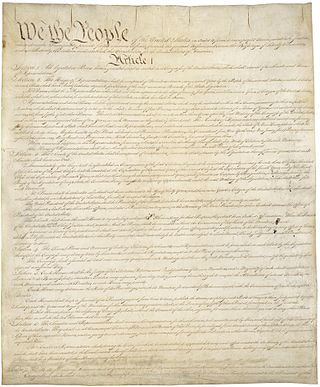
Constitution_of_the_United_States,_page_1

Did the Constitution of the United States deprive them or their descendants of citizenship?

That Constitution was ordained and established by the people of the United States, through the action, in each State, or those persons who were qualified by its laws to act thereon, in behalf of themselves and all other citizens of that State. In some of the States, as we have seen, colored persons were among those qualified by law to act on this subject. These colored persons were not only included in the body of “the people of the United States,” by whom the Constitution was ordained and established, but in at least five of the States they had the power to act, and doubtless did act, by their suffrages, upon the question of its adoption. It would be strange, if we were to find in that instrument anything which deprived of their citizenship any part of the people of the United States who were among those by whom it was established.

I can find nothing in the Constitution which, proprio vigore, deprives of their citizenship any class of persons who were citizens of the United States at the time of its adoption, or who should be native-born citizens of any State after its adoption; nor any power enabling Congress to disfranchise persons born on the soil of any State, and entitled to citizenship of such State by its Constitution and laws. And my opinion is, that, under the Constitution of the United States, every free person born on the soil of a State, who is a citizen of that State by force of its Constitution or laws, is also a citizen of the United States…

It has been often asserted that the Constitution was made exclusively by and for the white race. It has already been shown that in five of the thirteen original States, colored persons then possessed the elective franchise, and were among those by whom the Constitution was ordained and established. If so, it is not true, in point of fact, that the Constitution was made exclusively by the white race. And that it was made exclusively for the white race is, in my opinion, not only an assumption not warranted by anything in the Constitution, but contradicted by its opening declaration, that it was ordained and established by the people of the United States, for themselves and their posterity. And as free colored persons were then citizens of at least five States, and so in every sense part of the people of the United States, they were among those for whom and whose posterity the Constitution was ordained and established.

So it turns out that, despite being a nation in which white supremacy was enshrined in law, there were numerous places and times in America when this was honored more in the breach than in the observance. Without any Jewish “control” whatsoever, unless Christianity is admitted to be such a controlling influence, there had always been a strong undercurrent of anti-racism and of America being a “proposition nation,” which eventually and disastrously grew to the whirlpool of destruction that sucked the whole nation down into the carnage of the Civil War. After that, through ratification of the 13th, 14th, and 15th Amendments, it was made explicitly so.

Oh say can you see, by the dawn’s early light, a proud Christian nation of racial cuckolds? American patriotism = cuck pride!

Categories
Adolf Hitler Catholic Church Christendom Final solution Inquisition Mein Kampf (book) New Testament Protestantism Psychology Table talks

Uncle Adolf’s table talk, 81

the-real-hitler


Night of 3rd-4th February 1942

Christianity as a Jewish psyop for whites—After Jews disappear from Europe the world will recapture its sense of joy.
 

My thirteen months of imprisonment had seemed a long time—the more so because I thought I’d be there for six years. I was possessed by a frenzy of liberty. But, without my imprisonment, Mein Kampf would not have been written. That period gave me the chance of deepening various notions for which I then had only an instinctive feeling. It was during this incarceration, too, that I acquired that fearless faith, that optimism, that confidence in our destiny, which nothing could shake thereafter.

It’s from this time, too, that my conviction dates—a thing that many of my supporters never understood—that we could no longer win power by force. The State had had time to consolidate itself, and it had the weapons. My weakness, in 1923, was to depend on too many people who were not ours…

There are towns in Germany from which all joy is lacking. I’m told that it’s the same thing in certain Calvinistic regions of Switzerland. Near Würzburg, there are villages where literally all the women were burned. We know of judges of the Court of the Inquisition who gloried in having had twenty to thirty thousand “witches” burned. Long experience of such horrors cannot but leave indelible traces upon a population.

One cannot succeed in conceiving how much cruelty, ignominy and falsehood the intrusion of Christianity has spelt for this world of ours. If the misdeeds of Christianity were less serious in Italy, that’s because the people of Rome, having seen them at work, always knew exactly the worth of the Popes before whom Christendom prostrated itself. For centuries, no Pope died except by the dagger, poison or the pox.

saint-paul-preaching-in-athensI can very well imagine how this collective madness came to birth. A Jew was discovered to whom it occurred that if one presented abstruse ideas to non-Jews, the more abstruse these ideas were, the more the non-Jews would rack their brains to try to understand them. The fact of having their attention fixed on what does not exist must make them blind to what exists. An excellent calculation of the Jew’s part. So the Jew smacks his thighs to see how his diabolic stratagem has succeeded.

He bears in mind that if his victims suddenly became aware of these things, all Jews would be exterminated. But, this time, the Jews will disappear from Europe. The world will breathe freely and recover its sense of joy, when this weight is no longer crushing its shoulders.

Categories
Individualism John Stuart Mill Liberalism Wikipedia

Liberalism, 9

Classical liberalism

The development into maturity of classical liberalism took place before and after the French Revolution in Britain, and was based on the following core concepts: classical economics, free trade, laissez-faire government with minimal intervention and taxation and a balanced budget. Classical liberals were committed to individualism, liberty and equal rights. The primary intellectual influences on 19th century liberal trends were those of Adam Smith and the classical economists, and Jeremy Bentham and John Stuart Mill.

adam-smith

Adam Smith’s The Wealth of Nations, published in 1776, was to provide most of the ideas of economics, at least until the publication of J. S. Mill’s Principles in 1848. Smith addressed the motivation for economic activity, the causes of prices and the distribution of wealth, and the policies the state should follow in order to maximize wealth.

Smith wrote that as long as supply, demand, prices, and competition were left free of government regulation, the pursuit of material self-interest, rather than altruism, would maximize the wealth of a society through profit-driven production of goods and services. An “invisible hand” directed individuals and firms to work toward the nation’s good as an unintended consequence of efforts to maximize their own gain. This provided a moral justification for the accumulation of wealth, which had previously been viewed by some as sinful.

His main emphasis was on the benefit of free internal and international trade, which he thought could increase wealth through specialization in production. He also opposed restrictive trade preferences, state grants of monopolies, and employers’ organizations and trade unions. Government should be limited to defense, public works and the administration of justice, financed by taxes based on income. Smith was one of the progenitors of the idea, which was long central to classical liberalism and has resurfaced in the globalization literature of the later 20th and early 21st centuries, that free trade promotes peace.

Jeremy_Bentham

Utilitarianism provided the political justification for the implementation of economic liberalism by British governments, which was to dominate economic policy from the 1830s. Although utilitarianism prompted legislative and administrative reform and John Stuart Mill’s later writings on the subject foreshadowed the welfare state, it was mainly used as a justification for laissez-faire. The central concept of utilitarianism, which was developed by Jeremy Bentham, was that public policy should seek to provide “the greatest happiness of the greatest number”. While this could be interpreted as a justification for state action to reduce poverty, it was used by classical liberals to justify inaction with the argument that the net benefit to all individuals would be higher. His philosophy proved to be extremely influential on government policy and led to increased Benthamite attempts at government social control, including Robert Peel’s Metropolitan Police, prison reforms, the workhouses and asylums for the mentally ill.

The repeal of the Corn Laws in 1846 was a watershed moment and encapsulated the triumph of free trade and liberal economics. The Anti-Corn Law League brought together a coalition of liberal and radical groups in support of free trade under the leadership of Richard Cobden and John Bright, who opposed militarism and public expenditure. Their policies of low public expenditure and low taxation were later adopted by the liberal chancellor of the exchequer and later prime minister, William Ewart Gladstone. Although British classical liberals aspired to a minimum of state activity, the passage of the Factory Acts in the early 19th century which involved government interference in the economy met with their approval.

Categories
Adolf Hitler Ancient Greece Ancient Rome Table talks

Uncle Adolf’s table talk, 82

the-real-hitler


4th February 1942, evening

The call of the South—Struggling through the mud.
 

We know to-day why our ancestors were not attracted to the East, but rather to the South. Because all the regions lying east of the Elbe were like what Russia is for us to-day. The Romans detested crossing the Alps. The Germanic peoples, on the other hand, were very fond of crossing them—but in the opposite direction. One must bear in mind that at this period Greece was a marvellous garden, in which oak-forests alternated with orchards. It was only later that olive-growing was introduced into Greece.

The reason why the climate has become temperate in Upper Bavaria is that Italy was deforested. The warm winds of the South, which are no longer held in check by the vegetation, pass over the Alps and make their way northwards.

The Germanic needed a sunny climate to enable his qualities to develop. It was in Greece and Italy that the Germanic spirit found the first terrain favourable to its blossoming. It took several centuries to create, in the Nordic climate, the conditions of life necessary for civilised man. Science helped there.

For any Roman, the fact of being sent to Germania was regarded as a punishment—rather like what it used to mean to us to be sent to Posen. You can imagine those rainy, grey regions, transformed into quagmires as far as eye could see. The megalithic monuments were certainly not places of worship, but rather places of refuge for people fleeing from the advance of the mud. The countryside was cold, damp, dreary. At a time when other people already had paved roads, we hadn’t the slightest evidence of civilisation to show. Only the Germanics on the shores of the rivers and the sea-coasts were, in a feeble way, an exception to this rule. Those who had remained in Holstein have not changed in two thousand years, whilst those who had emigrated to Greece raised themselves to the level of civilisation.

The Greek profile, and that of the Caesars, is that of the men of this North of ours, and I’d wager that I could find amongst our peasants two thousand heads of that type.

Categories
Feminism Liberalism Wikipedia

Liberalism, 8

Radicalism

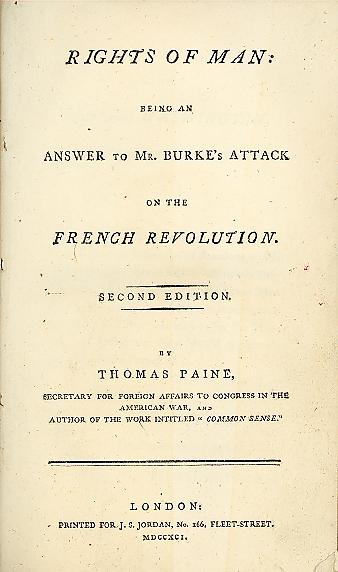
The radical liberal movement began in the 1790s in England and concentrated on parliamentary and electoral reform, emphasizing natural rights and popular sovereignty. Thomas Paine’s The Rights of Man (1791) was a response to Burke’s conservative essay Reflections on the Revolution in France.

paines-bookAn ensuing revolution controversy featured, among others, Mary Wollstonecraft, who followed with an early feminist tract, A Vindication of the Rights of Woman. Radicals encouraged mass support for democratic reform along with rejection of the monarchy, aristocracy, and all forms of privilege.

The Reform Act 1832 was put through with the support of public outcry, mass meetings of “political unions” and riots in some cities. This now enfranchised the middle classes, but failed to meet radical demands. Following the Reform Act the mainly aristocratic Whigs in the House of Commons were joined by a small number of parliamentary Radicals, as well as an increased number of middle class Whigs. By 1839 they were informally being called “the Liberal party.”

The Liberals produced one of the most influential British prime ministers, William Gladstone, who was also known as the Grand Old Man: the towering political figure of liberalism in the 19th century. Under Gladstone, the Liberals reformed education, disestablished the Church of Ireland, and introduced the secret ballot for local and parliamentary elections.