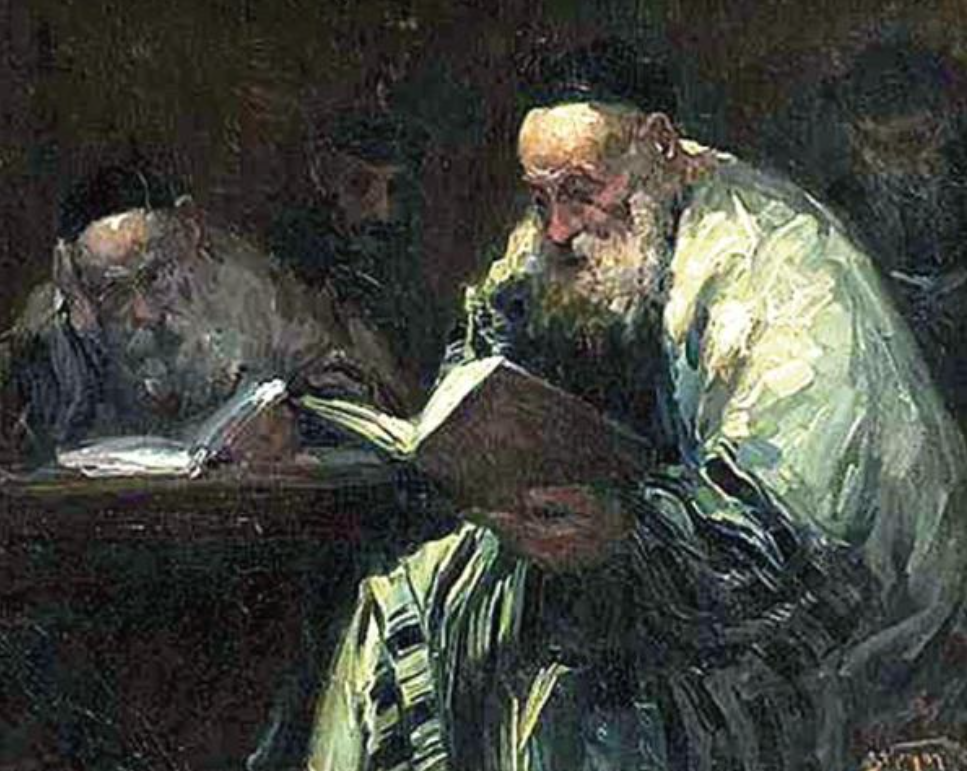
Talmud Readers by Adolf Behrman.
Below, selected quotes from Adam Green’s 2026 book The Jesus Deception: A Mystical Midrashic Myth:
______ 卐 ______
What is Midrash?
Midrash is the ancient Jewish technique of interpreting, elaborating, and even rewriting scripture to uncover hidden meanings, resolve contradictions, or apply old texts to new contexts. It is not merely commentary…
This bringing together of widely separate scriptural references and deriving meaning and scenarios from their combination was the secret to creating the early Christian message… Jewish midrash was the process by which the Christian recipe was put together and baked into the doctrine of the divine Son who had been sacrificed for salvation.
Talmudic Scholar Dr. Daniel Boyarin explains in his book The Jewish Gospels how the New Testament is a product of midrashic mythmaking which was commonplace tradition in second temple Judaism:
The Gospels use perfectly traditional, midrashic ways of reasoning to develop these ideas and apply them to Jesus. Indeed, in the Gospels these ideas (Suffering and rejected Messiah and Son of Man) have been derived from the Torah by that most Jewish of exegetical styles, the way of midrash. That the Messiah would suffer and be humiliated was something Jews learned from a close reading of scripture in precisely the style of classically rabbinic interpretation known as midrash…
That Paul and the Gospels used Midrash is not contested. Even Christian authors agree Paul was incorporating Midrash…
The concept of Midrash is crucial for understanding early Christianity. The New Testament writers were themselves Jews [emphasis by Ed.], steeped in this tradition of scriptural interpretation. When they portrayed Jesus, they used midrashic techniques, re-reading the Hebrew Bible to learn of his life, death, and mission. This is why so much of the Gospel narrative appears to “fulfill” older texts: the evangelists were not simply recording biography but crafting a theological portrait using the interpretive art of midrash, just as their Jewish contemporaries did the Dead Sea Scrolls, in the Talmud and Kabbalistic and apocryphal texts.
2 replies on “Adam, 5”
A few years ago, in the previous incarnation of this site (when it was hosted by WordPress), some Christians like Matt Parrott used to come to this blog to debate with me. They don’t anymore. Why? Could it be because they can’t respond to new exegetical studies of the New Testament, such as Green’s?
Yes, their arguments cannot compete. All they have left is cope and their unshakeable faith in the jooish god and his son.