web analytics
Categories
Henry Picker Hitler's Religion (book) Monologe im Führerhauptquartier Richard Carrier Richard Weikart

A note on sources

(excerpts)

by Richard Weikart

The authenticity of most of Hitler’s speeches and writings are uncontroversial, and I use them liberally. However, some have questioned Hitler’s Table Talks as a reliable source for discovering Hitler’s views on religion. In an interesting piece of detective work, Richard Carrier demonstrates convincingly that the English version of Hitler’s Table Talk is based on the translation of a problematic and possibly inauthentic text.[1] Thus, I do not use nor cite the English translation of Hitler’s Table Talk. However, even Carrier admits that the two German editions edited by Henry Picker and Werner Jochmann are generally reliable. Carrier was hoping that debunking Hitler’s Table Talk would demolish the image of Hitler as an anti-Christian that many scholars have built on this flawed document. Unfortunately for Carrier, Hitler is every bit as anti-Christian in the Jochmann and Picker editions.

The Picker and Jochmann editions of Hitler’s Table Talk monologues are very similar—indeed verbatim—in many passages. Each contains some passages not found in the other one. However, when comparing the many passages they share in common, most of them are identical, though occasionally there are very minor differences. Oddly, Carrier maintains that Picker is probably more reliable than Jochmann, but this is not the opinion of most scholars. I have read both editions and will rely mostly on Jochmann, though many of the passages I quote are in both editions. I will only use Picker sparingly and to confirm points Hitler made elsewhere, not to try to establish some unique point. We also need to remember that these monologues are not transcriptions of Hitler’s talks, but are reconstructions based on notes taken during the monologues. Based on some testimony of those present at these monologues, the renditions we have are generally accurate, since they were written immediately afterwards.

The only book Hitler published during his lifetime, Mein Kampf, poses a different kind of problem. It is notoriously unreliable as a memoir, and many scholars—myself included—consider some of the vignettes about his earlier life completely fictitious. It does, however, accurately convey Hitler’s ideology, as does Hitler’s Second Book, which was only discovered after World War II.

Two other contemporary sources—Joseph Goebbels’ diaries and the recently recovered Alfred Rosenberg diaries—confirm the general account of Hitler’s monologues. My book is one of the first to use Rosenberg’s diaries, which do not divulge anything that overturns our previous knowledge about Hitler, but rather corroborate other sources and provide some interesting details…

Where I use English language sources, in most cases I have read the original German to verify the accuracy of the translation.

___________

[1] Richard C. Carrier, ‘Hitler’s Table Talk: Troubling Findings’, German Studies Review, 26 (2003): 561-76.

Categories
Charles Darwin Hitler's Religion (book) Richard Weikart Theology

Hitler’s religion: Introduction

I woke up thinking that I was going to post another entry on Deschner’s history of Christianity today, but this comment from Mauricio, and my response changed my mind:

What strikes me about the matter is that, in recent times, American white nationalism has had only a couple of notable individuals who openly identify with NS memory: Carolyn Yeager and Hadding Scott.

By rejecting the final solution or the Master Plan East as Allied propaganda, they both hold to Christian ethics, and in Yeager’s case, she believes in Hitler’s public pronouncements on Christianity which, according to the Weikart book that just reached me, were PR pronouncements compared to Hitler’s harsh judgments in private (recorded even outside his table talks).

The revisionist historian Mark Weber also, a few years ago, looked solely and exclusively at Hitler’s public pronouncements. Simply put, there is no one of note in today’s white nationalist world who dares to look the ghost of Hitler in the eye.

______ 卐 ______


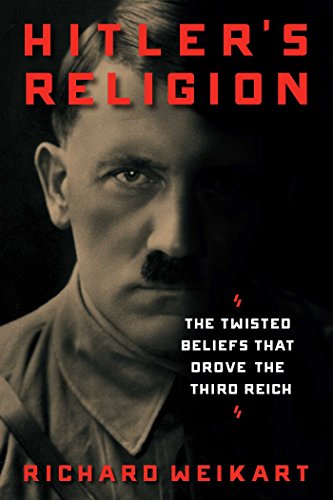
Hitler’s Religion by Richard Weikart offers a detailed analysis of a subject I am passionate about. Already in the dustcover we learn that with this book Weikart is ‘delving more deeply into the question of Hitler’s religious faith than any researcher to date’, and that ‘like the racist forms of Darwinism prevalent at the time, Hitler’s… religion was a direct attack on the Judeo-Christian ethics on which Western civilization is built’.

Herein lies the fundamental flaw of the book. Weikart doesn’t seem to realise that European civilisation is not to be confused with Western Christian Civilisation (see Daybreak, pages 25-44). Charles Bellinger, author of The Genealogy of Violence and The Trinitarian Self, wrote about Weikart’s book:

Hitler… sought to avoid alienating his support base in Germany, which was to a great extent churchgoing. But in private Hitler led his top aids in developing a subtle strategy to gradually destroy any traces of religious faith that would dissent from his [Bellinger’s pejorative adjective] plans to redraw the map of Europe, eliminate all Jews, and extirpate from human consciousness the idea that all human beings have an equal dignity and value before God, and a call from God to love all people as neighbors, with particular care for the weak.

Like Bellinger, Weikart is a Christian. He insulted National Socialism even in the subtitle of his book: ‘The Twisted Beliefs that Drove the Third Reich’, and on pages x and xii of his Introduction he says: ‘Evil often appears in the guise of piety’ and ‘Hitler’s evil was so intense and inexplicable that…’

This reminds me of some words from a book by Ron Rosenbaum about Hitler that I read when I was still a normie. Rosenbaum is a Jewish author, but Weikart is something worse: a traitor to his ethnic group. Because he reasons as Christians reason, he fails to realise that the evil was not in Hitler, but in himself and the other Christians who obey the Jew (i.e., who subscribe to the ethical value system bequeathed to us by Judeo-Christianity). That said, Weikart’s book is a real gold mine for those of us who know that racial preservation cannot be mixed with the cult of a Semitic god, as we see in this paragraph:

Otto Strasser, a leader in the early Nazi movement who broke away from Hitler in 1930, told his brother in the late 1920s why he was increasingly dissatisfied with Hitler: ‘We are Christians; without Christianity Europe is lost. Hitler is an atheist’. Despite the fact that Hitler never renounced his membership in the Catholic Church, before he seized power in 1933 and for about two months thereafter, the Catholic hierarchy forbade Catholics from joining the Nazi Party because they viewed Hitler’s movement as fundamentally hostile to their faith. In 1937, Pope Pius XI condemned the Nazi regime, not only for persecuting the Catholic Church and harassing its clergy, but also for teaching ideology that conflicted with Catholic doctrines.

Will those American white advocates sympathetic to NS be honest enough to recognise this?

Whatever conformed to the laws of nature was morally good, and whatever contravened nature and its ways was evil. When Hitler explained how he hoped to harmonize human society with the scientific laws of nature, he emphasized principles derived from Darwinian theory, especially the racist forms of Darwinism prominent among Darwin’s German disciples. These laws included human biological inequality (especially racial inequality), the human struggle for existence, and natural selection. In the Darwinian struggle for existence, multitudes perish, and only a few of the fittest individuals survive and reproduce. If this is nature’s way, Hitler thought, then he should emulate nature by destroying those destined for death.

Weikart omits—as neochristian atheists also don’t want to see—that Darwin himself harboured exterminationist ideas about blacks (see pages 37-39 of Daybreak). For those who believe that Hitler was a Christian, this passage should alert them:

Indeed, the Nuremberg Party Rally continued through the weekend, and when it came time for the normal Sunday morning worship services for the Christian God, Hitler and the Nazi hierarchy conspicuously participated in Nazi Party festivities instead of going to church…

George Lincoln Rockwell was right that Hitler tried to form a new religion:

During the Second German Empire (1871–1918), a common nationalist slogan had been ‘One Volk, one Empire, one God’. Just about every German would have recognized this saying, since it was emblazoned on many postcards and even on a German postage stamp during the Second Empire.

The book then reproduces the image of a NS

poster proclaiming the new Nazi saying, Ein Volk, ein Reich, ein Führer (‘One Volk, one Empire, one Führer’). In this new slogan, which was widely disseminated in the Third Reich on posters and a postage stamp, the Führer had replaced God… By 1938, the confession of faith did not even mention God and seemed to imply that Hitler was now filling His shoes.

Perhaps what most enraptured me about the religion that I now call the religion of sacred words,[1] Hitlerism, is the following passage (I’ve highlighted some words in red):

The messianic thrust of the Hitler cult manifested itself frequently, as in this Hitler Youth song at the 1934 Nuremberg Party Rally:

We are the joyful Hitler Youth
We need no Christian virtue
For our Führer Adolf Hitler
Is ever our Mediator.
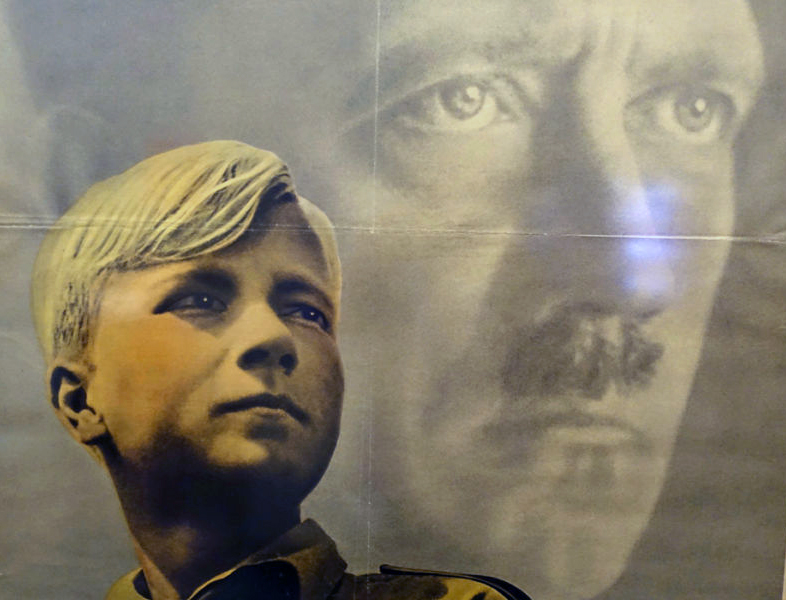


No pastor, no evil one, can hinder
Us from feeling as Hitler’s children.
We follow not Christ but Horst Wessel,
Away with incense and holy water.

The church can be taken away from me,
The swastika is redemption on the earth,
Its will I follow everywhere,
Baldur von Schirach[2] take me along!

Of course, not all Germans thought that way:

Some leading Nazis considered themselves Christians, while others were staunchly and forthrightly anti-Christian. Some Nazis embraced occultism, while others scoffed at it. Some promoted neo-paganism, while others considered pagan rites and ceremonies absurd. Hitler really did not care what they believed about the spiritual realm as long as it did not conflict with Nazi political and racial ideology…

[H]e clearly enunciated the central tenet of his worldview: the primacy of race. This racial worldview attempted to explain the essence of human existence and the meaning of history, while also providing moral guidance. Though this does not make Hitler’s ideology a religion per se, his comprehensive philosophy of life inevitably came into conflict with many religions, because most religions also claim to provide answers to these fundamental questions. Hitler recognized this problem, maintaining in Mein Kampf that a worldview such as his own must be intolerant toward any other worldview that conflicts with it—and here he specifically mentioned Christianity as a rival.

American white nationalism comes to mind. However, while it is true that Hitler had no choice but to become a public hypocrite because he was a public figure (in private he behaved like the real Hitler), white nationalists, who aren’t public figures because they have almost zero power in today’s West, are like Boromir.

Three years later, in his cultural speech to the Nuremberg Party Rally, he told the party faithful, ‘A Christian era can only possess a Christian art, a National Socialist era only a National Socialist art’. Hitler believed that the triumph of his worldview would transform the entire culture of Germany, whereupon it would no longer reflect previous religious concerns.

This reminds me of what a friend who speaks fluent German, and has helped me with the German section of this site, said about Bach’s music. But publicly Hitler could pretend to be someone else, so Weikart tells us: ‘As long as the churches or other religious organizations allowed him to rule this world, they could say whatever they wanted about the spiritual realm’.

This is especially true if we consider the moral philosophy of Nazism, which centered on promoting the biological welfare and advancement of the Nordic race and often conflicted with Christian ethics. Hitler’s Darwinian-inspired moral code called for the eradication of the weak, sick, and those deemed inferior, rather than universal love.

Deemed? Weikart seems to ignore what Jared Taylor has been calling race realism for decades. Universal love? I call that deranged altruism, which didn’t exist among whites before Christianity. Nevertheless, Weikart has a very clear mind, a thousand times better than Wikipedia’s definition of panentheism. I rarely speak of God but I have used this word on this site to explain my theological views. Weikart says:

In addition to pantheism, a position known as panentheism also emerged during the Romantic era. Panentheism is close to pantheism, but not quite the same, since it teaches that nature is a part of God, but God also transcends nature to some extent. In this view, nature is divine, but it is not all of God. In pantheism, God and nature are completely identical… During the Nazi period, the philosopher Kurt Hildebrandt argued that the pantheism or panentheism of German idealist philosophy—which he espoused—was the basis for any valid theory of biological evolution. He thus argued that pantheism and panentheism were the proper foundation for Nazi racial ideology.

Very true, and that’s why we have been saying that atheists are not true apostates but that, axiologically, they remain Christians. But some NS Germans had yet to mature:

Another problem creating confusion about Hitler’s religion is that some people (though usually not historians, who know better) think the Nazis had a coherent religious position. Some wrongly assume that because Rosenberg or Himmler embraced neo-paganism, this must have been the official Nazi position. However, there was no official Nazi position on religion, except perhaps for the rather vague and minimalist position that some kind of God existed.

Hitler’s blunder was to go on a rampage against the Soviet Union (almost a whole continent). Instead, his immature countrymen should have practised an internal jihad as a prelude to the external jihad of the new faith that was to conquer the world. We can already imagine the influence that a National Socialist state that didn’t invade the SU (unless it developed atomic bombs before them) would have exerted in the West if it had dedicated itself to propagating this new faith with the full power of the State…

____________

[1] I refer to the 14 words. But Hitler equally agreed with what now I call ‘the 4 words’.

[2] The leader of the Hitler Youth.
Categories
Monologe im Führerhauptquartier

Monologe im Führerhauptquartier, 18

Führerhauptquartier

auf 15. 9. 1941, nachts H/Fu.

Die Herrschaft des Untermenschentums 1918 erklärt sich daraus, daß auf der einen Seite der vierjährige Krieg einen starken Verlust bester Kräfte mit sich gebracht hatte, während andererseits das Verbrechertum im Mutterland gehegt war. Todesstrafen wurden so gut wie nicht verhängt. Es brauchten nur die Gefängnisse geöffnet zu werden, so hatte die revolutionäre Masse ihre Führung.[1]

Ich habe dem Reichsführer-SS Weisung gegeben, falls einmal mit inneren Unruhen zu rechnen sein sollte, alles aus der Welt zu räumen, was sich in den Konzentrationslagern findet; damit ist der Masse die Anführerschaft genommen.

Auch das alte Reich wußte im besetzten Gebiet eisern zuzugreifen; so sind Eisenbahnsabotage-Versuche in Belgien vom Grafen von der Goltz als Generalgouverneur damit geahndet worden,[2] daß er alle Dörfer im Umkreis von soundsoviel Kilometern hat niederbrennen lassen, nachdem die Bürgermeister erschossen, die Männer in Gefangenschaft gebracht und Frauen und Kinder abgeführt waren; so drei-, viermal und es ist nichts mehr vorgekommen. 1918 allerdings hat die Bevölkerung den zur Offensive marschierenden Kolonnen eine feindselige Haltung zum Ausdruck gebracht. Ich erinnere mich eines Ortskommandanten, der uns zugezischt hat: »Weitergehen!«, wie wir uns gegen Kerle, die uns die Zunge herausgestreckt haben, wenden wollten. Die Truppe wäre mit so etwas immer fertig geworden, aber die Juristen haben die Bevölkerung gegen die Truppe in Schutz genommen. Wie ich ihn hasse, diesen fiktiven Rechtsbegriff! Erst in Polen ist es vorgekommen, daß Juristen sich gegen die Truppe wenden wollten, die 60 Einwohner anliegender Straßen erschossen hatte als Entgeltung dafür, daß verwundete Deutsche dort niedergemacht worden waren.

Der Jurist eröffnet in solchem Fall ein Verfahren gegen Unbekannt, stellt eine Beweiserhebung an, bei der selbstverständlich nichts herauskommt, weil niemand dabei war; kennt man den Täter, so hütet man sich, einen Aktivisten zu verraten.

Sie begreifen nicht, daß in Notzeiten andere Gesetze gelten. Ich bin nur gespannt, ob sie den Burschen, der auf der »Bremen« aus reiner Lust am Feuer den Brand gelegt hat, zum Tode verurteilen werden. Ich habe Weisung gegeben, daß, wenn das nicht geschieht, der Kerl sofort erschossen wird.[3]

Der Staatsanwalt beantragt immer Todesstrafe, die Richter aber finden im Zweifel immer mildernde Umstände, so daß, wenn das Gesetz nebeneinander Tod, lebenslänglich Haft, Zuchthaus oder Gefängnis vorsieht, in der Regel auf Gefängnis erkannt wird.

An zweitausend Personen verschwinden jährlich spurlos, meist als Opfer von Sittlichkeitsverbrechern. Man weiß, daß es sich dabei um Gewohnheitsverbrecher handelt; aber sie werden von den Juristen gehegt, um nach einiger Zeit wieder losgelassen zu werden. Diese Untermenschen sind das Ferment der Staatsunterhöhlung. Sie unterscheiden sich im Typ in nichts von den Tieren, die sich in den Gefangenenlagern der Russen finden.

Die Juristen pflegen die Verantwortung für ihre Duldsamkeit auf den Gesetzgeber zu schieben; heute aber ist ihnen der Weg zur Härte bis zum Äußersten in jedem Falle freigegeben. Sie erkennen auf Gefängnis, weil da ihre Verantwortung geringer ist. Es fehlt ihnen der Mut.

Ein juristischer Wahnsinn ist, Menschen, die nicht gewillt sind, die Gesetze des Landes, in dem sie leben, zu respektieren, in den Genuß der Wohltaten gelangen zu lassen, die das Gesetz bietet.
___________

[1] Vgl. dazu das Gespräch vom 20. 8.1942, Dok. 177, in dem Hitler Reichsminister Thierack und Staatssekretär Rothenberger seine Auffassung über die Justiz im nationalsozialistischen Staat entwickelt.

[2] Colmar Frhr. von der Goltz, 1843-1916, 1914 Generalgouverneur in Belgien.

[3] Die »Bremen« – 51656 BRT – hatte unmittelbar vor Kriegsbeginn, am 30. 8. 1939 den New Yorker Hafen verlassen und am 6. 9. den sowjetischen Nordmeerhafen Murmansk angelaufen. Von dort war dem Schiff im Dezember der Durchbruch durch den Blockadering gelungen, am 12.12.1939 lief es in Wesermünde ein. 1940 wurde das Fahrgastschiff in Hamburg für das geplante Unternehmen »Seelöwe« als Truppentransporter umgebaut. Es lag danach am Columbuskai in Wesermünde und diente der Kriegsmarine als Wohnschiff. Am 16. 3. 1941 brannte es vollkommen aus. Den Brand hatte ein Schiffsjunge gelegt, der sich für eine Ohrfeige rächen wollte, die ihm ein Matrose gegeben hatte. Der Täter, obwohl noch nicht volljährig, wurde von einem Kriegsgericht zum Tode verurteilt und hingerichtet. Hitler hatte ein Gnadengesuch abgelehnt.

Categories
PDF backup

WDH – pdf 432

Click: here
Categories
Monologe im Führerhauptquartier

The Führer’s monologues, 1

For the context of these translations click here,
for this monologue in German, here.

Part One: Table talks # 1-74
– 5 July to 31 December 1941 –


Führer Headquarters Saturday, 5 July 1941

What we lack, he said, is a clear presentation of the will to live, the way of life of der Völker [the Germanic peoples]. The difference between the fascist and the Russian people’s movements is that the fascist involuntarily followed the path of the old Roman community formation, while the Russian tended in the direction of anarchy.

The Russian does not, by nature, strive for higher forms of community. The people can also live in such a way that there is no grouping of family units into a whole; if Russia has a state form in the occidental sense, it’s merely the result of coercion.

In a certain sense all human culture, the beautiful, is a result of coercion, of what we call education; but the Aryan peoples have a disposition to activity. A man like Krümel[1] is active from morning till night, another is always thinking; the Italian is industrious as a bee; for the Russian, the highest cultural creation is vodka, the ideal: to always do only what is necessary. Work in our sense and even more work, such as an Aryan might demand from him, are a nuisance to him.

It is questionable whether one can get along in Russia without the priest; the Pope has comforted the Russian about the fact that he is condemned to work; in return, he will be well off in the afterlife. The Russian will work if he is under an iron organisation, but he is unable to organise himself. Only the drop of Aryan blood in individual veins is what has given the Russian people inventions and state organisation.

A just regime belongs to the strong hand of rulership, who presupposes this in every leadership. But just as the horse, if it isn’t constantly kept in check, throws away all training in a flash—in America a few horses had run away and a few decades later the country had enormous herds of wild horses. The horse found its way back to nature so quickly, so the primal urge to return to nature is also always present in the Russian. For him, these are the forms of life in which the family exists. Like a mother hare, the Russian will care for her children with everything that belongs to motherhood. But that’s all the Russian wants. His rebellion against the coercion of state organisation—and it always means coercion because it curtails the freedom of the individual—is brutal and blindly cruel, as is always the reaction of the women. If he fails in this, he breaks down in self-recriminations; it is in these revolutions that he strives back to nature. Thus nihilism remains the form of his revolution.

The boss also said:

He believes that there was still oil in a thousand places; in the case of coal, we know how the coal reserves decrease: cavities form. When it comes to oil, we don’t know whether the cavities won’t fill up again from reservoirs invisible to us.

Man is perhaps the most dangerous microbe imaginable. He takes the whole earth without asking whether there might be substances of vital importance for life in another region, which he looks with the microscope for the cause of devastation that is felt on the surface of the earth.

___________

[1] The cook in Hitler’s special train was known by this joking name.

Categories
Lord of the Rings Racial right Richard Carrier

A new translation of Adolf’s talks

Or

The younger brother of Boromir

Before we begin translating each talk from Werner Jochmann’s 2000 edition, published in German, I must clarify a few points.

Hitler’s after-dinner talks have been repudiated both by some white nationalists (those who are Christian and sympathetic to National Socialism), and by anti-Christian liberals like Richard Carrier who resent the idea that Hitler might have harboured anti-Christian ideas. Both base their arguments on the botched English translation currently on the market. The way to shut them up is simply to translate into English a reliable edition of the original manuscript, which we will do for The West’s Darkest Hour.

Each Hitler after-dinner talk will be accompanied by a hatnote linking to this PDF: the translated introduction by Werner Jochmann and a very brief text by David Irving (the original in German can be read: here). Since Jochmann’s introduction consists of 34 pages, we have taken the liberty of adding some subheadings to make it less of a chore to read: Heim, Picker, Bormann, Hitler, Master Plan East, Final solution and Christianity (the subheading This edition does appear in Jochmann’s original text).

The Christian question is central to understanding not only the dark hour, but the resounding failure of white nationalists. Recently, some commenters and I made use of LOTR and the character Boromir to understand the problem. While I agree with what Krist Krusher said about Tolkien, the metaphor is splendid to illustrate why using the One Ring—Christianity—to save the race will always end in the destruction of whoever dons the ring.

The point is that ‘No one here can wield the ring: it only answers to its Master’. And the Master is none other than the Jew who wrote the Gospel! (even though he now only lives disembodied in the amorphous form of Sauron). The One Ring answers only to him and to him alone. When a racialist Christian wants to put on the ring to fight the dark hour he falls into the trap set by Sauron: precisely what I recently said about an old article published on this site: ‘Silly Christian apologetics on The Occidental Observer’.

I’d like to end this entry with what I said a couple of days ago in the comments section: ‘Even the toughest Americans are willing to put on the One Ring to fight Sauron rather than understand—as Frodo’s servant, Sam, finally made Faramir understand—that it was impossible to use it for Gondor’s purposes’.

In his private talks, Hitler understood what American white nationalists still fail to understand.

Categories
Catholic Church Franks Kriminalgeschichte des Christentums (books) So-called saints

Christianity’s Criminal History, 148

For the context of these translations click here


St. Gregory of Tours (Louvre)

When we read the History of the Franks, as amorphous as it is detailed, by Gregory of Tours, which is the main source of that period, we are surprised that the same head in which such a grotesque belief in miracles and the devil was floating around, and that seems to have no other concern than some obscure miracles and signs—for him unquestionable facts, gesta praesenti—, we are surprised, I repeat, that this same head relates with the most realistic tone and often with an almost amoral indifference the horrors of the time without admiring either the decadent displays of conscience or the most criminal heroes of the age.

He doesn’t feel the slightest scruple and knows nothing of the conflicts between loyalties, being unreservedly in favour of the brutal policy of the princes, that is, in favour of their crimes insofar as they represented the advance of the Catholic Church. This means, however, a halfway between securing for the Church a stable situation and for the high clergy’s ever-increasing riches; he belonged to that clergy. (Someone has observed that the episcopal ministry, supposedly so exhausting, left Gregory sufficient time to write his extensive works.)

No doubt civil and fratricidal wars didn’t entirely fit into the saint’s mind, for they naturally affected him and his Church. But external wars, wars aimed at the aggrandisement of the Christian kingdom—the annihilation of the ‘heretics’ and especially the Arians (four times he tells the hoax story of the fathers of the Church, according to which Arius burst in the toilet); the extinction of the pagans and other infidels—, could never be terrible enough. Thus, at the beginning of the fifth book of his History of the Franks, he confesses without a qualm: ‘Would that you too, O kings, were engaged in battles like those in which your fathers struggled, that the heathen terrified by your union might be crushed by your strength! Remember how Clovis won your great victories, how he slew opposing kings, crushed wicked peoples and subdued their lands, and left to you complete and unchallenged dominion over them!’

Fighting battles, killing enemy kings, and subjugating hostile peoples as well as his own, is what a famous Catholic saint, after more than half a millennium of Christianity, calls all this. For ‘the triumphs of the Franks are also the successes of Gregory’ (Haendler).

Even when it comes to sexually motivated murder, Gregory acts as a modern ‘progressive’. Without batting an eyelid he recounts the case of the exuberant Deoteria. While her husband was on a trip to Béziers, she sent word for King Teudebert: ‘No one can resist you, dearest lord. We know that you are our master. Come, then, and do what is pleasing in your eyes’. And Theudebert came to the castle, made Deoteria his concubine, his wife; and Bishop Gregory calls the Catholic lady (who afterwards began to fear her own daughter’s rivalry and had her killed at Verdun) ‘a skilful and clever woman’. As skilful and clever as Theudebert himself because, as Gregory himself proclaims, ‘she ruled her kingdom with justice, honoured the bishops and made donations to the churches’; and ‘all the taxes, which had hitherto reverted to the royal treasury of the churches of Auvergne, she graciously remitted to them’.

In other words, Gregory turns a blind eye to the well-known Catholic double standard.

Categories
David Irving Heinrich Himmler

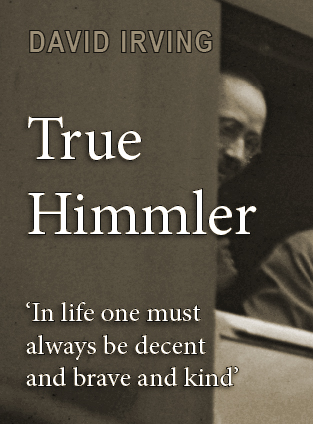
True Himmler, 1

I won’t read the first chapter for the moment because I am pained by David Irving’s hypothesis: that the Allies assassinated Himmler when he was taken prisoner, that it wasn’t suicide. But I will be reading my hard copy of this thick volume over the next few weeks until I finish it. So far as I have read the second chapter, Irving’s style is very readable, and I think anyone who considers himself sympathetic to National Socialism should buy it from the author’s bookstore.

The editing is splendid, and trying to read such magnificent books in PDFs is an outrage, as it is precisely these books that deserve to be in our personal library, with plenty of footnotes in our own handwriting.

Categories
David Irving Racial right Richard Weikart

On the Boromirs

A commenter drew my attention to the most recent interview with Richard Weikart. I just watched the interview and at minute 35:40 Weikart said something that contradicts the impression I have of American white nationalism: ‘They are overwhelmingly anti-Christian’.

Most American white nationalists are either Christian or sympathetic to Christianity. Rare in American white nationalism is the person like Alex Linder who sees Christianity as evil, and there is no longer a truly central figure in that movement, as the late William Pierce, who has a negative image of Christianity.

It is a pity that there are no surveys to know the exact percentage of Christians or Christian sympathisers in white nationalism. But the impression I get after reading a dozen years of white nationalist sites is that, except for Linder, there is no major figure who truly abhors Christianity (Kevin Alfred Strom’s webzine is not as vehement as Linder in its criticism of Christianity).

Although brief, a good example of Christian racialists was seen recently in what was said to me in the comments section of The Occidental Observer, to which I have already referred a couple of times. The moderator didn’t let my last comment pass. In addition to answering his third question to one Occidentan, I suggested he read Pierce’s story of the race. It doesn’t matter that that answer of mine didn’t appear in TOO, as long as I was at least able to defend myself against the slanders that racialist Christians were casting on me.

As a good Christian, Weikart (who is almost exactly my age by the way), is anti-racist. The interview I heard today was very enlightening because it shows how the Christian religion clouds the otherwise clear understanding of such scholars. If I could answer Weikart I would tell him that regarding the leading white nationalist sites, the webzines of Jared Taylor, Kevin MacDonald and Greg Johnson, he won’t find overtly anti-Christian positions. Even a racialist site as much visited as Taylor’s according to the latest statistics I saw, Hunter Wallace’s, is openly Christian.

Given that Christianity is inherently anti-racist, the question that comes to mind is how much longer American white nationalists will continue to ignore the issue. People like Weikart, a good scholar of Hitler, are fascinating in that they show that, from the Christian POV, he is more consistent by being anti-racist than racist. Wallace may be looking to square the circle, but the other pundits mentioned in the previous paragraph simply ignore the CQ, the Christian Question. The West’s Darkest Hour will continue to be ignored by racialist Christians and even racialist non-Christians because an honest discussion about the religion of our parents is a taboo subject in the dissident right.

Changing the subject, today I received a mail from David Irving. The second volume of his biography of Himmler will be published next year. I am very much looking forward to reading it… It is infinitely more important to know Hitler and Himmler well than the Boromirs who covet the One Ring to the point of self-destruction. I hope that Weikart’s book, which will reach me this month, will help me in this endeavour.

Update of May 29: The comments are now closed on that TOO thread, and the moderator finally let my response to Occidentan pass. But it took some days for my comment to be approved.

Categories
Hitler's Religion (book) Richard Weikart

Weikart’s book

Last year a commenter called to my attention a passage from Hitler’s Religion by Richard Weikart:

Worse yet, he [Hitler] actually threatened to obliterate Christianity later in the second volume. After calling Christianity fanatically intolerant for destroying other religions, Hitler explained that Nazism would have to be just as intolerant to supplant Christianity:

A philosophy filled with infernal intolerance will only be broken by a new idea, driven forward by the same spirit, championed by the same mighty will, and at the same time pure and absolutely genuine in itself. The individual may establish with pain today that with the appearance of Christianity the first spiritual terror entered in to the far freer ancient world, but he will not be able to contest the fact that since then the world has been afflicted and dominated by this coercion, and that coercion is broken only by coercion, and terror only by terror. Only then can a new state of affairs be constructively created. (Mein Kampf, Chapter V)

Hitler’s anti-Christian sentiment shines through clearly here, as he called Christianity a ‘spiritual terror’ that has ‘afflicted’ the world. Earlier in the passage, he also argued Christian intolerance was a manifestation of a Jewish mentality, once again connecting Christianity with the people he most hated. Even more ominously, he called his fellow Nazis to embrace an intolerant worldview so they could throw off the shackles of Christianity. He literally promised to visit terror on Christianity. Even though several times later in life, especially before 1934, Hitler would try to portray himself as a pious Christian, he had already blown his cover.

Hitler’s tirade against Christianity in Mein Kampf, including the threat to demolish it, diverged remarkably from his normal public persona. He was usually more circumspect, refraining from open criticism of Christianity. However, many of his colleagues testified that Hitler’s personal opinion about Christianity did not match his hypocritical public stance; Hitler, for his part, thought religion itself was hypocritical.

Gilad Atzmon, a Jew whose relatively recent books have been reviewed by the racial right, said that the intolerant fanatics win.

He is right: and that was why Julian the Apostate failed: he was a very tolerant emperor towards Christians, Jews and pagans. The priest of the 14 words, on the other hand, is as intolerant as the Christians who destroyed the classical world.

As I said last year to the commenter who quoted the passage above, ‘Although Richard Weikart is ideologically an enemy, he is infinitely more honest about Hitler’s anti-Christianity than Richard Carrier. I guess I’ll have to get a copy of Weikart’s book…’

I just ordered it from Amazon.