
Christianity is called the religion of pity… Pity runs counter to the whole law of evolution, which is the law of selection. It preserves whatever is ripe for destruction; it fights on the side of those disinherited and condemned by life, and it gives a depressive and questionable character to life itself by keeping alive an abundance of failures of every type.
Editor’s note:
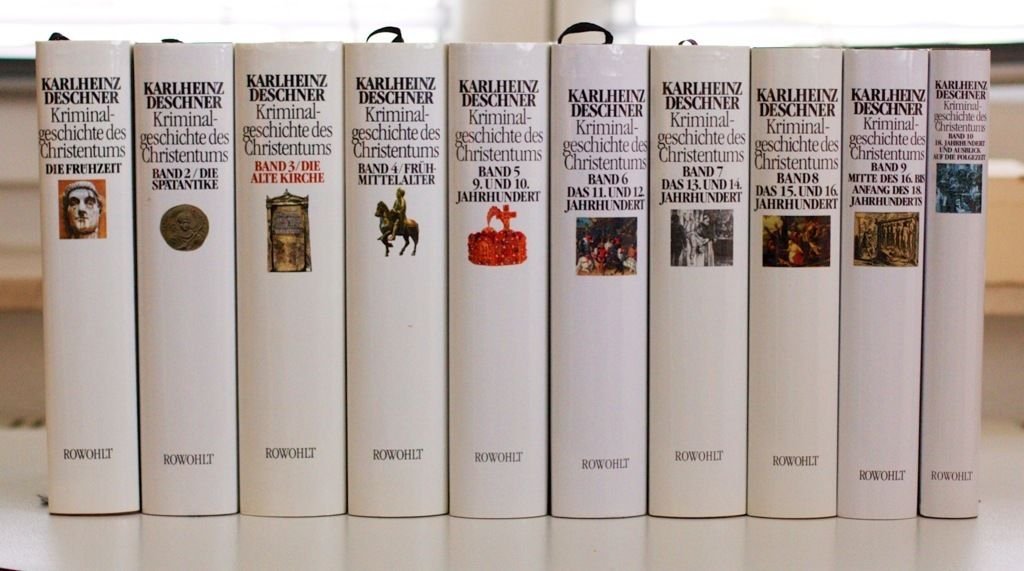
Recently I have said that I was reviewing the syntax of the first seventy posts that, on this site, I have excerpted from the first volume of Kriminalgeschichte des Christentums by Karlheinz Deschner. It’s true, but now that I’ve been rereading volumes 2 and 3 of Deschner’s ten volume-series I’ve decided to make editorial changes to the first book of my translated extracts, which I plan to make it available through Lulu.
It seems to me that what Deschner says in some chapters of volumes 2 and 3, a critical approach to the historicity of the biblical narrative, should come at the beginning of the first book of my printed translations; for example, pseudepigraphy regarding the New Testament authors. The same can be said of Deschner’s chapters on the falsifications of non-biblical Christian texts in the first centuries of our era, including fabrications of the stories of the martyrs. Therefore, although these days I will continue reviewing the syntax of the previous seventy entries that have appeared on this site, which will appear, already corrected, in the aforementioned Lulu book, I’ll postpone its publication until I finish translating the mentioned passages from volumes 2 and 3.
Once the translation of these passages is finished, I will include them all under a single cover. Incidentally, from this entry, instead of the German title Kriminalgeschichte in each post, I’ll use the English translation: as can be seen above in this # 71 instalment of the series. The following passage is taken from volume 3 of Christianity’s Criminal History:

Christian Fabrications in Antiquity
Many people, perhaps most, are afraid to admit the grossest lie in the field to them ‘more sacred’. It seems inconceivable to them that those who give ocular and auricular testimony of the Lord can be no more than vulgar falsifiers. But it has never been lied and cheated as often and as unscrupulously as in the field of religion. And it is entirely in Christianity where taking us for a ride is the order of the day, where an almost infinite jungle of deceit is created since Antiquity and in the Middle Ages in particular.
But counterfeiting continues in the 20th century, massively and officially. Thus, J.A. Farrer asks himself almost desperate: ‘If we reflect on everything that has emerged from this systematic deception, all the struggles between popes and sovereigns, the dismissal of kings and emperors, excommunications, inquisitions, indulgences, acquittals, persecutions and cremations, etc., and it is considered that all this sad history was the immediate result of a series of falsifications, of which the Donatio Constantini (Donation of Constantine) and the False Decretals were not the first, although the most important, one feels obliged to ask if it has been more the lie than the truth that has permanently influenced the history of humanity’.
Of course, the most successful lie, the one that causes the most havoc among most souls, is certainly not a Christian invention. But it bears a close relationship with the religious pseudepigraphy. (A pseudepigrapha, anglicized pseudepigraph, is a text under a false name: a text that does not come from who, according to the title, content or transmission, has written it.) Both methods, fabrication and pseudepigraphy, were not Christian innovations. Literary falsification had already existed for a long time among the Greeks and the Romans; it has appeared in India, among the Egyptian priests, with the Persian kings and, also, in Judaism.
Categories
Anglin’s playground
 ‘History is the mighty Tower of Experience, which Time has built amidst the endless fields of bygone ages. It is no easy task to reach the top of this ancient structure and get the benefit of the full view. There is no elevator, but young feet are strong and it can be done’, wrote Hendrik Willem van Loon in The Story of Mankind.
In theory, if there is anything that should matter those who want an Aryan nation, it is the facts. History should be considered the most important of the humanities, yes: the tower of experience. But I do not see much interest in the white nationalism forums for ancient historical facts in Europe, especially those facts that explain why the white race is going extinct. (What we see in most of the forums are opinions and news comments; these days for example, Trump meeting with Putin.)
When are they going to be interested in their roots, the old history of their race? What is it that prevents them from reading William Pierce’s only non-fiction book (and let’s not talk about heavy treatises like Deschner’s)? Could it be that both Pierce and Deschner were anti-Christians? Could it be that they are clinging to their parents’ religion like a baby with a pacifier? Are not yet prepared to digest strong meat? Will I continue to be talking to myself with these Deschner translations because they’re still in Anglin’s playground, like kids living in the present?
Presently I am reviewing the syntax of the first seventy entries I have posted in this site of Karlheinz Deschner’s Kriminalgeschichte des Christentums. Once I finish the review I’ll provide a PDF. The reviewed translation will also be available in book form under the title Christianity’s Criminal History.
 The present book is an abridged translation of the first volume of Karlheinz Deschner’s ten-volume Kriminalgeschichte des Christentums. The original volume with hundreds of endnotes (every quotation is accompanied by the proper reference), and whose first chapter on the Old Testament is longer than our brief excerpts, was published in German in 1986. My hope is that this preliminary translation is only the first step for a more academic translation of Deschner’s magnum opus. Furthermore, in this translation I took the liberty to add several illustrations and even replace many instances of the author’s use of the word ‘pagan’, which is derogatory Christian Newspeak, with terms like ‘Hellenist’ or ‘advocate of Greco-Roman culture’.
But why reproduce excerpted passages from Deschner’s opus in the first place?
White nationalists are aware of the Jewish problem. But very few are aware that Jewish subversion is not the product of spontaneous generation but of a religion of Semitic origin: Christianity. Who among the white nationalists knows the real history of Christianity? Who is aware that Christian fanatics destroyed, literally, the Greco-Roman world? As Catherine Nixey put it in The Darkening Age: The Christian Destruction of the Classical World:
In a spasm of destruction never seen before—and one that appalled many non-Christians watching it—during the fourth and fifth centuries, the Christian Church demolished, vandalized and melted down a simply staggering quantity of art. Classical statues were knocked from their plinths, defaced, defiled and torn limb from limb. Temples were razed to their foundations and burned to the ground. A temple widely considered to be the most magnificent in the entire empire was levelled.
Many of the Parthenon sculptures were attacked, faces were mutilated, hands and limbs were hacked off and gods were decapitated. Some of the finest statues on the whole building were almost certainly smashed off then ground into rubble that was then used to build churches.
Books—which were often stored in temples—suffered terribly. The remains of the greatest library in the ancient world, a library that had once held perhaps 700,000 volumes, were destroyed in this way by Christians. It was over a millennium before any other library would even come close to its holdings. Works by censured philosophers were forbidden and bonfires blazed across the empire as outlawed books went up in flames.
Most white nationalists ignore the ISIS-like history of early Christianity right after Constantine handed over the Roman Empire to his bishops. They know only the martyr myths, the pious legends and the lies they told us as children educated in the Christian faith.
Karlheinz Deschner (1924-2014) was a liberal German. He spent the first sixty years of his life investigating the history of the Catholic Church before starting the ten volumes of his Kriminalgeschichte series, which only ended at ninety. It is a more complete treatise, or encyclopaedia I would dare to say, about the real history of Christianity than Nixey’s The Darkening Age.
I started reading Deschner in 2002 when I was also a liberal. I would not wake on the Jewish question until 2010. But Deschner, like all Germans of our times who aspire to see their books in the bookstores, never woke up. He even criticised the most notorious ‘anti-Semites’ in early Church history. This said, the difference between Deschner and liberal theologians like Hans Küng (The Church) and conservative historians like Paul Johnson (A History of Christianity) is that Küng and Johnson concealed a great deal of Christianity’s criminal history. It is remarkable how a scholar who abandoned Christianity, like Deschner, was capable to criticise it in a way that Küng, Johnson, and the most prominent Christian intellectuals would never dream of.
After awakening to the realities of the Jewish problem I realised that Deschner’s information, despite his mistaken point of view, can be rescued. It only has to be processed through the filter of someone who has awakened on the Jewish question. Had Germany won the war, Deschner, who appears in a previous page in Nazi uniform, could have written his history from the National Socialist point of view.
C.T.
July of 2018
Categories
All Christians are Cucks, 7
 Our “CI” boys who wish to identify as “Israelites” who escaped Egypt would have to be Asiatic, not European. Finally, Christianity today is the same shit as Feminism—a Jewish project that was not stopped early enough and has grown into a destructive problem.
Enjoy the images. It took quite some time to collect all the data and format them properly.
________
See the images: here.
Categories
Julian, 36
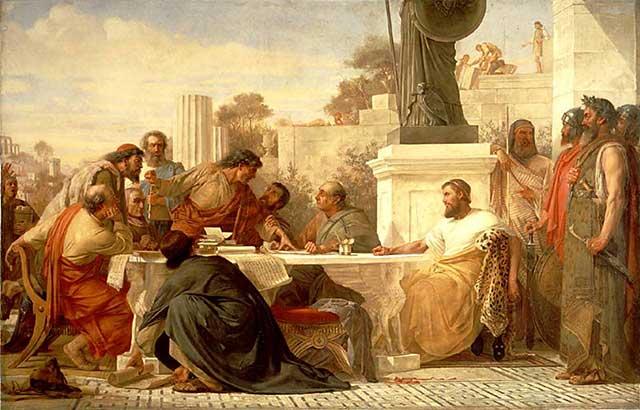
Julian presiding at a conference of Sectarians
(Edward Armitage, 1875)
Julian Augustus
In the autumn of 353, Gallus made a state visit to Pergamon. It was the first time we had met since we were boys at Macellum. I stood with the town prefect and the local dignitaries in front of the senate house and watched Gallus receive the homage of the city.
During the five years since we had seen one another, I had become a man with a full beard. But Gallus had remained exactly as he was, the beautiful youth whom all admired. I confess that I had a return of the old emotion when he embraced me formally and I looked once again into those familiar blue eyes. What was the old emotion? A loss of will, I should say. Whatever he wanted me to do I would do. Gallus, by existing, robbed me of strength.
“We are pleased to see once again our beloved and most noble brother.” Gallus had by now completely assumed the imperial manner. Before I could reply, Gallus had turned to the bishop of Pergamon. “He is, we have heard, a pillar of the true church.”
“Indeed, Caesar, the most noble Julian is a worthy son of holy church.” I was extremely grateful to the bishop. Also, I was rather pleased that my efforts to appear a devout Galilean had been so successful.
Gallus then made a graceful speech to the city fathers, who were so charmed by him that they were obviously puzzled at how this enchanting creature had ever got the reputation of being a cruel and frivolous despot. Gallus could charm anyone, even me.
That night a dinner was given him at the prefect’s palace. He behaved himself quite well, though I noticed that he did not cut his wine with water. As a result, he was drunk by the end of the evening. Yet he maintained his dignity and only a slight slowness of speech betrayed his state. Though I sat beside him during dinner, he did not speak to me once. All his efforts were bent on delighting the city prefect. I was miserable, wondering in what way I had managed to offend him. Oribasius, who sat across the room with the minor functionaries of the court, winked at me encouragingly. But I was not encouraged.
The dinner ended, Gallus suddenly turned to me and said, “You come with me.” And so I followed him as he moved through the bowing courtiers to his bedroom, where two eunuchs were waiting for him.
I had never before seen the etiquette of a Caesar’s bedchamber and I watched, fascinated, as the eunuchs, murmuring ceremonial phrases, undressed Gallus while he lolled in an ivory chair, completely unaware of them. He was without self-consciousness or modesty. When he was completely undressed, he waved them away with the command “Bring us wine!” Then while the wine was served us, he talked to me or rather at me. In the lamplight his face glowed red from drink and the blond hair looked white as it fell across his brow. The body, I noticed, though still beautifully shaped, was beginning to grow thick at the belly.
“Constantia wants to know you. She talks of you often. But of course she couldn’t come here. One of us must always be at Antioch. Spies. Traitors. No one is honest. Do you realize that? No one. You can never trust anyone, not even your own flesh and blood.”
I tried to protest loyalty at this point. But Gallus ignored me. “All men are evil. I found that out early. They are born in sin, live in sin, die in sin. Only God can save us. I pray that he will save me.” Gallus made the sign of a cross on his bare chest.
“But it is a fine thing in an evil world to be Caesar. From here?” he indicated a height, “you can see them all. You can see them at their games. But they can’t see you. Sometimes at night, I walk the streets in disguise. I listen to them. I watch them, knowing I can do anything to them I want and no one can touch me. If I want to rape a woman or kill a man in an alley, I can. Sometimes I do.” He frowned. “But it is evil. I know it. I try not to. Yet I feel that when I do these things there is something higher which acts through me. I am a child of God. Unworthy as I am, he created me and to him I shall return. What I am, he wanted me to be. That is why I am good.”
I must say I was stunned by this particular self-estimate. But my face showed only respectful interest.
“I build churches. I establish religious orders. I stamp out heresy wherever I find it. I am an active agent for the good. I must be. It is what I was born for. I can hardly believe you are my brother.” He shifted his thought without a pause. He looked at me for the first time. The famous blue eyes were bloodshot in the full lamplight.
“Half-brother, Gallus.”
“Even so. We are the same blood, which is what matters. That is what binds me to Constantius. And you to me. We are the chosen of God to do the work of his church on earth.”
At this point an extraordinarily pretty girl slipped quietly into the room. Gallus did not acknowledge her presence, so neither did I. He continued to talk and drink, while she made love to him in front of me. I suppose it was the most embarrassing moment of my life. I tried not to watch. I looked at the ceiling. I looked at the floor. But my eyes continually strayed back to my brother as he reclined on the couch, hardly moving, as the girl with infinite skill and delicacy served him.
“Constantius will do anything I ask him. That is what blood means. He will also listen to his sister, my wife. She is the most important woman in the world. A perfect wife, a great queen.” He shifted his position on the couch so that his legs were spread apart.
“I hope you marry well. You could, you know. Constantius has another sister, Helena. She’s much older than you, but that makes no difference when it is a matter of blood. Perhaps he will marry you to her. Perhaps he will even make you a Caesar, like me. Would that please you?”
I almost missed the question, my eyes riveted on what the girl was doing. Oribasius says that I am a prude. I suppose he is right. I know that I was sweating with nervous tension as I watched the ravishing of Gallus. “No,” I stammered. “I have no wish to be Caesar. Only a student. I am perfectly happy.”
“Everyone lies,” said Gallus sadly. “Even you. Even flesh and blood. But there’s very little chance of your being raised up. Very little. I have the East, Constantius the West. You are not needed. Do you have girls in your household?”
“One.” My voice broke nervously.
“One!” He shook his head wonderingly. “And your friend? The one you live with?”
“Oribasius.”
“Is he your lover?”
“No!”
“I wondered. It’s perfectly all right. You’re not Hadrian. What you do doesn’t matter. Though if you like boys, I suggest you keep to slaves. It’s politically dangerous to have anything to do with a man of your own class.”
“I am not interested…” I began, but he continued right through me.
“Slaves are always best. Particularly stableboys and grooms.” The blue eyes flashed suddenly: for an instant his face was transfigured by malice. He wanted me to recall what I had seen that day in the clearing. “But suit yourself. Anyway, my only advice to you, my only warning to you, not only as your brother but as your ruler…” He stopped suddenly and took a deep breath. The girl had finished. She got to her feet and stood in front of him, head bowed. He smiled, charmingly. Then he reached up and with all his strength struck her full in the face. She staggered back, but made no sound. Then at a gesture from him, she withdrew.
Gallus turned to me as though nothing had happened and picked up his sentence where he had left off. “…under no circumstances are you to see this magician Maximus. There are already enough rumours that you may have lost your faith. I know that you haven’t. How could you? We are of the house of Constantine the Great, the equal of the Apostles. We are the chosen of God. But even so…” He yawned. He lay back on the couch. “Even so…” he repeated and shut his eyes. I waited a moment for him to continue. But he was asleep.
The eunuchs reappeared. One placed a silk coverlet over Gallus. The other removed the wine. They acted as though what I had witnessed was a perfectly ordinary evening; perhaps it was. As Gallus began drunkenly to snore, I tiptoed from the room.
Yesterday I said that in the third volume of the series Christianity’s Criminal History, ‘The Ancient Church: Forgery, Brainwashing, Exploitation, Annihilation’, Deschner argues that the tales of Christian martyrs in early Christianity were grossly exaggerated, and that I planned in the future to translate some passages of it. But the impatient English reader can go to his nearest library and read chapter four of Catherine Nixey’s recently published The Darkening Age, ‘On the Small Number of Martyrs’.
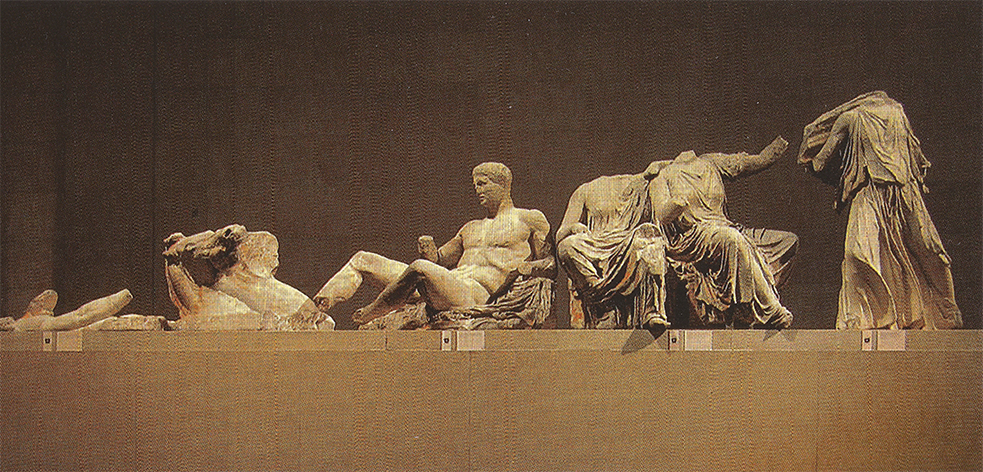
Within that chapter are included the images in colour that illustrate the book. Above, you can see the surviving figures of the Parthenon in Athens. Nixey says that these figures ‘were almost certainly mutilated by Christians who believed them to be “demonic”. The central figures of the group are missing, probably levered off the ground into rubble to build a Christian church’ (image facing page 57).
Categories
Masthead
See the top of the mast that leads the flagship of this site: Rome vs. Judea; Judea vs. Rome: an 89-page PDF with 32 images.
I understand corruption (as I am sure you have guessed by now) in the sense of decadence: my claim is that all the values in which humanity has collected its highest desiderata are values of decadence.
I call an animal, a species, an individual corrupt when it loses its instincts, when it chooses, when it prefers things that will harm it…
Life itself appears to me as an instinct for growth, for survival, for the accumulation of forces, for power: whenever the will to power fails there is decline.
I intended to go through various Christian sites and social media pages in order to collect for you a massive amount of their lunatic statements, phrases and beliefs—but, I will be very honest here—I saved some, but I just couldn’t finish the job. I had to think about my own health and seeing all the idiocy made me worried about my anger, blood pressure and various other things…
Alas, how does one help wake up a 2000 year old brainwashing? Well, one must be persistent and ignore the hardship that is involved in succeeding in it. If I were to look at this difficult task and wonder what exactly it would take me to achieve victory against this Jewish poison, I’d probably never even begin doing it. I’d find myself demoralized from not only the advantage of Time they have, but also of the generations of people that have been self-indoctrinating their own children with this infection. When that happens, when the lemmings poison themselves, then the Jews have won over their minds.
Or, look at this one [the author linked these words to a defunct page], which is from Psalms—and, if you remember, Psalms are the Scriptures in which it is said that they will destroy all Nations surrounding them. All Nations. So, here we have a spin on that mission by telling us that they will “sing their song” in all the Nations. Boy, that must be a particularly sick tune of Death, right? We have said already that “vibrations” are capable of changing the entire infrastructure of the Mind. Therefore, having the Jews sing among us is lethal and dangerous: their singing is primarily expressed nowadays through the Media. Ain’t that a charming sound?
To those of us who still have working Aryan brains, their patterns are becoming ever more self-evident. For example, in Deuteronomy 7:6 we can read: For you are a people holy to the Lord your God. The Lord your God has chosen you out of all the peoples on the face of the earth to be his people, his treasured possession. So, we have a group of people walking among us who believe to be better than we are, yet at the same time are telling the rest of the Goyim that we are all equal. Of course, from the Jewish perspective, we are all equal: we are all the same Cattle and Animal to them. All these liberal, modern bullshit ideologies are viewpoints on life from the Jewish perspective.
This equality and diversity thing eventually accomplishes another commandment from the Jewish Bible which we find a few verses later, in Deuteronomy 7:16: You must destroy all the peoples the Lord your God gives over to you. Do not look on them with pity and do not serve their gods, for that will be a snare to you. Never does it enter the mind of the average Christian that Jews have destroyed their entire culture and are planning to literally genocide their people. It never enters their mind that the Jewish Semitic War God Yahweh might have “given over to the Jews” the European people.
But, just a moment ago we had seen that Christians use Deuteronomy as some kind of Jesus reference, which just goes to show us once more that they really, I mean really, do not know how to read or have a functioning brain anymore.
These are the modern liberal White women—they get raped and feel sorry for the invading immigrant who raped them. They allow a Negro immigrant into their house because he is a “refugee”, who then kills their daughter, and they don’t even get mad at him. If you wonder therefore why our Society is so fucked up, it is because it is Christian: it has a Christian mentality. No matter what horrible shit is done to our people, people as retarded as this bitch right here, she sees no evil in them.
Editor’s interpolated note: Those white nationalists who claim over their forums that Christianity has only been recently hijacked by Jewry are simply ignorant of history. Here down the south the 16th century Spaniards brought the religious orders along with the soldiers. All of them—no exception—preached love toward those Mesoamericans that sacrificed their children and even ate them.
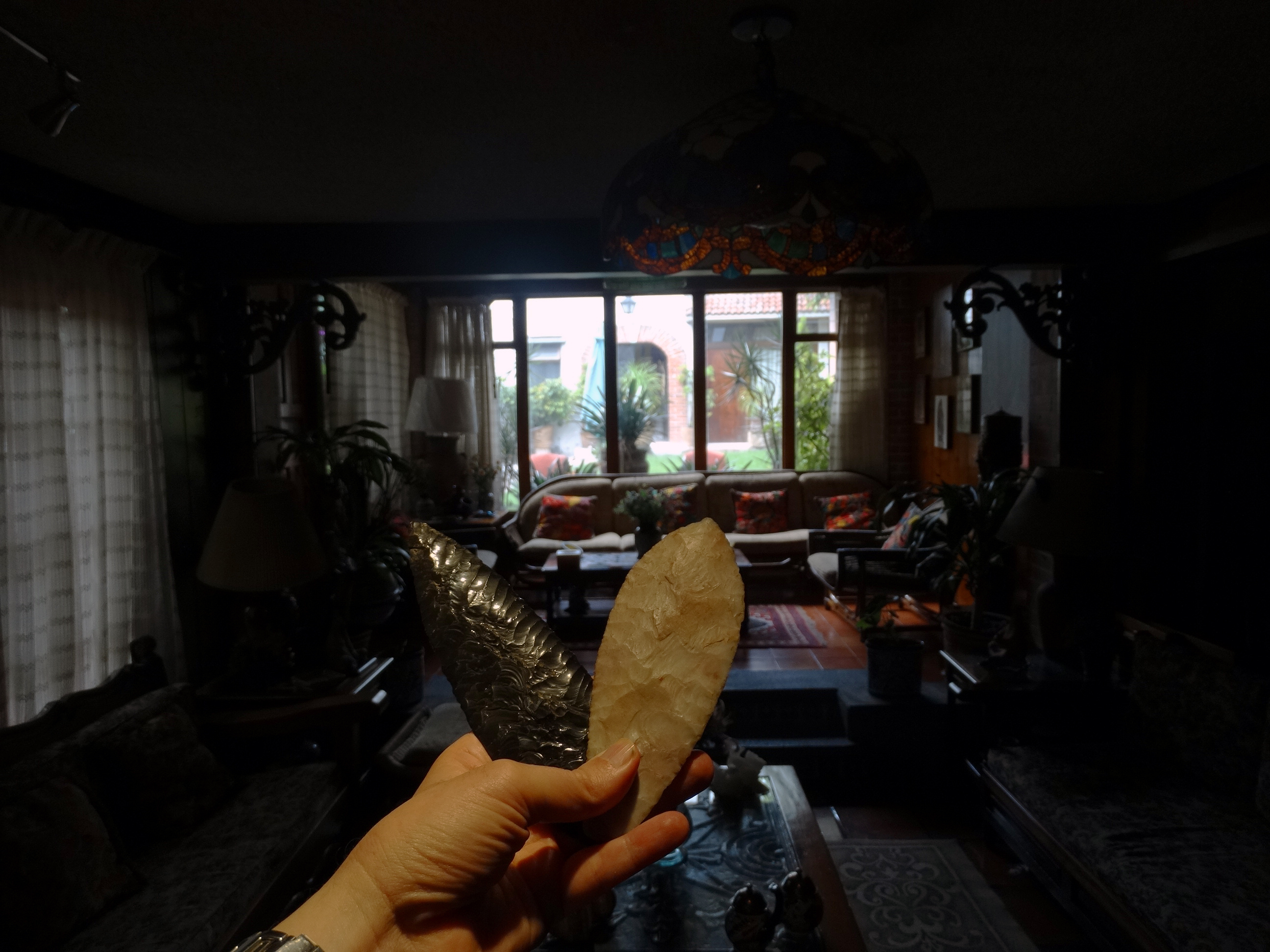
This pic shows my hand holding some possible sacrificial instruments: archaeological pieces from the Aztec world of my private collection. The Spanish not only preached love toward the Amerindians: they actually married their women, ruining their gene pool forever. This happened when the Spanish Inquisition targeted crypto-Jews in New Spain, now Mexico, which proves that whites can behave ethnosuicidally without the help of the tribe. Unaided Christian ethics does the trick!
Axe of Perun continues:

It would seem that God is trying to make all White European Nations saints. They sure are suffering right now under heavy invasion of biological weapons of mass destruction. But, here you have a simple choice: you either follow the early Christian fathers and become a passive faggot who doesn’t defend himself or his people—or—you become a Jesuit and Church follower who does whatever the Church says even if it is wrong…
The problem is that Europeans were like this to each other always—especially the Nordic ones. We shared with each other, helped each other, we weren’t as materialistically mad as Semites were. But Jews used that Nature of ours and turned it into weapon against us. Our good Nature is killing us…
Editor’s interpolated note: Remember the slogan of this site: ‘LOVE IS MURDERING THE WHITE RACE’.
…because we have been duped into believing that an African Somalian is our Equal with whom we should share everything in common, even our daughters.
The Christian belongs to nothing else but Jerusalem: you have no other family, no other nation, no other profession. You are a believer whose place is in Jerusalem. You are a Semite who loves Jews and Yahweh, who can’t wait for Jesus to return and to establish a Communistic Kingdom on Earth ruled by the Jews. I don’t know actually who I hate more: the modern day Christians or the old ones.
So, what really changed over the years? Not much. Christianity began as a hippy movement which managed to destroy all Civilizations surrounding the Jews. It then disarmed and destroyed all European people. As Europe lost its strength to resist Evil, Jews introduced Islam and used their Arab brothers to try and conquer us. As that failed, they changed tactics. They began using us to spread this hippy movement message around the world carrying Jews alongside—allowing them to gain influence in every single place of the Earth.
Once they established their control all over the world, it was time to immigrate non-White people into our lands—no matter what the cost was. It was also time to make the Bible publicly available, because remember, up to the 1600’s it was forbidden to own a Bible—people had no fucking idea what it was saying. Well, as the message got out, the more liberal did Europe become through its various Christian movements…
Jews do not hate Christianity, they hate Europeans. I’ve said it many times before: they made the poison and won’t drink it of course. Since they know it is poison, they can openly claim they hate it. Besides, if they were to follow Christ, they would have to lose their Jewish identity—at least according to the version Paul sold to non-Jews. It is actually absolutely irrelevant what the Jews think about it. What matters is what it has done to us and what it is still doing to us.
________
Read it all: here.