 • Reclaim your women that the anti-white System stole from you.
• After we win the Revolution you’ll be able to abduct the Sabine woman of your dreams.
• The torture of involuntary celibacy will be over!
Categories
• Reclaim your women that the anti-white System stole from you.
• After we win the Revolution you’ll be able to abduct the Sabine woman of your dreams.
• The torture of involuntary celibacy will be over!
Below, an abridged translation from the third volume of
Karlheinz Deschner’s Kriminalgeschichte des Christentums.
The ‘Holy Scriptures’ are piled up
No evangelist intended to write a kind of revelation document, a canonical book. No one felt inspired, neither did Paul, and in fact none of the authors of the New Testament. Only the Book of Revelation: the one that, with difficulty, became part of the Bible pretends that God dictated the text to the author. But in 140 Bishop Papias did not consider the Gospels as ‘Holy Scriptures’ and gave preference to oral tradition. Even St. Justin, the greatest apologist of the 2nd century, sees in the Gospels—which he hardly quotes while he never ceases to mention the Old Testament—only ‘curiosities’.
The first to speak about an inspiration of the New Testament, which designates the Gospels and the epistles of Paul as ‘holy word of God’, was the bishop Theophilus of Antioch at the end of the 2nd century: a special luminary of the Church. On the other hand, in spite of the sanctity and divinity that he presupposes about the Gospels, he wrote a piece of apologetics about the ‘harmony of the Gospels’, as they were evidently a little too inharmonious.
Until the second half of the 2nd century the authority of the Gospels was not gradually accepted yet. Still, by the end of that same century the Gospel of Luke was accepted with reluctance; and that of John with was accepted with a remarkable resistance. Is it not odd that proto-Christianity did not speak of the gospels in the plural but in singular, the Gospel? In any case, throughout the 2nd century a fixed canon ‘of the Gospels did not yet exist and most of them were really considered a problem’ (Schneemelcher). This is clearly demonstrated by two famous initiatives of that time which tried to solve the problem of the plurality of Gospels with a reduction.
In the first place, there is the widespread Marcion Bible. This ‘heretic’, an important figure in the history of the Church, compiled the first New Testament in Sacred Scripture, and was the founder of the criticism of its texts, written shortly after the year 140. With it Marcion completely distanced himself from the bloodthirsty Old Testament, and only accepted the Gospel of Luke (without the totally legendary story of childhood) and the epistles of Paul; although, significantly, the latter without the forged pastoral letters and the epistle to the Hebrews, also manipulated. Moreover, Marcion deprived the remaining epistles of the ‘Judaistic’ additions, and his action was the decisive motive for the Catholic Church to initiate a compilation of the canon; thus beginning to constitute itself as a Church.
The second initiative, to a certain extent comparable, was the Diatessaron of Tatian. This disciple of St. Justin in Rome solved the problem of the plurality of the Gospels in a different way, although also reducing them. He wrote (as Theophilus) a ‘harmony of the Gospels’, adding freely in the chronological framework of the fourth Gospel the three synoptic accounts, as well as all kinds of ‘apocryphal’ stories. It had great success and the Syrian Church used it as Sacred Scripture until the 5th century. The Christians of the 1st century and to a large extent also those of the next century did not, therefore, possess any New Testament. As normative texts they used, until the beginning of the 2nd century, the epistles of Paul; but the Gospels were still not cited as ‘Scripture’ in religious services until the middle of that century.
The true Sacred Scripture of those early Christians was the sacred book of the Jews. Still in the year 160, St. Justin, in the broadest Christian treatise up to that date, almost exclusively referred to the Old Testament. The name of the New Testament (in Greek he kaine diatheke, ‘the new covenant’, translated for the first time by Tertullian as Novum Testamentum) appears in the year 192. However, at this time the limits of this New Testament were not yet well established and the Christians were discussing this throughout the 3rd and part of the 4th century, rejecting the compilations that others recognised as genuine. ‘Everywhere there are contrasts and contradictions’, writes the theologian Carl Schneider. ‘Some say: “what is read in all the churches” is valid. Others maintain: “what comes from the apostles” and third parties distinguish between sympathetic and non-sympathetic doctrinal content’.
Although around 200 there is in the Church, as Sacred Scripture, a New Testament next to the Old—being the central core the previous New Testament of the ‘heretic’ Marcion, the Gospels and the epistles of Paul—, there were still under discussion the Acts of the Apostles, the Book of Revelation and the ‘Catholic Epistles’. In the New Testament of St. Irenaeus, the most important theologian of the 2nd century, the book Shepherd of Hermas also appears which today does not belong to the New Testament; but the Epistle to the Hebrews, which does belong in today’s collection, is missing.
The religious writer Clemente of Alexandria (died about 215), included in several martyrologies among the saints of December 4, barely knows a collection of books of the New Testament moderately delimited. But even the Roman Church itself does not include around the year 200, in the New Testament, the epistle to the Hebrews; nor the first and second epistles of Peter, nor the epistle of James and the third of John. And the oscillations in the evaluation of the different writings are, as shown by the papyri found with the texts of the New Testament, still very large during the 3rd century.
 (Papyrus Bodmer VIII, at the Biblioteca Apostolica Vaticana, showing 1 and 2 Peter.)
Even in the 4th century, Bishop Eusebius, historian of the Church, includes among the writings that are the subject of discussion the epistles of James, of Judas, the second epistle of Peter and the so-called second and third epistles of John. Among the apocryphal writings, Eusebius accepts, ‘if you will’, the Revelation of John. (And almost towards the end of the 7th century, in 692, the Quinisext Council, approved in the Greek Church canons, appear compilations with and without John’s Book of Revelation.) For the North African Church, around the year 360, the epistle to the Hebrews, the epistles of James and Judas do not belong to the Sacred Scriptures; and according to other traditions, neither belonged the second of Peter and the second and third of John.
On the other hand, prominent Fathers of the Church included in their New Testament a whole series of Gospels, Acts of the Apostles and Epistles that the Church would later condemn as apocryphal but in the East, until the 4th century, they enjoyed great appreciation and were even considered as Sacred Scripture, among others, Shepherd of Hermas, the Apocalypse of Peter, the Didache, etc. And even in the 5th century it is possible to find in a codex some ‘apocryphal’ texts, that is, ‘false’ together with the ‘genuine’ ones.
The so-called Catholic epistles needed the most time to enter the New Testament as the group of the seven epistles. The Father of the Church St. Athanasius, the ‘father of scientific theology’ was the first one to determine its extension (whom the investigators also blame for the falsification of documents, collecting the 27 known writings, among them the 21 epistles). St. Athanasius lied without the slightest hesitation when affirming that the apostles and teachers of the apostolic era had already established the canon. Under the influence of Augustine, the West followed the resolution of Athanasius and consequently delimited, almost about the beginnings of the 5th century, the Catholic canon of the New Testament in the synods of Rome in 382, Hippo Regius in 393 and Carthage in 397 and 419.
The canon of the New Testament, used in Latin as a synonym for ‘Bible’, was created by imitating the sacred book of the Jews. The word canon, which in the New Testament appears only in four places, received in the Church the meaning of ‘norm, the scale of valuation’. It was considered canonical what was recognised as part of this norm, and after the definitive closure of the whole New Testament work, the word ‘canonical’ meant as much as divine, infallible. The opposite meaning was received by the word ‘apocryphal’.
The canon of the Catholic Church had general validity until the Reformation. Luther then discussed the canonicity of the second epistle of Peter (‘which sometimes detracts a little from the apostolic spirit’), the letter of James (‘a little straw epistle’, ‘directed against St. Paul’), the epistle to the Hebrews (‘perhaps a mixture of wood, straw and hay’) as well as the Book of Revelation (neither ‘apostolic nor prophetic’; ‘my spirit cannot be satisfied with the book’) and he admitted only what ‘Christ impelled’.
On the contrary, the Council of Trent, through the decree of April 8, 1546, clung to all the writings of the Catholic canon, since God was its auctor (author). In fact, the real auctor was the development and the election through the centuries of these writings along with the false affirmation of their apostolic origin.
______ 卐 ______
Liked it? Take a second to support this site.
 Finally, one white nationalist site, the webzine Counter Currents, has published a book review of the subject we consider most important, the destruction of the Greco-Roman world by early Christians.
I refer to A. Graham’s review of the 2018 American edition of Catherine Nixey’s The Darkening Age: The Christian Destruction of the Classical World (Boston: Houghton Mifflin Harcourt).
However, the commentariat of Counter Currents seems ignorant of Evropa Soberana’s eureka essay that I have been advertising in the masthead of this site (see especially these paragraphs). Perhaps a visitor of The West’s Darkest Hour may wish to link Soberana’s essay, that I translated from Spanish to English, in that thread of Counter Currents (for example: here)?
This is probably the most important topic of the whole white nationalist blogosphere. If Aryans remain ignorant of the very roots of Judaic infection they won’t be able to find a cure, as an incomplete diagnosis translates into an incomplete or imperfect medicine.
 Four years ago I had posted this chapter here but now, that I’ve used engines to check the grammar, I realised the old text was plagued with syntactic inaccuracies. Although I feel it is greatly improved (see below) I can never be sure as English is not my native language. Now that the revision is almost compete, as soon as I order a proof copy, and get it from Amazon Books, the softcover will be available again for the general public.
______ 卐 ______
(Abridged Spanish-English translation
from the introduction to ¿Me Ayudarás?)
Men are the devils of the earth, and
animals are their tormented souls.
—Schopenhauer
At fifty-three, I received a surprise in what in Hojas Susurrantes I call the cursed house. Someone had left a box on the shelf outside the bathroom for visitors. When I opened it I saw something that amazed me. A divine little animal! He looked like a very young bunny but it was so beautiful and graceful that it could not be a rabbit, I told myself. It took me a long time to recognize that he was really a white bunny, but so otherworldly it seemed to me that I had difficulty in reconciling my two hemispheres: one telling me that it could only be a divine creature, and another telling me that it was a little rabbit that had come into the world not long ago.
Almost abandoned in a non-custodial box, it had been one among many gift bunnies to the kids at a birthday party that one of my irresponsible siblings had bought, the father of the celebrated child. Elsewhere I might tell how I came to interact with the creature, whom I would rescue from an uncertain destiny due to the pettiness of my family and the Mexicans in general. I had never interacted in such way with an animal before. In fact, I had never wanted to have a pet even though I did not get married and have no offspring. But seeing a being so helpless and at the mercy of the modified apes in my family moved me to adapt it. Elsewhere I may tell anecdotes, but the only thing I can add now is that, over time, the white rabbit would help me in my way out from the inverted world of Alice.
A little less than two and a half years later I would receive a great shock. The Mirror reported that four teenagers from Seaham in Durham, England, tortured and murdered Percy: a bunny who, in the picture that can be seen online with the naked young people, seems identical to my pet; now, an adult rabbit. They tried to shave and rape Percy; set her on fire, tried to drown her and then threw her dying but still alive from the window. The human monsters, all white, even recorded on their cell phone what they did: a video that the owner of the bunny could not see when the police arrested the perpetrators; only a frozen image to identify it. The punishment for these criminals was negligible in today’s Britain. I would have tortured them—exactly what they did to the rabbit—and then cast them out the window to let them die in agony lying on the ground (eye for an eye). In fact, if by a miracle of fate an extraterrestrial force had empowered me on my latest visit to the United Kingdom, I would have done it.
We must bear in mind that if the Anglo-Saxon demons had allowed Germany an empire from the Atlantic to the Urals, in the areas under the Nazi flag the torment of the animals would have been greatly reduced. Personally, I regard Hermann Göring one of my patron saints: and he should also be for those who long for a world free of this type of abuse. Let us not forget the 1933 caricature in which the freed animals—“No more vivisection! No more experimentation with animals!”—salute their savior Hermann.
 Unlike my beloved Nazis, in one of my blogs I spoke of what non-Nazis are capable of doing with defenseless animals. I mentioned fur coats factories in China where some mammals are skinned alive; farms in Mexico where they hang rabbits from their ears until they die, which has also happened in some Australian farms. That and what they did to Percy pierced my soul. Her photograph in The Mirror shows her in a posture of serene confidence before the humans who would torture her: identical image to the postures of my own little bunny who, accustomed as Percy was to her benign owner, relaxes placidly in human presence. The betrayal of the universe that Percy had to experience before the change from her angelic owner to human devils must have been such that I caressed the idea of dedicating this volume to her memory.
Although what those damned humans did in Durham was condemned by other Englishmen, so-called normal people are not left behind. Humans whom I consider exterminable are able to pour concentrated solutions into laboratory rabbits, and to prevent them from closing their eyes, hold their eyelids with tongs. How many women ignore that their cosmetic products have been tested in this way… This happens today with the approval of society precisely because the Second World War was won by the wicked. Few know that from 1944 to 1947 the Soviets and the Americans, including Jews on both sides, practiced a real holocaust of Germans, the “Hellstorm,” preventing among other things that the benign policies of Hermann, who had saved our mammals cousins in the very brief historical window that represented the Third Reich, were implemented in the West after the war.
Science philosopher Thomas Kuhn used the optical illusion of the duck-rabbit to show how a paradigm shift causes one to see the same information in a completely different way. If Westerners had not been brainwashed, instead of seeing a duck (the Nazis were bad) they would see a rabbit (actually they were the good guys). I noticed this psychological phenomenon in 1992 when I studied the so-called Faces of Bélmez in a small town in Andalusia.
 (The author at thirty-three in Spain’s “House of the Faces”.) Originally I believed that the faces of Mrs. María Gómez Cámara’s kitchen were a paranormal phenomenon until, once, seeing the face called “La Pelona” (part of the concrete block with this image is behind my back in the photo above), I made a change in my inner subjectivity. I experienced the sensation that the crude strokes of the face were the work of a human hand, debunking the parapsychological investigation in which I had placed my hopes. Perhaps in the future I will have a life to write the details of that adventure in Spain. Suffice it to say that the paradigm shift comes from the internal will. Following Kuhn’s example, the volitional faculty of my mind stopped seeing a bird and discovered another small animal.
 The same can happen in our inner eye as we transcend Christian and neo-Christian values to their National Socialist antithesis. Many white nationalists, mostly Christian theists and Neochristian atheists, are frightened by The Turner Diaries. Unlike William Pierce, with their stupid love for the modified apes they condemn other animals to a torture of millennia—as potentially the Aryans, who are extinguishing themselves, are capable of becoming Görings. For a truly integrated individual it is obvious that moral is putting a screeching stop to the sadism towards our cousins, and the only way to do this is to get rid of the human devils. A change from love to hatred towards sinful humanity—great hatred I mean: a hatred à la Yahweh in the mouth of Jeremiah—represents a paradigm shift.
Do you remember the quote from Arthur Clarke’s Childhood’s End that I included in the fifth and final book of Hojas Susurrantes? In this novel human beings are metamorphosed into a higher entity. I will quote one of those passages again. In the novel “Karellen” was the leader of the extraterrestrial visitors, physically indistinguishable from the iconography of the devils:
“If you want a single proof of the essential—how shall I put it—benevolence of the Overlords, think of that cruelty-to-animals order which they made within a month of their arrival. If I had had any doubts about Karellen before, that banished them—even though that order has caused me more trouble than anything else he’s ever done!
That was scarcely an exaggeration, Stormgren thought. The whole incident had been an extraordinary one, the first revelation of the Overlords’ hatred of cruelty. That, and their passion for justice and order, seemed to be the dominant emotions in their lives—as far as one could judge them by their actions.
And it was the only time Karellen had shown anger, or at least the appearance of anger. “You may kill one another if you wish,” the message had gone, “and that is a matter between you and your own laws. But if you slay, except for food or in self-defense, the beasts that share your world with you—then you may be answerable to me.”
No one knew how comprehensive this ban was supposed to be, or what Karellen would do to enforce it. They had not long to wait.
The Plaza de Toros was full when the matadors and their attendants began their processional entry. Everything seemed normal; the brilliant sunlight blazed harshly on the traditional costumes, the great crowd greeted its favorites as it had a hundred times before. Yet here and there faces were turned anxiously towards the sky, to the aloof silver shape fifty kilometers above Madrid.
Then the picadors had taken up their places and the bull had come snorting out into the arena. The skinny horses, nostrils wide with terror, had wheeled in the sunlight and their riders forced them to meet their enemy. The first lance flashed—made contact—and at that moment came a sound that had never been heard on earth before.
It was the sound of ten thousand people screaming with the pain of the same wound—ten thousand people who, when they had recovered from the shock, found themselves completely unharmed. But that was the end of that bullfight, and indeed of all bullfighting, for the news spread rapidly.
Before I woke up to the real world and stopped diabolizing Hitler, Childhood’s End had been my favorite book. Now I see that the devil Karellen, as Clarke painted him, was too magnanimous with humans. The mere fact that there are seedy slaughterhouses should move us to take more drastic measures than those of that character.
In Mexico the calves are enclosed in compartments so narrow that they cannot even turn inside the cage. As adults, farmers cut horns, castrate and mark with iron without anesthesia. In trucks on the way to the slaughterhouses, the animals sometimes spend more than a day without food or drink, arriving thirsty and dizzy to the Inferno. The first thing the poor animal sees in the slaughterhouse is a Dantesque spectacle: puddles of blood and corpses skinned or torn from other cows; severed heads on the ground… She enters the first circles of hell in a state of panic. At the seventh circle the blow that the slaughterer gives the cow’s head does not always kill her. Sometimes this noble animal is only wounded, in a state of shock and with the deepest pain, wondering without language why the demons of Hell do what they do to her. Humans are so exterminable that they throw live pigs into a pond of boiling water so that the pain of the Gehenna fire causes the animal to release its hairs. (In Mexico people are fond of eating pork rind—a delicacy for my father by the way—and they dislike seeing hairs on it.) The Spaniards do not stay too far behind. They prepare the bull in a bullfight to make it less dangerous: they cut off the tips of the horns, they put vaseline on his eyes to cloud his vision and an irritating solution on his legs so that the bull is always moving in the ring. (Long before they would have stuck a needle in his genitals to atrophy its growth.) They put tow in the nose to make it hard for him to breathe, they give him strong laxatives before the bullfight, and hit his loins and kidneys with sacks before he faces the bullfighter. And let’s not talk about what can be seen on television at both sides of the Atlantic once the bull goes out to the arena.
Only until now can the strength of my unconscious be glimpsed during my dream in Madrid [recounted also in the introduction to ¿Me Ayudarás?]. If we pass the dream from the unconscious not only to consciousness but to super-consciousness, it means that most human beings should not exist. It is not enough that, according to the polls, most Spaniards of today do not care about bullfighting. The mere fact that they and other peoples are involved in the chain of cruelty to animals—whether using a feminine vanity product that was experimented in the eyes of a bunny or gobbling fried skin from a pig that had been submerged alive in boiling water—should be enough to arouse the exterminationist hatred of the savior devil. Consider for example this passage from a comment by one J. Marone, who in 2005 reviewed for Amazon Books Slaughterhouse: The Shocking Story of Greed, Neglect, and Inhuman Treatment Inside the US Meat Industry:
Cows, pigs and chickens are taken through the slaughter house alive. Cows are often alive all the way through the line, this includes while they are getting their legs chopped off with cutters—imagine that… They do not stop the line for these inconveniences. The workers shove electric prods in their rectums and eyes—deep into the sockets occasionally pulling out the eye to get them moving to the slaughter line.
After reading this I will never eat another piece of meat again. It is not my decision to make any other living thing suffer. But I find it amazing that when you go to share this book, people don’t want to know. They would rather stay ignorant and that in itself has shocked me tremendously.
The italics in the last paragraph are mine and express why it is not enough for humans to claim ignorance, as almost every adult has heard what happens in the slaughterhouses.
When in my preparations to write this chapter I began to read what was happening in those places, I promised myself, like Marone, not to put again pieces of mammalian or bird carcasses into my mouth. I do not believe in the postmortem survival of the soul. However, until one has stopped eating meat (or derivatives from tormented animals), a part of our soul remains unawakened. This goes back to what was stated in the previous pages, which expose the psychogenic evolution of man. If in childrearing the Spaniards represented a psychogenic quantum leap compared to the Amerindians who still ate the flesh of their children, a new leap means to develop, in our times, empathy towards our cousins of the animal kingdom. Unlike Hitler and the vegetarians at the top of the Nazi party most Aryans have not gone through that leap, not even neo-Nazis. It is enough to see the photographs of mammals in laboratory experiments that are carried out throughout North America and Europe to perceive that the human being is truly a wicked species. I will not incur the rudeness of adding those photographs in this text: a task I leave to my readers.
My exterminating fantasies would not seem unhealthy if we do another thought experiment. In Dies Irae I quoted a non-fiction book by Arthur Clarke where he talked about the “judgment from the Stars” that earthlings could experience. If we imagine that in real life someone similar to a Karellen visited our planet, what is the first thing he would see from his distant silver ships, far above the human tingling? Urban spots. Industries that destroy the environment and, bringing his cameras closer, abject human misery and inconceivable suffering of the other species that share the planet with us. If, as in Clarke’s novel, the visitor also possessed machines to open a visual window to the past to study the species, he would perceive that, besides the hell that the naked apes subject their cousins, through history and prehistory they had behaved in an absolutely horrendous way with their own children. It does not hurt to summarize the revelations of the previous pages.
With his machines to literally see the human past this hypothetical extraterrestrial would be taken aghast by the magnitude of infanticide: nine percent of all human births. He would see thousands of young children slaughtered ritually, offered to the goddess of Babylon. He would see the infant sacrifices of the Pelasgians, the Syrians, the sacrifices in Gezer and in Egypt of the centuries that the earthlings call 10th to 8th before Christ. And let’s not talk about what the visitor would see with his machines when focusing on the ancient Semites of Carthage, where the burning of living children ordered by their own parents reached levels that surpassed the exclamation of Sahagún. Something similar could be seen by our visitor about other Phoenicians, Canaanites, Moabites, Sepharvaim, and ancient Hebrews: who in their origins offered their firstborn as a sacrifice to their gods. With his magic to see our past, the alien visitor would learn that both the exposure and the abandonment of infants continued in Europe until a council took action against the custom of leaving the children to die in the open.
With technology based on unimaginable principles the visitor would also see much worse behavior in the lands of colored people: thousands of babies, mostly women, abandoned in the streets of ancient China, and how those babies that were not abandoned were put in cold water until they died. He would see how in feudal Japan the baby was suffocated with wet paper covering her nose and mouth; how infanticide was systematic in the feudal Rajputs in India, sometimes throwing the living children to the crocodiles; and how in pre-Islamic Arabia they buried alive not a few newborns. The visitor would also see that the sub-Saharan inhabitants of Africa killed their children much more frequently than other races did. He would even see that the sacrifice of children in Zimbabwe was practiced as recently as the beginning of the century that the earthlings call the 20th century. The window to the past would also make visible the incredibly massive slaughter of infants among the natives of the countless islands of Oceania, New Guinea and even more so among the extremely primitive aborigines of Australia, Tasmania and Polynesia. He would realize that in the American tribes, including the redskins, infanticide continued at a time when the practice had been abandoned in Europe. The same happened not only in Central American and South American tribes, but also in the civilizations prior to the Spanish conquest: where the ritual sacrifice of women and children suggests that they did it out of pure sadism. Finally, the visitor would see how, after the Conquest, the sacrificial institution of the Mesoamerican and Inca Indians was forbidden only to be transferred to the animals in the so-called santería in times when our visitor no longer has to use his devices to open the Complete Book of History and Prehistory of the species he studies.
It’s clear where I want to go… If it is legitimate for this hypothetical extraterrestrial to remove from the face of the Earth a newly-arrived species whose haughtiness blinds them from seeing their evil ways, how can it be pathological for an earthling to arrive at identical conclusions? Just because, unlike the visitor, he lacks technological power? The sad truth is that the infanticidal passion and cruelty of primitive humans have not been atoned, only transferred to our cousins.
In Dies Irae I talked about the Star-Child. An eschatology from above would be a son of man who returned on the clouds with great power and glory to judge humanity, or, in the new version of the myth, a David Bowman in a sphere of light approaching Earth. But I, who am skeptical of both personal deities and intelligent civilizations in the Milky Way, could conceive, rather than an eschatology “from above”, an eschatology “from below.” I am referring to the intrapsychic evolution of a human being by developing an infinitely more intense empathy than that developed by the bulk of the modified apes (whom I call Neanderthals).
In other words, the rhetoric currently used by child and animal protectors in the West is just a first babbling of what we have in mind. Unlike the hypothetical Star-Child, the most fanatical animal protectors I have met do not even dare to see that, in addition to humans, there are other species that must be removed from the earth and its oceans. A Star-Child with mile-high empathy and powers would not tolerate, for example, the torture of hours that a pack of killer whales inflict on a whale calf by killing her to tear out her tongue. And the images of hyenas eating a small elephant alive—there are video recordings of how a member of the pack rips off the trunk from the small elephant—speak for themselves and we do not need to think much about how we would proceed.
Regardless of the cruelty of animals with animals, the hatred that the metamorphosed human also feels towards the modified apes that surround him can be glimpsed in the following anecdote. Before visiting England with plans to emigrate I left my pet in the cursed house that, as we saw in the fifth book of Hojas Susurrantes, is virtually on a freeway that goes out to the Cuernavaca highway where trucks and cars are constantly passing, even in the wee hours of the morning. Seeing my bunny in a cultivated garden that is paradise for him, but wrapped in such noise, especially at night, I imagined, with powers à la Bowman, eliminating each and every one of the Mexicans who drive through that stretch of the road in order to avoid the background roar for the little animal. Such a fantasy would not seem far-fetched if, in the new tablets of the law, we value the naked apes negatively; and noble species of animals, like some lagomorph mammals, positively regardless of the relative size of their brains or sophistication of their culture. It does not matter that to cleanse the freeway from humans it is necessary to eliminate millions of Mexicans, since literally millions are taking that road. The interests of a single bunny trump the interests of millions of humans, insofar as the modified apes are valued on the negative side of our scale.
Except for a few nymphs as beautiful as Catalina residing here (see the cover of The Fair Race’s Darkest Hour) no one else from the inhabitants of this city is worthy. Of Creole men, for example, I know exactly no one with honor or true nobility of the soul. In an article that the author himself requested to be removed from The Occidental Observer, Farnham O’Reilly stated that Mexico City needs to be razed and transformed into a memorial atonement park dedicated to Nature. I would add that the sum of millions of modified apes in this city does not give a positive just because they are millions. It gives a great negative. In contrast, a single modified dinosaur (contemporary bird) or a lagomorph, however modest and discreet his life, is a small positive. The arithmetic with which the Star-Child judges the species of the Earth, including the primates, has little to do with the standards about the positive or the negative in the eyes of the latter. A world of cultivated forests turned into an Arcadia, and Percys that will never be molested again by monsters, is what the Earth shall inherit. It cannot be more significant that my most important works to date, Hojas Susurrantes and this one that I begin to write, are dedicated to nonhumans: a tree and a bunny.
In the final chapter of Childhood’s End the metamorphosed children eliminated all forms of animal and plant life except theirs. I do not think it is necessary to go that far. In the laws of the universe there is an Aristotelian golden mean between the apocalyptic children of the end and the law of the jungle that the naked apes currently impose. The mean lies in populating the planet with an archipelago of Elysian islands. Twenty-nine-year-old Clarke beautifully described this place with his prose: the city of Lys in his first novella, Against the Fall of Night, where, in addition to the forests and some animals, an evolved form of human being is allowed—a human in which empathy prevails and the original sin is a thing of the past. But let’s get down from the heights of Clarkean science-fiction and get back to the real world.
The monastic orders brought by the Spanish crown alongside the soldiery, including some mendicant orders that protected the natives, did not represent genuine empathy. The 16th century Spain was Don Quixote, and these orders represented a counterproductive version of empathy or compassion for those who suffer. What the Franciscans, the Dominicans, the Augustinians, and eventually the Jesuits did in the Americas was quixotic folly: to conceive the naturals as souls to be saved. In the islands of the Caribbean and Tasmania the Europeans would exterminate the natives but not having exterminated them in the American continent meant that, throughout the Colonial period, the natives displaced their sadism with their children (as we have seen) towards the animals. If, instead of catechizing them, they had been cornered, as the Americans did on this part of the continent, the New Spaniard psychoclass of the Americas would have reflected the Iberian psychoclass without the tinges of Mesoamerican sadism. The social engineering of the Counter-Reformation was the great culprit that a mestizo cruelty between Spanish bullfighting and the Amerindian sacrificial passion was born in this enormous part of the continent.
In this book [¿Me Ayudarás?] we will analyze the stubborn infatuation of my father for a Dominican who protected the Amerindians and who, with his jeremiads, originated the Black Legend against Spain. At the moment suffice it to say that the bases of my feelings towards humanity are already in these pages. Hojas Susurrantes was like the tunnel in which Dave suddenly found himself: a vortex of colored lights where, terrified, he traveled at great speed across vast distances of space, seeing bizarre cosmological phenomena and strange landscapes of unusual colors. But Hojas ends before the final metamorphosis: before the new Odysseus discovered himself as middle-aged in a bedroom designed in the style of Louis XVI; progressively seeing later versions of himself and, finally, a very old man lying in a bed.
My complete autobiography will explain how, due to the evil in my family and society, without extraterrestrial agency in the form of a black monolith at the foot of the bed of an agonizing centenary, I underwent an inner metamorphosis and now I return to hate humanity as much as the Star-Child.
Below, an abridged translation from the third volume of
Karlheinz Deschner’s Kriminalgeschichte des Christentums.
Fabrications in the New Testament
‘Forgeries begin in the New Testament era and have never ceased’.
—Carl Schneider, evangelical theologian
The error of Jesus
At the beginning of Christianity there are hardly any falsifications, assuming that Jesus of Nazareth is historical and not the myth of a god transported to the human being. However, historicity is merely presupposed here; it is, independently from some exceptions, the communis opinio (common opinion) of the 20th century. But there is no actual demonstration. The hundreds of apologetic nonsense in circulation, such as that of the Jesuit F.X. Brors (with imprimatur), are as gratuitous as brazen: ‘But where is a personality somewhere whose existence is historically guaranteed as the person of Christ? We can also mythologize a Cicero, a Caesar, even Frederick the Great and a Napoleon: but more guaranteed that the existence of Christ is not theirs’.
On the contrary, what is clear is that there is no demonstrative testimony of the historical existence of Jesus in the so-called profane literature. All extra-Christian sources do not say anything about Jesus: Suetonius and Pliny the Younger on the Roman side, Philo and, especially important, Justus of Tiberias on the Jewish side. Or they do not take into consideration, as the Testimonia (Testimony) of Tacitus and Flavius Josephus, what even many Catholic theologians admit today. Even a well-known Catholic like Romano Guardini knew why he wrote: ‘The New Testament is the only source that reports on Jesus’.
Insofar as the judgment that the New Testament and its reliability deserves, critical historical theology has shown, in a way as broad as precise, a largely negative result. According to critical Christian theologians the biblical books ‘are not interested in history’ (M. Dibelius), ‘they are only a collection of anecdotes’ (M. Werner), ‘should be used only with extreme caution’ (M. Goguel), are full of ‘religious legends’ (Von Soden), ‘stories of devotions and entertainment’ (C. Schneider), full of propaganda, apologetics, polemics and tendentious ideas. In short: here everything is faith, history is nothing.
This is also true, precisely, about the sources that speak almost exclusively of the life and doctrine of the Nazarene, the Gospels. All the stories of Jesus’ life are, as its best scholar, Albert Schweitzer, wrote, ‘hypothetical constructions’. And consequently, even modern Christian theology, all of which is critical and does not cling to dogmatism, puts into question the historical credibility of the Gospels; arriving unanimously at the conclusion that, regarding the life of Jesus, we can find practically nothing. The Gospels do not reflect, in any way, history but faith: the common theology, the common fantasy of the end of the 1st century.
Therefore, in the beginnings of Christianity there is neither history nor literary fabrications but, as the central issue, its true motive, error. And this error goes back to none other than Jesus.
We know that the Jesus of the Bible, especially the Synoptic, is fully within the Jewish tradition. He is much more Jewish than Christian. As to the others, the members of the primitive community were called ‘Hebrews’. Only the most recent research calls them ‘Judeo-Christian’ but their lives were hardly different from that of the other Jews. They also considered the sacred Jewish Scriptures as mandatory and remained members of the synagogue for many generations.
Jesus propagated a mission only among Jews. He was strongly influenced by the Jewish apocalyptic—and this influenced Christianity mightily. Not in vain does Bultmann has one of his studies with the title Ist die Apokalyptik die Mutter der christlichen Theologie? (Is the apocalyptic the mother of Christian theology?). In any case, the New Testament is full of apocalyptic ideas and such influence has its mark in all its steps. ‘There can be no doubt that it was an apocalyptic Judaism in which the Christian faith acquired its first and basic form’ (Cornfeld / Botterweck).
But the germ of this faith is Jesus’ error about the imminent end of the world. Those beliefs were frequent. It did not always mean that the world would end, but perhaps it was the beginning of a new period. Similar ideas were known in Iran, in Babylon, Assyria and Egypt. The Jews took them from paganism and incorporated them into the Old Testament as the idea of the Messiah. Jesus was one of the many prophets—like those of the Jewish apocalypses, the Essenes, John the Baptist—who announced that his generation was the last one. He preached that the present time was over and that some of his disciples ‘would not taste death until they saw the kingdom of God coming’; that they would not end the mission in Israel ‘until the Son of Man arrives’; that the final judgment of God would take place ‘in this same generation’ which would not cease ‘until all this has happened’.
Although all this was in the Bible for a millennium and a half, Hermann Samuel Reimarus, the Hamburg Orientalist who died in 1768 (whose extensive work, which occupied more than 1,400 pages, was later published in parts by Lessing), was the first to recognise the error of Jesus. But until the beginning of the 20th century the theologian Johannes Weiss did not show the discovery of Reimarus. It was developed by the theologian Albert Schweitzer.
The recognition of Jesus’ fundamental error is considered the Copernican moment of modern theology and is generally defended by the critical representatives of history and the anti-dogmatics. For the theologian Bultmann it is necessary ‘to say that Jesus was wrong in waiting for the end of the world’. And according to the theologian Heiler ‘a serious researcher discusses the firm conviction of Jesus in the early arrival of the final judgment and the end’.
But not only Jesus was wrong but also all Christendom since, as the archbishop of Freiburg, Conrad Gröber (a member promoter of the SS) admits, ‘it was contemplated the return of the Lord as imminent, as is testified not only in different passages in the epistles of St. Paul, St. Peter, James and in the Book of Revelation; but also by the literature of the Apostolic Fathers and the Proto-Christian life’.
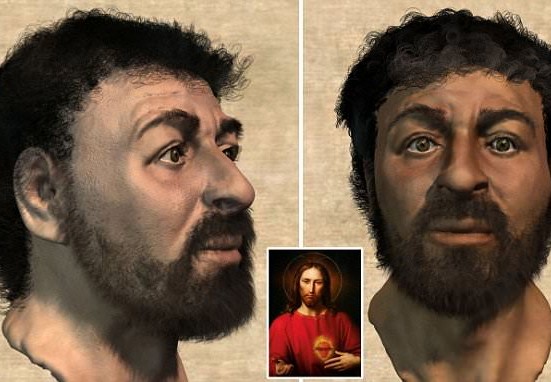 (Note of the Ed.: The face that Richard Neave constructed from skulls of typical 1st century Palestinian Jews suggests that Jesus, if he existed, must have differed significantly from the traditional depictions in Western art, which invariably ‘Nordicize’ the Semites.)
Marana tha (‘Come, Lord’) was the prayer of the first Christians. But as time passed without the Lord coming; when doubts, resignation, ridicule and discord were increasing, the radicalism of Jesus’ affirmations had to be gradually softened. And after decades and centuries, when the Lord finally did not arrive, the Church converted what in Jesus was a distant hope, his idea of the Kingdom of God, into the idea of ‘the Church’. The oldest Christian belief was thus replaced by the Kingdom of Heaven: a gigantic falsification; within Christian dogma, the most serious one.
The belief in the proximity of the end decisively conditioned the later appearance of the Proto-Christian writings in the second half of the 1st century and in the course of the 2nd century. Jesus and his disciples—who expected no hereafter and no state of transcendental bliss but the immediate intervention of God from heaven and a total change of all things on Earth—naturally had no interest in taking notes, writings, or books; for whose writing they were not even trained.
And when the New Testament authors began to write, they softened the prophecies of Jesus of a very imminent end of the world. The Christians did not live that end and this is why questions arise in all ancient literature. Scepticism and indignation spread: ‘Where, then, is his announced second coming?’ says the second Epistle of Peter. ‘Since the parents died, everything is as it has been since the beginning of creation’. And also in Clement’s first epistle the complaint arises: ‘We have already heard this in the days of our fathers, and look, we have aged and none of that has happened to us’.
Voices of that style arise shortly after the death of Jesus. And they are multiplied in the course of the centuries. And here there is how the oldest Christian author, the apostle of the peoples, Paul, reacts. If he first explained to the Corinthians that the term ‘had been set short’ and the ‘world is heading to the sunset’, ‘we will not all die, but we will all be transformed’—later he spiritualised the faith about the final times that, from year to year, became increasingly suspicious. Paul thus made the faithful internally assume the great renewal of the world, the longing for a change of eons, was fulfilled through the death and resurrection of Jesus.
Instead of the preaching of the kingdom of God, instead of the promise that this kingdom would soon emerge on Earth, Paul thus introduced individualistic ideas of the afterlife, the vita aeterna (eternal life). Christ no longer comes to the world but the believing Christian goes to him in heaven! Similarly, the gospel authors who write later soften Jesus’ prophecies about the end of the world and make the convenient corrections in the sense of a postponement. The one that goes further is Luke, who substitutes the hopeful belief for a history of divine salvation with the notion of previous stages or intermediate steps.
______ 卐 ______
Liked it? Take a second to support this site.
We need to say whom we feel opposed to—theologians and everything with theologian blood in its veins—the whole of our philosophy…
Nine percent?
At the beginning of our century some Amazonian tribes continue the practice as horribly as described above. With the advances in technology we can even watch videos on YouTube about such practices, like children being buried alive.
Let us remember the exclamation of Sahagún. The humble friar would have found it rather difficult to imagine that not only the ancient Mexicans, but all humanity had been seized by a passion for killing their little ones. Throughout his treatise on infanticide, Larry Milner mentioned several times that our species could have killed not millions, but billions of children since the emergence of Homo sapiens. At the beginning of his book Milner chose as the epigraph a quotation of Laila Williamson, an anthropologist at the American Museum of Natural History:
Infanticide has been practiced on every continent and by people on every level of cultural complexity, from hunter-gatherers to high civilizations, including our own ancestors. Rather than being an exception, then, it has been the rule.
Milner cowers in his book to avoid giving the impression that he openly condemns the parents. Before I distanced myself from deMause, in the Journal of Psychohistory of Autumn 2008 I published a critical essay-review of his treatise. My criticism aside, Milner’s words about the even more serious cowardice among other scholars is worth quoting:
As for the research into general human behavior, infanticide has been almost totally ignored. When acts of child-murder are referenced at all, they generally are passed off as some quirk or defective apparatus of an unusual place or time. Look in the index of almost all major social treatises and you will find only a rare reference to the presence of infanticide. […] Yet, the importance of understanding the reasons for infanticide is borne out by its mathematical proportions. Since man first appeared on earth about 600,000 years ago, it has been calculated that about 77 billion human babies have been born. If estimates of infanticide of 5-10 percent are true, then up to seven billion children [9 percent!] have been killed by their parents: a figure which should suffice as one of incredible importance.
Even assuming that this figure is contradicted by future studies, the anthropologist Glenn Hausfater would have agreed with Milner. In an August 1982 article of the New York Times about a conference of several specialists at the University of Cornell on animal and human infanticide, Hausfater said: “Infanticide has not received much study because it’s a repulsive subject. Many people regard it as reprehensible to even think about it…” In that same conference Sarah Blaffer Hrdy, a primatologist at Harvard said that infanticide occurs in all groups of evolved primates. Given the psychological limitations of academics, it is not surprising to see that the few who are not silent on the subject argue that the primary cause is economic. But the “economic explanation” does not explain why infanticide occurred equally among both the rich and the poor, or why it had been so frequent and sometimes even more frequent in the most prosperous periods of Rome and Carthage. The same is true about those seeking explanations about the taboos, superstitions and customs of the peoples, or the stigma attached to children born out of wedlock. None of these factors explains infanticide for the simple reason that modern Western societies have had these features and refrain from practicing it. Marvin Harris’s position is typical. Harris has calculated that among Paleolithic hunters, up to 23-50 percent of infants were put to death, and postulated that female infanticide was a form of population control. His colleagues have criticized him as a typical proponent of “environmental determinism.” If environmental determinism were true, there would have to be more sacrifice and infanticide today given the demographic explosion.
It is true that Milner fails to condemn the perpetrators. But despite his flaws, outlined in my 2008 review in deMause’s journal, the information Milner collected under a single cover is so disturbing that it made me think: What is really the human species? I have no choice but to try to ponder the question by analyzing one of the most horrendous forms of infanticide practiced over the centuries.
Historical Israel
In the past, the shadow of infanticide covered the world, but the Phoenicians and their biblical ancestors, the Canaanites, performed sacrifices that turn pale the Mesoamerican sacrifices of children.
The Tophet, located in the valley of Gehenna, was a place near Jerusalem where it is believed that children were burned alive to the god Moloch Baal. Later it became synonymous with hell, and the generic name “tophet” would be transferred to the sacrificial site of the cemetery at Carthage and other Mediterranean cities like Motya, Tharros and Hadrumetum, where bones have been found of Carthaginian and Phoenician children.
According to a traditional reading of the Bible, stories of sacrifice by the Hebrews were relapses of the chosen people to pagan customs. Recent studies, such as Jon Levenson’s The Death and Resurrection of the Beloved Son: The Transformation of Child Sacrifice in Judaism and Christianity have suggested that the ancient Hebrews did not differ much from the neighboring towns but that they were typical examples of the Semitic peoples of Canaan. The cult of Yahweh was only gradually imposed in a group while the cult of Baal was still part of the fabric of the Hebrew-Canaanite culture. Such religion had not been a syncretistic custom that the most purist Hebrews rejected from their “neighbor” Canaanites: it was part of their roots. For Israel Finkelstein, an Israeli archaeologist and academic, the writing of the book of Deuteronomy in the reign of Josiah was a milestone in the development and invention of Judaism. Josiah represents what I call one of the psychogenic mutants who firmly rejected the infanticidal psychoclass of their own people. Never mind that he and his aides had rewritten their nation’s past by idealizing the epic of Israel. More important is that they make Yahweh say—who led the captivity of his people by the Assyrians—that it was a punishment for their idolatry: which includes the burning of children. The book of Josiah’s scribes even promotes to conquer other peoples that, like the Hebrews, carried out such practices. “The nations whom you go in to dispossess,” says the Deuteronomy, “they even burn their sons and their daughters in the fire to their gods.” (12: 29-31). “When you come into the land that the Lord is giving you, you shall not learn to follow the abominable practices of those nations. There shall not be found among you anyone who burns his son or his daughter as an offering.” (18: 9-10).
This emergence, or jump to a higher psychoclass from the infanticidal, is also attested in other books of the Hebrew Bible. “The men from Babylon made Succoth Benoth, the men from Cuthah made Nergal, and the men from Hamath made Ashima; the Avvites made Nibhaz and Tartak, and the Sepharvites burned their children in the fire as sacrifices to Adrammelech and Anammelech, the gods of Sepharvaim” (2 Kings: 17: 30-31). There were kings of Judah who committed these outrages with their children too. In the 8th century B.C. the thriving king Ahaz “even sacrificed his son in the fire, following the detestable ways of the nations the Lord had driven out before the Israelites” (2 Kings 16: 1-3). Manasseh, one of the most successful kings of Judah, “burnt his son in sacrifice” (21:6). The sacrificial site also flourished under Amon, the son of Manasseh. Fortunately it was destroyed during the reign of Josiah. Josiah also destroyed the sacrificial site of the Valley of Ben Hinnom “so no one could use it to sacrifice his son or daughter in the fire to Molech” (23:10). Such destructions are like the destruction of Mesoamerican temples by the Spaniards, and for identical reasons.
Ezekiel, taken into exile to Babylon preached there to his people. He angrily chided them: “And you took your sons and daughters whom you bore to me and sacrificed them as food to the idols. Was your prostitution not enough? You slaughtered my children and made them pass through the fire” (Ezekiel 16: 20-21). The prophet tells us that from the times when his people wandered in the desert they burned their children, adding: “When you offer your gifts—making your sons pass through the fire—you continue to defile yourselves with all your idols to this day. Am I to let you inquire of me, O house of Israel? As surely as I live, declares the Lord, I will not let you inquire of me” (20:31). Other passages in Ezekiel that complain about his people’s sins appear in 20: 23-26 and 23: 37-39. A secular though Jung-inspired way of seeing God is to conceive it as how the ego of an individual’s superficial consciousness relates to the core of his own psyche: the Self. In Ezekiel’s next diatribe against his people (16: 35-38) I can hear his inner daimon, the “lord” of the man Ezekiel:
Therefore, you prostitute, hear the word of the Lord! This is what the Lord says: Because you poured out your lust and exposed your nakedness in your promiscuity with your lovers, and because of all your detestable idols, and because you gave them your children’s blood in sacrifice, therefore I am going to gather all your lovers, with whom you found pleasure, those you loved as well as those you hated. I will gather them against you from all around and will strip you in front of them, and they will see all your nakedness. I will sentence you to the punishment of women who commit adultery and who shed blood; I will bring upon you the blood vengeance of my wrath and jealous anger.
When a “prophet” (an individual who has made a leap to a higher psychoclass) maligned his inferiors, he received insults. Isaiah (57: 4-5) wrote:
Whom are you mocking? At whom do you sneer and stick out your tongue? Are you not a brood of rebels, the offspring of liars? You burn with lust among the oaks and under every spreading tree; you sacrifice your children in the ravines and under the overhanging crags.
The very psalmist complained that people sacrificed their children to idols. But what exactly were these sacrificial rites? The spoken tradition of what was to be collected in biblical texts centuries later complained that Solomon “built a high place for Chemosh, the detestable god of Moab, and for Molech, the detestable god of the Ammonites,” and that his wives made offerings to these gods (1 Kings 11: 7-8). And even from the third book of the Torah we read the commandment: “Do not give any of your children to be passed through the fire to Molech, for you must not profane the name of your God.” (Leviticus 18:21). A couple of pages later (20: 2-5) it says:
Say to the Israelites: “Any Israelite or any alien living in Israel who sacrifices any of his children to Molech must be put to death. The people of the community are to stone him. I will set my face against that man and I will cut him off from his people; for by giving his children to Molech he has defiled my sanctuary and profaned my holy name. If the people of the community close their eyes when that man gives one of his children to Molech and they fail to put him to death, I will set my face against that man and his family and will cut off from their people both him and all who follow him in prostituting themselves to Molech.”
Despite these admonitions, the influential anthropologist James Frazer interpreted some biblical passages as indicating that the god of the early Hebrews, unlike the emergent god quoted above, required sacrifices of children. After all, “God” is but the projection of the Jungian Self from a human being at a given stage of the human theodicy. Unlike Milner, a Christian frightened by the idea, I do not see it impossible that the ancient Hebrews had emerged from the infanticidal psychoclass to a more emergent one. In “The Dying God,” part three of The Golden Bough, Frazer draws our attention to these verses of Exodus (22: 29-30):
Do not hold back offerings from your granaries or your vats. You must give me the firstborn of your sons. Do the same with your cattle and your sheep. Let them stay with their mothers for seven days, but give them to me on the eighth day.
A similar passage can be read in Numbers (18: 14-15), and the following one (3: 11-13) seems especially revealing:
The Lord also said to Moses, “I have taken the Levites from among the Israelites in place of the first male offspring of every Israelite woman. The Levites are mine, for all the firstborn are mine. When I struck down all the firstborn in Egypt, I set apart for myself every firstborn in Israel, whether man or animal. They are to be mine. I am the Lord.”
The psychohistorian Howard Stein, who has written scholarly articles on Judaism since the mid-1970s, concludes in an article of 2009 that the gathered information suggests a particular interpretation. According to Stein, the substrate of fear for the slaughter “helps to explain the valency that the High Holiday have for millions of Jews worldwide,” presumably echoes of very ancient happenings: actual sacrifices by the Hebrews.
In contrast to what the evangelicals were taught in Sunday school as children, Moses did not write the Torah—it was not written before the Persian period. In fact, the most sacred book of the Jews includes four different sources. Since the 17th-century thinkers such as Spinoza and Hobbes had researched the origins of the Pentateuch, and the consensus of contemporary studies is that the final edition is dated by the 5th century B.C. (the biblical Moses, assuming he existed, would have lived in the 13th century B.C.). Taking into account the contradictions and inconsistencies in the Bible—for example, Isaiah, who belonged to a much more evolved psychoclass, even abhorred animal sacrifice—it should not surprise us that the first chapter of Leviticus consists only of animal sacrifices. The “Lord” called them holocausts to be offered at the entrance of the Tent of Meeting. After killing, skinning and butchering the poor animal, the priest incinerates everything on the altar “as a burnt offering to the Lord; it is a pleasing aroma, a special gift presented to the Lord.” A phrase that is repeated three times in that first chapter, it also appears in subsequent chapters and reminds me those words by Cortés to Charles V about the Mesoamerican sacrifices (“They take many girls and boys and even adults, and in the presence of these idols they open their chests while they are still alive and take out their hearts and entrails and burn them before the idols, offering the smoke as the sacrifice.”) In the book of Exodus (34:20) even the emerging transition of child sacrifice to lamb sacrifice can be guessed in some passages, what gave rise to the legend of Abraham:
For the first foal of a donkey, they should give a lamb or a goat instead of the ass, but if you do not give, you break the neck of the donkey. You must also give an offering instead of each eldest child. And no one is to appear before me empty-handed.
Compared with other infanticidal peoples the projection of the demanding father had been identical, but the emergency to a less dissociated layer of the human psyche is clearly visible. As noted by Jaynes, the Bible is a treasure to keep track of the greatest psychogenic change in history. The Hebrews sacrificed their children just as other peoples, but eventually they would leave behind the barbaric practice.
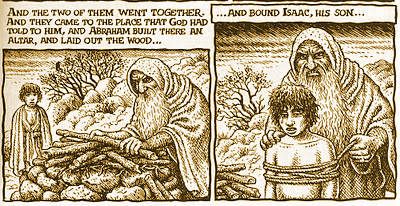
After captivity in the comparatively more civilized Babylon in 586 B.C., the Jews abandoned their practices. In his book King Manasseh and Child Sacrifice: Biblical Distortions of Historical Realities, published in 2004, Francesca Stavrakopoulou argues that child sacrifice was part of the worship of Yahweh, and that the practice was condemned only after the exile. Like their Christian successors, the Jews had sublimated their filicidal impulses in the Passover ritual. Each year they celebrate the liberation of their people and remember how Yahweh killed the firstborn Egyptians: legendary resonance of the habit of killing one’s eldest son.
But the biblical Moloch (in Hebrew without vowels, mlk), represented as a human figure with a bull’s head was not only a Canaanite god. It also was a god of the descendants of the Canaanites, the Phoenicians. The founding myth of Moloch was similar to that of many other religions: sacrifices were compensation for a catastrophe from the beginning of time. Above I said that Plutarch, Tertullian, Orosius, Philo, Cleitarchus and Diodorus Siculus mentioned the practice of the burning children to Moloch in Carthage, but refrained from wielding the most disturbing details. Diodorus says that every child who was placed in the outstretched hands of Moloch fell through the open mouth of the heated bronze statue, into the fire. When at the beginning of the 3rd century B.C. Agathocles defeated Carthage the Carthaginians began to burn their children in a huge sacrifice as a tactical “defense” before the enemy. The sources mention three hundred incinerated children. If I had made a career as a film director, I would feel obliged to visually show humanity its infamous past by filming the huge bronze statue, heated red-hot while the Greek troops besieged the city, gobbling child after child: who would be sliding to the bottom of the flaming chimney. In addition to Carthage, the worship of Moloch, whose ritual was held outdoors, was widespread in other Phoenician cities. He was widely worshiped in the Middle East and in the Punic cultures of the time, including several Semitic peoples and as far as the Etruscans. Various sacrificial tophets have been found in North Africa, Sicily, Sardinia, Malta, outside Tyre and at a temple of Amman.
Terracotta urns containing the cremated remains of children, discovered in 1817, have been photographed numerous times. However, since the late 1980s some Italian teachers began to question the historicity of the accounts of classical writers. Tunisian nationalists took advantage, including the president whose palace near the suburban sea is very close the ruins of the ancient city of Carthage. The Tunisian tourist guides even make foreigners believe that the Carthaginians did not perform sacrifices (something similar to what some ignorant Mexican tourist guides do in Chiapas). Traditional historians argue that the fact that the remains are from very young children suggests sacrifice, not cremation by natural death as alleged by the revisionists. The sacrificial interpretation of Carthage is also suggested by the fact that, along with the children, there are charred remains of lambs (remember the biblical quote that an evolved Yahweh says that the slaughter of sheep was a barter for the firstborn). This suggests that some Carthaginians replaced animals in the sacrificial rite: data inconsistent with the revisionist theory that the tophet was a normal cemetery. Furthermore, the word mlk (Moloch) appears in many stelae as a dedication to this god. If they were simple burials, it would not make sense to find those stelae dedicated to the fire god: common graves are not inscribed as offerings to the gods. Finally, although classical writers were staunch enemies of the Carthaginians, historical violence is exerted by rejecting all their testimonies, from Alexander’s time to the Common Era. The revisionism on Carthage has been a phenomenon that is not part of new archaeological discoveries, or newly discovered ancient texts. The revisionists simply put into question the veracity of the accounts of classical writers, and they try to rationalize the archaeological data by stressing our credulity to the breaking point. Brian Garnand, of the University of Chicago, concluded in his monograph on the Phoenician sacrifice that “the distinguished scholars of the ridimensionamento [revisionism] have not proven their case.”
However, I must say that the revisionists do not bother me. What I cannot tolerate are those subjects who, while accepting the reality of the Carthaginian sacrifice, idealize it. On September 1, 1987 an article in the New York Times, “Relics of Carthage Show Brutality Amid the Good Life” contains this nefarious phrase: “Some scholars assert, the practice of infanticide helped produce Carthage’s great wealth and its flowering of artistic achievement.” The memory of these sacrificed children has not really been vindicated even by present-day standards.
The Carthaginian tophet is the largest cemetery of humans, actually of boys and girls, ever discovered. After the Third Punic War Rome forced the Carthaginians to learn Latin, just as the Spanish imposed their language on the conquered Mexicans. Personally, what most alarms me is that there is evidence in the tophets of remains of tens of thousands of children sacrificed by fire over so many centuries. I cannot tremble more in imagining what would have been of our civilization had the Semitic Hannibal reached Rome.
Lately I’ve had contact with a child that a couple of days ago has turned six years old and who loves his mother very much. I confess that to imagine what a Carthaginian boy of the same age would have felt when his dear papa handed him over to the imposing bronze statue with a Bull’s head; to imagine what he would have felt for such treachery as he writhed with infinite pain in the fired oven, moved me to write this last chapter. Although my parents did not physically kill me (only shattered my soul), every time I come across stories about sacrificed firstborns, it’s hard not to touch my inner fiber.
In the final book of this work I will return to my autobiography, and we will see if after this type of findings humanity has the right to exist.
___________
The objective of Day of Wrath is to present to the racialist community my philosophy of The Four Words on how to eliminate all unnecessary suffering. If life allows, next time I will reproduce the final chapter. Day of Wrath will be available again through Amazon Books.

‘Those who make peaceful revolution impossible will make violent revolution inevitable’.
—John F. Kennedy
This month will be one year after the event in Charlottesville, which incidentally happened on my birthday: an ambush on the white nationalists of the United States in which the government of the state of Virginia colluded with the antifa and the media. If there is one thing that emerges from that day, it is that the System has decided to make a peaceful revolution impossible. They were able to violate their own laws and decree a state of emergency in order to sabotage the right of peaceful assembly of those protesting against the government’s decision to remove a Confederate statue.
With the hindsight of a year later it should be increasingly obvious that the System itself is telling us that there is no other way but violent revolution. I have spoken with Norman Spear and Joseph Walsh about this matter via Skype. Although I disagree with Spear that the federal government of the USA would never allow, in my opinion, a Neo-Nazi state as Covington dreamed in the Northwest, his Twitter account is a treasure trove of FAQs on how to make a Revolution.
Using chess terms I would say that I disagree with Spear’s ultimate strategy. In my humble opinion, the strategy should be to checkmate Uncle Sam à la Turner Diaries. But we completely agree on tactics about what guerrilla fighters should start learning right now.
The following is not a formal post but rather a comment that I chose to put here rather than on this thread, where it belongs.
______ 卐 ______
Obviously, we see the world in a very different way.
The mere fact that Rome changed from Republic to Empire was a voluntary surrender to evil, as Brutus and his followers saw it. Julius Caesar should be one of the most reviled figures in Western history.
Believing the Jews was explicable among the envious non-whites around Rome. But for a white Roman to believe them, and allowing being baptized, was a sin as Julian the Apostate saw it.
Following Constantine and the next Christian emperors was voluntary surrender to evil, as philosophers like Libanius saw it.
Once Christianity was established, having burned the libraries of classical knowledge was voluntary surrender to evil. To have broken the statues that represented the divine beauty of the Aryan race was voluntary surrender to evil (for a list of these atrocities see: here).
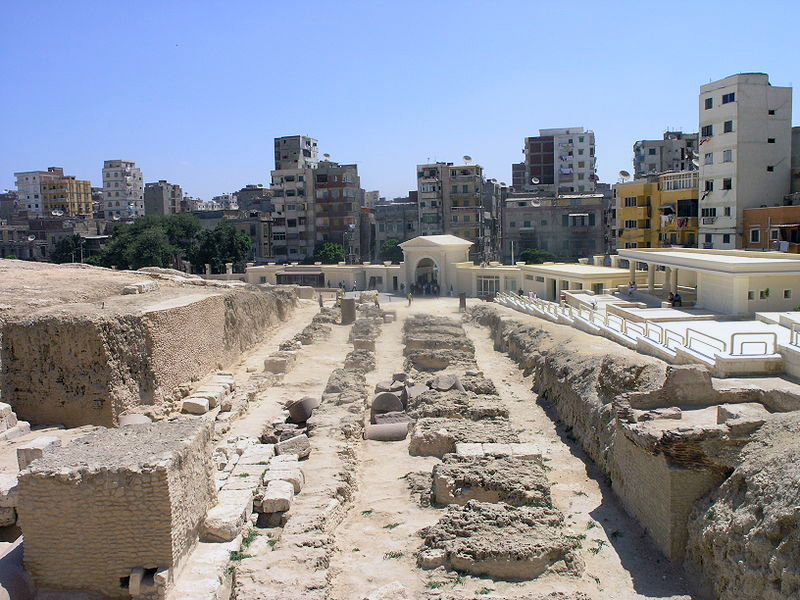 To have destroyed the temples, including the most beautiful building of Alexandria and another one, one of the Seven Wonders of the Ancient World leaving only these ruins in the respective two cases, was voluntary surrender to evil.
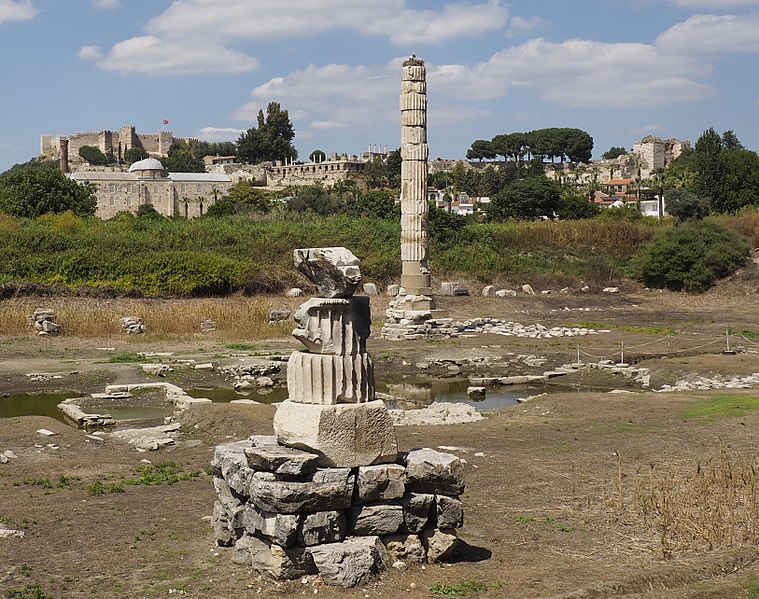 The fact that whites repudiated the healthy religion of the Hellenes and accepted the idea of eternal torture by fire, even for unbaptized infants, was such a massive and astronomical voluntary surrender to evil, that it is most likely that their little race will perish due to such a sin.
That the so-called secularized whites of today are incapable of healing psychically, and continue to believe the lies of the Jews and Christian ethics, is voluntary surrender to evil.
As Axe of Perun says, with the historical and exegetical tools at our disposal today there is no excuse. Nationalists could repudiate the perfidy of their own parents—their religion—; the ethics that accompany it, as well as its secular offshoot from the late 18th century. Not doing so is voluntary surrender to evil. And there are hundreds of white nationalists who think they’re good but deep down they’re bad. (That’s why the first pages of my Day of Wrath start with the example of Greggy’s ethics.)
If there is something that emerges from my Hojas Susurrantes and ¿Me Ayudarás? it’s to frame the discourse in ethical terms—if we are to save the West from the extermination in progress. But that can only be done with the complete collapse of the USA and through the acute suffering that, for decades, white sinners shall suffer: a dark night for the soul, a window of opportunity to amend one’s own ways.
As Pierce said about the common American, so surrendered to evil, ‘The only way to persuade the population of this country that they need to change their ways is to give them a good, hard boot in the ass—about 600 times. They need to be reprogrammed, and that takes order and discipline, not books or leaflets…’
What does Christianity mean today? National Socialism is a religion. All we lack is a religious genius capable of uprooting outmoded religious practices and putting new ones in their place. We lack traditions and ritual. One day soon National Socialism will be the religion of all Germans. My Party is my church, and I believe I serve the Lord best if I do his will, and liberate my oppressed people from the fetters of slavery. That is my gospel.
—Joseph Goebbels
National Socialist and Christian concepts are incompatible.
— Martin Bormann
There’s an old saying: “Judge them by the company they keep.” Hitler surrounded himself with openly rabid anti-Christians like Himmler, Bormann, Rosenberg, Goebbels and Heydrich. Hardly the people a devout Christian would want to be around.
—VNN commenter