Wikipedia is horrible about racial issues and about the Jewish question: true enemy territory. But in neutral articles such as science, engineering, computing and even putting pseudosciences in place, it can be a good resource for consultation. In 2004, the article on the Shroud of Turin became ‘a featured article’ on Wikipedia: the maximum decoration offered to an article in that online encyclopaedia. Over the years, many Christians began to get their hands on it and currently it is not even considered a ‘good article’, the previous step to convert the Wiki article into a featured one by the standards of that encyclopaedia.
Although I cannot recommend the current article as a good introduction to the subject, such an article may still be useful for those who wish to know the latest research that the sindonologists do to the shroud (for example, three days ago they made a modification to the article). In the following posts I will be quoting passages from one of the best books that have been written about the shroud: something much better than even the featured article of the Wiki in 2004.
From the comments of the previous article, I think the concept of ‘falsifiability’ and what pseudosciences really are has not become crystal-clear. Many use the expression ‘it is pseudoscience!’ more as an epithet than to designate a real pseudoscience. For example, a Dr. Morales from Brazil who commented here recently used that word to refer to raciology. Neither Dr. Morales nor many anti-racists seem to have any notion of the litmus tests that distinguish between true and false science: falsifiability and Occam’s razor.
I know them, because before blogging I dedicated myself to question the beliefs of my father, who inculcated in me the Turin shroud thing; and in my struggles against the parental introjects I had to subscribe, for years, to the Skeptical Inquirer; buy dozens of books from Prometheus Books, have correspondence with some sceptics (which I will quote in future instalments of this series) and even attend their conferences. I currently know how to distinguish between true and false science; and I think that WDH visitors could benefit from my knowledge prior to my discovery of white nationalism in 2009.
But let’s go back to the Wikipedia article. Although, as I said, it is no longer a featured article, one of the passages that I would consider good is the lead paragraph with which the article opens:
The Shroud of Turin or Turin Shroud (Italian: Sindone di Torino, Sacra Sindone or Santa Sindone) is a length of linen cloth bearing the negative image of a man who is alleged to be Jesus of Nazareth. It is kept in the royal chapel of the Cathedral of Saint John the Baptist in Turin, northern Italy. The cloth itself is believed by some to be the burial shroud that Jesus was wrapped in when he was buried after crucifixion. It is first securely attested in 1390, when a local bishop wrote that the shroud was a forgery and that an unnamed artist had confessed. Radiocarbon dating of a sample of the shroud material is consistent with this date.
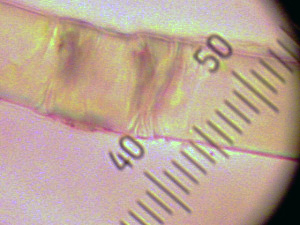
(Phase contrast microscopic view of image-bearing fibber from the Shroud of Turin during the Carbon 14 test.)
The Catholic Church has neither formally endorsed nor rejected the shroud, but in 1958 Pope Pius XII approved of the image in association with the devotion to the Holy Face of Jesus. Pope John Paul II called the Shroud “a mirror of the Gospel”. Other Christian denominations, such as Anglicans and Methodists, have also shown devotion to the Shroud of Turin.
Diverse arguments have been made in scientific and popular publications claiming to prove that the cloth is the authentic burial shroud of Jesus, based on disciplines ranging from chemistry to biology and medical forensics to optical image analysis.
In 1988, three radiocarbon dating tests dated a corner piece of the shroud from the Middle Ages,[5] between the years 1260 and 1390. Some shroud researchers have challenged the dating, arguing the results were skewed by the introduction of material from the Middle Ages to the portion of the shroud used for radiocarbon dating. However, all of the scientific hypotheses used to challenge the radiocarbon dating have been scientifically refuted,[1][2][3] including the medieval repair hypothesis [4][5][6], the bio-contamination hypothesis[7] and the carbon monoxide hypothesis.[5]
The image on the shroud is much clearer in black-and-white negative than in its natural sepia color, and this negative image was first observed in 1898 on the reverse photographic plate of amateur photographer Secondo Pia, who was allowed to photograph it while it was being exhibited. A variety of methods have been proposed for the formation of the image, but the actual method used has not yet been conclusively identified. Despite numerous investigations and tests, the status of the Shroud of Turin remains murky, and the nature of the image and how it was fixed on the cloth remain puzzling.
The shroud continues to be both intensely studied and controversial.
Unlike screaming the ‘pseudoscience!’ wolf as irresponsible anti-racists do when they listen to us, sindonology is a true case of a pseudoscientific field of research. I do not mean the laboratories that did the Carbon 14 tests, obviously: but the Christian sindonologists. In popular publications some of them preach, with apologist fervour, that the Turin relic is the shroud that wrapped ‘the Body of Our Lord’ to use their language. And as we saw in the previous instalment, many wield the mystery of the image—that even the lead paragraph of the Wiki article acknowledges—as proof of the most important article of faith in Christendom: the Resurrection.
I hope that when I finish this series on the shroud of Turin, with this paradigm it will become crystal-clear what a pseudoscience really is.
________________
[1] Chivers, Tom (20 December 2011). ‘The Turin Shroud is fake. Get over it’. Daily Telegraph.
[2] Christopher Ramsey, ‘The Shroud of Turin’, Oxford Radiocarbon Accelerator Unit, March 2008.
[3] Radiocarbon Dating, Second Edition: An Archaeological Perspective, By R.E. Taylor, Ofer Bar-Yosef, Routledge 2016; pg. 167-168.
[4] R.A. Freer-Waters, A.J.T. Jull, ‘Investigating a Dated piece of the Shroud of Turin’, Radiocarbon, 52, 2010, pp. 1521–1527.
[5] Schafersman, Steven D. (14 March 2005). ‘A Skeptical Response to Studies on the Radiocarbon Sample from the Shroud of Turin by Raymond N. Rogers’ (available online: here).
[6] The Shroud, by Ian Wilson; Random House, 2010, pgs. 130-131.
[7] Gove, H. E. (1990). ‘Dating the Turin Shroud: An Assessment’. Radiocarbon. 32 (1): 87–92.