web analytics
Categories
Daybreak Publishing Kriminalgeschichte des Christentums (books)

I’ve changed my mind

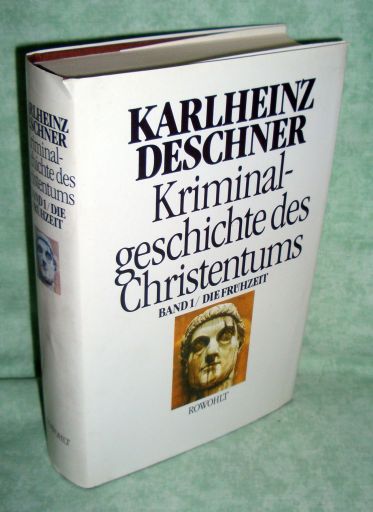
I had said that the revised edition of the first volume of our abridged translation of Karlheinz Deschner’s criminal history of Christianity would cover the origins of Judeo-Christianity up to Charlemagne.

Now that I have just finished proofreading up to the time of Emperor Justinian of Constantinople, I realised that it is better to finish the first volume up to that monarch and leave the rest of the High Middle Ages (roughly from the 6th to the 10th century) for the second volume.

As I am thinking in editorial terms for my Daybreak Press, I think the cover of the first volume should have the face of Constantine; and the second volume, the face of Charlemagne.

So the revised edition of the first volume will soon be ready and its PDF will be available on this site, and we will continue working on what we still have to translate for volume II.

To give the visitor an idea of what we have translated so far for this site, here is the table of contents:
 

CONTENTS

Editor’s foreword

Introduction

Forgeries in the Old Testament

The bibles
The five books that Moses did not write
David and Solomon
Joshua and Isaiah
Ezekiel and Daniel
The Jewish apocalyptic
Portrayals of the biblical female world
Opposition to the Old Testament
Forgeries in diaspora Judaism

Forgeries in the New Testament

The scriptures are piled up
God as the author?
Christians forged more consciously than Jews
Neither the Gospel of Matthew, nor the Gospel of John,
nor John’s Book of Revelation come from the apostles to
whom the Church attributes them
Forged epistles of ‘Paul’
The second epistle to the Thessalonians
Colossians, Ephesians and Hebrews
Forged epistles of Peter
Forged John and James
Interpolations in the New Testament

The invention of Popes

There is no evidence of Peter’s stay in Rome
The story of the discovery of Peter’s tomb
The list of fabricated Roman bishops

 
Christianity’s Criminal History:

Background in the Old Testament

Moses and the Book of Judges
The ravages of David and the modern translators
The sacred warmongering of the Maccabees
The Jewish War (66-70)
Bar Kokhba and the ‘last war of God’ (131-136)
The Jewish religion, tolerated by the Roman state

Early Christianity

Interpretatio Christiana
‘Orthodoxy’ and ‘heresy’
First ‘heretics’ in the New Testament
Thirteen good Christians
Saint Jerome and Origen

The persecution of the Christians

Anti-Hellene hatred in the New Testament
The defamation of the Greco-Roman religion
Celsus and Porphyry
The persecution of the Christians
Most of the written statements about the martyrs are false,
but all of them were considered as valid documents
The Roman emperors viewed retrospectively

Saint Constantine: The First Christian Emperor

War against Maxentius
War against Maximinus
War against Licinius
The Catholic clergy increasingly favoured
Constantine as saviour and vicar of God
No longer a pacifist Church
Savage criminal practices
Constantine against Jews and ‘heretics’
Constantine against the Greco-Roman culture

Constantine’s successors

The first Christian dynasty founded
on family extermination
First wars among devout Christians
Constantius and his Christian-style government
A father of the Church who preaches killing
First assaults on the temples

Julian

Hecatombs under the pious Gallus
Emperor Julian
Christian tall stories

After Julian

Rivers of blood under the Catholic Valentinian
Trembling and gnashing of teeth under the Arian Valens

Athanasius, Doctor of the Church

The complicated nature of God
It was not fought for faith but for power
The Council of Nicaea
Character and tactics of a Father of the Church
The death of Arius
The battlefield of Alexandria
Antioch and Constantinople
Shelter with a twenty-year-old beauty

Ambrose, doctor of the Church

Ambrose drives the annihilation of the Goths
Emperor Theodosius ‘the Great’
Against the Hellenist religion

The Father of the Church Augustine

‘Genius in all fields of Christian doctrine’
Augustine’s campaign against the Donatists
The overthrow of Pelagius
Augustine attacks classical culture
Augustine sanctions the holy war
Christianity sanctions the mistreatment of animals

The Christian Book Burning and the
Annihilation of Classical Culture

The annihilation of the Greco-Roman world
The oldest Christianity is hostile to education
The Christian ideal: the inversion of values
The hostility to culture of the first Greco-Christian writers
The hostility to classics in early Latin-Christian writers
The theatre, ‘The temple of the devil’
Natural Science
Everything a person needs to know is contained in the Bible
The Western world darkens more and more

The Catholic ‘children emperors’

The division of the Empire: Two Catholic states emerge
The massacre of Goths in Constantinople
Alaric enters Rome

Justinian (527-565): A theologian on the imperial
throne

Justin: From pigman to Catholic emperor (518-527)
Emperor Justinian, dominator of the Church
The Vandal state
The great beneficiary of all that hell: The Roman Church

 
The Middle Ages

A panoramic view

From convinced subjects to convinced lords

The Christianisation of the Germans

The spread of Christianity in the West
Conversion methods
Jesus becomes the Germanic broadsword
The weed of the past
‘Demonstrative destruction’

Clovis, founder of the Great Frankish Empire

The Rise of the Merovingians
A great bloodbath and the German Church
A moralistic assessment of history?

The sons of Clovis

The division of the kingdom
A saint and murderer
Theudebert I and kings killer

The Invasion of the Lombards

The last Merovingians
The Conversion of the Visigoths to Catholicism

Pope Gregory I (590-604)

The flight from the world
The man of double standards
Thinking differently: a crime worthy of death
Use and abuse of slaves as livestock
The beginning of papal propaganda in England
Pope Gregory’s books

The Christianisation of the idea of king

The Christianisation of the idea of kingship
Mission and slaughter

The Church in the Merovingian Period

A kind of holy cancerous ulcer
Ignorant, criminal and a good Catholic
St Gregory of Tours
The throne and the altar

The Ascension of the Carolingians

Armed mission among the Frisians
The irruption of Islam

St Boniface, ‘Apostle of the Germans’ and of Rome

Deliverance from ‘all uncleanness’
The dispute over images begins
The papal revolution fails

Charles I, known as The Great or Charlemagne

Papal negotiations
The most momentous event of the Middle Ages
Criminal excesses at the papal court
The beginning of the pro-pope warfare
The bloody mission of the Saxons (772-804)
Plunder and Christianisation
The Christian banners enter Saxony
A mission along military shock lines
The butcher of the Saxons
Last uprisings, war of annihilation
Charlemagne’s bloody laws
Karolus serenissimus augustus


Appendix: Constantine controversy

‘Response given’ by Hermann Gieselbusch
Deschner responds to Maria R.-Alföldi


______ 卐 ______


Regarding the way I rearranged Deschner’s books, as can be seen in the index above, he published his Vol. 3, Die Alte Kirche (full title: The Ancient Church: forgery, brain-washing, exploitation, annihilation) in 1990, from which I took the passages of the first couple of chapters of our abridged Vol I. Twenty years later, biblical scholar Bart D. Ehrman published Forged: Writing in the Name of God: Why the Bible’s Authors Are Not Who We Think They Are, pictured left.
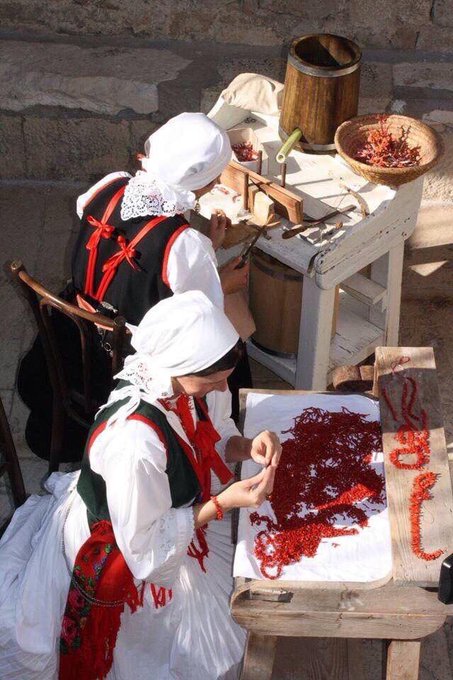
European beauty

Croatia 2021

Categories
2001: A Space Odyssey (movie) Art Film

60K words article!

‘Jews control Hollywood and make movies for themselves that the dumb white gentiles believe to be about them.’

You may read this article, nay a mini-book, on The Unz Review here.

In the comments section we learn that the mini-book is full of typos, and there’s another comment I agree about ‘the late great Stanley Kubrick.’ He wrote: ‘2001 a Space Odyssey ASO is the greatest work of art ever made by a human being.’ But what does ‘ASO’ stand for? (remember, I am not a native English speaker).

Categories
Racial right Vegetarianism

Jef Costello’s article

The article ‘American Renaissance 2022’ published yesterday on Counter-Currents contains a few passages I would like to say something about:


What can explain such madness—this moral fanaticism coupled with hatred of one’s own? Taylor noted that white people seem to have a compulsion to throw themselves into virtuous causes… But the real mystery is why whites are attracted to causes that are anti-white—why, as Taylor put it, they ‘make a fetish out of opposing their own people.’ We simply do not see this at all in other races. Is there any other race that campaigns for other races to the detriment of its own? Why are we the only race that gets a dopamine surge from hating ourselves? So far as I can see, Taylor did not really offer a theory that might explain this most mysterious aspect of whites.

One of the things I have noticed is that there is no dialogue between our position, which we call here the priesthood of the 14 words, and the American white nationalists. That which Taylor and Costello find so mysterious has been answered ad nauseam on this site, and the PDFs in the featured post explain our POV didactically.

But let’s say it for the umpteenth time: whites didn’t do these suicidal follies prior to Christianity. There is nothing wrong with the ‘hardware’ of whites: only their ‘software’: the Christian ethics that even atheists suffer from. In his article Costello quotes D. H. Lawrence: ‘In attempting to convert the dark man to the white man’s way of life, the white man has fallen helplessly down the hole he wanted to fill up. Seeking to save another man’s soul [italics added], the white man lost his own, and collapsed upon himself.’

Christian ethics! But Costello doesn’t connect the dots. He also tells us:

A further characteristic they [the leftists] exhibit is hatred—not just hatred for their political enemies, but for strength, health, beauty, achievement, masculinity, femininity, family, hierarchy, religion, meat [italics added], and much else. In short, a hatred for life itself.

Nationalists might argue that The West’s Darkest Hour is such an obscure forum that hardly anyone reads it. But the above passage shows that these American racialists also don’t bother to educate themselves about the big movement that preceded them: German National Socialism. About those words I italicised, does Costello know what Hitler and his close associates thought of Christianity? Or how Hitler wanted to close the slaughter-houses after winning the war? I mention these two things—religion, meat—because Hitler was closer to today’s vegans than to the old-fashioned American racialists, Christian or not, who still sympathise with Christianity and eat meat.

American racialists will continue to tell themselves such things in their conferences (‘Oh mystery! Why are we doing these things to ourselves?’) if they don’t have the decorum to listen to voices other than their own.

I didn’t want to add more entries this month because I’m way behind in proofreading Karlheinz Deschner’s book on the real history of Christianity (I’m only on page 120 in a text of more than 400 pages). But Costello’s article motivated me to respond to him and the racial right of the neighbouring country to the north.

Categories
American Revolutionary War Americanism Individualism Racial right

Sam Dickson at AmRen

I am still reading Deschner’s book before publishing, in PDF, the 2022 edition. It is slow work that takes me about a chapter a day.

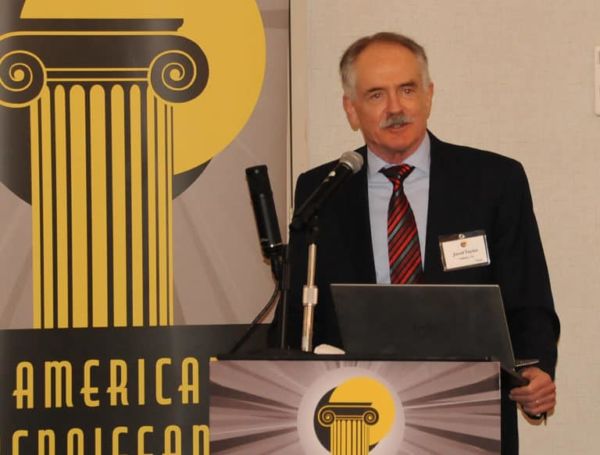
The annual American Renaissance conference recently took place, from which I would like to quote an abstract of the last of its papers according to the AmRen staff article:

Sam Dickson concluded the conference, as he always does. He said that aspects of our national history are difficult problems for whites. He said the American Revolution may have been a mistake, as it divided the British and American people. He also argued American culture favors too much materialism, opposes the frank and necessary use of state power, and often gives Americans the “easy way out,” of just moving away. Mr. Dickson argued that Americans are the descendants of men and women who uprooted themselves in the name of personal fortune-seeking rather than staying loyal to places their families had lived for centuries. This makes our people dangerously individualist and leaves them with only shallow roots and traditions.

Mr. Dickson argues that this easy-way-out mentality means that Americans have always avoided hard choices. Southern slaveholders were never willing to free the slaves and send them back to Africa to build a nation of their own, even though compensated emancipation and colonization would have cost the nation a fraction of the cost of the Civil War. We must delay hard choices no longer. We need a home of our own. Mr. Dickson said that if whites don’t meet this historical challenge to secure self-determination, our children will pay ever higher costs. There remains only one question: How high a price will we have to pay?

I doubt that anyone at that conference was thinking, when listening to Sam, of prices that reach the fiction of The Turner Diaries

Categories
Currency crash Daybreak Publishing Sponsor

Yet another proofreading…

Yesterday The Occidental Observer published an article in which the author says that the results of the recent midterm elections are due to the fact that Americans are still in a comfort zone, and that they won’t change their paradigm until the dollar collapses (just as the Germans of the degenerate Weimar period didn’t change until their mark hyperinflated).

However, there is a phrase of the author with which I disagree: ‘I don’t want to see anyone suffer.’

Only suffering saves! For example, only the enormous suffering, inflicted by my father’s Catholic beliefs, led me to apostatise from Christianity. If my teenage life hadn’t been completely shattered, as my foreword to the forthcoming edition of Deschner’s book begins, I wouldn’t now have such a negative image of our parents’ religion.

So I hope that the times ahead with the collapse of the dollar will drag the desperate to awaken. (It is time to think about buying silver coins: the recent FTX disaster is deeper than you think: huge losses are coming for all cryptocurrencies).

Changing the subject, the backbone of this site is its books, which after the printer that published them for me refused to reprint them, are now only available as PDFs. Before I post a link to the PDF of the enlarged edition of Christianity’s Criminal History which incorporates blog posts 101-172 of that series, I will do a review reading.

That means that I will not add new entries here until I finish reading all 441 pages of the book. However, visitors can entertain themselves in the meantime. As our friend Ørdnung said yesterday on Twitter, ‘[C.T.] just released an excellent compendium of exterminationist thought. Read it here [link].’

Please note that, as I have no printing press at the moment, I am not earning a single penny from these books which I am offering free to visitors to The West’s Darkest Hour. A donation, however modest, is always appreciated. Although I still maintain my Bitcoin and Monero accounts, my PayPal account is still working.

Categories
Daybreak Publishing Kriminalgeschichte des Christentums (books)

Kriminalgeschichte 2022!

 
EDITOR’S FOREWORD
[pages 5-8 of the forthcoming Edition]

In his after-dinner conversations Hitler said: ‘Christianity is the greatest regression humanity has ever experienced: The Jew has thrown back humanity one and a half thousand years’. And the Romanian philosopher Emil Cioran, who once described himself as a Hitlerist, wrote: ‘The whole world has forgiven Christianity.’

Well, not the whole world. As I confess in my philosophical autobiography De Jesús a Hitler, Christianity played a central role in the destruction of my teenage life and my twenties, something I will never forgive…
 

Some clarifications

Aleksandr Solzhenitsyn, who was a Christian, wisely allowed Edward Ericson to abbreviate The Gulag Archipelago so that the heavy volumes of the original work could reach a wider audience in a single, readable tome. The present book, Christianity’s Criminal History: Volume I is an abridged translation of the first volumes of Karlheinz Deschner’s Kriminalgeschichte des Christentums. The original German volumes, and also the Spanish translation I have used, contain thousands of endnotes, which are omitted here. This preliminary translation is only the first step towards a more formal German-English translation of Deschner’s maximum opus.

In this abridged translation I have added a few headings, as well as several illustrations with footnotes explaining them, and brackets translating German or Latin terms. Unlike Ericson’s abridgement of the Archipelago, sometimes I have omitted ellipses between unquoted paragraphs, and I have simplified some sentences. I have also replaced some words. I refer to the phrases where the author uses the word ‘pagan’. I replaced it with terms such as ‘Hellenes,’ ‘defenders of Greco-Roman culture,’ ‘classical culture’ or simply added inverted commas on the word ‘pagan.’

The term I have chosen, Hellenes, requires some clarification. It could not be more significant that before the introduction of the pejorative term pagan to refer to unconverted citizens of the Roman Empire, whites were called héllenes or éthne by 4th-century treatises (the expression hellénon éthne can be translated into modern English as ‘the Greek races,’ i.e. the white peoples). As I am aware of the rhetorical use of language, instead of the author’s pejorative term ‘pagan’ I have sometimes chosen the non-pejorative term common in the 4th century vernacular, ‘Hellenes.’

White nationalists claim to be quite informed on the Jewish question. But very few are aware that Jewish subversion began with Christianity, as Hitler said in the opening lines of this preface. Who among today’s nationalists knows the true history of the religion of their parents? Who is aware that Christian fanatics used violence to destroy the ‘pagan’ (i.e., the Greco-Roman world)? Yes: Deschner wrote in German. But how many English-speaking racialists are familiar with Catherine Nixey’s The Darkening Age: The Christian Destruction of the Classical World, published in 2017?

Independently of the nationalists and the racial right, virtually all Westerners ignore the apocalyptic catastrophe of early Christianity after Constantine handed over the Roman Empire to his bishops. They know only the myths of the martyrs (see the chapter ‘The Persecution of the Christians’ in this book), the pious legends, hagiographies and the New Testament fictional tales we were told as children: topics covered in the first section of this abridged translation.

Karlheinz Deschner (1924-2014) was a liberal German. He spent the first sixty years of his life researching the history of the Catholic Church before beginning the ten volumes of his Kriminalgeschichte series in 1986, which he completed in 2013. The series is an encyclopaedic treatise on the true history of Christianity.

I started reading Deschner at the beginning of this century, when I was a liberal, and I would not wake up to the Jewish question until 2010. But Deschner, like all Germans of our time who aspire to see his books in bookshops, never woke up. In his Kriminalgeschichte he went so far as to harshly criticise the anti-Semites of the Early Church: passages omitted in this abridgement. This said, the difference between Deschner and liberal theologians like Hans Küng (The Church) and conservative historians like Paul Johnson (A History of Christianity) is that Küng and Johnson concealed a great deal of the criminal history of Christianity. It is remarkable how Deschner, a scholar who like me became an apostate, was able to see Church history in a way that Küng, Johnson and a veritable galaxy of other Christian scholars would never dream of. After waking up to the reality of the Christian problem I realised that Deschner’s massive work, despite his liberal bias, could be rescued. It just has to be processed through the prism of someone who is racially awake. Of course: if Germany had won the war, Deschner, shown here in National Socialist uniform as a young man, could have written his story from our point of view.
 

Three German holocausts

More than one holocaust with millions of victims each has been perpetrated against the Germanic peoples. After 1945, the Allies killed millions of defenceless Germans (see, for example, Thomas Goodrich’s Hellstorm: The Death of Nazi Germany: 1944-1947). This is the best-kept secret of modern history. Conversely, the genocide committed in Germany during the Thirty Years’ War by fanatic Catholics is fairly well known (in the next volume of our abridgement we will incorporate those chapters). But who knows about the millions of other Germanic peoples killed by Emperor Justinian, recounted in this volume?

If the Aryan Man is currently committing ethnosuicide, it is because the System has lied to him about his own History.[1] The System’s favourite method is what we might call lying by omission: not saying, for example, a word about what happened to the Germans in 1945-1947, or how Christianity was imposed on the white race by Constantine and his successors. It was not enough for the Imperial Church to destroy the Greco-Roman world in the 4th and 5th centuries. In the 6th century, after the fall of Rome, Justinian, the Emperor of Constantinople went on to commit a gigantic genocide of the Germanic race, which by then had established itself on the Italian peninsula. Deschner’s chapter on this Holocaust appears in his second volume, Die Spätantike (Late Antiquity), published in 1989. The full title in translation is: ‘Late Antiquity. From the Catholic “child emperors” to the extermination of the Arian Vandals and Ostrogoths under Justinian I (527-565).’ These were the two Germanic peoples that were exterminated during the Byzantine Empire’s military incursion into Italy and Africa (no wonder there are few pure Germanic peoples in those regions today).

Finally, Deschner died in the same year that Richard Carrier published a book which will be considered the most important book since Hermann Samuel Reimarus’ critical approach to the Gospels. I refer to Carrier’s On the Historicity of Jesus: Why We Might Have Reason for Doubt. Deschner did not have the opportunity to evaluate the Christ myth theory in its phase of full exegetical maturity. For a new history of Christianity to be complete, Deschner’s criminal history must be complemented by Carrier’s ongoing work, and even our axiological critique of Christianity (see our booklist on page 3).

César Tort
November 2022

____________

[1] See ‘Foundation Myth’ on pages 90-93 of On Exterminationism.

Categories
Ethnic cleansing Miscegenation

Basket case

by Mauricio

There would be little consequence for a racial awakening of the Hispanics.

For the Hispanic world to become racially conscious, it first needs to accept the fact that they are a conglomerate of inferior races. Hispanics (Latinos, or ‘Meds’) are all part-Whites mixed with Black, Semitic and Amerindian blood. Racial truth is a massive blow to their egos [bold emphasis by Editor], and they prefer to believe the blue pill of an ‘independent’ Latino Race.

And even if they accept the red pill of them being dirty Muds, and that the ultimate goal is to become White, how can they achieve it? How can they form racial brotherhoods, when they are so compromised and diversified? Are they going to unfriend their mulatto friends, and divorce their mulatto/Latina wives? Will they abstain from reproduction, and work to provide for White families? Are they even capable of that level of altruism?

In the end, miscegenation has taken root, and it would take many generations of proper breeding and dedicated effort to repair the genetic damage—which is ultimately a wasted effort, because it’s better to raise a White child to fight for its own race, than to raise a Latino child to fight for another.
 

______ 卐 ______


Editor’s note: This is precisely why I no longer blog in Spanish: Latin America is a basket case! It would be better to convince the Anglo-Americans of the North to transvalue their fucking values, think like Himmler and devise a ‘Master Plan South’ (cf. the book whose revised edition we have just published).

As Christian ethics is the barrier that prevents such a transvaluation of all their cherished (it’s better to use the F-word here) values, the next book I will put in the featured post is Deschner’s enlarged edition…

Categories
Daybreak Publishing Exterminationism On Exterminationism (book)

November 2022 edition

Thanks to the programme DeepL Translator, which allows me to correct the style (as English is not my mother tongue), I have finished proofreading the November 2022 edition of the book On Exterminationism, which can now be read here.

If I receive enough funds, I will hire a cover designer to make this horizontal image appear vertically so that the printed book can be sold through IngramSpark.

I would suggest that visitors read the Preface because, compared to the earlier editions, in this one I not only added new articles but removed a large number of articles from the previous edition.

The final three articles, where in addition to my voice the voices of Gaedhal, Maurice and Krist Krusher also appear, provide a good insight into the axiological and metaphysical POV of The West’s Darkest Hour.

I will now add this book to the list of our books in the featured post…

Categories
Cicero Judea v. Rome Literature

Krauze and the JQ

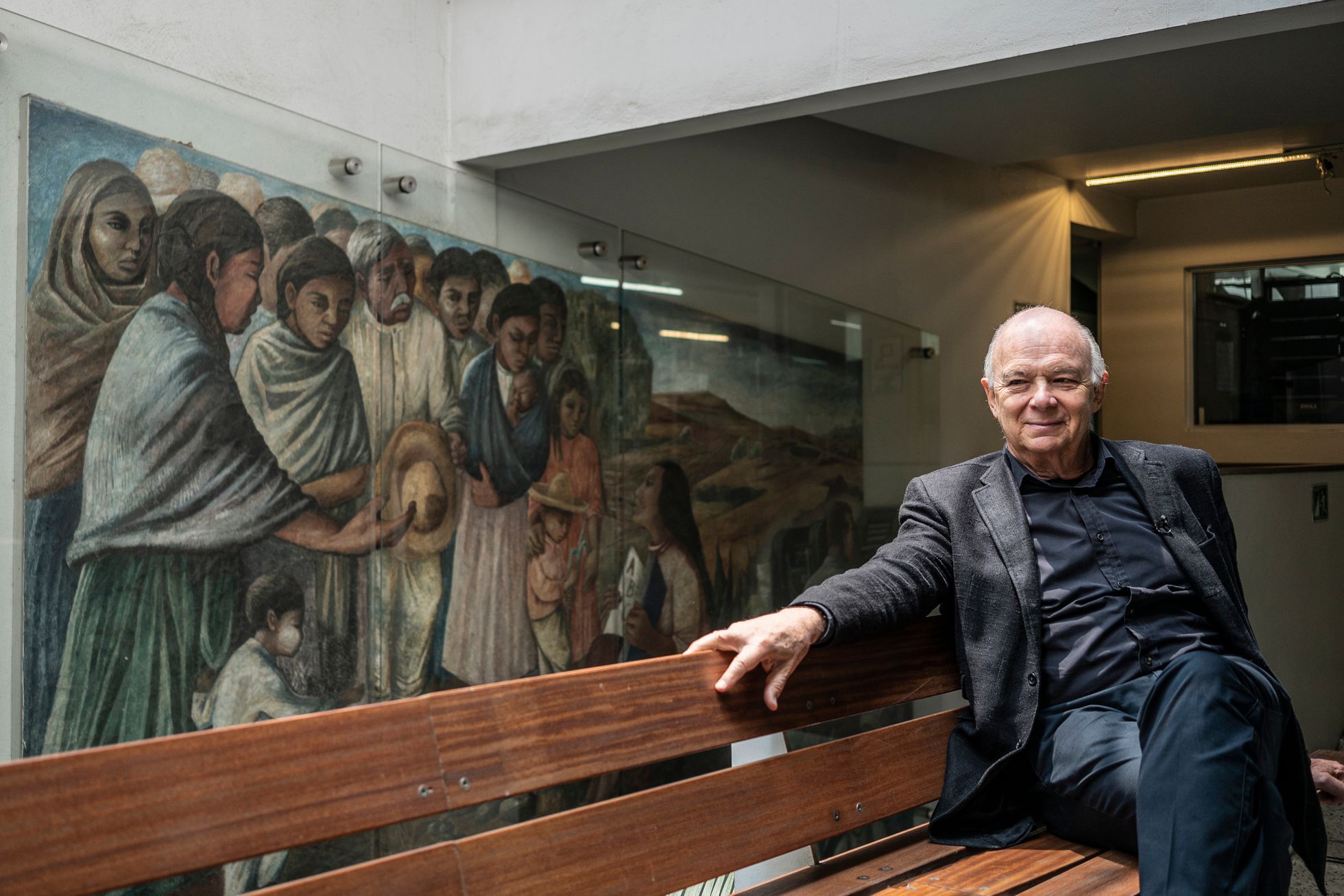
Last Friday I added a short piece on Spinoza in Mexico Park: a book by the Mexican-Jewish Enrique Krauze that I had just bought. Now that I’ve been reading it, I couldn’t resist the urge to write a critical review of it for The Occidental Observer (TOO). My book review has just been published in that webzine for JQ connoisseurs—click: here!

The following is a passage (my translation) of Spinoza in Mexico Park that I could have quoted in my TOO article:

José María Lassalle: In our last conversation we had covered a decade in your intellectual life: that of your integration into Mexican culture as a historian and as editorial secretary of the magazine Vuelta… The one you described in the first conversation with great detail and love: your culture of origin, Jewish culture. I was very surprised by everything you said. I didn’t know that this root was so deep. It almost covered everything… I understand that you wanted to belong to Mexico and to the Hispanic world, and all your life you have worked to achieve it. But secretly you were driven by that initial impulse, by that root. That root is Judaism: the tree grew in Mexico, in Mexican soil, and bore Mexican fruit, but the root and the trunk were Jewish.

Enrique Krauze: What I did was to build that Jewish compound in Amsterdam [obliquely, Krauze is referring to Spinoza, who was born in Amsterdam]… And I began to build a library of Jewish subjects from all eras. A library, above all, of characters and ideas. [pages 419-420]

Latin Americans idolise their intellectuals and writers, so there are a couple of things I’d like to add to what I wrote in the TOO review.

Besides having enormous fame in the Spanish-speaking world, Krauze is one of those serene-speaking ethnic Jews with subtle but toxic messages for the white world. For example, he hasn’t only translated Susan Sontag for the cultural magazines in Spanish he has edited (I have read Krauze since 1990). In Spinoza in Mexico Park, where he talks a lot about WW2, the historian Krauze doesn’t mention David Irving once. Moreover, Krauze writes ‘Holocaust’ in a capital letter and ‘gulag’ in a lowercase in spite of the fact that far more Gentiles died in the Gulag than Jews in the so-called holocaust!

In the TOO piece I only mentioned a few names of the Jewish authors that influenced Krauze, but Spinoza in Mexico Park is replete with other names of historical Jews, from cover to cover. (There is no notable writer in the Spanish-speaking world to point these things out. That’s why I have been calling Latin America the ‘blue pill’ subcontinent.)

On the dilemma that plagues every Westerner—Athens or Jerusalem?—Krauze wrote the following (my translation) about the Greco-Roman world, in the context of Jewish writers of antiquity, such as Josephus and Philo:

[Jewish historian Arnaldo] Momigliano argues that Jerusalem resisted Athens because of the radical religious obstinacy of the people. The Jewish people remained faithful to the priests, the guardians of orthodoxy. For them, Greek culture was synonymous with idolatry, vain pleasures, frivolous comedies, and pagan myths… The Alexandrian Jews tried to persuade the Greek world of the goodness of their faith… One text points to the excesses of a certain Flaccus, the Roman governor in Egypt, who unleashed a veritable pogrom in that city. Even then, this persecution took on the dramatic forms and dimensions that were to be seen many centuries later in the Middle Ages. The profile he [the Jew Momigliano] draws of the delirious Caligula is a jewel worthy of Suetonius [Spinoza in Mexico Park, pages 430-431].

Regular visitors to The West’s Darkest Hour know that this site has a masthead, a guide that allows us to navigate the seas of history. Compare Krauze’s Jewish POV quoted above with the Aryan POV of our ‘masthead’ (pages 33-123 of The Fair Race’s Darkest Hour, linked in our featured post):

In 62-61 b.c.e., the proconsul Lucius Valerius Flaccus (son of the consul of the same name and brother of the consul Gaius Valerius Flaccus) confiscated the tribute of ‘sacred money’ that the Jews sent to the Temple of Jerusalem. The Jews of Rome raised the populace against Flaccus. The well-known Roman patriot Cicero defended Flaccus against the accuser Laelius (a tribune of the plebs who would later support Pompey against Julius Caesar) and referred to the Jews of Rome in a few sentences of 59 b.c.e., which were reflected in his In Defence of Flaccus, XVIII:

‘The next thing is that charge about the Jewish gold… I will speak in a low voice, just so as to let the judges hear me. For men are not wanting who would be glad to excite those people against me and against every eminent man, and I will not assist them and enable them to do so more easily. As gold, under the pretence of being given to the Jews, was accustomed every year to be exported out of Italy and all the provinces to Jerusalem, Flaccus issued an edict establishing a law that…’

From these phrases, we can deduce that already in the 1st century b.c.e., the Jews had great political power in Rome itself and that they had an important capacity for social mobilization against their political opponents, who lowered their voices out of fear: the pressure of the lobbies.

Thus spake Cicero (brown letters) before the senate. The story of the Flaccus family doesn’t end there. In the masthead we then see what happened to another Flaccus[1] in the section about Caligula: another historical figure maligned by Jews and Christians, including the historian Krauze.

Incidentally, I’m in the final proofreading of the November 2022 edition of On Exterminationism, so I won’t be adding more entries here while I work on it. But I’ll answer any questions I am asked about Krauze, whom I met personally—even shook hands with him in 1993!—when he and Octavio Paz published a book by Cuban dissident Guillermo Cabrera Infante.

________

[1] Aulus Avilius Flaccus was appointed praefectus of Roman Egypt from 33 to 38 c.e.