web analytics
Categories
Heinrich Himmler

Himmler on Christianity

(June 9, 1942)

Although the Hitler regime largely limited itself to the subjugation and suppression of the Christian churches and postponed a “final solution of the church question” to the end of the war, there were radical groups within the government who called for the “de-Christianization” of the German people as soon as possible. At the beginning of the century, various neo-pagan currents were already making themselves felt in Germany. They often advocated völkisch-racial views and believed that the spiritual regeneration of the nation would come from its supposedly genuine Nordic-Germanic religion.
After 1933, the NSDAP lent official support to “God Belief” [Gottgläubigkeit], an ersatz religion borrowing from neo-paganism. By 1939, “God Belief” had more than 3 million adherents in Germany. One of the most important Nazi proponents of racial-mystical paganism was Heinrich Himmler, who regarded his SS as an elite Germanic tribe. In the following speech, which was delivered on the occasion of Reinhard Heydrich’s funeral, he explained some of the principles of his faith, which were based largely on a general contempt for individuality and humanity:
 

______ 卐 ______

 
[…] We will have to deal with Christianity in a tougher way than hitherto. We must settle accounts with this Christianity, this greatest of plagues that could have happened to us in our history, which has weakened us in every conflict. If our generation does not do it then it would I think drag on for a long time. We must overcome it within ourselves. Today at Heydrich’s funeral I intentionally expressed in my oration from my deepest conviction a belief in God, a belief in fate, in the ancient one as I called him—that is the old Germanic word: Wralda. We shall once again have to find a new scale of values for our people: the scale of the macrocosm and the microcosm, the starry sky above us and the world in us, the world that we see in the microscope.
The essence of these megalomaniacs, these Christians who talk of men ruling this world, must stop and be put back in its proper proportion. Man is nothing special at all. He is an insignificant part of this earth. If a big thunderstorm comes, he can do nothing about it. He cannot even predict it. He has no idea how a fly is constructed—however unpleasant, it is a miracle—or how a blossom is constructed. He must once again look with deep reverence into this world. Then he will acquire the right sense of proportion about what is above us, about how we are woven into this cycle.
Then, on a different plane, something else must happen: we must once again be rooted in our ancestors and grandchildren, in this eternal chain and eternal sequence. […]
By rooting our people in a deep ideological awareness of ancestors and grandchildren we must once more persuade them that they must have sons. We can do a very great deal. But everything that we do must be justifiable vis-à-vis the clan, our ancestors. If we do not secure this moral foundation which is the deepest and best because the most natural, we will not be able to overcome Christianity on this plane and create the Germanic Reich which will be a blessing for the earth. That is our mission as a nation on this earth. For thousands of years it has been the mission of this blond race to rule the earth and again and again to bring it happiness and culture. […]
___________
Source of English translation: Jeremy Noakes and Geoffrey Pridham, eds., Nazism, 1919-1945, Vol. 2: State, Economy and Society 1933-1939. Exeter: University of Exeter Press, 2000, p. 304.
Source of original German text: Rede vor den Oberabschnittsführern und Hauptamtschefs im Haus der Flieger in Berlin am 9. 6. 1942 (Gedenkrede für Reinhard Heydrich), U.S. National Archives and Records Administration, College Park, MD, T-175, Roll 90, Frames 2664-2685; reprinted in Heinrich Himmler: Geheimreden 1933 bis 1945 und andere Ansprachen. Bradley F. Smith and Agnes F. Peterson, eds. Frankfurt am Main: Propyläen, 1974, pp. 159-61.

Categories
Ancient Rome Egalitarianism Individualism Liberalism Miscegenation Napoleon

Heisman’s suicide note, 7

The Christian Collapse into Capitalism

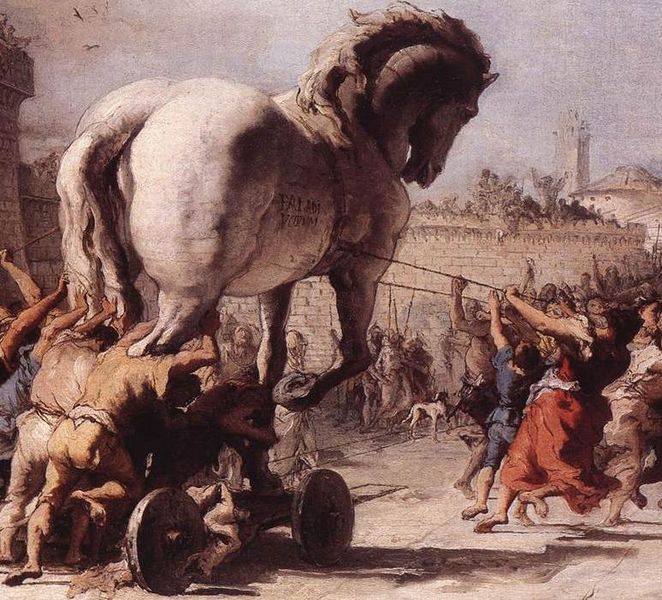
If the Trojan Horse of Christianity successfully injected its moral-behavioral code into a given host, what would the aftermath look like? Theoretically, one would expect that the frequency of kin selective based behaviors would decline. Individuals would be freed or even barred from self-organization on the basis of kinship. It follows that the most thoroughly Christianized nations would be the most susceptible to the breakdown of kin selective altruism over time. In short, if a people succumbed to the holy virus of Christianity, one would expect it to look something like America.
The very survival of liberal democracy through two world wars was made possible by the involvement of an America remarkable for both its ethnic diversity, and its unusually high level of religious commitment among developed nations. America’s ethnic diversity and America’s Christianity are directly related to one another. After all, genetic miscegenation is a practical logical fulfillment of love against the law. Conventional Christianity itself represents the cultural miscegenation of Jewish and gentile moral civilizations (i.e. the gargantuan adoption project known as American immigration is partially an inheritance of Constantine’s adoption of the foreign God of the Jews). Jesus himself was spiritual miscegenation of Jewish and gentile moral civilizations as a fulfillment of love against the law.
The secular West inherited from Christianity a moral or spiritual attitude that associates goodness with the inverse of the logic of kin selection. The entire idea of modern egalitarian progress is a logical continuation of the anti-kin selective logic of Christianity in action. It is a measure of the success of the mutated Christian meme-virus that Westerners do not even need Jesus to further perpetuate the logic of his attack on kin selection.
Yet the specific mechanisms of Christian influence on kin selection require clarification. For argument’s sake, let us say that Christianity tended to attract the most altruistic members of the population. Let us say, furthermore, that the minority of superlative altruists contains, on average, a greater proportion of genes for altruistic behavior than the majority population. If the most highly altruistic inclinations originally evolved through kin selection, and learning the discipline of Christianity tends to divert such altruistic behaviors into channels that are either indifferent or detrimental to genetic adaptation for the highly altruistic minority, then Christianity, over many generations, will tend to decrease the genetic fitness of the population. While this is only one scenario among many, the seditious genius of Christianity (a.k.a. Christian goodness) is that it may attract individuals with the greatest share of genetically based altruism within a population while serving to subvert its original genetic basis.
If everyone followed the superlative example of a chaste Catholic priest, it would lead to the extinction of the human race. Catholic priests that cheat by having children and propagating their genes, however, may perpetuate any possible genetic basis for their hypocrisy. I use the superlative example of a Catholic priest only to illustrate a far more general phenomenon: Christianity can very literally breed “hypocrisy” relative to the honest Christians who restrain themselves. Through this pattern, over a period of generations, Christianity may have literally helped breed the modern bourgeoisie on a both a genetic and cultural level. Generally speaking, Christianity breeds a bourgeoisie simply by chipping away at the advantages of the stronger to the advantage of the weaker, and undoing the correlation of reproductive success and military-political success (i.e. of kings and aristocracy).
Christian memes impacted Christianized genes by making the highest the lowest, the first the last, the alpha the omega and, in general, rewriting the rules of the social game. Christianity literally helped to breed the progressive left by gradually altering the social status of certain human types. It made conventional Darwinian winners moral losers and enshackled the genetically adaptive function of pagan virtues in its moral snares.
Within the hypocrisy industry that Christianity created, those inconsistent with general ideal principles tend to be the ones that survive. To be fully consistent would be as biologically suicidal as dying on the cross. The ethically honest ones tend to be selected out of the population. The cheaters of these ethical principles tend to multiply. In short, the supremacy of Christian ideals tends to breed a bourgeoisie; egoists who follow the moral letter in a practical sense while trampling over ideal spirit. This is why Pharisees survived to become the ancestors of most Jews while Jesus got the cross. This is how Christianity helped to create the modern world.
Machiavelli could be considered the first mature philosophic representative of the twilight zone between the ancient political world and modern liberalism. Machiavelli attributed the decay of duty to fatherland to Christianity. By socializing men in faith in the higher fatherland of God’s Kingdom, his contemporaries betrayed the fatherlands of the Earth. Yet something changed that made Machiavelli’s advice something other than a return to ancient Roman ways. In Machiavelli one can discern a breakdown of a certain kind of altruism; a breakdown of a level of political duty that was taken for granted by the Romans. While Machiavelli criticized the Christian corruption of political duty, he himself exemplifies the consequences of the Christian corruption of kin selective altruism.
In a manuscript dating from 1786, Napoleon Bonaparte wrote:

It is axiomatic that Christianity, even the reformed kind, destroys the unity of the State: (1) because it is capable of weakening as well as of inspiring the trust which the people owe the representatives of the law; (2) because, such as it is constituted, Christianity contains a separate body which not only claims a share of the citizens’ loyalty but is able even to counteract the aims of the government. And, besides, is it not true that the body [the clergy] is independent of the State?… Its kingdom is not of this world. Consequently, it is never civic-minded.

Yet, in a letter to the bishop of Como in 1797, Napoleon also concluded that “[t]he morality of the Gospels is the morality of equality and, by that token, the morality best suited to the republican form of government.” On one hand, Christianity promotes a morality of equality. On the other hand, Christianity poses a permanent potential fifth column that is inherently enervating of political authority. Liberalism inherited both characteristics from the fifth column character of Christianity. (Islam, incidentally , is another variation on the Semitic way of empire that is currently exploiting the fifth column ground that Christianity prepared in Europe and is thus poised to take its place.)
Napoleon followed Rousseau in acknowledging the destructive power of modern liberal-individualism upon civic virtue. However, if the origins of modern democratic morality are Biblical, then why is it destructive of altruism? The answer is to be found in the neutralization of kin selective altruism achieved by the Christianization of pagan naturalism. Modern political equality is the cumulative neutralization of the extreme kin selective paradigm of Roman Empire. Neutralization of paganistic kin selective altruism was effected by the radical opposition party of the Christian Kingdom of God. Kinship bonds that classically culminate in the patriarchal duties of alpha altruism were neutralized by the omega altruism of Christianity and the net result is modern political equality.
The early Christians were considered antisocial. They would not make sacrifices to the Roman gods. The early Christians would not do their duty. Christianity proved a dangerously preemptive of Roman virtue because it formally addressed gentiles, not primarily as members of a group, but as individual souls.
Edward Gibbon concluded that Christianity’s valuation of private salvation over the public good contributed to the decline and fall of the Roman Empire. This Christian inheritance is immediately recognizable in liberalism’s valuation of the private rights of individual as the foundation of politics. “Rights” counter duties and grant freedom from duties. Freedom has a tangible meaning only if one is as free to be wholly self-absorbed as to dedicate one’s life to others.
There is a common belief or misunderstanding that the opposite of Christian altruism is individual selfishness. This is incorrect. The diametrical opposite of Christian altruism is not individual selfishness. The opposite of Christian omega altruism is the kind of group selfishness represented by Roman alpha altruism.
After all, from the viewpoint of those conquered by Rome, what was the problem? Were the Romans too individualistic? Was that the problem? Was the problem that Romans were too likely to put their individual interests before the interests of the Roman state? No, the problem was exactly the opposite. The problem was that Romans were all too dutiful to their state. Roman virtue was what made Rome: a race of conquerors. The problem was Roman virtue itself.
Christian “virtue” was an attack on Roman virtue. The ultimate target of Christian omega altruism was not individual selfishness. Christian omega altruism targeted Roman alpha altruism. Christianity fought altruism with altruism, and the long-term result of this clash of virtues was the corruption of both forms of altruism and the rise of the middle ground of modern, Western, equal individualism.
Christianity led to capitalism by canceling out, neutralizing, and delegitimizing extreme expressions of kin selective altruism. As omega altruism broke kinship bonds down, the premise of the individual human soul began to build up. As the idea of altruism so radical that it transcended kinship became socially legitimated, the kinship social shackles encumbering individuals became illegitimated. By reversing the evolutionarily normative prioritization between kinship and altruism, Christianity corrupted the kinship foundations of altruism and stimulated the rise of capitalistic individualism.
Torn between the irreconcilable opposites of alpha altruism and omega altruism (that the Crusaders vainly attempted to unite), “the individual” became the logical social solution. In consequence, the West landed in the middle ground of the moral mediocrity of the middle class. The cumulative waste product of this process of secularization is commonly called liberalism. Alpha altruism and omega altruism cancelled one another out, and the cumulative result of this neutralization is political equality.
A classic verification of this theory can be found in a small-scale repetition of the very same process during the social revolutions of the late 1960s. Leftist social movements of that time reaffirmed the egalitarian aspirations of liberal revolution, launching attacks on the social remains of kin selective organizations and its classical, quasi-Roman, patriarchal, warmongering corollaries. The ultimate result of these social movements was another collapse of “we” into “me”. 1960s socialism collapsed into the greed of 1980s individualism. In terms of its underlying sociobiological basis, this baby boomer episode was only a repetition of the original collapse of Christianity into capitalism.

Categories
Obituaries

Octavio

(1962-2018)

Categories
Autobiography

Family tragedy

Of my male first cousins, there was one I mostly got along with in my twenties.
Today he killed his teenage daughter and then hanged himself.
What I find pathetic is that my cousin was one of the first to read, decades ago, the most primitive draft of the first chapter of my autobiographical book.
He recently asked for family help for a very serious depression. But he did not ask me for any counsel: the only one in the family who could have helped him.
Had I talked to him—I’m the only one in the family who has written books about abuse within our family—I could have tried something.
But that did not happen.
Even my closest relatives block in their minds my work of decades in which I try to avoid family tragedies by understanding them.
I hope that one day my two books that appear in the sidebar will be translated into English…

Categories
Autobiography Catholic religious orders Christendom Darkening Age (book) Matthias Grünewald

Darkening Age, 3

In the chapter ‘The Invisible Army’ of The Darkening Age: The Christian Destruction of the Classical World, Catherine Nixey talks about how, once the Christians seized the Weltanschauung of the Roman Empire, a demonological hysteria arose that led Christians to a state of virtual paranoia.
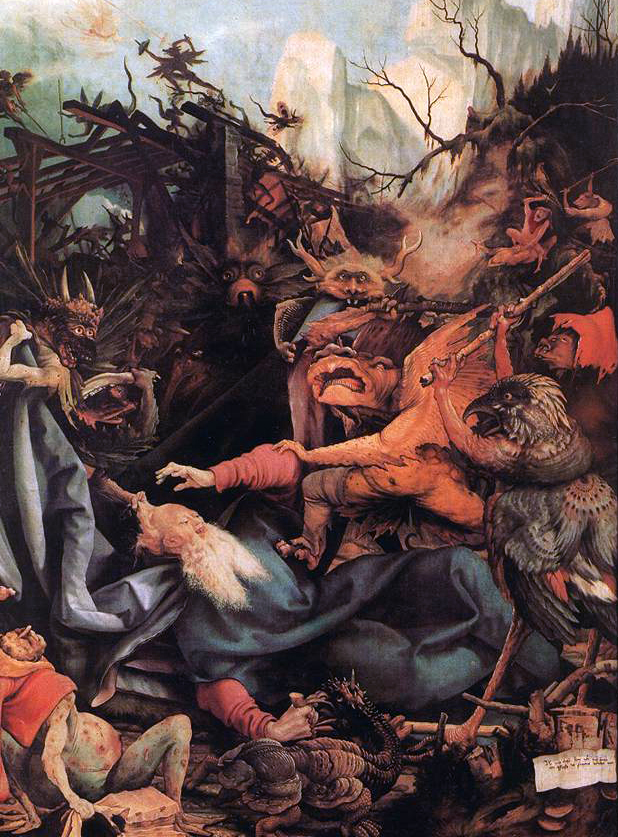
It is curious how Christians today ignore fundamental aspects of the history of their religion. When not long ago I told a friend about the demons that persecuted St Anthony the Great (251-356), I found out that he knew nothing about the subject: something so popular throughout Christendom that the ‘temptations of St Anthony’ permeated European imagination for centuries.
Saint Anthony was the founding father of the monastic life: one of the most influential men in Christianity. As a teenager I saw images like this painting by Grünewald. I knew that the demons (temptations) that the ascetic fought were sexual thoughts that he, who had taken a vow of chastity, had to fight.
The case of St Anthony, which Nixey details in the first chapter of her book, was not isolated. My ignorant Catholic friend, who did not know the history of this very influential man, could think that all that lies now in the remote past.
Not really. When I was a teenager my mother used to come to my room with holy water while I slept because she thought the devil had gotten into me. My sister was terrified to see, in puberty, the movie The Exorcist on the big screen because she believed that the devil really existed.
Decades later, when my brother wanted to divorce, my father wrote him a letter saying that the devil was hanging around tempting them to divorce. My mother even summoned her children on one occasion to tell us that, recovering from an operation, she had committed the blunder of challenging the devil so that he would not mess with her children, and that the devil had insinuated her presence in front of her. A priest scolded her: the devil should never be challenged: only ignored. More recently, some nuns told my mother that the noises they heard in their monastery were angry demons due to the saintly work of the nuns.
This is not the place to narrate how the Catholicism at home was a fundamental factor in the destruction of my adolescent life. I would just like to point out that, in Nixey’s chapter, it is described how, once the classical culture was destroyed, the Europeans were under perpetual attack by Satan and his fearsome soldiers, the demons. Their aim, in European imaginary, was to drag them all to damnation.
Currently a residue of this paranoia is only seen in the most traditional Christian families.

Categories
Charles Darwin

Heisman’s suicide note, 6

Darwin helped clarify the ethics underlying pagan worship of the warrior. The social Darwinian notion that death itself is a vehicle of goodness means the more death of the weak and the unfit, the more natural selection. The more natural selection, the more goodness and progress towards biological aristocracy. The natural justice of natural selection is progress through death. From this point of view, the soldier represents the human with the greatest virtue because the soldier is a killer.
This was the Nazi way of progress, the Nazi way of virtue.
From this point of view, it is easier to see what liberalism and traditional Judaism have in common. When liberals and traditional Jews give charity to help the poor, they are working against the natural justice of natural selection. Instead of leaving the poor to die in accordance with natural justice, they advocate a supernatural justice of preserving all life. While modern liberals and leftists tend to be more consistent than traditional Jews, both have taken the decisive step towards progress through life. [pages 153-154]
 
Success is Disaster
However, to follow this logic to its extreme, to consistently choose and value the weaker, is to value weakness itself. To overthrow the strong, in principle, ultimately leads one to overthrow what is strong within one’s self. In this way, radical moral integrity through rational moral self-consistency leads to rational self- destruction…
For the Zionist state to consistently empower the disempowered Palestinians at their own expense would be political suicide. Being Goliath is a problem when the moral of the story is that David ultimately wins.
The internationalism of Christianity laid the common ground for a world that has a place for the nationalism of the Jews. Just as Roman conquerors penetrated the territorial-sociobiological boundaries of the ancient Jewish state, the Jewish-based God memes of Christianity penetrated the ancient Roman world.
Christianity began a process of blunting and mollifying the deepest ethical-cultural gulfs between Jew and gentile. The penetration of Jewish genes into the modern gentile West is only a continuation of the anti-kin selective logic that began with Christianity. In other words, Jewish assimilation as individuals in the modernistic West is only a continuation of gentile assimilation to the sociobiological impact of Christianity. Both as individuals and as a Zionist state, Western assimilation of Jewish bodies was founded upon Western assimilation of a Jewish “spirit”. [pages 165-166]
 
The Elimination of Selection
People are material things, too, according to Darwin. To place the principle of equality at the top of a hierarchy of values is a formula for rational biological deconstruction.
The death march to the land of no egalitarian hypocrisy leads to a general trajectory of evolutionary “regression” because it leads to equality with the most simple and “primitive” evolutionary forms. It is almost like “descending” from Homo sapiens to apes, to primates, to mammals, to amniotes, to tetrapods, to vertebrates, to animals, to eukaryotes, etc., until we are lead to the very origins of life itself out of nonbiological, physical matter…
Modern equality began by dismissing the importance of biology. Ultimately, it leads to the removal of all biological factors from the equation of life until the achievement of death. [pages 184-186]
Equality would seem to implicate an ultimate trajectory of evolutionary “regression” because equal rights imply the beginning of the end of Darwinian selection. A genuine, progressive implementation of universal equal rights implies the artificial end of natural selection; the systematic unraveling of the mechanism that made the evolution of life possible in the first place. The principle of equality can thus be look at as the principle of the elimination of selection.
The opposite of the modern idea of individual rights is the right of the stronger. Individual rights tend to defend the weaker, while natural selection tends to eliminate the weaker. From some points of view, then, equal rights can be looked upon as the “progress” of genetic maladaptation.
Kin selection, for example, leads to discrimination against kinship outsiders and altruism towards kinship insiders. The moral logic of egalitarian universalism works in precisely the opposite direction, with moral preference given to outsiders over insiders. Western institutionalization of the elimination of discrimination ultimately means the systematic elimination of selection. Eliminating selection ultimately leads to internationalism and trans-species universalism. It also implies the elimination of the political as an active means of evolutionary, eugenic, biological self-control.
Insofar as Jews have contributed disproportionately to Western egalitarianism, and the end of discrimination on biological grounds, Jews have contributed to the elimination of biological selection…
Are Jews leading the entire human race towards an evolutionary dead end? Are Jews, for the sake of their own biological survival, leading the human race as a whole towards rational evolutionary self-destruction? [pages 189-190]

Categories
Joseph Goebbels Mainstream media Psychology

Heisman’s suicide note, 5

People of the Media

Jews prominent in the media industry tend to have a leftist bias that implies that race is not important. Goebbels and other Nazis that took direct control over Germany’s media propagated the message that race is more important than environmental conditioning. Yet if environmental conditioning were not important, then it would make no difference who controls the media or what its message is, since media memes would be powerless to overcome the power of the genes. After all, Jewish media influence provided empirical verification that control over the cultural environment can overpower the influence of genes…
The very obsession with Jewish media influence demonstrates that Nazis and other extreme racialists have somehow been the most radical believers in the power of media and memes to overpower the influence of genes…
The inordinate concentration of Jews in highly influential media positions does require an evolutionary explanation. Jews may have an inclination to control human behavior with words and other media forms because Jews owe their very existence to their ancestor’s ability to control Jewish behavior with the media technology commonly known as the Bible. Modern Jewish media control is only an extension of ancient Jewish media self-control. Jews may have a genetic ability to influence human behavior with “nurture” because first, foremost, and fundamentally, Judaism was founded through the nurturist ability to overpower their own genetically maladaptive tendencies. Jews exist because they embody this paradox of a genetic inclination to correct genetic inclination with “nurture”, i.e. the laws of Moses.
Consider the significance of Deuteronomy 20:17-18, a passage now considered one of the most morally problematic sections of the Bible for its sanction of genocide. Even this action was justified on the basis of corrupting cultural behaviors: “…you shall utterly destroy them…so that they will not teach you to act according to all their abominations that they performed for their gods, so that you will sin to Hashem, your God.” Genocide was justified with memocide.
While the Jewish religion began with the correction of Jewish behavior, its ultimate implication is social change; the correction of the entire world. While it is not conventional to describe “social engineering” as a form of technology, it is really the most powerful way in which non-biological evolution has mastered biological evolution. [pages 140-144]

Categories
Christendom Jesus New Testament

Heisman's suicide note, 4

Editor’s note: To better understand Mitchell Heisman✡ yesterday I printed the first five hundred pages of Suicide Note, and I have been reading it carefully. Although he shot himself after finishing his book, committing suicide does not mean he was aware of the Jewish Problem.
Suicide Note is a labyrinth full of traps for the unsuspecting reader. Even before I printed the first 500 pages, I told Spahn Ranch that getting into that book reminded me of Bacon’s criticism:

Francis Bacon said that philosophers love to spin webs. You can imagine the care one must have with this large web [Heisman’s book]. I feel like Frodo crossing Shelob’s tunnel with no more help than the Phial of Galadriel!
But this light is enough for me to orient myself in such a tunnel. In fact, in about fifteen minutes you will see, as my first entry about this new Otto Weininger, my excerpts from his extremely long-winded book. [comment link: here]

More than long-winded, Heisman reminds me of ‘Sartre’s verbosity diarrhea’: what an American visitor observed when visiting Sartre in Paris. Just compare this with the laconic way in which the Spartan spake (see the series on Sparta that these days publishes The Occidental Observer, for example: here).
Although I’m not going to read all of Heisman’s Suicide Note, in the comments section I also told Joseph Walsh the following:

If I understand the kike correctly, he’s saying that through Xtianity the Jewish memes have won the battle over Aryan genes; and that the creation of ‘God’ thru A.I. will even take that victory further, obliterating race altogether and even the human species. [comment link: here]

The triumph of the Aryan would be the triumph of white genes over Jewish memes. Recall in Evropa Soberana’s essay that, when the Jews realised that they could not defeat the Romans through conventional wars—genes—they resorted to the subterfuge of confusing them by means of an ethnosuicidal theology—memes. Heisman✡ is good to see this theology. He wrote:
 

______ 卐 ______

 
Jesus radicalized a form of altruism. But here one must be very careful about precisely what kind of altruism Jesus radicalized. At first glance, it would appear that Jesus radicalized “love your neighbor”. Jesus did praise loving your neighbor, but “neighbor” can be ambiguous; somewhere between family and enemy. Insofar as “loving your neighbor”, in practical terms, amounts to loving your kin or your tribe (as opposed to enemies of your kin or tribe), radicalizing the love of kin or tribe would amount to advocating radical Jewish nationalism. Was this Jesus’s defining innovation, a morality of exclusive Jewish nationalism?

You have heard that it was said, ‘You shall love your neighbor and hate your enemy.’ But I say to you, Love your enemies and pray for those who persecute you. (Matt. 5:43- 44)

Jesus’s reversal implied not only loving your enemies, but hating your neighbor—insofar, that is, as “neighbor” is connected with family in opposition to enemy. Jesus did not radicalize the corrective of the Jewish kinship paradox; Jesus radicalized the Jewish kinship paradox itself. This is one reason why Jesus’s innovations contradicted Jewish law at its traditional root. Instead of preaching “love thy neighbor” as a correction of “causeless hatred”, Jesus radicalized causeless hatred itself: Brother will betray brother to death, and a father his child; children will rebel against their parents and have them put to death. All men will hate you because of me, but he who stands firm to the end will be saved. When you are persecuted in one place, flee to another. (Matt. 10:21-23)
In place of the Old Testament commandment, “You shall not hate your brother in your heart”, Jesus preached, in effect, you shall hate your brother in your heart. This necessarily broke Jewish law. And this is why the kind of “love” Jesus advocated worked against Jewish “nationalism” and towards human internationalism. This extreme compelled the genesis of Christianity out of Judaim. Unqualified radical altruism leads to the negation of family values…
The core innovation at the heart of the Five Books of Moses is the Exodus paradigm; the inversion of the Egyptian pyramid-hierarchy; the first revolution. From Judaism to Christianity to the neo-Judaism of liberal democracy to neo-Christianity of Marxism, all of these revolutions share in common the fire started by Moses: the decisive triumph of nurture over sociobiological nature. Like waves that ripple from a singular stone plunged in water, all share reverberations of the first revolution. Like a miracle, the ripples are gathering back to their singularitarian source, humanity’s last revolution. [pages 126-128]
 

______ 卐 ______

 
Editor’s note:
‘And this is why the kind of “love” Jesus advocated worked against Jewish “nationalism” and towards human internationalism’ wrote Heisman✡ above. This is one of the dozens of traps I have found in Heisman’s book. What this guy astutely omits is that Jesus’ message is not really directed at the already ethnocentric Jews but at Romans.
At this point I differ radically from both commenter Arch Stanton and Heisman✡. The trick of the Jewish psyop is to make us believe that a wise individual said such and such, that eventually the evangelists recorded and now good Christians try to use as a new golden rule.
There is no historical evidence of this, as Joseph Hoffmann saw in the primal essay of this site to understand the so-called historical Jesus. What can be verified with certainty is that the authors of the New Testament were either Jews or Judaised gentiles. That is what concerns us.
The trap of Heisman✡ and of every Christian or neo-Christian is that they continue to sell us the idea of a historical Jesus who fought for such and such ideal, when ultimately the only thing that matters is the so-called New Testament itself: its message to the Romans; who wrote it, and the motivation of the authors.
When one reads the passages quoted above by Heisman✡ the motivation is obvious.

____________

Liked it? Take a second to support this site.

Categories
Ancient Rome Catholic Church Classical sculpture Egalitarianism Enlightenment Individualism Jesus Liberalism Martin Luther New Testament Protestantism St Paul Tacitus

Heisman’s suicide note, 3

Rupture: How Christ hijacked
the moral compass of the West

The English word “virtue” is derived from the Roman word virtus, meaning manliness or strength. Virtus derived from vir, meaning “man”. Virilis, an ancestor of the English word “virile”, is also derived from the Roman word for man.
From this Roman conception of virtue, was Jesus less than a man or more than a man? Did the spectacle of Jesus dying on a Roman cross exemplify virtus; manliness; strength; masterliness; forcefulness? Consistent with his valuation of turning the cheek, it would seem that Jesus exemplified utterly shamelessness and a total lack of the manly honor of the Romans.
Yet the fame of his humiliation on the cross did, in a sense, exemplify a perverse variety of virtus, for Jesus’s feminine, compassionate ethics have mastered and conquered the old pagan virtues of the gentiles. Jesus’s spiritual penis has penetrated, disseminated, and impregnated the West with his “virtuous” seed. And it is from that seed that “modernity” has sprouted.
Jesus combined the highest Roman virtue of dying honorably in battle with highest Jewish virtue of martyrdom and strength in persecution. This combination formed a psychic bridge between pagan and Jew, i.e. between ideal cruelty in war and ideal compassion in peace. This is one way in which Christianity became the evolutionary missing link between the more masculine ethos of the ancient pagan West and the more feminine ethos of the modern West.
The original Enlightenment notion of revolution reflects a quasi-creationist view of change that makes the sudden rupture between the moral assumptions of the ancient and modern world almost inexplicable. However, if we take a more gradualistic view of social change wherein modern egalitarianism evolved from what preceded it, then the origins of modern political assumptions become more explicable. The final moral-political rupture from the ancients became possible, in part, because Christianity acted as an incubator of modern values.
Christian notions of “virtue” were not an outright challenge to pagan Roman virtue by accident; these values were incompatible by design. To even use the Roman term “virtue” to describe Christian morality is an assertion of its victory over Rome. The success of the Christian perversion of the manliness of Roman “virtue” is exemplified by its redefinition as the chastity of a woman.
A general difference between ancient Greco-Roman virtue and modern virtue can be glimpsed through the ancient sculpture, the Dying Gaul. The sculpture portrays a wounded “barbarian”. Whereas moderns would tend to imitate Christ in feeling compassion for the defeated man, its original pagan cultural context suggests a different interpretation: the cruel defeat and conquest of the barbarian as the true, the good, and the beautiful.
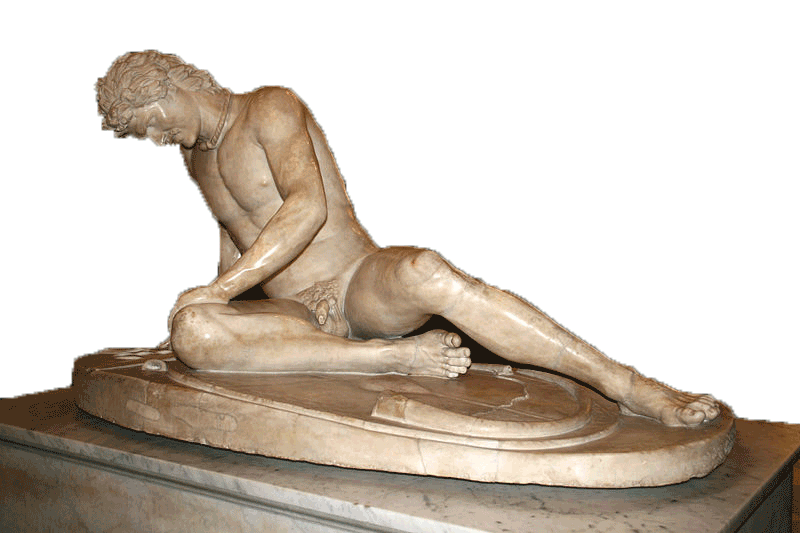
The circumstances of the sculpture’s origins confirm the correctness of this interpretation. The Dying Gaul was commissioned by Attalus I of Pergamon in the third century AD to celebrate his triumph over the Celtic Galatians of Anatolia. Attalus was a Greek ally of Rome and the sculpture was only one part of a triumphal monument built at Pergamon. These aristocratic trophies were a glorification of the famous Greco-Roman ability to make their enemies die on the battlefield.
A Christian is supposed to view Christ on the cross as an individual being, rather than as a powerless peasant of the despised Jewish people. If one has faith in Jesus, then one “knows” that to interpret Jesus as the member of a racial-religious group is wrong and we “know” that this interpretation is wrong. How do we “know” this? Because we have inherited the Christianity victory over Rome in that ancient war for interpretation.
Liberalism continues the Christian paradigm by interpreting Homo sapiens as individuals, rather than members of groups such as racial groups. If it is wrong to assume Jesus can be understood on the basis of group membership, then the evolutionary connection between Christianity and modern liberalism becomes clearer. Jesus was a paradigmatic individual exception to group rules, and his example, universalized, profoundly influenced modern liberal emphasis on individual worth in contradistinction to assumptions of group membership.
Love killed honor. The values of honor and shame are appropriate for group moralities where the group is valued over “the individual”. Crucially, such a morality is inconceivable without a sense of group identity. Jesus’s morality became liberated from a specifically Jewish group identity. Once it dominated gentile morality, it also eroded kin and ethnic identity. The Christian war against honor moralities became so successful and traditional [that] its premodern origins were nearly forgotten along with the native pagan moralities it conquered.
Jesus’s values implicated the end of the hereditary world by living the logical consequences of denying the importance of his hereditary origins. This is a central premise underlying the entire modern rupture with the ancient world: breaking the import of hereditary origins in favor of individual valuations of humans. In escaping the consequences of a birth that, in his world, was the most ignoble possible, Jesus initiated the gentile West’s rupture with the ancient world.
The rupture between the ancient and the modern is the rupture between the rule of genes and the rule of memes. The difference between ancient and modern is the difference between the moral worlds of Homer and the Bible. It is the difference between Ulysses and Leopold Bloom.
On Nero’s persecution of the Christians, Tacitus wrote, “even for criminals who deserved extreme and exemplary punishment, there arose a feeling of compassion; for it was not, as it seemed, for the public good, but to glut one man’s cruelty, that they were being destroyed.” The modern morality of compassion begins with Christianity’s moral attack on the unholy Roman Empire. Christianity demoralized the pagan virtues that upheld crucifixion as a reasonable policy for upholding the public good.
If, as Carl Schmitt concluded, the political can be defined with the distinction between friend and enemy, then Jesus’s innovation was to define the political as enemy by loving the enemy, and thus destroying the basis of the distinctly political. The anarchy of love that Christianity spread was designed to make the Roman Empire impossible. The empire of love that Paul spread was subversive by design. It was as subversive as preaching hatred of the patriarchal family that was a miniature model for worldly empire.
Crossan and Reed found that those letters of Paul that are judged historically inauthentic are also the ones that carry the most inegalitarian message. It appears that their purpose was to “insist that Christian families were not at all socially subversive.” These texts “represent a first step in collating Christian and Roman household ethics.” For these historians the issue is “whether that pseudo-Pauline history and theology is in valid continuity with Paul himself or is, as we will argue, an attempt to sanitize a social subversive, to domesticate a dissident apostle, and to make Christianity and Rome safe for one another.”
What could be more ridiculous that the idea that Jesus’s attack on Roman values would not need some “modification” before making themselves at home in Rome? Jesus and Paul were heretics of mainstream or Pharisaic Judaism and rebels against Rome. Since the purity and integrity of the internal logic of Christianity is hostile to purely kin selective values, there is no way whatsoever that Christianity could survive as a mass religion without corrupting Jesus’s pure attitude towards the family. Jesus’s values subvert the kin selective basis of family values.
That subversion was part of the mechanism that swept Christianity into power over the old paganism, but it was impossible that Christianity maintain its hold without a thorough corruption of Jesus’s scandalous attacks on the family. If not this way, then another, but the long-term practical survival of Christianity required some serious spin doctoring against the notion that Jesus’s teachings are a menace to society.
These, then, are the two options: the pure ethics of Jesus must be perverted or obscured as models for the majority of people or Christianity will be considered a menace to society. The very fact that Christianity did succeed in achieving official “legitimacy” means its original subversive message was necessarily subverted. State-sanctioned Christianity is really a joke played upon on a dead man who never resurrected to speak on his own behalf.
Official Christianity was making Jesus safe for aristocracy; falsifying Jesus; subverting Jesus. Rome subverted his subversion. Jesus attempted to subvert them—and they subverted him. (Bastards!) Yet without this partial subversion of subversion, Christianity would never have taken the deep, mass hold that is its foundational strength.
This insight, that pure Christianity must be perverted in all societies that wish to preserve their kin selective family values, is a key to understanding the process of secularization. Secularization is, in part, the unsubverting of the evidence for Jesus’s original social program from its compromised reconciliation with Rome. The first truly major step towards unsubverting Rome’s subversion of Jesus’s message was the Protestant Reformation.
The Roman Catholic hierarchy contains elements of a last stand of the old Roman pagan virtue, a reminder that it had and has not been subdued completely. The Reformation begun by Martin Luther was directed, in part, against this last stand. While Luther partially continued the containment of Jesus by checking the advance of the idea that heaven should be sought on earth, this German also continued the work of the Jewish radical he worshiped in attacking the hierarchy of Rome.
Secularization is the unsubverting of Jesus’s message subverted by Christian practice. Modern liberal moral superiority over actual Christians is produced by unsubverting the subversion of Jesus’s message subverted by institutional Christianity. There is an interior logic to Jesus’s vision based on consistency or lack of hypocrisy. Liberal arguments only draw this out from its compromises with the actual social world. In this role, Protestantism was especially influential in emphasizing individual conscience over kinship-biological imperatives based on the model of the family.
The average secular liberal rejects Biblical stories as mythology without rejecting the compassion-oriented moral inheritance of the Bible as mythology. That people, still, after Nietzsche, tout these old, juvenile enlightenment critiques of Christianity would seem to be another refutation of the belief that a free and liberal society will inevitably lead to a progress in knowledge. The primitive enlightenment critique of Christianity as a superstition used as a form of social control usually fails to account that its “social control” originated as a weapon that helped to bring down the Goliath of Rome.
Still, at the beginning of the twenty-first century, this old enlightenment era castigation of Christianity for not being Christian endures without realization that this is actually the main technical mechanism of the secularization of Christian values. When one asks, what is secularization?, the attempt to criticize Christianity for its role in “oppression”, war, or other “immoral” behaviors stands at the forefront. Liberal moral superiority over actual Christians commonly stems from contrasting Christian ideals and Christian practice. This is what gives leftism in general and liberalism in particular its moral outrage.
Secularization arises as people make sense of Christian ideals in the face of its practice and even speculate as to how it might work in the real world. Enlightenment arguments for the rationalization of ethics occurred in the context of a Christian society in which the dormant premises of the Christian creed were subjected to rational scrutiny. To secularize Christianity is to follow Jesus in accusing God’s faithful believers of a nasty hypocrisy:

Woe to you, teachers of the law and Pharisees, you hypocrites! You are like whitewashed tombs, which look beautiful on the outside but on the inside are full of dead men’s bones and everything unclean. In the same way, on the outside you appear to people as righteous but on the inside you are full of hypocrisy and wickedness. (Matt. 23:27-28)

To charge Christians with hypocrisy is to relish in the irony of Jesus’s biting charges of hypocrisy against the Pharisees. Jesus’s attempt to transcend the hypocrisies inherent in Mosaic law’s emphasis on outer behavior was one germinating mechanism that produced Christianity out of Judaism. The same general pattern generated modern liberalism out of Christianity. Just as Jesus criticized the Pharisees for worshipping the formal law rather than the spirit of the law, modern liberals criticize Christians for following religious formalities rather than the spirit of compassionate, liberal egalitarianism. It was precisely Christianity’s emphasis on the spirit that helps explain how the spirit of liberal compassion evolved out of the spirit of Christianity even if the letters of the laws are different.
To recognize hypocrisy is to recognize a contradiction between theory and action. The modern ideology of rights evolved, in part, through a critique of the contradictions of Christian theology and political action. Modern ideology evolved from Christian theology. Christian faith invented Christian hypocrites, and modern political secularism seized upon these contradictions that the Christian hypocrisy industry created. Resolving these moral contradictions through argument with Christians and political authorities is what led to the idea of a single, consistent standard for all human beings: political equality. The rational basis of the secularization process is this movement towards consistency of principle against self-contradiction (hypocrisy).
Modern ideas of political rights emerged out of a dialogue; a discourse; a dialectic in which Christianity framed the arguments of secularists, defining the domain upon which one could claim the moral high ground. The “arguments” of Christian theology circumscribed the moral parameters of acceptable public discourse, and hence, the nature of the counterarguments of “secular” ideology. Secular morality evolved by arguing rationally against the frame of reference provided by the old Christian Trojan Horse and this inevitably shaped the nature of the counter-arguments that followed. Christianity helped define the basic issues of secular humanism by accepting a belief in the moral worth of the meek of the world.
The Roman who conquered Jesus’s Jewish homeland could feel, in perfect conscience, that their conquest should confirm their greatness, not their guilt. Roman religion itself glorified Mars, the god of war. Pagan Roman religion did not automatically contradict the martial spirit—it helped confirm the martial spirit.
Chivalry, the code of honor that tempered and softened the warrior ethos of Christian Europe, is the evolutionary link between pagan virtue and modern virtue. Yet the imperial vigor of the Christian West was made, not by Christian religiosity, but by Christian hypocrisy. Christianity planted in its carriers a pregnant contradiction between Christian slave morality and Christian reality that was just waiting for the exposé of the “age of reason”. Christianity made the old European aristocracies “unjust” by dissolving the prehistoric and pagan assumptions of its existence.
Jesus himself contrasted his teachings with the ways of pagans:

You know that the rulers of the Gentiles lord it over them, and their great ones are tyrants over them. It will not be so among you; but whoever wishes to be great among you must be your servant, and whoever wishes to be first among you must be your slave; just as the Son of Man came not to be served but to serve, and to give his life a ransom for many. (Matt 24:25-28)

To reverse the high political development of kin selection represented by Rome leads towards sociobiological primitivity; to an immature stage where human ontology is closest to a more primitive phylogeny; when humans are closest to our common evolutionary ancestors; when humans are biologically most equal to one another since genes and environment have not yet exacerbated differences.
Christianity reached a state of fruition called “modernity” when a kind of justice was reaped for the ancestral betrayal of a Christian’s pagan forefathers. The pagan values that genuinely supported an ancestral chain of sacrifice for their kin kind and the patriarchal kingdoms of this world were betrayed.
A war of generations broke Christianity from Judaism, and left wing humanism from Christianity. These are only peak points that matured from the gradual kneading of cultural dough; from change guided by visions of the moral high grounds in heaven or on earth. Out of a conflict between generations that Christianity helped leaven, the modern social idea of progress rose.
Categories
Athens Autobiography Catholic Church Christendom Darkening Age (book) Evil Free speech / association Library of Alexandria

Darkening Age, 2


INTRODUCTION
Athens, AD 532

‘That all superstition of pagans and heathens should be annihilated is what God wants, God commands, God proclaims.’

— St Augustine

This was no time for a philosopher to be philosophical. ‘The tyrant’, as the philosophers put it, was in charge and had many alarming habits. In Damascius’s own time, houses were entered and searched for books and objects deemed unacceptable. If any were found they would be removed and burned in triumphant bonfires in town squares. Discussion of religious matters in public had been branded a ‘damnable audacity’ and forbidden by law. Anyone who made sacrifices to the old gods could, the law said, be executed. Across the empire, ancient and beautiful temples had been attacked, their roofs stripped, their treasures melted down, their statues smashed. To ensure that their rules were kept, the government started to employ spies, officials and informers to report back on what went on in the streets and marketplaces of cities and behind closed doors in private homes. As one influential Christian speaker put it, his congregation should hunt down sinners and drive them into the way of salvation as relentlessly as a hunter pursues his prey into nets.
The consequences of deviation from the rules could be severe and philosophy had become a dangerous pursuit. Damascius’s own brother had been arrested and tortured to make him reveal the names of other philosophers, but had, as Damascius recorded with pride, ‘received in silence and with fortitude the many blows of the rod that landed on his back’. Others in Damascius’ s circle of philosophers had been tortured; hung up by the wrists until they gave away the names of their fellow scholars. A fellow philosopher had, some years before, been flayed alive. Another had been beaten before a judge until the blood flowed down his back.
The savage ‘tyrant’ was Christianity. From almost the very first years that a Christian emperor had ruled in Rome in AD 312, liberties had begun to be eroded. And then, in AD 529, a final blow had fallen. It was decreed that all those who laboured ‘under the insanity of paganism’—in other words Damascius and his fellow philosophers—would be no longer allowed to teach. There was worse. It was also announced that anyone who had not yet been baptized was to come forward and make themselves known at the ‘holy churches’ immediately, or face exile. And if anyone allowed themselves to be baptized, then slipped back into their old pagan ways, they would be executed.
For Damascius and his fellow philosophers, this was the end. They could not worship their old gods. They could not earn any money. Above all, they could not now teach philosophy. The Academy, the greatest and most famous school in the ancient world—perhaps ever—a school that could trace its history back almost a millennium, closed.
It is impossible to imagine how painful the journey through Athens would have been. As they went, they would have walked through the same streets and squares where their heroes—Socrates, Plato, Aristotle—had once walked and worked and argued. They would have seen in them a thousand reminders that those celebrated times were gone. The temples of Athens were closed and crumbling and many of the brilliant statues that had once stood in them had been defaced or removed. Even the Acropolis had not escaped: its great statue of Athena had been torn down.
Little of what is covered by this book is well-known outside academic circles. Certainly it was not well-known by me when I grew up in Wales, the daughter of a former nun and a former monk. My childhood was, as you might expect, a fairly religious one. We went to church every Sunday; said grace before meals, and I said my prayers (or at any rate the list of requests which I considered to be the same thing) every night. When Catholic relatives arrived we play-acted not films but First Holy Communion and, at times, even actual communion…
As children, both had been taught by monks and nuns; and as a monk and a nun they had both taught. They believed as an article of faith that the Church that had enlightened their minds was what had enlightened, in distant history, the whole of Europe. It was the Church, they told me, that had kept alive the Latin and Greek of the classical world in the benighted Middle Ages, until it could be picked up again by the wider world in the Renaissance. And, in a way, my parents were right to believe this, for it is true. Monasteries did preserve a lot of classical knowledge.
But it is far from the whole truth. In fact, this appealing narrative has almost entirely obscured an earlier, less glorious story. For before it preserved, the Church destroyed.
In a spasm of destruction never seen before—and one that appalled many non-Christians watching it—during the fourth and fifth centuries, the Christian Church demolished, vandalized and melted down a simply staggering quantity of art. Classical statues were knocked from their plinths, defaced, defiled and torn limb from limb. Temples were razed to their foundations and burned to the ground. A temple widely considered to be the most magnificent in the entire empire was levelled.
Many of the Parthenon sculptures were attacked, faces were mutilated, hands and limbs were hacked off and gods were decapitated. Some of the finest statues on the whole building were almost certainly smashed off then ground into rubble that was then used to build churches.
Books—which were often stored in temples—suffered terribly. The remains of the greatest library in the ancient world, a library that had once held perhaps 700,000 volumes, were destroyed in this way by Christians. It was over a millennium before any other library would even come close to its holdings. Works by censured philosophers were forbidden and bonfires blazed across the empire as outlawed books went up in flames.

Fragment of a 5th-century scroll
showing the destruction of the Serapeum
by Pope Theophilus of Alexandria

The work of Democritus, one of the greatest Greek philosophers and the father of atomic theory, was entirely lost. Only one per cent of Latin literature survived the centuries. Ninety-nine per cent was lost.
The violent assaults of this period were not the preserve of cranks and eccentrics. Attacks against the monuments of the ‘mad’, ‘damnable’ and ‘insane’ pagans were encouraged and led by men at the very heart of the Catholic Church. The great St Augustine himself declared to a congregation in Carthage that ‘that all superstition of pagans and heathens should be annihilated is what God wants, God commands, God proclaims!’ St Martin, still one of the most popular French saints, rampaged across the Gaulish countryside levelling temples and dismaying locals as he went. In Egypt, St Theophilus razed one of the most beautiful buildings in the ancient world. In Italy, St Benedict overturned a shrine to Apollo. In Syria, ruthless bands of monks terrorized the countryside, smashing down statues and tearing the roofs from temples.
St John Chrysostom encouraged his congregations to spy on each other. Fervent Christians went into people’s houses and searched for books, statues and paintings that were considered demonic. This kind of obsessive attention was not cruelty. On the contrary: to restrain, to attack, to compel, even to beat a sinner was— if you turned them back to the path of righteousness—to save them. As Augustine, the master of the pious paradox put it: ‘Oh, merciful savagery.’
The results of all of this were shocking and, to non-Christians, terrifying. Townspeople rushed to watch as internationally famous temples were destroyed. Intellectuals looked on in despair as volumes of supposedly unchristian books—often in reality texts on the liberal arts—went up in flames. Art lovers watched in horror as some of the greatest sculptures in the ancient world were smashed by people too stupid to appreciate them—and certainly too stupid to recreate them.
Since then, and as I write, the Syrian civil war has left parts of Syria under the control of a new Islamic caliphate. In 2014, within certain areas of Syria, music was banned and books were burned. The British Foreign Office advised against all travel to the north of the Sinai Peninsula. In 2015, Islamic State militants started bulldozing the ancient Assyrian city of Nimrud, just south of Mosul in Iraq because it was ‘idolatrous’. Images went around the world showing Islamic militants toppling statues around three millennia old from their plinths, then taking hammers to them. ‘False idols’ must be destroyed. In Palmyra, the remnants of the great statue of Athena that had been carefully repaired by archaeologists, was attacked yet again. Once again, Athena was beheaded; once again, her arm was sheared off.
I have chosen Palmyra as a beginning, as it was in the east of the empire, in the mid-380s, that sporadic violence against the old gods and their temples escalated into something far more serious. But equally I could have chosen an attack on an earlier temple, or a later one. That is why it is a beginning, not the beginning. I have chosen Athens in the years around AD 529 as an ending—but again, I could equally have chosen a city further east whose inhabitants, when they failed to convert to Christianity, were massacred and their arms and legs cut off and strung up in the streets as a warning to others.