web analytics
Categories
Poetry Souvenirs et réflexions d'une aryenne (book) Technology Tree Welfare of animals

Reflections of an Aryan woman, 90

It is again verses of Leconte de Lisle—that nostalgic singer of all the beauties destroyed by the inexorable march of Time—that come back to my memory when I think of ‘this worm weaker than the grasses’ of the ancient Forest, but strong in the omnipotence of its intelligence dedicated to the work of disintegration, the diabolical work (‘in reverse’ of the ideal order). The poet addresses the Forest, which seemed to last forever, and says:

Like a swarm of ants on a journey,
That one crushes and burns, yet still they march,
The floods will bring the king of the last days to you;
The destroyer of woods, the man with the pale face. [1]

Words that are only too true but if the White Man was indeed, until the middle of the 20th century, the ruthless destroyer of the forest as well as of the fauna—the massacrer of forty million bison in North America—, and who emptied North Africa and the former Asia of their lions, and India of most of its tigers and leopards, the Negro’ and the swarthy man of every hue, have, with grim enthusiasm, hastened to follow suit and pursue, with a neophyte’s relentlessness, the war of man against tree and animal.

They put themselves in the service of the White Man not necessarily and not always Aryan, and believed his lies, accepted his money, and assisted him in the work of destruction. They killed for him the elephants whose ivory he traded; hunted or trapped the big cats, whose magnificent skins he wanted. And, imbued with the anthropocentrism newly learned in his schools, and proud to possess at least some of his techniques, they continued the butchery after he had grown weary of it—even after belated remorse or awakening of his sense of self-interest had prompted him to ‘protect’ endangered species from now on.

It is all mankind that is guilty of the usurpation of the soil at the expense of the forest and its ancient inhabitants—all except the few individuals or groups, always in the minority, who have protested against it all their lives, and proved, by everything they have said, written or done that they had taken a stand for the animal and for the tree against man, of whatever race he might be.

At the root of this indefinite usurpation is, without doubt, technology, which is, it must be admitted, the most inferior but an expression nonetheless of Aryan genius. Even in Roman times, when unfortunate wild animals were captured by the hundreds and thousands, to be sent to their deaths in circuses, the massacre of African, Asian (and European) fauna[2] never reached the proportions it was destined to reach in our time thanks to modern methods of hunting, and in particular to firearms.

But technology in all its forms, including this one, has developed only as an advantageous—sometimes the only possible—solution to the problems of survival of increasingly compact masses of men. It is only beyond a certain numerical limit that man, of whatever race, becomes a scourge to all that lives on the land he inhabits—and if he is of one of the inferior races (generally, alas, the most fertile), a dangerous rival to the nobler races: a veritable plague, in every respect.

_____________

[1] Leconte de Lisle, ‘La Forêt Vierge’, (Poèmes Barbares).

[2] And American. It is impossible here not to refer to the slaughter of seals, especially seal pups, so atrocious that many of our contemporaries themselves have been outraged.

Categories
Quotable quotes

Best quotable quote of 2022!

What does Russia’s break with the West mean?

Salvation.

The modern West, where the Rothschilds, Soros,
Schwab, Bill Gates and Zuckerberg triumph is the
most disgusting phenomenon in world history.

—Alexander Dugin

Categories
Monologe im Führerhauptquartier

Monologe im Führerhauptquartier, 8

Führerhauptquartier

25.7. 1941, abends

England und Amerika werden einmal einen Krieg haben und der wird mit dem denkbar größten Haß geführt werden. Eines von beiden Ländern wird verschwinden müssen.

Categories
PDF backup

WDH – pdf 422

Click: here

The software converter was unable to add the YouTube embedded image in the “Why Russia is invading Ukraine” article, but I did embed it below:

Categories
Hinduism Neanderthalism Schutzstaffel (SS) Souvenirs et réflexions d'une aryenne (book)

Reflections of an Aryan woman, 89

It is curious, to say the least, to note that this expansion, still slow, perhaps, but now inexorable, of the two-legged mammal, begins, according to the estimation of researchers, ‘around four thousand years before the Christian era’,[1] that is, according to Hindu tradition, a few centuries before the beginning of the Dark Age, or Kali Yuga, in which we live.

This is not surprising. The Kali Yuga is the age of universal and irremediable decadence—or rather, the age during which the irremediable decadence, imperceptible at the dawn of the cycle, then, relatively slow, accelerates, until it becomes, in the end, vertiginous. This is the age in which we are increasingly witnessing the reversal of eternal values in the lives of peoples, and in the lives of the growing majority of individuals, and the persecution, ever more relentless (and more effective, alas!), of those beings who live and want to continue to live according to these values of the human elite: the elites of all traditional civilisations, which, originally, are always biological, and of the entire animal and plant world.

This is the age in which, contrary to the primitive order, quantity increasingly takes precedence over quality; in which the Aryan worthy of the name recoils before the masses of inferior races, increasingly numerous, compact, and uniformly daubed with compulsory education. It is also the age when, on the other hand, the king of the animals and, with him, all the aristocrats of the jungle, recoil before the average (and less than average) man: less handsome than they, less strong than they; decidedly further from the perfect archetype of his species than they are from that of theirs.

This is not the triumph of man in the sense in which we understand that word; of that ‘god-man’ of which there is sometimes talk in certain remarks by Adolf Hitler, as Rauschning reported them.

This man died, mostly in the uniform of the SS on all the battlefields of the Second World War, or in the dungeons of the victors of 1945, or hung from their gallows. If, exceptionally, he survives—or if, born after the disaster, he breathes among us, adorned with youth—it is in the strictest clandestinity. He lives in a world that is not his, and which he knows will never become his, at least until the day when the sleeping Emperor—He-Who-Returns-Age-After-Age—will come out of the shadows where He waits, and rebuild the visible in the image of the eternal. Until that day the overman, or at least the candidate for overmanhood, knows that he is and will remain ‘the vanquished’: the one who has no place anywhere and whose action remains useless, heroic though they may be.

The man who reigns today—the victor of 1945 and, before him and with him, the winner in all the decisive conflicts of ideas of truly global importance—is the insect-man. Innumerable, and increasingly uniform, banal, despite all the contortions to make himself look ‘original’, and believe himself to be so; irresistible by sole virtue of his proliferation without limits, he takes possession of the Earth at the cost of all beings that change relatively little, while he was degraded more and more quickly during this cycle, and particularly during the Dark Age.
 

______ 卐 ______


Editor’s note: According to an online encyclopaedia, Kaliyuga is a period that appears in Hindu scriptures. It is commonly referred to as the ‘age of quarrelling and hypocrisy’. In Sanskrit, kali means ‘die’ (or more precisely ‘the side of the die marked with a one’) and yuga, ‘age’.

Kali (not to be confused with the goddess Kali or with Kalki, the Avenger) is a brown-skinned demon that committed incest with his friend Durukti (‘slander’) and thus had two sons: Bhaia (‘fear’) and Mritiu (‘time’). He appears as an evil genie in the Nala episode in the Mahabhárata.

The age of Kali began at midnight on the twelfth day of the Kurukshetra war which lasted a total of eighteen days, the night when the two armies refused to stop at sunset to pray and continued killing each other in the dark, until dawn. In the middle of the 6th century, Aria Bhatta determined by astrological calculations that this time could have been between 17 and 18 February 3102 BC. Today, Hinduists maintain that this date is correct.

Because of the presence of the god Krisna on the planet, the personification of Kali didn’t dare to enter in full force. But on the very day of Krisna’s ascension to heaven Kali entered this world in the form of the crime of hurting a cow.

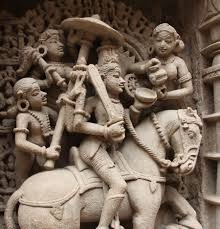
(Left, the demon Kali tries to kill a cow and is stopped by the Aryan king Parīkṣit, a descendant of the Pandavas.) This yuga of vice will last exactly 1200 years of the devas (gods) or 432,000 years of humans. In the end, Kalki—again: not to be confused with Kali—will be born, the tenth and last avatar of Vishnu, who, riding a white horse and wielding a sword, will kill all corrupted humanity and save those who remain devotees of Vishnu.

_________

[1] Tier, eleventh year, No. 5, page 44. Article: ‘Die Überbevölkerung droht als nahe Weltkatastrophe’.

Categories
Kali Yuga Nature Souvenirs et réflexions d'une aryenne (book) Tree Welfare of animals

Reflections of an Aryan woman, 88

You, who are one of us—sons and fathers of the Strong and Beautiful—, look around you without prejudice and passion, and say what you see! From one end of the earth to the other, the strong are retreating before the weak, armed with ingenious malice; the beautiful, before the ungainly, the deformed, the ugly, armed with deception; the healthy, before the sick, armed with recipes for combat taken from the demons with whom they have made a pact. The giants give way to the dwarfs, holders of divine power usurped through sacrilegious research. You see all this more clearly than ever since the disaster of 1945.

But don’t think that this dates from 1945. Certainly not! The collapse of the Third German Reich and the persecution of the Religion of the Strong, which has been raging ever since, are but the consequence of a desperate struggle, as old as the fall of man and the end of the ‘Age of Truth’. They are the recent phases of a gradual and inexorable loss of ground, which has been going on for millennia, and is only more apparent since our fruitless effort to stop it.
 

______ 卐 ______


Editor’s note: As I said yesterday in the comments section, Savitri lived at a time when the real history of Christianity was still unknown. Had she known it, she wouldn’t have needed to dip into Hindu mythology to speculate about a purported decadence of many thousands of years old. Occam’s razor is applicable here, and we can point to Christian ethics, even in its secular form, as the inversion of values that in our day has culminated in the West’s darkest hour.


______ 卐 ______


Consider the trees. Among the Strong, they are the oldest. They are our elder brothers: old kings of Creation. For millions of years, they alone possessed the Earth. And how beautiful was the Earth in the time when, aside from some giant insects and the life born amidst the oceans, it nourished only them!

The Gods know what enthusiasm seized me, on my return to Germany in 1953, at the sight of the resurrected industries of the Ruhr basin! In every cloud of nitrogen peroxide that billowed in fiery volutes from the chimneys of rebuilt factories, I greeted a new and victorious challenge to the infamous Morgenthau plan. And yet… an image haunts and fascinates me: that of the Ruhr basin at the time when the future coal which, along with iron, makes it rich today, existed ‘in potential’ in the form of endless forests of tree ferns.
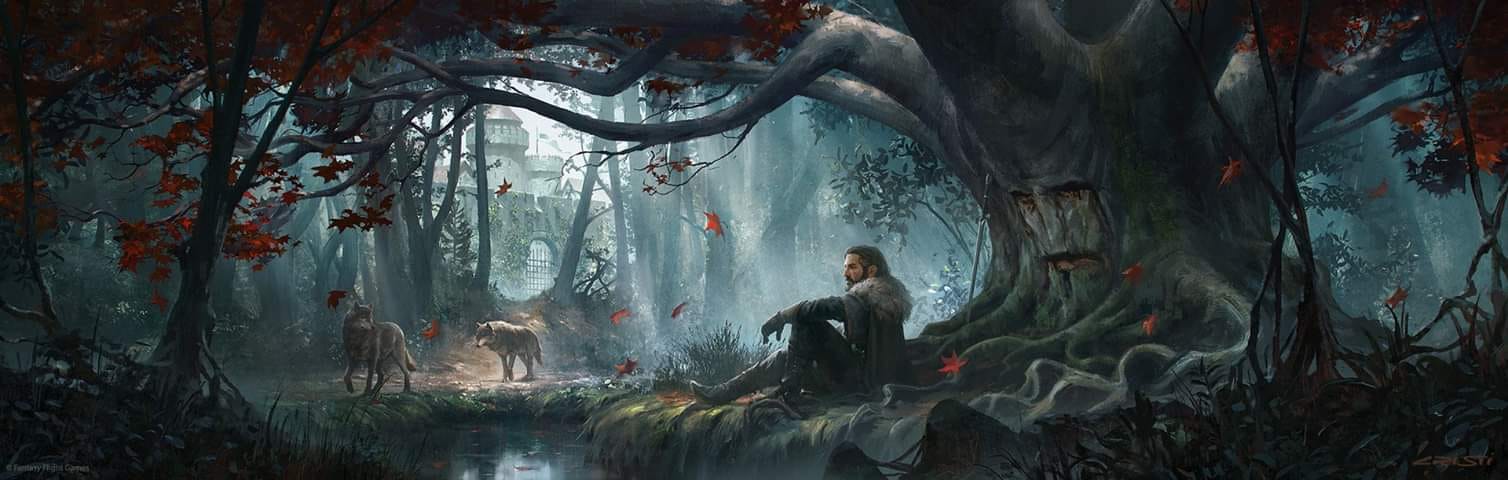
I think I can see them, these fifty-metre-high ferns, endlessly crowded together, competing in their strength in their push towards the light and the sun. It was night between their innumerable shafts, so thick was the evergreen ceiling of their entangled leaves: a humid night, heavy with the vapours arising from the warm blackish mud in which their roots were immersed; a night that the wind, blowing through the gigantic foliage, filled with a harmonious wailing, or that the torrential rains filled with a din. Everywhere one finds coal mines today such forests then extended.

But there is, for me, an even more nostalgic image. It is that of the forest of many species, populated by colourful birds, reptiles beautifully marked with brown, pale yellow, amber and ebony, and mammals of all kinds—especially felines: the most beautiful of all living creatures—, the forest of the hundreds of millennia before man appeared on our planet, and the forest of the time when man, few in number, was not yet the harmful beast he has become. The domain of trees was then almost everywhere. And it was also the domain of animals. It included the domain of the oldest and most beautiful civilisations. And man, to whom the dream of ‘dominating Nature’ and overturning its balance for his benefit would then have seemed absurd and sacrilegious, found his numerical inferiority normal. In one of his most suggestive poetic evocations of ancient India, Leconte de Lisle has one of his characters say:

I know the narrow, mysterious paths
That lead the river to the nearby mountains.
Large tigers, striped and prowling by the hundred…
[1]

In the hot and humid forests of the Ganges (or Mekong) there were tigers, leopards and elephants. In the north of Asia and Europe, it was aurochs and wolves, by the thousands, by the millions. The first hunters—the first herders, rivals of the four-legged predators—certainly killed some of them, to keep the flesh of the domesticated herds for themselves. But from the boundless forest others emerged. The natural balance between the species had not yet been broken, nor was it to be broken for long. It was not until the forest, or the savannah, definitely retreated before man when ‘civilisation’ encroached on it without interruption.

For centuries, however, man was destined to remain confined to very small areas. In ancient times, in Egypt as well as in Assyria, Mesopotamia, Syria, North Africa and even in Southern Europe, lions were found within a few kilometres of cities. All the accounts of the ancients, from those reported in the Bible to those of the adventures of Androcles (how recent, in comparison!) bear witness to this. Unfortunately, these beasts were hunted, and there is abundant evidence of this in the written and sculpted testimonies. Personally, I have always been outraged when reading the inscription that relates the success of the young Amenhotep III, who supposedly killed ‘one hundred and four’ of these royal beasts in a single hunt. And the famous bas-reliefs in the Oxford Museum, which, with that frightening realism of which Assyrian art has the greatest secret, represent Assurnasirpal and his retinue piercing with arrows a whole army of lions—of which some, their backs broken, twist and seem literally to howl in pain—inspire me to nothing less than a burning hatred of man.

And yet… I must admit that, no more at the dawn of the 14th century than during the 9th before the Christian era, this primate had not yet become, on the scale on which it was soon to be, the scourge of the living world. It hunted, it is true, as did other predators. And it had the arrow which strikes from afar, instead of the honest claw and tooth, which only reach up close. But he didn’t exterminate whole species as it was destined to do later, and like no other beast of prey did.

The forest, the endless savannah, the desert—the space which he couldn’t occupy entirely, and in which he was not even able to make his presence felt in a more or less permanent way—remained the free, if not inviolate, domain of non-human life. No civilisation had yet monopolised for the benefit of ‘man’ all the territory on which it flourished. Egypt itself, whose people were by far the most prolific in antiquity, kept, in addition to its luxuriant palm groves, its fauna of lions, crocodiles and hippopotami. And, what is more, thanks to its theriomorphic representations of the divinity, and especially thanks to the pious love with which it surrounded certain animals—such as the innumerable cats, fed and pampered by the priestesses of the Goddess Bastet[2]—it maintained with this fauna a link of a more subtle and stronger order, comparable to the one that still exists today between the Hindu and the Cow, certain monkeys and certain snakes, among other symbolic animals.

It would have seemed to a superficial observer that, despite the hunting, the sacrifices, and the extensive use of wood in the construction of houses as well as ships, the animal species and the forest species could count on an indefinitely prosperous future.

However, even at that relatively early date, man had become ‘the only mammal whose numbers continue to increase’.[3] In other words, the balance that had been maintained for so long between all living species, including man, had been upset in favour of the latter for several centuries.
_________

[1] Leconte de Lisle, ‘Çunacépa’ (Poèmes Antiques).

[2] These cats were mummified after their death. Hundreds of thousands of them have been found in the necropolises where they had been deposited.

[3] ‘der einzige Säuger, der sich in ständiger Vermehrung befindet’ (Tier, 11th year, No. 5, page 44. Article ‘Die Uberbevölkerung droht als nahe Weltkatastrophe’).
Categories
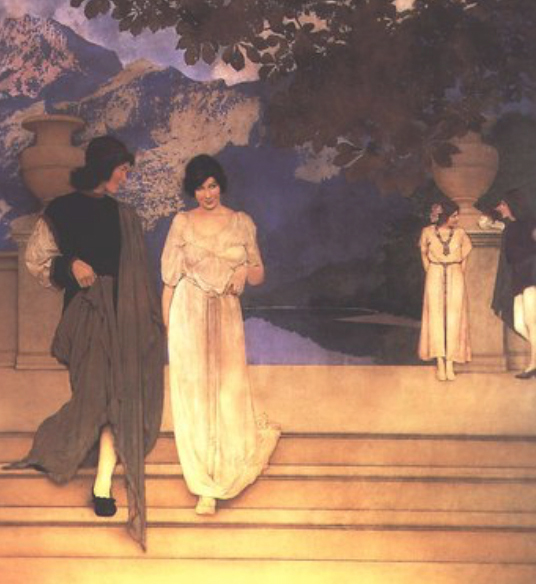
Exterminationism Maxfield Parrish Souvenirs et réflexions d'une aryenne (book)

Reflections of an Aryan woman, 87

‘With the death of Adolf Hitler in the close of the 2nd World War in 1945 Western civilization, as it had existed and is still perceived died once and for all. The only thing that was left now was a gene pool’.

—James Mason

So what is left for those who now live, devoted body and soul, to our ideal of visible (and invisible) perfection on all levels? On a global scale, or even a national scale, absolutely nothing. It is too late. The ‘twenty-fifth hour’ has come and gone, too long ago.

On an individual scale, or at least on a ‘restricted’ scale, we must preserve, insofar as it is still within our power, the beauty of the world—human, animal, vegetable, inanimate; all beauty—to watch over the elite minorities obstinately and effectively, ready to defend them at all costs: all the noble minorities, whether they be the Aryans of Europe, Asia or America, conscious of the excellence of their common race, or the splendid big cats threatened with extinction, or the noble trees threatened with the atrocious uprooting by bulldozers to install on their nourishing soil invasive multitudes of two-legged mammals, less beautiful and less innocent than themselves.

It remains to watch and resist, and to help any beautiful minority attacked by the agents of chaos; to resist, even if it only delays by a few decades the disappearance of the last aristocrats, men, animals or trees. There is nothing else one can do, except, perhaps, to curse in one’s heart, day and night, today’s humanity (with very rare exceptions), and to work with all one’s efforts for its annihilation. There is nothing to do but to make oneself responsible for the end of this cycle, at least by wishing it ceaselessly, knowing that thought—and especially directed thought—is also a force, and that the invisible governs the visible.


______ 卐 ______


Editor’s note:

I would like to clarify what I said about Richard Spencer in my previous post. Unlike him, our loyalties are not with a specific country, Europe or the West in general; but with the fourteen words. And if male westerners betray their ethnic group, our loyalties won’t ever be with them.

It’s tricky, because we are genetically programmed to defend the beauty of the nymphs on the sidebar, and we also need some males to impregnate them. How to overcome this apparent contradiction, when we are living amid the worst generation of whites since prehistoric times? Answer: the last step of the Mauritius scale tells us not to worry about male traitors.

In the case of the nymphs it’s different, in that we will need lots of them to fulfil the sacred words. If they are young, they’ll have a place in the ethnostate for that reason alone. (Of course: each girl will have to have at least ten or so children to repopulate the decimated planet after the coming apocalypse.)

In the case of men, a good marker of the West’s darkest hour is to ask ourselves who we admire. In today’s world, I admire no one but, from yesterday’s world, I admire quite a few Aryan men.

It’s different with women because we shouldn’t look at their character, only at their physique. I’m not the least bit interested in what they think because, after the Day of the Rope, they will gladly submit to the blond beast. So, unlike Spencer, those of us who belong to Savitri’s religion fully identify with her statement that today’s humanity (with very rare exceptions) deserves annihilation.

Spencer is ultimately a normie; Savitri, a true initiate.

Categories
Exterminationism Lord of the Rings Racial right

Replying to Spencer

Richard Spencer has been harshly criticised on racialist forums (see for example the thread on Occidental Dissent, here). A couple of days ago I quoted a tweet in which Strom was replying to Spencer, but the latter has just tweeted:

Russia could drop a nuclear bomb in Western Europe, and the Traitors Coalition (Dissident Right and Dirtbag Left) will continue to yammer about NATO expansion, the Donbas region, and wokeness in America and the EU. I genuinely don’t think there is a limit to their insanity.

What people like Spencer don’t quite understand is that mushrooms over the Western capitals would represent the destruction of Mordor, after throwing the ring into the lava. If Mordor is burned down—the System’s capitals—, the white race will have a chance of salvation. (In Tolkien’s LOTR the story doesn’t end with the destruction of the ring. After that the Shire still must be saved and Saruman killed.)

Mixing metaphors, Spencer hasn’t read the book we are translating from French into English by Savitri Devi. Had he read it, he would have noticed that only Kalki saves, and this means genocide on an unprecedented scale—even, if necessary of our loved ones (see, e.g., our Savitri post today).

Categories
Exterminationism Neanderthalism Souvenirs et réflexions d'une aryenne (book)

Reflections of an Aryan woman, 86

But that’s not all. The visible world around them was infinitely more beautiful than what is spread out today—or was spread out already yesterday and the day before yesterday—, in the vicinity of human agglomerations. It was more beautiful because there were then few men, and many animals, and trees, and immense inviolate spaces.

There is no worse enemy of the beauty of the world than the unlimited proliferation of man. There is no worse enemy of the quality of man himself than this overgrowth: it cannot be repeated too often that a choice must be made between ‘quantity’ and ‘quality’.

______ 卐 ______


Editor’s note: This is where the light-years of distance between Savitri and me compared to today’s racialists is most noticeable. It isn’t enough to say that there are billions of Neanderthals on the planet who disfigure the world. The Mauritian scale has to be climbed to level 10. In other words, grab hold of the Christian ethics that our parents and secular schooling instilled in us, wipe our asses with it, and do it publicly (as Putin is currently defecating on American hubris).

The Aryan who fails to understand this is not a real Aryan but a eunuch lobotomised with NT values.
 

______ 卐 ______

 
The history of our cycle is, like that of any cycle, the history of an indefinitely prolonged struggle between quality and quantity, until the victory of the latter: a complete victory, but a very short one, since it necessarily coincides with the end of the cycle, and the coming of the Avenger, whom I have called by his Sanskrit name: Kalki.

If I say that the heroic but practically useless attempt at ‘recovery’ represented by Hitlerism is the last—beyond which any effort of whatever magnitude against the current of Time, is doomed to immediate failure—it is because I know of no force in the present world able to stop universal decadence, in particular to pitilessly reduce the number of men while raising the quality of the survivors; none, that is, apart from that sole champion of the Powers of Light and Life, fully victorious: Kalki. Despite all the power and the prestige at his disposal, Adolf Hitler was unable to create—recreate—the conditions that were and remain essential for the blossoming of a Golden Age. He could neither suppress technology nor reduce the number of people in the world to anything like one-thousandth of what it is today, that is, practically to what it was during the centuries before our Dark Age.

It is possible and even probable that, victorious, he would have tried to do so, gradually. But his victory would have had to be complete, and not only on a European but on a world scale; and there would have been no power on earth to rival his and to thwart his work.

But then he would have been Kalki Himself, and we would now be living at the dawn of a new cycle. In fact, he needed technology, and at least a growing German population, to carry out his fight against the tide of time under the present conditions.

If, like many of his great predecessors who left behind them new civilisations, he had been partially successful in material terms, his work would hardly have lasted at all, simply because it was set in an era so close to the end of the cycle. Everything suggests that it would have deteriorated in a few years, given the sordid selfishness and stupidity of the vast majority of our contemporaries, even of the best races. The most skilful cook cannot make an appetising and healthy omelette with rotten eggs.

However atrocious it may seem to us, with its immediate and distant consequences, the military defeat of 1945 was still better than the galloping degeneration of a Hitlerian civilisation that appeared too late, after the definitive closure of the era of possible, albeit ephemeral, rectification!

Even in the collapse of the Third German Reich, even in the horror of the last days of the Führer and his ultimate followers in the Chancellery Bunker, under the blazing inferno that Berlin had become, there is a grandeur worthy of the tragedies of Aeschylus or the Wagnerian Tetralogy. The combat without hope and weakness of the superhuman hero against inflexible Destiny—his destiny, and the world’s—replayed itself there, undoubtedly for the last time.

The next time it won’t be giants or demigods, but miserable dwarfs who will suffer the inevitable destruction: billions of dwarves, banal in their ugliness, without character, who will disappear before the Avenger like an anthill destroyed by a lava flow.

In any case, whether or not we survive the painful childbirth of the new cycle, we won’t be among these dwarfs. The ordeal of 1945 and especially of the post-war years—the victoriously overcome ordeal of seductive prosperity—will have made us, the few, what we are and what we remain. And in the roar of unleashed power that will mark the end of all that we so cordially despise, we shall greet with a shiver of ecstasy the Voice of divine revenge, whose triumph will be ours—even if we must perish.

Better that, a hundred times, than participation in universal degeneration under a glorious security (but increasingly devoid of all meaning!) which would undoubtedly have been our lot, if the victorious Reich had survived the ‘twenty-fifth hour’.

Categories
War!

A realist voice

John Mearsheimer’s Ukraine-Russia War 2022 analysis has some technical flaws in the recording. But it is worth listening to. Westerners nowadays are all crazy, suffering from moral panics in the past years like the BLM riots, the hysterical psychosis about Covid, and now the folie en mass in favour of Ukraine. But this American represents the voice of a gentleman from another era.