St. Catherine’s Oratory, Isle of Wight, England.
St. Catherine’s Oratory, Isle of Wight, England.
Response given
by Hermann Gieselbusch
– Reinbek, 23 August 1996 Sachbuchlektorat Rowohlt Verlag –
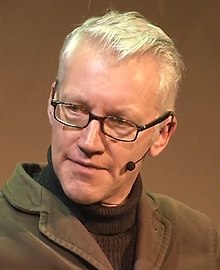
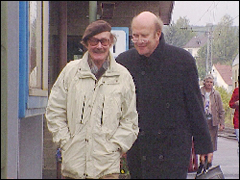 (Left, Karlheinz Deschner with his editor Hermann Gieselbusch.) After some thirty years of preparation, the first volume of Karlheinz Deschner’s ten-volume Kriminalgeschichte des Christentums (Criminal History of Christianity) appeared in Germany in September 1986. The second volume was published in October 1988 and the third in October 1990. This marked the end of the first epoch: Antiquity.
Three imposing volumes, representing some 1,600 pages, with some 350 scientific notes, around half a thousand names of historical characters and as many place names and thousands of quotations from primary and secondary sources. In all, a veritable Milky Way of names, dates, Christian dogmas, titles and data.
Such a well-founded and fundamental accusation against Christianity—not only against the Church—has never been made before. In any case, the attacked party in principle adhered to Oggersheim’s rule: hold on.
When competent and professional Christians could not ignore it; when tens of thousands of readers devoured every new volume of Deschner’s historical Krimi every two years, when the number of annual departures from the Church was rapidly increasing sixfold and many of the dissidents were giving historical reasons in support of their decision—in particular the cruelties Deschner exposes—then it seemed to the attacked ministers of organised Christianity that the matter had passed the point of no return. And in 1992 they went on a counter-attack.
Hans Reinhard Seeliger, professor of historical theology at the Siegen University of Applied Sciences, organised a conference entitled ‘Criminalisation of Christianity? Deschner’s Church History on the Test Bench’: a three-day symposium at the Katholische Akademie Schwerte am Nordrand des Sauerlandes.
From 1 to 3 October 1992, lectures were given on the twenty-three chapters of the three volumes that have appeared to date, either in general or in particular. Most of the lecturers were professors from Germany and Austria: ordinary, extraordinary, supernumerary, and emeritus, as well as one professor and one honorary professor. Two belong to the Dominican order and one is a Franciscan. The spectrum of specialisations ranges from ancient church history, patrology, Christian archaeology, ancient history, ancient philology and Judaism to historical and systematic theology. The group was joined by a professor of criminal law (because Deschner’s is a criminal history!) as well as a newly qualified doctor of medicine from Freiburg.
Karlheinz Deschner was also invited—a chivalrous gesture—to present ‘the basic and general conception of his work’. One against twenty-two, a very tempting challenge for the combative spirit like Deschner. Nevertheless, he declined the invitation. He had already discussed the proposed topic at length in the general introduction to his work: ‘On the Subject, Methodology, the Question of Objectivity and the Problems of Historiography in General’, which consists of sixty printed pages. To this introduction, as Deschner himself wrote to the organisers, he had nothing to add. [1]
All lectures appeared in book form in the Catholic Traditionsverlag Herder in Freiburg, edited by the initiator Hans Reinhard Seeliger, with a total of 320 pages. On the cover we see the image of the Dominican Savonarola in Florence, painted by Fra Bartolommeo. A joke? (in 1498 Savonarola was burned at the stake). An aspiration? In any case, the editor writes in his introduction that ‘a “beheading” of the author would have been easy to execute’.
Of course, the book published by Herder, which is quite expensive by the way, has not been a bestseller. But even with a limited number of copies it fulfilled its function as a smokescreen. From now on, and with the very erudite reference to this collective volume, is interwoven the verdict that in that book more than twenty experts have shown that Deschner works in an unscientific way and writes with bias. When someone referring to Deschner now asks the Church painful questions, the initiate need only smile with a compassionate expression and refer to the said book—without having read it, of course—and with this magic trick of authority the whole historical mosaic of criminal history is diluted into complacency, and the soul seduced by Deschner must continue to believe that Christianity and its Churches have never had a criminal history, but only and exclusively a sacred history.
The philosopher Hermann Josef Schmidt, a professor in Dortmund, has thoroughly analysed the volume edited by Seeliger in Herder and published his exposé under the title Das ,,einhellige” oder scheinheilige ,,Urteil der Wissenschaf”? Nachdenkliches zur katholischen Kritik an Karlheinz Deschners ,,Kriminalgeschichte des Christentums”.
Deschner assumed that the interested reader can judge for himself which point of view is more convincing, and which author is closer to the critical and historical truth. Deschner, who continually advises his audience to examine what he says, not to ‘believe’ him, believes in the undertow of reason.
But to remain silent in this case would be self-harming and out of touch with reality. Calumniare audacter, semper aliquid haeret: Don’t be shy to slander, there is always something left! A foreign scientist recalled with special emphasis this old, and true, cynicism: Deschner should take a sharp, immediate and clear stand against his Schwerte critics.
The malignant flu in the winter of 1996 made it difficult for Deschner to write the fifth volume of the Criminal History, so he took up the Herder volume again, as a kind of spiritual gymnastics for convalescents, and looked for a modus operandi. To critically analyse the entire three-hundred-page-long text? Impossible. He could only proceed selectively by choosing a single article and analysing it in depth.
Deschner decided on the paper ,,Kaiser Konstantin: ein Grosser der Geschichte?” by Maria R.-Alföldi (the only woman in the Schwerte group). On the face of it, this lecture corresponds to the average level of volume. Some texts yield to all kinds of criticism. A few at least refrain from personal defamation and try to do justice to Deschner’s peculiarities and contribution: Maria R.-Alföldi occupies a middle ground and is therefore representative of the work.
She was born in 1926 in Budapest, received her doctorate in 1949, was appointed professor in Munich in 1961 and worked since then as a scientific advisor and later as a lecturer at the seminar for Greek and Roman history at the University of Frankfurt of Main in auxiliary sciences for archaeology and the history and culture of the Roman provinces (among the auxiliary disciplines of history are epigraphy, papyrology, glyptography and sigillography). Maria Radnóti-Alföldi has mainly published works on numismatics, such as Die constantinische Goldpragung: Untersuchungen zu ihrer Bedeutung für Kaiserpolitik und Hofkunst (1963) and Antike Numismatik: Theorie, Praxis, Bibliographie (1978).
Professor Radnóti-Alföldi is a corresponding member of the Academy of Science and Literature in Mainz. Hans Reinhard Seeliger, at the Schwerte meeting, introduced her as a ‘Constantine researcher of international standing’. Her lecture was received with particular sympathy at Schwerte, but here it seemed like a chorus to torpedo Deschner’s reliability as a historian. How many targets did she make? That is what Karlheinz Deschner discusses in the following reply.
______________
[1] Editor’s note: Our abridged translation of Deschner’s global introduction to his ten volumes can be read on pages 15-25 of a PDF. Deschner’s response to Professor Radnóti-Alföldi will appear in the next post.
Do you remember my article under the long title ‘Enrique Krauze, Mexico’s Most Prominent Public Intellectual, Hates Trump (and White, Protestant America)’ that was published almost four years ago in The Occidental Observer?
 Enrique Krauze has just published a thick autobiographical book.
I obtained a copy of his book earlier this week and find it fascinating, as Krauze recounts how he was raised by his Jewish family in Mexico City after they fled Poland with Hitler’s rise to power. What he says about Nazism and the Holocaust also fascinated me, as it is rare in Mexico for Jews to speak openly about their philias, phobias and abismal fears, and even more so in books that become bestsellers (as Krauze’s book is becoming)!
I live to the uttermost south of the big city, where apparently no Jews live (in Mexico City, Jews are concentrated in Polanco and Las Lomas). In a café where I used to play chess, years ago I spoke, very briefly, with a Jewish scholar of chess, about Hitler. But I have never had a long conversation with one of them on the subject—which is why I was so interested in the book by Krauze that the Spanish publisher TusQuets has just released (Krauze is even going to Argentina and Chile this month to continue promoting his book!).
Of course: such a book could only be of interest to Spanish speakers who are aware of the Jewish question. Here I can only say that my short 2018 article that Kevin MacDonald accepted for his webzine caused me some trouble, though not serious, in the city where I live.
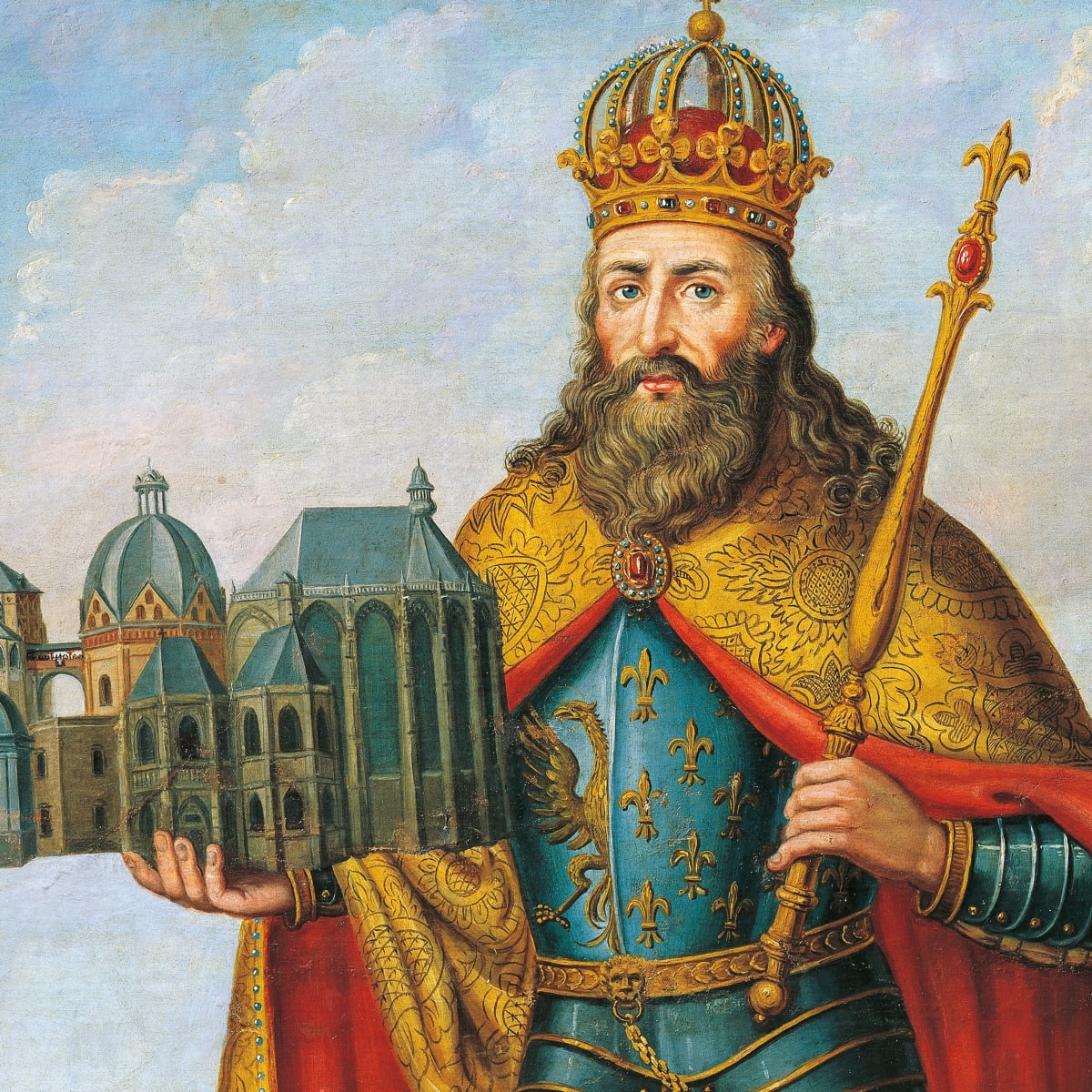
Karolus serenissimus augustus a Deo coronatus magnus pacificas (Charles, most serene emperor, great and peaceful emperor, crowned by God). As the beginning of his prolix title already read in 801, that peacemaking Caesar, crowned by God and reigning also per misericordiam Dei (by the mercy of God), the one who from 802 was also called imperator christianissimus and who (supposedly) died with the words of Psalm 31: ‘Into thy hands, O Lord, I commend my spirit’, that man had prepared one slaughter after another, and in his forty-six years of rule—from 768 to 814—he had warred almost continuously with about fifty military campaigns. For only two years (790 and 807) he didn’t fight ‘A happy period for the Church’ (Daniel-Rops).
There is nothing strange about the fact that in the Chanson de geste—the French epic poems of the early Middle Ages—he is already ‘more than two hundred years old’, accompanied by his bravest paladins. He fought against the Lombards, the Frisians, the Bavarians, the Avars, the Slavs, the Basques and the Arabs in Spain, and the Byzantines in southern Italy, with offensive wars almost coldly planned and with which he inflicted death, often cruel and terrible death, on countless people.
And not only did he kill in the wars, but he also had 4,500 prisoners murdered and thousands of families banished. Or, as it is said in one of the oldest liturgical poems in honour of Charles: ‘He struck down thousands, cleansed the earth of the heathen weeds, converted the infidels, broke the statues of the gods, drove out the foreign gods’. For him, according to his biographer Einhard, the wars against the Saxons and the Avars were more important than all other political tasks. Moreover, for certain ecclesiastical circles in the 10th century, the Saxon wars were the most important work he did for the Christian mission.
It is not just that Charles ‘the Great’ in fact killed, subjugated and enslaved without pause (winters generally excepted); that he was nothing but a warrior, conqueror, murderer and predator on the grandest scale—which, as the most learned of scholars have long since taught us, was then so commonplace, so much a part of the ‘Saxon way of life’, was then so commonplace, so much the ‘good’ style of the time, that to criticise it would be a crass anachronism, from our ‘enlightened’ time as well as being arbitrary, rigorist, moralistic and square-jawed in the extreme. No, it is also about the fact that Charles ‘the Great’ carried out all this incredible bloodshed with the most intense participation of Christianity and the Church of his time (which, of course, were also ‘sons of their time’! according to the apologists). And that this Church never protested, but rather took full advantage of it all.
The point is that the Christian feudal state and the Christian feudal Church were one and the same thing—and the same thing in crime.
Charles, whose true ‘book of state’ was the Bible, and whose favourite works included Augustine’s City of God, not only ruled and acted as king of the Franks but also as an enlightened protector of the Church, as an interlocutor and ally of the pope, as evidenced by his legislation, his epistolary correspondence written by ecclesiastics and his closest collaborators. This monarch was a kind of priest-king, he was rector et devotus sanctae ecclesiae defensor et adiutor im omnibus (guide and devoted defender and helper of the Holy Church in all things).
Empire and Church became indissolubly intertwined in the imperium christianum, with hardly any difference between political diets and ecclesiastical councils. Charles convened synods, over which he presided; he chose bishops and abbots as he pleased, and in Saxony he instituted the bishoprics he needed. When he needed an archbishopric for his attacks on the miserly, he had the pope erect the archbishopric of Salzburg. He also disposed of church property, enriching popes and bishops with territories. He granted them numerous privileges of immunity and punished the violation of ecclesiastical immunity with the doubled royal penalty of 600 solids. He freed the bishops from taxes and granted them the right to mint money. He punished the plundering and burning of churches with capital punishment.
But above all, he imposed the universal obligation of tithes on the clergy and demanded tithes for the Episcopal churches at the state level. He also bequeathed three-quarters of his cash to the Church, which he took special care of in his last years (while he left only one-twelfth to his children and grandchildren as a whole, and one-twelfth to the palace servants). And the prelates were also entirely dependent on him, although their influence during his reign—considering him at least all the Frankish bishops as the universal head of the Church—grew considerably: under Charles, they marched to war, acted as judges alongside the counts and were at the head of the royal court.
A 1967 study lists no less than 109 places of worship of St. Charles. These include Aachen (where Charles’ death day, 28 January, is still celebrated in the cathedral today, and where I celebrated my name day as a child), Bremen, Brussels, Dortmund, Frankfurt (one of the main places of Charles’ cult), Fulgem (another of the main places of Charles’ cult), Falkirk (another of the main places of Charles’ cult’), Fulda, Halle, Ingelheim, Cologne, Constance, Lüttich, Mainz, Minden, Münster, Nuremberg, Regensburg, Strasbourg, Trier, Vienna, Würzburg and Zurich. It is also noteworthy that Charles received cultic veneration throughout Saxony. For centuries Charles ‘the Great’, Charlemagne, has been regarded as the ideal model ruler, and for many, for very many, he still is today.
Voltaire and Gibbon stigmatised his barbarism and denied him personal greatness.
At the beginning of the 19th century, Napoleon was exalted to the full extent of his power as a ‘Charlemagne redivivus’. After the founding of the German Reich in the 19th century, Germans rediscovered Charles’ Germanness and his bellicose spirit. In the fascist era, amid the Second World War, the 1200th anniversary of Charlemagne’s birth was celebrated on 2 April 1942, and he was presented as ‘Charles the Unifier’.
The Carolingian empire, the imperiun christianum, as Alcuin called it from 798, the regnum sanctae ecclesiae (Libri Carolini), stretched from the North Sea to the Pyrenees and the Adriatic. It covered what is now France, Belgium, Holland, western Germany, Switzerland, most of Italy, the Marca Hispanica and Corsica. It was approximately 1,200,000 square kilometres in area: almost as large as the Western Roman Empire.
______ 卐 ______
Editor’s Note:
I have been very critical of American white nationalism on this site, but hardly at all of German National Socialism.
It is time to realise that Hitler and the Nazis weren’t perfect. As I implied in my post yesterday, if they had become wise instead of, using chess imagery, gambit the Third Reich against General Winter in Russia, they would have devoted all their efforts to understand the root causes of the dark hour. Karlheinz Deschner, the author of the above text, wouldn’t have hung up his Nazi uniform and become a philo-Semitic liberal because Hitler would have kept his Reich. Deschner could have written his criminal history of Christianity from the point of view of a Germany that had already transvalued its values.
I have said it and it bears repeating: To win the war we must know what we are fighting against. Both the most populist Nazis, like Goebbels, and today’s white nationalists emphasise Jewry. I think Manu Rodriguez, quoted in my post yesterday, was right: the Semitic hydra also includes Christianity and Islam. From time immemorial, anything to do with the Semitic race has been the enemy. Recall that Republican Rome began to decline just after Hannibal and the Carthaginians decimated the flower of the Roman army. That created the spiritual degradation that resulted in the later Roman Empire’s citizens beginning to interbreed with mudbloods. Eventually, the Judeo-Christians took advantage of that opportunity and the rest is history.
After I finish proofreading On Exterminationism, I will start putting together other books-PDFs of the most important entries on this site that show this meta-perspective.
I usually add my comments within the posts of Karlheinz Deschner’s Christianity’s Criminal History (to contextualise this series, click here). But what I am about to say is so vital that I prefer to add it as a separate entry.
If Hitler and his closest associates, some of them anti-Christian, had understood that the Christian Question is far more toxic than the Jewish Question (the white traitor is worse than the kike), they wouldn’t have ventured into the Soviet Union.
The evil lay at home, including Hitler’s admiration for Charlemagne, the butcher of Saxons! So at home was the evil, that it was child’s play for the victorious Allies to brainwash the Germans after the Hellstorm Holocaust, in which more Germans died than Jews in the so-called Jewish Holocaust.
Had they known that the CQ was a more serious matter than the JQ, they would have prepared the German people so that, gradually—as Hitler well saw in his after-dinner talks—the Germans would abandon the religion of our (really asshole) parents. It is worth quoting, again, what the Spaniard Manu Rodríguez told me almost a decade ago:
______ 卐 ______
Your words have made me rethink this whole period [of the Third Reich—Ed.]. In this period the Aryan people are identified and recognised for the first time in the history of a people. For the first time, our people became aware of themselves, their origin and their nature. Since the emergence of our people (that primitive nucleus) six or seven thousand years ago, there had been nothing like it. It was a dawn, a new dawn. These were sublime moments.
This ‘birth’ has to do with the emergence of Indo-European studies, and the evolutionary and genetic studies of that time. They spread new knowledge about our biocultural being, our race, and our languages and cultures. It was a recognition. It was like looking in a mirror for the first time. We were there in those texts: in the hymns of the Rig Veda, in the Iliad, the Aeneid, the Edda, the Mabinogion. It was us, our blood, our genius, our race, that had generated those texts, those cultures, those worlds.
The swastika, our banner, was not only raised against liberalism and communism… It is only today that we are beginning to understand the greatness and scope of its mission—our mission. To situate it precisely, we can make these words of Saint-Loup our own:
[Hitler was] the man who had thrown down to the world this extraordinary challenge: to attack at the same time Anglo-Saxon capitalism, Red Bolshevism, Jewish racism, international Freemasonry, the Catholic Church, pauperism and social iniquities, the Treaty of Versailles, colonialism and the French disorder.
And the list is not complete.
It was not just Hitler, but Germany as a whole: the entire German people. It was a collective ‘enterprise’.
The German community was born armed, like Athena, the first Aryan community to awaken or be reborn. And it does so to fight against those who have sought to harm it; against a whole counter-cultural environment that denies its being. Spiritually alienated, it has to fight against the Judeo-Messianic delusion, the ‘Christian millennium’. It wasn’t the only Jewish monster that had to confront this newborn Aryan nation: communism also ravaged the population and others. The Jewish hydra had multiplied, had branched out, and had too many faces, too many heads.
It seems that we have had only one enemy throughout history: the Semitic peoples and their discourses (Jewish, Judeo-Messianic Christian and Muslim). They dominate us spiritually. It is the multiple alienations we suffer at the hands of the Semites or Semitic ideologies (religious, political, economic, anthropological, sociological, psychological…). Our enemy possesses us in one way or another. The dreaded Jewish hydra. Typhon. Evil. Our evil.
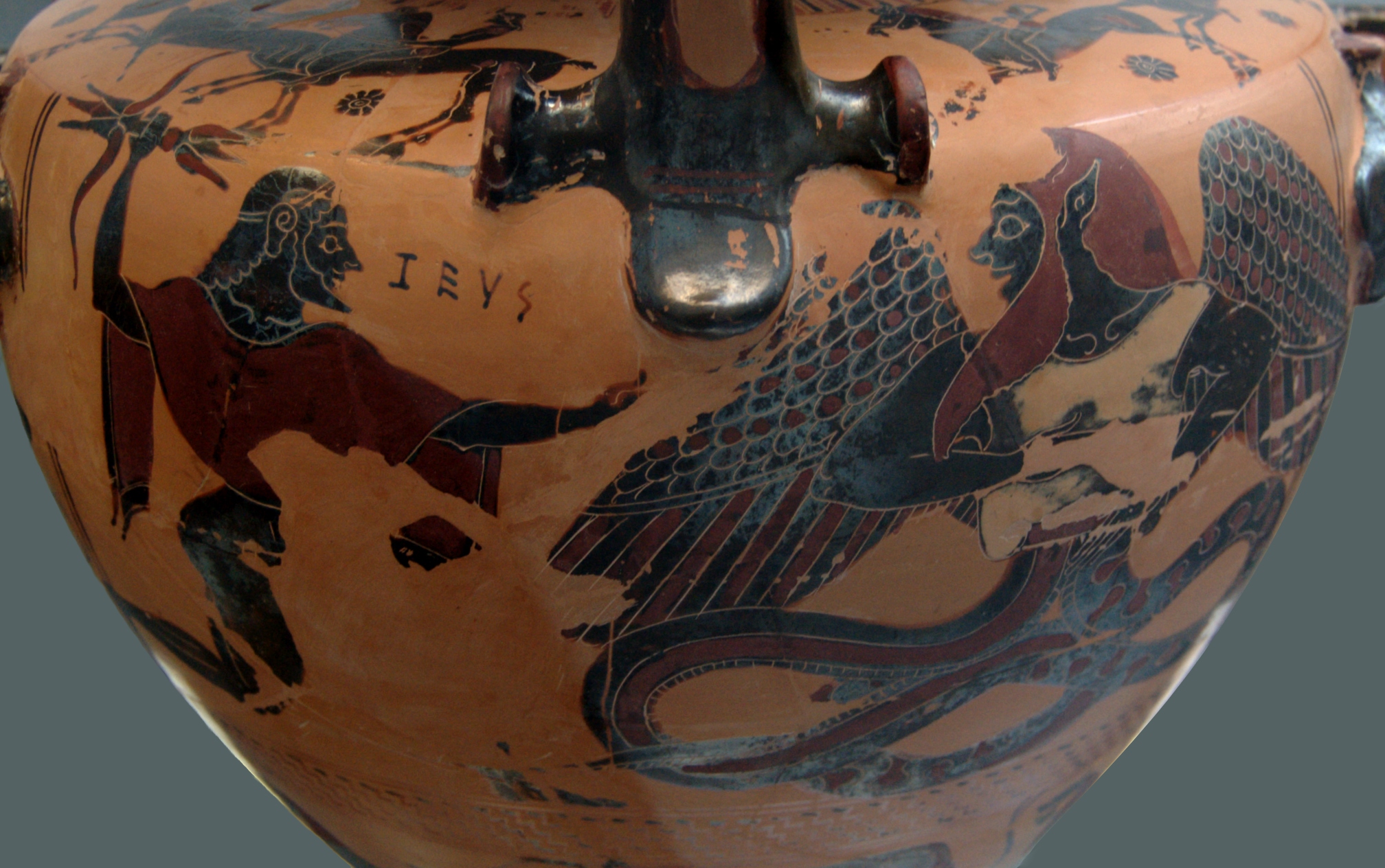 Was it an awakening, a premature birth? Too young was this community to face this age-old Monster. As a young Hero, it failed in its first attempt to defeat it. Too old and cunning such a monstrosity. It engulfed the child, and the young Aryan community, in a few years.
We must rescue the memory of this period and raise it to the top with pride. We should be proud of this period. We lost a battle, but not the war. We are still alive and active… We will beat them at last. I know that.
The birth of our people is conceived in the years before Hitler came to power. The Aryan consciousness of a whole people saw the light then and received its ‘baptism’ publicly. A whole people recognised itself. 1933 was the year of its birth, the first Aryan community to be recognised as such. It was lost in 1945. We are therefore on the 80th anniversary of its birth, the birth of the first Aryan nation, of the Aryan nation itself.
That period is an unparalleled milestone in our short history. The first appearance of our people in history. We are now a people: the Aryan nation.
Hitler symbolises our first period, our first battle and our first loss. His struggle was our struggle. His loss was our loss. But this defeat hasn’t conquered us in our first open confrontation against evil, against our evil. We were defeated, so what? It was a huge thing to fight. Too many hydra tentacles… The war has just begun.
These anniversaries of Hitler and the birth of our people have been for me like a small rebirth too. Let’s say I see more light, I see more clearly. I have a feeling about the next battle—that there will be another battle. And this time we will have a space from which to advance, a bulwark, a solid base: the Aryan nation itself. We will reconquer our people. We have many great spiritual warriors, well-armed with knowledge and truth. In the end, we will win.
This is my spirit now.
Chechar, I feel I owe this letter to you (and to all those I upset with my harsh words about Hitler and the Nazi period).
Regards,
Manu.
(translated from Spanish)
Charlemagne’s bloody laws
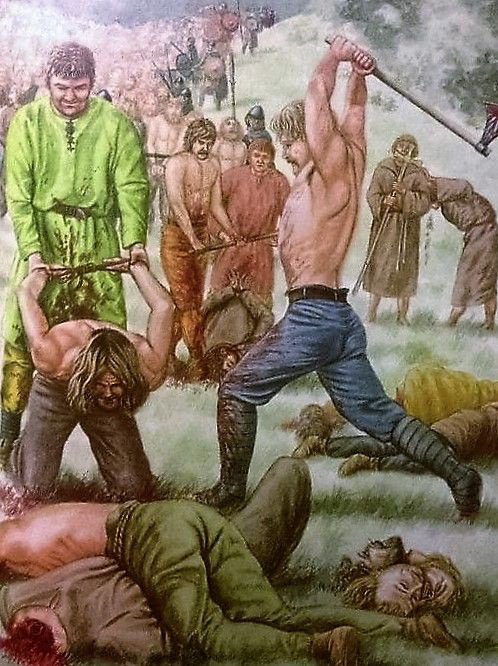
During his struggle, the king issued draconian laws, evidently whenever he believed that he had finally subdued the Saxons and could bring them to ‘order.’ Notable in this respect are the Capitulatio departibus Saxoniae (782) and the Capitulare Saxonicum (797). And as conversions to Christianity were forced by mass baptisms, while the Saxon people secretly persisted in their paganism and abhorred the clergy, Charles imposed a complete change of ideological education based on the total eradication of ancient beliefs and their rites and by the forced baptism of all Saxons.
Of the fourteen provisions of the Capitulatio, which carry the death penalty, ten refer exclusively to crimes against Christianity. He had previously sought the advice of the pope and was clearly guided by the missionary method of the Fulda monks for the extirpation of paganism, which began with unceremonious mass baptisms and the total destruction of their shrines.
A stereotypical morte moriatur (die without remission) threatened everything the heralds of the good news wanted to erase: the plundering and destruction of churches, the cremation of the dead, the rejection of baptism, the secret avoidance of baptism, the mockery of Christianity, the undermining of church property, the offering of pagan sacrifices, the practice of gentile customs (emphasis added!—Ed.), and so on. This was its tenor:
• If anyone violently breaks into a church and steals anything from it, or sets fire to the church, let him die without remission.
• If anyone out of contempt for Christianity does not keep the sacred fast of forty days and eats meat, let him die without remission.
• If anyone, according to heathen custom, causes the body of a deceased person to be destroyed by fire and reduces his limbs to ashes, let him die without remission.
• If anyone in the future among the Saxon people pretends to hide without having been baptised and stops approaching baptism because he wants to remain a pagan, let him die without remission.
• If anyone in agreement with the heathen plots something against the Christians and seeks to maintain hostility against the Christians, let him die without remission.
Even the transgression of the precept of fasting carried the death penalty!
Baptism in the first year of life, church attendance on Sundays and feast days, the taking of oaths in churches and even the observance of the canon law on marriage were ordered. As Alcuin had already criticised, ‘severe penances were imposed for the slightest faults.’
Since the forcibly converted Saxon people cared little or nothing for Christianity, they had to continue to be forced to support the Church. Everyone, noble, free and common, had to give the Church a tithe for the harvest of their fields and all their earnings. In addition, each church was to get two rural estates, as well as one manservant and one maidservant for every 125 inhabitants, so that the mass of the Saxons was exploited as never before.
The aim of Charles’ war could hardly be stated more clearly and convincingly: the destruction of paganism, expansion of Christianity and annexation.
Or:
How the Woke Monster originated
See what I wrote on Saturday about Tom Holland’s book Dominion, some of whose passages from the Preface I quote below. Holland contrasts the jovial spirit of the Greco-Roman world with the medieval spirit after the Church infected the minds of Europeans:
Something fundamental had indeed changed. ‘Patience in tribulation, offering the other cheek, praying for one’s enemies, loving those who hate us’: such were the Christian virtues as defined by Anselm. All derived from the recorded sayings of Jesus himself. No Christians, then, not even the most callous or unheeding, could ignore them without some measure of reproof from their consciences. [page 9]
Because the American racial right is ignorant of European history, they don’t realise that the Woke Monster—i.e., the inversion of Greco-Roman values—has been suffered by whites since the Middle Ages, not only in recent years:
God was closer to the weak than to the mighty, to the poor than to the rich. Any beggar, any criminal, might be Christ. ‘So the last will be first, and the first last.’ To the Roman aristocrats who, in the decades before the birth of Jesus, first began to colonise the Esquiline Hill with their marble fittings and their flowers beds, such a sentiment would have seemed grotesque. [page 9]
But Holland is similar to Kevin MacDonald in one respect. Although he has abandoned the faith of his childhood, he is still sympathetic to Christianity in some ways. Holland is a secular historian, and like most secular historians that makes him dangerous: he gives us the impression that he is objective, not what we have been calling a neochristian. For example, in the Preface Holland refers to Nero as a ‘malignant Caesar’ (page 10). If the visitor has read the masthead of this site, the Spaniard’s essay on the Judean war against Rome and how Christians wrote history, he will remember that from the ancient world these Judeo-Christians were engaged in defaming figures like Caligula and Nero because they took anti-Jewish measures. (Believing mainstream historians is akin to believing what CNN has said about Trump.)
In the middle of Dominion, the book contains splendid colour reproductions such as the following, in the context of the reversal of classical to Christian values, with St Peter, the very vicar of Christ on earth, depicted in this way:
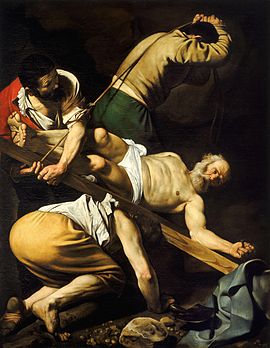
No ancient artist would have thought to honour a Caesar by representing him as Caravaggio represented Peter: tortured, humiliated, stripped almost bare. And yet, in the city of the Caesars, it was a man broken to such a fate who was honoured as the keeper of ‘the keys of the kingdom of heaven’. The last had indeed become first… [page 10]
In the Middle Ages, no civilisation in Eurasia was as congruent with a single dominant set of beliefs as was the Latin West with its own distinctive form of Christianity. Elsewhere, whether in the lands of Islam, or in India, or in China, there were various understandings of the divine, and numerous institutions that served to define them; but in Europe, in the lands that acknowledged the primacy of the pope, there was only the occasional community of Jews to disrupt the otherwise total monopoly of the Roman Church. [page 11]
As we have often insisted in discussing the climax of the Spaniard’s essay, the incredible juggling act that the Judeo-Christians performed in a process that culminated with Emperor Theodosius II, was to allow only Judaism and Judeo-Christianity as the religions of the Roman Empire. No other—and under no circumstances the previous religions with Aryan gods!
Well might the Roman Church have termed itself ‘catholic’: ‘universal’. There was barely a rhythm of life that it did not define. From dawn to dusk, from midsummer to the depths of winter, from the hour of their birth to the very last drawing of their breath, the men and women of medieval Europe absorbed its assumptions into their bones. Even when, in the century before Caravaggio, Catholic Christendom began to fragment, and new forms of Christianity to emerge, the conviction of Europeans that their faith was universal remained deep-rooted. It inspired them in their exploration of continents undreamed of by their forefathers; in their conquest of those that they were able to seize, and reconsecrate as a Promised Land… [page 11]
Time itself has been Christianised. [page 12]
If today’s members of the racial right were not charlatans, the first thing they would want to do would be to proclaim that the coming new age is no longer to be measured by the birth of a non-existent Jew (pace Holland, Jesus didn’t exist), but of the Aryan man about whom Savitri Devi wrote: ‘To the god-like Individual of our times; the Man against Time; the greatest European of all times; both Sun and Lightning…’ (see the featured post).
How was it that a cult inspired by the execution of an obscure criminal in a long-vanished empire came to exercise such a transformative and enduring influence on the world? To attempt an answer to this question, as I do in this book, is not to write a history of Christianity. Rather than provide a panoramic survey of its evolution, I have sought instead to trace the currents of Christian influence that have spread most widely, and been most enduring into the present day. That is why—although I have written extensively about the Eastern and Orthodox Churches elsewhere, and find them themes of immense wonder and fascination—I have chosen not to trace their development beyond antiquity. My ambition is hubristic enough as it is: to explore how we in the West came to be what we are, and to think the way that we do… [page 12]
Today, at a time of seismic geopolitical realignment, when our values are proving to be not nearly as universal as some of us had assumed them to be, the need to recognise just how culturally contingent they are is more pressing than ever. To live in a Western country is to live in a society still utterly saturated by Christian concepts and assumptions. This is no less true for Jews or Muslims than it is for Catholics or Protestants. Two thousand years on from the birth of Christ, it does not require a belief that he rose from the dead to be stamped by the formidable—indeed the inescapable—influence of Christianity. Fail to appreciate this, and the risk is always of anachronism… [page 13]
Remember the negrolatric revolution (BLM riots) that surprised everyone less those who see recent history as the explosion of the Christian sun in its secular, incendiary form: a red giant that I have called neochristianity (although it’s more precise to see it as ‘neofranciscanism’)?
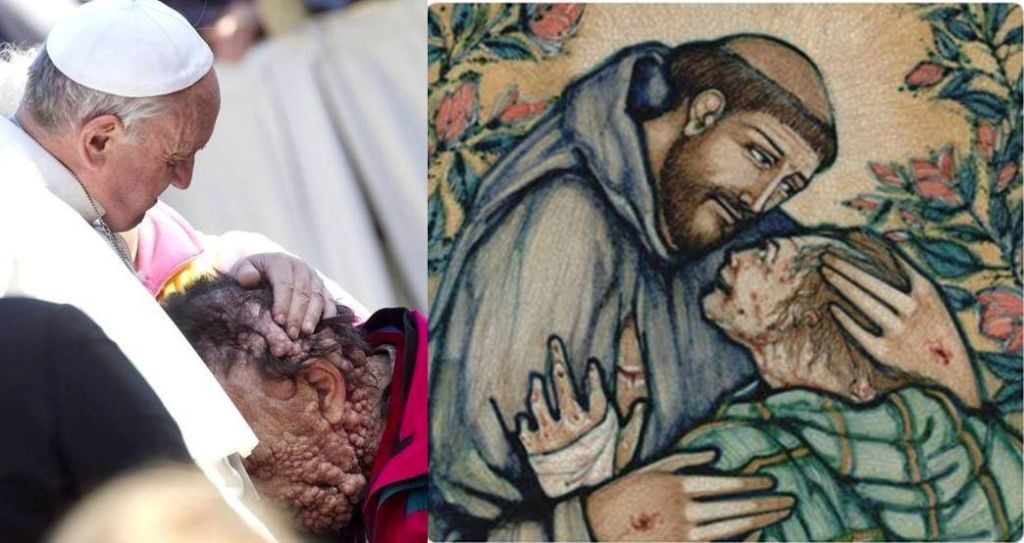
The West, increasingly empty though the pews may be, remains firmly moored to its Christian past. There are those who will rejoice at this proposition; and there are those who will be appalled by it. Christianity may be the most enduring and influential legacy of the ancient world, and its emergence the single most transformative development in Western history, but it is also the most challenging for a historian to write about. [page 13]
One thing I like about Holland’s prose is that he sprinkles his erudite treatise with personal vignettes:
…although I vaguely continued to believe in God, I found him infinitely less charismatic than the gods of the Greeks: Apollo, Athena, Dionysus. I liked the way that they did not lay down laws, or condemn other deities as demons; I liked their rock-star glamour. As a result, by the time I came to read Edward Gibbon and his great history of the decline and fall of the Roman Empire, I was more than ready to accept his interpretation of the triumph of Christianity: that it had ushered in an ‘age of superstition and credulity’. My childhood instinct to see the biblical God as the po-faced enemy of liberty and fun was rationalised. The defeat of paganism had ushered in the reign of Nobodaddy, and of all the various crusaders, inquisitors and black-hatted Puritans who had served as his acolytes. Colour and excitement had been drained from the world. ‘Thou hast conquered, O pale Galilean,’ wrote the Victorian poet Algernon Charles Swinburne, echoing the apocryphal lament of Julian the Apostate, the last pagan emperor of Rome. ‘The world has grown grey from thy breath.’ Instinctively, I agreed. [pages 15-16]
Then Holland says something that reminds me of Yockey’s words in Imperium: that Europeans claim to be based on the Greco-Roman world when in fact they are completely different civilisations:
Yet over the course of the past two decades, my perspective has changed. When I came to write my first works of history, I chose as my themes the two periods that had always most stirred and moved me as a child: the Persian invasions of Greece and the last decades of the Roman Republic. The years that I spent writing these twin studies of the classical world, living intimately in the company of Leonidas and of Julius Caesar, of the hoplites who had died at Thermopylae and of the legionaries who had crossed the Rubicon, only confirmed me in my fascination: for Sparta and Rome, even when subjected to the minutest historical enquiry, retained their glamour as apex predators. They continued to stalk my imaginings as they had always done: like a great white shark, like a tiger, like a tyrannosaur. Yet giant carnivores, however wondrous, are by their nature terrifying. The more years I spent immersed in the study of classical antiquity, so the more alien I increasingly found it. The values of Leonidas, whose people had practised a peculiarly murderous form of eugenics and trained their young to kill uppity Untermenschen by night, were nothing that I recognised as my own; nor were those of Caesar, who was reported to have killed a million Gauls, and enslaved a million more. It was not just the extremes of callousness that unsettled me, but the complete lack of any sense that the poor or the weak might have the slightest intrinsic value. Why did I find this disturbing? Because, in my morals and ethics, I was not a Spartan or a Roman at all. That my belief in God had faded over the course of my teenage years did not mean that I had ceased to be Christian. For a millennium and more, the civilisation into which I had been born was Christendom. Assumptions that I had grown up with—about how a society should properly be organised, and the principles that it should uphold—were not bred of classical antiquity, still less of ‘human nature’, but very distinctively of that civilisation’s Christian past. So profound has been the impact of Christianity on the development of Western civilisation that it has come to be hidden from view. It is the incomplete revolutions which are remembered; the fate of those which triumph is to be taken for granted. [pages 16-17]
And in the final words of the Preface, Holland tells us:
The ambition of Dominion is to trace the course of what one Christian, writing in the third century AD, termed ‘the flood-tide of Christ’: how the belief that the Son of the one God of the Jews had been tortured to death on a cross came to be so enduringly and widely held that today most of us in the West are dulled to just how scandalous it originally was. This book explores what it was that made Christianity so subversive and disruptive; how completely it came to saturate the mindset of Latin Christendom; and why, in a West that is often doubtful of religion’s claims, so many of its instincts remain—for good and ill—thoroughly Christian. [page 17]
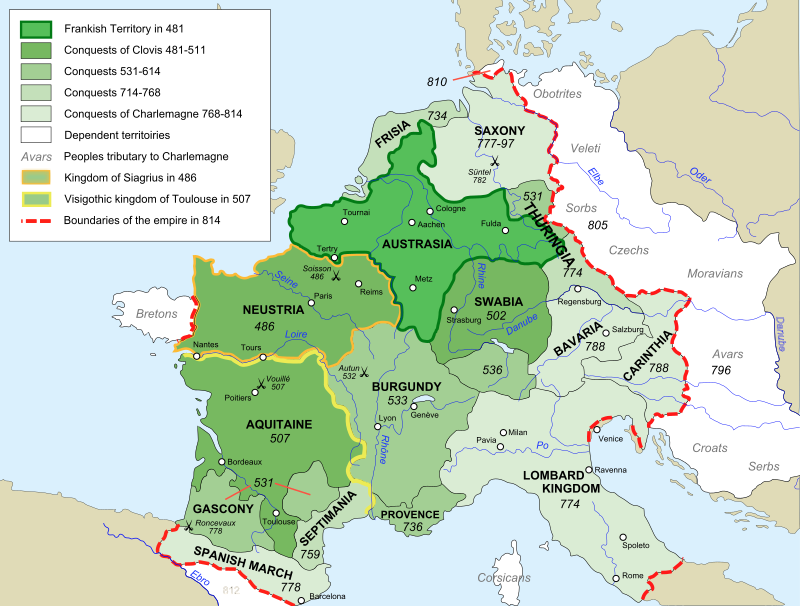
Frankish expansion from 481 to 814
Last uprisings, war of annihilation and ‘the serene height of the staff’
The war of the Saxons, which lasted for more than ten years, didn’t, however, affect the foreign sovereignty of the Franks, or even Christianity as such. Rather, it was directed primarily against their representatives and institutions, against the Church, their rigorous attacks on private property, and their brutal collection of tithes, of which Alcuin, Charles’ Anglo-Saxon adviser, had already complained, seeing predators (praedones) in the missionaries rather than preachers (praedicatores). ‘That tithes had destroyed loyalty and faith’ seems to have been a proverbial saying among the Franks. The northern Albigensians then fought the Church with the same harshness that the latter had shown. Everywhere the new temples were destroyed, the ecclesiastics were expelled, and not infrequently the Christian Saxons were murdered and their possessions plundered. In short, the entire ecclesiastical organisation north of the Elbe was completely eradicated.
The uprising grew into a war of annihilation lasting more than ten years, with extreme cruelty on both sides. The counter-offensive, which was only resumed in the autumn of 794 and in which Charles took several relics with him, consisted of simple raids of destruction. Several times he even used pagan Slavs, such as the Wilzos and the Obrodites, whose King Witzin was attacked and killed by the Saxons at the Elbe crossing. Charles plundered, destroyed and ravaged everything he could find, mainly with the use of firebrands, and killed thousands of people. After a victory at Kiel, it seems that 4,000 Saxon corpses littered the battlefield. And year after year he made large numbers of hostages, taking every third males—‘as many as he wanted’ the chronicler says—most of whom he ‘regularly killed’ (Bullough). Until 799 the ‘apostle of the Saxons’, ‘he who preached the gospel with a bronze tongue’ (Bertram), marched annually against them. In 802 he sent out another army, while he spent the whole summer in the Ardennes indulging in the pleasures of hunting. In 804 he returned in person to the battlefield, where the Saxons finally succumbed to his power.
To make any uprising impossible, he ended up ordering mass deportations with frightful large-scale population transplants, such as the Byzantine Christians had already practised. ‘He took out such several hostages as had never been seen in his day, nor the days of his father, nor in the days of the Frankish kings’, says one chronicler. The man who, as early as 794 at the synod of Frankfurt, openly presented himself as ‘head of the Western Church’, had his army settle thousands of Saxons with their wives and children in the years 795-799 and 804, totalling 160,000. Even today, the event is still remembered by some place names on Frankish soil, such as Sachsenfahrt and Sachsenmühie.
Many of the deportees, however, were placed in closely guarded camps and had to spend the rest of their lives there. One source even speaks of ‘total extermination’. And not a few Saxons, who had certainly not yet been cleansed of all pagan filth by the sacred bath of baptism, were sent in the course of the war to Verdun, the great slave emporium.
Thus, in the North, the relations of ownership and possession were completely changed. For even the territory stolen from the Elbe was again divided among bishops, priests and his lay vassals. And in the 9th century, numerous monasteries were founded in Saxony at the expense of private nobles.
Thus, using a thirty-three-year war, Charles had convinced ‘the most heathen’ of the idea ‘that there is still something superior to fighting and victory, superior to death on the battlefield’, as Cardinal Bertram, the encourager of two world wars and Hitler’s assistant, assures us. Charles had ‘planted the victorious and beneficent cross in the virgin soil of the Saxon country’. And, finally, most importantly, ‘the serene height of the staff acted beneficently and alongside the power of the royal sceptre and sword’.
______ 卐 ______
Editor’s immodest note: It is right here that you may notice not only the gulf between us and the white nationalists but even with the Nazis.
Hitler allowed, it seems to me amid the world war, a homage to be paid to Charlemagne because he had Germanic blood (as we shall see when I review one of the chapters of Tom Holland’s Dominion).
While Hitler and those closest to him were already aware of the Christian problem, they, like today’s anti-Christian racialists, didn’t realise that it was far more serious than the Jewish problem.
As we review Holland’s book you will see what I mean. For the moment I can only repeat my metaphor. The active substance that has been killing the white man since Constantine is Christian ethics (cf. the process of miscegenation in the Byzantine Empire and the Americas under Iberian rule). Jewry is only a catalyst that accelerates an ethnocidal process that already existed, albeit slower, in Christendom.
Even Hitler didn’t know that the main enemy was Christianity rather than Judaism: the modern catalyst of Christian ethics. Can you begin to glimpse why the message of The West’s Darkest Hour is the most important of all?
‘The only way to fight a moral war is the Jewish way: Destroy their holy sites. Kill men, women and children’. —Hassid rabbi Manis Friedman [1]
The kike quote will appear in the forthcoming edition of On Exterminationism. It is a shame that white nationalists repudiate Himmler’s exterminationism. It reminds me of Adunai’s quoted exchange in the aforementioned book:
A commenter: It is obvious that the Old Testament is just Jew mystical garbage filled with tribal hate.
Adunai: You are so Christian, you see the good part of the Bible as the bad one. That tribal hate you speak of is precisely what we need! What we must admire and put into a myth! What every single healthy nation has lived with.
________
[1] Quoted in Popper, Nathaniel, ‘Chabad rabbi: Jews should kill Arab men, women and children during war’, in Haaretz, 9 June 2009.
 Yesterday I got the book whose review I reproduced last Sunday: Dominion: How the Christian Revolution Remade the World by Tom Holland (pictured left). I read the preface and a few pages Holland wrote about how Hitler and Himmler had broken with Christian ethics. I found what I read fascinating, and I would like to start reviewing Dominion in many entries under a new series that could be titled ‘How the Woke Monster Originated’. Although the author is a normie, Dominion demonstrates the main thesis of The West’s Darkest Hour: Christian ethics governs today’s secular, atheistic West (a moral compass that, I would add, directs us to ethnic suicide).
I have done this with another normie writer: Richard Weikart’s book on Hitler’s pantheistic religion, not to mention another normie, the late Karlheinz Deschner’s criminal history of Christianity. Alex Linder does something similar: he reads entire books on tape recordings which he then uploads onto the internet, commenting here and there on a few illustrative passages. The difference is that Linder does in audio what I do in text.
The dust cover of Holland’s book contains these words:
Today, the West is utterly saturated by Christian assumptions… Christianity is the principal reason why, today, we assume every human life to be of equal value.
Bingo! And this cannot but remind me of what, alluding to Nietzsche’s loneliness, I said the day before yesterday about my solitude—insofar as reversing Christian ethics in our moral compass results in social ostracism, even from those who argue in racialist forums.
I said that Holland is a normie. When I just started to leaf through his book yesterday, I detected a terrible flaw. In the last two chapters, he cherry-picked historical cultural milestones (which I label ‘neochristian’) from 1916 to 1967—skipping how WW2 was a vicious conflict perpetrated by Anglo-Americans who abhorred a pagan resurgence in Europe (Tom Sunic talks about this in Homo Americanus).
Another thing that irritates me greatly about Holland is that living in London, where there are still English roses, he doesn’t denounce in the least how the English Establishment is exterminating them by promoting intermarriage. It’s obvious that, despite his lucidity in Dominion, Holland suffers from a huge blind spot at the centre of his vision.
But that’s natural: the book of a true dissident—like Sunic’s Homo Americanus—wasn’t elegantly published by a prestigious publisher (as Dominion was), nor would it have reached me as quickly and efficiently via Amazon Books. And though I’ve only just started reading it, there are several things to keep in mind before the first instalment of this new series.
First, Holland, who had a Christian upbringing and then became a secular freethinker, hasn’t read Richard Carrier. As a scholar, he has no excuse since Carrier’s magnum opus was published five years before Dominion. Like many agnostics today, Holland believes that Jesus existed, though he hastens to add that the only thing that can be known about him is that he was crucified by the Romans (before Dominion, Holland wrote a book about the last days of the Roman Republic that became a bestseller).
While Holland hasn’t read Deschner’s ten volumes, there is no excuse for him not to mention the very readable book by his fellow countrywoman, Catherine Nixey, on how Christians murdered the classical world (as a conventional scholar, Holland confines himself to Gibbon’s nineteenth-century treatise).
Needless to say, in the Index at the end of Dominion, which is replete with scholarly bibliographical references, the names of David Skrbina and Tom Goodrich are missing (as I said above, WW2 should be a perfect paradigm for Dominion’s central thesis) as is missing Kevin MacDonald (Holland has written on several occasions about anti-Semitism). Has Holland even read Hitler’s after-dinner talks?
However, the last chapter of Dominion is entitled ‘Woke’, and Holland claims that this ethos is by no means a new phenomenon but, by doing a deep psychic archaeology of the West from the ancient world, it is the same mental virus albeit mutated.
If all goes well, on Monday I will start my comments on this very erudite 612-page book.