web analytics
Categories
Ancient Rome Axiology Celsus Christendom Jesus Judaism Miscegenation New Testament Psychology St Paul Tacitus

Heisman’s suicide note, 2


How Rome was raped by Jesus’s penis of the spirit, contracting a deadly virus
The Roman historian Tacitus wrote that the founder of the sect of Christians, Christus,

had undergone the death penalty in the reign of Tiberius, by sentence of the procurator Pontius Pilate, and the pernicious superstition was checked for a moment, only to break out once more, not merely in Judea, the home of the disease, but in the capital itself, where all things horrible or shameful in the world collect and find a vogue.

In the view of Tacitus, Christianity did not merely spread like a disease—it was a disease. As with Marxism, it originally appealed to the lower social classes. Writing sometime between 177-180 C.E., the Roman philosopher Celsus wrote of:

a form of belief harmful to the well-being of mankind. Taking its root in the lower classes, the religion continues to spread among the vulgar: nay, one can say it spreads because of its vulgarity and the illiteracy of its adherents. And while there are a few moderate, reasonable and intelligent people who are inclined to interpret its beliefs allegorically, yet it thrives in its purer form among the ignorant.

Christianity conquered from the bottom up. The new religion conquered by attacking the Roman principle that might made right. Impotent against Christianity contagion within the Empire, Seneca raged:

The customs of that most accursed nation [more exactly: most criminal nation, sceleratissimae gentis] have gained such strength that they have been now received in all lands; the conquered have given laws to the conquerors.

Seneca correctly described the victory of a memetic virus that injected its codes of law into hosts that reproduced it and spread it further. Attack by a disease or plague of God’s holy, blessed goodness has a parallel and precedent in the Biblical story of the ten plagues visited upon Egypt. Christianity was to the Romans what the ten plagues were to the Egyptians: a reflex of divine retribution in the name of God.
Jesus could be considered a “new Moses” only because there was a “new Egypt” to be delivered from. Rome was that new Egypt, and its victims would become the new Hebrews. The Jesus movement unified the motley slaves of all nations into a novel form of Judaism. Yet Christianity cannot be understood as only a spiritual revolution against the Roman Empire.
The tax collectors Jesus associated with were Jews who collected taxes from other fellow Jews. They often made their profit by charging extra (and thus breaking Jewish law). They were also popularly considered traitors for collaborating with Romans against their own people. Since tax collectors were considered impure for associating with gentiles in this way, Jesus may have associated with Jewish tax collectors out of a kind of identification with them. Does this mean that Jesus identified with Rome on some level? Instead of the justice of retaliatory revenge or even simple self-defense, Jesus proscribed what most Jews would consider unjust:

You have heard that it was said, ‘An eye for an eye, and a tooth for a tooth.’ But I say to you, do not resist an evil person…

The alternative to retaliation is turning the other cheek. Total forgiveness meant both forgiving his persecutors and forgiving the Roman oppression that provoked this dynamic. Salvation was for everyone; everyone including ultimate sinners such as Caesar himself—and Jesus himself. How could Jesus hold that his mother Mary should have resisted his evil Roman rapist father when it made the goodness of himself possible?
Long before Jesus was born, the Roman Emperor Caesar Augustus and his successors were called “the son of a god”. Far from being an inexplicable coincidence, Crossan and Reed explained:

Christians must have understood, then, that to proclaim Jesus as Son of God was deliberately denying Caesar his highest title and that to announce Jesus as Lord and Savior was calculated treason.

Worshipping Jesus as the “son of God” was tantamount to ejaculating Jesus’s spiritual seed right in the face of Caesar and Augustus.
Pilate, with or without realizing it, ultimately sanctioned the destruction of Jesus’s part-Roman blood. But what would the hypothetical acceptance of Jesus by the Roman aristocracy represent for their empire? Roman acceptance of Jesus would represent, not only a repudiation of the warrior virtues that made Rome, but a precedent and model of miscegenation that would spell the end of Rome as a kin selective order. And this is a central reason why the triumph of Christianity parallels the genetically maladaptive or un-kin selective disintegration of the Roman Empire. For the ancient Romans to accept Jesus as one of their own would have collapsed the sociobiological foundations of the pagan Roman Empire—and it did.
Edward Gibbon, well known for his negative appraisal of the empire crumbling effects of Christianity in The History of the Decline and Fall of the Roman Empire, wrote that the early Christians:

refused to take any active part in the civil administration or the military defence of the empire… it was impossible that the Christians, without renouncing a more sacred duty, could assume the character of soldiers, of magistrates, or of princes. This indolent, or even criminal disregard to the public welfare, exposed them to the contempt and reproaches of the Pagans, who very frequently asked, what must be the fate of the empire, attacked on every side by the barbarians, if all mankind should adopt the pusillanimous sentiments of the new sect?

Good news! Jesus has come to free you from the boundaries between Roman and barbarian that were a foundation for the struggle for imperial existence. What the Christian world inherited from Jesus was an ancient postmodernism that deconstructed the Roman Empire from within. At every point, the Kingdom of God offered the victims of Rome a binary ethical opposite against the Kingdom of Caesar. In the Christian discovery of the universal individual soul of infinite, God-given value, a thread was found, that when pulled, was able to unravel the entire Caesar-centered world.
The great Roman hierarchy was built on a central contradiction: the glorified selfish altruism of duty to Rome. Christianity worked by exposing this contradiction to Jesus’s radicalization of the ideal of altruism: consistent self-sacrifice unto the self-destruction of the ego. This was the seditious genius of Jesus. Christianity deconstructed the Roman hierarchy by pulling the thread of altruism loose from its conventional association with familial love and thus unraveled the whole structure as if a yarn from a knitted sweater.
The Kingdom of God was simultaneously and indivisibly both political and religious. The Kingdom of God could break all the sociobiological rules only by destroying kin selective altruism and the entire order of social rank emergent from a world ruled by selfish genes:

To destroy the house of the powerful
you must defeat the arms that protect it (i.e. Matt. 12:29).

The conquest of the Jewish homeland by the Roman war machine was a desecration of its religious-kin selective boundaries. The rape of Mary by a Roman soldier(s) was a desecration of Judaism’s religious-kin selective boundaries. If Jesus’s existence was God’s will, then this implied that God willed the overcoming of all sociobiological boundaries.
Jesus was only returning the favor with non-violent warfare that deeming the preservation of all sociobiological boundaries immoral. Positing itself as the ultimate good, early Christianity was the Trojan horse that opened the sociobiological boundaries of the Roman Empire from the inside out and from the bottom-up. This disarming and destruction of sociobiological barriers is of the essence of Christianity.
As Paul put it in his letter to the Galatians (3:28), “There is neither Jew nor Greek, slave nor free, male nor female, for you are all one in Jesus.” Paul’s evangelical mission focused, not on total Jews or total pagans, but those culturally between Jews and pagans. Both Jews and pagans were opposed to Paul, but gentiles attracted to Judaism became fertile missionary ground for early Christianity. Such persons reflected Jesus himself as the living border between Jew and gentile.
In the struggle for existence in a hostile world, it matters little whether one’s method of destruction is a machete or morality. Morality is a form of social control. It disarms seemingly stronger enemies of their own weapons from the inside. Jesus commanded the jihad of love against his enemies because love kills.
Just as the strength of Roman altruism made possible the vanquishing of the Jewish state, the strength of Christian altruism made possible the vanquishing of the declining Roman state. Just as Jesus was born through violation of the sociobiological boundaries of the Jewish state, Christianity was born through violation of the sociobiological boundaries of the Roman state. Just as Roman conquerors penetrated the territorial-sociobiological boundaries of the ancient Jewish state, the Jewish-based God memes of Christianity penetrated the ancient Roman world.
Jesus’s hatred for the family was also hatred of his Roman father for raping his mother and abandoning him to an orphan’s fate. The rape of Mary symbolized the larger Roman rape of the Jewish homeland. The spiritual penis of Jesus would rape Rome back and inseminate Rome with his love seeds just as his hated Roman father had raped his Jewish mother. After contracting the meme-virus equivalent of HIV, Rome would die of the cultural equivalent of AIDS as its sociobiological immune system was weakened beyond the capacity for resistance.
The imperial theology of Roman was a religion of rape. Rape of this kind stems from the logic of selfish genes. The “son of man” was greatest rapist of the sociobiological boundaries built by the selfish genes.
Jesus was the most insane spiritual rapist in history. He raped his own mind into faith that he was the son of God, and not the son of a Roman rape fiend. Yet he overcame the accusation that he a natural born rapist by sublimating his fate and becoming a truly God-like supernatural rapist. Jesus’s God-like spiritual penis raped the social boundaries of the ancient Roman world, inseminated that world with selfish memes that violated its sociobiological boundaries and, in doing so, gave birth to Christianity.

Categories
Darkening Age (book) Evil

Darkening Age, 1


PROLOGUE
Palmyra, c. AD 385

‘There is no crime for those who have Christ.’

—St. Shenoute

The destroyers came from out of the desert. Palmyra must have been expecting them: for years, marauding bands of bearded, black-robed zealots, armed with little more than stones, iron bars and an iron sense of righteousness had been terrorizing the east of the Roman Empire.
Their attacks were primitive, thuggish, and very effective. These men moved in packs— later in swarms of as many as five hundred—and when they descended utter destruction followed. Their targets were the temples and the attacks could be astonishingly swift. Great stone columns that had stood for centuries collapsed in an afternoon; statues that had stood for half a millennium had their faces mutilated in a moment; temples that had seen the rise of the Roman Empire fell in a single day.
This was violent work, but it was by no means solemn. The zealots roared with laughter as they smashed the ‘evil’, ‘idolatrous’ statues; the faithful jeered as they tore down temples, stripped roofs and defaced tombs. Chants appeared, immortalizing these glorious moments. ‘Those shameful things,’ sang pilgrims, proudly; the ‘demons and idols… our good Saviour trampled down all together.’ Zealotry rarely makes for good poetry.
In this atmosphere, Palmyra’s temple of Athena was an obvious target. The handsome building was an unapologetic celebration of all the believers loathed: a monumental rebuke to monotheism. Go through its great doors and it would have taken your eyes a moment, after the brightness of a Syrian sun, to adjust to the cool gloom within. As they did, you might have noticed that the air was heavy with the smoky tang of incense, or perhaps that what little light there was came from a scatter of lamps left by the faithful. Look up and, in their flickering glow, you would have seen the great figure of Athena herself.
The handsome, haughty profile of this statue might be far from Athena’s native Athens, but it was instantly recognizable, with its straight Grecian nose, its translucent marble skin and the plump, slightly sulky mouth. The statue’s size—it was far taller than any man—might also have impressed. Though perhaps even more admirable than the physical scale was the scale of the imperial infrastructure and ambition that had brought this object here. The statue echoed others that stood on the Athenian Acropolis, well over a thousand miles away; this particular version had been made in a workshop hundreds of miles from Palmyra, then transported here at considerable difficulty and expense to create a little island of Greco-Roman culture by the sands of the Syrian desert.
Did they notice this, the destroyers, as they entered? Were they, even fleetingly, impressed by the sophistication of an empire that could quarry, sculpt then transport marble over such vast distances? Did they, even for a moment, admire the skill that could make a kissably soft-looking mouth out of hard marble? Did they, even for a second, wonder at its beauty?
It seems not. Because when the men entered the temple they took a weapon and smashed the back of Athena’s head with a single blow so hard that it decapitated the goddess. The head fell to the floor, slicing off that nose, crushing the once­ smooth cheeks. Athena’s eyes, untouched, looked out over a now-disfigured face.
Mere decapitation wasn’t enough. More blows fell, scalping Athena, striking the helmet from the goddess’s head, smashing it into pieces. Further blows followed. The statue fell from its pedestal, then the arms and shoulders were chopped off. The body was left on its front in the dirt; the nearby altar was sliced off just above its base.
Only then does it seem that these men—these Christians—felt satisfied that their work was done. They-melted out once again into the desert. Behind them the temple fell silent. The votive lamps, no longer tended, went out. On the floor, the head of Athena slowly started to be covered by the sands of the Syrian desert.
The ‘triumph’ of Christianity had begun.

Categories
Ancient Rome Jesus New Testament St Paul Universalism

Heisman’s suicide note, 1

Editors’ note: To understand why I am reproducing excerpts from the book by Mitchell Heisman✡ see the previous entry. I won’t quote from Heisman’s previous chapter, where he accepts the claim of a 2nd-century Greek philosopher, Celsus, that Jesus’ father was a Roman soldier. (For a short blog article explaining such claim see for example: here.)
The following is taken from Heisman’s chapter on ‘How Christianity’s Subversion of Kin Selective Altruism Evolved into the Modern Idea of Social Progress’.
 

______ 卐 ______

 
Christian Altruism: The Selfish Meme
What is it like to take part in the Kingdom of Heaven?

Birth castrates some.
Owners castrate others.
There are those who castrate themselves for the Kingdom of Heaven.
(Matt. 19:10-12)

Christian love is a radical passive-aggression of the spirit. Whereas genetic insemination requires penetration of biological borders, memeic insemination requires penetration of mental or spiritual borders. Because Jesus’s mind-spirit was the penetration of the mental-spiritual borders that separated Jew and Roman, his spiritual ideas could penetrate and inseminate hitherto “natural” borders.

Editors’ note: What follows is very important, as most white nationalists are so brainwashed by Judeo-Xtian ethics that they are under the impression that hate is something evil, when only genocidal hatred will save the race from extinction.
Heisman continues:

What is hate? Why are so many people prejudiced against hate?
My subject here is not all varieties of hate, but rather, the kind of hate associated with racism or xenophobia. The roots of this form of hate can be discerned in its original evolutionary function as a genetic adaptation. Racism, xenophobia, and other hate feelings may be the product of an immunological response of a kin selective social body. From this sociobiological perspective, the love mechanism of Christianity functions as an inhibitor of the sociobiological-body immune response of hate towards strangers.
If xenophobic hate is like a sociobiological immune response to foreign bodies such as strangers, Christian memes dismantle the capacity for resistance to foreign social bodies by dismantling the capacity for hate. Christianity meme-viruses are comparable to the HIV virus that causes AIDS in that the religion, like HIV, specifically attacks the immune system. In attacking the immune system of a kin selective body, Christian meme-viruses spread as a “religion” with effects that are comparable to AIDS. What kills the AIDS victim in the end is usually not the HIV virus itself, but rather, opportunistic diseases that exploit the reduced capacity for immunological resistance by the victim.
If the greatest virtue of a Roman is embodied in duty to Rome, and the greatest realization of duty is self-sacrifice, then on the level of abstract thought, self-sacrifice is the highest virtue. Yet Roman duty is inherently unable to compete with Jesus’s idealization of altruism in itself.
Taking the self of altruism; the self-seeking selfishness of altruism-in-itself to its logical extreme necessarily sabotages its original biological evolutionary raison d’être. Total altruistic negation of the logic of the selfish gene leads to total bodily selflessness, total powerlessness, and an ethic of genetic self-destruction. The most universalistic altruism would be the genetic suicide of all humanity. Christian altruism can be looked upon as the survival strategy of Christian memes that are waging an evolutionary war against the genes of the believing Christian.
Christianity possesses an inherent memetic genius at spreading itself across the earth because it is strategically designed to simultaneously exploit and subvert kin selective altruism. It exploits altruism by seducing many of those with the most highly developed valuation of altruism evolved through genetic adaptation. It subverts this kin selective altruism by uprooting its behavioral expressions against its original basis in genetic adaptation. The notion of God the father, for example, leeches parasitically upon a classical model of patriarchy while deracinating its genetically adaptive origins.
The conflict here is natural kin selection versus Christian stranger selection; a more pagan discriminate love versus Christian indiscriminate love. The secret of the “universalism” of Christianity, then, is this countering of kin selection that promotes the reversal of the social mechanisms of inclusive genetic fitness. More specifically, Christianity works by reversing the normative kin selective prioritization between kinship and altruism. If kin selective behaviors are those that effectively subordinate altruism to kinship, then Jesus’s anti-kin selective behaviors are those that subordinate kinship to altruism.
If normative kin selection depends on altruism as a means of genes, then the ethics of Jesus reverse this relationship, demanding that genes become the means and servants of altruistic ends. There is an unmistakable conflict of interests between genes and memes here, and in this conflict, Jesus is unmistakable on the side of the God memes.
According to Mark 3:31-35, Jesus asked:

‘Who are my mothers and brothers?’ And looking at those who sat around him, he said, ‘Here are my mothers and my brothers! Whoever does the will of God is my brother and sister and mother.’

To follow Jesus is to obey God over one’s genes; to obey these Jesus memes over one’s mother and father. The patriarchal family is correlated with kin selection since it represents a hierarchical division of labor that evolved through its conduciveness to gene propagation, i.e. the woman is subordinate to her role as gene propagator. Christianity taught gentiles a lesson integral to the original innovation of Judaism: jump out of the sociobiological system so as to approach a God’s eye view of things. If the sociobiological system begins with the family and culminates in Caesar, Jesus took the jump out of this system one step further from Judaism by attacking and overriding the roots of the system found in the bonds of the family.
Jesus effectually hacked the sociobiological system by propagating memes that, like a Trojan horse, infiltrate and change the rules of the system from the inside out. This is one way of looking at how Christianity gradually spread like an epidemic and overtook the Roman Empire.
The two kinds of predators, carnivores and parasites, correspond to the differential predatory survival strategies of Rome and Christianity. Between them is a struggle between genes and memes; power and influence; body and “spirit”. While carnivores rely on their superior strength and size, parasites must balance predation on their host with the minimal level of health requisite for the host’s existence. Viruses, for example, are classic parasites. They can reproduce themselves only by penetrating a host cell and injecting their genetic material so that the host constructs new viruses from the injected genetic code. New copies of the original virus then extrude or bud from the host.
The units of cultural information called memes have been called viruses because they also display this pattern of parasitism upon their primary hosts: human minds. All of the theologies, texts, and cultural inheritances that constitute Christian memes depend on the minds of their human hosts for their reproduction. Early Christianity displayed this same viral pattern from penetration to dissemination as it spread bottom up through the Roman Empire. Like a virus, early Christianity penetrated the minds of its hosts and injected its laws or codes of behavior. Christian moral codes call for behavior very different from the pagan naturalism that was usually more compatible with the unadorned genetic code of its host. Also like a virus, the Christian law of love contained evangelical instructions for its replication and further dissemination.
Christian ethics, so depraved from the standpoint of genetic fitness, live parasitically off genetic inclinations towards altruism evolved primarily through kin selection. Kin selection is by nature and definition exclusive, and Jesus generally stood for including the excluded. A part-outsider with Judaism, Jesus was also part-outsider as a Roman. In expanding the scope of Judaism for the excluded, he expanded appeal of Judaic tradition for the gentiles. By opening a place for the foreign within the context of Judaism, Jesus opened a place for the Judaic within the context of the Roman world. Jesus’s emphasis on treating outsiders as insiders among Jews ultimately brought gentile outsiders of Judaism into the Biblical world.
In this way, the Christian meme virus exploded the sociobiological walls of the late Roman Empire. The gospels portray Jesus as deliberately commanding his followers to spread his message, and his ultimate intentions may be gleaned from the parable of mustard seed. This is the only parable attributed to Jesus that has three independent attestations. The following version is from Mark 4:30-32:

With what can we compare the kingdom of God, or what parable shall we use for it? It is like a grain of mustard seed, which, when sown upon the ground, is the smallest of all the seeds on earth; yet when it is sown it grows up and becomes the greatest of all shrubs, and puts forth large branches, so that the birds of the air can make nests in its shade.

Roman author Pliny the Elder (23-79 C.E.) noted in his encyclopedic Natural History that mustard “grows entirely wild, though it is improved by being transplanted: but on the other hand when it has once been sown it is scarcely possible to get the place free of it, as the seed when it falls germinates at once.”
So while mustard “with its pungent taste and fiery effect is extremely beneficial for the health”, even the domesticated variety breeds rapidly and can overrun the garden. If this strain is dangerous, then the wild one can wreak an agricultural epidemic. It not only gets out of control like a weed, but also can attract the further danger of nesting birds to the point of destroying the garden. The way of this aggressively multiplying weed, in Jesus’s parable, was the way of the Kingdom of God: a dangerous, pungent shrub with fiery effect that takes over where it is not wanted.
Love was not only beneficial, but also necessary, to the health of the Roman patriarchal-imperial order. However, too much of a good thing can become absolutely deadly if not controlled within proscribed bounds. Roman altruism and the Roman sense of duty was part of what made their empire one of the most effective political forces the world has ever known. But an altruism that is not disciplined, altruism that does not know its place, and altruism that does not conform to the order of the carefully cultivated Roman garden has the power to engender its very opposite.
The “mustard seeds” of Christian memes helped bring down the greatest power of its time. Paul, the most eminent Jesus freak of his generation, seems to have appointed himself Minister of Propaganda within the Kingdom of God. With his replacement of circumcision with baptism, the doing away with exclusionary dietary laws, the bestowing of elect status onto gentiles, and other innovations, he allowed the mustard seeds to plant deep roots.

Categories
Ancient Rome Darkening Age (book) Kriminalgeschichte des Christentums (books) Library of Alexandria

Nixey & Heisman

Today, as I finished reproducing my extracts from the first volume of Kriminalgeschichte, I would like to clarify something.

There was a time when I wanted to add to my excerpts the hundreds of footnotes that appear in Karlheinz Deschner’s book but I changed my mind: mere excerpts do not require the notes, especially in a blog. However, I must point out that there are bibliographical references in a book that the English speaker can read in his native language.

I am referring to Catherine Nixey’s The Darkening Age: The Christian Destruction of the Classical World: an elegant book published last year in Britain and available this year, in addition, by an American publisher.

Deschner was an obsessive scholar who worked to the nitty-gritty, nose-to-the-grindstone level throughout his life. Although The Darkening Age is not as monumental as Kriminalgeschichte des Christentums, I will reproduce Nixey’s preface and the third part of her Introduction. It is vital that English speakers know that we are not inventing a black history of Christianity. Some of the main references that support what we have been saying with the translations of Deschner and Evropa Soberana, also appear in Nixey’s book.

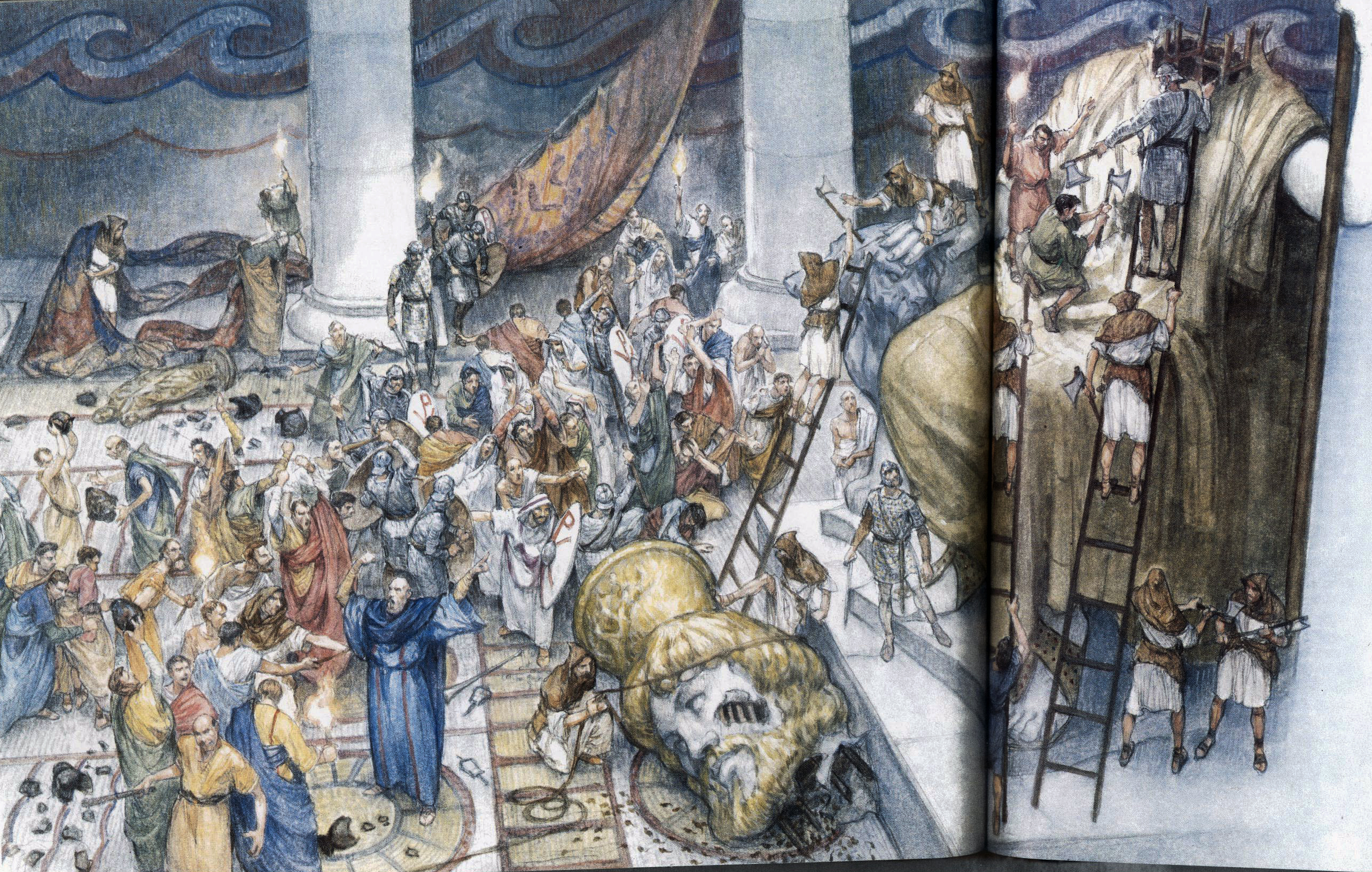
What is more, if you search you will find that even The Reader’s Digest which publishes copiously illustrated books for the simple, and very Christian, American families acknowledges the facts. For example, the image below shows a crowd of Christians who, encouraged by Pope Theophilus of Alexandria, destroyed the temple of Serapis in 391.

I scanned that image from pages 242-243 of the translation from English into Spanish of After Jesus (The Reader’s Digest Association, Inc., 1992). What we see in the illustration represents the first dark hour of the West: the era that saw the destruction of ancient knowledge in the Library of Alexandria. Now we are living the second dark hour, when the enemy attacks directly your DNA so that the West cannot recover again, not even after a dark age as it did in the Renaissance.

That’s why I call ‘darkest hour’ to our times.

About the first dark hour, of the authors I have quoted and will continue to quote, Soberana, Deschner and Nixey are gentiles. But yesterday almost midnight a commenter called my attention to Suicide Note, a book of almost two thousand pages of Mitchell Heisman (1975-2010). I began to leaf through the Suicide Note chapter on how the Christians installed Semitic malware in the psyche of the Romans to move them to commit ethnic suicide.

I was fascinated and continued reading until almost two in the morning today. However, when I wanted to inquire about the author via Google, I discovered that Heisman was a Jew who committed suicide upon finishing the book!

Of the German Deschner, the English Nixey and the Spaniard Soberana, only the latter awoke about the Jewish question. It is really curious that, although neither Deschner nor Nixey took the red pill, an American Jew did take it.

The PDF of Suicide Note is available online for anyone who wants to read the whole thing. Tomorrow I’ll start reproducing those passages that elucidate what we have been saying about the Christian problem. Of course: I have to place the star of David after the author’s name. It is very rare for a Jew to say anything about the psyop that his tribe applied to the Aryan since the origins of Christianity. One of them is Heisman✡.

Trouble is that most white nationalists still don’t want to see what even a kike saw just before blowing his brains…

Categories
Ancient Rome Christendom Darkening Age (book) Eduardo Velasco Kriminalgeschichte des Christentums (books) Library of Alexandria

Nixey & Heisman

Today, as I finished reproducing my extracts from the first volume of Kriminalgeschichte, I would like to clarify something.
There was a time when I wanted to add to my excerpts the hundreds of footnotes that appear in Karlheinz Deschner’s book but I changed my mind: mere excerpts do not require the notes, especially in a blog. However, I must point out that there are bibliographical references in a book that the English speaker can read in his native language.
I am referring to Catherine Nixey’s The Darkening Age: The Christian Destruction of the Classical World: an elegant book published last year in Britain and available this year, in addition, by an American publisher.
Deschner was an obsessive scholar who worked to the nitty-gritty, nose-to-the-grindstone level throughout his life. Although The Darkening Age is not as monumental as Kriminalgeschichte des Christentums, I will reproduce Nixey’s preface and the third part of her Introduction. It is vital that English speakers know that we are not inventing a black history of Christianity. Some of the main references that support what we have been saying with the translations of Deschner and Evropa Soberana, also appear in Nixey’s book.
What is more, if you search you will find that even The Reader’s Digest which publishes copiously illustrated books for the simple, and very Christian, American families acknowledges the facts. For example, the image below shows a crowd of Christians who, encouraged by Pope Theophilus of Alexandria, destroyed the temple of Serapis in 391.

I scanned that image from pages 242-243 of the translation from English into Spanish of After Jesus (The Reader’s Digest Association, Inc., 1992). What we see in the illustration represents the first dark hour of the West: the era that saw the destruction of ancient knowledge in the Library of Alexandria. Now we are living the second dark hour, when the enemy attacks directly your DNA so that the West cannot recover again, not even after a dark age as it did in the Renaissance.
That’s why I call ‘darkest hour’ to our times.
About the first dark hour, of the authors I have quoted and will continue to quote, Soberana, Deschner and Nixey are gentiles. But yesterday almost midnight a commenter called my attention to Suicide Note, a book of almost two thousand pages of Mitchell Heisman (1975-2010). I began to leaf through the Suicide Note chapter on how the Christians installed Semitic malware in the psyche of the Romans to move them to commit ethnic suicide.
I was fascinated and continued reading until almost two in the morning today. However, when I wanted to inquire about the author via Google, I discovered that Heisman was a Jew who committed suicide upon finishing the book!
Of the German Deschner, the English Nixey and the Spaniard Soberana, only the latter awoke about the Jewish question. It is really curious that, although neither Deschner nor Nixey took the red pill, an American Jew did take it.
The PDF of Suicide Note is available online for anyone who wants to read the whole thing. Tomorrow I’ll start reproducing those passages that elucidate what we have been saying about the Christian problem. Of course: I have to place the star of David after the author’s name. It is very rare for a Jew to say anything about the psyop that his tribe applied to the Aryan since the origins of Christianity. One of them is Heisman✡.
Trouble is that most white nationalists still don’t want to see what even a kike saw just before blowing his brains…

Categories
Christendom Kriminalgeschichte des Christentums (books) Old Testament Philosophy of history Theology Vegetarianism Welfare of animals

Kriminalgeschichte, 70

Below, an abridged translation from the first volume of Karlheinz Deschner’s Kriminalgeschichte des Christentums (Criminal History of Christianity). For a comprehensive text that explains the absolute need to destroy Judeo-Christianity, see: here. In a nutshell, any white person who worships the god of the Jews is, ultimately, ethnosuicidal.

 
Augustine sanctions the ‘holy war’
The amantissimus Domini sanctissimus, as the bishop Claudius of Turin of the 9th century called Augustine, recorded, like no one before him, the compatibility between service to war and the doctrine of Jesus.
The father of the Church Ambrose had already celebrated a pathetic instigation of war, and the father of the Church Athanasius had declared that in war it was ‘legal and praiseworthy to kill adversaries’. However, none of them admitted the bloody office with as few scruples and as the hypocrite ‘angel of heaven’ who looks ‘constantly to God’.
Certainly, Augustine did not share the optimism of an Eusebius or an Ambrose, who equated the hope of the pax romana with that of pax christiana as providential, since ‘The wars to the present are not only between empires but also between confessions, between truth and error’. By weaving his web of grace, predestination and angels, Augustine theoretically committed himself in an increasingly negative way before the Roman state.
Every State power based on the libido dominandi rests on sins and for that reason must submit to a Church based on grace, but in fact not free of sin either. This philosophy of the State, which constituted the historical-philosophical basis of the medieval power struggle between the popes and the emperors, was decisively influential until the times of Thomas Aquinas.
Until the year of his death, Augustine not only asked for the punishment of the murderers, but also to crush the uprisings and subdue the ‘barbarians’, taking it as a moral obligation. It was not difficult for him to consider the State malignant but he praised its bloody practices and, like everything else, also ‘attribute it to Divine Providence’ since ‘its way of proceeding’ is ‘to avoid human moral decay through wars’.
Whoever thinks so, in a childlike and cynical way at the same time, obviously interprets in the same sense the commandment ‘Thou shalt not kill’. That commandment should not be applied to the totality of nature and the animal kingdom. Augustine discusses with the Manichaeans that it does not include the prohibition of ‘pulling a bush’ or the ‘irrational animal world’ because such beings ‘must live and die to our advantage; submit them to you!’
‘Man owns animals’, complains Hans Henny Jahnn in his great trilogy Fluss ohne Ufer. ‘He does not need to try. He just has to be naive. Naive also in his anger. Brutal and naive. This is what God wants. Even if he hits the animals, he will go to heaven’.
Earlier, authors such as Theodor Lessing and Ludwig Klages had persuasively shown that, as the latter affirms, Christianity conceals something with its connotation of ‘humanity’. What it really means is that the rest of living beings lack value—unless they serve human beings! They write: ‘As is well known, Buddhism prohibits the killing of animals, because the animal is the same being as we are. Now, if one scolds an Italian with such a reproach when he torments an animal to death, he will claim that “senza anima” and “non è christiano” since for the Christian believer the right to exist lies only in the human beings’.
Augustine on the other hand believes that the human being ‘even in situations of sin is better than the animal’: the being ‘of lower rank’. And he treats vegetarianism as ‘impious heretic opinion’.
That God can be pleased with arms is shown by the example of David and that of ‘many other righteous’ of that time. Augustine quotes at least 13,276 times the Old Testament, about which he had previously written that he had always found it unpleasant!
But now it was useful. For example: ‘The just will rejoice when contemplating revenge; He will bathe his feet in the blood of the wicked’. And of course all the ‘just’, logically, can make a ‘just war’ (bellum iustum).
It is a concept introduced by Augustine. No Christian had used it before, not even the easy-going Lactantius, whom he read carefully. Soon the whole Christian world made a iusta bella, based upon a ‘just’ reason for war any minimal deviation from the Roman liturgy. Augustine strongly recommends military service, and cites quite a few cases of ‘God-fearing warriors’ from the Bible; not only the ‘numerous righteous’ of the Old Testament, so rich in atrocities, but also a couple of the New Testament.
Augustine experienced the collapse of Roman rule in Africa, when the Vandal hordes invaded Mauritania and Numidia in the summer of 429 and in the spring of 430. He witnessed the annihilation of his life’s work: whole cities were grass of the flames and its inhabitants assassinated. Anywhere the Catholic communities, depleted by the Church and the State, opposed no resistance; at least there is no relation of it.
Augustine died on August 28, 430, and was buried that same day. A year later Hippo, retained by Boniface for fourteen months, was evacuated and partially burned. Augustine’s biographer, the holy bishop Possidius, who like the teacher was a fervent fighter against the ‘heretics’ and the ‘pagans’, still lived some years among the ruins.


END OF VOLUME I


______ 卐 ______

Liked it? Take a second to support this site.

Amazon’s CreateSpace

These guys have suspended—momentarily I hope—the availability of my Day of Wrath. I received an email today concerned about copyright issues because their software detected reproduction of Day of Wrath in this site. Apparently, they ignored that I am also the sole admin of this site.
But I just responded to their email. I hope Day of Wrath will be available again.

Categories
Charlemagne Kriminalgeschichte des Christentums (books)

Kriminalgeschichte, 69

A note of the Editor to those who tried
to defend the statue at Charlottesville:

Perhaps you ignore that removing the statues that represent the white and healthy part of a culture has been a practice that goes back to Antiquity.
As to why the non-white, African Augustine, considered the destruction of the Greco-Roman statues an act of devotion, recall what Evropa Soberana wrote in his essay on Judea against Rome: ‘To destroy a statue was to destroy the Hellenic human ideal: it was to sabotage the capacity of [Aryan] man to reach the very Divinity, from which He proceeds and to which He must return one day’.
 

______ 卐 ______

 
Augustine attacks classical culture
Just as he repressed the ‘heretics’, evidently Augustine also repressed the so-called ‘pagans’.
The bishop fought against ‘the infamous gods of all kinds’, ‘the ungodly cults’, ‘the rabble of gods’, the ‘impure, abominable spirits’; ‘they are all bad’, ‘throw them away, despise them!’ Augustine insults Jupiter by calling him ‘seducer of women’, speaks of his ‘numerous and malignant acts of cruelty’, of the ‘irreverence of Venus’; defines the cult of the mother of the gods as ‘that epidemic, that crime, that ignominy’, to the great mother herself as ‘that monster’ who ‘through a multitude of public gallants gets the Earth dirty and offends the sky’, and says that Saturn surpasses them ‘in that shameless cruelty’.
Like Thomas Aquinas or Pope Pius II, Augustine defends the maintenance of prostitution so that ‘the violence of the passions’ does not ‘throw everything down’: the usual Catholic double standard. (Popes like Sixtus IV [1471-1484], creator of the feast of the Immaculate Conception of Mary, and bishops, abbots and priors of honourable convents, kept profitable brothels!) Augustine repeats the already trite arguments against polytheism, from the matter and insensibility of the statues until the inability of the gods to help. And, like many others before him, he identifies them with demons.
The scope, the methods and the disrespectful mockery that the saint shows are evident, and extraordinarily detailed, in his magnum opus The City of God (413-426), directed specifically against the adepts of classical culture: twenty-two books that were one of Charlemagne’s favourite readings. In this work, as the Catholic Van der Meer ponders, Augustine ‘sets accounts, from a high point of view, with all the old culture of lies’, in favour of a new and far worse culture!
Augustine even resorts to counterfeiting, since in The City of God, in which the belief in the gods appears as the capital vice of the Romans; in which polytheism appears as the main cause of moral defeat as well as the fall of Rome in 410; as the main motive of all crimes, of all the mala, bella, discordiae of Roman history—in his masterpiece, then, Augustine does not hesitate to ‘discredit by means of conscious deformations’ (F.G. Maier) the world of the gods, allowing himself, when writing about the so-called pagans ‘any means’, even the ‘falsification of quotations’ (Andresen). ‘Lying and scandal are the two great things on which everything is based on the polytheistic faith’ (Schuitze).
At the beginning of his life as a bishop, Augustine had simply preached to use the wicked against the violence of the wicked. He soon fights the adepts of classical culture with the same lack of scruples as the ‘heretics’.
The Roman state itself is bad, a second Babylon, ‘condita est civitas Roma velut altera Babylon’. He justifies with resolution the eradication of the Old Faith; he orders the destruction of temples, centres of pilgrimage and images, the annihilation of all cults: a measure of reprisal against those who had previously killed Christians. He also affirmed that there was a common front of all those he condemned—heretics, adepts of classical culture and Jews—’against our unity’. Thus, around the year 400 he says triumphantly: ‘Throughout the Empire temples have been destroyed, idols are broken, sacrifices abolished, and those who worship the gods, punished’.
In response to Augustine’s phrase in which he says to welcome the Hellenists ‘with pastoral kindness and generosity’, the theologian Bernhard Kötting writes:

But he agrees with the laws and the measures of the emperor against the pagan cult and the sacrifices and the places where they are practiced, the temples. It is based on precepts of the Old Testament, where it is ordered to destroy the places of sacrifice to the idols, ‘as soon as the country is in your hands’.

As soon as one has power, annihilation follows ‘with pastoral goodness and generosity’! Several times Augustine rejected a literal understanding of the Old Testament in favour of an allegorical exegesis. However, the same as so many, other times he conveniently rejected the allegorical in favour of the literal.
As usual, the Catholic State fulfilled the requirements of the Catholic Church. Just as with the dispute with the ‘heretics’, in confrontations with the adepts of the classical culture there were first defamatory sermons by the clergy, strict canons, and then the corresponding civil laws. Then Greco-Roman culture in Africa was pushed back and annihilated.
In March of 399 the Gaudentius and Jovius committees profaned in Cartago the temples and the statues of the gods, according to Augustine, a milestone in the fight against the infernal cult. Later, Gaudentius and Jovius also destroyed the temples of the cities of the province, evidently with enormous satisfaction on the part of the holy bishop, for which the demolition of the idols already foreseen in the Old Testament is fulfilled. Augustine approves the decrees of 399 by the Christian emperor—who, based on Psalm 71: 11, finds justified—, in which he demands the destruction of idols and warns with the capital punishment those who worship them.
On June 16, 401, the fifth African synod decided to ask the emperor to demolish all the Greco-Roman shrines and temples that still remain ‘all over Africa’. The synod did not even allow so-called pagan banquets (convivio), because they performed ‘impure dances’, sometimes even in the days of the martyrs. The old Church again threatens Christians who participate in such meals with penances of several years or excommunication. There would be no communication with those who think differently.
At the time, in June 401, Augustine again incited the destructive rage. In a Sunday sermon in Carthage, he congratulated himself on the fervour against ‘idols’, and mocked them so primitively that the listeners laughed. At the foot of the golden-bearded statue of Hercules, we read: Herculi Deo. Who is? He should be able to say it. ‘But he can’t. He remains as silent as his sign!’ And when he remembers that even in Rome the temples have been closed and the idols have been thrown down, a clamour resounds throughout the church: ‘As in Rome, also in Carthage!’ Augustine continues to stir: the gods have fled Rome to come here. ‘Think about it, brothers, think about it! I already said it, apply it now you!’
Emperor Honorius (393-423), one of the sons of Theodosius I, made great concessions in his time to the Church. He was subject to both the influence of Ambrose and that of his pious sister Galla Placidia, founder of temples and persecutor of ‘heretics’ by legal means, which in turn influenced Saint Barbatian (festivity: December 31), his counsellor for many years and great miracle worker.
Thus, after repeated requests of the Church, the emperor, through a series of edicts promulgated in 399, 407, 408 and 415, ordered to remove in Africa the images of the temples, destroy the altars and close or confiscate the sanctuaries, assigning the goods for other purposes. When Augustine asked in court a more severe application of the laws, Honorius did so, threatening even to resort to the garrison. ‘The Government was increasingly inclined to meet the demands raised from the Christian side’ (Schulze).
With the support of the Church and the State, the Catholic hordes were no less brutal in the ‘cleansing’ of the rural properties of Greco-Roman gods than the Circumcellions were previously. At times, Augustine even established as a rule that those who converted to Christianity should destroy the temples and the images of the gods themselves. This happened in Calama, near Hippo, where Bishop St. Possidius, biographer and friend of Augustine, was so hated that neither the members of the curia, the councillors, protected him.
However, while they assaulted the monastery and beat a monk with blows, the prelate escaped. And when the Christians demolished the temple of Hercules in Sufes, a tumult arose such that Augustine, who denounced the government of the city, still of the old religion, had to mourn the loss of 60 slaughtered brothers of faith. He reports it with a strange mixture of indignation, hatred and sarcasm, without saying a single word about how many adepts of classical culture lost their lives in the uproar caused by the Christians. It should be noted that in Sufes, as a response from the Church, the temples and images of gods that were still preserved were destroyed, with bloody fights, partly in the sanctuaries themselves.
If out of fear of the fanaticism of their adversaries, the Hellenists abjured their faith—as a multitude of Christians once did in front of the pagans—Augustine mocks: ‘These are the servants that the devil has’. He considered the destruction of the Greco-Roman cult centres and their statues as an act of devotion. On the battlefield against the Hellenists he celebrated the final victory achieved. Is it surprising that, in a letter to the father of the Church, the Neo-Platonist Maximus called the saints knaves?
At the request of Augustine, his disciple Orosius, an Iberian priest, continued the disruption and defamation of classical culture. Following the tendency of his teacher he wrote Historiarum Adversum Paganos Libri VII (Seven Books of History Against the Pagans). This apologetic, a sloppy and superficial product, became one of the most read works during the Middle Ages, perhaps the history book by antonomasia. It appeared in almost all clerical libraries and has completely contaminated historiography. Until the 12th century, this image of history manufactured by Augustine and Orosius predominated in the Christian world, and continued for a long time.
 

______ 卐 ______

 
Note of the Ed.:
The complete title of Augustine’s magnum opus was The City of God Against the Pagans. His legacy was so influential that, as Deschner says above, Charlemagne (742-814) was a fan of The City of God Against the Pagans (emphasis added).
Charlemagne was the first European emperor since the fall of Rome, and he slaughtered thousands of those Germanics who were not Christians or refused to become Christians. The Nazis even created a stone memorial to those Saxon victims in 1935.
White nationalists still ignore the tragic history of those centuries when the last Germanics, who still resisted the enforced infection of an originally Semitic cult, fell.
 

Liked it? Take a second to support this site.

Categories
Civil war James Mason

Siege, 38

Brief your people


As we’ve said often enough in the past, not everyone is a leader type. Not everyone can be expected to do all the thinking, all the time. If you are working with others, under whatever pretenses, it is a serious mistake to assume they will be able to think things through and make all the right moves under a sudden and stressful situation—such as a police attack—with no preparation. The only best way to prepare for such an event—which you may safely assume WILL occur sooner or later—is by BRIEFING YOUR PEOPLE in advance of any contingency.
A briefing is just that: it is a going-over, aloud, of only the essential points involved in any specific situation. Only the crucial, critical facts and principles that are known to be involved.
I personally have worked miracles through the successful use of briefings. A person totally unfamiliar to a given situation can be made to pass as being intimately familiar with it after a thorough briefing. And a thorough, successful briefing should require no more than thirty minutes time, maximum. Anymore than that and you run the risk of confusing your people. At times I have taken people either by car or on foot from place to place while I have briefed them on the essentials and facts (and if there is a fabrication to be made, then that is to be injected after the known, indisputable facts have been introduced and established).
The key is to remove all confusion and uncertainty. Avoid redundancy and concentrate upon making as many important impressions on the minds of your subjects as possible. Making them acquainted at first hand by sights and motions only aids in making those impressions. Once they grasp the workings and are aware of the facts, then most anything can be added, including extra events and even extra people. This, of course, comes in most handy when prepping or coaching witnesses before appearing under oath.
When getting ready to head off a possible mess involving the law, as in the case concerning a revolutionary circle living and existing outside of legal bounds, briefings made well in advance of any expected investigation or attack and rehearsed periodically, designed to DELETE certain group activities, are what is required.
A successful briefing will never involve an attempted recital of a cut-and-dried script. To be credible and, thus, be effective in practical use, whether offensively or defensively, one’s given story must flow naturally and show all the characteristics of a normal, relaxed conversation. It must never go in direct contradiction of the known facts but instead merely present an “unknown side” of the story, basically in agreement with all the others. It must never include easily, readily demonstrable lies. Further, when under investigation or attack by any Pig agency of the System, it is of the utmost importance that everyone KEEP THEIR STORIES STRAIGHT! Consistency is one of the most basic keys to successful briefing.
A shrewd individual will know how to brief his people so that the enemy will provide the cues for the prepared stories or answers. To be really successful at briefing people, you must make them able to recognize dangerous or trick questions when they are asked. Most generally, the appropriate answer will be only too obvious. With practice, all involved will get better. Briefings should properly provide what amounts to “instant experience” in whatever area it is you are going into. Its effect should be of building confidence within, and robbing the enemy of any element of surprise.
I have done this successfully with groups, with individuals, with the elderly and with very small children. The object is always the same: defeat the Pig.

Vol. XIII, #7 – July, 1984

_____________
Why we are reproducing articles from Siege can be surmised: here.

Categories
James Mason

Siege, 37

Stupid people


Stupid people are more dangerous than any time bomb.
You’ll find stupid people everywhere but let us confine ourselves to those within the Movement itself, those whom we must deal with on a regular basis. Those armies of idiots within the System bureaucracy stand backed-up and reinforced by so many replacements that errors of judgment on their part—which would otherwise prove fatal—are usually quickly caught and reversed before any real damage gets done. Often times they are caught and squelched before anyone not part of the bureaucracy even can take note of them.
It gives the aura of invincibility but in fact provides for a deadly defect, in that everyone is depending on everyone else to carry things through. There are plenty of “sharpies” within the System but not the same kind as are found in revolutionary movements. Those that can do it all for themselves. The System needs their stupid people for errand boys, etc., while we just cannot afford their presence at all. With us, things must stand or fall with just you and I. And THAT is the basis of real responsibility.
Regardless whether they are with you or against you, stupid people are equally disastrous to have around. It is easy for anyone to imagine how stupid people can foul up the best plan or program and defeat the efforts of dozens of good and prudent people with whom they have associated themselves. But it is less easily understood what it means to have fools for adversaries. Again, I emphasize that we are dealing within the limits of the Movement itself. I’d much rather run the risk of a tactical personal set-back at the hands of a sharp, intelligent person, something I would expect I could reverse in time, than to have everything, the whole ball of wax, upturned or destroyed by some flake who loses all better judgment and control.
The very reason one falls out with persons of limited intelligence usually involves the same lack of vision, imagination, and discipline that will later lead them to tip the balance over from a localized clash to a full-scale disaster, too often involving the System and threatening to destroy or seriously injure BOTH participants.
It’s also hell to try to second-guess an unintelligent person. They are largely unpredictable and are liable to do anything. An intelligent adversary can most of the time be anticipated and, if not, it usually means that he is a jump or two ahead of you himself. He can be expected to fight things with at least the protection, if not the immediate furtherance, of the Cause in mind. A stupid individual won’t care. They can see or understand nothing beyond the immediate object of “I’ll show you!” How often have we witnessed this in Right Wing dealings? How often have we seen it in personal affairs? And how the Pigs laugh at it all!
Within the Movement, whenever a person like this is uncovered and proceeds to threaten to disrupt things, he properly should be killed before any damage can be done. If that is not feasible then it is critical to place as much distance between them and the Movement as possible. Same goes for personal dealings as well. Of course, in the long run, it is better to learn how to spot them in advance and never let them penetrate to a level where they can do no good and only harm. In this way we shall forge ourselves into a truly formidable political weapon.

Vol. XIII, #7 – July, 1984

_____________
Why we are reproducing articles from Siege can be surmised: here.