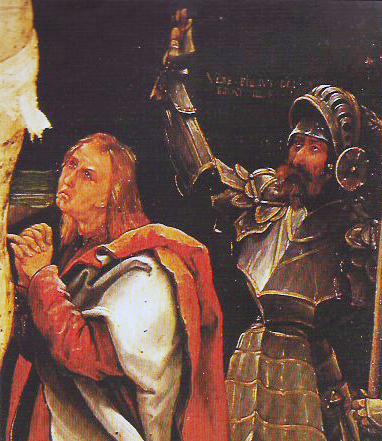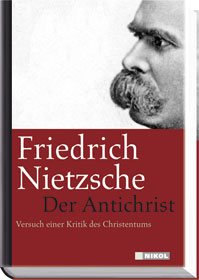
In this fragment of a Crucifixion of Grünewald the body of the crucified Jew is barely visible on the left margin. What is worth showing is the white man’s piety at the foot of the cross and the soldier. As Richard Spencer recently said in a video referring to the spiritual triumph of the Jews over the Romans, ‘The blond beast could not be confronted directly. He had to be turned into a guilt-ridden head case’.
In Christianity, the instincts of the subjugated and oppressed come to the fore: the lowest classes are the ones who look to it for salvation. Casuistry of sin, self-critique, and inquisitions of conscience are sources of employment, cures for boredom; affects inspired by a Great Power called ‘god’ are continuously cultivated (through prayer); the highest is considered unachievable, a gift, ‘grace’.
There is no sense of a public presence; the hide-away, the unlit room is Christian. The body is an object of hatred, hygiene is rejected as sensuousness; the church defends itself even against cleanliness (—the first Christian edict following the expulsion of the Moors was the closure of the public baths—there were some 270 in Cordoba alone).
There is a distinctively Christian sense of cruelty towards yourself and others; hatred of heterodoxy; the will to persecute. Dismal and upsetting thoughts have pride of place; the most highly prized states, described with the highest names, are epileptoid; diet is constructed to promote morbid appearances and over-stimulate the nerves. It is Christian to harbour a deadly hatred of the masters of the earth, the ‘nobles’—while maintaining a hidden, secret edge of competition (—they can have the ‘body’, we only want the ‘soul’…).
It is Christian to hate spirit, to hate pride, courage, freedom, libertinism of the spirit; it is Christian to hate the senses, to hate enjoyment of the senses, to hate joy in general…
Delayed PDF
As I continue reviewing Evropa Soberana’s essay on Sparta, this Sunday I realised that the changes I’ll make to The Fair Race will be more considerable than I originally imagined. In short, what I said in my post last Thursday, ‘Spartan break’, alters the architecture I had planned for The Fair Race.
That means I’ll have to add my differences with Soberana and others. (He once wrote that we, modern man, could follow Spartan laws as a revaluation of all values; while I believe that German National Socialism is the best paradigm.)
As this review for the PDF will take longer than expected, tomorrow I’ll resume my activities with some Christian paintings contrasted with Nietzsche’s quotes (as I was doing not long ago).
Even with this delay, hopefully, the PDF will be finished this month. Those who want to obtain a copy of the 2019 version of The Fair Race that will become obsolete once the PDF is finished can still do it: here.
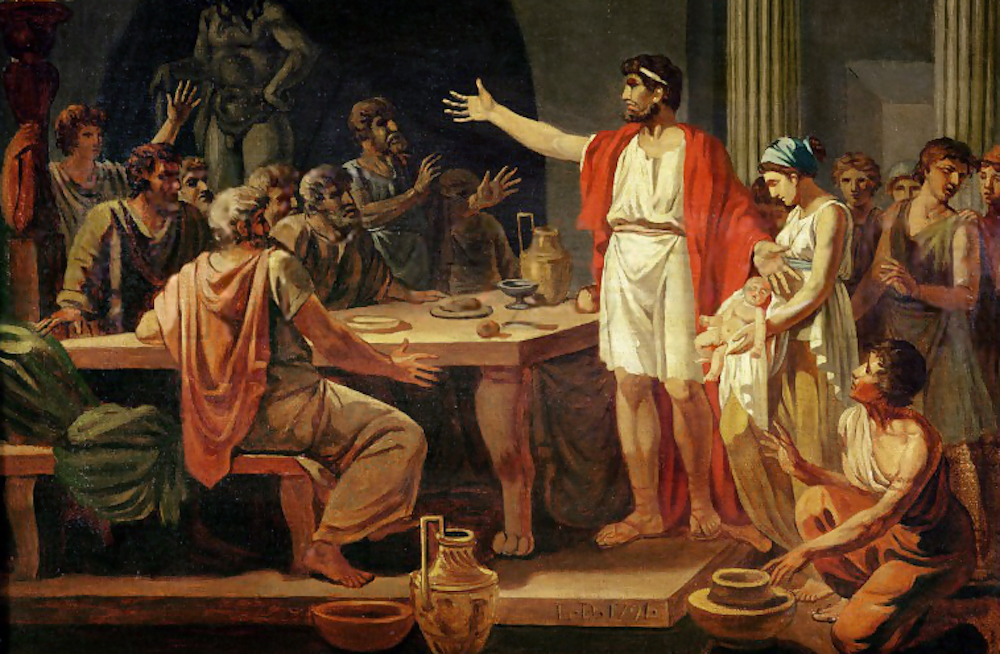
Incidentally, the painting by Jacques-Louis David that I reproduced above and in my Thursday post is flawed. On this subject Soberana got it right: the early Spartans were blond, a breed of pure Dorians uncontaminated with Meds.
P.S. The old sticky post with links to the ‘Rome & Judea’ essay and the Hellstorm review—the first section of the PDF—can be seen: here.
Spartan break
Note of September 5:
I have used most of the text that used to be on this post for an introductory article about Evropa Soberana’s essays on Sparta and the Vikings in the forthcoming PDF of The Fair Race’s Darkest Hour.
WDH – pdf 319
Click: here
PDF preface
Update of August 31:
Since I have now modified the Preface I’m removing the text that used to be on this post.
A slow and detailed proof reading of the translated mini-books by Evropa Soberana within The Fair Race is taking longer than expected. Instead of the Preface that used to be here, I’m moving my first comment below into this entry:
‘The battle between Rome and Judea’, says Richard Spencer (1:14:32 in the August 25, 2019 Radix podcast) ‘is a battle fought in the field of morality. That was Nietzsche’s crucial insight. The blond beast could not be confronted directly. He had to be turned into a guilt-ridden head case’ by the transvaluation of all values, said Spencer with other words.
‘So this political overthrow that occurred on the end of the Ancient World’, concludes Spencer, ‘was a moral battle. And morality itself is will to power. Morality itself is an attempt to dominate someone mentally, supernaturally I could say’.
I guess the alt-right and this site are starting to converge…
The programmed WordPress software closes comments of a post after a week. This means that my post of last Monday, ‘Busy for proof reading’, will be closed today after 2:00 P.M.
I am still busy reviewing the book, especially the Spanish-English translated essays of Evropa Soberana.
Once the PDF of the whole book is ready, I will replace the sticky post for another one. I will also delete the current edition of the ‘Rome vs. Judea’ essay because, after my revision, it has become obsolete.
This February I wrote: ‘I recently flipped through the copy of the 2014 edition of The Fair Race’s Darkest Hour that I own and was surprised that, since that year, I have eliminated no less than… fifty essays!’ In the later versions, I have been also adding many new essays and translations from the Spaniard Evropa Soberana and others.
Unfortunately, the PDF that a certain person uploaded to the Internet, without my permission, is the very outdated 2014 version of The Fair Race.
The United States is the country of the First and Second Amendments, which makes them superior to Europeans, at least in regard to freedom of expression and the right to possess weapons as a counterweight to the government’s power.
But the recent events in that country, as we see with Donald Trump’s pronouncements about confiscating weapons from unruly citizens, or Lindsey Graham’s super-quotable quote in my post yesterday, make me think that anti-white accelerationism has already begun. When Graham, the same senator who defended Judge Brett Kavanaugh last September, makes such pronouncements it can be said that the first snowflakes of a long winter have already fallen.
For this reason, I feel obliged to place on this site the PDF of the most updated version of The Fair Race for free. The updated book will still be available from Lulu for those who want a hard copy. It was never my intention to profit from the essays of other authors collected in The Fair Race. But it seems to me important that, if the US government were to violate the First Amendment, visitors of this site should download the PDF of the best essays collected for ten years since I started blogging.
The next few days I will be reading the more than six hundred pages of The Fair Race so that the public PDF may be as clean as possible, and I will add a couple more essays that will render obsolete even the previous edition of this year.
I apologise to regular visitors that I will not be very active these days, as I’ll be busy reviewing the long book.
Bye, First Amendment
‘The guy in El Paso was on one of these white supremacist hate sites where they radicalize each other. We should shut those sites down’.
Julian, 75
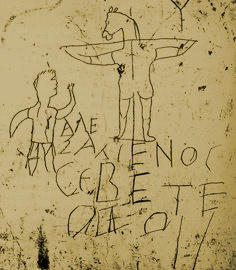
The Alexamenos graffito (also known as the graffito blasfemo, or blasphemous graffito) is a piece of Roman graffiti scratched in plaster on the wall of a room near the Palatine Hill in Rome, which has now been removed and is in the Palatine Hill Museum. It may be the earliest surviving depiction of Jesus and, if so, competes with an engraved gem as the earliest known pictorial representation of the Crucifixion of Jesus. It is hard to date, but has been estimated to have been made around 200 C.E. The image seems to show a young man worshipping a crucified, donkey-headed figure. The Greek inscription approximately translates to ‘Alexamenos worships [his] god’, indicating that the graffito was apparently meant to mock a Christian named Alexamenos.
______ 卐 ______
While we were talking amiably, I heard far off the uneasy neighing of horses, but thought nothing of it. Then Oribasius mentioned those Hebrew books which the Galileans refer to as the old testament. This was a favourite subject with me. So much so that I forgot Helena was in the room. “I admire the Jews because of their devotion to a single god. I also admire them because of their self-discipline. But I deplore the way they interpret their god. He is supposed to be universal, but he is interested only in them…”
“Christ,” said my wife suddenly, “was sent by God to all of us.” There was an embarrassed silence.
“The issue,” I said finally, with great gentleness, “is just that: would the One God intervene in such a way?”
“We believe that He did.”
The room was now completely still save for the far-off sound of horses. My companions were on edge.
“Yet is it not written in the so-called gospel of John, that ‘out of Galilee arises no prophet’?”
“God is God, not a prophet,” said Helena.
“But the idea of the Nazarene’s mission, in his own words, is taken from the old testament, which is Jewish, which says that a prophet—a messiah—will one day come to the Jews, but not God himself.”
“That is a difficulty,” she admitted.
“In fact,” and I was stupidly blunt, “there is almost no connection between what the Galileans believe and what the Nazarene preached. More to the point, I see nothing in the Jewish text that would allow for such a monstrosity as the triple god. The Jews were monotheists. The Galileans are atheists.”
I had gone too far. Helena rose, bowed, and withdrew, accompanied by her ladies.
My companions were alarmed. Priscus spoke first. “What a gift you have, Caesar, for making the difficult impossible!”
The others agreed. I asked their forgiveness. “Anyway,” I said, not believing my own words, “we can trust Helena.”
“I hope so.” Sallust was gloomy.
“One must be true to what is true,” I said, wishing as I so often do that I had held my tongue.
There was a sudden shouting in the streets. We all sprang to our feet. We had hardly got to the door when an officer arrived to report that Sens was being attacked. Elsewhere I describe what happened and I shall not repeat it here.