web analytics
Categories
Adolf Hitler Charles Darwin Racial right Richard Carrier Richard Weikart William Shakespeare

The two Richards

In my previous posts I said that I have been counter-signalling white nationalists because they maintain Judeo-Christian tails, and at the same time I have been citing Richard Carrier’s work on the nonexistence of Jesus. But Carrier is a typical liberal, as can be seen from the debate I heard yesterday between him and Richard Weikart on YouTube:

Hitler is often claimed to have been an atheist or a Christian by believers and skeptics eager to put the dictator in the other’s camp. Christian historian Richard Weikart argues he was neither in his new book Hitler’s Religion: The twisted beliefs that drove the Third Reich. Richard Carrier is an atheist historian who has researched Hitler’s purported anti-Christian statements often quoted by apologists in his book Hitler, Homer, Bible, Christ. He says that Hitler was anti-Catholic but thought of himself as a “positivist” Christian. In contrast Weikart argues Hitler was a pantheist who personally despised Christianity and only used it in public to aid his rise to power.

Everything sharp and forceful that Carrier had in debating (and refuting) the historicists of Jesus collapses when he speaks of Hitler. He is suddenly transmuted into a completely dishonest fellow. In that 2017 debate, you can tell that Carrier overstates his case when he wants to force his view that a Christianity similar to Christian Identity (‘Positive Xtianity’) was always behind Hitler. What would Carolyn Yeager say about such claim?

Weikart repeatedly replied that Hitler used the word ‘Christianity’ in his criticisms, that Hitler was not only referring to Catholicism or the Church. But Carrier, with that alchemy that he refutes in the fundamentalists, transmutes everything that Hitler said about Christianity as if he supposedly referred only to Catholicism. A case of self-delusion, and big time!

The nadir of the debate occurred in the final segment, where Carrier became as dense as those NPCs that Black Pigeon Speaks was making fun of a month ago. I mean: Carrier criticised Trump claiming that what Trump was doing was ‘demonizing Muslims and Hispanics’. Really? Why did Carrier see nothing about Muslim terrorism, and that Trump only wanted to restrict the migration of the seven countries that produce the most terrorists?

This demonstrates once again that intelligence can be accompanied by very serious character flaws that remind me of my favourite Hamlet quote (cited below). Intelligence is of no use if people voluntarily surrender themselves to self-deception. And Carrier does it. For example, in his discussion with Weikart he sugars the pill about Charles Darwin, claiming that his Darwinism was human and sensitive to other races! Does Carrier ignore that according to Darwin niggers were to be exterminated?

Both Carrier and Weikart regurgitate the widespread myth that Hitler wanted to exterminate the Jews ‘because they were an inferior race’. At this point, Weikart surprises me more than Carrier, as the latter is not a Hitler scholar, only a Jesus scholar. Is it possible that none have read Esau’s Tears, a 1997 book with an academic imprimatur and good reviews among normies, authored by a Jew who showed the depredations of the Jewish quarter in the 19th century (which caused the German reaction in the 20th century)?

White nationalism has a point. What could we possibly do with these two Richards, a typical Christian and a typical liberal, without the incredibly detailed analysis of the JQ in WN?

You must understand the POV of this site: if I criticise white nationalists, it is because they maintain a tail of Judaism in the sense of Judeo-Christian axiology, so toxic to the Aryan cause. But I don’t criticise white nationalism for its general vision of the JQ. And if there is something in which the two Richards are absolute ignorant it is the JQ. I wonder if any of them know the work of Kevin MacDonald, if they have even looked at The Occidental Observer?

The debate linked above only corroborates something that my female friend told me: that men—including myself—tend to worship the intellect at the expense of character, in the sense that there may be very intelligent people whose moral flaws eclipse their virtues, the Hamlet quote:

So oft it chances in particular men
That for some vicious mole of nature in them,
By the o’ergrowth of some complexion,
Oft breaking down the pales and forts of reason,
Or by some habit grown too much; that these men–
Carrying, I say, the stamp of one defect,
Their virtues else — be they as pure as grace,
Shall in the general censure take corruption
From that particular fault.

Categories
Kevin MacDonald Racial right William Shakespeare

The land of the winning Aryan

‘Only Orga [humans] believe what cannot be seen or measured…’

—Gigolo Robot to David in the film A.I.

Years ago, when I blogged here without counter-signalling what white nationalists said in other forums, I sometimes had as many as two thousand daily visitors. Together with the donations, these statistics collapsed when I started criticising them. I am not going to blog as I did before as, after crossing the psychological Rubicon, there is no going back.

In ‘How Awake Are You?’ Mauricio is right that the leap from a naïve white nationalism to a mature one is as dizzying as crossing a suspension bridge. The transit is, in fact, much more spatially extensive than what it may seem at first glance with mere blog texts.

For example, secular pro-whites maintain atavisms of the previous paradigm, as the belief in the hereafter.

If one revises the texts in The Fair Race about the healthiest moments of the Aryan—Sparta (as unlike the Athenians the Spartans did not have sex with the native Mediterraneans), the Early Rome, the Germans who conquered the decadent Rome, the Vikings and the men of the Third Reich—we won’t see an obsession with the hereafter. Decadent whites became obsessed with death only in the mongrelized Imperial Rome, the dark Middle Ages and more recently with the flowering of the New Age. Even in the most lucid moments of Christendom, let’s say Elizabethan England that flourished thanks to the expulsion of the Jews, we don’t see this obsession with the hereafter. Shakespeare for example seems far more akin to secular Montaigne than the ‘spiritual’ madness of the New Age. (By the way, there isn’t anything genuinely ‘spiritual’ in the New Agers’ beliefs and I hate that they still use that term referring to crazy metaphysical systems.)

The white nationalists who argue that, since prehistory, man believed in life after death are ignorant in one respect. Those same men practiced, at the same time, horrific infanticide rituals—by billions!

I confess that most of my life I believed in life after life. These beliefs began to diminish more or less at the stage when I realised that my belief in psychokinesis was unfounded. But the spiritual odyssey of one does not say anything to the other, unless they intend to cross the psychological Rubicon.

Perhaps the best way to overcome this afterlife obsession is to study the Jews, starting with Kevin MacDonald’s first book: my favourite of his trilogy. In that book it is striking that, unlike Christians, Jews base their Judaism not on the hereafter but on the here and now and in a tribal way: not in an individualistic manner like the Christian (‘Save your soul!’, ‘Get to heaven!’). If we take into account that the healthiest moments of Greece and Rome were also focused on the here and now, it is obvious what we have to do.

But I don’t get my hopes up. I know that very few white nationalists will cross the suspension bridge, ‘the leap from 5 to 6’ in Mauricio’s list. They are much closer to Normieland than to the other side: the land of the winning Aryan. That shows not only in that secular nationalists share Christian ethics but other Christian cultural waste, such as the unhealthy obsession with an imaginary life after death.

Unobsessed with the afterlife, the Jew will continue to beat the Aryan unless the latter repudiates the last vestige of the Christian infection (see the video I embedded in my first comment in the comments section).

Categories
PDF backup

WDH – pdf 326

Click: here
Categories
On the Historicity of Jesus (book) Richard Carrier

Unhistorical Jesus, 7

Or:

How (((Luke))) transvalued an Aryan value

But even if we accede to that hypothesis, it then only confirms the same point: that Luke is not writing history, but myth. He or his sources are simply making everything up. His tales are told for their meaning and rhetorical effect, not because they were researched or came from witnesses. I’ll close with one more example of this, the Emmaus narrative of Luke 24, a resurrection-appearance tale found in no other Gospel and thus distinctive of Luke’s style of invention.

Here Luke tells the story of a man named Cleopas (along with an unnamed friend) who journeys by road from Jerusalem to nearby Emmaus, after they learn the corpse of Jesus has vanished. On the way, the resurrected Jesus appears to them (albeit in disguise) and explains the secrets of the kingdom (which happens to be a spiritual kingdom, not a physical one), then vanishes, and Cleopas recognizes who he was and goes on to proclaim what he was told. Conveniently, the name Cleopas means ‘tell all’, in other words, ‘proclaim’. The story thus has several telltale markers of myth: a name invented or selected for its meaning to the tale rather than any historical truth; an absurdly ahistorical narrative (never heard of from any earlier source [Mark or Matthew – Ed.]) of a disguised divine visitor; an unrealistic conversation with a complete stranger; a miraculous vanishing; and an all-too-convenient rhetorical purpose for all of it. This is the Vanishing Hitchhiker legend—ancient Roman style.

As it happens, the founding myth of Rome, then famously known everywhere and celebrated in annual passion plays, is almost the exact same story: a man named Proculus (archaic Latin for ‘Proclaimer’ or ‘He Who Proclaims’, thus not only again a fictional name designed for the story but essentially the same name as Cleopas) journeys by road from nearby Alba Longa to Rome, after the Roman people learn the corpse of Romulus has vanished; and on the way, the resurrected Romulus appears to him (not in disguise but this time in glorious form) and explains the secrets of the kingdom (literally: how to conquer and rule the world), then ascends into heaven (as Luke eventually has Jesus do as well), and Proculus recognizes who he was and goes on to proclaim what he was told. I’ve already demonstrated the extent to which the Gospels have borrowed this Romulan resurrection tale for Jesus (see Chapter 4, §1, and Element 47). Mark had already fashioned his passion account in light of it, and Matthew embellished it even more in accord. So it is not unexpected that Luke would take the same model further.

And indeed he has. Not only in the ways I have already pointed out in previous chapters but also here, in the tale of Cleopas on the road to Emmaus. lf we accept the identification of Luke’s intended Emmaus as the Ammaus mentioned by Josephus as a town nearby Jerusalem, then in both Luke’s narrative and the Romulan tale the Proclaimers are journeying from a city on a mountain to a city in a valley, roughly the same direction (east to west, like the sun), and roughly the same distance (seven to twelve miles).

But the changes are the point. While Proculus receives his gospel on the road to Rome, Cleopas receives his gospel on the road from Jerusalem: so while the old story suggests ‘all roads lead to Rome’, the new story suggests all roads lead from Jerusalem. While Romulus appears in awesome glory, befitting the awesome glory of Rome’s dominion and the very visible empire he promises, Jesus appears in disguise, hidden, just as the kingdom he promises is hidden, and which, like Jesus, becomes visible (and thus knowable) only in the communion of believers. Luke has thus transvalued the Romans’ founding myth: unlike the Romans, their resurrected hero promises a hidden spiritual kingdom originating from Jerusalem on high. And just as the glorious visage of Romulus is what confirmed to Proculus that what he said was true, so it is the powerful word of the gospel that confirms to Cleopas that what Jesus said was true. Luke thus rewrites the story to communicate how Christian values differ from mainstream Roman values. This is a classic hallmark of mythmaking. [1]

______________

[1] Pages 480-482 of Carrier’s book. Italics in the original but bold-type added by Ed. For more on the Romulus parallels and reversals in the Emmaus narrative see Arnold Ehrhardt, ‘The Disciples of Emmaus’, New Testament Studies 10 (January 1964), pp. 182-201, and Francis Gerald Downing, ‘A Rival to Romulus’, in Doing Things with Words, pp. 133-51.

Categories
Islam Women

‘Islam is right about women’

To understand why this meme is making NPCs mad watch what Black Pigeon Speaks said a month ago or what Eli Harman said last Sunday (especially in the first two minutes of his video).

Categories
Aryan beauty New Testament

Merrie Melodies

If we remember a passage in The Fair Race (‘The Arab historian Ibn Fadlan, ambassador of Baghdad to the Bulgarians of the Volga, says of the Vikings: “I have never seen physical specimens so perfect, tall as palm trees, blond and ruddy-skinned”’) it is obvious that the other human races should not exist. If they exist for billions it is due to the counterproductive greed of the white man, so well portrayed in The Man Who Would Be King, where the inhabitants of Kafiristan seem apes compared to Sean Connery and Michael Caine. Both white greed and Christian ethics are behind the creation of the billions of non-whites currently flooding the globe.

Those who are familiar with Richard Carrier’s work will know that the strongest point of his argument is his analysis of the epistles of St Paul. The oldest texts of the New Testament, the Pauline epistles, do not mention an earthly Jesus but an exclusively heavenly one. St. Paul does not even locate the crucifixion of Jesus on earth! In recent days I have continued reading Carrier’s book and I came across a chapter on Clement of Rome and his epistle, which may have been written in the first century. Surprise: Clement also fails to speak, in so early writing, of an earthly Jesus. Apparently the stories that Mark and the other evangelists would write had not yet reached Clement’s ears.

The evidence that the central character of the New Testament is fictional is overwhelming to anyone who has read Carrier’s book, or seen the YouTube videos where he discusses with theologians who believe Jesus was a historical figure. How was it that, instead of the religion of the beautiful Hellenes, whites submitted to the Semitic religion of eternal fire for whites? (In the representations of old paintings of hell I do not see gooks or blacks but whites.) This reminds me that I took the expression ‘Fruitcake Hospital’, which I used in my previous article, from a program that I saw in the early 1970s in The Porky Pig Show, although I don’t remember which character was sent to the psychiatric hospital (huge buildings in those times, like the one we saw in Joker).

Many whites who have abandoned Christianity maintain in their minds a Christian residue, the belief in the immortality of the human soul. They do not seem to notice that, in doing so, they inadvertently join blacks and gooks as long as ‘Man is special’ and the rest of creation is treated as despicable creatures—as if a camel were the same as a spider! Such is the axiological by-product of those who maintain that only Man possesses a soul that survives death: the ultimate brotherhood with other races. (*)

Some white nationalists argue that the white race has always had a belief in personal immortality. What they fail to realise is that the obsession to save themselves from the eternal fire caused an unhealthy focus with the beyond that didn’t exist in the Ancient World, at least not among whites. The complete apostasy of Christianity not only implies abandoning Christian ethics, the crux of this site, but abandoning the obsession with the hereafter as well. Otherwise whites seem to me like that character from Merrie Melodies I saw as a kid who was sent to the Fruitcake Hospital.

_______

(*) Oliver Sacks’ books are hilarious and also explain how the faculties of the supposed ‘soul’ can be damaged simply by accidentally injuring the human brain.

Categories
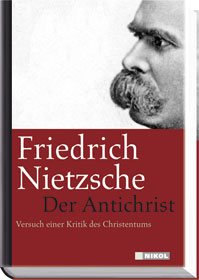
Der Antichrist (book)

The Antichrist § 22

Buddhism is a religion for mature people, for kindly, gentle races that have become excessively spiritual and are too sensitive to pain… Christianity wants to rule over beasts of prey; its method is to make them sick,—weakening is the Christian recipe for domestication, for ‘civilisation’.

Categories
Impeachment of Man (book)

Even whites are animals

This is a comment from me that, instead of putting it in response to what commenters said in a recent discussion thread, I put it as an independent entry as the topic is central to understanding us.

Apparently, these commenters suffer from human megalomania: that humans are superior to animals, or that humans have souls. I doubt that they have read with due attention the books of William Pierce, or Impeachment of Man by Savitri Devi. Already in January 2015 I had published an entry with the title of ‘Animals’, and as epigraphs I chose some words from Pierce and Hunter Wallace. The latter, as a Christian, continues to believe in the existence of the human ‘soul’. But despite this he acknowledges that whites deserve to be committed to the Fruitcake Hospital:

By that standard most people are simply animals—thinking animals, but still animals, without the essence of humanity.

William Pierce

For those who don’t believe Whites are capable of imposing this madness on themselves, I will point to France during the French Revolution which abolished slavery in the name of the “Rights of Man” and made every Negro a citizen of the French Republic.

Hunter Wallace

He who wants to venture into why we need a lesson in humility must read Impeachment of Man. In short, much of the evil of our time is due to pride, the primordial sin that modified apes are the crown of evolution when, because of their fruitcake behaviour, they obviously are not.

Read my Day of Wrath and tell me with a straight face that humans are ‘sane’ or ‘superior’. That does not mean that they are a lost cause, as potentially the eternal feminine could lead the white race to the Absolute, as I say in my last essay in The Fair Race (pages 652ff).

Categories
Emperor Julian On the Historicity of Jesus (book) Ovid Richard Carrier Romulus Tacitus

Unhistorical Jesus, 6

This is an update on what I have been saying about how the Christians transvalued Greco-Roman values through stealing vital elements of the Romulus story. I have resumed reading Carrier’s book and on pages 302-303 I came across this:

Later in the third century the Neoplatonist Porphyry wrote his own fifteen-volume treatise Against the Christians, which again does not survive, except for diverse scattered quotations in later Christian authors. A century after that Emperor Julian (the last pagan emperor, himself taking the throne only after a long line of Christian emperors) wrote Against the Galileans, his own critique of the religion that had transformed the empire he inherited. Once again, this does not survive; all we have are portions of Cyril of Alexandria’s treatise Against Julian. Eunapius then wrote in the year 414 a History against the Christians (perhaps not literally named that, but it was regarded as such by later Christians), an extensive critique of Christian ‘versions’ of historical events from 270 to 404 CE. This, too, does not survive; his otherwise inoffensive Lives of the Sophists was preserved instead. The only reason we know of his anti-Christian work is that before it faded into oblivion, many later historians, including Christians, employed it as a source.

I didn’t know the following until today:

Again, these are just the ones we know about: Which would be a fraction of what there was. All of it was tossed out or destroyed. Instead, we get to read only what medieval Christians wanted us to read. Another example of this phenomenon is that of the ‘mysterious lacuna’. Several texts that were preserved have sections removed. Sections whose disappearance seems convenient for Christians. Now, a lot of ancient literature, indeed arguably most, has missing material. This is typically a result of carelessness and accident, multiplied by time. But in some cases the precision and location of what was lost is a bit more peculiar than chance accident would suggest.

Carrier illustrates this with Refutation of all Heresies by the Christian scholar Hippolytus in the 3rd century. Remember that the Christians were so thorough that sometimes they even destroyed the ‘refutations’ authored by Christians so that not even what the pagan said about Christianity remained, even as ‘refuted’ quotes! (Some passages of Celsus survived simply because they didn’t dare to destroy the work of Origen, one of the early fathers of the Church.) Carrier continues:

But the second and third volumes are missing. The text skips directly to volume 4, which begins his discourse on astrology. This does not look like an accident. Some Christian or Christians decided to destroy those two volumes—for some reason fearing their contents. The resulting loss in our knowledge of the mystery religions is beyond considerable.

The below paragraph is what moved me to post this entry:

Another strange loss concerns the annual festival of Romulus in which his death and resurrection were reenacted in public passion plays (see Chapter 4, §1). That festival was held on the 7th of July. At the beginning of the first century Ovid wrote an elaborate poem, the Fasti, describing all the festivals throughout the year at Rome and what went on in them and why. This only survives in its first half, covering January to June, the remaining months are lost. It seems strange that the text cuts off precisely before the month in which a passion play [of Romulus] is described that was the most similar to that of Jesus Christ.

The fact that we have other descriptions of this festival (albeit none as complete as Ovid’s would have been) does mean there was no organized conspiracy to doctor the record (except when it came to controlling faith literature, for which we have clear evidence of Christians actively eliminating disapproved Gospels, for example), but this along with all the other cases (above and below) indicates a common trend among individual Christians to act as gatekeepers of information, suppressing what they didn’t like.

Ovid! And this even happened to Plutarch and Tacitus!:

Another example along similar lines is a mysterious gap in the text of Plutarch’s Moralia, a huge multivolume library of treatises on diverse subjects. In one of these, the Tabletalk, Plutarch is discussing the equivalence of Yahweh and Dionysus, and linking Jewish theology to the mystery religions, when suddenly the text is cut off. We have no idea how much is missing, although the surviving table of contents shows there were several sections remaining on other subjects besides this one. If an accident, this seems like a very convenient one.

A similar mysterious gap is found in the Annals of Tacitus. The text of the Annals survives in only two manuscript traditions, one containing the first half, the other the second half, with a section in between missing—and thus its loss is explicable. But there is another gap in the text that is harder to explain: two whole years from the middle of 29 CE to the middle of 31. That the cut is so precise and covers precisely those two years is too improbable to posit as a chance coincidence. The year 30 was regarded by many early Christians as the year of Christ’s ministry and crucifixion (see Element 7).

Robert Drews analyzed all the gaps in the Annals and concluded that this one has no more plausible explanation than that Christians excised those two years out of embarrassment at its omission of any mention of Jesus or associated events (like the world darkness reported in the Synoptic Gospels). Tacitus digresses on Christianity in his coverage of the year 64, in such a way that guarantees he made no mention of it earlier (if the passage there is authentic: see §10)—although Tacitus surely must have discussed other events under Pontius Pilate. So we can be certain Christians weren’t trying to hide anything embarrassing said about Jesus. But the embarrassment of saying nothing was evidently enough to motivate their targeted destruction of the corresponding text.

To understand the censor who eliminated those chapters so that posterity would remain in the dark, let us remember that St. Augustine also struggled with an omission. Seneca de Younger wrote On Superstition between 40 and 62. Carrier again: ‘that lambasted every known cult of Rome, even the most trivial and obscure—including the Jews—but never mentioned Christians’.

It is increasingly clear: Not only Jesus of Nazareth did not exist. The authors of the gospels (Semites, I suppose) stole the myth of the Aryan god Romulus for incredibly subversive purposes (see red letters: here).

That is why they tried to erase any hint of the Romulus festivals when they destroyed almost all the books in Latin, from the fourth to the sixth century (see Catherine Nixey’s words in bold type: here).

Categories
Neanderthalism William Pierce

What ‘The Turner Diaries’ is all about

by William Pierce

It is important for us to understand that one person is not a Methodist and another a Catholic and a third a Marxist as the result of any rational process—at least, not in the vast majority of cases, although there are individual exceptions.

That is, one is not a Methodist because one sat down and studied the Methodist doctrine, compared it with other doctrines, and decided that Methodism was what made the most sense. One is a Methodist, generally, because one’s parents and neighbors were—that is, out of an entirely unreasoning desire to conform, to believe what one perceives that one is expected to believe. John Wesley undoubtedly was an exception to this rule, but very few other Methodists have been.

There has been strong resistance to accepting the implications of this important facet of human behavior. People seem to want to believe that we are all quite rational, when most of us aren’t. For our purposes, the implication of the fact that most people are governed far more by herd instinct than by reason is this: Insofar as the general public is concerned, truth cannot fight its own battles. As long as Norman Lear, the Jewish television producer, has more kilowatts for reaching the public than we do, it will be his view of history and, more important, his view of what is moral rather than ours which will be generally accepted and which will govern the political process.

This means that we can realistically expect our educational efforts to be effective with only a rather small minority of our fellow citizens. We cannot expect to make a partisan for our cause out of the average man or woman who perceives, even unconsciously, that our cause is not popular, no matter how many books or leaflets we may coax that person into reading. We win only two types of people: One is the person who is already alienated to a certain extent from Mr. Lear’s world and does not fully feel himself a part of the herd to which Mr. Lear is preaching with his cleverly designed television sermons. Unfortunately, in many cases people are alienated for reasons which are entirely or partly wrong from our point of view. That is why protest movements and revolutionary movements always pick up lots of defective people. On the other hand, alienation is certain to remain a growth industry, as they say, and one can hope to see many more essentially healthy people becoming alienated from the mainstream in the years ahead.

The second type of person we are able to win with an educational effort at this time is the person who is one of those rare exceptions to the general rule, a person who is strongly motivated by ideas as well as by instinct, and who has already been groping in our direction. Our effect with such a person is primarily to help him clarify his ideas and to lead him more rapidly to their logical conclusions.

This contrast between idealistic motivation and herd instinct tell us only part of the story as to why people behave the way they do. The rest of the story takes us into the realm of values. Consider your average man or woman, your ordinary White American: what, other than herd instinct, determines his behavior—in particular, the way he votes?

Well, he generally likes to be warm, dry, and comfortable. He likes to eat. He likes sex. He likes to feel secure. He likes to be entertained. He likes to own shiny things, such as automobiles, boats, houses, new golf clubs, and jewelry. And that’s about it. If these desires of his are gratified, then he is satisfied. If he thinks a politician will satisfy him, he’ll vote for the man.

Now, if this average citizen hears that Blacks are rioting and killing Whites somewhere 1,000 miles away he will be annoyed—if Norman Lear hasn’t already affected his mind too much and he still has healthy instincts. When he hears that hundreds of thousands of non-White aliens are pouring into the country, again he’ll be annoyed. All these things are, to a greater or lesser extent, perceived as threats at the instinctual level. They trigger his normal territorial or xenophobic reflexes. But unless the threat becomes very direct and very personal—unless the riot is in his neighborhood, unless a member of his immediate family marries a non-White, or unless he receives a special tax bill in the mail to provide welfare payment for more immigrants—the annoyance remains minor. It does not override his desire to be satisfied.

When it comes time to vote, if one candidate is in favor of forced busing or more boat people and a second candidate is against these things—and if all other factors are equal—then he’ll vote for the second man. But all the other factors are never equal. And if the pro-busing man has a nice smile and a warm personality that makes the voter feel more secure, while the anti-busing man wants to raise the charge for fishing licenses, say, and the voter likes to fish, then he’ll vote for the pro-busing candidate nine times out of ten.

That is why a state like Minnesota, which has one of the racially healthiest populations in the country, could keep sending a piece of filth like the late Hubert Humphrey back to the U.S. Senate term after term. Old Hubert could stand up in the Senate and support forced busing, forced housing, forced hiring, and everything else that most Minnesotans didn’t favor—except, of course, those Minnesotans already convinced by Norman Lear that they should favor those things—and then Hubert could make up for it all by going for bigger farm price supports than his opponent and by being, as they say in New York, a mensch. And the good folks of Minnesota would re-elect him.

Many people don’t like the view of human behavior I am presenting to you, because it is mechanistic; it reduces man to no more than another animal. And I’ll admit that it is an oversimplified view. But it is nevertheless a fact that man is an animal, and that fact accounts for 99 per cent of his behavior. In particular, it accounts for the way he votes. That’s why democracy is such a catastrophe.

I said the fact that man is an animal explains 99 per cent of his behavior, and anyone who wants to change the world in any way must take that fact into account. But it is the other one per cent of human motivation that I’m more interested in and that the Alliance is more interested in. It’s the other one per cent that explains why Earl Turner, the hero of The Turner Diaries, did the things he did.

Earl Turner was a man whose priorities were different from those of your average American voter. Earl Turner liked to be warm and dry and to have a full belly, just like everyone else. He enjoyed sex. And, presumably, he liked to own shiny things. But when Blacks killed Whites 1,000 miles away, it wasn’t just a minor annoyance to him. He had a larger view of the world and of his race and of his relationship to them. He could abstract what was a minor, personal threat to your average voter, and he could relate that abstraction to his view of the world.

When Earl Turner saw a racially mixed couple on the street, the sight did more than arouse a twinge of xenophobia or offend his sense of beauty. Unlike your average voter, he saw all the implications of that mixed couple. He saw mongrel children and mongrel grandchildren; he saw a race defiled. He saw a threat not just to himself, but to the whole upward course of life; a threat not just to his race, but to what his race could become.

And it was this that was important to Earl Turner: it was this that counted more than being satisfied, more than owning shiny things. And that’s why he didn’t behave like your average voter. His priorities were different.

Actually, there are two concepts here. First, Earl Turner had the capacity for abstraction, for taking an idea out of a specific set of circumstances and putting it into a more general context: for converting an idea into an ideal. That is a capacity which distinguishes our race from Blacks, in general, but it is still a capacity which relatively few Whites have to any significant degree.

And, second, there are values, the choice of which things count most. For most people the things that come first, even if they have the capacity for abstraction, are entirely personal. It is only for a minority within a minority that the long-range things are the ones that count. Only the very few can feel that it is more important that strength and beauty and wisdom prevail and become stronger and more beautiful and wiser with each succeeding generation than it is that any individual—or a million individuals—have full bellies.

In The Turner Diaries the real struggle was not so much one of a revolutionary band against the government as it was of one set of values against another set. Earl Turner and his Organization were the champions of a life-centered set of values, a set of values in which the central reality is not the individual, but all of Life: the Cosmos, in its entire temporal extension. Opposed to them were not only the values of the government and the media and the plutocrats, but also the individual-centered set of values of mass man, of the average voter. And in The Turner Diaries the life-centered values won, and those values then ruled. And the whole world was changed: its government, its racial composition, its art and industry, it life-styles, and all its priorities.

Human nature didn’t change—that is, the mentality and the values of the average White person didn’t change, because those are things which can only be changed over the course of generations, through the evolutionary process. But a different set of values, the values of an elite minority, gained precedence over the values of man. That’s what The Turner Diaries is all about.

And as I said earlier, it’s not a plan or a blueprint. The details—the bombings and assassinations, the nuclear war and its aftermath—are all fiction. But the struggle for dominance between the two sets of values portrayed in the book is not fiction. That’s real. And it is in this regard that Earl Turner’s Organization is the model for the National Alliance.

We are concerned, then, not only with education, with helping people clarify their thoughts and reach the proper conclusions, but also with embodying and institutionalizing a set of fundamental values and a view of the world. We are convinced that, unless our values prevail and rule, unless it is our world view which determines the shape of the future by setting men’s priorities and guiding them in their decisions, then there will be no future—that is, no future worth mentioning, because it will be a retrograde future, and our race will not be a part of it. And, in fact, the only valid reason why our race should survive is that it is the bearer of the values that we are determined shall prevail. For life loses its intrinsic value when its only motive is to increase its quantity, when its only goal is satiety.

The value of every form of life—of every race—of every individual—is not that it is an end in itself but that it is a means to a higher end. The value of a man’s life is not to be found in the degree to which he enjoys himself or in the amount of wealth or power he accumulates—and it especially is not to be found in the so-called good he does by making life more comfortable for others. It is to be found only in the extent to which he helps prepare the way for a higher, a more fully conscious life than his own.

Earl Turner understood that and acted accordingly and we must do the same.

____________

The above material has been excerpted from a portion of Pierce’s address at the Estonian House in New York City. The original title was ‘Whose Values Shall Rule?’ which appeared in the National Alliance Bulletin of June, 1980.