The Danaides is a 1903 painting
by John William Waterhouse
(Private collection)
The Danaides is a 1903 painting
by John William Waterhouse
(Private collection)
In the comments section of my recent piece about Parsifal I said: ‘This is the Verwandlungsmusik and the first version of Parsifal that I saw when I was still in my thirties. Nonetheless, without a couple of good speakers, almost all of the magnificence of Wagner’s music is lost in this YouTube video. And even with a couple of speakers the numinosity is lost if you are not in an elegant opera house’.
I omitted to add something fundamental. Currently, the scenery they use in most of the theatres is pure mud and one has to look hard to find a representation that respects the traditional scenery: a lotus, among all the mud.
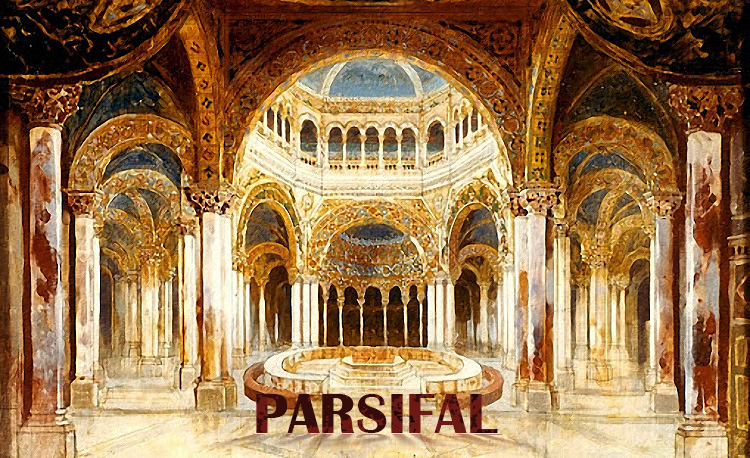
Michael Colhaze had already complained about this profanation of Wagner in a 2012 article I copied and pasted from The Occidental Observer. Unfortunately, all the articles by this German, Colhaze, have been deleted in The Occidental Observer. Why?
Parsifal, which premiered at Bayreuth on July 26, 1882, is Wagner’s most numinous work. It was performed sixteen times that first year and was the most carefully prepared premiere of an opera in history. European royalty made the pilgrimage to hear Wagner’s new work.
The original sketches for the sets and costumes were designed by German-Russian painter Paul von Joukowsky, who based his design for Act One on the Cathedral of Siena, and for Klingsor’s Magic Garden, in Act Two, on the gardens of the Palazzo Rufolo in Ravello.
After Wagner’s death, this production acquired mythic proportions but in our times the sets have become increasingly dilapidated in most representations, where we see the rubbish scenery that Colhaze complained about another of Wagner’s musical dramas.
 Click: here
The software converter could not add the image of the video within the article ‘My thoughts on Moly’, but I’ve embedded it below:
Click: here
The software converter could not add the image of the video within the article ‘My thoughts on Moly’, but I’ve embedded it below:
Bach did not compose any opera at a time when the genre was very much in vogue. In this, he cannot contrast more with Wagner, mainly known for his operas (or, as some of his mature works later became known, ‘musical dramas’). Unlike Bach who used the Gospel text in his most ambitious works, Wagner wrote both the libretto and the music for each of his works. My father, a composer of classical music, used to say that Wagner’s art predicted cinema.
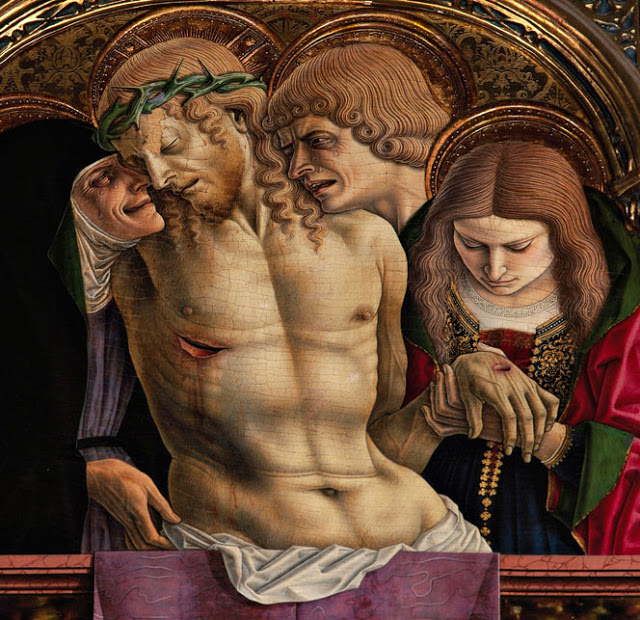 However, the narrator tells us in the aforementioned documentary that St Matthew Passion has operatic elements. It was music that inspired ‘contrition and remorse’, and it is striking how the pundits of white nationalism don’t want to see the elephant in the room when they agonize to explain how the guilt that currently kills the white man originated. St Matthew Passion lasts an hour and a half, and has twice the choir and orchestra than St John Passion.
Who has hit you
my Savior, and with torments
so harshly abused you?
The narrator tells us: ‘And it’s in that moment that I feel Bach is saying, This suffering is unbearable. We have to stop it. We have to show our sense of moral outrage’.
You know nothing of our sins…
Have mercy my God
for the sake of my tears.
After explaining St Matthew Passion the narrator made the mistake of passing the microphone to a psychologist to ‘psychoanalyse’ Bach. Readers of this site know that I think clinical psychology is pseudoscientific, and it’s not worth adding much here except to say that Freud and his disciples loved to ‘psychoanalyse’ geniuses to feel superior to them (see what I say about the Vienna quack: here).
After the shrink mistake, the narrator tells us that Bach’s obsession with composing religious music was such that, despite his Lutheran background, he composed a large-scale Latin mass for a Catholic court. As the lyrics of one of his last compositions say shortly before Bach died:
Before (((your))) throne now I appear…
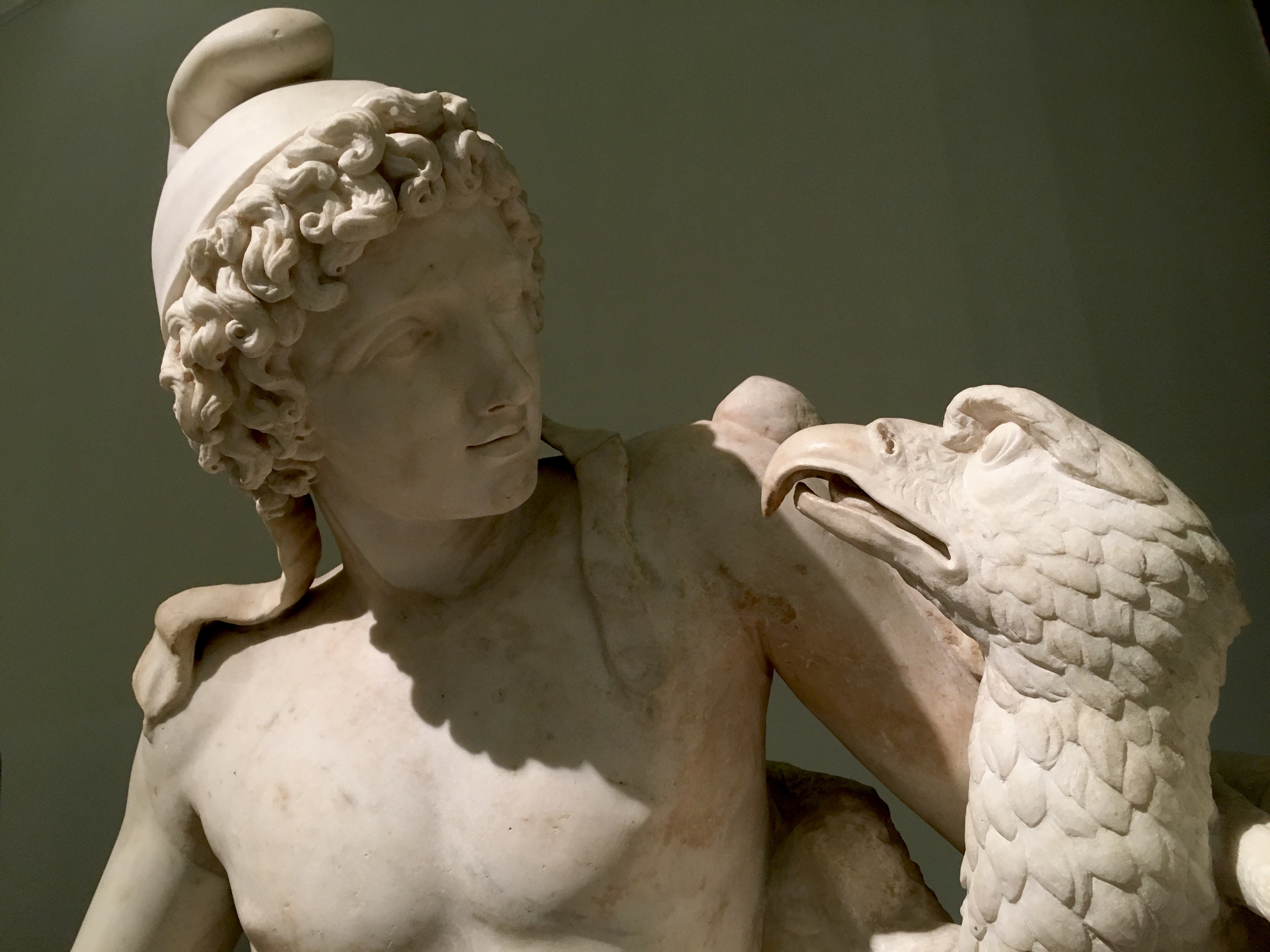
Homer describes Ganymede as the most beautiful of mortals, and in one version of the myth, Zeus falls in love with his beauty and abducts him in the form of an eagle to serve as cup-bearer in Olympus.
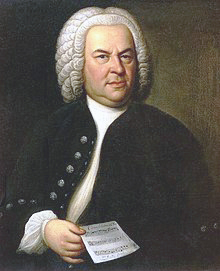 In the aforementioned documentary, after minute 46 the narrator talks again about Bach’s ‘life ambition’: writing music for the church. It is very interesting to observe how Bach worked frantically in Leipzig to compose, in a relatively short time, his two Passions.
Leipzig was ‘the city of churches’ and out of a population of thirty thousand, nine thousand of them gathered together in two churches, making Bach the centre of an audience ten to twelve times larger than an opera house. Wagner would have envied him! It was there that Bach premiered a Passion: a central gem in a series of cantatas and oratorios that told the story of a rabbi’s arrest, trial, and crucifixion. This was a fictional rabbi that the treasonous Aryans still adore, including a good many of the misnamed white nationalists. St John Passion is an amalgam of ‘storytelling, meditation and drama’ and let us remember that the Gospel of John was Luther’s favourite gospel.
If one takes a look at minute 56:40 in the referred documentary we see the narrator directing a group of musicians that includes a woman of dark skin: the perfect corollary of an ethic that commands the German to love every anthropomorphic creature. The narrator comments on playing St John Passion: ‘It’s like nails being driven into bare flesh’ and that’s exactly the feeling that that music causes me. But not in the sense that the narrator imagines: but in the sense of my dreams of terrifying cathedrals and my dislike for dad’s Christianity (and Bach’s music). I especially feel that when the choir sings together.
In a non-nightmarish world Aryan Germany would have continued without Levantine contamination. How would that Teutonic music have sounded in an 18th-century parallel world in which Julian had not been murdered? Maybe when Christianity finishes dying Bach’s music will die but even in secular Germany Christianity is alive. Just listen to the lyrics of St John Passion sung by the German choir after the 58th minute!:
(((Lord))), our ruler
whose fame in every land is glorious!
Axiologically (‘ethnocentrism for me but universalism for thee’), the Hebrew god still rules the West, even the secular West. In a ‘wonderful presentation of story-telling’ the Passion composed by Bach tried to transmit, in ‘an extraordinary amalgam between theology and music’, the drama of the rabbi’s crucifixion whom mad people ordered to be killed. It hurts to see these Aryans sing to the god of the Jews seven decades after a German Reich tried to get them on the right track.
St John Passion, the narrator informs us, is a masterpiece even though the authorities at the time disliked it so much that they forced Bach to make changes to it.

The Women of Amphissa is a 1887 painting by the Anglo-Dutch artist Lawrence Alma-Tadema. (Clark Art Institute)
I invite visitors who like classical music to watch an hour-and-a-half documentary: ‘Bach: A Passionate Life’. The host of the documentary informs us that, when Luther took refuge in a castle, he believed that the devil was stalking him from the ceiling. Compare such dark paranoia with the return to the artistic spirit that then reigned in Renaissance Rome!
In that room the dark monk, Luther, translated the New Testament using many German dialects, thus creating a unified language for that nation. In one of my previous posts I said that all western nations since Constantine, except for the brief reigns of Julian the Apostate and Hitler, should be considered quackery from the new point of view. The reason why the Germans allowed themselves to be brainwashed so easily since the US-imposed Diktat is explained if we see that the inertia of their culture was infinitely more Christian than the occult paganism of the Third Reich. In other words, what succeeded again in WW2 was, as happened after the assassination of Julian, the grip that the Christian archetype holds over the white man’s psyche.
Compare my point of view with what even a racist revolutionary, a non-Christian, wrote in one of his novels. Harold Covington envisioned a dispute between Christians and pagans, both freedom fighters for the 14 words, during the racial revolution: a dispute that was only resolved when the pagans allowed that the hymn of the new Aryan republic was… a hymn that Luther had composed! Naturally, neither the late Covington nor his secular followers that can still be heard once a month on Radio Free Northwest knew that Christianity and the JQ are one and the same.
These Luther hymns went perfectly in line with the central goal of Bach’s life, as we are informed after minute 29 of the documentary linked above: ‘A well-regulated church music to the glory of (((God)))’. Those were Johann Sebastian Bach’s words: the words of the grandfather of all the composers! But without putting triple parentheses now, after the 45th minute of the documentary a writer confesses to us, when we hear Partita for Violin No. 2 in the background, that this sort of musical soliloquy ‘would convince me that there is a God’.
This is most interesting because that Partita is the music solo I have heard the most from Bach, and although it is secular (i.e., non-sacred music) it perfectly portrays the feeling of the child of my dream in my previous post: that what for my father (or Christians) seemed sublime to me it seems hellish. Infernal not in the sense of today’s degenerate music, but in another sense. Just as Gothic cathedrals represent magnificent art, much of Bach’s music (and even Beethoven’s quartets) transports me to that gargoyle-filled nightmare world of which I want nothing more than a return to a musically enlightened world.
Please understand me well. Unlike those Neanderthals who don’t understand the music of Bach, Beethoven or Wagner, since my parents were musicians by profession I did understand them. But it is the dark Zeitgeist that, as in my dark cathedrals series of dreams, bothers me even though I recognise that the Partita is a masterpiece. Curiously, when after getting used to listening to it on violin I once heard the same Partita by Bach, but this time versioned for classical guitar, the gargoyles disappeared and I was finally able to enjoy it. Something similar happens to me with the church organ and the harpsichord: I cannot hear them except when the pieces are versioned for other classical instruments, although more modern. It is the Christian Era Zeitgeist that irritates me, and to understand my subjectivity I must translate another page of El Grial:
______ 卐 ______
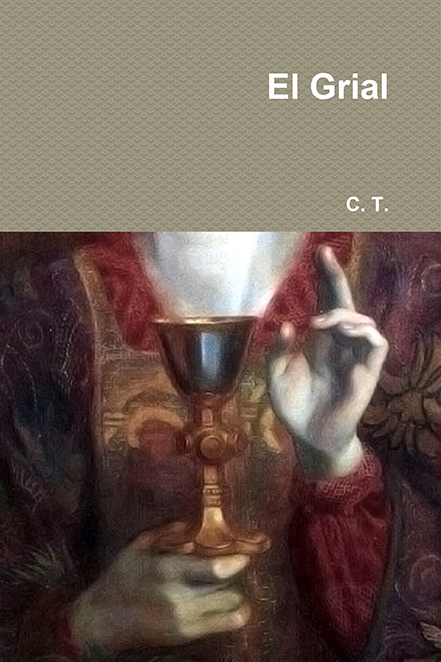
What impresses me about this historical revisionism is the clairvoyance of the teenager I was, whom my parents and a psychoanalyst destroyed at the time. He saw things as they were, and compared the loss of his beautiful life with the loss of the ancient Hellas. For the adolescent Caesar, the best of his Palenque had been his ‘Greek’ stage, and the stage after November 1974 was like the fourth century and subsequent European centuries. How I remember the way in which I then projected that drama on the image of an LP that my father liked, that we called the Hercules Mass.
 I was deeply hurt by the transition from the world of the Greeks and the Romans to Christendom; and the face of the lad on the cover of the album, together with the Kyrie of Josquin des Prés, represented the fateful transit: sculpture and music that, in my adolescent mentality, I thought dated from the times after Constantine. Still something of the Hellenic beauty was seen in the profile of the young man—I felt inside—and it hurt me that, unlike the jovial times of the ancient world, he was now praying with his face up (note that the female above the lad is no longer Aryan). Later I remember very vividly that, already living with my grandmother in the darkest stage of my life, I blamed my father’s Christianity for the annihilation of the beautiful youth of Athens. What I was unaware of at my seventeen is that the grandiose temples, statues, and libraries of Greco-Roman culture had been ripped apart, and adepts of the old culture marginalised and even genocided by Christians…
Now I know that the tragedy of the West in general, and the tragedy of my life in particular, are two sides of the same coin. The soul that the adolescent Caesar so projected on the downgraded ‘Greek’ of the album was killed by the same regressive forces by which the Greco-Roman world was killed: the incredible evil, stupidity, massive psychosis and envy of humans. From this angle, writing about my life has also been, in some way, writing about the western tragedy.

Seated statue of Jupiter:
the so-called Jupiter Verospi.
Vatican Museums, Rome.
The fourth part of El Grial begins with a dream that I now translate into English:
I was walking on a street by day next to Dad, who pointed out to me, enthusiastic and joyful as his character, the great church—or wall of a great church, rather like a Gothic cathedral—while I felt real horror for the (not glimpsed, only felt) kind of gargoyles, low relief sculptures or external figures of a very dark-stone cathedral. The contrast between the spirited Dad in pointing out to me that Christian bastion as something so positive that he even smiled at me and the horrified son—although I corresponded to Dad’s smile from my height as a child with another smile to be nice with him—couldn’t be greater.
Then I commented that over the years I had several dreams with that theme. I interpreted that my father lacked enough empathy to realise that traditional Catholic doctrine, which seemed so positive to him, horrified his little firstborn.
I recently said that Parsifal’s music has been one of my favourites, despite the fact that the opera characters are quasi-Christian knights that Wagner devised. Wagner’s last opus is not a hundred percent Christian insofar the script never names Christ or Christianity. Rather, it resembles the spirit of the Germanic sagas in times of Christian conversion, when something of the ancient pagan spirit was still breathed. In this first entry about how I contrast Wagner with Bach I confess that, unlike Parsifal, traditional Christian music has horrified me as much as that series of dreams with which I opened this post.
Iconoclasm, even in music, is a thorny topic. If we proclaim the transvaluation of all values the question immediately arises: What to do with the so-called sacred music after the anti-Christian revolution conquers the world? We have already seen that Nietzsche loved Parsifal’s music but abhorred its message, especially the chastity of the quasi-Christian knights. In my opinion, Wagner, Hitler’s favourite composer, is salvageable but how should we treat sacred music from his predecessors?
Unlike Richard Wagner (1813-1883) who flourished a century after the death of Johann Sebastian Bach (1685-1750) Bach had no passion for the Germanic sagas of the pagan past. On the contrary: Bach composed his music for the main Lutheran churches in Leipzig, and adopted Lutheran hymns in his vocal works. The hundreds of sacred works that Bach created are generally seen as a manifestation not only of his craft, but of his great devotion to the god of Christians: the very god of the Jews. Bach even taught Luther’s catechism as Thomaskantor in Leipzig, and some of his pieces represent it. For example, his very famous St Matthew Passion, like other works of this type, illustrates the Passion of (((Christ))) directly with biblical texts.
Compare all this with Wagner’s relatively paganised work who didn’t quote the gospel: a musician who, by introducing pre-Christian elements in his operas, was already starting to shake off the Judeo-Christian monkey from his back. But before continuing my talk about Bach I would like to quote, once again, the words of Nietzsche that appear in The Fair Race:
§ 61
Here it becomes necessary to call up a memory that must be a hundred times more painful to Germans. The Germans have destroyed for Europe the last great harvest of civilisation that Europe was ever to reap—the Renaissance. Is it understood at last, will it ever be understood what the Renaissance was?
The transvaluation of Christian values: an attempt with all available means, all instincts and all the resources of genius to bring about a triumph of the opposite values, the more noble values… To attack at the critical place, at the very seat of Christianity, and there enthrone the more noble values—that is to say, to insinuate them into the instincts, into the most fundamental needs and appetites of those sitting there…
I see before me the possibility of a heavenly enchantment and spectacle: it seems to me to scintillate with all the vibrations of a fine and delicate beauty, and within it there is an art so divine, so infernally divine, that one might search in vain for thousands of years for another such possibility; I see a spectacle so rich in significance and at the same time so wonderfully full of paradox that it should arouse all the gods on Olympus to immortal laughter: Cæsar Borgia as pope!… Am I understood? Well then, that would have been the sort of triumph that I alone am longing for today: by it Christianity would have been swept away!
What happened? A German monk, Luther, came to Rome. This monk, with all the vengeful instincts of an unsuccessful priest in him, raised a rebellion against the Renaissance in Rome…
Instead of grasping, with profound thanksgiving, the miracle that had taken place: the conquest of Christianity at its capital—instead of this, his hatred was stimulated by the spectacle. A religious man thinks only of himself. Luther saw only the depravity of the papacy at the very moment when the opposite was becoming apparent: the old corruption, the peccatum originale, Christianity itself, no longer occupied the papal chair! Instead there was life! Instead there was the triumph of life! Instead there was a great yea to all lofty, beautiful and daring things!
And Luther restored the church.