Apparently, some visitors to this site don’t even know what child or adolescent abuse is. This prompts me to publish below the final pages of my book. I refer to the pages preceding the appendices:
How to murder your child’s soul
– with the help of a psychiatrist –
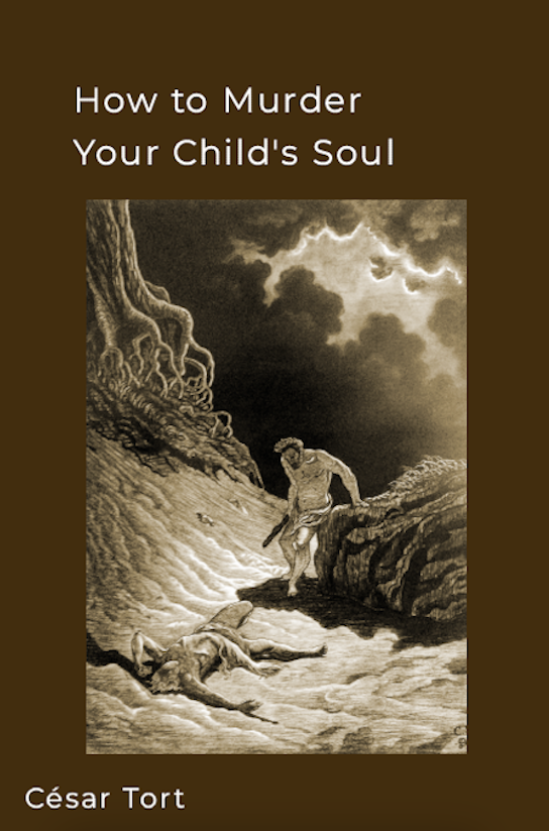 First, marry a man who is super-affectionate with children: someone who has an extraordinary graceful charm with them and whom you can also manipulate.
Second, narcissistic mother, you must understand that your child is a part of your mind. His thoughts, feelings and desires are your private property: they are part of your inheritance. His emerging mind is like a computer and you have the duty and the right to program it as you please.
Any initiative, natural spontaneity or free will of the child that doesn’t reflect your programming is a symptom of mental illness, so you must harass him mercilessly.
If, upon reaching puberty, he rebels against your possessive behaviour, go to your husband. He is stronger than the boy, and if you use your feminine wiles to have your husband publicly humiliate him with tremendous slaps across his little face, all the better. The harder the overly affectionate father hits him, the greater the trauma will be. The goal is to provoke a monstrous confusion of feelings: that the one who gave him the most love as a child will be the one who shows him the greatest hatred as a teen…
This is the key to murdering your child’s soul, and if your husband fails to develop the gift of lycanthropy, you may not achieve your objectives. Remember that nothing undermines more the sensitive and developing mind of a child or teenager who adores his dad than these inexplicable changes.
If, even with these measures, you haven’t reached his inner self to injure it, seek the services of a specialist! A psychiatrist or psychoanalyst will do a good job. Your son will be forced to attend sessions at the Ministry of Love…
Since he is already in a state of shock and trauma from the insults and beatings from his beloved dad, you will have a golden opportunity to, precisely at that moment of maximum vulnerability victimize him again to produce irreversible psychological damage. If you also choose a professional with gentle manners and media fame, no one will suspect a thing about the drastic measure you’ve taken.
If, in O’Brien’s therapy, your child suffers panic attacks and develops delusions (‘mum wants to possess my thoughts,’ ‘my father is turning into Mr. Hyde,’ ‘a doctor they hired wants to poison me with drugs’) don’t go thinking these are echoes of your splendid upbringing or the medical attack. The therapist will inform you that under no circumstances should the parents be blamed for the child’s emotional disturbance. Quite the contrary: the evidence of a biological defect in your kid is irrefutable. This wise man in a white coat has a Malleus Maleficarum DSM where he will easily find the name of his ailment. Once diagnosed, his prescription will be to bombard the deluded brat with the most incisive neuroleptic. The resulting panic attacks, dystonia and akathisia—all effects of the drug—will be more than enough to control him. Akathisia is hellish: and people will think the crises are your sick child’s doing, not the drug you secretly slip into his food.
But make sure he doesn’t get away with it and avoids a chemical lobotomy. You wouldn’t want him to write an autobiography when he’s grown! On the other hand, if he takes his meds he’ll be as docile as a lamb and he’ll never be able to say what you, your husband and the psychiatrist did to him.
Then you’ll have the beloved little child of your dreams. You’ll be able to dress him, feed him and, given his irreversible tardive dyskinesia, change his diapers.
And remember: you have your husband, the medical establishment and the whole of society on your side…
4 replies on “Final pages”
I move through life like a shadow trailing my caster—always one step behind, doubting every footprint.
My mother, a silver-tongued architect of guilt, wove her control from whispers and feigned frailty. “You’re all I have,” she’d sigh, eyes glistening just enough to hook me, turning his budding independence into betrayal.
From childhood, she dismantled my choices: the wrong friends were “users,” my dreams too selfish, every achievement credited to her sacrifices.
Praise came laced with barbs—”Finally, something right”—leaving me starved for validation I could never earn.
Now, in quiet apartments and dead-end jobs, I second-guess my own voice.
I apologize preemptively, shrink from conflict, my spine softened by years of her gaslighting:
“I never said that; you’re imagining things again.”
Relationships crumble under the weight of inherited suspicion—I probes lovers for hidden motives, convinced loyalty is a myth.
Therapy whispers of “complex PTSD,” but I hesitate, after all, wasn’t it love?
In my mirror, a man stare back, polite and proficient, yet hollowed—perpetually the boy who couldn’t leave without breaking her heart.
Write your memoirs as I did. That’s the healing process…
Dear Elias,
I’m sorry for your life’s painful struggle. I empathise with you. In my case it was my father (my mother tended to stand back doing nothing; that’s one of the core points of my autobiography, although admittedly her favourite line was also ‘I think you’re imagining me hurting your feelings’, and variations off that).
My best friend (only real, and a very close one) was named Mick. He effectively saved my life more than once, once by taking me off the streets in Camden Town in the early 2000s when I was pretty much semi-homeless, shortly before another guy planned to traffic me on to a forced labour gang, and letting me stay in his flat periodically instead, and once by leaping in and intervening when a black Yardie gangster was trying to stab me to death the year after. Beyond that, we had many truly good times, and he was like a brother to me. When he died (of what I have always suspected could have been a deliberate overdose; he was suicidal at the time) all my father could say was just that… ‘he was a user’, ‘he was a waster’, ‘he was no good for you’, or variations off ‘don’t worry yourself over that fucking skaghead!’ when I was experiencing the first terrible years of grief (which took almost a decade to subside).
All my career choices when I was younger were shot down by my father, and he put me off so thoroughly, and dented my confidence so much, that I really struggle these days with that sort of thing.
I know the backhanded praise well. “oh that’s very good!” if I show him a piece of my art, or present him a poem, or when I let him hear a recording of me on my violin, or whatever, and then a second later “actually, no, you could have done that better… and that bit doesn’t sound/look right, and I think you should have done this instead, and this is frankly boring!” – he despises my print books and very occasional articles though, so I don’t bother sharing them with him anymore, as it’s straight on hatred-grade criticism. It’s made me both a neurotic perfectionist with regard to my own work, and also rendered me loathe to pursue some avenues at all. I have absolutely no faith in the quality of my own skills, and I think this would hamper me in that environment. I know I still use him periodically for validation, but it’s never sufficient to plug the hole.
I know the feeling of wondering pre-emptively if you’ve put your foot in it, and apologising at the drop of a hat. I’ve tried to train myself out of this over the years, but I’m still quite bad at it. As a teenager I used to apologise to a door if I accidentally kicked it – that’s how conditioned I was. I’m very awkward in conversation also, readily suspecting myself of having ruined the mood (even if I don’t tend to raise this with others anymore). I ever do it with my posts on here – endless disapproving self-scrutiny.
I’ve always wondered what it feels like to be confident. I suppose my only bonus is I’m quite grumpy by temperament and don’t shrink from conflict; better physically than in shouted words (when tend to get my heartbeat up). But that doesn’t mean I don’t criticise myself also, having subsumed that parental distrust a while back.
I’ve been informed they speculate ‘PTSD’ co-morbid in my case, but the main ‘diagnosis’ they’re inordinately fond of for me is Schizoaffective Disorder, stemming from some trouble I had with the law a couple of years ago, more than actually having psychotic delusional blips now and again (it’s the latest trend in the UK to over-diagnose ‘the WN right’ with that), so they’d don’t want to play up my trauma symptoms (or recognise them at all most sessions).
Again, I’m sorry for your hollowness. It’s impossible to convey sometimes, the pain parents cause, especially to an ignorant, know-better world. I’m glad you feel you are proficient. If you do choose to follow César’s recommendation, I’d happily buy and read your book.
Best regards.
I could say the same about my mother. She was the Medusa—the “evil eye”—whose internalised verbal abuse paralysed me throughout my youth: psychically, she turned me into a statue.