and the survival of the West, 4
by Revilo Oliver (1973)
Chapter Four THE PREDICTABLE FUTURE
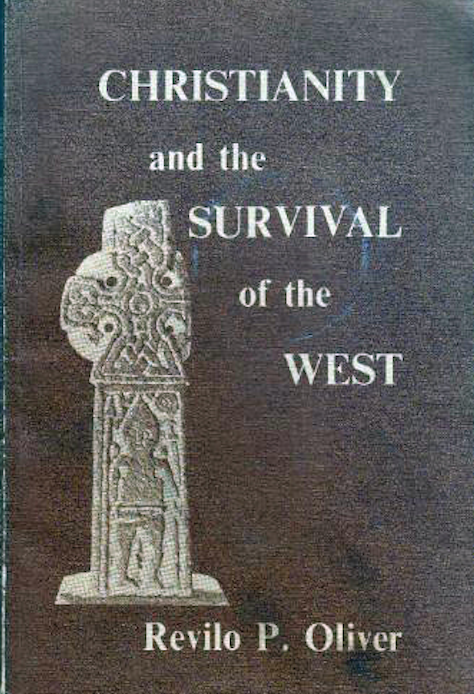 Christendom is no longer Christendom. The faith that Christ was literally the Son of God, which dominated the Western world for fifteen centuries, and effectively united all the men of our race for ten, has become the faith of a minority. […]
One common ground for hope is, at best, uncertain. We Americans, thanks to our folly, will soon undergo a considerable amount of physical suffering: domestic violence, economic collapse, probably some starvation, quite possibly conquest by foreign invaders and resident revolutionists. It is true that, as history shows, such afflictions usually induce a revival of religion, and many Christians expect such an effect here. That is not likely in the future that we can foresee. For one thing, the historical effect requires an unremitting and prolonged suffering—thirty years or more. The Crusade to Save the Soviet in 1939-1945 inflicted great suffering on many nations of Europe, especially Germany and Poland, but produced no significant religious revival. Secondly, if there should be such an effect, it probably would not benefit Christianity. The Protestant Churches as a whole have long been disgraced by the pinks and punks of the National Council. The Catholic Church is now committing suicide by repudiating its own doctrines and burlesquing its traditions. In the eyes of non-believers now, the religion has been compromised by the antics of the greater part of the professional clergy, and despite the admirable loyalty of “traditionalist” and “fundamentalist” minorities, it is likely that the coming disasters will—unjustly, but understandably—make Christianity seem a religion that failed. Thus any revival of religiosity will benefit cults that will have the attraction of novelty and a new “revelation,” possibly including some doctrine of metempsychosis.
We are left, therefore, with the present situation and very little hope that it will or can be soon altered. So we had better reckon with it, whatever our personal desires or convictions.
The visible consequences of the withering of our religion are enormous, overshadowing, frightening. Christianity was much more than a religion comparable to the religion of Osiris in early Egypt, the worship of the Olympian gods, the Orphic mysteries, or Mithraism. Unlike those cults in their time and place, Christianity for a large part of our history was the whole formal basis of our entire culture, the absolute from which were deduced our moral codes, our laws, and our political systems; it largely informed our art, inspired our literature, animated our music, and sustained our men of science. The void that has been left is so great that few can peer into the dark abyss without vertigo. […]
If Christ was not literally the Son of God, the entire morality on which our civilization was consciously based for so long seems to collapse, to vanish as an illusion, to be as unfounded as the old nation that the earth was flat. [Editor's Note: This gives me carte blanche for my exterminationist fantasies.] And this apparent dissolution includes all of the ancient Indo-European morality that guided our peoples in the many centuries that preceded our adoption of Christianity.[1] That is obviously what is happening—has happened today, when we witness everywhere tacit and explicit repudiation of all morality—not only Christian teaching, but the antecedent and basic morality without which civilization is flatly impossible. And, what is even more disheartening, there seems to be no basis left for any morality.
For a long time, men, except a few romantic and evangelical atheists, have agreed that a viable morality must be based on a religious faith. Hesiod, whom some scholars place in the ninth century B.C., warned the judges of his day that Zeus had 30,000 invisible and immortal observers who go through the whole earth and report the evil deeds of men. A discerning correspondent, whose letter reached me yesterday, remarks that “unfortunately, most people need to feel that they are watched by a superhuman power.”
For Aristotle, Plato, and Cicero, civilized society must be based on a generally accepted and uniform religious faith. And, with few exceptions, the thoughtful non-Christians of our world have held the same opinion. Renan, for example, took leave of Christianity with elegiac sadness and deep apprehension: “What is ominous is that we cannot foresee for the future any means of giving men a code of conduct that they will generally accept… I frankly admit that I cannot imagine how it will be possible to restore, without the ancient illusions, the foundations of a noble and serene life.”
On a quite different level, the pragmatic and cynical Augustus believed religion the indispensable basis of political stability, and many rulers and statesmen, before him and after him, had the same conviction. And some of the world’s most acute minds have drawn the conclusions that Machiavelli, perhaps, stated most bluntly:
Principalities and republics that would save themselves from decadence must above all other things keep uncorrupted the ceremonies of their religion, and hold it always in veneration; for there can be no greater symptom of the ruin of a state than to see divine rites held in contempt… They should therefore use every opportunity to foster and augment their religion, even though they perceive it to be false; and the more prudent they are and the more they know about natural phenomena, the greater their obligation to do this.
It is now too late to heed Machiavelli ‘s warning. The disaster that he apprehended has come upon us.
It is vain to dream of a religion to replace Christianity. Comte’s notion of a “Religion of Humanity,” whereby congregations would throng temples to venerate Henry Ford, Thomas Edison, and Werner von Braun as “benefactors,” was one of the ideas that occurred to him when he was out of a straight-jacket, but it should have suggested to his friends and keepers the need to hustle him into one. True, there have been serious proposals by eminently sane men, who, however, seem to forget that a religion must be based on faith, not speculation or psychological peculiarities. Captain Ludovici is a highly intelligent and earnest man, and when he wrote his Religion for Infidels (1961), he must have known that his “rational religion” could appeal only to a few, and had no chance whatsoever of meeting our society’s need for a unifying faith.
If the faith of Christendom was an error, alien gods can command no true piety—not even in the little circles where they may enjoy a passing vogue. The Oriental cults that make wealthy dowagers beam and write cheques are not for men. Christianity is irreplaceable.
___________
[1] Christianity, of course, introduced very little that was novel in the practical ethics governing human conduct in society, most of which were not only traditional in our race but were common to most civilized societies, including the oldest of which we have adequate knowledge. (Clergymen who impudently talk of “Judaeo-Christian ethics” try to give the impression that the prohibition of theft, adultery, etc. in the Ten Commandments was some kind of dazzling and miraculous invention, but if they were honest they would speak of “Sumerian-Christian ethics” in that connection.) About the only element that can fairly be called a Christian innovation was the great emphasis on forgiveness as a duty rather than an act of unnecessary generosity. (Its doctrine of rewards and punishments after death tended to enforce observance of the whole moral code, but that is another matter.) The historical antecedents, however, will not help us now, for our religion was so long regarded as the one and only basis for morality and the unique source of all right conduct that the earlier traditions have vanished except insofar as we still instinctively regard certain actions as dishonorable. Even those feelings, however, may be consciously repressed as “relics of superstition” by persons who have reacted strongly against the religion and are proud of having “emancipated” themselves from it.
5 replies on “Christianity”
At the end of his chapter we see Oliver’s great failing (“Christianity is irreplaceable”), and indeed the failure of almost all American white nationalists except for the group Lincoln Rockwell founded.
The replacement is obviously National Socialism.
The nihilism that plagues the West is due, as Matt Koehl said, to the fact that white men have rejected Hitler. The point is that a race that rejects Him will surely perish.
The mission of The West’s Darkest Hour is to rectify this foundational error of American racialism, and the only way to achieve this is by attacking Christianity with arguments that no Christian can refute (see, for example, Adam Green’s interview with Richard Carrier).
I would disagree with his footnote [1] also, where he writes:
It seems to me the sixth commandment, when processed through the New Testament also is now indeed “some kind of dazzling and miraculous invention” in that the net has been widened due to universalism, and there is no longer such thing in this awful morality system as a friend-enemy distinction.
Where is it traditional in our race not to kill our enemies? I would have said – and I think some modern day non-white spokespeople are in agreement on this, if I recall correctly from some recent comments; Tucker Carlson also – that the natural state of the Aryan when freed of Christianity is one of active genocidal passion.
I think he mourns the loss of it too much. I don’t think it’s irreplaceable so much as it wasn’t required in the first place. It’s a relief to shake off that mantle.
Curiously, the Wikipedia article on Oliver includes this paragraph:
Oliver wrote that seventeen years after the booklet cited above.
Yes, I think both William Pierce and Revilo Oliver came to the conclusion by around 1990 that we have on this forum that Christianity is absolutely spiritual poison and cannot be tolerated. Matt Koehl is great! I have read his pamphlet about National Socialism that he wrote in the 1980s. This idea that we need a religion is an interesting one. Do we put Hitler up as an image for a new religion. Zeus, Odin, Hitler in a pantheon? I tried Cosmotheism which Pierce advocated for but that seems too universalist to me with the idea every human being is part of this “creator” or “whole” as Pierce put it. We need a religion just for Nordics I think
Hitler cannot be placed alongside mythical figures. The correct way is what we said in The Fair Race: