web analytics
Categories
Souvenirs et réflexions d'une aryenne (book) Swastika Technology Third Reich

Reflections of an Aryan woman, 46

Maybe you could admit it, if it was about a politician. But the Leader of National Socialist Germany was something else entirely. He represented, as I have said, the most recent of the visible and tangible manifestations of Him who periodically returns to lead the struggle ‘against Time’ which has been going on, intensifying, since the end of the unthinkable Golden Age, far, far behind us, and which, at the same time, announces the next Golden Age: the blessed beginning of the next cycle.
 

______ 卐 ______

 
Editor’s note: It seems to me that here I’ll differ with Savitri (I don’t think the Golden Age existed), but for the moment I won’t enter into the discussion because I haven’t yet read The Lightning and the Sun. I’ve ordered a hard-cover copy from Counter-Currents Publishing since last month, but for some reason I haven’t received it yet. Only when I read The Lightning and the Sun, considered Savitri’s magnum opus, will I know whether I will disagree with her on this point. In the meantime, let’s stick with the book she wrote in French:
 

______ 卐 ______

 
Any action he may have taken in the direction of Time can only be fully explained in the light of his mission against Time, of his desperate effort at recovery accomplished in the present conditions of the world, that is, very close relatively speaking to the end of the present cycle. It is the action of an initiate, and therefore of a visionary (not in the sense of a victim of hallucinations but in the sense of a man capable of considering time, including the time in which he lived and the people who lived with him from the point of view of the eternal present); the action of a prophet, a realist as all true prophets are.

He saw very clearly, and it was not necessary to be an initiate or a prophet, the growing interest of the masses in the material pleasures of life, and the absurdity of any effort to distract them from it. He understood that in an age increasingly dominated by technology it cannot be otherwise. More than that, he understood that, deep down, it had never been otherwise; that only the nature of the ‘material amenities’ could change, not the tendency of the majority of people to give them enormous importance—and this for the simple reason that the masses are the masses, everywhere and always. He knew that while human races are unequally gifted, so are men within the same race, or even the same people; that, in particular, alongside the German elite which all his efforts tended to promote, there was—and always would be, even after the installation of the National Socialist ‘new order’—the masses.

In an interview reported by Hermann Rauschning (a man who has become the enemy of the Hitler faith to the very extent that he has begun to grasp at least some aspects of it and whom, therefore, we must believe whenever the words he quotes are really in the mind of the person who is supposed to have uttered them) the Führer sets forth, as early as the summer of 1932, his conception of the German social order as it must, in his eyes, emerge from the revolution he is leading. ‘There will be’, he said, ‘a class of lords from the most diverse elements, which will be recruited in the struggle and will thus find its historical justification. There will be a crowd of the various members of the Party, ranked hierarchically. It is they who will form the new middle classes. There will also be the great mass of the anonymous, the collectivity of servants, the miners ad aeternum. It doesn’t matter whether they were farm owners, workers or labourers in the former bourgeois society. The economic position and social role of the past will no longer have the slightest significance.[1]

There was, therefore, and there must have been for him, even within the good and brave German people he loved, a mass that was irreducibly ‘minor’: a sympathetic mass, to be sure, because of the good Aryan race despite its naivety from which exceptional individuals could sometimes emerge and stand out; but, on the whole, a mass nonetheless with all the mediocrity that this word suggests. It was to them that the Führer offered an increasingly standardised life, full of amenities within their reach, material amenities above all, it goes without saying: the cheap house (which could be dismantled and reassembled) whose parts, the same everywhere, would be easy to find; the radio, the typewriter, and other cheap conveniences.

One only has to remember how much of an artist he was to the core, and in particular how much he had an innate sense of everything that ‘looked good’, to imagine the secret contempt he must have felt for any uniformity from below: a pitiful caricature of unity, the principle of creative synthesis.

One only has to think of his lifestyle—his legendary frugality, in the most beautiful surroundings possible; the fact that in Vienna, for example, during the years of misery that were to mark him so deeply, he went without food to afford a place in the ‘henhouse’ and to hear and see some of Wagner’s opera—to measure the gulf that separated him from all vulgar humanity, and especially from a certain fat type of Teutonic plebeian, whose conception of happiness is schematically, but forcefully and aptly, evoked in the title of a record emanating from the satiated Germany of 1969, Sauerkraut und Bier. This type didn’t wait for 1969 to appear but was widely represented among the crowds who, between 1920 and 1945, cheered Adolf Hitler, voted for him and, especially after the seizure of power, flocked to the Party and helped to increase its membership to fourteen million.

This abyss between the Führer and the densest folk, physically and intellectually, or the most mediocre of his people didn’t prevent him from loving them. He saw, beyond their narrow-minded individuality, the beautiful children who could spring from them, blood having many mysteries. And he saw the Reich, which he was reshaping from top to bottom to make it the centre of a pan-Aryan Empire, and he knew that ‘in their place’ they were part of it.

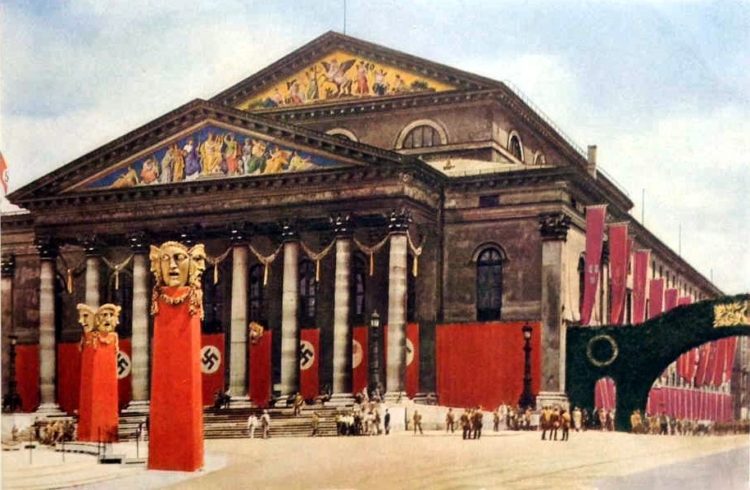
And if, understanding their limitations and the impossibility of making them overcome them, he offered them each a comfortable material life, ‘pleasant’ in its growing uniformity—a life which he didn’t offer at all to the elite—he also offered them, in the increasingly grandiose public ceremonies, the interminable parades, the music of battle songs through the paved streets, the nightly processions by the light of real torches; the Harvest festivals; the Labour festivals; the Youth festivals; the magnificent annual Party meetings in Nuremberg for days on end with countless red flags with black swastikas on a white circle at the foot of giant pylons at the top of which the flame from the massive bronze cups, the morning to evening in the bright sunshine, and from evening to midnight under the unreal phosphorescence of the columns of light faltering from the floodlights all around.

He offered them, I say, in all this, as well as in his radio speeches, and above all in the magnetism of his presence: an atmosphere such as no people had yet had the privilege of experiencing. The less intuitive, the less artistic, the densest people were subjected to this magical atmosphere which lifted them despite of themselves, above themselves; which transformed them little by little, without their knowledge, by the mere fact of the almost daily intoxication which it poured upon them: the intoxication of beauty; vertigo of strength; repeated contact with the very egregore of Germany which possessed them, pulling them out of their insignificance and returning them for a moment to what was eternal in them, the bewitching rhythm of the ‘Sieg! Heil!’ from five hundred thousand chests.

They were under this spell, and as long as they remained ‘under the spell’ they were great—greater than all peoples; greater than the men, Germans or foreign visitors, who, individually more refined, more intelligent, better than each of them, remained, for some reason or other insensitive to this spell in the strongest sense of the word. For they participated in the divine power which emanated from Him who called them to battle against the sinister Forces of decadence. They were encompassed in the beauty of His dream. And it is enough to remember the imposing solemnities of the Third Reich, if one has seen any, or to read a description of them in person (for example, Robert Brasillach’s description of the Party Congress in Nuremberg in September 1935 in his novel The Seven Colours), or just to look at good photographs of them in the few surviving albums of the period, to realise how beautiful they were—beautiful and popular—and how different they were from the official celebrations, even with military parades, of other countries under other regimes.

Unlike the organised displays of collective patriotic fervour that the governments of the ‘free world’ periodically (though increasingly rarely) regale their citizens with, there were no weary faces, no dull faces, no signs of reluctant participation or boredom. And, unlike the parallel collective demonstrations of the communist world there was nothing vulgar about them. There were no monstrous, oversized daguerrotypes of the dictator, or some ‘people’s father’ ideologue, living or dead, posted on the surrounding buildings or marching with the political, military and paramilitary formations, brandished high above their ranks; none of these heterogeneous bands daubed with demagogic slogans; nothing, I repeat, absolutely nothing of the pasteboard paraphernalia of the delirious proletarian.

There is more. These extraordinary solemnities of National Socialist Germany were beautiful in the sense that works of art of cosmic significance are beautiful. Not only was there a profusion of the immemorial swastika on the folds of the red, white and black banners (themselves symbolic colours), on the immense banners, on the men’s armbands, on the granite of the stands from the top of which the Führer was communing with his people.

It was a metaphysical symbol and not a mere image recalling such and such human activities, or ideas to the measure of man; but the gestures that were performed there, the words that were repeated there, unchanging on every occasion: symbolic, liturgical. Let us think, among other things, of the consecration of the new flags that Adolf Hitler put, one by one, in contact with the old ‘Blood Standard’: all charged with the magnetism of the dead of November 9, or of the ritual dialogue of the Führer with the leaders and young recruits of the peasant formations of the Arbeitsdienst, standing in perfect order before him, armed with their shovels like soldiers with their rifles: ‘Are you ready to fertilize the holy German land?’ – ‘Yes; we are ready’.

These solemnities were themselves symbolic: gigantic sacred dramas, mysteries where the attitude, the word, the creative rhythm and the silence in which the hundreds of thousands communed with the Centre of their collective being evoked: the hidden meaning, the eternal meaning of the New Order.

Only He who returns from age to age could, amid the reign of excessive technology—and mind-numbing standardisation—delight the working masses, and make them participate in such mysteries; transfigure them, infuse them if only for a few brief years—even the densest human specimens among them!—the enthusiasm of the regenerate.

___________

[1] H. Rauschning, Hitler Told Me translated from the German by A. Lehmanu 13th edition, Paris 1939, page 61.

Categories
Evil Miscegenation On Exterminationism (book)

Good and bad Germans

As can be seen at the end of the last entry, Savitri’s admiration for Hitler was not as blind as that of those who never criticise the founder of the religion to which they belong. Dr Robert Morgan, who comments in The Unz Review, would be happy with Savitri’s pronouncement. But I differ from her.

One must bear in mind the words in Andrew Hamilton’s ‘The Depth of Evil’ which appears in On Exterminationism (see sidebar): what has impressed me most, to date, of anything written for the Counter-Currents webzine. Hamilton says that the fact that people blindly follow those in power (pack mentality) means that they aren’t good. If someone like Hitler is in power, the Germans behave in a very sane and healthy way. If bad people are in power, says Hamilton, the people just follow them.

This is as true for whites as it is for non-whites. Here in Mexico all the media, the universities and the state are promoting the rampant, suicidal liberalism that is destroying the West: equality of race, gender and sexual orientation. Yesterday’s Reforma newspaper, considered by some the most important in the country, published this aberrant note on page 21 of its main section (my Spanish-English translation): ‘Luise Greve, 23 [an Aryan girl] from Erlangen, Germany, bought the first flight to take her to her [gook] partner as soon as the White House announced that the nation will be open to visitors fully vaccinated against Covid-19’.

We can already imagine such ‘good news’ if Hitler had won the war!

What I’m getting at is that Savitri seems to be saying that humans, including Aryans, are good people when in reality they are animals who practice nothing but the most abject social conformity depending on who is in power. As I say in On Exterminationism: ‘What I failed to realise for many years was the depth of the evil and the resistance to individual redemption. Obviously, if people are evil when evil people rule, and good only when good people rule, they are not really good’, wrote Hamilton. In other words, people, including the overwhelming majority of whites, are not really good.

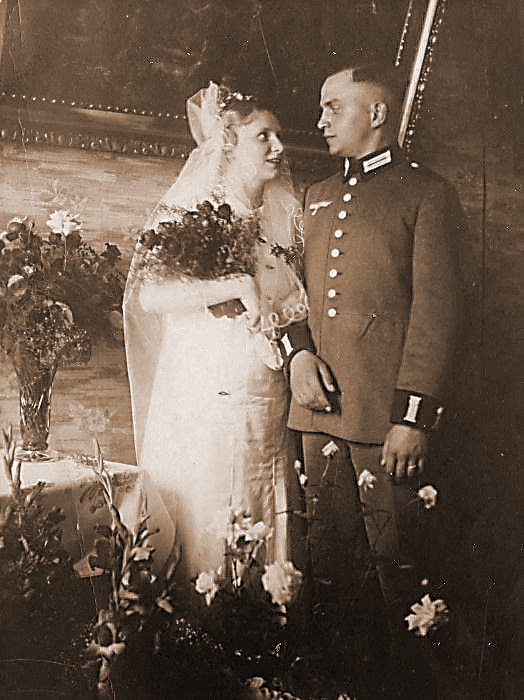
Bingo. Responding to Savitri, there is nothing wrong that the Third Reich would have wanted to homogenise the people by producing items like the Volkswagen and others for mass consumption. If whoever is in power is a man like gold, to use the Platonic metaphor of The Republic, the people will behave as if they were saints (photo above). If, on the other hand, those in power are real pieces of shit, as the elites currently are, they will behave like the Luise in this other photo (or her cuck parents who allowed that) .

Like the vast majority of white nationalists—Hamilton would be the exception—Savitri didn’t delve into the pettiness of our species: something I believe I’ve delved into in my books in Spanish (titles translated: here).

I think my way of presenting Savitri’s book is the right one: not just a rough translation, but a constant dialogue with what the priestess of the 14 words used to write. Just because the priest and the priestess belong to the same religion doesn’t mean that we will agree on everything.

Categories
Berlin Souvenirs et réflexions d'une aryenne (book) Technology Third Reich

Reflections of an Aryan woman, 45

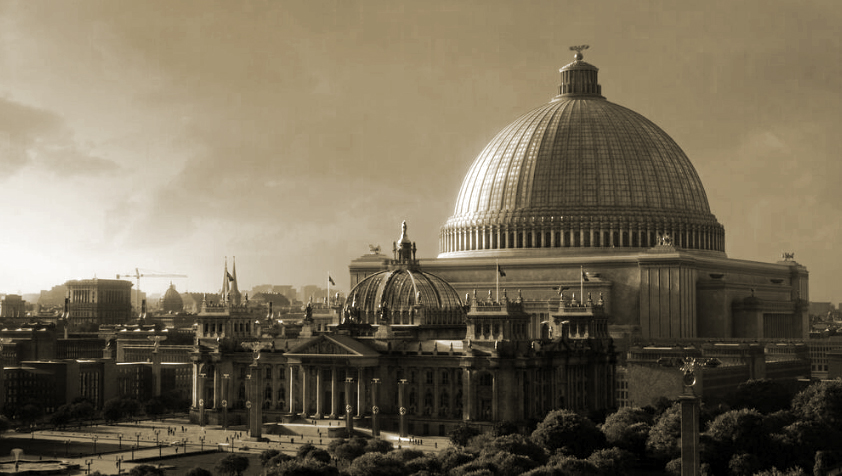
(Editor’s Note: A model of Hitler’s plan for Berlin formulated under the direction of Albert Speer, looking north toward the Volkshalle at the top of the frame.)

The enormous industrial, technical and material development of the Reich, which was the inspiration long before the war in 1939, was due to the willingness to fulfil everything Hitler had promised as soon as he took over the government. More than seven million unemployed people had their eyes on him. They had voted for him, for his workers’ party. They had—and their sons had often helped him—to hold the streets where for thirteen years his followers and the Communists had clashed. He could not disappoint them. Besides, he loved them. Ten years later, at the height of his fame, he would still speak with the emotion of ‘the humble’ who had joined his Movement ‘when it was small’ and could be thought doomed to failure.

It was impossible to keep seven million unemployed people busy and to restore strength and prosperity to a country of eighty million people—prosperity being the primary source of strength—without intensively promoting industry and undertaking all kinds of public works. The factories that had been closed due to the unstable political and economic situation of the Weimar Republic soon began to operate at full capacity, and an unprecedented fever of construction, transformation and gigantic remodelling took place throughout the Reich.

It was then that hundreds of kilometres of four-lane autobahns were laid out, lined with forests, and admired by all travellers who had the good fortune to visit Germany at that time (or even later, as most of these grandiose roads still exist). It was then that some of the great architectural ensembles that were the glory of Hitler’s Germany were built such as, in Munich, the monument to the Sixteen who fell on 9 November 1923, or the Brown House; or in Berlin, the New Reich Chancellery or in Nuremberg, at the Zeppelin Wiese Stadium, the monumental staircase dominated by a double peristyle linking three enormous pylons with massive bronze doors, one central; two lateral, from the top of which on the great solemnities of the Party the Führer saw the S A and SS formations parade; those of the Hitler Jugend of the ‘Labour Front’ and the German Army from which he would harangue the multitudes that overflowed the stands and the immense grounds.

These works of art and masonry, which Robert Brasillach called ‘Mycenaean’ to show their overwhelming power—which others have likened to the most imposing works of Roman architecture—were, in Adolf Hitler’s mind, intended to last. And they would have lasted, defied the centuries, if Germany had won the Second World War. They had occupied thousands of workers, at the same time capturing them in their greatness as Germans. Adolf Hitler also wanted the most modern industry—that which allows a country, increasingly populated in a world of galloping demography, to indefinitely increase its production and raise its ‘standard of living’ and remaining independent of foreigners if not beating them on his own ground—helped his people to grasp their greatness.

He understood very well that technology was not everything but that it was of little importance compared to other areas, such as the quality of man. But he also realised that without it there was, in the present world, the world corresponding to the advanced stage of the Dark Age, neither power nor independence possible; nor survival worthy of the name. He was as aware of this fact as the realist leaders of traditional Japan may have been at the time of their forced choice in 1868, or as some of the men who took it upon themselves in India after 1947 to reject Gandhi’s archaic conception of autarky and to proceed with the industrialisation of the country against his will.

But he was, as a European and especially as a German, conscious of the fact that, imperfect as it may be compared with the splendid Aryan creations of the past, recent or remote, modern technology, the daughter of experimental science, is nevertheless, in itself, an achievement of the master race and a further argument in favour of its superiority.

He certainly didn’t put it on the same level as the work of the classical German musicians, in particular, nor that of Richard Wagner, his favourite composer, nor that of the builders of Gothic cathedrals or ancient temples; nor that of the Aryan sages, from Nietzsche to the Vedic bards, via Greek thought. However, he saw in it the proof that the last and grossest achievement of man in the Dark Ages, the only great achievement of which he was still capable, when neither true art, nor pure thought, but still a product of Aryan genius.

This, along with his desire to keep his people strong amid an increasingly mechanised world, led him to promote national industry and to do everything possible to raise the material standard of living of each of his compatriots. He was certainly interested in machines—every machine, from the most advanced machines of war, to the vulgar typewriters which avoid wasting time ‘deciphering doodles’. He spoke, they say, of each one with such precision of technical knowledge; the autodidact in this field as in all the others, left the specialists speechless.

He had a clear concern for the motor car. Not only could he discuss the various engine models with any experienced technician but loved this mode of transport. Speaking in a talk on February 3 to 4, 1942, about his memories of the Kampfzeit (the time of his power struggle) he said, among other things: ‘The first thing I did when I got out of Landsberg prison on December 20, 1924 was to buy my Kompressor Mercedes. Although I had never driven myself, I had always been a car enthusiast. I particularly liked this Mercedes. From the window of my cell in the fortress I followed the cars passing by on the Kaufbeuern road with my eyes and wondered if the time would ever come when I would drive again’.[1] Everyone knows the part he played in the creation and launch of the Volkswagen, the popular car with a solid mechanism that he would have liked to see in the possession of every German working-class or peasant family.

And he seems to have been, in yet other areas of everyday life, anything but an opponent of standardisation. Here, for example, is what he said in a talk of 19 October 1941, reported in his Tischgespräche translated into French under the title Libres Propos sur la Guerre et la Paix:

‘Building a house should consist of nothing more than an assembly which would not necessarily lead to a standardisation of housing. One can vary the number and arrangement of the elements, but they must be standardised. Anyone who wants to do more than is necessary will know what it costs. A Crésus is not looking for a ‘three-room apartment’ at the lowest price. What is the point of having a hundred different models of washbasins? Why are there differences in the size of windows and doors? You move to a new flat and your curtains can’t be used anymore. For my car I can find spare parts everywhere, not for my flat… These practices only exist because they are an opportunity for those who sell to make more money. In a year or two this scandal will have to stop’.

‘In the field of construction, the tools will also have to be modernised. The excavator still in use is a prehistoric monster compared to the new spiral excavator. What savings could be made here through standardisation! Our desire to provide millions of Germans with better living conditions forces us to standardise and thus to use standardised elements wherever necessity doesn’t dictate individual forms’.

‘The mass will only be able to enjoy the material pleasures of life if it is standardised. With a market of fifteen million buyers, it is quite conceivable that a cheap radio set and a popular typewriter could be built’.

A little further on, in the same talk, he says: ‘Why not give typing lessons in primary school instead of religious education, for example? I wouldn’t mind that’.

It seems difficult to go more resolutely in what I have called ‘the direction of time’: to willingly accept the side that perhaps is most repulsive: this tendency, precisely, to uniformity from below, to the serial hatching of objects all similar, of identical tastes, of interchangeable ideas, of interchangeable men and women; of living robots, for how can’t we feel that the uniformity of the intimate environment facilitates the uniformity of people? Is this the Fighter against this general decadence which characterises our ‘end of cycle’, the One who returns from age to age to take over the increasingly heroic, desperate struggle against the tide of Time, or is it a flatterer of the appetite for cheap comfort, a demagogue, who speaks in this talk?

If one can still pay tribute to the Aryan genius in the most stunning inventions of modern technology, it can no longer be a question about that here. Should we then admit the existence of a profound contradiction in the very personality of the Führer, of an opposition between the Architect of superhumanity and the politician eager to please the plebs by providing them with ‘better living conditions’?

_________

[1] Libres Propos, p. 75.

Categories
Souvenirs et réflexions d'une aryenne (book) Third Reich

Reflections of an Aryan woman, 44

But this new world, inspired by eternal principles, this environment generating demigods of flesh and blood, had to be forged from the already existing human material and the conditions, both economic and psychological, in which it found itself. These conditions evolved in the years before and after the seizure of power, especially during the war years. This must be taken into account if we want to understand both the history of the National Socialist regime and the feature that the Third German Reich had in common with all the highly industrialised societies of the modern era, namely the emphasis it placed on the application of science and material prosperity within everyone’s reach, presented as an immediate goal to millions of people.

We must never forget that ‘it was out of the despair of the German nation that National Socialism emerged’.[1] We must never lose sight of the picture Germany presented in the aftermath of the First World War: the economic collapse following the military disaster; the wanton humiliation of Europe’s most vigorous people, their sense of betrayal, the insistence of the Allied commissions on reparations under the terms of the infamous Treaty of Versailles; the growing threat, and then tragic reality, of inflation, unemployment, hunger and the Jewish usurer replying to the German mother who had come to sell her wedding ring for an already paltry sum: ‘Keep it! You’ll come back next week and give it to me for half that price!’ But…

‘The cloud is already less dark where the dawn shines
And the sea is less high and the windless rough’
.[2]

He who, ‘from age to age’ takes human form and returns ‘when Justice is trampled, when evil triumphs’ and restores order for a time, was watching, incognito, lost in the crowd of the desperate. He rose; he spoke as Siegfried once spoke to the Valkyrie; as Frederick Barbarossa, emerging from his mysterious cave, must one day speak to his people. And prostrate Germany felt the divine breath pass over her. And she heard the irresistible Voice: the same; the eternal.

And the Voice said: ‘It is not the lost wars that ruin peoples. Nothing can ruin them, except the loss of that power of resistance which lies in the purity of blood’.[3]

She said: ‘Deutschland erwache!’, ‘Germany wake up!’ And the haggard faces, and the weary faces—the faces of men who had done their duty and yet lost everything; of those who were hungry for bread and hungry for justice—arose; the dull eyes met the glowing gaze of the living Unknown Soldier, a simple corporal in the German army who had like them ‘made war’.

And they saw in him the immortal gaze of the red-bearded Frederick, whose return Germany awaits; of the One who has returned a hundred times over the centuries, in various places under various names, and whose return the whole world awaits. From the depths of the dust Germany has cried out its allegiance to him. Galvanised, transfigured, she rose and followed him. She gave herself to him in the fervour of her reconquered youth—to him in whom her atavistic intuition had recognised the Depositary of the Total Truth. She gave herself to him like the Valkyrie to Siegfried, conqueror of the Dragon, master of Fire.

‘Nowhere in the world is there such a fanatical love of millions of men for one’ [4] wrote Dr Otto Dietrich in a book about the Führer at the time. It was this love, the unconditional love of the little people—of the unemployed factory workers and craftsmen, the ruined shopkeepers, the dispossessed peasants, the unemployed clerks, all the good people of Germany and of a minority of inspired idealists—who brought to supreme power the God of all time back in the form of the eloquent veteran of the previous war. They recognised him by the magic of his words, by the radiance of his face, by the power of his every gesture. But it was his fidelity to the promises he made during the struggle for power that bound them to him unwaveringly, even in the hellstorm of the Second World War and—more often than the superficial observer thinks—beyond the absolute disaster of 1945.

What had he promised them? Above all Arbeit und Brot, work and bread, Freiheit und Brot, freedom and bread; the abolition of the Versailles Diktat, that treaty imposed on Germany with a knife at her throat and claiming to seal forever her position as a defeated and dismembered nation: a place in the sun for the German people; the right, for them, to live in honour, order and prosperity thanks to the virtues with which Nature has endowed them; the right, finally, to recover in their bosom their blood brothers, torn from the common fatherland against their will. (In 1918 the Austrian Parliament had, as is too often forgotten, voted unanimously to join Germany.)

Politicians, especially those who come to power ‘by the legal and democratic means’ as Adolf Hitler did, rarely keep the promises they have made from the electoral podium, or on their propaganda posters and pamphlets. Sincere patriots do not necessarily keep their promises. They are sometimes overtaken by events. They make mistakes, even when they have not lied. Only the Gods do not lie or make mistakes. They alone are faithful, always. Adolf Hitler kept in full all the promises he had made to the German people before taking power. More than that: he went beyond what he had promised.

And if the very fate of the Age in which we live had not stood in the way of his momentum; if it had not been too late for a final turnaround against the tide of Time to be possible, and too early to hope, so quickly (and so cheaply) for the end of this temporal cycle and the dawn of the next one, he would have given much more, both to his people and to the whole world.

_______

[1] Free Remarks on War and Peace, p. 252.

[2] Leconte de Lisle, Les Erinnyes Part 2, iii.

[3] Mein Kampf, 1935 edition, p. 324.

[4] ‘Nirgends auf der Welt gibt es eine derart fanatische Liebe, von millionen Menschen zu einem….’

Categories
Souvenirs et réflexions d'une aryenne (book) Third Reich

Reflections of an Aryan woman, 43

In short, it is the ‘species’ (in other passages it is the ‘race’), that is to say, the most permanent, impersonal and essential aspect of the ‘people’ itself, that counts for the leader of the Third German Reich.

The people—his beloved German people—were to expand to the East, to colonise with the plough the immense spaces conquered by the war, build there a culture he wanted to be unprecedented; and this, not because they were ‘his’ people, but because they represented, in his mind, the nursery par excellence of a collective superhumanity; because, considered objectively, they were distinguished by qualities of health, of physical beauty, of a character of conscience, of hard work, of honesty, courage and loyalty; of intelligence both practical and speculative and of aesthetic sense: qualities which made them the ideal type of ‘the species’: the historical human closest to the ‘Idea of Man’ in the Platonic sense of the word.
 

______ 卐 ______

 
Editor’s Note: But apparently, according to this recent comment, those Germans are already gone. See my forthcoming entry on this subject right after I post the present one. Savitri continues:
 

______ 卐 ______

 
Because the Führer felt that he could, and indeed in our time was the only one who could have done it, he laid the foundations of a ‘Great Reich’ which would have been much more than a political entity. In the centuries that would have followed a National Socialist German victory, it was to gradually found a new, healthy and beautiful civilisation faithful to the fundamental laws of life (in contrast to modern society which denies them, or at least tries to thwart them): a peculiar civilisation within the Dark Ages into which we are plunged but centred, unlike that of Europe today, on the ceaseless struggle against the Forces of disintegration; against all softening and all uglification, against ‘the direction of history’ which is only decadence.

And it was to be up to this grandiose task that he had to practise the politics of the overflowing life; encourage the birth rate, certainly, but also not oppose natural selection; eliminate without hesitation the crazy, the weak, the mongrels and to ensure the survival of the best.

The elite of the best, the natural aristocracy, necessarily constituting a minority (and this, more and more as the Dark Ages progressed), was necessary to exalt the large family, to honour spectacularly the most fertile mothers, to do everything for the healthy, good-bred child, so that this minority would still be large enough to provide the framework for an indefinitely conquering organisation, as well as the creative core: the giants of art and thought of a superior culture.

The Führer repeatedly emphasised his plan to incorporate the Nordic elites—Scandinavian, Dutch, Danish, etc. into the Great Reich which he wanted to build, and sought the collaboration of Aryans (not necessarily ‘Nordics’) throughout the world. This alone would show how his racist philosophy and war aims transcended Germany, while retaining their roots there. And he would, if he had had the power to do so—that is, if he had won the war—have extended to all the Aryan elite of the earth his policy of encouraging fertility.

Two facts prove abundantly that for him these were quite different from projects ‘in the direction of Time’. The number of births was planned only because, without it, quality—already scarce, today, even among the superior races—risked becoming even scarcer: children destined to become men of exceptional value are not necessarily among the two or three first-born of their family.[1] We know what the race loses when an adult, or even a promising youth, dies. We don’t ‘know what we may be depriving the race of every time we prevent a child from being conceived, or remove it before it is born’.

On the other hand, the natural equilibrium between man and his environment was to be ensured not by any limitation of births (or pregnancies), but by the abolition of any intervention tending to encourage the survival of the weak or the ill-constituted by the quasi-permanent state of war on the ever-expanding frontiers of the Great Aryan Reich, and by the attraction which any activity that was both useful or simply beautiful and dangerous would have exercised on the young.

The Aryan world, dominated to some extent by regenerated Germany, was to be a world of the Strong; a world where, at least, their scale of values was to express the collective ethics. There, one had to cultivate a love of life and hard and beautiful action, contempt for human suffering and death; banish from it the preoccupation with ‘happiness’, the search for consoling illusions, the fear of the unknown and all kinds of weaknesses, pettinesses, futilities inseparable from decadent civilizations. It was to be a milieu capable of engendering and promoting a more-than-human aristocracy: the complete antithesis of the stultifying reign of anthropocentric materialism, either of the Communists or the ‘consumer societies’.

_________

[1] Libres propos sur la guerre et la paix, translation by R. d’Harcourt, p. 74.

Categories
Miscegenation Souvenirs et réflexions d'une aryenne (book)

Reflections of an Aryan woman, 42

Most people who think they know Hitlerism, and many who witnessed or even participated in its struggle for power, will find this interpretation of the movement which, by transfiguring Germany, came so close to renovating the Earth and by so little! It was, they will say, the very opposite of a movement intended to put an end to the present ‘reign of quantity’, with all the mechanisation of work and of life itself that it implies. It was a doctrine visibly addressed to the working masses—‘pure-blooded’ masses—or supposed to be so, with healthy instincts, no doubt biologically superior to the Jewish elements of the ‘intelligentsia’, but ‘masses’ anyway.

Didn’t the organisation which represented the instrument of dissemination bear the eloquent name of ‘National Socialist German Workers’ Party’?[1] And didn’t the Führer, himself a product of the people, repeat over and over again in his speeches that only what comes from the people, or at least has its roots in them, is healthy, strong and great? Incidentally, the word völkisch has such a resonance in National Socialist terminology that it became highly suspect after the disaster of 1945. It is avoided in re-educated post-war Germany, almost as much as the words Rasse (race) and Erbgut (heredity).

But there is more: the Führer seems to have aimed, as few men responsible for the destinies of a great people have done in the modern world, at three goals most in keeping with the spirit of our age: ever-greater technical perfection, ever-greater material well-being and indefinite demographic growth—more and more births in all healthy German families, even outside the family framework, provided the parents were healthy and of good breeding.

It is certain that most of the statements which illustrate the first and last of these aims are justified by the state of war that threatened Germany at the time they were made. Here is one, for example, from 9 February 1942: ‘If I now had a bomber capable of flying at more than seven hundred and fifty kilometres an hour, I would have supremacy everywhere… This aircraft would be faster than the fastest fighters. Therefore, in our manufacturing plans we should first tackle the bombers problem’… ‘Ten thousand bombs dropped randomly on a city are not as effective as a single bomb dropped with certainty on a power station, or on the pumping stations on which the water supply depends’.[2]

And further: ‘In the war of technology, it is the one who arrives at the right time with the right weapon who wins the decision. If we succeed in bringing our new panzer on line this year, at the rate of twelve per division, we will overwhelmingly outclass all the armoured vehicles of our adversaries… What is important is to have technical superiority at least on a decisive point. I admit it: I am a technical fanatic. You have to come up with something new that surprises your opponent so that you always keep the initiative’.

One could multiply such quotations ad infinitum taken from the Führer’s talks with his ministers or generals. They would only prove that he had a sense of reality, the absence of which would be surprising, to say the least, in a warlord.

The same applies to Adolf Hitler’s ideas about the need for a large number of healthy children. His point of view is that of a legislator, and therefore of a realist; and not only of someone who knows how to draw the right conclusions from the observations he himself has made—someone who, among other things, knows the consequences that a pernicious policy of anti-natalism has had for France but of one who understands the lessons of history and wants to make his people benefit from them.

The Ancient World, he stressed, owed its downfall to the restriction of births among the patricians and to the passage of power into the hands of the most diverse races of plebs ‘on the day when Christianity erased the border which, until then, separated the two classes’.[3] And he concluded, a little further on: ‘It is the baby bottle that will save us’. His viewpoint is also that of a conqueror conscious of the perenniality of natural law, that wants ‘the worthiest’ to be ultimately, in the eyes of Destiny, the strongest, conscious and therefore of the necessity for a missioned people—a people of the future to be the strongest.

Adolf Hitler dreamed of Germanic expansion in the East. He said so, and repeated it. It appears, however, that there was a difference between this dream and that of those conquerors of the East or West who had only the lucrative adventure in mind.
 

______ 卐 ______

 
Editor’s Note: This is precisely why I don’t identify at all with the Castilians who conquered Mexico. These idiots were only chasing gold, and the first thing they did when they stepped on the shores of the new continent was to fornicate with Indian women. It also explains why I have zero male friends in this country. Spanish-speaking liberals are bananas, and no one among the Criollo conservatives wants to see the damage that blood mixing caused in the Americas.

Savitri goes on to quote the Fuhrer:
 

______ 卐 ______

 
I would consider it a crime’, he said in the same talk on the night of 28-29 January 1942, ‘to have sacrificed the lives of German soldiers simply for the conquest of material wealth to be exploited in the capitalist style. According to the laws of Nature, the land belongs to whoever conquers it. Having children who want to live; the fact that our people are bursting at the seams within their narrow borders, justifies all our claims on the Eastern spaces. The overflow of our birth rate will be our chance. Overpopulation forces a people to get out of the woods. We are not in danger of remaining frozen at our present level. Necessity will force us to always be at the forefront of progress. All life is paid for in blood’.[4]

Elsewhere, in a talk on the night of 1 to 2 December 1941, he said: ‘If I can admit a divine commandment it is this: ‘The species must be preserved. [Editor’s note: Gens alba conservanda est!] Individual life must not be valued at too high a price’.[5]

____________

[1] Nationalsozialistische Deutscher Arbeiter Partei (hence NSDAP).

[2] Libres propos sur la guerre et la paix, translation by Robert d’Harcourt, p. 297-98.

[3] Ibid, p. 254.

[4] Ibid, pp. 254-255.

[5] Ibid, p. 139.

Categories
Egalitarianism French Revolution Philosophy of history Red terror Souvenirs et réflexions d'une aryenne (book) Technology

Reflections of an Aryan woman, 41

It is the bloodshed that accompanied the seizure of power by these ideological movements that gives the illusion. We readily imagine that killing is synonymous with revolution and that the more a change is historically linked to massacres, the more profound it is in itself. We also imagine that it is all the more radical the more visibly it affects the political order. But this is not the case. One of the most real and lasting changes in known history, the transition of multitudes of Hindus of all castes from Brahmanism to Buddhism between the 3rd and 1st centuries BC, took place not only without bloodshed, without revolution in the popular sense of the word, but without the least political upheaval. Nevertheless, Buddhism, even though it was later practically eliminated from India, has left its mark on the country forever.[1]

Marxism-Leninism is, despite the persecutions, the battles, the mass executions, the tortures, the slow deaths in the concentration camps and the political overthrows which have everywhere accompanied its victory, far too much ‘in line’ with the evolution of the West—and of the world, increasingly dominated by Western technology, to deserve the name of ‘revolutionary doctrine’.

Fundamentally, it represents the logical continuation, the inevitable continuation, of the system of ideas and values which underlies and sustains the world which arose both from the French Revolution and the increasing industrialisation of the 19th century; the seeds of this system were already found in the quasi-religious respect of the Jacobins for ‘science’ and its application to the ‘happiness’ of the greatest number of men, all ‘equal in rights’ and before that, the notion of ‘universal conscience’ linked to ‘reason’: the same for all, as it appears in Kant, Rousseau and Descartes.

It represents the logical continuation of that attitude which holds as legitimate any revolt against a traditional authority in the name of ‘reason’, ‘conscience’ and above all of the so-called ‘facts’ brought to light by ‘scientific’ research. It completes the series of all these stages of human thought, each of which constitutes a negation of the hierarchical diversity of beings, including men: an abandonment of the primitive humility of the sage, before the eternal wisdom; a break with the spirit of all traditions of more than human origin. It represents, at the stage we have reached, the natural culmination of a whole evolution which merges with the very unfolding of our cycle: unfolding which accelerates, as it approaches its end, according to the immutable law of all cycles.

It has certainly not ‘revolutionised’ anything. It has only fulfilled the possibilities of expressing the permanent tendency of the cycle, as the increasingly rapid expansion of technology coincides with the pervasive increase in the population of the globe. In short, it is ‘in line’ with the cycle, especially the latter part of it.

Christianity was, of course, at least as dramatic a change for the Ancient World as victorious Communism is for today’s world. But it had an esoteric side that linked it, despite everything, to Tradition from which it derived its justification as a religion. It was its exoteric aspect that made it, in the hands of the powerful who encouraged or imposed it, first of all in the hands of Constantine, the instrument of domination assured by a more or less rapid lowering of the racial elites; by a political unification from below.[2]

It is this same exoteric aspect, in particular the enormous importance it gave to all ‘human souls’, that compels Adolf Hitler to see in Christianity the ‘prefiguration of Bolshevism’: the ‘mobilisation, by the Jew, of the mass of slaves to undermine society’, the egalitarian and anthropocentric doctrine, anti-racist to the highest degree, capable of winning over the countless uprooted of Rome and the Romanised Near East. It is this doctrine that Hitler attacks in all his criticisms of the Christian religion, in particular in the comparison he constantly makes between the Jew Saul of Tarsus, the St. Paul of the Churches, and the Jew Mardoccai, alias Karl Marx.

But it could be said that Christian anthropocentrism, separated of course from its theological basis, already existed in the thought of the Hellenistic and then the Roman world; that it even represented, more and more, the common denominator of the ‘intellectuals’ as well as the plebs of these worlds. I even wonder if we do not see it taking shape from further back, because in the 6th century BC Thales of Miletus thanked, it is said, the Gods for having created him ‘to be human, and not animal; male, not female; Hellene, not Barbarian’ meaning a foreigner.

It is more than likely that, already in Alexandrian times, a sage would have rejected the last two, especially the last one!, of these three reasons to give thanks to Heaven. But he would have retained the first. And it is doubtful that he would have justified it with as much simple common sense as Thales.
 

______ 卐 ______


Editor’s Note: Here I agree with Thales. But keep in mind that if Thales had not been an Aryan, I’d agree with Savitri. The point is that only the most beautiful specimens of the Aryan race are the image and likeness of divinity. The rest are, using the language of the priest of the 14 words, exterminable Neanderthals.


______ 卐 ______

 
Now any exaltation of ‘man’ considered in himself, and not as a level to be surpassed, automatically leads to the over-estimation of both the masses and individuals with interesting hands; to a morbid concern for their ‘happiness’ at any cost; therefore, to an utilitarian attitude above all in the face of knowledge as well as of creative action.

In other words, if, on the one hand, in the Hellenistic world—then in the Roman world—esoteric doctrines more or less related to Tradition—that is, doctrines ‘above Time’—have flourished within certain schools of ancient wisdom—among the Neo-Platonists, the Neo-Pythagoreans and certain Christians—it is, on the other hand, quite certain that all that conquering Christianity (exoteric, and to what degree!) was, as was the widespread interest in the applications of experimental science, in the direction of the Cycle.

The fact that the Churches have, later on in the centuries opposed the statement of several scientific truths, ‘contrary to dogma’ or supposedly so, doesn’t change anything. This is, in fact, a pure rivalry between powers aiming at the ‘happiness of man’—in the other world or this one—and embarrassing each other as two suppliers of similar commodities.

If the Churches today are giving more and more ground, if they are all (including the Roman Church) more tolerant of those of their members who like Teilhard de Chardin give ‘science’ the largest share, it is because they know that people are more and more interested in the visible world and the benefits that flow from its knowledge, and less and less to what cannot be seen or ‘proved’—and they do what they can to keep their flock. They ‘go with the flow’ while pointing out as often as possible that the anthropocentric ‘values’ of the atheists are, in fact, their own; that they even owe them, without realising it.

No doctrine, no faith linked to these values is ‘revolutionary’ whatever the arguments on which it is based, whether drawn from a ‘revealed’ morality or from an economic ‘science’.

The real revolutionaries are those who militate not against the institutions of one day, in the name of the ‘sense of history’, but against the sense of history in the name of timeless Truth; against this race to decadence characteristic of every cycle approaching its end, in the name of their nostalgia for the beauty of all great beginnings, of all the beginnings of cycles.

These are precisely those who take the opposite view of the so-called ‘values’ in which the inevitable decadence inherent in every manifestation in Time has gradually asserted itself and continues to assert itself. They are, in our time, the followers of the one I have called ‘the Man against Time’, Adolf Hitler. They are, in the past, all those who, like him, have fought against the tide, the growing thrust of the Forces of the Abyss, and prepared his work from far and near—his work and that of the divine Destroyer, immensely harder, more implacable, further from man than he, whom the faithful of all forms of Tradition await under various names ‘at the end of the centuries’.
__________

[1] The same could be said of Jainism, which still has one or two million followers there.

[2] Racial purity no longer played any role under Constantine. And even in the Germanic but Christian empire of Charlemagne much later, a Christian Gallo-Roman had more consideration than a Saxon or other pagan German.

Categories
Neanderthalism Souvenirs et réflexions d'une aryenne (book)

Reflections of an Aryan woman, 40


Chapter VII

Technical development
and ‘fight against time’

‘What a sun, warming the already old world
shall ripen the glorious labours again
who shone in the hands of virile nations?’

Leconte de Lisle (L’Anathème’, Poèmes Barbares)

It should be noted that the Churches, which theoretically should be the custodians of all that Christianity may contain in terms of eternal truth, [1] have only opposed scholars when the latter’s discoveries tended to cast doubt on, or openly contradicted, the letter of the Bible. (Everyone knows Galileo’s disputes with the Holy Office about the movement of the Earth.)

But there was never, to my knowledge, any question of their protesting against what seems to me to be the stumbling block to any unselfish research of the laws of matter or life; namely, against the invention of techniques designed to thwart natural purpose—what I shall call techniques of decadence. Nor did they denounce and condemn categorically, because of their inherently odious character, certain methods of scientific investigation such as all forms of vivisection.

______ 卐 ______

 
Editor’s Note: They don’t mind tormenting animals because they are Neanderthals; that is to say, they belong to an inferior psychoclass to ours: just as the pre-Columbian Amerinds belonged to an inferior psychoclass to that of the Spaniards. Is this passage from my Day of Wrath remembered (in the chapter ‘Sahagún’s exclamation’)?:

I don’t believe that there is a heart so hard that when listening to such inhuman cruelty, and more than bestial and devilish such as the one described above, doesn’t get touched and moved by the tears and horror and is appalled; and certainly it is lamentable and horrible to see that our human nature has come to such baseness and opprobrium that [Aztec] parents kill and eat their children, without thinking they were doing anything wrong.

Like Sahagún, the priestess and the priest of the four words (‘eliminate all unnecessary suffering’) throw our hands up in horror when the man of today torments defenceless creatures, to the point of precognizing the appearance of a Kalki who avenges them (and us). Savitri continues:
 

______ 卐 ______

 
They could not, given the anthropocentrism inherent in their very doctrine. I recalled above that the vision that the esoteric teaching of Christianity opened to its Western initiates in the Middle Ages did not go beyond ‘Being’. But no exoteric form of Christianity has ever gone beyond ‘man’. Each of them affirms and emphasises the ‘apartness’ of that being, privileged whatever his individual worth (or lack of it) whatever his race or state of health. Each one proclaims concern for his own best interest, and the help it offers him in the search for his ‘happiness’ in the hereafter, certainly, but already in this lower world. Each of them is concerned only for him, ‘man’, always man, contrary even to the ‘exoterisms’ of Indo-European origin (Hinduism; Buddhism) which insist on the duties of their followers ‘towards all beings’.

______ 卐 ______


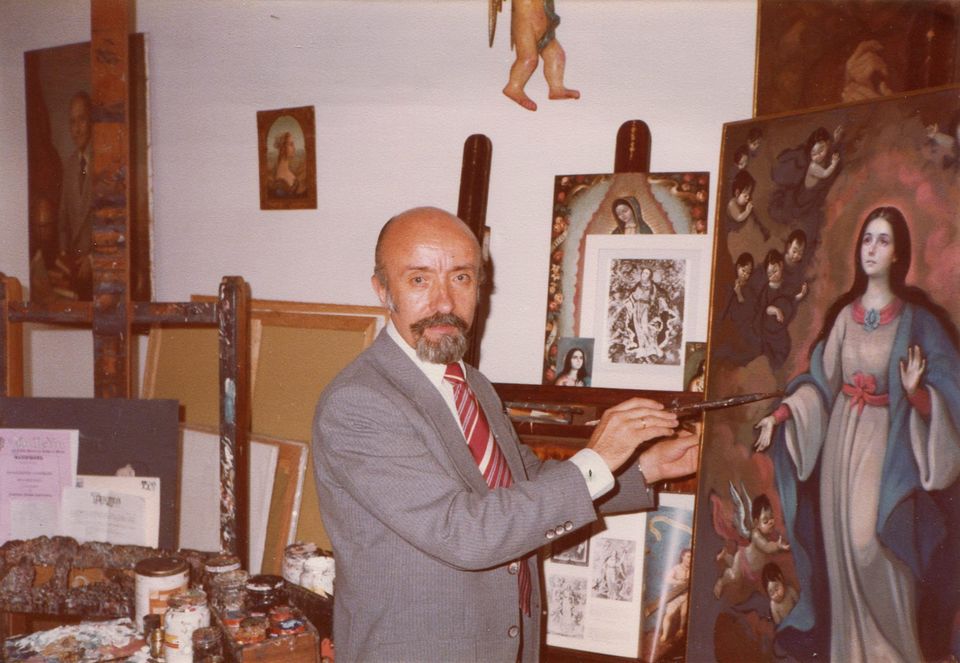
Editor’s Note: Remember my post from exactly a month ago: This very Catholic painter asked me at a family dinner: “¿Por qué los animales todavía existen?” (‘Why do animals still exist?’).
 

______ 卐 ______

 
It is, I think, precisely to this intrinsic anthropocentrism that Christianity owes the short duration of its positive role in the West insofar as, despite all the horror attached to the history of its expansion, a certain positive role can be attributed to it. Once weakened and death, the influence of its true spiritual elite—that which, until perhaps the 14th or 15th century, was still attached to Tradition—nothing was easier for the European than to move from Christian anthropocentrism to that of the rationalists, theists or atheists; to replace the concern for the individual salvation of human ‘souls’, all considered infinitely precious, by that of the ‘happiness of all men’ at the expense of other beings and the beauty of the earth, due to the proliferation of the techniques of hygiene, comfort and enjoyment within the reach of the masses.

Nothing was easier for him than to continue to profess his anthropocentrism by merely giving it a different justification, namely, by moving from the notion of ‘man’, a privileged creature because he was ‘created in the image of God’—and, what is more, of an eminently personal ‘god’—to that of ‘man’: the measure of all things and the centre of the world because he’s ‘rational’, that is to say, capable of conceiving general ideas and using them in reasoning; capable of discursive intelligence hence of ‘science’ in the current sense of the word.

The concept of ‘man’ indeed underwent some deterioration in the process. As Antoine de Saint-Exupéry has shown, the human individual, deprived of the character of ‘creature in the image of God’ that Christianity conferred on him, finally becomes a number within a pure quantity and a number that has less and less importance in itself. Understandably, everyone is sacrificed ‘to the majority’. But we no longer understand why ‘the majority’, or even a collectivity of ‘a few’, would sacrifice themselves or even bother for another one.

Saint-Exupéry sees the survival of a Christian mentality in the fact that in Europe, even today, hundreds of miners will risk their lives to try to pull one of them out of the hole where he lies trapped under the debris of an explosion. He predicts that we are gradually moving towards a world where this attitude, which still seems so natural to all of us, will no longer be conceivable.

Perhaps it is no longer conceivable in communist China. And it should be noted that, even in the West where it is still conceivable, the majorities are less and less inclined to impose simple inconveniences on themselves to spare one or two individuals, not of course of death but discomfort and even real physical suffering. The man who is most irritated by certain music, and who isn’t sufficiently spiritually developed to isolate himself from it by his asceticism, is forced to endure, in the buses, and sometimes even in the trains or planes, the common radio or the transistor of another traveller if the majority of passengers tolerate it or even more so enjoy it. They are not asked for their opinion.

One can, if one wishes, with Saint-Exupéry, prefer Christian anthropocentrism to that of the atheistic rationalists, fervent of experimental sciences, technical progress and the civilisation of well-being.

______ 卐 ______

 
Editor’s Note: This is true, and the best way to show it is to compare the most famous television series introducing the West: Kenneth Clark’s Civilisation (1969), Jacob Bronowski’s The Ascent of Man (1973) and Carl Sagan’s Cosmos (1980). Obviously, the series by Christian Clark has its problems, but at least he transmits the spirit of the Aryan through art. Bronowski and Sagan on the other hand present civilisation from the point of view of science and technology: something that betrays the essence of the Aryan and his notion of the numinous.
 

______ 卐 ______

 
It is a matter of taste. But I find it impossible not to be struck by the internal logic that leads, without a solution of continuity, from the first to the second and from the latter to Marxist anthropocentrism for which man—himself a pure ‘product of his economic environment’—taken en masse is everything; taken individually, worth only what his function in the increasingly complicated machinery of production, distribution and use of material goods for the benefit of the greatest number. It seems to me impossible not to be struck by the character quite other than revolutionary and of Jacobinism at the end of the 18th century; and Marxism (and Leninism), both in the 19th and in the 20th.

____________

[1] Offered to the faithful through the symbolism of sacred stories and liturgy.

Categories
Neanderthalism Souvenirs et réflexions d'une aryenne (book) Technology

Reflections of an Aryan woman, 39

But this slowly decadent Hellenic world, which, after having been subjected to Christianity was only to be reborn to detach itself more and more from ‘Europe’ without being able or willing, even today, to integrate with it, is characterised by the boom in experimental sciences and their applications.

The thirst to study the phenomena of Nature and to discover its laws (that satisfy reason and is becoming more widespread as the traditional science of the priests of Greece and Egypt, fruit from a direct intellectual intuition of the very principle of these laws) becomes rarer there. And above all, there was a growing determination, as there was later during the Renaissance and even more so in the 19th and 20th centuries, to use these physical laws to construct devices of practical use—such as the endless screw, the inclined screw and forty other machines whose invention is attributed to Archimedes such as the ‘burning mirrors’, enormous magnifying glasses using which this same man of genius set fire to the Roman ships that blocked Syracuse, or the ‘compression fountains’, or robots, of Heron.

Anatomy, physiology and the medical art which is based on both are, and this too is to be noted, in the spotlight. If it is true that in the 17th century Aselli and Harvey were already foreshadowing Claude Bernard, it is no less true that at the end of the 4th century B.C., two thousand years earlier, Erasistratos and Herophilus were foreshadowing not only Aselli and Harvey but also the famous physiologists, physicians and surgeons of the 19th and 20th century.

Of course, there is a long way to go from Herophilus’ automata to modern computers, just as there is a long way to go from Herophilus’ dissections and, four hundred years later, Galen’s dissections, however horrific they may have been, to the atrocities of organ or head transplanters, or even to those of cancer specialists, carried out today in the name of scientific curiosity and ‘in the interest of mankind’.

There is a long way to go in terms of results, from the embryonic technique of the Hellenistic world, and later the Roman world, to that which we see developing in all areas around us, and even to that of the 16th century. But it is no less true that in these two periods when a form of traditional religion relaxed before being definitively cut off from its esoteric base, there was a resurgence of interest in the experimental sciences and their applications, a reawakening of man’s desire to dominate the forces of Nature and living beings of other species than his own, with a view to the profit or convenience of as many people as possible.

This is not yet the excessive mechanisation and mass production that the 19th century would inaugurate in Europe and that the 20th intensified with all the consequences that we know. But it was already the spirit of the scientists whose work had, in one way or another, prepared this evolution: the spirit of experimental research to apply the information gained to the material comfort of man, to the simplification of his work and the prolongation of his physical life, that is to say, to the fight against natural selection.

The machine enables the individual or the group to succeed without innate strength or special ability, and the drug or the surgical operation prevents even the most useless and uninteresting patient from leaving the planet and giving up his place to the healthy man, more valuable than he.

It is difficult not to be impressed by the ever-increasing importance, both in the last centuries of the ancient world, in the early modern period, and in our own time, of experimentation on living beings to gain more complete information about the structure and functions of bodies and apply it to the art of healing—or trying to heal at any cost. These are times when, as today, the physician, the surgeon and the biologist are honoured as great men and when vivisection—older, of course, since as early as the sixth century B.C. Alcmaeon is said to have dissected animals, but increasingly encouraged thanks to unrestricted anthropocentrism—is regarded as a legitimate method of scientific research.

There are, therefore, precedents. And we would no doubt find others, corresponding to other collective declines, if the history of the world were better and more uniformly known. But it seems that the further back in time we go, the less certain traits that bring the most sophisticated ancient civilisations closer to today’s mechanised world are evident. I am thinking, for example, of those very old metropolises of the so-called Indus Valley civilisation, Harappa and Mohenjodaro, where archaeologists have attested to the existence of seven- or eight-storey buildings, and pointed to the enormous mass production of earthenware vessels and other objects, all of them perfectly made but all hopelessly similar. How can we not be struck by this uniformity in quantity and imagine, in the workshops from which these mass-produced objects emerged, on the assembly line, a robotization of the worker that already, five or six thousand years later, prefigured that of the ‘human material’ of our factories?

And how can we fail to see in the successive Aryan invasions which, from the 4th millennium before the Christian era if not earlier, that came up against this ultra-organised world—mechanised, as far as it was possible at the time—and destroyed it (while assimilating, certainly, the best that its elite could offer). How can we fail to see in them the blessed instruments of a recovery?

How can we fail to see in their work the installation of the Vedic civilisation in India: a halt, at least momentarily, in the downward march of the Vedic civilisation?: a halt in the downward march that the course of our Cycle represents, especially in the Dark Age, then close to its beginning: an attempt to fight ‘against Time’ undertaken by the Aryas under the impulse of the Forces of Life as were to be undertaken, centuries later, still driven by these same Forces by invaders of the same race, the Hellenes and Latins at the decline of the Aegean and Italic cultures, technically too advanced; the Romans, at the decline of the Hellenistic world, the Germans, at the decline of the Roman world?

But the hold of mechanisation on the civilisation of Harappa and Mohenjo-Daro—modest mechanisation, moreover, since it was still only a matter of mass production of crafts—was to be less fatal than that which the Mediterranean and then the Western world underwent, respectively in the time of Archimedes, then Heron and the ergastulas of Carthage, Alexandria, then Rome, and in the 18th century and especially the 19th and nowadays. The world of the Indus Valley still had, even in its decline, something else to give to its successors than recipes for production. It is said that they learned at least some forms of Yoga. In the same way, the Hellenistic and later the Greco-Roman world even in its most advanced decadence retained, if only in the Neo-Pythagoreans and Neo-Platonists, something of the essence of ancient esotericism. This was, along with what was eternal in the teaching of Aristotle, assimilated into esoteric Christianity, survived in Byzantium and gave rise there, as well as in the West throughout the Middle Ages, to the flowering of beauty that we know: beauty is the visible radiation of Truth.

But of the treasures of the Middle Ages—of all that it had preserved of the eternal Indo-European Tradition, despite its rejection of the forms that this had taken in Germania and in the whole of the north of the continent, as in Gaul before the appearance of Christianity—the narrowly ‘scientific’ spirit of the Renaissance, and above all of the centuries that followed, wanted, or was able, to retain nothing. If we are to believe René Guénon and a few other well-informed authors, these treasures would have been put beyond the reach of the West as early as the 14th century, or at the very least the 15th, as soon as the last direct heirs of the secret teachings of the Order of the Temple disappeared.

The interest of so many 19th-century writers in the Middle Ages remains, like the 16th-century infatuation with classical antiquity and Greco-Roman mythology, attached to the most picturesque and superficial aspects of that past. The proof is that, for them, it goes hand in hand with the most naive belief in ‘progress’ and the excellence of generalised literacy as the surest way to hasten it (we may recall the pages of Victor Hugo on this subject). The link with immemorial Indo-European wisdom, and even with the little that Christianity has managed to assimilate from it after having destroyed—by snatch or by violence, from the Mediterranean to the North Sea and the Baltic—all the exoteric expressions, is indeed cut.

And it is in the place of this ancient wisdom that the West is seeing a true religion of the laboratory and the factory take shape and spread and flourish: a stubborn faith in the indefinite progress of man’s power, and I repeat, of any ‘man’, ensured by the ‘enslavement’ of the forces of Nature, that is to say, their use in parallel with the indefinitely increased knowledge of its secrets. It is in its place that he sees it imposing itself, and no longer alongside it, as in India or Japan and wherever peoples of ‘traditional’ civilisation have, reluctantly, and while clinging to their souls, accepted modern techniques.

This leads to the ‘conquest of the atom’ and the ‘conquest of space’ (so far, of the tiny space between our Earth and the Moon; less than half a million of our poor kilometres). But we are not discouraged. Soon, say our scientists, it will be the entire solar system that will fall within the ‘domain of man’. The solar system and then, for why stop?, ever-larger portions of the physical Beyond ‘without bottom or edge’. This also leads—at the cost of what horrors of experimentation on a world scale!—to the Luciferian dream of the indefinite prolongation of corporeal life with, already, the terrible practical consequence of the efforts made so far to reach it: the unrestrained pullulation of man, and more particularly of the lower man at the expense of the noblest flora and fauna of the earth and of the human racial elite itself.

Categories
Souvenirs et réflexions d'une aryenne (book)

Reflections of an Aryan woman, 38

Unlike the Indies and Japan, Europe has unfortunately not been able to preserve a visible form of Tradition that is uninterrupted and whose origin is lost in the mists of time. In other words, even from the dawn of its history, not to mention its pre-history, it has nowhere continued to worship the same gods.

On the other hand, it is her sons, and even only those of a very limited West, who, after having cultivated the experimental sciences, invented one after the other all the modern industrial techniques, as well as the medical art and the ‘preventive’ hygienic measures of today and yesterday, which have so lamentably contributed to the overpopulation of the continent, and soon of the planet, and to the sacrifice of the quality of men to their number. And increasingly, in this West in the narrow sense of the word, people’s attachment to the pomp, customs and teachings of exoteric Christianity has relaxed in favour of an ever greater infatuation with ‘Science’ and especially for the applications of science as a source of wealth, easy enjoyment and power, both individual and collective.

This is especially true of the 19th century, if we look at the material achievements, the staggering progress of the sciences of the measurable world and the industries that depend on them, and the naive confidence, increasingly widespread in all domains (including the ‘moral’ domain) parallel to the progress of the sciences and the generalisation of their applications. But don’t be fooled!

The cult of positive science based on the experimental study of phenomena, and the dream of enslaving Nature to man through the application of scientific discoveries in the search of human well-being, have much more distant origins. To understand them, we must go back to the 17th century, Cartesian rationalism and the anthropocentrism that is inseparable from it. We must go back even further, to that fever of universal curiosity combined with the Promethean will of ‘man’ to dominate, the characteristic features of the Renaissance.

The physiologist Aselli, who studied the process of digestion in the open entrails of living dogs, is the counterpart of Claude Bernard, two centuries later. And Descartes himself, with his frenzied anthropocentrism—his famous theory of ‘machine animals’—as well as his eagerness to examine everything, to dissect everything, to want to know everything by the sole means of ‘reason’, and Francis Bacon, for whom science is above all the means that ensures the ‘triumph of man’ over Nature and so many others who, between the 1500s and 1750s, thought and felt the same, are also the fathers, or elder brothers, of all the more recent enthusiasts for science, technology, and the salvation of man by both—the Victor Hugos and the Auguste Comtes, no less than the Louis Pasteurs, the Jenners, the Kochs, and, closer to home, the Pavlovs, the Demikhovs[1], and the Barnards.

Certainly, the European Middle Ages had, alongside its undeniable greatness, weaknesses and barbarities which classify it without question among the epochs of the advanced Dark Ages. It had, among other things, all the shortcomings linked to his narrowly Christian faith, and therefore rigorously anthropocentric, faith: a faith whose esoteric aspect didn’t even embrace anything beyond ‘Being’ (in contrast to Hindu esotericism, for which Non-Being is also a manifestation of the fundamental ‘Non-Duality’). It deserves the sometimes virulent attacks of thinkers and artists who were most hostile to it but… provided that it is made clear that the centuries that followed it, far from being better than it from viewpoint of the essentials, were worse; worse, because they got rid (and how slowly!) of some of its superstitions and atrocities, only to replace them by superstitions of another order but just as crude, and by atrocities just as revolting, and this, without retaining anything of what had made its greatness.

It deserves the attacks of its detractors provided that they are fair, and recognise that within the Dark Ages, which covers almost everything we know about world history it represents, despite everything, a cultural and above all a spiritual ‘recovery’: a period when, with all the narrow-mindedness, all the religious intolerance inherited from the authors of the Old Testament, and all the anthropocentrism inherent in Christianity as it has come down to us, Western Europe (and Eastern Europe, for all this is also true of Byzantium) was then closer to the traditional ideal order than it was at the time of the decadence of Greco-Roman Paganism, and above all than it has been since the 16th century.

There is no doubt that Christian esotericism—which the initiates of a spiritual elite still lived, whose existence until the 14th century at least, and perhaps even afterwards, for some decades more—ensured this connection of the whole social edifice—the feudal pyramid where, in principle, everyone was in his place—with its secret archetype.

The light of a more-than-human knowledge penetrated from above, through symbols, into the life of the people, and in particular into that of the craftsmen-masons, woodcarvers, glassmakers, blacksmiths, weavers, goldsmiths. It was expressed in the world of forms and colours through the wealth of anonymous and disinterested creation that we know, from the Romanesque or Gothic or Byzantine cathedrals to the delicate illuminations of gold, azure and vermilion; creation, I repeat, anonymous and disinterested: of a beauty whose secret was to be sought in truths independent of time. The practical utility of the works of art it inspired was nevertheless less important than their ‘meaning’, revealing a world held to be more real than the visible.

It is curious, to say the least, to note that it is precisely when initiatory knowledge, and thus knowledge of the Eternal, becomes obscured in the elite that had previously held it, and when, as a result, the spiritual ‘meaning’ of every work of beauty increasingly escapes the artist and the craftsman, that the thirst for investigation of the future using systematic experimentation begins to spread. It is from this moment onwards that the demand for visible and tangible proof of all knowledge, the refusal to believe in the existence of the overman (or at least to be interested in it) and the growing preoccupation with the development of the world’s material wealth for the benefit of the greatest possible number of people converge—in other words, experimental science and the technology, both industrial and medical that derive from it, are increasingly being imposed.

And it is interesting to note that this is not a unique state of affairs, appearing only with the decline of Christianity at the dawn of the Modern Age. The same moral and cultural phenomenon, the same transfer of values manifested itself, along with the weakening of the traditional faith, during the long and slow agony of the Ancient Greek World, from the end of the fourth century BC, until the end of the next century. It was then, already in the field of letters and even more so than at the time of the Renaissance, that began the reign of quantity at the expense of quality.

There was a proliferation of polygraphs, rather like in our own time, and an almost complete absence of major works, apart from Aristotle’s (admittedly gigantic) work, which was still in its infancy when the period was just beginning. It was a time of grammarians, not poets; of scholars of the word, not creators through the word; of people who knew well and were able to analyse in detail, the work of their predecessors, not of literati whose own work, like that of the tragic authors of the classical Greek period, was to dominate the centuries to come. The geniuses of the verb and pure thought—the Virgils, the Lucretia—appear, in the famous century of Augustus, no longer in Greece or Hellenised Sicily, or Alexandria, but in Italy proper, already in the sphere of that West from which will eventually emerge, still under the influence of the peoples of the North, a young Europe, the only true one.
 

______ 卐 ______

 
Once we finish translating Savitri’s book from French to English we’ll resume the translation of Karlheinz Deschner’s book about the Middle Ages. We discover a very different medieval history once, instead of reading Christian authors, we read those who have actually left Christianity behind, as Savitri did.

I will devote tomorrow to producing a PDF of a German translation by our friend Albus. I refer to Ferdinand Bardamu’s essay on why Europeans must abandon Christianity, a long essay that appears in The Fair Race (see sidebar). This essay mentions the Middle Ages but Kevin MacDonald refused to publish it in his webzine when Bardamu submitted it to The Occidental Observer.
______________

[1] The Russian physiologist who, in the 1950s and 60s, was involved in grafting dog heads onto other living dogs.