by Joseph Goebbels on Adolf Hitler
and the Christian Question
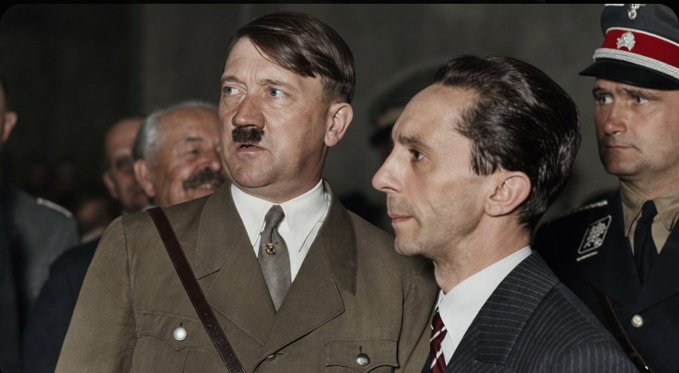
[Conversation] with the Führer
He also admires the courage of the Greeks in particular. Perhaps there is still a touch of the old Hellenic strain in them. The Serbs are fighting desperately. But once the first resistance has been broken, then the great retreat will begin. More detailed information on the progress of the operations is not yet available. Things must be given time to develop. Piraeus has been mined. The Führer forbids the bombing of Athens. This is right and noble of him. Rome and Athens are his Meccas [emphasis by Ed.]. He greatly regrets having to fight the Greeks. If the English had not established themselves there, he never would have gone to the Italians’ aid. It was their affair, and they should have been able to settle it alone.
The Führer is man totally attuned to antiquity. He hates Christianity, because it has crippled all that is noble in humanity. According to Schopenhauer, Christianity and syphilis have made humanity unhappy and unfree. What a difference between the benevolent, smiling Zeus and the pain-wracked, crucified Christ. The ancient peoples’ view of God was also more noble and more humane than the Christians’. What a difference between a gloomy cathedral and a light, airy ancient temple. He describes life in ancient Rome: clarity, greatness, monumentality. The most wonderful republic in history. We would feel no disappointment, he believes, if we were now suddenly to be transported to this old, eternal city.
The Führer cannot relate to the Gothic mind. He hates gloom and brooding mysticism. He wants clarity, light, beauty. And these are the ideals of life in our time. In this respect, the Führer is a totally modern man.
To him, the Augustinian period [Augustan Age of ancient Rome (27 b.c.e. to 14 c.e.) —Ed.] is the high point of history.[1]
Thank you, Martin Kerr, for bringing the above quote to my attention. I would like to add this one I saw yesterday on Twitter:
Hitler expressed agreement with Nietzsche’s rejection of Christianity. In January 1941, Goebbels recorded in his diary that Hitler was riled up against scholars, including philosophers, but he made an exception for Nietzsche, who, he asserted: “Only Nietzsche is an exception here. He proved in detail the absurdity of Christianity. In two hundred years it will only remain a grotesque memory. We must gradually undermine it in all areas. Above all, among the younger generation.”
Thus, Hitler approved of Nietzsche’s anti-Christian stance and predicted the ultimate demise of Christianity.[2]
___________
[1] Source: The Goebbels Diaires: 1939-1941. Translated and edited by Fred Taylor, Penguin Books, NY, 1982. Entry for April 8, 1941, pp. 304-305.
[2] Barch N 1118/13 Die Tagebücher von Joseph Goebbels, Eintrag vom 30. Januar 1941, p.64.
7 replies on “Commentary”
I was dwelling on Hitler’s words here: “We must gradually undermine it in all areas. Above all, among the younger generation.”
I completely agree (as even Lenin remarked on) that it is the youth – once suitably enthused and educated – that must be at the forefront of any change in society. It is a shame for us that no only do we still have that dying Christianity to content with among Aryans, but we also have the vast hordes of normies/neo-Christians, surely a consequence itself of the inability to defeat Christianity earlier (as much as a civilisation-wide product of the loss of the second world war to Savitri’s ‘death forces’) which, as we have agreed here, would have been more prudent for Hitler to have focused on and achieved. From what I gather he opposed it. He just did not oppose it quite enough; with enough prominence. Perhaps his shift was too gradual; too accommodating. For example, I have read about the gottgläubig principle (which in a principle I agree with), but I cannot imagine Hitler with his Sun personality, would have been able to bring himself to crucify unrepentant Christians, as we have remarked on ourselves on this site. I think our coming youth will have to be encouraged to be far fiercer than those of his generation; far more ruthless.
I see things differently.
Hitler did exactly the right thing regarding the CQ. As seen in his dinner table conversation, he wouldn’t wage open war against Christianity because that would be political suicide; instead, he pursued a gradual education process. Although several anti-Nazi preachers ended up in Dachau, that was very wise.
What wasn’t wise was believing that the JQ was the main problem! In that, the entire German National Socialist movement—like today’s white nationalists—failed miserably. My two previous posts, one a magnificent quote from William Gayley Simpson, argue that the main problem was (and still is) the CQ, although now in the form of atheistic hyper-Christianity.
Just for the record, “The Gottgläubig (literally believing in God) principle was a religious designation used in National Socialist Germany to describe citizens who left Christian churches but maintained a belief in a higher power or divine creator. It was a state-sponsored form of deism designed to replace traditional religious affiliations with a worldview rooted in Nazi ideology.”
Here we see also that the Nazis weren’t totally exempt from Jewish infection, since Gottgläubig implies monotheism: something foreign to the Aryan (before the Xtians took over the Roman Empire). A genuine transvaluation involves rejecting Jewish monotheism, which is why I, with poetic license, speak of “the Gods” and never of “God”.
Oh fair play. I didn’t know that. I interpreted Gottgläubig as allowing for pantheism/panentheism (and, as such, accommodating of Pagan monotheism/henotheism). I don’t necessarily speak with poetic license though – I’m agnostic over non-Christian God ideas.
I take it the problem then was not that he did not pursue the right course of action with regard to Christianity, but that he didn’t win the war, so was unable to continue the process to satisfaction (thus averting neochristianity – which seems to have a lot in common today with that was considered then as ‘Marxism’; also an atheistic development of Christianity).
But therein lies the problem.
Hitler didn’t win the war because he was unaware that the CQ, as William Gayley Simpson stated in the post preceding this one, is the primary cause of the Aryan decline.
Had he known this, he would have said in a soliloquy: “Oh Gods, we have a monumental problem before us: to eradicate every vestige of Judeo-Xtian infection from the German collective unconscious (and eventually, from the Nordic countries)! What shall I do? I will have to re-educate my people. It could take us a century to eradicate every trace… I cannot be distracted by more wars when I have a huge problem at home…!”
Hitler could have thought this after defeating England and France on the continent, in addition to occupying Czechoslovakia. He could have negotiated the Polish corridor without crossing the red line drawn by the British. The non-aggression pact with the USSR could have continued until Hitler had the bomb before Stalin did.
But the most important thing is, as I said last year on this site, on September 17, 1941 the Einsatzgruppe, already overwhelmed by the intensity of its genocidal task in the East, suggested that the extermination of the Jews would not solve all the problems:
Of course! Those doing the dirty work knew the infection went far beyond the Jewish problem. Notice that I’m criticising the project to holocaust Jews not out of love for them, but out of love for the Germans, who put the cart before the horse—and that’s why everything went wrong for them!
The correct thing would have been: “We have to put our own house in order (a century of Judeo-Christian deprogramming) and then we’ll see what to do.” It wasn’t possible any other way because the Americans were going to get the bomb before the Germans. The mistake of Hitler and his movement in general was not realising what an autobiographer, William Gayley Simpson, realised.
Do you see now why in-depth autobiography is so important for our cause? Potentially, it could remove the last vestiges of Semitic malware, at least among autobiographers…
________
[1] RSHA IV-A-1, Report on Operations in the USSR, No. 86, NO-3151.
From everything I’ve read, Hitler placed very little importance on the development of an atomic weapon. I think someone in his inner circle even asked him about the possibility of using a doomsday type weapon and he was quite dismissive of it.
I did a little more research on this. Apparently, Otto Skorzeny claimed in a book he wrote that he had a conversation with Hitler in 1944 regarding the possible use of a nuclear weapon. Skorzeny stated that Hitler said he was against the use of nuclear weapons as they would lead to the end of humanity or something to that effect. Of course, like a a lot of quotes attributed to Hitler, it can’t be proven that ge ever said such a thing.