While Hitler tried to reduce his exposure to petty party disputes in prison, it is striking that he tried to maintain engagement with the wider world, especially potential ideological sympathizers and funders in Italy and the United States. Despite the fact that he allowed Göring to find sanctuary in Italy after the Putsch, Mussolini was careful to keep the Nazis at arm’s length.
That left America. In early January 1924, not long after the start of his incarceration at Landsberg, Hitler penned a letter of accreditation for his envoy Kurt Lüdecke. He asked Lüdecke ‘to promote the interests of the German freedom movement in the United States and especially to collect money for them’.
At the end of January, Lüdecke set off with Winifred and Siegfried Wagner to Detroit. Despite Lüdecke’s invocation of the ‘solidarity of white men’, and his offer to promote the kind of international anti-Semitism demanded by the Dearborn Independent, he was unable to persuade Ford at their meetings to provide any funding for the movement. Lüdecke repeatedly visited Hitler in Landsberg in May and June 1924. In 1924, a National Socialist Ortsgruppe was founded in the German quarter of Chicago, and there also appears to have been some sort of presence in New York City; a year later, Hitler personally thanked one of his activists in America for sending back money for the movement. In general, however, the attempt to reach out to the United States was a failure.
Hitler was under no illusions about the timescale for the national and racial regeneration of Germany. The failure of the coup had cured him of any vanguardism. He was now thinking in terms not of years, or even decades, but of centuries. In late June 1924, he made a public announcement that ‘the re-establishment of the German people is by no means a matter of the acquisition of technical weapons, but rather a question of the regeneration of our character’.
‘Spiritual renewals,’ Hitler continued, ‘require, if they are to be more than just a passing phenomenon, many centuries [emphasis in the original]’ to be ‘successful’. Five months later, Hess recorded that Hitler ‘is under no illusions about the extent to which the “idea” can be implemented by him’. ‘The ripening of ideas, the adapting of reality to the idea and the idea to reality,’ he continued, ‘will probably require many generations.’
Hitler, Hess went on, saw his own role as merely ‘setting up a new marker in the distance’, ‘loosening the soil’ around the existing pole, which ‘represented a major era in the development of mankind’. The task of ‘ripping out’ the pole and advancing it some way towards the goal, by contrast, would be the task ‘of another, a greater man yet to come’. In other words, after the certainty of 1923, Hitler was once again unsure whether he was the messiah himself rather than just John the Baptist, the ‘drummer’ of 19 19-20.
______ 卐 ______
Editor’s 2 ¢
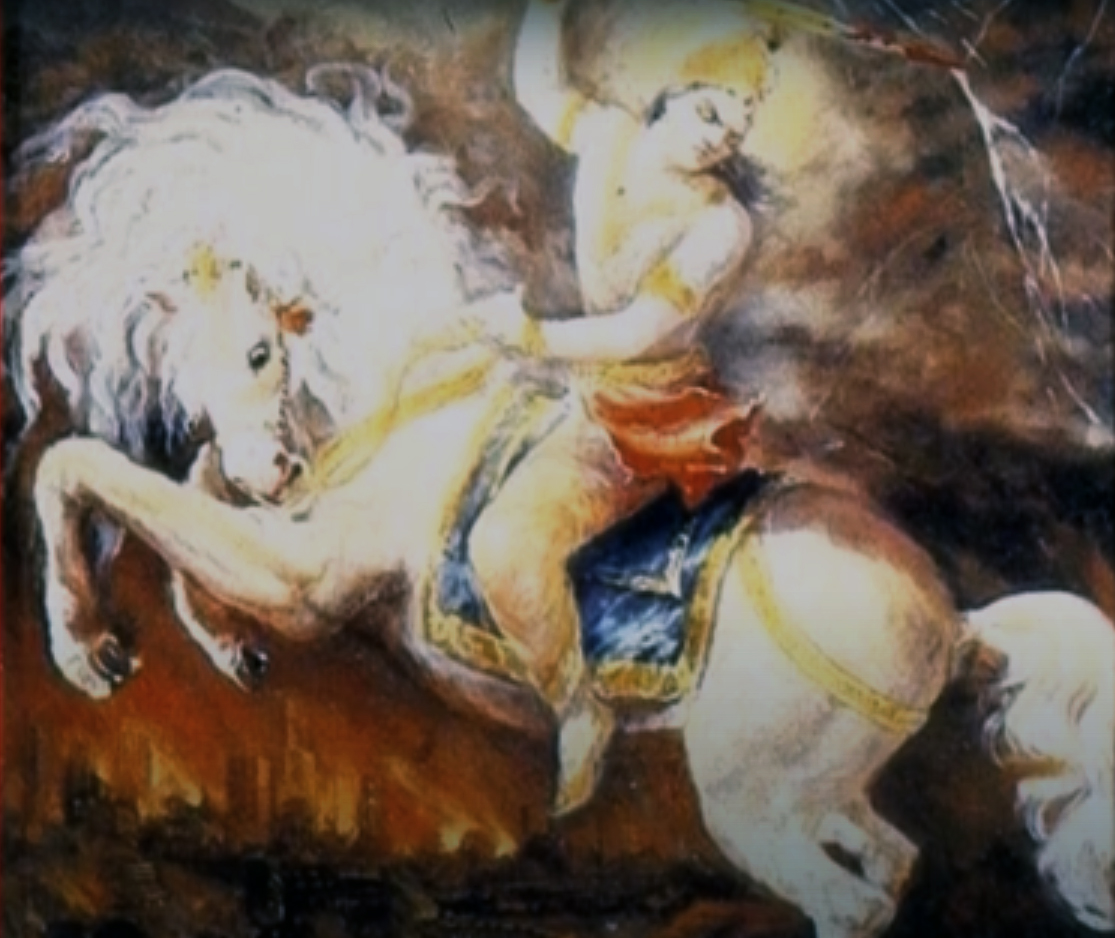
This is most interesting. Post-1945 European National Socialism is best represented by the philosophy of Savitri Devi, who by the end of her books used to invoke the Hindu archetype of Kalki in the sense—translated into Christian metaphors—that Hitler had been a sort of John the Baptist and that the Aryan leader who would really vindicate his people in the darkest hour would use many more ‘lightnings’ than Uncle Adolf had used; that is, he would be an exterminationist (something we could visualise with William Pierce’s novel The Turner Diaries).
3 replies on “Hitler, 49”
Hitler and the NSDAP’s devotion to race was purely physical which was a reversed reflection of the Judeo-Christian spirit of mind-body duality. The old aristocratic Nordic spirit of mind-body unity was rarely found among them. Only Frick and Darre came close to such spirit.
I disagree. Have you read Savitri’s books?
I’m glad to read Hitler and Hess realised they were on a long mission to reform Germany, that was beyond there own lifetimes. That makes the disaster of WW2 even harder to understand how it came about, and was actively expanded by Hitler and his Generals, when there were much higher stakes than a territorial war.
Hess is perhaps the pure soul of NSDAP Germany, while Hitler was the earthly power.