Editor’s Note: The photo I posted yesterday from a film about Alexander (wrongly called “the Great” by normie historians) marrying a mudblood can also be applied to Caesar.
Whoever controls the past controls the future, and if we don’t invert the values of the official narrative about Alexander and Caesar, it won’t be easy to fulfil the 14 words in a West resurrected from its historical catatonia.
Let’s see what William Pierce said about Caesar:
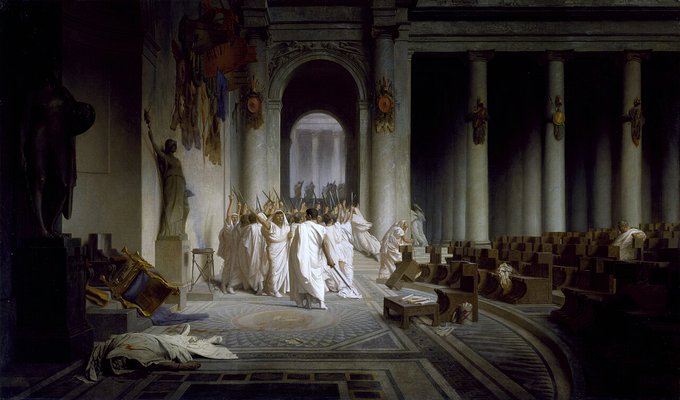
Celtic bands continued to whip Roman armies, even to the end of the second century B.C., but then Roman military organization and discipline turned the tide. The first century B.C. was a time of unmitigated disaster for the Celts. Caesar’s conquest of Gaul was savage and bloody, with whole tribes, including women and children, being slaughtered by the Romans.
By the autumn of 54 B.C, Caesar had subdued Gaul, having destroyed 800 towns and villages and killed or enslaved more than three million Celts. And behind his armies came a horde of Roman-Jewish merchants and speculators, to batten on what was left of Gallic trade, industry, and agriculture like a swarm of locusts. Hundreds of thousands of blond, blue-eyed Celtic girls were marched south in chains, to be pawed over by greasy, Semitic flesh-merchants in Rome’s slave markets [emphasis by Editor!] before being shipped out to fill the bordellos of the Levant.
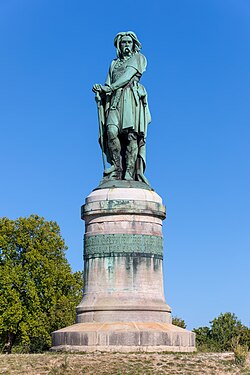
Vercingétorix Memorial in Alesia, near the village of Alise-Sainte-Reine, France.
Vercingetorix
Then began one, last, heroic effort by the Celts of Gaul to throw off the yoke of Rome, thereby regaining their honour and their freedom, and—whether consciously or not—re-establishing the superiority of Nordic mankind over the mongrel races of the south. The ancestors of the Romans had themselves established this superiority in centuries past, but by Caesar’s time Rome had sunk irretrievably into the quagmire of miscegenation and had become the enemy of the race which founded it.
The rebellion began with an attack by Ambiorix, king of the Celtic tribe of the Eburones, on a Roman fortress on the middle Moselle. It spread rapidly throughout most of northern and central Gaul. The Celts used guerrilla tactics against the Romans, ruthlessly burning their own villages and fields to deny the enemy food and then ambushing his vulnerable supply columns.
For two bloody years the uprising went on. Caesar surpassed his former cruelty and savagery in trying to put it down. When Celtic prisoners were taken, the Romans tortured them hideously before killing them. When the rebel town of Avaricum fell to Caesar’s legions, he ordered the massacre of its 40,000 inhabitants.
Meanwhile, a new leader of the Gallic Celts had come to the fore. He was Vercingetorix, king of the Arverni, the tribe which gave its name to France’s Auvergne region. His own name meant, in the Celtic tongue, “warrior king,” and he was well named.
Vercingetorix came closer than anyone else had to uniting the Celts. He was a charismatic leader, and his successes against the Romans, particularly at Gergovia, the principal town of the Arverni, roused the hopes of other Celtic peoples. Tribe after tribe joined his rebel confederation, and for a while it seemed as if Caesar might be driven from Gaul.
But unity was still too new an experience for the Celts, nor could all their valor make up for their lack of the long experience of iron discipline which the Roman legionaries enjoyed. Too impetuous, too individualistic, too prone to rush headlong in pursuit of a temporary advantage instead of subjecting themselves always to the cooler-headed direction of their leaders, the Celts soon dissipated their chances of liberating Gaul.
Finally, in the summer of 52 B.C., Caesar’s legions penned up Vercingetorix and 80,000 of his followers in the walled town of, Alesia, on the upper Teaches of the Seine. Although an army of a quarter-million Celts, from 41 tribes, eventually came to relieve besieged Alesia, Caesar had had time to construct massive defenses for his army. While the encircled Alesians starved, the Celts outside the Roman lines wasted their strength in futile assaults on Caesar’s fortifications.
Savage End
In a valiant, self-sacrificing effort to save his people from being annihilated, Vercingetorix rode out of Alesia, on a late September day, and surrendered himself to Caesar. Caesar sent the Celtic king to Rome in chains, kept him in a dungeon for six years, and then, during the former’s triumphal procession of 46 B.C., had him publicly strangled and beheaded in the Forum, to the wild cheers of the city’s degraded, mongrel populace.
After the disaster at Alesia, the confederation Vercingetorix had put together crumbled, and Caesar had little trouble in extinguishing the last Celtic resistance in Gaul. He used his tried-and-true methods, which included chopping the hands off all the Celtic prisoners he took after one town, Uxellodunum, commanded by a loyal adjutant of Vercingetorix, surrendered to him.
Decadent Rome did not long enjoy dominion of the Celtic lands, however, because another Indo-European people, the Germans, soon replaced the Latins as the masters of Europe.
5 replies on “Caesar”
Just as Hitler only confided his most intimate thoughts on understanding National Socialism to his closest circle of friends, but spoke to the masses of Germans in terms these neo-normies could understand, Pierce addressed the neo-normies on his weekly radio program, but in his books he got to the heart of the matter.
Because Pierce’s story on the white race wasn’t published (to become not only a bestseller but also the cornerstone for understanding the West), it resulted in the American neo-normies not advancing more than two baby steps in their attempt to cross the psychological Rubicon (1st baby step: Jared Taylor’s race realism; 2nd baby step: Kevin MacDonald’s work on the JQ).
What I notice in some X accounts and other racialist forums is that they are unaware of some tragic events in history: extremely calamitous events for the 14 words that Alexander and Caesar exemplify!
I never read much of Pierce, his style drove me away.
He was a bit pompous and dry, like an American evangelist, and used for some jokes as the oracle of WN.
Maybe he could be classed as a ‘man beyond time’ to use a Savitri Devi classification.
Didn’t you even read The Turner Diaries (or the WWA quotes I posted on this blog)?
Yes I own a copy of Turner Diaries and it’s worth reading. But I never jelled with Pierces serious work, he’s too black pilled, and also high-falutin as the Americans would say.
Uh! His essay “Seeing the Forest” is the most lucid essay I’ve ever read on the JQ (and I’m at least as pretentious as he was).
But even without being pretentious, no one but him opened my eyes to the historical Alexander or the historical Caesar from the perspective of sacred words. And why the Greco-Roman world fell—because of miscegenation (and the same could be said of the history of Spain and Portugal in Who We Are).
I truly believe he was the most intelligent American the US has ever produced, by far.