web analytics
Categories
Psychohistory Racial right Tom Sunic

Fertile ground

by Tomislav Sunic

Contrary to widespread belief [in the American racial right], political sycophancy toward Israel—including its fellow travelers among millions of fervent Christians awaiting the coming Apparition of Jesus—is not the result of a violent ideology imposed by a handful of Jewish conspirators.

Rather, long-standing, Bible-inspired guilt feelings had already created fertile ground for the erosion of freedom of thought. Coupled with the illusion of endless capitalist growth, alongside Christian “love thy non-White neighbor” ecumenism, a belief has taken hold that everything will somehow sort itself out.

It won’t. At its core, the spirit of Christian-inspired self-denial amounts to a loss of Spirit itself.

____________

The above is just an excerpt from a recent article:
“U.S. Political Theology: Weaponizing the Bible” (here).

Categories
Roger Penrose Science

A.I. fallacy

by Benjamin

In response to another popular permutation of reductionism, it is clear that AI advancements themselves, a very popular topic indeed in contemporary technological research, cannot provide us with machine consciousness, computers lacking all self-awareness, emotion, and conception of beauty, bereft of joy, awe, or delight, loveless and wholly insensate, and even before we consider the proposed full limits of Artificial Intelligence as presented by Hubert L. Dreyfus in his classic What Computers Can’t Do where he states:

In discussing CS [cognitive simulation] we found that in playing games such as Chess, in solving complex problems, in recognising similarities and family resemblances, and in using language metaphorically and in ways we feel to be odd or ungrammatical, human beings do not seem to themselves or to observers to be following strict rules. On the contrary, they seem to be using global perceptual organization, making paradigmatic distinctions between essential and inessential operations, appealing to paradigm cases, and using a shared sense of the situation to get their meanings across.

It is noticeable that, from his very first publications up until now, the AI community has been very conspicuous in burying its head in the sand over the writings of Dreyfus, with the occasional haughty dismissal (somewhat expectable, if unsubstantiated), and no solid academic rebuttals have ever been presented that can counteract his compelling blend of Heideggerian philosophy, phenomenology, and hard science—the most one could do in one instance was claim that humans do indeed follow hard-set rules, which we are so far unaware of, echoing the words of Alan Turing, in his 1950 ‘Argument from the Informality of Behavior’, although admittedly this does seem, from a practical standpoint, to have parallels to the unfalsifiable ‘just over the horizon’ gene-hunting manias of bio-psychiatric genetics researchers. When is enough considered enough, and a scientific moratorium imposed on what, so far, has proven a considerable waste of time and money?

It is accurate, as of 2026, to state that computers—despite wild publicity and hype (and, again, the atmosphere of unquenchable, quasi-religious enthusiasm in favour of AI research’s purported ‘success’, a belief-level common also to devoted psychiatrists, which may not entirely be a coincidence given the contemporary model of—human—cognition which is adhered to by both disciplines and the bio-reductionistic overlaps between these fields of consciousness research)—are still unable to perform tasks that would require deep context and meaning, just as they lack the nuance of emotional intelligence, and thus cannot respond effectively to human emotions, context-heavy cultural references, or subtle human interactions, or indeed interpret them at all.

There is no empathy, and no amount of personalised feedback or interactive gamification by humans can install a legitimate phenomenological drive to compassion or interpersonal understanding. They cannot perceive us; there is no theory of mind.

Neither is there an ability present in the computing machines of today to make the intuitive leaps humans rely on in their decision-making.

Besides this, they have no genuine creativity or sensible artistic impulse, and no agency, relying instead, rather obviously, on human input.

Even artificial general intelligence (‘AGI’)—a theoretical form of AI that surpasses human cognitive ability in all areas— cannot handle causal problems dependant on a model of reality, as proved by Ragnar Fjelland in 2020 in his paper for Humanities and Social Sciences Communications. 7 (1): 1–9, titled “Why general artificial intelligence will not be realized”.

This paper states that, reliant as they are on the work of Yuval Noah Harari and Francis Crick, proponents of AGI and the strong AI model have made the glaring error that mathematician and philosopher Edmund Husserl famously recognised in Galileo’s Platonic thought (an idea also present in the deterministic mathematical ideas of Pierre Simon de Laplace), namely that, in objectivist fashion, they presume the world is ‘nothing but’ one of bio-chemical algorithms in vast assembles of nerve cells, which in truth, and as elaborated on by Theodore Rosdak with his thought experiment example of a Buchenwald psychiatrist’s ignorant incomprehension over why his patients displayed to him as very upset (!), does nothing to help us understand other people, by putting ourselves in their shoes, as context is forever missing, providing a serious oversimplification of humanity and social phenomena, and abstracting reality into something idealised and metaphysical, governed by mathematical functions rather than the causal relationships evidenced by empirical science.

Computers not being in our world (i.e. there being no genuine connect with us outside of what we ourselves contrive; a gap forever in place), the claims of Big Data advocates that the data ‘speak for themselves’ are thus hollow, as, despite not all neural networks requiring a programmer—the deep reinforcement learning of the company Deep Mind/Alphabet’s artificial neural network game, AlphaGo, could train on earlier versions of itself rather than competent players, and indeed can handle tacit knowledge, albeit of an unrealistic kind—the data models utilised must still be selected by humans, and consist of numbers.

As it stands, despite the expectable stiff expenses of research and development, DeepMind continues to run at a loss on account of deep reinforcement learning’s disconnect with real world problems in a changing world, having lost over one billion dollars over the course of three years, from 2016-2018, all victims of the ‘fallacy of initial success’, as with the rest of the AI industry.

It may be a shame for some to burst this bubble, if long overdue, but these vital human abilities will not—cannot—ever be achieved by computing technology, fundamentally as by the nature of these machines at all, the immense, irresponsible time-sink and energy-heavy resources drain of quantum computing research—high-tech machines functioning far beyond the capabilities of the best classical supercomputers—accounted for in this pronouncement.

Even quantum entanglement and superposition cannot determine quantum phases of matter, susceptible as these computers are to decoherence. As mathematician Gil Kalai observed in 2025, the phenomenon of noise (i.e. random fluctuations and errors) seriously affects the outcome of the process, with the potential to corrupt many qubits all at once, and the machines lack quantum error correction. Since this correction effort increases exponentially with the number of qubits, it becomes impossible to create a low enough error level to implement quantum circuits. Solving some difficult problems (such as detecting the mass of the black hole binary GW231123) would take a—so far theoretical—20 million qubit quantum computer an estimated many billions of trillions of years, and current machines are nowhere near that number of qubits, operating barely past the 1000 qubit mark, in fact.

Quantum computers remain less complex than the human brain, lacking the intricacy of the brain’s neural networks, comprised of around 86 billion neurons interconnected by trillions of synapses, a brain that excels at parallel processing, pattern recognition, and learning, even before emotional and social intelligence is considered.

So even if they could—which they can’t—reach that level of qubits, would it be worth it?

Also, reliant as quantum computers are on the generation of random numbers, is it even correct to claim they are modelled on the reality of human thought?

Indeed, in Shadows of the Mind, in the conclusions of his chapter 3, “The Case for Non-Computability in Mathematical Thought,” the physicist Roger Penrose also acknowledges a clear non-axiomatic quality to the process of thinking, saying, “we appear to be driven to the firm conclusion that there is something essential in human understanding that is not possible to simulate by any computational means”, having speculated further in the previous lines, asking of us “is it conceivable that there is an essentially non-random nature to the detailed behaviour of some chaotic systems, and that this ‘edge of chaos’ contains the key to the effectively non-computable behaviour of the mind?”

Furthermore, edge-of-chaos dynamics are discussed at length in the first chapter of a fascinating Advances in Consciousness Research book titled “Fractals of Brain, Fractals of Mind,” edited by Earl Mac Cormac and Maxim I. Stamenov—and which may render my other writings to some degree obsolete— which reminds us, on the very first page that when various scales of complexity in the (nonlinear dynamical) brain are considered, the brain can be observed to take on a fractal-like structure where neural structures at many different spatial scales are embedded recursively, making reference to the many scales of supra-neural structure in the ‘Neural Darwinism’ neural model of Maurice Edelman, 1987 (among discussing many other researchers and theorists), and going on to suggest that, as by Chris G. Langton (the paper “Computation at the edge of chaos: Phase transitions and emergent computation” in Physica D. Nonlinear Phenomena, Volume 42, Issues 1-3, June 1990, pages 12-37) complex systems may be positioned on a continuum between highly ordered and highly chaotic.

In the specific example of a brain system, the movement to a more ordered state makes up a recognition-based, engaged, unreceptive mode of interaction whereas movement to a more chaotic state requires an alert, ready, receptive mode of interaction (according to the article “How brains make chaos in order to make sense of the world”, by Christine Skarda and Walter J. Freeman, Behavioral and Brain Sciences(1987)10:161–195).

One way to explore this is to examine cellular automata i.e. simple computational devices which are theorised to switch from one discrete state to another depending on neighbour-states at the previous discrete time step, much as, as by Stephanie Forrest’s paper in Physica D: Nonlinear Phenomena, Volume 42, Issues 1-3, June 1990, Pages 1-11, titled “Emergent computation: Self-organizing, collective, and cooperative phenomena in natural and artificial computing networks”, large systems of identical automata display properties which are very non-computational. An analogy of these extremes would be the behaviours of solids and gases, respectively.

In an further linked analogy to the process of sublimation, we can consider ‘class four automata’, which display properties not seen in either highly ordered or highly chaotic cellular automata, the complex behaviours described as extended transients, i.e. metastable dynamics produced by the tension between order and chaos, propagating unpredictably, albeit with clearly observable coherent patterns in their evolution (hence effervescent). Extended transients enable the possibility of long-range interactions at the global scale—at the edge-of-chaos, cellular automata can influence each other according to a power law distribution (Stuart Kauffman, 1991) where nearby sites communicate frequently in small ‘avalanches’ of changes, whereas distant sites communicate rarely, albeit with large change avalanches, with extended transients revealing the most effective trajectories, optimally positioned between total order and total chaos, the resulting behaviour resembling the dynamics of real-world complex systems capable of producing solitary waves, i.e. a ‘soliton’: a nonlinear, self-reinforcing, localised wave packet, providing stable solutions to a range of—weakly—nonlinear dispersive partial differential equations describing physical systems, and ensuring a nearly lossless energy transfer of wave-like propagations (again, with initial reference to Chris G. Langton, 1990).

To return, however, to the basic nature of thought, according to the overview given in Chapter 7 of Stairway to the Mind, by Alywn Scott, Roger Penrose clarifies matters by outlining “four philosophical positions that one may assume”:

1) All thinking is computational; in particular, feelings of conscious awareness are evoked merely by the carrying out of appropriate computations.
2) Awareness is a feature of the brain’s physical action; and whereas any physical action can be simulated computationally, computational simulation by itself cannot simulate awareness.
3) Appropriate physical action of the brain evokes awareness, but this physical action cannot even be properly simulated computationally.
4) Awareness cannot be explained by physical, computational, or any other scientific terms.

Scott goes on to explain:

A is the position of strong artificial intelligence, or functionalism and D is the position of the mystic. Both are rejected by Penrose so the choice is between B and C. B, he suggests, is the view that would generally be regarded as “scientific common sense” because the simulation of a physical process is not the same as the actual process. (“A computer simulation of a hurricane, for example, is certainly no hurricane!”) Nonetheless, C is the position that Penrose believes to be closest to the truth. View C holds that not all physical actions can be simulated on a computer, and Penrose argues—as did [Eugene] Wigner—that such non-computable physical laws may lie outside the present purview of physics.

In his short, informative presentation on the debate between Roger Penrose and Emanuele Severino in Artificial Intelligence Versus Natural Intelligence, Fabio Scardigli summarises this argument, explaining to us that the authors consider, as Roger Penrose does, that ‘true’ intelligence requires consciousness, something that our digital machines do not have, and never will. These authors are also opposed, like Penrose, to the standard AI view of human beings as a kind of ‘wetware’. They contrast the strong AI belief that consciousness emerges from brains alone, as a product of something similar to the software of our computers, as well as the physicalist view that consciousness ‘emerges from functioning’, like some biological property of life.

He goes on to say that these researchers hold that the essential property of consciousness is the ability, the capacity, to feel. Of course, the ability to feel implies the existence of a subject who feels—a self. Therefore consciousness is inextricably entangled with a self which (or who) feels inner experiences. Central to the discussion is thus the construction of a theory of ‘qualia’ (i.e. specific instances of subjective experience, for example, the taste of a tomato, or the pain sensation of a broken rib, as opposed to propositional attitudes, which are merely neutral, content-bearing beliefs about an experience).
 

Benjamin’s postscript by email:

The other part of the ‘popular reductionist positions’ is of course psychiatric bio-reductionism. I wanted to take down both at once in this chapter, as a nod to my preceding chapter (“Psychiatry is a Sham”), insinuating that they’re both wrong as they’re utilising the wrong model of (human) cognition.

My final (serious) paragraph in the chapter reads:

It feels to me that this matter requires much more investigation, where science ends—the current body of multidisciplinary research is not suitably balanced. By that, I do not mean that we should make a naïve capitulation to the patent ridiculousness of New Age mysticism, only an acknowledgement, as with the naturalists of the German Romantic movement, that positivist scientism cannot address some questions, much as, as noted by Stephan Zweig in his analysis of the European psyche in his 1939 book The Struggle with the Daimon: Hölderlin, Kleist, Nietzsche, we have unfortunately come by now to a fiercely analytic tradition in the West, at odds with our natural disposition, if very hard to shake at times (and with disastrous consequences for all three men considered, particularly Friedrich Nietzsche).

Categories
Child abuse Welfare of animals

The trap

of forgiveness

by Barbara Rogers

Barbara was born in Essen, Germany, in 1950, where she lived until she was twenty-eight years old. For 19 years of her adult life, she lived in Chicago. Since 2005, Barbara has lived in Mexico.

To begin with, a quote by Judith Herman:

“Forgiveness is a relational process. ‘I forgive you’ is the response to a heartfelt apology and request for forgiveness,” Herman says. If the apology is never made, the process of forgiveness cannot take place. And “genuine contrition in a perpetrator is a rare miracle,” Herman writes, after decades of experience. For a victim to attempt to forgive a perpetrator who never asked for forgiveness, or who is unrepentant and still lying and refusing to admit any wrongdoing, would be an empty exercise, like kissing oneself in the mirror.

The relationship between parents and their children is marked by the command to honor and forgive parents—while the main focus for treating children lays on the importance of discipline. Why do we think in these terms about this unique relationship, where one part has all the physical, emotional, and mental power, and also the responsibility to guide malleable, innocent children by being a meaningful role model—while the other part is dependent, powerless, vulnerable, and at his or her parents’ mercy?

These different expectations of parents and children really speak about how power is handled and used. In order to ensure their child’s obedience and loyalty, parents are allowed, even encouraged, to use anything they define as discipline. What is thus handed down to children as punishment teaches them that power has the right to use violence and degradation—and that these are acceptable forms of human behavior, when practiced by those in power. The powerless child is without human rights.

We teach children never to attack or hurt others. How can we be meaningful role models if we don’t respect our children’s human rights—above all their right to physical integrity? There are certainly parents who treat their children with caring respect and loving guidance. But corporal punishment is still approved by two-thirds of Americans and sanctioned in schools by more than 20 states. Society is a silent by-stander that ignores the suffering of abused children. No laws protect them. And later in life, we ask these abused children, when they try, often through therapy, to deal with the consequences of what happened to them that they need to forgive—at least at some point.

The command to honor parents allows a destructive mechanism to continue from childhood into adulthood—that children may be treated with disrespect and disregard for their dignity, humanity, and human rights. The true feelings of the child, who suffers from abusive parental behavior, are either ignored or defined as non-existent, disobedient, rebellious, disrespectful, or as unforgiving towards the parents.

But this mechanism blocks the child’s feelings, his understanding of his current life’s problems, of himself, and of his past. It is kept alive by the belief that those with unlimited power are entitled to punish, humiliate, belittle, and ignore the child’s feelings and pain; by the belief that parents always deserve to be honored and forgiven; and by the belief that repressing the child’s truth and true feelings is “forgiving.”

Even if no parent asked the child’s forgiveness or tried to understand him or her, forgiveness is praised as the cure for anger and hatred and as the path to inner peace. I know from my own experience that I found inner peace through forgiving myself—above all for taking a path that led me more and more away from my parents and their beliefs. Every step I took on this path led me closer to my true Self.

Anger, hatred, or pain are labeled as a problem only when they appear in children, who suffer from abuse, or if they later try through therapy to overcome the consequences of the abuses they suffered. For adults, even the most revengeful and cruel treatment can be disguised and excused by the euphemistic word “discipline.”

As I was growing up, my mother was always in a state of suffering and bitterness. Her uncontrolled angry outbursts terrified me and my brothers and sisters. She did not practice forgiveness towards her children, and educational beliefs did not advise forgiveness towards children but stressed the importance of discipline. Her belief that she was justified in punishing and persecuting us gave her a free hand to take out on us whatever she struggled with internally. It took years of therapy for me to understand emotionally that her actions and beliefs were wrong and cruel, that I was not a guilty, evil monster as she portrayed me. Late in adulthood, when I finally had the inner strength and power to do so, I learned that I had the right to create boundaries to not be hurt anymore by her coldness, lack of compassion, and cruel harshness.

After a long journey in therapy, I know that every human being experiences different feelings, depending on what is happening in his or her life, or what may be triggered from the past. These feelings create our aliveness and contribute to our sense of self. I have lived for many years now not only in geographical distance to my mother, but also without contact with her. Often, I have been advised to forgive her. But staying away from her to protect myself from her—from her stubborn self-righteousness, from her endless self-pity, from her complete unwillingness to understand me and my life’s ordeal, and from her demand that I deny that incest happened with my father—allows me to be true to myself. It enables me to experience my feelings and thoughts freely and powerfully. I don’t have to bury them for her anymore.

Leaving the idea of forgiveness behind, I am not a person mired in anger or hatred. When such feelings come up, which is rare, I check if a painful experience from my childhood has been touched, and, if necessary, I write to understand it with compassion. And then I forgive myself for having suffered so greatly without the strength to speak up, to defend myself, to change my life and my relationships. Finally, I deal with my present life, where the outcome is the realization that now I have choices, can live differently, may speak up for myself, and must protect my well-being.

I consider this forgiveness for myself essential and a great therapeutic healer. It is this kind of forgiveness I would advise to abused children, who are now clients working in therapy to overcome past traumas.

An act—especially a one-sided act—or attitude of forgiveness towards a parent does not heal the traumas and destructive mechanisms from the child’s past. Instead, it pushes them back deeply into the unconscious with the unspoken but explicit order: “Stay there; don’t act up or start bleeding again; I am over this, the past is behind me, so I won’t listen to you.” It does not ask parents or society to confront the abuser’s responsibility and to recognize the consequences of abusive actions. Thus, the reality and truth of the abusive behavior is buried under the blanket of forgiveness—and may be acted out again, most tragically and destructively, against the next generation.

When the past and the child’s suffering can be acknowledged, discussed, and shared, when a parent can express compassion, understanding, regret, and is capable of accepting his or her responsibility—then forgiveness will flow freely, without being demanded. But for many, the concept of forgiveness is meant for unforgiving parents, who are unwilling to even look at the harm they have done, much less sincerely apologize for it, regret it, or try to have empathy and compassion for their child [bold emphasis by Editor—also below]. Thus, forgiveness becomes an invisible, secret tie, which continues to attach the victim to the perpetrator. It silences the voices of the victims and the truth through the recommendation, or even the demand, to forgive. I call it the trap of forgiveness.

The trap of forgiveness makes us believe that we are done recognizing what has harmed and deformed us as children. So we no longer strive to become conscious of it and to work it out—not only for ourselves but also to not repeat abusive, hurtful, or unkind behaviors with our own children.

In order to resolve feelings of pain, of anger, of protest, of hate, the victim of abuse is asked to forgive—as if this were to resolve the issues which a burdened childhood has created. This kind of forgiveness means to me that I must cut off my feelings, thoughts, and aliveness. It would silence my true Self. It would end the deepest desire I have had all my life—to be true to myself. Only if I am open to all my feelings and memories when they arise, all through my life, can I be true to myself and learn from them.

I have witnessed people who are trapped in feelings of anger, hatred, suffering, self-pity, jealousy, and others. They don’t need forgiveness to overcome their predicament but enlightening therapy. Often they are not aware at all that these obsessive, overwhelming feelings are triggered by painful or traumatic childhood experiences.

In my therapeutic journey—with different therapists, different forms of therapy, and much therapy writing on my own—feelings of anger, sadness, outrage, or hatred needed time to surface and to be acknowledged. Once they were understood and accepted, they passed and gave way to inner peace. A painful childhood memory was revealed by those feelings—and then simply became a fact.

The idea of forgiveness is often burdened with vague concepts and a dogmatic religious energy. It is meant to install guilt into the abused human being. It exploits and feeds on old feelings of guilt, accumulated in childhood. It enables a well known, past form of control over our feelings and needs to continue into adulthood and therapy. It prevents us from becoming empowered and free adults, who can speak their truth and lovingly care for themselves and their true needs.

All other crimes go to court, are prosecuted, and punished. But crimes committed by parents towards their children are dealt with secretly and shamefully in therapy, buried with the advice to forgive, and never find justice.

It is human and meaningful to forgive the acting out of revengeful ideas. But forgiveness becomes a trap when different levels of destructive guilt ties to parents prevent the creation of healthy and self-protective boundaries that nurture the self and nourish our well-being. While the importance of forgiveness is recommended over and over again towards abused children, it is not expected of parents. Parenting advice is dominated by the word discipline, which can condone spanking, beating, whipping, and other humiliating abusive behaviors. These practices are degrading, inhuman, and would often be called torture if administered to an adult.

What would happen if we stressed forgiveness for and understanding of our children—and not solely demanding it from them? Then there would be no need for children to forgive abusive behavior because they would have experienced compassion, forgiveness, and love—instead of having learned the behavioral language of unforgiveness and inhumanity in the form of merciless and hateful parental behavior.

Why don’t we teach forgiveness to parents and expect it from them? Children need to be able to make mistakes and learn from them. They need to be guided with compassion and understanding in meaningful, human ways, without violence and degradation. Thus they experience love and become empowered to build lives and to create a world that are not dominated by violence.


______ 卐 ______


Editor’s note, April 3:

I’m not sure, but I think Barbara Rogers—Alice Miller’s pupil—recently moved back to Berlin.

A few years ago, when she lived in Guadalajara (the capital and the most populous city in the Mexican state of Jalisco), I offered to send Barbara my recently published Letter to mom Medusa (the Spanish-English translation), but she didn’t reply to my email.

A blogger who writes about child abuse told me that Barbara’s father was a very prominent National Socialist from the Third Reich, but that she had become anti-Nazi.

That’s the problem with writers on the rights of children abused by their parents: they’re normies. It never occurs to them that the Hitler Youth would prevent the massive projections of negative emotions from dissociated parents onto their offspring.

A curious anecdote:

A couple of days ago I went to a vegan restaurant, and they had a multicoloured flag of sexual degeneracy. The menu stated that they didn’t want animals to suffer in slaughterhouses.

Ironically, in a Venn diagram, solidarity with animals (or abused children) by latter-day liberals intersects an area associated with Hitlerian ideals!

This is a crazy world, in which I have to rescue the legacy of Jewess Alice Miller and her student Barbara—an anti-Nazi, daughter of a very prominent Nazi—from our Hitlerian perspective! (Hitler wanted to close the slaughterhouses after the war).

Categories
Julius Caesar William Pierce

Caesar

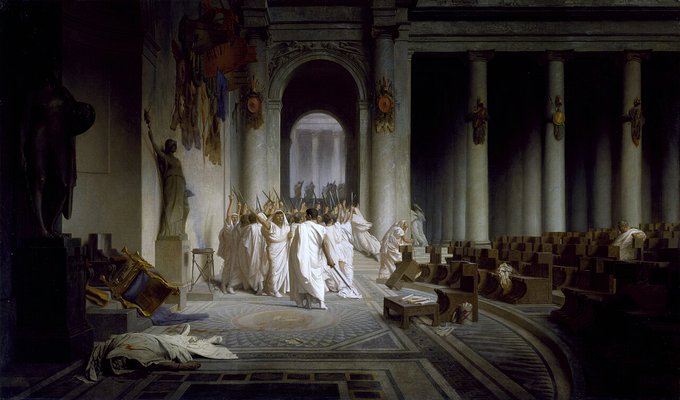
Editor’s Note: The photo I posted yesterday from a film about Alexander (wrongly called “the Great” by normie historians) marrying a mudblood can also be applied to Caesar.

Whoever controls the past controls the future, and if we don’t invert the values of the official narrative about Alexander and Caesar, it won’t be easy to fulfil the 14 words in a West resurrected from its historical catatonia.

Let’s see what William Pierce said about Caesar:

Celtic bands continued to whip Roman armies, even to the end of the second century B.C., but then Roman military organization and discipline turned the tide. The first century B.C. was a time of unmitigated disaster for the Celts. Caesar’s conquest of Gaul was savage and bloody, with whole tribes, including women and children, being slaughtered by the Romans.

By the autumn of 54 B.C, Caesar had subdued Gaul, having destroyed 800 towns and villages and killed or enslaved more than three million Celts. And behind his armies came a horde of Roman-Jewish merchants and speculators, to batten on what was left of Gallic trade, industry, and agriculture like a swarm of locusts. Hundreds of thousands of blond, blue-eyed Celtic girls were marched south in chains, to be pawed over by greasy, Semitic flesh-merchants in Rome’s slave markets [emphasis by Editor!] before being shipped out to fill the bordellos of the Levant.

Vercingétorix Memorial in Alesia, near the village of Alise-Sainte-Reine, France.

 
Vercingetorix

Then began one, last, heroic effort by the Celts of Gaul to throw off the yoke of Rome, thereby regaining their honour and their freedom, and—whether consciously or not—re-establishing the superiority of Nordic mankind over the mongrel races of the south. The ancestors of the Romans had themselves established this superiority in centuries past, but by Caesar’s time Rome had sunk irretrievably into the quagmire of miscegenation and had become the enemy of the race which founded it.

The rebellion began with an attack by Ambiorix, king of the Celtic tribe of the Eburones, on a Roman fortress on the middle Moselle. It spread rapidly throughout most of northern and central Gaul. The Celts used guerrilla tactics against the Romans, ruthlessly burning their own villages and fields to deny the enemy food and then ambushing his vulnerable supply columns.

For two bloody years the uprising went on. Caesar surpassed his former cruelty and savagery in trying to put it down. When Celtic prisoners were taken, the Romans tortured them hideously before killing them. When the rebel town of Avaricum fell to Caesar’s legions, he ordered the massacre of its 40,000 inhabitants.

Meanwhile, a new leader of the Gallic Celts had come to the fore. He was Vercingetorix, king of the Arverni, the tribe which gave its name to France’s Auvergne region. His own name meant, in the Celtic tongue, “warrior king,” and he was well named.

Vercingetorix came closer than anyone else had to uniting the Celts. He was a charismatic leader, and his successes against the Romans, particularly at Gergovia, the principal town of the Arverni, roused the hopes of other Celtic peoples. Tribe after tribe joined his rebel confederation, and for a while it seemed as if Caesar might be driven from Gaul.

But unity was still too new an experience for the Celts, nor could all their valor make up for their lack of the long experience of iron discipline which the Roman legionaries enjoyed. Too impetuous, too individualistic, too prone to rush headlong in pursuit of a temporary advantage instead of subjecting themselves always to the cooler-headed direction of their leaders, the Celts soon dissipated their chances of liberating Gaul.

Finally, in the summer of 52 B.C., Caesar’s legions penned up Vercingetorix and 80,000 of his followers in the walled town of, Alesia, on the upper Teaches of the Seine. Although an army of a quarter-million Celts, from 41 tribes, eventually came to relieve besieged Alesia, Caesar had had time to construct massive defenses for his army. While the encircled Alesians starved, the Celts outside the Roman lines wasted their strength in futile assaults on Caesar’s fortifications.
 

Savage End

In a valiant, self-sacrificing effort to save his people from being annihilated, Vercingetorix rode out of Alesia, on a late September day, and surrendered himself to Caesar. Caesar sent the Celtic king to Rome in chains, kept him in a dungeon for six years, and then, during the former’s triumphal procession of 46 B.C., had him publicly strangled and beheaded in the Forum, to the wild cheers of the city’s degraded, mongrel populace.

After the disaster at Alesia, the confederation Vercingetorix had put together crumbled, and Caesar had little trouble in extinguishing the last Celtic resistance in Gaul. He used his tried-and-true methods, which included chopping the hands off all the Celtic prisoners he took after one town, Uxellodunum, commanded by a loyal adjutant of Vercingetorix, surrendered to him.

Decadent Rome did not long enjoy dominion of the Celtic lands, however, because another Indo-European people, the Germans, soon replaced the Latins as the masters of Europe.