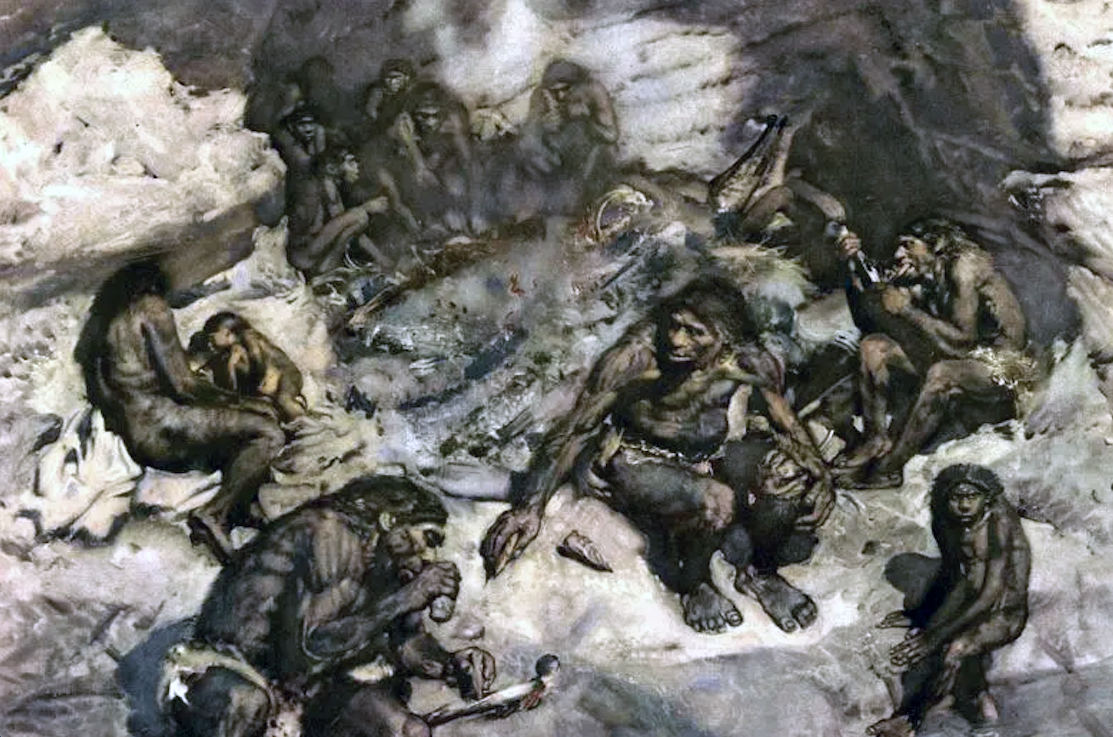
Even in a conventional representation of Neanderthal physiognomy (decades ago my father acquired a large book with this illustration), the authors/artist portray them as they were: cannibals.
Last year I read Danny Vendramini’s Them & Us on Kindle. Now I’ve reread it in print.
Reading on Kindle should only be done with mediocre books. It’s astonishing how much information is lost in a screen-based read, unlike on paper where we can use a yellow highlighter and jot down numerous footnotes—a practice that helps us absorb the content.
The fact that Them & Us was one of the few books that greatly improved my worldview doesn’t mean it’s without flaws. Far from it! Vendramini is as liberal and anti-racist as other authors who revolutionized my way of thinking. I’m referring to Lloyd deMause and Alice Miller’s work on the mistreatment of children; how Richard Weikart demonstrated that Hitler was privately a pantheist highly critical of Christianity; and how historian Tom Holland showed that Christian values were transmuted into the ethno-suicidal ethics of contemporary Westerners.
It doesn’t matter that all these authors, including Vendramini, are archetypal liberals. What matters is that it’s perfectly possible to use their findings for the cause of 21st-century National Socialism.
Vendramini published his book in 2009, after Jorge Velasco and an associate of his, “Varg,” wrote their lengthy essay on the new racial classification. An abridged version of that essay appears as an appendix in The Fair Race’s Darkest Hour. But now that I’ve reread Vendramini’s book and better understood its content, I realise that Velasco and Varg relied on accepted wisdom about Neanderthals, who, according to Vendramini, have been anthropomorphised by naïve and politically-correct scholars to the point of being considered human.

František Kupka based his work on Marcellin Boule’s interpretation of the Neanderthal remains found in France. The simian appearance is closer to reality than the primitive humans in the first image.
I’m writing this post because our point of view must be consistent, especially in the texts linked in the featured article. So yesterday I removed a couple of pages from Velasco and Varg’s essay, where the authors failed to notice that prehistoric Neanderthals resembled apes, not humans.
The February 2026 edition of The Fair Race can be read here, and it’s the one now linked in the featured article. However, the PDF of that appendix without this recent censorship is still available on this site, here.
14 replies on “Consistency”
I also reviewed the PDF Neanderthal Extermination, which I barely made any changes to (for example, I had forgotten to clarify that “NP theory” means Neanderthal Predation theory).
I’m under the impression than Vendramini’s research has been on the whole ignored by the scientific orthodox. Much as with the reception to Tom Holland (though the former is more well known) I put most of this down to his unavoidably ‘non-PC’ conclusions, much as he himself remains a liberal. However, I was just wondering, have you come across any official attempts to debunk him (i.e. print journal standard), not just those low tier idiots on YouTube? I’d be very interested to see what they tried to take him down with, and if there is any criticism of him stronger than a kind of ‘how could he say this about our primordial human brothers?’ Boasian nonsense i.e. is there any accusation of a flaw in his scientific approach, liberal ideology aside?
I ask this, as I side with his perspective on Neanderthals, and was just wondering what the true scope of the opposition was. You’d think he’d be much more well-known (I hope he’s still working at all and they haven’t destroyed him!). Currently, he’s about as overshadowed in my eyes as Mendel was in his day, if not more so – good theories get lost more easily in a modern world inundated with easy access ideas.
Perhaps I’m giving too much benefit of the doubt to their even being a respectable science these days, and the entire thing is irredeemably corrupt at official level. Either way, thank you for preserving his ideas. I enjoyed the detailed discussions on here on this topic some months back.
People in general don’t realize what Schopenhauer and Thomas Kuhn were saying: that novel ideas are ignored, then fiercely combated, and finally accepted.
Currently, Vendramini is receiving the same treatment that Richard Carrier has received for a dozen years. Despite his central study being published with peer review, the Bible scholars ignore his work without refuting it in specialised journals. That’s why I liked Carrier’s last book, The Obsolete Paradigm, because it shows how academics have ignored him, and when they do respond, it’s clear that sometimes they hadn’t even read his previous book.
You’re right that Vendramini’s thesis is—like Carrier’s—revolutionary insofar as it dismantles this neo-Boasian obsession of considering hominids noble savages. Without knowing it or intending to, his thesis refutes this pathological projection of liberals onto all wingless bipeds, including pre-humans. Furthermore, many were offended that Vendramini’s thesis was, so to speak, “antifeminist.” From the moment Neanderthals began preying on them, as a defence mechanism, our ancestors began to behave toward their females more like chimpanzees behave toward theirs than like bonobos do.
In other words, without realising it, the liberal and even feminist Vendramini has provided scientific support for prehistoric and historical patriarchy, insofar as Homo sapiens is a dysmorphic species.
There are many other aspects of Vendramini’s thesis that liberals find shocking, such as the notion of a twenty-thousand-year campaign to exterminate Neanderthals, which is what happened when Cro-Magnons invaded Europe. If you read today’s academic articles, although several mainstream scholars suggest that Cro-Magnons may have exterminated Neanderthals, they use euphemisms like “territorial competition” and similar phrases to avoid calling a spade a spade: “genocide,” the extermination of one race by another, which is what actually happened (and IMHO what should happen again).
As I say in the PDF linked in this comments section, only an ethnostate would rescue Vendramini’s work from the obscurity it suffers today. I suspect it will take longer than it took to recognise Mendel because this monk’s findings weren’t controversial.
P.S.
If critics of Vendramini want a book claiming to be 100% flawless, not in need of any correction of any sort (thinking back to Christopher Hitchens), they should just pick up a Quran, and be duped by that, having asked for the impossible. In this case, I think it was Varg who was incorrect, not Vendramini—independent researchers don’t always find each others work, due to the monolithic state of modern orthodox science, a real gatekeeper to the progress of knowledge.
“Why hasn’t my comment been published yet? Anyway, I’ll ask you this again: Do you believe that Varg’s theory is compatible with Vendramini’s theory, with some tweaks? For example, Varg’s theory states that blonde hair and blue eyes were the result of natural selection, while Vendramini says that those mutations may have appeared only in a small minority in Northern Europe but became so dominant due to artificial selection (sexual selection).”
I hadn’t replied because it was your first comment on this site, and I sent you an email to the email address you provided (usual protocol with first-time commenters). You didn’t reply.
Ok, Do you believe varg theory is compatible with Vendramini theory or not?(with some tweaks obviously)
Regarding the appearance of Neanderthals, where Varg adheres to the convention that they were human, obviously not. As for the other points Varg makes, I’m not an expert on the subject; perhaps Benjamin, who has read more about it, could offer some insight?
Something that the Varg Theory agrees with mainstream theories on is that the Khoisan were the first humans, and that virtually every race is descended from them. The Vendramini Theory debunks this.
I’m not an expert. Just to check, Ulfilas, are you referring to the section from page 27-29 of the New Racial Classification where the authors write on the rapid development of WN/RN phenotypical traits:
In which case, I would take the on board but rule out option c) (they talk about Neanderthal race-mixing, whereas I’m under the impression Vedramini thinks we exterminated all half-breeds, recognising them firmly as not-human). Option a) (‘stockbreeders’) feels the strongest to me, going on what our proud race could have intended for itself, freed of the lapse in self-confidence and the egalitarian dogmas of later ages. This would also match to Vendramini’s ideas about the strictly imposed internal boundaries on what it meant to be human.
In general I would draw as much as possible from the NRC, only in fact taking out (or altering – the document needs proper revision) the references to Neanderthals as human, or Neanderthal genetic influence on White Nordids. Out of the two sources, it would be NRC I rated as the strongest all-round, and Vendramini strong on the specifics of Neanderthals but not necessarily correct (or detailed enough) in general on other points. I gather he’s a liberal in general, so I wouldn’t suspect him to have an in-depth interest in the specifics of race science.
At least, like César noted, the NRC writers referenced some form of lasting battle between Cro-Magnons and Neanderthals: but again, as with other modern researchers, they’ve considered it in terms of territorial disputes, as opposed to being strictly genocidal.
As I say, I’d have to refer to both these documents again to refresh myself, but that was just my initial thoughts.
Thank you Ben, for your response!
I’m certainly not an expert on either genetics or palaeontology; These are just my initial brainstorms, so shouldn’t be taken as my definitive stance on the matter. I’m not convinced I’m on firm enough ground to be saying some of this stuff yet.
My gut instinct is that Vendramini is better on the more ancient racial anthropology/palaeontology, and Varg is better on my more ‘modern’ i.e. once the European races are distinguishable. I still think Varg’s is a strong work for what it is designed as but he wasn’t writing as an evolutionary biologist, and his archaeological side isn’t good enough.
Does it make sense to say that Varg wasn’t quite racist enough when he wrote it? We really need to account for all his superfluous points on interbreeding with Neanderthals. I don’t have the technical background in genetics or race science to be able to re-write this document. It’s a shame Varg isn’t still alive to write to about this.
He’s saying the interbreeding occurred around the proto-Khoisanid point (where he considers them human), whereas I think Vendramini is more specific in referring to the Levant populations as undergoing the transformation into humans, not by interbreeding (and thus presumably forming the Armenid race) but by predation shaping them.
Maybe this all comes down to how we’re defining ‘human’.
For your reference, I was compared that set of pages above (pp. 35-37) with pages 4-7 of the abridged version of Them and Us César released.
I still thinking working out how Armenid fit into all this is the toughest part, that is, if one’s taking on Vendramini as well.
P.S. It occurs to me that Vendramini doesn’t so much ‘debunk’ the claims of Varg (+ the mainstream) over the Khoisanid point as reinvent the concept.
After all, what species of hominid are the proto-Khoisanid said to be? Closer to Homo erectus, or Homo sapiens? If we’re still dealing with Africa at that point, and not the Near East, then both interpretations could be correct i.e.
proto-Khoisanid [Africa] -> Skhul-Qafzeh [Levant] -> Cro-Magnon [Levant-Europe] (after this point the race splits in Europe into WN, and RN, whereas Armenid could have a higher proportion of Khoisanid genes, thus preventing the need for Neanderthal admixture.)
Something along these lines at least. So we do – pan-racially – descend from proto-Khoisanid in an ‘out of Africa’ capacity, but we (i.e. as modern humans) descend from Cro-Magnons surviving out of the radical evolutionary processes undergone by the Skhul-Qafzeh (themselves descendants of proto-Khoisanid).
That’s all I could think of really. Until we get Varg’s major race-mixing error out, it’s harder to look into this.
Leaving aside the subjective term “human,” were the Skhul–Qafzeh individuals essentially lighter-skinned Sub-Saharan Africans with “Mongoloid” features and little body hair similar to modern Khoisan populations? Or did proto-Khoisan groups look like furrys just like vendramini theory states?. If we try to fuse both into one theory proto khoisan cannot be hairless as modern khoisan ones are but furries just like neanderthals.
Just to confirm, I think you’re referring to the segment I’m taking from page 30 of Neanderthal Extermination: Although it is interesting to speculate on what colour skin the Skhul-Qafzeh people had, it was not a factor at the time because it is almost certain that the Skhul-Qafzeh people were covered in dense body hair. While readers may find the prospect of recent human ancestors sporting so much body hair unpalatable, this is precisely what NeoDarwinian theory predicts. Coming from Africa where they occupied an open savannah environment, it is highly likely that the Skhul-Qafzeh people acquired a coat of protective hair to insulate them from the hot African sun and its equally cold nights. The same reasoning suggests that—like lions, monkeys and other mammals occupying the same grassland environments—light brown fur would probably have been most adaptive because it facilitated concealment from predators.
If proto-Khoisan groups are to be placed prior to Skhul-Qafzeh in the evolutionary history, yes, I’d imagine they’d have body fur. Then again, we have to keep account of the fact that, as we are claiming we descend directly from the then single Skhul-Qafzeh population, we do not thus descend then from the developing proto-Khoisanid populations external to that i.e. obviously it’s not linear. I think Vendramini makes the point that there would have been other hominid populations elsewhere in the world, and, I would add, perhaps other parallel reasons why they evolved to their modern look. As for their facial features, I don’t know the answer.
In general, I think we’re going with Vendramini on this, otherwise we have no baseline to correct Varg from. We could move back in later and see if Vendramini himself needs any corrections. I don’t actually have a copy handy of anything with proto-Khosanid skull-examinations evidence handy, so I can’t refer to that as counter-point.