Himmler tells the Church their time is over:
I once told a high-ranking Church representative: Your time is over; now you will face exactly what you did to us. The 2000 years where you lived in the sunshine and we in the shadows have come to an end. Now, we will live in the sunshine, and you in the shadows.
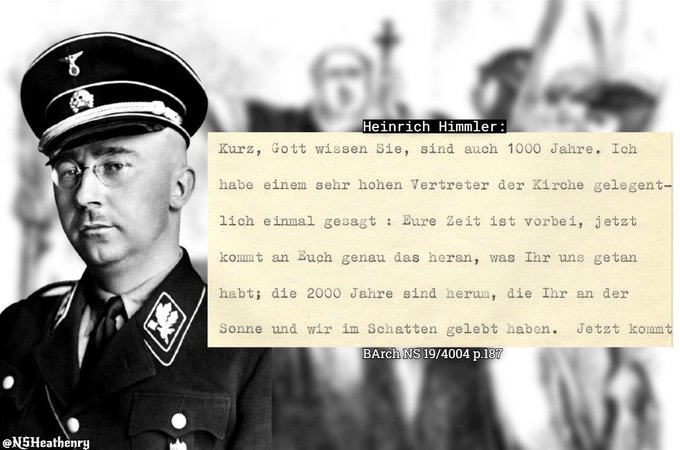
—Heinrich Himmler, speech at the group leader meeting in Bad Tölz in 1937.
5 replies on “Church”
I just read this on X.
Alas, what happened after 1945 was the complete opposite.
I must repeat countless times what our friend Joseph Walsh said before the British authorities imprisoned him for seven years: that that year marked the complete inversion of Aryan values to Christian values.
We live under the red giant phase of those values: an expanding sun that burns everything Aryan. And most racialists, except for those who post this kind of thing on X, are complicit in this axiological inflation of post-WWII Christian ethics.
The litmus test to prove you’re not an accomplice is simple: are you an exterminationist like Himmler or not?
Dear César,
Thank you for the X account link.
I had a question: you were reviewing a few of the original SS pamphlets recently for mistakes and bad messaging. Do you have a copy of ‘Positive Christianity’? I’d love to see you go through that one.
I read from the same X account that its author, ‘Prof. Dr. Caius Fabricius’ was sent personally by Hitler to a concentration camp, only released on mercy later because of his extensive blindness.
I struggle to understand the concept they were promoting with that title, as I can see nothing positive in Christianity that is not found elsewhere anyway, functioning despite it, not because of it. It feels too dangerous to promote in any form (even a racially-conscious one that, if I read it correctly, ignores the Old Testament and Jewish influence – seeming impossible in fact as the New Testament continues that Jewish lie with the mythological Jesus and his errant subversion).
From this collection, I have a copy of “SS Culture, booklet 7: Christianity,” but it’s not authored by that professor.
There are clear contradictions between National Socialism for the masses of Germans, which includes Positive Christianity, and the esoteric National Socialism for the SS.
It’s important to remember that at that time, New Testament exegesis hadn’t yet developed to the point of concluding that Jesus wasn’t even a historical figure. From the pantheist Hitler on down, they believed he existed. Hitler and Rosenberg, in particular, believed he was the son of a Roman soldier from Gaul, who raped Mary: a myth created by ancient Jews. Not even the Jews knew that Jesus wasn’t historical!
Let’s remember that Christians destroyed all the information from the 1st century except for what they later compiled in the so-called New Testament. However, as early as the 2nd century there were Christians who said that Jesus hadn’t walked the Earth (cf. Carrier’s recent book).
Upon reading the booklets, I didn’t dare criticise them on this site out of respect for National Socialism. But given that the red giant is burning everything rapidly, boiling the water, I think the time has come to warn the frog so it doesn’t get burned: something that was impossible to do when miscegenation was gradual and the frog got burned (for example, as blood mixing was perpetrated for centuries in both the Roman Empire and in Latin America).
I still have many booklets to criticise. There, I will be outlining the differences between the esoteric National Socialism to which we priests belong, and the exoteric National Socialism for the Germans of the previous century. One way to understand this spot in the middle of the Rubicon is to watch Wagner’s Tannhäuser and Parsifal and compare them with The Ring of the Nibelung. (Remember that Hitler invited his Nazis to the Bayreuth Festival, but many were as uneducated as today’s white nationalists and were bored at the operas.)
Thank you for answering my question.
I am sad to say that recently, when doing a CD purge of my collection (not so much to save space primarily as to weed out composers’ works I no longer longer got along with, or had never really appreciated) I removed the von Karajan recording I had of Parsifal. I had always very much enjoyed the numinous intensity of the prelude musically but by the end of the first Act I was running into themes that upset me (such as the miraculous appearance of the Grail filling the hall with light, and sustaining the knights with wine and bread, and especially Gurnemanz dismissing Parsifal from his company as a total fool – no longer even a ‘pure fool’ – for not appreciating this moment, plus the themes of forgiveness Kundry narrates in Act 2 and all talk of a ‘Redeemer’). I like the scene with the swan though, at the start, but I feel its message is made too broad. The thematic content tainted the music for me. I’ve considered buying it again in one of those ‘music only’ editions, but I’m not sure if that would help, as the music itself is tailored obviously to fit the themes also.
That opera is inspired by Good Friday and The Ring by pre-Christian Germanic myths. What I meant was that to get to the other side of the river you need to understand the people who, unlike normies, are already in the water but who never managed to cross it completely (like Wagner or those who promoted Positive Christianity).