by Gaedhal
I am not a Randian Libertarian, but one thing that she got right is that we are at home upon the earth. The Orthodox anchorite is not at home upon the earth, which is why he is climbing a ladder to “Heaven” to escape it. Take a look at some of these Orthodox icons. They can be really trippy:
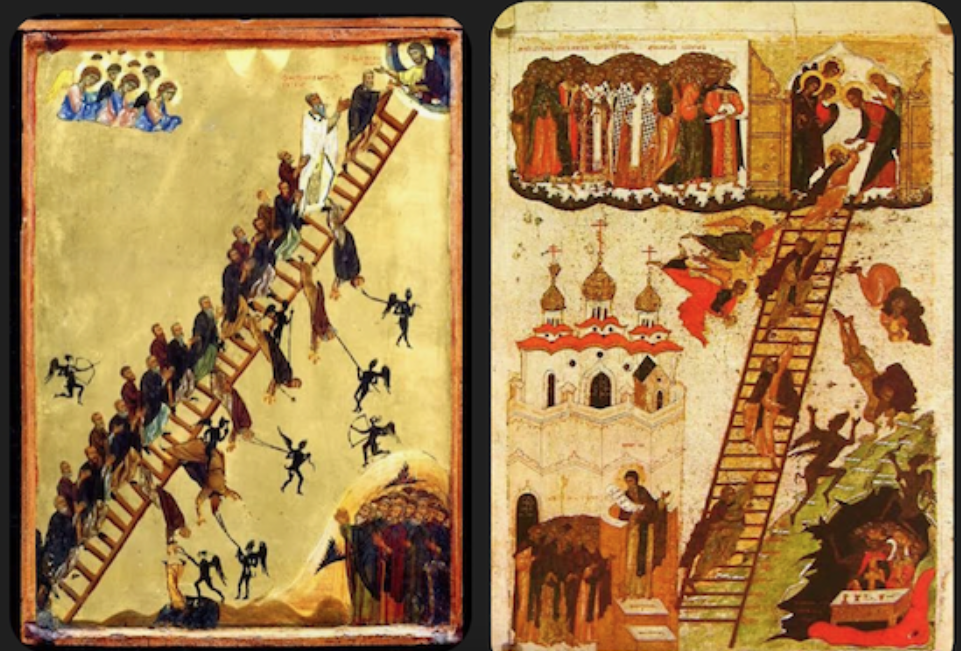
The earth is presented as a sterile desert… because Christianity was, originally, a desert religion.
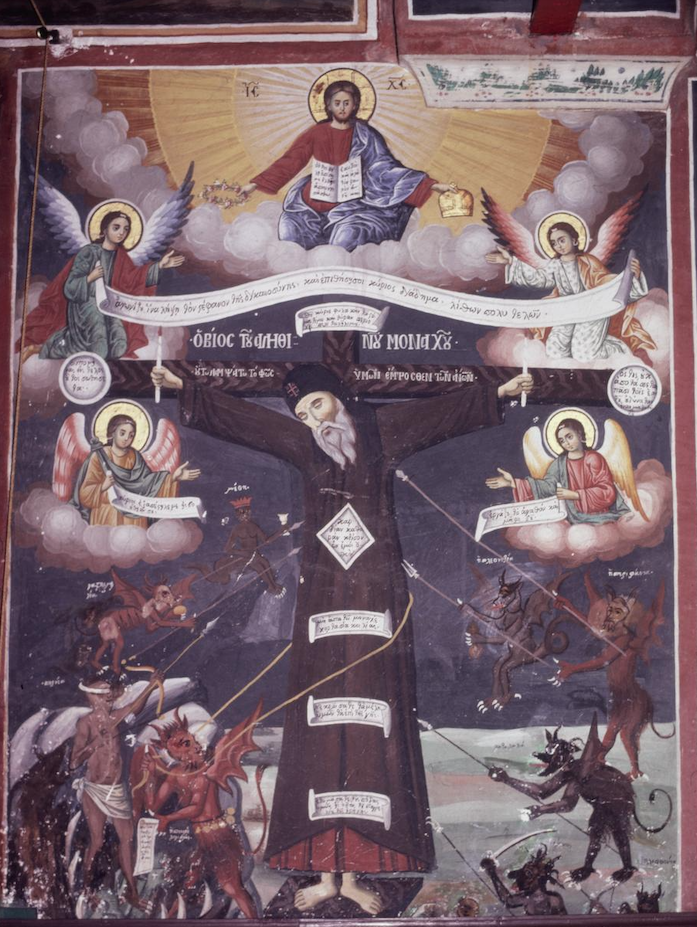
As we discussed on your blog, César, there is probably a Schopenhauerian, Pessimistic, Benetarian, Antinatalist, EFIL-ist interpretation to these icons: better to have never been, and second best is to deny the will to live, and to annihilate oneself, through ascesis and chastity/celibacy, so as not to burden another generation with the “pain and boredom” of life, as pessimists put it. As Jesus himself said: let he who can take castration, take it. One of the things that Antinatalists often do is get vasectomies. Richard Carrier has gotten a vasectomy, which is why I suspect his being an Antinatalist.
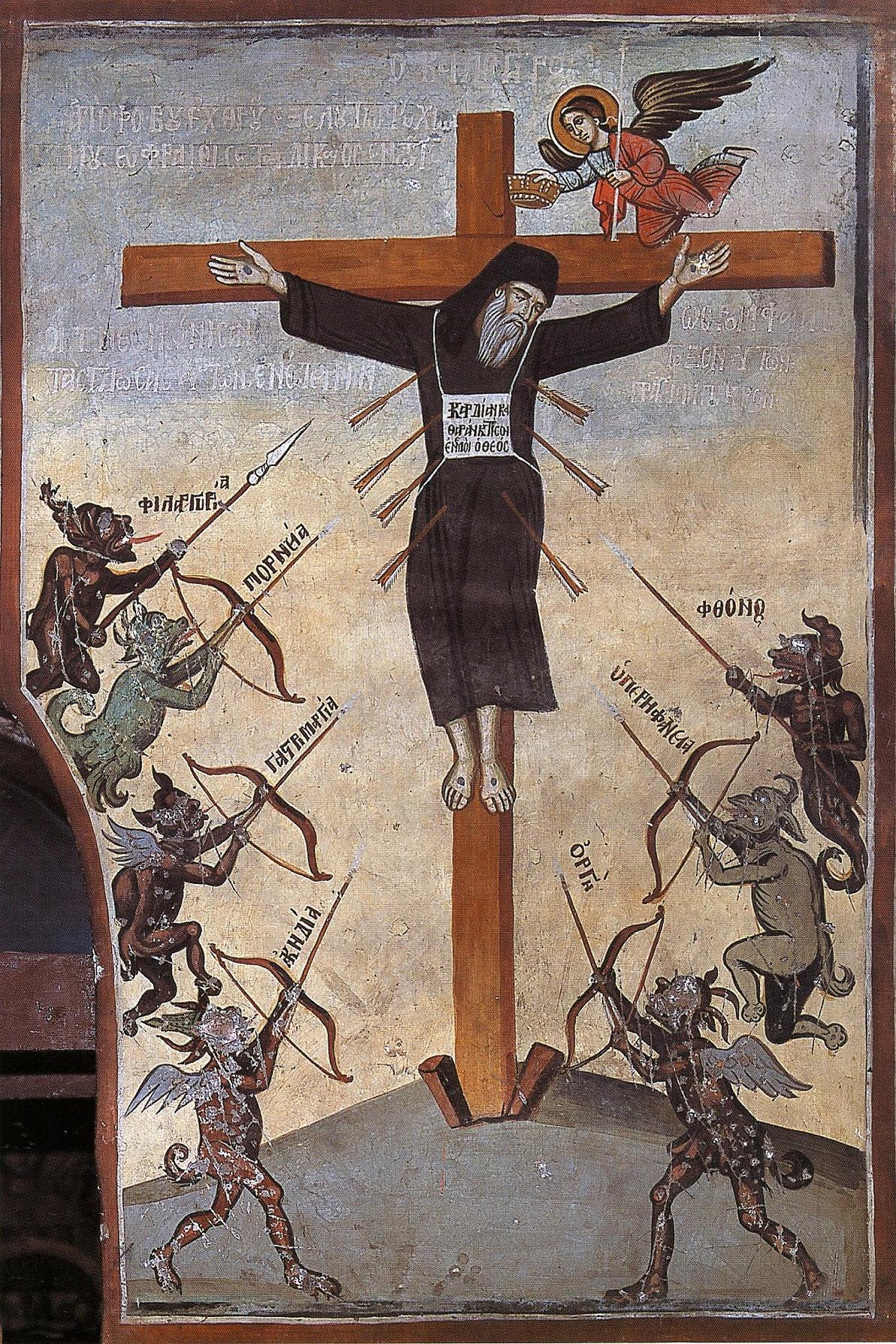
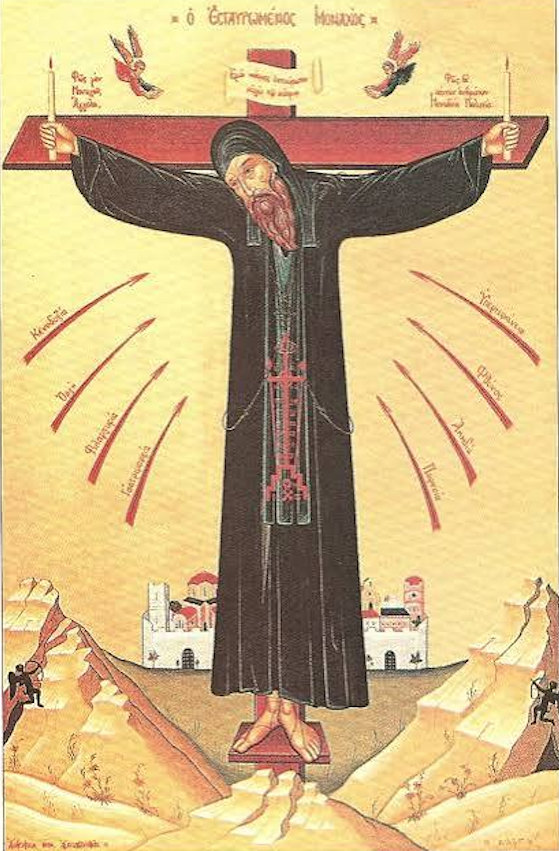
In my view, “Jesus”, is merely Nirvana, the “breathed-out state”, as Alan Watts put it, i.e. the “all-sufficient void” as Schopenhauer put it. It is conjectured by the likes of Richard Carrier that there was an adept Christianity, that is now lost to us, wherein the obviously fictional life of Jesus was understood as a parable. The Christian adepts understood that deceased Jewish carpenters do not respawn and float off into the sky. Dominic Crossan, my fellow Ulsterman from the lost county of Donegal, also believed that Jesus’s entire life, as recounted by the gospels, and especially the original gospel, the gospel of Mark, is a parable.
But a parable for what? Who knows? But given that we know that there were Antinatalist Buddhist preachers/missionaries in the Levant, since around 100 BCE—see mythicist papers for more on this—perhaps Christianity is a parable for the various forms of Pessimism, listed above.
If John of Patmos had an IQ north of 80, then he too would have understood that Jesus’s life was a parable. Again, virgins don’t give birth, and dead Jewish carpenters never respawn and levitate into the sky… there are no exceptions to this. I am putting money on the fact that the Jewish con-artists who wrote the New Testament understood this as well. Thus, the true end to the Book of Revelation would be the earth melting in fervent heat—as pseudo-Peter sayeth in an epistle—and the sky being rolled up as a scroll. The sky was a physical thing in those days, preventing the primordial waters from drowning us all. Thus, the Revelation is an EFIL-ist parable where the ideal state is the destruction of the planet. Revelation is a 2nd-Century C.E. version of the Red-button EFIL-ist thought experiment. The “New Heavens and the New Earth” is merely for the non-adepts, for the profane.
As Schopenhauer says: he is practising true Christianity, and in my view it could actually be the original version of Christianity.
And here is the website where Salm explores the link, perhaps direct, between Buddhism and Christianity. We know that there were Buddhist proselytizers from India in the region, at about the turn of the era, in about 1 CE.
However, it could just be a case of independent convergence. This is a hell-planet where living things must kill and eat other living things to survive. This is the Darwinian problem of evil [emphasis added by Ed.]. No sensible or ethical god would have created a system like this. This is why I view “theistic evolution”, such as that promoted by Biologos, to be every bit as delusional as creationism. To me, Pete Enns is every bit as delusional as Ken Ham. Once we introduce gods to evolution, then it becomes intelligent design. Theistic Evolution is an oxymoron to me.
Given that this is a hell planet for most sentient beings, then the thought often independently arises that it were better to have never been. The Jesus movement need not have had a formal connection to Buddhism to come up with Pessimism and Antinatalism—let he who can receive [castration] receive it—on their own.
One reply on “César,”
If I were given the choice of whether I would want to live again in the next incarnation of the universe—if Roger Penrose is right that it is cyclical before and after the Big Bang—I would say: “No.”
Interestingly, if my parents in particular and society in general hadn’t ruined my life, I would say “Yes.”
This makes me suspect that rejecting (Schopenhauer) or asserting oneself in life (Nietzsche) has an aetiology rooted in childhood or adolescence. Schopenhauer had severe problems with his mother. What would have become of Schopenhauer’s philosophy if he hadn’t had them?
I became an exterminationist not only because the abuse at home left me without a career, without a job, and without a partner (an eternal incel), but especially because of the infernal levels of suffering I was subjected to as a minor by an inconceivably stupid and deranged society (my book How to Murder Your Child’s Soul is almost ready for publication).
Now I try to spare others in this earthly hell that same suffering; hence my “religion of the four words.”