 Since I’ve been talking not only about the Neanderthal Predation theory but also about Danny Vendramini’s teem theory, I’d like to add that it’s worth reading the preface to Vendramini’s second book.
Tag: Danny Vendramini
Categories
Postscript
to my previous post
As I begin rereading the appendix to The Fair Race this morning I realise that, due to the timeline, it’s impossible to reconcile Danny Vendramini’s findings with the study by Eduardo Velasco’s collaborator, Valg (not Varg, as I mistakenly wrote the previous days).
According to Vendramini, European Neanderthals began invading the Levant around 100,000 years ago and preyed on pre-humans for 50,000 years. During that time, the latter developed evolutionary defence mechanisms—in addition to natural selection, sexual selection and artificial selection—which eventually produced a completely different species.
Cro-Magnon would evolve into contemporary Homo sapiens but the topic at hand, the white race, is a product of this sexual and artificial selection that continued after the extermination of the Neanderthals by the Cro-Magnons. The distinctive features of Aryans, such as pale pink skin, yellow or red hair, and blue or green eyes, are very recent dating back ten to twenty thousand years.
Both Velasco and Valg, as well as Vendramini, published their essays in 2009. Valg followed the old paradigm of anthropologists who have not resolved why our primate species is the only one that “got naked,” lost its fur (cf. the title of Desmond Morris’s famous book, The Naked Ape, who, like his colleagues, was unable to solve the enigma).
Since I believe Vendramini is correct with his theory of Neanderthal predation, what I did in previous days proved insufficient: removing about a page and a half from Valg & Velasco’s very long article, who were under the impression that Neanderthals were human. The page and a half I removed is insufficient because of the dates Valg includes in his study, which assume that the naked ape was much older than the dates Vendramini suggests.
So, in the coming day(s), I will dedicate myself to seriously editing Valg & Velasco’s article and reducing it to its essentials: human physiognomy, Valg’s strong point.
Regarding physical anthropology, Valg followed orthodox academia. But academia is trapped in an anti-white ideology in which, like the Boasian anthropologists, physical anthropologists religiously idealise all wingless bipeds. Using the language of my Day of Wrath, anthropologists massively project their psychoclass onto the prehistoric past: an ideological pathology. This is symptomatic of what I call neochristianity and what Gaedhal calls atheistic hyper-Christianity.
The point is that objective physical anthropology will be impossible as long as these religious figures reign in academia. The reason for considerably shortening Valg & Velasco’s essay in the coming day(s) is that I believe their new racial classification has merit. But we need a Fourth Reich so that today’s pseudoscientists—who do grotesque things like displaying shaved Neanderthals in their museums—can be challenged by studies from non-neochristians.
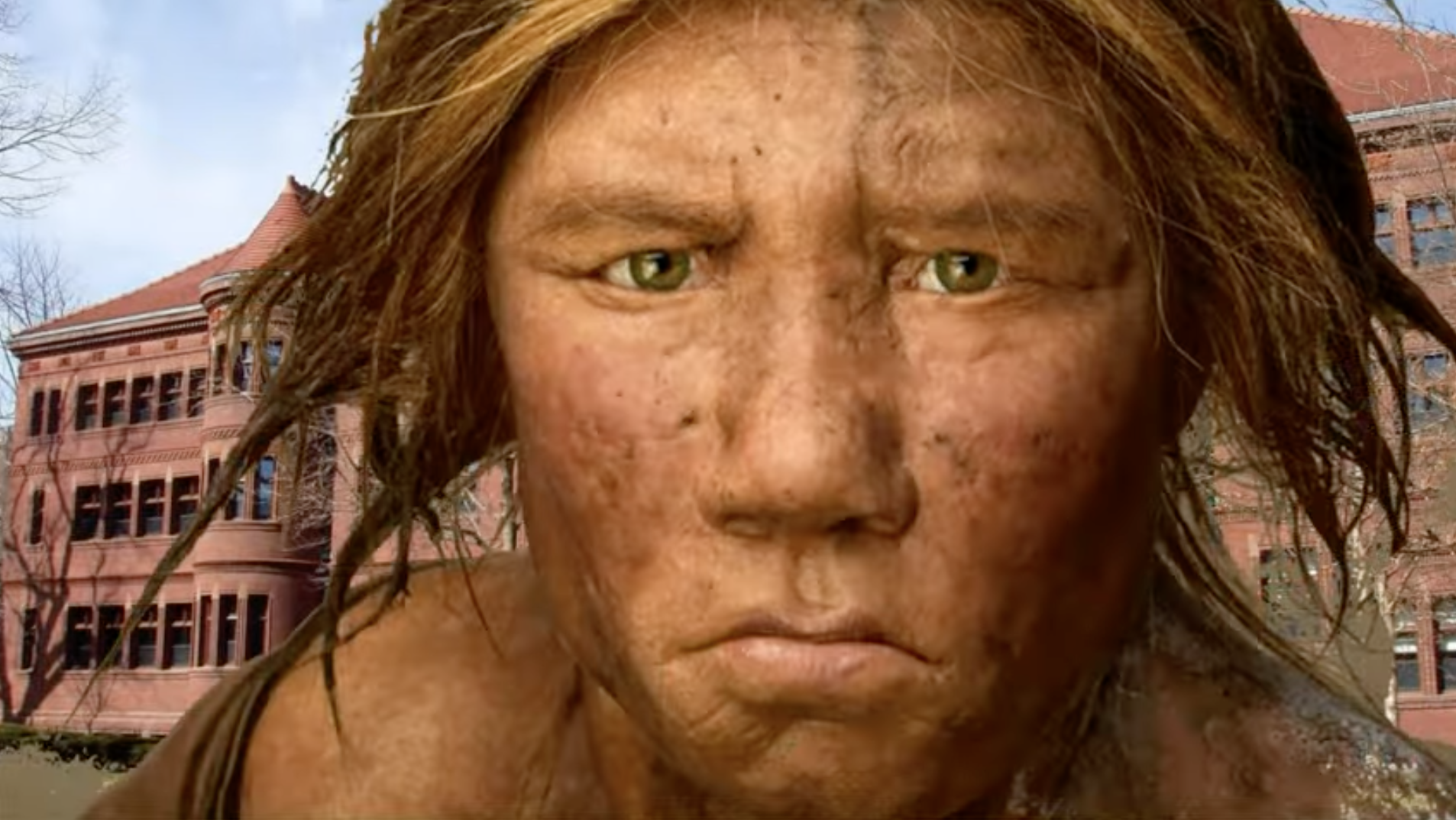
In the coming edition of The Fair Race Valg & Velasco’s essay will thus be pruned to its essentials: human physiognomy, although those interested can consult it as it was published in Velasco’s website, Evropa Soberana here (in Spanish) and here (in English).
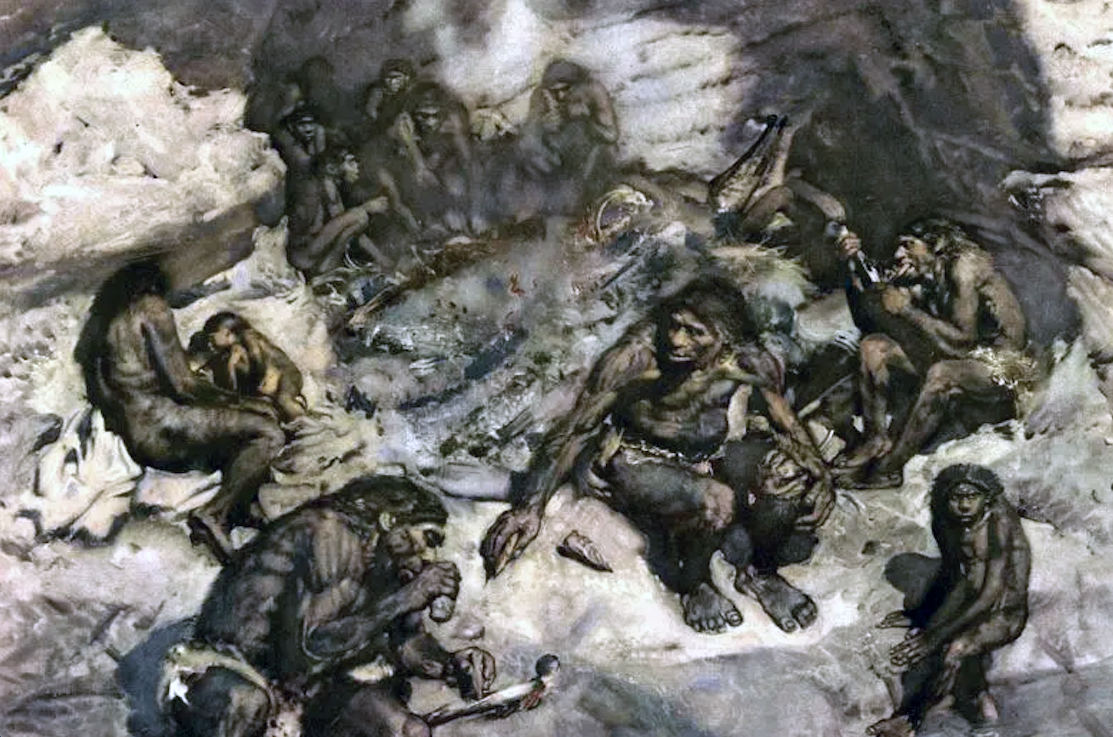
Even in a conventional representation of Neanderthal physiognomy (decades ago my father acquired a large book with this illustration), the authors/artist portray them as they were: cannibals.
Last year I read Danny Vendramini’s Them & Us on Kindle. Now I’ve reread it in print.
Reading on Kindle should only be done with mediocre books. It’s astonishing how much information is lost in a screen-based read, unlike on paper where we can use a yellow highlighter and jot down numerous footnotes—a practice that helps us absorb the content.
The fact that Them & Us was one of the few books that greatly improved my worldview doesn’t mean it’s without flaws. Far from it! Vendramini is as liberal and anti-racist as other authors who revolutionized my way of thinking. I’m referring to Lloyd deMause and Alice Miller’s work on the mistreatment of children; how Richard Weikart demonstrated that Hitler was privately a pantheist highly critical of Christianity; and how historian Tom Holland showed that Christian values were transmuted into the ethno-suicidal ethics of contemporary Westerners.
It doesn’t matter that all these authors, including Vendramini, are archetypal liberals. What matters is that it’s perfectly possible to use their findings for the cause of 21st-century National Socialism.
Vendramini published his book in 2009, after Jorge Velasco and an associate of his, “Varg,” wrote their lengthy essay on the new racial classification. An abridged version of that essay appears as an appendix in The Fair Race’s Darkest Hour. But now that I’ve reread Vendramini’s book and better understood its content, I realise that Velasco and Varg relied on accepted wisdom about Neanderthals, who, according to Vendramini, have been anthropomorphised by naïve and politically-correct scholars to the point of being considered human.

František Kupka based his work on Marcellin Boule’s interpretation of the Neanderthal remains found in France. The simian appearance is closer to reality than the primitive humans in the first image.
I’m writing this post because our point of view must be consistent, especially in the texts linked in the featured article. So yesterday I removed a couple of pages from Velasco and Varg’s essay, where the authors failed to notice that prehistoric Neanderthals resembled apes, not humans.
The February 2026 edition of The Fair Race can be read here, and it’s the one now linked in the featured article. However, the PDF of that appendix without this recent censorship is still available on this site, here.
Categories
Messala’s advice
 These days I’ve been reading a printed copy of Them and Us, which I used last year in its Kindle version for my excerpts from that book.
A common mistake among young Aryans who rebel against the System, even while admiring National Socialism, is wanting to imitate the men’s sports of the Third Reich.
I’ve often mentioned this moment of the 1959 film when Messala tells Sextus how to confront a Jewish idea that is infecting the Romans: with another idea!
The mistake of these young men lies in not knowing the saying, “For a stick to tighten, it must be made of the same wedge.”
We cannot move beyond the collective Jewish unconscious that has seized the Aryan soul with rough sports for Aryan men. We need to follow Messala’s advice. And to do so, it is necessary to become a philosopher, not in the way philosophy is understood in academia today, but in its ancient sense which implies questioning dogma.
There are several books that revolutionised my view of the world today. In my work on parental abuse of children, I have mentioned Alice Miller, whom I discovered almost a quarter of a century ago.
The next bibliographical milestone was two books by William Pierce: one fiction and one non-fiction, which I have mentioned countless times on this site. Pierce wasn’t a National Socialist, and I had to supplement his work with the memoirs written by Savitri Devi. Both authors address exterminationism.
After I had uploaded many hundreds of posts to The West’s Darkest Hour, I discovered Richard Carrier’s work on the highly dubious existence of the historical Jesus, which profoundly impacted my thinking because, since my early teens, I had been internally struggling with the Catholicism instilled in me by my father.
Last year, just when I thought my worldview was complete, I discovered Danny Vendramini’s book: a study of real prehistory which complements what Pierce wrote in his story of the white race.
We will never defeat the Jewish ideology that has seized our souls without these superb readings. It doesn’t matter that Miller, Carrier, and Vendramini are antagonistic to National Socialism. What matters is that it is perfectly possible to use their findings to further the National Socialist cause, as I have demonstrated on this site.
To young lads who believe that by practising rough sports in semi-secret societies—a healthy Männerbund—they will challenge the System, I suggest they follow Messala’s advice.
Become philosophers! Physical fitness is not enough.
Categories
All values
As returning visitors know, our seminal essay, published since The West’s Darkest Hour was hosted by Blogger, is “The Red Giant” which collects comments from a blogger who used to comment under the pen name Conservative Swede (Eric).
In 2009, before discovering white nationalism, I used to argue with Eric on Gates of Vienna: a pro-Western, anti-jihadist forum. One of the things Eric said stuck with me. This “Nietzschean of the North”, as Larry Auster who also used to comment on Gates of Vienna called him, said that he would transvalue some of the values of the 21st-century West to the values of the 1950s; others, to the 19th century; but still others ought to be transvalued to the times of ancient Rome.
As we can see even now, sixteen years after my interactions with Eric, the American racial right only wants to transvalue the decadent values of our century back to the 1950s: these racialists are de facto conservatives. Eric realised that some other values should be reversed to before the 50s. For example, the interaction between men and women was infinitely healthier in the world of Jane Austen, before the first wave of feminism took hold of the Aryan collective unconscious. However, as Eric believed that the primary cause of white decline was Christian axiology (after all, over time that axiology would give rise to feminism), other values would have to be reversed to pre-Christian times, Nietzsche’s ideal.
All of this seemed very logical to me when I discussed it with Eric in July and August 2009. Now that I have discovered a great book about our prehistoric past, I would add something to it.
Since reading Danny Vendramini’s Them and Us changed my worldview, as to re-evaluating some things back to the 1950s, others back to Austen’s time, and others back to the values of the Greco-Roman world, I would now add a final touch. In our interaction with the Other, it is not enough to behave like tough citizens of the Roman Empire. Let us remember that they committed the sin against the holy spirit of life: mixing their blood with mudbloods. We must re-evaluate much further back in time: to the values of prehistory, when our Cro-Magnon ancestors exterminated the ape-like Neanderthals.
This transvaluation of all values perfectly portrays the subtitle of this site: “National Socialism after 1945”, and contrasts dramatically with those who remain stuck on Mein Kampf as if it were similar to the Christian Bible. In reality, NS is a living philosophy that, over the years, has developed and rediscovered itself.
Eric would disagree with me that some aspects of our notion of good and evil need to be re-evaluated back to prehistoric times. Despite the nickname Auster gave him, “Nietzschean of the North”, he still subscribed somehow to Christian ethics, which forbids us from fantasising about genocide, let alone exterminationism, as if it were something good and noble.
Our Cro-Magnon ancestors would not agree with the Swede. Nor with Auster. Nor with white nationalists. Either our ancestors exterminated the evolved apes, or the genetic foundations for the Nordic race to flourish wouldn’t have been laid.
Umwertuung aller Werte!
Categories
Nerdels
For the 1909 illustration “The Man of La Chapelle-aux-Saints,” artist František Kupka relied on Marcellin Boule’s scientific interpretation of Neanderthal remains found in France.
I have referred to Neanderthals so many thousands of times in my soliloquies over the decades that I have abbreviated the word to “nerdels” (I use my Spanish expression, which doesn’t capitalise the word Neanderthals).
I want to clarify a point: even evidence by normies challenges the debunkers of Vendramini’s Neanderthal Predation Theory.
The book by George Constable and the editors of Time-Life that I finished reading today, despite subscribing to the current POV on Neanderthals, presents data that confirms what I said about the alleged debunkers: those who claim that Neanderthals lived in climates similar to those of present-day Europe.
Constable’s book states that the hominids who lived in Europe were confined by the seas during the Riss glaciation, and bands of these hominids had no easy way to escape to warmer regions. Later, the nerdels themselves were occasionally isolated during certain periods.
He adds that 75,000 years ago, this pressure acted with renewed force on the nerdels when, once again, the glaciers began to grow. This most recent glacial period, called the Wurm, wasn’t severe at first. It began with snowy winters and cold, rainy summers; however, open grasslands spread, and parts of Germany and northern France, once populated by forests, were transformed into tundra or a mixture of forest and tundra in open areas where mosses and lichens alternated with trees.
The nerdels, Constable’s book states, must have been first-rate hunters because the tundra regions offered little plant food to cover the lean days (exactly what Vendramini says). Many pages later, Constable states that even in the middle of summer, the weather remained rather cold, with average temperatures of ten degrees Celsius, and that winter storms would confine the nerdels to their smoky caves.
Although Constable and his editors fall into the fashionable fallacy of saying that the nerdels were human like us, at least they have the honesty to acknowledge that when nerdel and Cro-Magnon fossils are observed side by side, the difference seems enormous, given that the nerdel has a very elongated and low skull, bulging at the sides and with a protruding “bump” at the back of the skull. This creature had a protruding face, a wider nose and a broad jaw with no chin.
The book mentions the Skhul-Qafzehs fossils, which denote hybrids between nerdel and the hominids of the area: once again, this is in line with, and does not contradict, Vendramini’s NP theory. And on the following page, Constable’s editors mention the possibility that the Cro-Magnons exterminated them.
As I said in last month’s posts: we need academia to cleanse itself of its egalitarian psychosis in order to address Vendramini’s theory on its own merits. In the meantime, I find it sad that we only have Vendramini’s book (who is a liberal atheist) and my appropriation of his work in The West’s Darkest Hour.
Categories
Books
One of the problems when someone doesn’t charge you for a service is that there are risks… For example, yesterday I went to see a friend who had stored thirty boxes of books from my library in his house without charging me anything.
A month ago, there was a terrible storm that flooded the room where my boxes were stored. My friend didn’t tell me about it until yesterday when I visited him on his birthday!
All the books that got soaked, the ones at the bottom of the boxes, are now ruined. But what’s valuable about them isn’t the books themselves, but my countless handwritten footnotes! Yesterday, I realised that among the ruined books was an anthology by Octavio Paz that I treasured; Kubrick’s biography and a traditionally bound copy of the Satyricon (which I have already mentioned on this site). Of course, many other books were ruined too. To boot, all of my Parrish paintings are also ruined (for example, these and these that I had on the walls of the house I used to rent in Yautepec).


I didn’t become upset yesterday with the person who is storing them in his house because he will continue to store the ones that didn’t get wet. But I would like to say a few words about the only book I brought from that house to the small studio that I now rent, where I live.
Since I’ve been thinking a lot lately about the revelation that Vendramini’s work on Neanderthals has represented in my intellectual life, and why our ancestors exterminated them all, the book I brought with me—fortunately, it wasn’tdamaged by the flood—is a Spanish translation of one of those old collectible books published by Time-Life (the English title is The Neanderthals by George Constable).
One of the advantages of old books is that they mention things that don’t appear in updated books. To understand why our view of Neanderthals has changed so much in recent decades, we must bear in mind that since the 1960s, when attempts were made to integrate Negroes into American society, that zeitgeist contaminated academia including the minds of prehistorians. It is a myth to believe that academia is objective, something like a parallel universe to the vicissitudes of the culture that surrounds it. In reality, academics jump on the latest axiological bandwagon, and this is true not only of historians but also of prehistorians.
Vendramini, for example, seems radical to us when he suggests that our ancestors saw Neanderthals as bipedal gorillas with spears. But quite a few 19th-century palaeontologists believed something similar.
Let us recall the quotes from Pierce and Walsh in the featured article: since 1945, the zeitgeist of white men has been sliding more and more towards Christian ethics, especially among those we call neochristian atheists.
 Well, in this book, which survived the flood that caused such calamity to my beloved belongings, we can see this 19th-century reconstruction of what Neanderthals looked like. It is impressive because I now discover that Vendramini has not been alone: it is only the political correctness that reigns in academia that causes his work to be ignored (just as the racial right ignores mine for the reason I told Benjamin today).
What’s more, George Constable, who wrote his book in the early 1970s and already sides with this mania of anthropomorphising Neanderthals, at least had the honesty to publish this image:

And in the note next to the image, Constable wonders whether the version of the Neanderthal face that is currently accepted is accurate, given that the same skull can lead the person reconstructing the face to create either a human or an ape-like face.
In the past academia was dominated by a view of prehistory based on the book of Genesis, which is why some scientists were irritated by the discovery of pre-human fossils. Scientists today may not be Christians, but neochristians are as religious as humanity has always been, even though their secular religion is now the dogma of equality among all wingless bipeds.
Returning to Vendramini’s thesis. In Constable’s book, I learned yesterday that Thomas Huxley himself, upon examining a Neanderthal skull, said it was the most monkey-like he had ever seen. And William King, professor of anatomy, wrote that the Neanderthal skull was so distinctly ape-like that, he surmised, Neanderthal behaviour would be like that of an animal. In the 19th century a spade was called a spade, especially that Neanderthals must have been stocky, short in stature with elongated low heads, very pronounced brow ridges, and bulky faces projecting forward; powerful jaws and receding chins.
In fact, Marcellin Boule (1861-1942) was ahead of Vendramini in a way. He published the first analysis of Neanderthals and characterised them as beastly bipeds. In an illustration he made Neanderthals looked like hairy gorillas, and he determined that there wasn’t enough room for frontal lobes, as we have them, in the front part of the Neanderthal brain. (Although the Neanderthal brain was larger than ours, it wasn’t used as much for abstract thinking. The very elongated occipital part of their skulls hosted huge brains, yes: but that side of the brain served another purpose: their superb night vision.) Boule placed Neanderthals between apes and modern humans, but closer to the former, and he despised the beastly appearance of their muscular bodies, whose skulls with strong jaws revealed, according to him, the predominance of a beastly nature.
Boule was not the only one who considered Neanderthals to be gorilla-like in appearance. Even in the 20th century, but obviously before the great reversal of values that began in 1945, Elliot Smith, a London anthropologist working in the 1920s, said that the Neanderthal’s nose wasn’t clearly differentiated from the face, but was fused into: what in another animal we might call a snout. He also pointed out that Neanderthals not only had a coarse face, but probably had a hairy covering over most of their bodies.
 H.G. Wells himself said that Neanderthals were hairy or grim-looking, with large mask-like faces, large brow ridges and no forehead, wielding huge flint tools and running like baboons, with their heads forward and not like men with their heads held high. Ahead of Vendramini, Wells speculated that their appearance must have been frightening to our ancestors when they encountered them.
It is curious that, despite its great political correctness, Constable’s book has at least one passage in which he says that, 40,000 years ago, true human beings jumped onto the evolutionary scene by killing the “beast-men” (on the previous page he had talked about our Skhul-Qafzehs ancestors).
By the end of the 1950s, the decade after the fateful 1945, the stain of simianism that had been placed on Neanderthals began to be removed, and neochristian “science” accommodated this new point of view by repudiating the earlier approach. Present-day scientists have even christened Neanderthals as Homo sapiens neanderthalensis.
This information is so pivotal that, when I finish reading Constable’s book, I will add another appendix to my very recent PDF on the extermination of the Neanderthals.
Categories
YouTubers
Yesterday I watched the critics on YouTube of what Danny Vendramini says in Them and Us: How Neanderthal Predation Created Modern Humans. I don’t know if Vendramini still lives in Australia (his website is defunct). At any event, it’s very easy to debunk these “debunkers”.
One of them tried to refute Vendramini’s claim that Neanderthals had fur by arguing that fur can fossilize, and the Neanderthal remains found do not show fossilized fur. What the YouTuber omitted is that this, fossilized fur, rarely happens, so only if the remains of a mummified Neanderthal were ever discovered would we know who is right: the orthodox view of the Neanderthal as furless, or Vendramini.
More than one YouTuber claimed that Vendramini’s statement that Neanderthals evolved in Ice Age Europe was false and that the climate then was similar to that of Europe today.
These “debunkers” haven’t even read the Wikipedia page on Neanderthals and other hominids, which tells us that the origin of Neanderthals dates back to the Mindel Ice Age (between 400,000 and 350,000 years ago), during which climate change and the rise of the Arctic ice cap apparently forced European populations of H. heidelbergensis to seek refuge from the cold on the continent’s southern peninsulas. These migrations isolated H. heidelbergensis populations, inducing a population bottleneck and favouring speciation. By the end of the Ice Age, heidelbergensis populations had already begun to acquire Neanderthal traits. Finally, between 230,000 and 200,000 years ago, H. heidelbergensis had acquired enough physical range to be differentiated into a new species, Homo neanderthalensis.
A YouTuber misrepresented Vendramini by omitting that his bottle-neck theory only referred to our Skhul-Qafzehs ancestors of the Levant, not to other hominids in other parts of the globe (insofar as the latter didn’t clash with the Neanderthals). Another YouTuber misrepresented what Vendramini said, that Neanderthals belonged to the group of primates, as if implying that Vendramini was unaware that Homo sapiens was also a primate—a clear straw man since Vendramini never implied that! He also said that Neanderthals and early humans probably became best friends, good neighbours. I could mention other wishful thinking arguments, strawmen and misrepresentations from YouTubers but I will limit myself to saying that the final straw came when these “debunkers” showed Neanderthal and human skulls side by side on their own cameras.
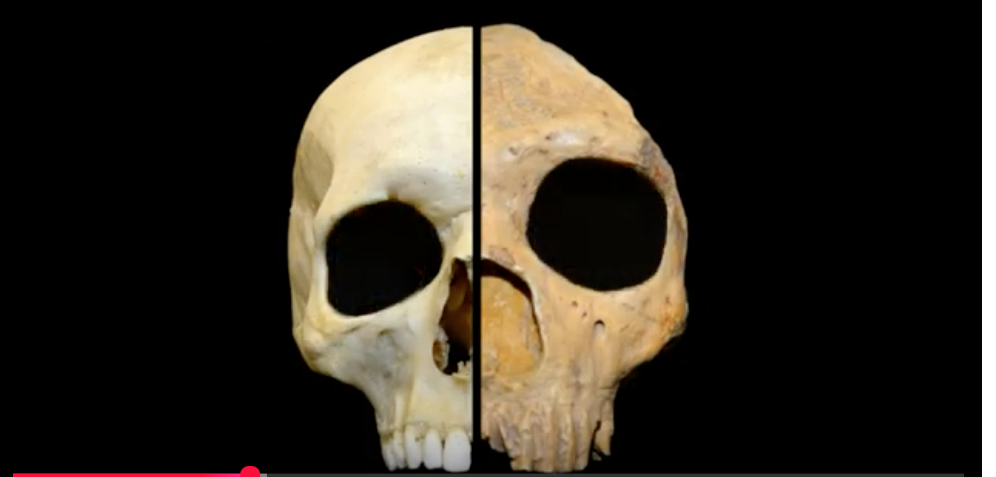
Anyone not infected with the kind of egalitarianism that wants to make us see niggers as brethren will see with his own eyes the enormous differences between the two skulls. I couldn’t believe what I was watching in the “debunkers'” videos…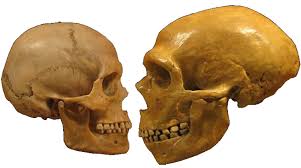 For example, although the visual impact is that we are looking at another species, one that looks more like an evolutionised ape (see the protuberances above the eye sockets and the great occipital elongation), these YouTubers were claiming, by posting images like the one above in their own videos, that Neanderthals were humans like us! Of course, not a word came from the lips of these “debunkers” about the fact that Neanderthals had eye sockets much higher than ours.
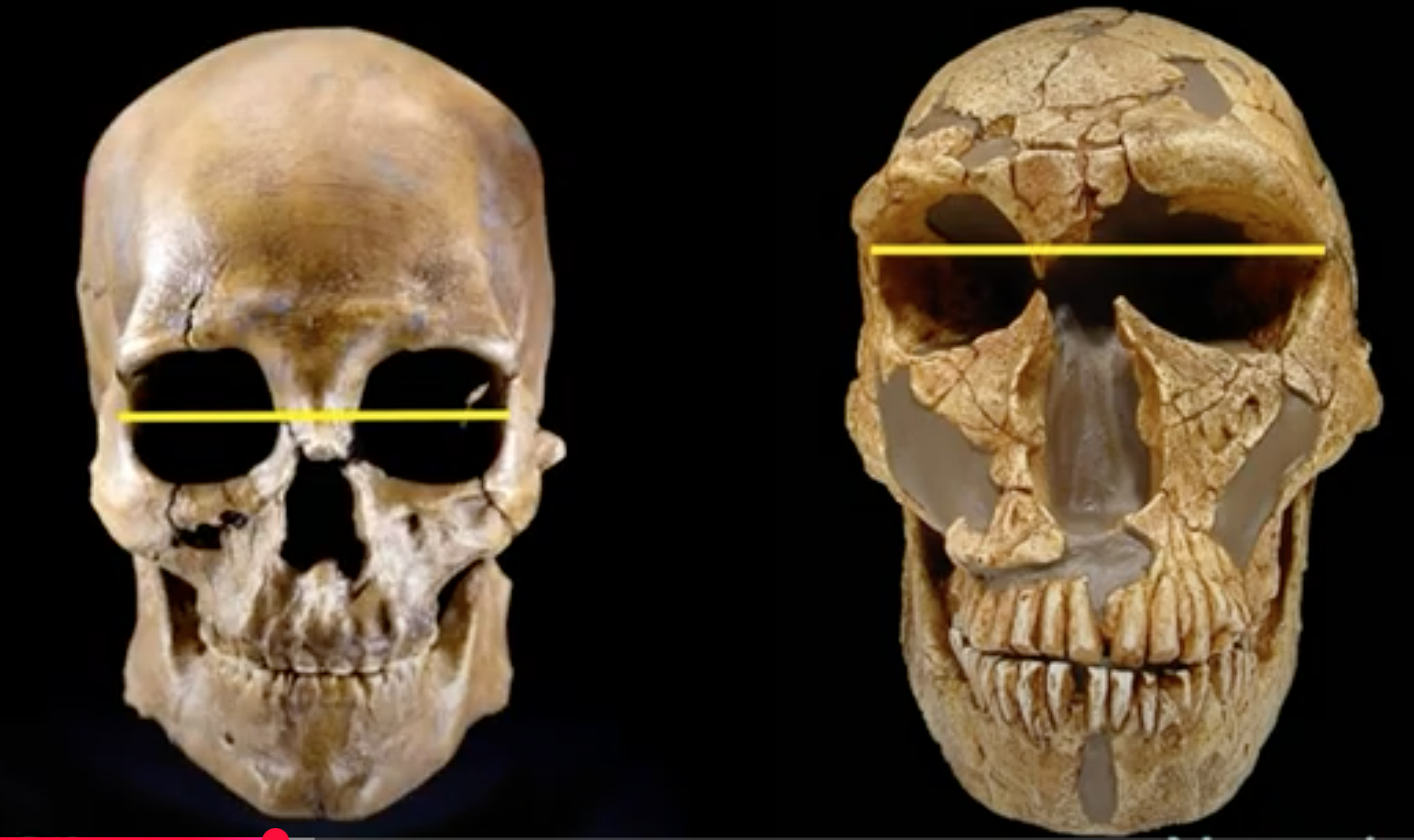 The “debunkers” also didn’t say a peep regarding another of Vendramini’s observations: that Neanderthals had larger eyes than ours.
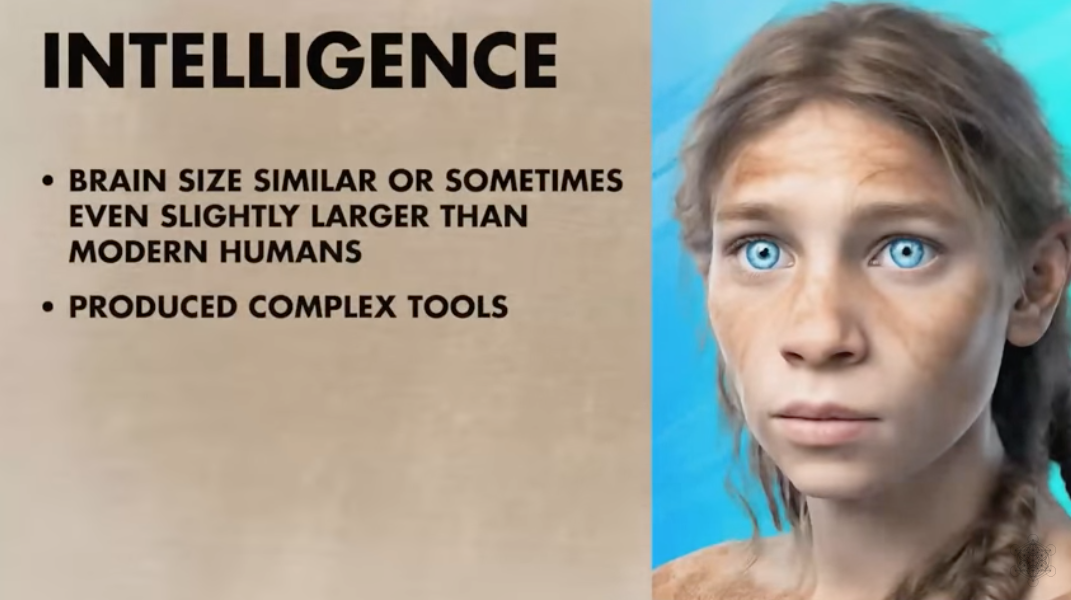
 To grotesquely insult our intelligence, one of the main “debunkers” included this image of… a purported Neanderthal girl several times throughout his video!
 Another of the “debunkers” had no choice but to acknowledge that throughout Europe multiple caves have been found whose remains prove that Neanderthals were cannibals. But he was quick to exonerate them by claiming that Homo sapiens had also eaten human flesh. This reminded me once again of how anthropologists, so imbued with the precept of loving one’s neighbour, write about the “noble savage” while idealising infanticidal cultures (see the delirious cases I compiled on this subject in my Day of Wrath).
Many other things the “debunkers” alluded to in their videos, such as whether Neanderthals could sew or use flowers at their funerals, can be answered simply by reading the Wikipedia page on Neanderthals—taking into account that Wikipedia is aligned with these YouTubers’ anti-white agenda. A calm reading of that Wikipedia article puts in its place the exaggerations the YouTubers had to resort to in their eagerness to dismiss Vendramini’s Neanderthal Predation theory.
Forget the YouTubers. They’re white trash. Only when academia returns to the hands of scholars who don’t hate the white man (and that would only happen after a revolution) can Vendramini’s work be valued on its own merits.
For the moment, that’s impossible.
Categories
Wrong look
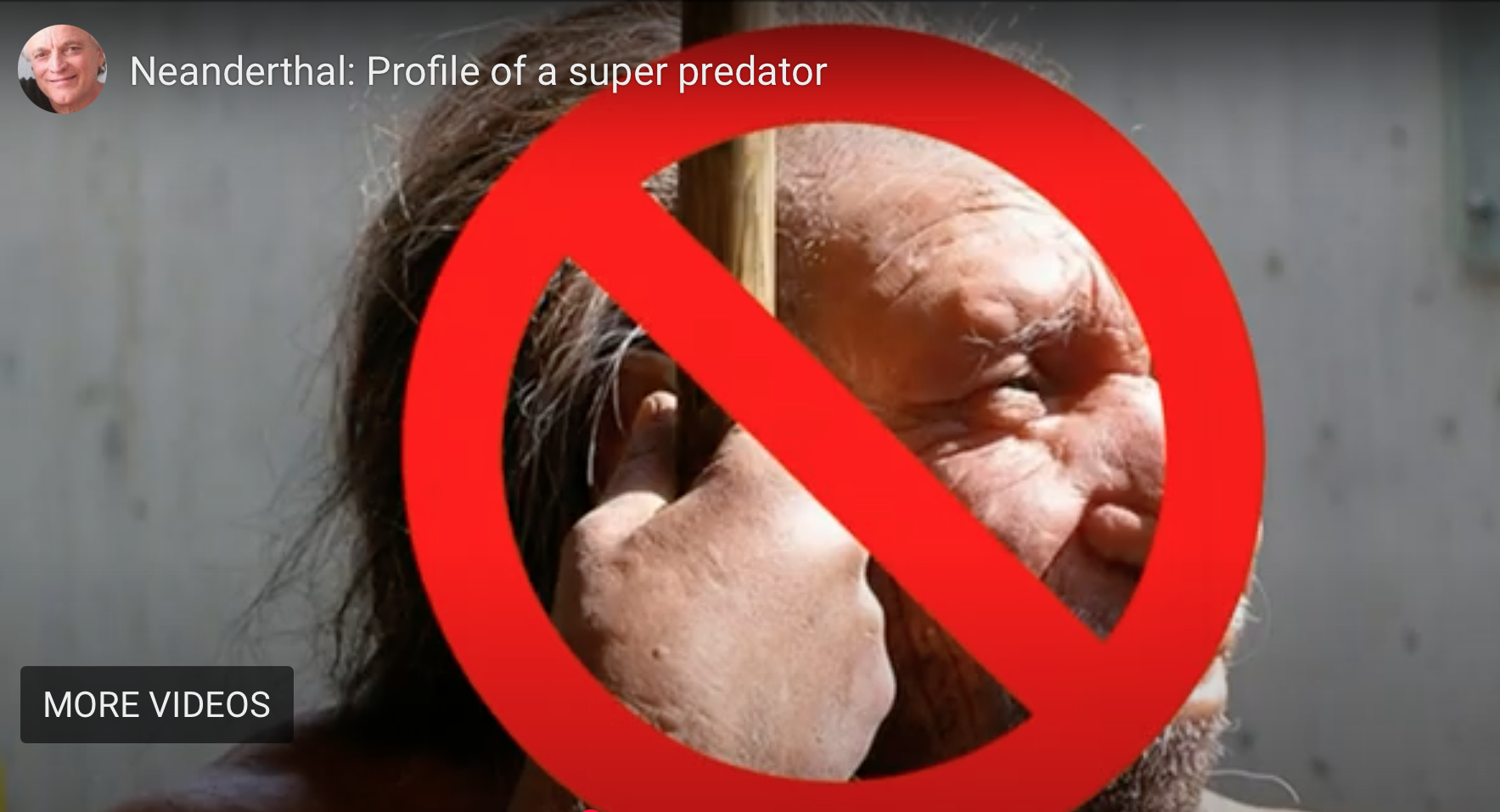
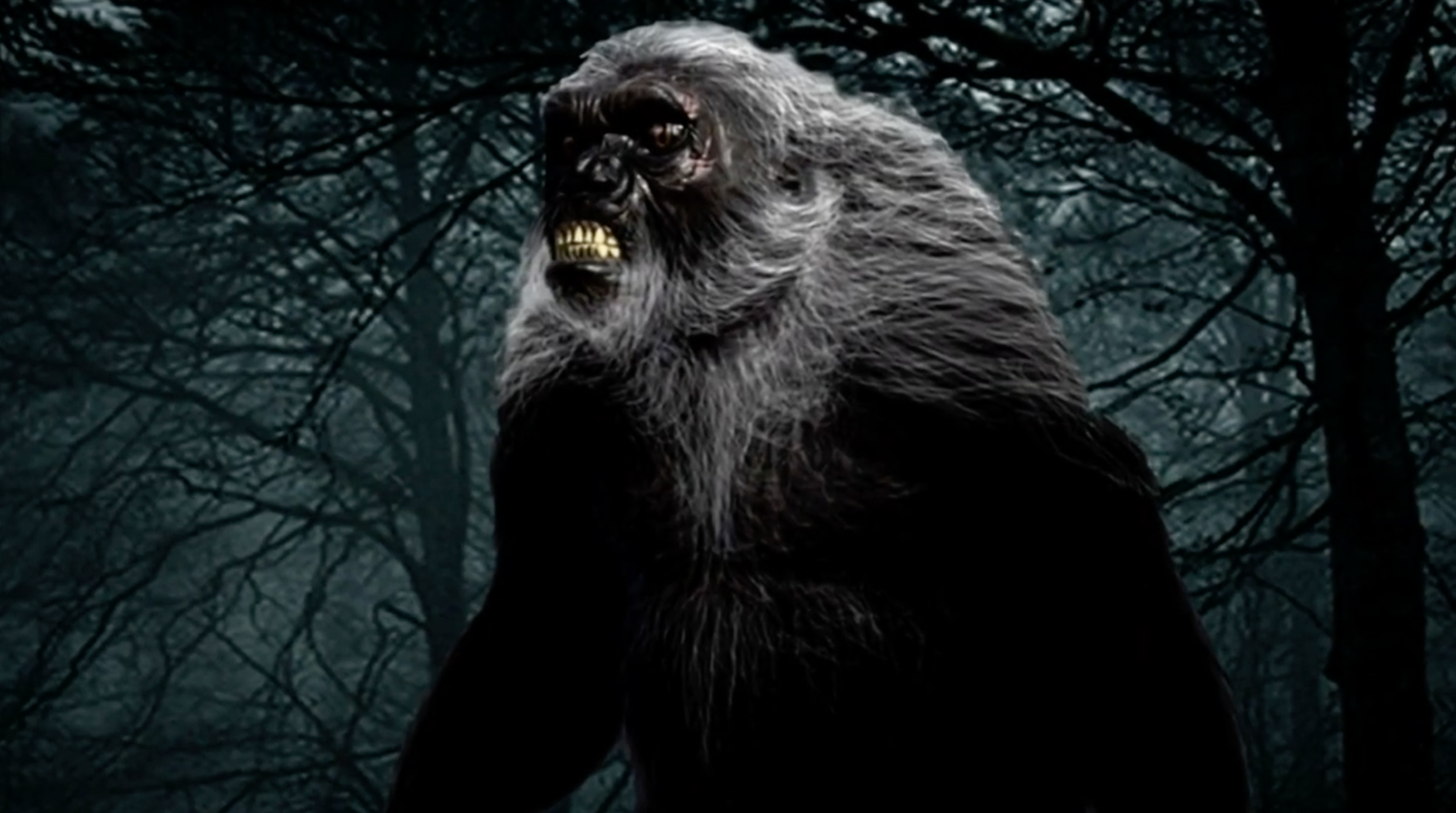
I just realised that I made a mistake at the beginning of the “Neanderthal Extermination” series by omitting the reasons why prehistoric Neanderthals didn’t look like what museums, collection books and TV documentaries show us. This video by Danny Vendramini himself corrects that mistake.
Categories
Neanderthal
extermination, 12
Editor’s note:
The modern man’s body beautification didn’t end with Cro-Magnon: it is a task that continued throughout later prehistory. In some passages from the final chapters of Them and Us, we read:
______ 卐 ______
The journal, Evolution and Human Behavior recently published a study by Canadian anthropologist Peter Frost, which claimed the genetic mutation in the hair colour gene that resulted in blonde hair occurred about 11,000 years ago and quickly spread through sexual selection. Researchers at Copenhagen University have identified the single point mutation in the OCA2 gene that is responsible for all the blue-eyed people alive today. They calculated the mutation happened between 6,000 and 10,000 years ago in Europe.
This genetic data supports NP theory’s argument that by 10,000 years ago, artificial selection and sexual selection of the nascent human phenotype was in full swing. […]
For example, so thoroughly had the genes for hairiness been expunged, rendered inoperative (turned into what are called pseudogenes) or silenced (which means they are no longer expressed) that today, anyone born with full body hair is considered a medical curiosity. Since records began in the Middle Ages, only about 34 cases of the condition, called congenital generalised hypertrichosis, have been described in the medical literature.
Because of its importance in differentiating the warring species, the Cro-Magnon human face received the full makeover. Faces became more symmetrical. Skin became wrinkle-free, clear and unblemished. The eye whites really were white, the lips fuller and the nose (petite by primate standards) protruded conspicuously from the face. Gone were the two forward-projecting gaping nostrils of the primate nose. Gone was the leathery skin. And gone too was the coating of protective body hair, even in hot tropical regions. Beauty became the prevailing guide to mate selection, and meant the opposite of what Neanderthals looked like.
Further accentuating the divide were mutational alleles for novel hair and eye colours. Amongst some Northern European groups the new lighter colours became highly-prized. From a distance nothing stamped a person one of us better than blue eyes and a coiffure of blonde, brunette or red hair, especially if it was well-groomed and decorated—something the others never did.
The 35,000-year-long process of genetic pruning was so comprehensive that it rendered Cro-Magnons almost unrecognisable from their former selves. They were now much smarter, more artistic, more creative… more human. Behaviourally though, it was a different story. There was still one step to go—one final transition before you’d let one of these Neolithic men date your daughter or sit down with you to discuss the economic meltdown over a decaf cappuccino. The last challenge was to curb—or at least control— hyper-aggression in young males. […]
Let ’s be logical about this
Hyper-aggression is derived from the emotional centres of the ‘reptilian brain.’ This means that Cro-Magnon fixed action patterns would have been inflexible, emotional responses. The non-cognitive nature of these behavioural responses is reflected today in psychological attitudes like racism, colourism, xenophobia, ethnocentrism, chauvinism, pack rape mentality, vigilantism, hooliganism and vandalism. For the most part, these are not specific behaviours. They are emotional states and psychological mindsets that, under certain circumstances, may predispose violent behaviour such as lynching, gang rapes and ethnic cleansing. Once they are triggered, these behaviours are normally resistant to cognitive constraint. […]
But despite the glacially slow progress, by 1790 the Declaration of the Rights of Man of the French Revolution was empowered in a genuine attempt to curb the devastation of barbarism, anarchy and mob rule.
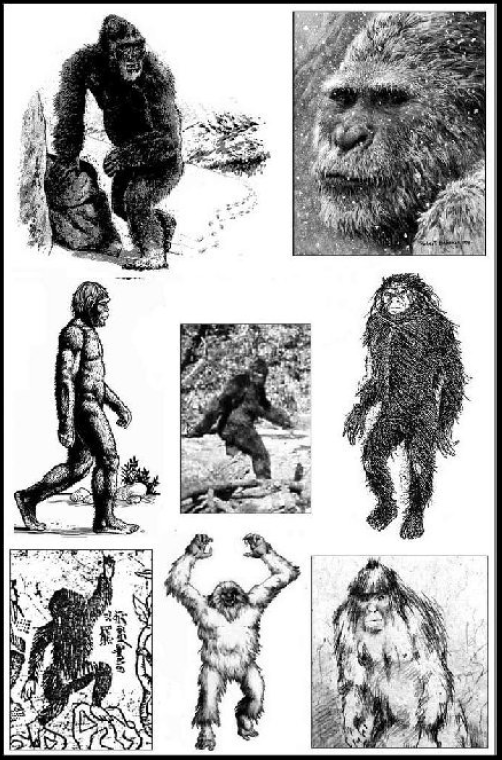
A motley collection of yetis, abominable snowmen and sasquatch from popular culture and mythology, all bear a striking similarity to Neanderthal physical characteristics.
The theory argues that all the great empires of antiquity—Phoenician, Persian, Greek, Roman, Mongol, Egyptian, Byzantine, Mogul and Aztec—engaged in expansionist re-enactments of the first great conquistadorial campaign by Cro-Magnons against the Neanderthals. Their strategies and techniques have uncannily mimicked Cro-Magnon tactics—classifying the alien enemy as inferior and sub-human; killing the men and raping the women; subjugating, pillaging and enslaving; occupying enemy lands; and showing no mercy. The same innate Neanderthal responses that find expression in ethnic cleansings and internecine conflicts have also been intuitively applied by dictators and unscrupulous politicians.
______ 卐 ______
Editor’s note: our gospel or good news
The trauma of Neanderthal predation and Cro-Magnon hyper-aggression shaped our psyches. This is such a significant revelation that I will need to modify the featured post of this site. For the priest of the sacred words the good news is that, under the right circumstances, the desire for extermination can be triggered today as Vendramini himself, a neochristian from our POV, acknowledges.
____________
N.B. You can read the first 35 pages of Vendramini’s book here.