web analytics
Categories
Christendom Literature New Testament Old Testament St Paul

Gospel Fictions, 1


Below, excerpts of Randel Helms’ Gospel Fictions’ first chapter, “The Art of the Gospels: Theology as Fictional Narrative” (ellipsis omitted between unquoted passages):


I shall use the word “fiction” rather than “myth” to refer to the study, contained in this book, of the fictional aspects of the four canonical Gospels.

I write as literary critic, not as debunker. The Gospels are, it must be said with gratitude, works of art, the supreme fictions in our culture. Literary artists use their imaginations to produce poetry and fiction, works open to the methods of literary criticism. This literature was oral before it was written and began with the memories of those who knew Jesus personally.

Their memories and teachings were passed on as oral tradition for some forty years or so before achieving written form for the first time in a self-conscious literary work, so far as we know, in the Gospel of Mark, within a few years of 70 A.D.

Luke was obviously writing during a time when literature about Jesus was flowering. Paul was an ecstatic visionary who experienced, for what seems to be a period of nearly thirty years after the death of Jesus, visions of a heavenly being he called “Christ” and “the Lord,” and the fact is that neither Paul nor any other first-century Christian felt a need to distinguish between the heavenly being and the “historical Jesus.”

What is surprising is the great differences among the stories, even though they share, for the most part, similar sources. For example, according to Matthew and Mark, the dying words of Jesus were, “My God, my God, why hast thou forsaken me?” According to Luke, Jesus’ dying words were “Father, into your hands I commit my spirit.” But according to John, they were, “It is accomplished.” To put it another way, we cannot know what the dying words of Jesus were, or even whether he uttered any. It is not that we have too little information, but that we have too much. Each narrative implicitly argues that the others are fictional. In this case at least, it is inappropriate to ask of the Gospels what “actually” happened; they may pretend to be telling us, but the effort remains a pretense, a fiction.

We are, with these scenes, in the literary realm known as fiction, in which narratives exist less to describe the past than to affect the present. In De Quincy’s phrase, the Gospels are not so much literature of knowledge as literature of power. As in the case mentioned above, the content of the Gospels is frequently not “Jesus” but “what certain persons in the first century wanted us to think about Jesus.” In the language of the Fourth Gospel, “Those [narratives] here written have been recorded in order that you may hold the faith that Jesus is the Christ, the Son of God” (John 20:31).

The Gospels are Hellenistic religious narratives in the tradition of the Greek Septuagint version of the Old Testament, which constituted the “Scriptures” to those Greek-speaking Christians who wrote the four canonical Gospels and who appealed to it, explicitly or implicitly, in nearly every paragraph they wrote. A simple example is the case of the last words of Christ. Mark presents these words in self-consciously realistic fashion, shifting from his usual Greek into the Aramaic of Jesus, transliterated into Greek letters Eloi eloi lama sabachthanei (My God, my God, why hast thou forsaken me?—Mark 15:34). Mark gives us no hint that Jesus is “quoting” Psalm 22:1; we are clearly to believe that we are hearing the grieving outcry of a dying man.

But the author of Matthew, who used Mark as one of his major written sources, is self-consciously “literary” in both this and yet another way. Though using Mark as his major source for the passion story, Matthew is fully aware that Mark’s crucifixion narrative is based largely on the Twenty-second Psalm, fully aware, that is, that Mark’s Gospel is part of a literary tradition (this description would not be Matthew’s vocabulary, but his method is nonetheless literary).

Aware of the tradition, Matthew concerned himself with another kind of “realism” or verisimilitude. When the bystanders heard Jesus crying, according to Mark, to “Eloi,” they assumed that “he is calling Elijah [Eleian]” (Mark 15:35). But Matthew knew that no Aramaic speaker present at the Cross would mistake a cry to God (Eloi) for one to Elijah—the words are too dissimilar. So Matthew self-consciously evoked yet another literary tradition in the service both of verisimilitude and of greater faithfulness to the Scriptures: not the Aramaic of Psalm 22:1 but the Hebrew, which he too transliterated into Greek—Eli Eli (Matt. 27:46)—a cry which could more realistically be confused with “Eleian.

Luke is even more self-conscious literary and fictive than Matthew in his crucifixion scene. Though, as I have said, he knew perfectly well what Mark had written as the dying words of Jesus, he created new ones more suitable to his understanding of what the death of Jesus meant—an act with at least two critical implications. First, that he has thus implicitly declared Mark’s account a fiction; second, that he self-consciously presents his own as a fiction. For like Matthew, Luke 23:46 deliberately placed his own work in the literary tradition by quoting Psalm 30 (31):5 in the Septuagint as the dying speech of Jesus: “Into your hands I will commit my spirit” (eis cheiras sou parathsomai to pneuma mou), changing the verb from future to present (paratihemai) to suit the circumstances and leaving the rest of the quotation exact.

This is self-conscious creation of literary fiction, creation of part of a narrative scene for religious and moral rather than historical purposes. Luke knew perfectly well, I would venture to assert, that he was not describing what happened in the past; he was instead creating an ideal model of Christian death, authorized both by doctrine and by literary precedent.

First-century Christians believed that the career of Jesus, even down to minor details, was predicted in their sacred writings. By a remarkably creative fiat of interpretation, the Jewish scriptures (especially in Greek translation) became a book that had never existed before, the Old Testament, a book no longer about Israel but about Israel’s hope, the Messiah, Jesus. Northrop Frye nicely sums up this self-reflexive aspect of the two Testaments as early Christians saw them:

How do we know that the Gospel story is true? Because it confirms the prophecies of the Old Testament. But how do we know that the Old Testament prophecies are true? Because they are confirmed by the Gospel story. Evidence, so called, is bounced back and forth between the testaments like a tennis ball; and no other evidence is given us. The two testaments form a double mirror, each reflecting the other but neither the world outside.

A voice, for example, in the (now) “Old” Testament became by interpretative fiat the voice of Jesus. When the psalmist wrote “My flesh shall rest in hope: because thou wilt not leave my soul in hell, neither wilt thou suffer thine holy one to see corruption” (Psalms 15 [16]:9-10 LXX), it was in fact not “really” the psalmist speaking, but Jesus, a thousand years before his birth. As Luke has Peter say, in interpreting these verses to the crowd at Pentecost:

Let me tell you plainly, my friends, that the patriarch David died and was buried, and his tomb is here to this very day. It is clear therefore that he spoke as a prophet… and when he said he was not abandoned to death, and his flesh never suffered corruption, he spoke with foreknowledge of the resurrection of the Messiah (Acts 2:29-31).

By fiat of interpretation, a psalm becomes a prophecy. David becomes Jesus.

We see a two-stage creative process here: first, the psalm is turned into a prophetic minidrama; then the interpretation of the psalm becomes another dramatic scene: Peter explaining it to the multitude. That the fictive creative act is Luke’s, and not Peter’s, is clear from the Greek of the scene: Luke has Peter quote, fairly loosely, as if from memory, the Septuagint Greek text of Psalms (though the historical Peter spoke Aramaic and needed, Christian tradition tells us, a Greek interpreter). The point of Luke’s interpretation depends on the Greek texts of the verse, not on the Hebrew. The Hebrew text of Psalm 16:10b has something like: “nor suffer thy faithful servant to see the pit,” which stands in simple parallelism to the first line of the distich, “Thou will not abandon me to Sheol” —that is, you will not allow me to die. The Greek text could, however, be taken to mean “You will not let me remain in the grave, nor will you let me rot.”

Peter’s speech is an effective work of dramatic fiction, the culmination of a complex two-stage creative process. Luke, as we shall see, creates the same kinds of dramatic fictions in his Gospel, the first half of the Christian history that includes his Acts of the Apostles.

Invention of that kind is the subject of this book.
Categories
Literature

On Harold

Whether Covington is a problematic character or not is a completely separate issue from the quality of his creative work. He is a powerful novelist and myth maker, as well as a capable radio host. The reality is that Covington has put out more inspiring and creative work in the last decade than anybody else.

Trainspotter

Categories
Ancient Greece Ancient Rome Art Beauty Charlemagne Civilisation (TV series) Islamization of Europe Kali Yuga Kenneth Clark Literature Mainstream media Philosophy of history

Civilisation’s “The Skin of our Teeth”

For an introduction to these series, see here.

Below, some indented excerpts of “The Skin of our Teeth,” the first chapter of Civilisation by Kenneth Clark, after which I offer my comments.

Ellipsis omitted between unquoted passages:


I am standing on the Pont des Arts in Paris.

What is civilisation? I don’t know. I can’t define it in abstract terms—yet. But I think I can recognize it when I see it; and I am looking at it now.

If I had to say which was telling the truth about society, a speech by a Minister of Housing or the actual buildings put up in his time, I should believe the buildings. But this doesn’t mean that the history of civilisation is the history of art—far from it. Great works of art can be produced in barbarous societies.

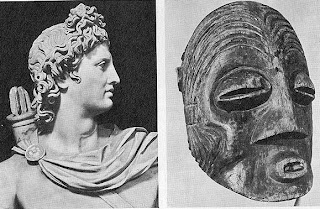
Whatever its merits as a work of art, I don’t think that there is any doubt that the Apollo embodies a higher state of civilisation than the mask. They both represent spirits, messengers from another world—that is to say, from a world of our own imagining. To the Negro imagination it is a world of fear and darkness, ready to inflict horrible punishment for the smallest infringement of taboo. To the Hellenistic imagination it is a world of light and confidence, in which the gods are like ourselves, only more beautiful.

It is not my intention to insult white nationalists. But what they ignore is that, presently, with their rock music and media tastes they themselves, like the overwhelming majority of the white population are, spiritually, far closer to the Negro mask than to the Apollo of Belvedere. For Lord Clark it would have been unthinkable to consider civilised the popular forms of cultural expression such as heavy metal and the movies that today are watched even by white nationalists throughout the West.

As we saw in some of my latest entries, other self-destructing forms of cultural expression already occurred in the times of the fall of the Roman Empire. Clark said:

The same architectural language, the same imagery, the same theatres, the same temples—at any time for five hundred years you could have found them all round the Mediterranean, in Greece, Italy, France.

What happened? It took Gibbon six volumes to describe the decline and fall of the Roman Empire, so I shan’t embark on that. But thinking about this almost incredible episode does tell one something about the nature of civilisation. It shows that however complex and solid it seems, it is actually quite fragile. It can be destroyed. What are its enemies? Well, first of all fear—fear of the supernatural, which means that you daren’t question anything or change anything. The late antique world was full of meaningless rituals, mystery religions, that destroyed self-confidence.

Unlike Gibbon and Nietzsche, before his TV audience Clark didn’t dare to point the finger at Christianity. But later in the program, Clark spoke about Islam:

In a miraculously short time—about fifty years—the classical world was overrun [by the Muslim conquests]. Only its bleached bones stood out against the Mediterranean sky. The old source of civilisation was sealed off, and if a new civilisation was to be born it would have to face the Atlantic.

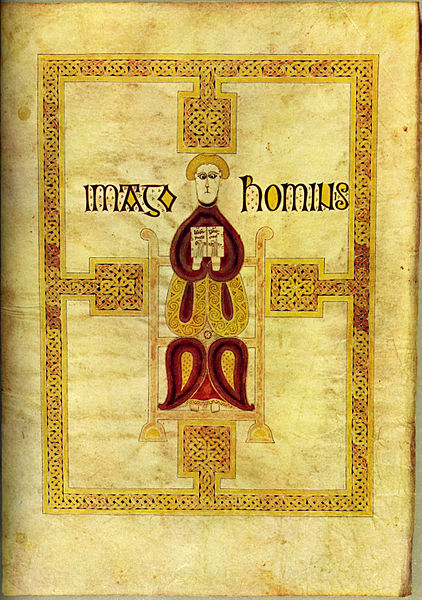
But something very odd happened to Man’s self-image in the early medieval world facing the Atlantic in what today is Ireland. According to Clark:

The subject of Mediterranean man was man. Two hundred years have passed—perhaps a little more—and man has almost vanished.

Crude as this imago hominis may be when compared to the Apollo, presently some white nationalists advertise their blogs with soft-porn pics of semi-nude women: something far more degrading for the divine human figure than the image of 8th century insular art in the Echternach Gospels.

To my mind—and, like Clark, I must say that this is only my personal view­—, the imago hominis only means a psychogenic regression in Man’s understanding of himself compared to the Greeks and the Romans. However, the white nationalists’ soft porn spits on the avatar of God, even if I don’t believe in the existence of a personal god.

After the above image chosen by Clark for the first episode of his program, in the following pages of the book version Clark mentions how St. Gregory destroyed entire libraries of the classical world (I quoted part of it in my recent antichristian series, here), and on the next page he states that even in those obscure days the Europeans fought strenuously against their enemies:

All great civilisations, in their early stages, are based on success in war. The Romans were the best organised and most ruthless fighters in Latium. So it was with the Franks. Clovis and his successors not only conquered their enemies, but maintained themselves by cruelties and tortures remarkable even by the standards of the last thirty years.

Without Charles Martel’s victory over the Moors at Poitiers in 732, western civilisation might never have existed, and without Charlemagne’s tireless campaigns we should never have had the notion of a united Europe.

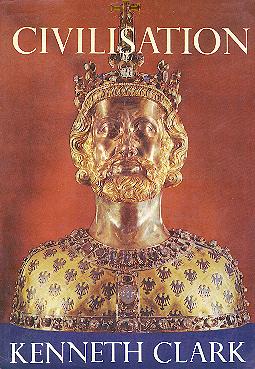
Charlemagne was the first great man of action to emerge from the darkness since the collapse of the Roman world. The old idea that he saved civilisation isn’t far wrong. On the whole, our whole knowledge of ancient literature is due to the collecting and copying that began under Charlemagne.

If we compared ourselves with the franks, what could it be said about present-day nationalists? Many of them don’t even let our most serious fighter discuss in their forums (by “serious fighter” I mean someone who’s actively planning a revolution). Didn’t the Führer say that those who want to live, let them fight, and that those who do not want to fight in this world of eternal struggle do not deserve to live? Do whites and white nationalists deserve to live? If so, where are the Charles Martels in today’s islamized Europe, in America’s mexicanized states?

I am not proposing to do something stupid in a world which media is a hundred percent dominated by the Enemy. But at least be prepared for the tough, revolutionary times that are coming after the dollar crashes.

Categories
Ancient Rome Christendom Emperor Julian Julian (novel) Libanius Literature Solitude

My impression on Vidal’s “Julian”

Our times are as decadent as the 4th century Rome of the Common Era, an age of treason that dragged our civilization straight into a dark night of the soul that lasted a millennium.

Tom Sunic is surely right in inviting would-be nationalists to become familiar with literature that balances the purely left-hemisphere, intellectual approaches to our western malaise.

The best historical novels ever written are Gore Vidal’s Julian (1964) and Umberto Eco’s The Name of the Rose (1980), which cover the gap that my high school skipped over: the zeitgeist of the peoples during Christendom, with Vidal covering its origins when the “Galileans” conquered state power to advance their cult, and Eco its apex in the fourteenth century.

This is my translation of what I wrote in the novel’s blank pages by the end of 1991, when I read a magnificent, hardcover English-Spanish translation of Julian that my girlfriend gave me as a present in Barcelona.

With pencil I wrote:

Now that I read the book, its antichristian message surprised me. What did the book-reviewers could have said?

I would feel appalled to know if the assassination of Julian was historical. I’ll have to check it out…

But the antichristian message of the last pages represents the moral of the story: the first clearly antichristian novel that I know. I wish that Kubrick makes a film of it instead of his dream about a Napoleon movie.

If I interpret the novel correctly, the emergent Christian authoritarianism was the storms harvested after the sowing of winds (the Roman state had persecuted the Christians before). But what makes me furious is that there were no groups that defended Hellenism with their teeth and nails!

What impressed me the most about the book is that it really makes one hate the Christians. I wish it had been published in those times! However, if the assassination of Julian by a fanatic Christian was not historical, Vidal could be accused of fabricating facts in search for drama. This is the most important event of my reading. I’ll find out next Monday when they open the library or perhaps even write the author.

I did go to the library and wrote to Vidal two decades ago but did not receive an answer. According to the Wikipedia article of today, the novel is historically accurate.

I wish I could know whether other assertions of the novel were historical. For example, Vidal makes Julian say in a specific moment (I only have the Spanish translation that Anabel gave me, so I can’t quote the original text) that “thirty years ago” Rome’s archives contained several contemporary reports about Jesus’ life, but they disappeared, destroyed by instructions from Constantine.

But the real climax of the novel are the words of Libanius, telling to himself in painful soliloquy after his most beloved, young disciple deserted him after converting to Judeochristianity that no invention from man can last forever, not even Christ: man’s most noxious invention.

Libanius was a historical figure, the one who claimed that Julian had been assassinated by a Christian. The novel ends with an aged Libanius feeling utterly alone in a world gone mad, telling silently to himself in the solitude of his study that the light of the world was gone with Julian, the last hope for our civilization; and that there was nothing left but let the darkness fall on the West and await for a new sun. A new day. In the future…

Categories
Literature Lord of the Rings Protestantism

The scouring

of the Shire

by Greg Johnson

After the destruction of the Ring and the downfall of the Dark Lord, Frodo, Sam, Merry, and Pippin return to the Shire only to find that it has been seized by aliens who have enslaved and robbed the hobbits and ravaged the land.

The returning veterans rouse their people to rebellion, killing many of the usurpers and driving the rest away. Then they discover who was behind it: the fallen wizard Saruman, who is banished from the Shire. Before he can leave, however, he is killed by his servant in crime, the treacherous Wormtongue, who is then felled by three hobbit arrows.

This chapter was omitted from Peter Jackson’s film trilogy (as well as Ralph Bakshi’s animated version), although Jackson does allude to it in two places. In The Fellowship of the Ring, when Frodo peers into Galadriel’s mirror, he has a vision of the hobbits enslaved and the shire blighted by dark satanic mills. In the extended version of The Return of the King, after the fall of Isengard, Merry and Pippin discover that Saruman’s storehouses contain products from the Shire, indicating some sort of contact.

But Jackson moved the deaths of Saruman and Wormtongue to the fall of Isengard. Wormtongue still kills Saruman, but he is dispatched by an arrow from Legolas. [see YouTube clip here] Thus when Frodo and company return to the Shire, they find it unchanged. Thus in Jackson’s telling, Frodo’s vision was just one possible future foreclosed by the death of Saruman at Isengard.

Still, I think it a shame that “The Scouring of the Shire” was not filmed, for it is a potent political allegory that remains relevant today. Most commentators simply note that the Scouring is based on Tolkien’s personal experience of returning from the trenches of World War I to find England a changed place. But the Scouring goes far beyond anything in Tolkien’s experiences. It is a work of imagination, a political allegory that far more closely resembles the experiences of German soldiers returning from the Great War to find a radically new, alien-dominated regime.

The Shire was subjugated as follows. After the fall of Isengard, Saruman was reduced to a wandering “beggar in the wilderness,” a refugee. But when he enjoyed power, the wandering wizard developed a far-flung network reaching all the way to the Shire, where he cultivated the friendship of Lotho Pimple.

The Shire was an agrarian, autarkic society of independent small farmers and merchants. Pimple, however, was sufficiently alienated and ambitious that he wished to change this social order. He wanted more land than he could work himself, and he wanted hirelings to work it, so he could grow rich by growing cash crops for export. In short, he wanted to be a big shot with a plantation.

By means of mysterious infusions of capital from outside the Shire (obviously from Saruman) Pimple managed to target economically troubled small holders for takeover (perhaps by loaning them money at usurious rates and then foreclosing when they could not pay), reducing them to employees on what was once their own land. Thus Pimple became a big man, styling himself Chief Shirrif and then just Chief. When Saruman and Wormtongue arrived as refugees, naturally Pimple took them in.

Having elevated the rootless and greedy Pimple to power, Saruman cozied up with the Chief and began to institute a new order. He brought in racially indeterminate aliens to intimidate and terrorize the hobbits. He also recruited hobbits of defective character — people who wanted to act big and meddle in other people’s business (in the internet age, we call them trolls) — to vastly expand the police force. This was necessary, because Saruman also vastly expanded rules and regulations in order to yoke and mulct the hobbits. Naturally there was discontent, so a vast network of spies and informants was created, as well as a courier service to swiftly convey reports and orders. Dissidents were thus easily ferreted out and imprisoned.

Society was collectivized. Private homes were replaced by ugly, cramped, ramshackle housing developments. Rationing was introduced to crush the hobbits’ spirits and lower their standard of living, freeing resources to be consumed by their new overlords or to be exported for cash. Leisure was restricted and work expanded. Handcrafts, which were fine for an aesthetically refined and ecologically sustainable subsistence economy, were replaced by heavy industry to produce exports for cash.

This industry was fueled by wholesale deforestation and fouled the water and the air. But the desecration of nature went far beyond the bounds of even economic necessity, betraying a hatred of nature and beauty as such. Saruman’s real goal was less to create a new world than to destroy the old.

Finally, to cement his rule, Saruman had his collaborator Pimple secretly killed once he had outlived his usefulness.

It is simply an error to reduce this all to an allegory of the endogenous rise of capitalism in England. For the role of Saruman indicates that this process was far from endogenous in the Shire. Nor was it in England, for that matter. Saruman represents an alien influence, specifically the Jewish spirit — rootless, alienated, materialistic, and ultimately nihilistic — which is incarnated both in Jewry and its extended phenotype, Calvinism and low-church Protestantism. (It was the Puritan Revolution that brought the Jews back to England.)

Yet Saruman’s takeover and elimination of Pimple does not resemble anything that happened in England. But it does resemble the revolution that deposed the Kaiser, followed by various Judeo-Bolshevik Putsches and ultimately the Jewish-dominated Weimar Republic. Furthermore, Saruman’s totalitarian system of spies and informants and his expropriation of small farms and seizure of their produce did not take place in England or Germany, but it did happen in Soviet Russia, leading to some of history’s greatest crimes against European man.

Thus “The Scouring of the Shire” is a political allegory applicable not just to England but to all forms of Jewish subversion of traditional society.

But it is also an allegory of how a people might regain control of its destiny. The hobbits have lost their freedom through salami tactics. Each day a little more of their freedom was sliced off, but not enough to cause a general rebellion, just a lot of passive grumbling, until finally, when the meaning of what was happening dawned on them, it was too late. Frodo and company, however, returned home after a long absence, and the change hit them all at once. It did not slowly demoralize and enervate them. It made them fighting mad.

And as war veterans, they knew something about fighting. The Shire was also lost because the hobbits were disunited and fearful, ultimately because they had enjoyed a soft and easy-going lifestyle. Frodo and his comrades, however, had been tested and hardened in the crucible of war. They were not cowed by alien bullies, no matter what their stature. They immediately resolved to rally their people and scour the Shire of the usurpers. The hobbits had been long groaning under the new regime. The veterans were the spark to the tinder.

A few opening skirmishes led to a climactic battle at Bywater, which left nearly 70 of the alien interlopers dead and the rest in chains or flight. Nineteen hobbits also lay dead. The hobbits then marched to Bag End to depose Saruman and send him packing without penalty. The prisoners were also sent on their way unharmed. These foolishly gentle policies toward murderers were justified by Frodo with effusions of moral and metaphysical clap-trap that remind us that, after all, this is children’s literature. Best we ignore him when our own enemies are at our mercy.

The closest historical analogy to “The Scouring of the Shire” comes from Germany, where various Freikorps groups — militias of demobilized veterans — put down Judeo-Bolshevik Putsches in Prussia and Bavaria. Furthermore, the successor of the Freikorps was the NSDAP, also led and staffed by veterans, which finally put an end to the Weimar Republic. It is a model worth contemplating today as thousands of white veterans return from a Jewish-instigated war in Iraq to face 30 percent unemployment in a homeland overrun and despoiled by non-white immigrants. They are a constituency just waiting for a leader.