web analytics
Categories
Adolf Hitler Art Table talks

Uncle Adolf’s table talk, 93

the-real-hitler


24th February 1942, midday

How great artists can serve their country.


I’ve learnt that young Roller has just fallen at the front. If I’d known that he’d gone out! But nobody told me. There are hundreds of thousands of men who could serve their country in no better way than by risking their lives for her, but a great artist should find another way. Can fate allow it that the most idiotic Russian should strike down men like that? We have so many men seconded for special duties!

What harm could it do to add to their number the five or six hundred gifted men whom it would be important to save? Roller is irreplaceable. We had only Sievert, Arent and Praetorius—Austria had given us the young Roller. Why didn’t Schirach warn me? I saw his Friedenstag. What a lovely thing! The young Roller was a brave man. Before the Anschluss he would have had to leave Austria. I’m convinced he went out as a volunteer.

I could have sent him anywhere at all, for personal reasons, if he hadn’t insisted on staying in Vienna.

Categories
Adolf Hitler Art Degenerate art Painting Rembrandt Table talks

Uncle Adolf’s table talk, 103

the-real-hitler


27th March 1942, midday

Jewish influence on German art
—Painting in Germany.


It’s striking to observe that in 1910 our artistic level was still extraordinarily high. Since that time, alas! our decadence has merely become accentuated. In the field of painting, for example, it’s enough to recall the lamentable daubs that people have tried to foist, in the name of art, on the German people.

This was quite especially the case during the Weimar Republic, and that clearly demonstrated the disastrous influence of the Jews in matters of art. The cream of the jest was the incredible impudence with which the Jew set about it! With the help of phony art critics, and with one Jew bidding against another, they finally suggested to the people—which naturally believes everything that’s printed—a conception of art according to which the worst rubbish in painting became the expression of the height of artistic accomplishment. The ten thousand of the élite themselves, despite their pretensions on the intellectual level, let themselves be diddled, and swallowed all the humbug. The culminating hoax—and we now have proof of it, thanks to the seizure of Jewish property—is that, with the money they fraudulently acquired by selling trash, the Jews were able to buy, at wretched prices, the works of value they had so cleverly depreciated. Every time an inventory catches my eye of a requisition carried out on an important Jew, I see that genuine artistic treasures are listed there. It’s a blessing of Providence that National Socialism, by seizing power in 1933, was able to put an end to this imposture.

Genuine artists develop only by contact with other artists. Like the Old Masters, they began by working in a studio. Let’s remember that men like Rembrandt, Rubens and others hired assistants to help them to complete all their commissions.

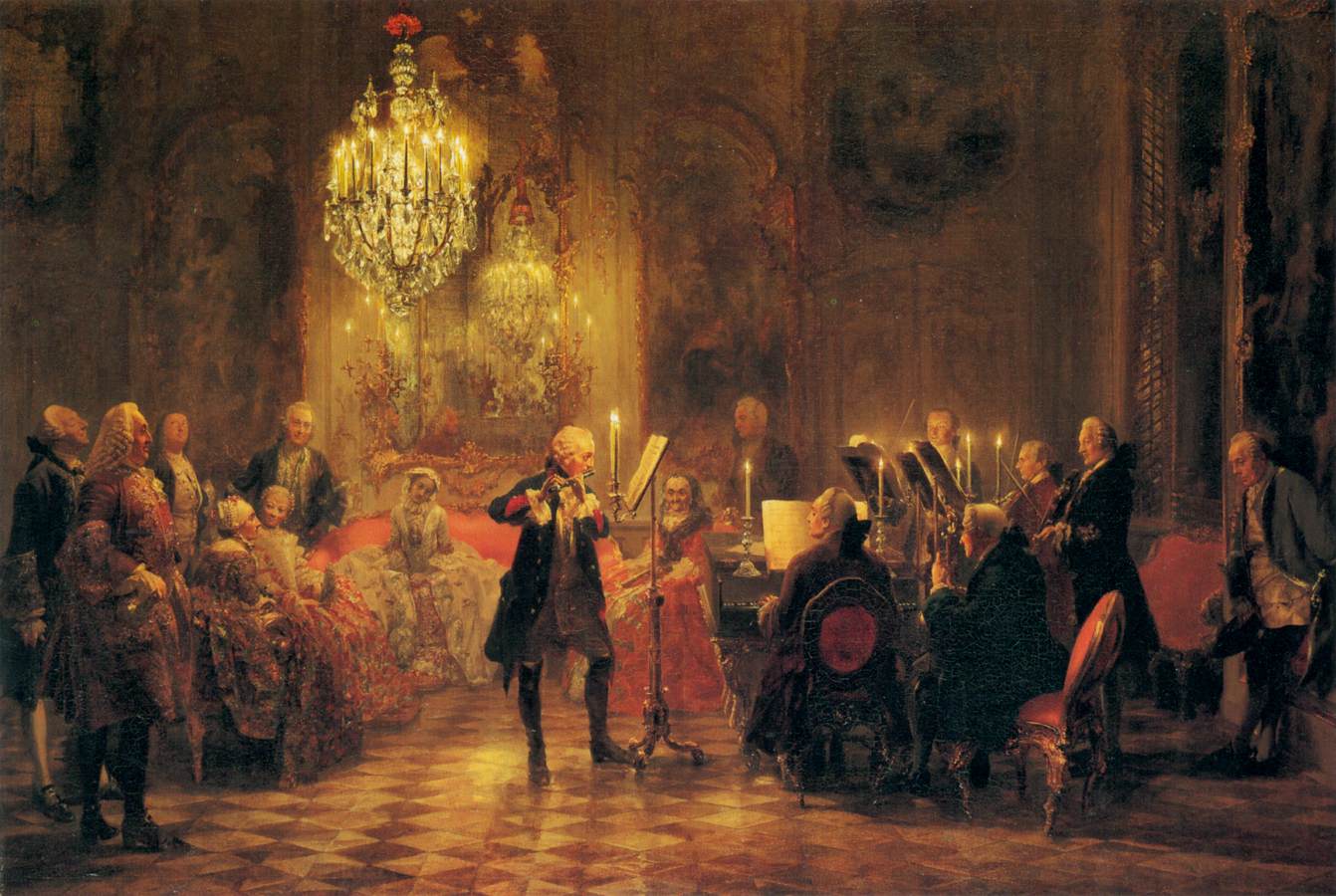
Amongst these assistants, only those reached the rank of apprentice who displayed the necessary gifts as regards technique and adroitness—and of whom it could be supposed that they would in their turn be capable of producing works of value. It’s ridiculous to claim, as it’s claimed in the academies, that right from the start the artist of genius can do what he likes. Such a man must begin, like everyone else, by learning, and it’s only by working without relaxation that he succeeds in achieving what he wants. If he doesn’t know the art of mixing colours to perfection—if he cannot set a background—if anatomy still has secrets for him—it’s certain he won’t go very far! I can imagine the number of sketches it took an artist as gifted as Menzel before he set himself to paint the Flute Concert at Sans-Souci.

Adolph_von_Menzel_-_A_Flute_Concert_of_Frederick_the_Great_at_Sanssouci

It would be good if artists to-day, like those of olden days, had the training afforded by the Masters’ studios and could thus steep themselves in the great pictorial traditions. If, when we look at the pictures of Rembrandt and Rubens, for example, it is often difficult to make out what the Master has painted himself and what is his pupils’ share, that’s due to the fact that gradually the disciples themselves became masters.

What a disaster it was, the day when the State began to interfere with the training of painters! As far as Germany is concerned, I believe that two academies would suffice: in Düsseldorf and Munich. Or perhaps three in all, if we add Vienna to the list. Obviously there’s no question, for the moment, of abolishing any of our academies. But that doesn’t prevent one from regretting that the tradition of the studios has been lost.

If, after the war, I can realise my great building programme—and I intend to devote thousands of millions to it—only genuine artists will be called on to collaborate.

Categories
Adolf Hitler Architecture Art Beauty Table talks

Uncle Adolf’s table talk, 126

the-real-hitler


Berghof, 1st May 1942, midday

Architectural problems—Our architects must plan on a grand scale—Bayreuth, Weimar and Dresden—Development of cultural life.

I am very grateful to Professor Giesler for having so successfully transformed the Schloss Kiessheim, which is to be our Guest House for distinguished visitors and which was opened in its new rôle by a visit from the Duce. The general lay-out, which corresponds so closely to my own ideas of spaciousness, pleases me particularly.

Giesler has planned on a grand scale. He has succeeded in leaving vast spaces between the portals and the staircase, and between the staircase and the entrance to the reception halls.

A sense of spaciousness is important, and I am delighted to see our architects planning on broad and spacious lines. Only thus shall we avoid the springing up of more towns in which the houses are cluttered up almost on top of each other, as one sees in Zwickau, Gelsenkirchen and so on.

If I were banished to a town of this kind, devoid of all beauty, I should lose heart and happiness just as surely as if I had been banished from my fatherland. I am therefore determined that some measure of culture and beauty shall penetrate even into the humblest of our towns, and that, step by step, the amenities of all our towns will reach a higher level. There is a lot of truth in the assertion that the culture of a town is dependent upon its traditions. Bayreuth, Weimar and Dresden afford classic examples.

It is not sufficient that a town should have a museum which the students occasionally visit; our representative must see to it that the men of the Labour Service and the Wehrmacht find it worthy of visit, and that gradually in this way the interest in, and the appreciation of, art will be aroused throughout the masses of the nation. The eye of the children must be weaned from the niggardly and trained on the grandiose, for only thus will they learn to appreciate both the ensemble and the finer points of any work of art.

Categories
Adolf Hitler Art Berlin Richard Wagner Table talks

Uncle Adolf’s table talk, 127

the-real-hitler


3rd May 1942, at dinner

Berlin must not monopolise the resources of the Reich—Berlin is not an artistic city—The choice of Nuremberg.
 
When I think of Bayreuth, I am invariably worried by the thought that one day we may have to appeal to the State for financial aid for the maintenance of its cultural institutions and surrender the administrative control of the city into the hands of the ministerial bureaucrats. This is one of the reasons why I am so interested in the two sons of Frau Winifred Wagner. I hope very much that they will prove capable of carrying on the great work of their parents. As long as I live, I shall always do everything in my power to maintain the prestige of Richard Wagner’s city. I see no better method of safeguarding cultural centres than to confide them to the safe-keeping of the cities which contain them.

Brilliant city though Berlin undoubtedly is, I doubt whether we can make of it a metropolis of the Arts. As a metropolis of political and military power, it is ideal, as I realised on the occasion of the procession organised for my last birthday. But the atmosphere of Berlin is not the atmosphere of an artistic city.

We have no reason for allowing any other town to attain the stature of Berlin. The Reich can be well content with one town of five million inhabitants, Berlin, two towns—Vienna and Hamburg—of a couple of millions, and quite a number which approach the million mark. It would be extremely stupid further to enlarge our great cities and to canalise all cultural activity towards them. I said one day to Christian Weber that it would be ridiculous to incorporate Starnberg into Munich. To preserve its own character, Munich must remain as it now is.

Had I so wished I could have arranged for the Party Congress to take place in Munich. But as I wished as many towns as possible—big, medium and little—to participate and to become centres of German cultural life, I suggested to the Party Committee that we should chose Nuremberg for our Rallies, and our annual gathering there must, I think, give the city for ten days the atmosphere of the Olympic Games Festivals of ancient days.

Categories
Adolf Hitler Art Mozart Table talks

Uncle Adolf’s table talk, 135

the-real-hitler


30th May 1942, midday

The rôle of Vienna—Death of Mozart—Artists should be supported before they die!
 

It should be the task of any reasonable culture policy to discover talent early, to encourage and foster it, and so give it the opportunity of reaching its highest fruition for the benefit of both the present and posterity.

During the last few centuries, the Viennese, who always used to set such store by the cultural standards of their city, have neglected this most important principle of cultural policy in an almost insanely irresponsible fashion. For example, they actually allowed a genius like Mozart to starve. He was even buried in a pauper’s grave, they say, and now no one knows where he lies. Like him, too, Bruckner and Haydn would have been allowed to die of hunger, if they had not found patrons in the Bishop of Linz and the Prince von Esterhazy respectively.

These examples show that the Viennese, like the people of Munich, owe their accumulation of artistic wealth solely to their rulers. Between the Viennese and the people of Munich, however, there is this vital difference, that the latter do show a measure of appreciation to their living artists, while the former wait until an artist has been dead for perhaps centuries and has acquired an international reputation before giving their approval.

Our own cultural policy can learn a lesson from this. It is, that artists who do good work must be assured of recognition in goodtime. It is for this reason that I have caused to be organised the arts exhibition in the House of German Art in Munich, and not merely because I wished to give the already famous a chance to exhibit, where their works will be seen by the whole world. By far the most important object of this exhibition is to seek out the best of German creative art.

Categories
Adolf Hitler Art Painting Pedagogy Table talks

Uncle Adolf’s table talk, 143

the-real-hitler


30th June 1942, at dinner

War as an inspiration in art—
reform of the Art Academies.


This war is stimulating the artistic sense much more than the last war. The works of the artists whom I have recalled from the front after a year or two in the field bear the hall-mark of personal experience and are among the most valuable examples of present-day art that our exhibitions can show.

These war paintings establish beyond discussion that the real artist is ripened by his own personal experience of life and not by study in some art academy. Most of the academy professors lack both the insight and the judgment necessary to bring real talent to the fore. Recall, if you please, how the beautiful seascapes of von Bock were refused by the Prussian Academy, although in their wonderful sweep they alone of current paintings gave a true picture of the northern seas. This same Prussian Academy which rejected these pictures was, however, not ashamed to adorn its walls with absolute muck.

Even in my exhibition in the House of German Art they always try to gain acceptance for the daubs of their own protégés. But when it comes to flinging these confections out, I am exceptionally obstinate! My views on the value of the academies are well known. And under present conditions it is difficult to see how talent, other than that which in practical life is incapable of producing a real picture, can be injected into the art schools as they are now constituted.

It is a characteristic of the present-day academies that they invariably try to stifle genius. No sooner does a real genius make his appearance in the circle of these very moderate “big-wigs” of the academies, than up they rise with their whole plumage ruffled in wrath against him.

If we wish to smoothe the way for an incipient genius in the academies and ensure him a practical livelihood in spite of the academies, then we must radically alter the whole structure of the academic world. They must be split up into a series of individual studios, on the lines of the State studios. Then the greatest artists available must be approached and asked if they would care voluntarily to take over one of these studios. Those who agree must be allowed a completely free hand, themselves to chose those pupils whom they consider worthy of further tuition.

If we organise the academies along these lines, then all the nonsense, claptrap and jargon, and all the juggling with mathematical formulae—a nonsense that only the sparrow-like brain of mediocrity could have conceived—will stop. And the great task of the academy will be, first, last and always, to teach the pupil to paint.

I always get angry when I think of how in the teachers’ training colleges the future school-teachers are stuffed with an inchoate mass of material, when all they will be called upon to do later is to teach the children the rudiments of the three Rs.

What special knowledge, for goodness’ sake, is required to teach six-year-old kiddies to say a, b, c correctly! It is equally ridiculous to try to cram children at school with all sorts of things. If you ask them, two or three years after they have left school, you’ll find that they have forgotten practically all about them. The curriculum of a school should be drawn up with the object of teaching the children those things which will enable them in after-life to take their places as decent citizens. And keep the children as much as possible in the open air! We shall then have a healthy rising generation, capable of roughing it without falling on their backs.

Categories
Adolf Hitler Art Table talks

Uncle Adolf’s table talk, 177

the-real-hitler

28th August 1942, evening

Some German towns must be protected at all costs—Weimar, Nuremberg, Stuttgart. Factories can always be rebuilt, but works of art are irreplaceable.

Categories
Adolf Hitler Architecture Art Degenerate art Painting Table talks

Uncle Adolf’s table talk, 186

the-real-hitler


13th June 1943, evening

The French painters—The great artistic achievements of the nineteenth century were German—Architecture in Munich.
 

I cannot make up my mind to buy a picture by a French painter, because I am not sure of the dividing line between what I understand and what I do not understand. I have the same feeling when I look at paintings by Corinth and Trübner—to mention only two of our German artists. These men started by painting pictures of great merit, and then, urged on by pride, they started to produce the most startling and extraordinary works. In literature the Jew has already blazed the same pernicious trail, and artists like Corinth and Trübner have followed them. The result is the frightful daubs with which they now inflict us.

In painting, the Italians were truly great from the fourteenth century to the seventeenth; in the eighteenth century they rested on their laurels, in the nineteenth their light began to wane, and today Italian art is completely degenerate. All this seems quite incomprehensible to me, but I suppose it is the law of averages. In the nineteenth century the greatest masterpieces in every branch were the works of us Germans. In the same period the French, too, had some good artists, but they all deteriorated in time.

When I think of the Paris Opera House, I cannot help feeling that those of Dresden and Vienna are in a very different category. The design itself of the Paris Opera is a work of genius, but the execution, from the artistic point of view, is very ordinary; and the interior is pretentious, overcrowded with decoration and devoid of all artistic taste. We must make sure that the new Opera House which we intend to build in Munich surpasses everything, in every way, that has ever gone before it.

The Palace of Justice in Munich is perhaps the most beautiful example of the baroque of recent times. Typical of the epoch of liberalism is the Palais de Justice in Brussels. It is a cyclops which dominates the whole town; and fancy having the Law Courts, of all things, as the dominating feature of a place! I am quite sure that a man is never more ready to fight for his country than when it is a question of defending the artistic and intellectual heritage of the nation. We have a fresh proof of it today. The destruction of a national monument has a greater effect on public opinion than the destruction of a factory.

_____________________________

Consider obtaining a copy of the complete notes
published by Ostara Publications.

Categories
Adolf Hitler Art Degenerate art Table talks

Uncle Adolf’s table talk, 187

the-real-hitler
 
15th June 1943, midday

Intellectual and artistic poverty—Only decadent art is harmful—Teutonic nostalgia—The need of open spaces.
 
The industrialisation of a country invariably provokes an opposite reaction and gives rise to a recrudescence of a certain measure of romanticism, which not infrequently finds expression in a mania for the collection of bibelots and somewhat trashy objets d’art. It is a phenomenon which recurs with each fresh migration from the land to the town. It is not the museums and the picture-galleries which attract these newcomers, but the vaults which foster the liking for the mysterious, like the blue grotto of the nymphs. The process of readjustment takes fifty or a hundred years.

Unfortunately, the period of economic and industrial progress in Germany coincided with a period of artistic hesitancy and poverty. One cannot, in justice, blame the masses, when one remembers the artistic junk with which the big industrialists filled their houses. But the latter were people of intelligence, and them I blame greatly.

The masses are still attracted by somewhat trashy art, but that has nothing in common with artistic degeneracy. If I am asked whether I am prepared to condone this, my reply is that I will condone anything which does not lead to artistic depravity.

The admiration for what we sometimes call chocolate-box beauty is not of itself vicious; it gives evidence, at least, of artistic feeling, which may well become later the basis for real taste. Permanent injury is done only by real depravity in art. It is perfectly true that we are a people of romantics, quite different from the Americans, for example, who see nothing beyond their sky-scrapers. Our romanticism has its origins in the intense appreciation of nature that is inherent in us Germans.

Properly to appreciate such artists as Weber, Ludwig Richter and the other romanticists, one must know Franconian mountains, for that is the background which gives birth to romanticism in both music and painting; and, of course, the stories and legends of our folklore also make a potent contribution.

The only romance which stirs the heart of the North American is that of the Redskin; but it is curious to note that the writer who has produced the most vivid Redskin romances is a German.

One thing the Americans have, and which we lack, is the sense of the vast open spaces. Hence the particular characteristics of our own form of nostalgia. There comes a time when this desire for expansion can no longer be contained and must burst into action.

It is an irrefutable fact that the Dutch, for example, who occupied the most densely populated portions of the German lands, were driven, centuries ago, by this irresistible desire for expansion to seek ever wider conquest abroad.

What, I wonder, would happen to us, if we had not at least the illusion of vast spaces at our disposal? For me, one of the charms of the Spessart is that one can drive there for hours on end, and never meet a soul. Our autobahns give me the same feeling; even in the more thickly populated areas they reproduce the atmosphere of the open spaces.

_____________________________

Consider obtaining a copy of the complete notes
published by Ostara Publications.
Categories
Adolf Hitler Art Music Richard Wagner Table talks

Uncle Adolf’s table talk, 189

the-real-hitler


1st March 1944, midday

A nursery for film actors—Futility of the art critics—Weber’s Freischütz and Bizet’s Carmen.
 

It is often said that among our film actors we have none capable of playing certain parts—that, for instance, of the hero. This type of artiste, they say, is non-existent. I have never heard such nonsense. But to find them, you must, of course, look for them. Producers make the mistake of seeking always in the same old circle—the stage and the theatrical agencies. If they would look elsewhere, they would soon find what they want. One has only to think of the splendid types of manhood to be found even now, after five years of war, in our regiments.

Some years ago, before the war, I passed a camp of the Labour Service at Bergdorf. Immediately my car was surrounded by a crowd of bronzed and laughing young men. I remember remarking to one of my companions: “Why don’t our film producers come to places like this in search of talent? In a year or two it would be possible to transform one of these lads into an accomplished actor, even if it were just for one particular part for which they are seeking a star.” In this respect Leni Riefenstahl has the right idea: she scours the villages in search of the peasant types she requires.

In the nature of things, the opinion of an art critic must not be accepted as an irrevocable and unassailable truth. His criticism is, after all, only the expression of his own personal opinion.

When in ten different newspapers ten different critics give their opinion on one and the same work, ten separate personal opinions emerge—unless, of course, they have previously received instructions from interested parties. Has such an opinion any value? I doubt it. We are too prone to forget that the ancients disregarded the art critic. They judged a work on its merits, as they saw them, which, after all, is the natural method of selection. Art criticism, as it has developed since the beginning of the nineteenth century, means either the death of a work of art, since the critics never cease to tear it to pieces; or the death of the press, since the public could have no faith in a press in which the critic of each individual newspaper gives a completely different story on exactly the same work.

If we were to be deprived of art critics, we should not lose very much! One single critique signed with a well-known name may destroy the aspirations of an artist for as long as twenty years.

Examples are not lacking. How many of the artists whom we admire greatly today were previously castigated by the oracles of the times! What is true of painters is true of artists in other fields.

Hoffmann was sufficient gravely to prejudice the chances of success of Der Freischütz. And yet this work, with its deep harmonies, had all the ingredients which should have appealed to the romanticism in Hoffmann. Think of Wagner and how he was torn to bits for ten years by the critics! Had there been no one who appreciated him, it is questionable whether he would have continued with his work. The same thing happened with Carmen. And now the critics who tore these masterpieces to shreds are completely and utterly forgotten, and the works live on.

_____________________________

Consider obtaining a copy of the complete notes
published by Ostara Publications.