I’ve been posting very short entries, sometimes just quotes, because I’m not only proofreading my Hojas Susurrantes for the edition Lulu Press will print this year, but also making some revisions and adding more images to the book.
It’s quite a strange thing, and Benjamin is going through the same process. Until we manage to establish a Syssitia in the country where I live and buy a small publishing house after the dollar collapse sends our stocks into the stratosphere, we have no choice but to revise and revise our books…
A Lulu “edition” sometimes consists of a single copy; say, a print run of Hojas Susurrantes that I gave to a friend five or twelve years ago. Alas, the relatives to whom I’ve sent copies of my Hojas Susurrantes or other books of my trilogy don’t say a word! Talking about family tragedies where the parents are the villains is a much deeper taboo than, say, the racial realism that Jared Taylor preaches. Egalitarians might try to contradict Taylor’s arguments about IQ differences between blacks and whites, but in my case my relatives don’t say a peep: the taboo is absolute.
The exception was my cousin Leonora. But of course, she too was abused by my parents and suffered terrible depression when she married a Canadian and emigrated to Victoria. Apparently, only the victims whose lives were shattered by the same people were able to listen to me.
Leonora died on May 10, 2015; my sister Corina the following year; and Octavio, Leonora’s brother, committed suicide in 2018. Now I am the only survivor who can tell our tragic stories.
It’s incredibly frustrating not to have a publishing house to promote our work. What I usually do is, when I review an “edition” of Hojas Susurrantes or any other book of my trilogy, I give the outdated copy to a relative or friend. But as I said, it’s incredibly rare to find someone with enough empathy and compassion to understand the content of an autobiographical confession about a family tragedy.
The first person to do so was my friend Paulina. When I was living in Houston in the mid-90s, she read my Letter to Mom Medusa (though she read it in Spanish, of course) and felt a lot of sympathy for the 17-year-old I was. Twenty-two years had to pass after 1976 before I found Pau: someone with the necessary compassion to understand a tragedy that left me half-destroyed, forcing me to take menial jobs in the neighbouring country to the north.
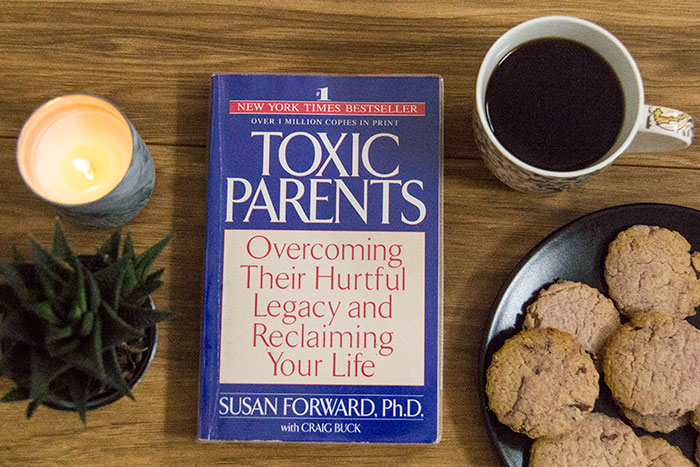 A book I highly recommend, which helped me tremendously to understand my dysfunctional family, is Toxic Parents by Susan Forward. If those visitors who commented on this blog and then announced they were going to commit suicide (and apparently did) had done the inner work that Ben and I did, perhaps they wouldn’t have taken their own lives.
What I realised during a long, dark night of the soul, like Dante’s in the dark wood before his Beatrice appeared, is that only writing down one’s own story is therapeutic. Group therapy sessions aren’t as therapeutic because verba volant, scripta manent.
In other words, only by reading my old diaries from many years ago did I escape a gnawing anxiety because it became increasingly clear that I was the victim (as were Leonora, Corina, and Octavio). But none of them first put their tragedy down on paper in a very raw way in diaries—the “coal”—and then subjected that coal to tremendous pressure to produce a literary diamond.
I was saying that these days I’ve been reviewing the syntax of my Hojas Susurrantes which comprises five large chapters, but I’ve also been dealing with a family problem lately.
One of the things Sue Forward says in Toxic Parents is that children who weren’t abused become infinitely selfish with their abused siblings, to the point of not even acknowledging that those siblings were in fact abused as children, or wanting to see any of the psychological toll that such abuse caused.
That’s exactly what has been happening to me with my surviving siblings these past years, months, weeks, and days. I won’t go into details because it would take a whole book. But it’s something like a family tragedy that never ends, not even after our parents died, because the evil has been inherited by some of the children. Those who weren’t abused behave horribly toward their abused siblings because they live in utter denial of what happened.
Those who have the problem of siblings living in abject denial should read Forward’s book. The fact that it was a bestseller shows that the taboo surrounding toxic parents has begun to break down.
Presently, what impresses me most about that book are the pages where Forward talks about how the unabused siblings react to the testimony of the sibling who was abused. It seems like a perfect portrait of how my four surviving siblings have been treating me (or how they treated the now deceased Corina and Leonora)! A true nightmare, which becomes much less nightmarish once you learn that it’s a very common phenomenon in families with toxic parents!
In other words, the only way out of depression is to tell the truth to everyone, even if 99 per cent of those we talk to don’t want to listen. The remaining one per cent, in my case Paulina, became my Beatrice (what Alice Miller calls a “knowing witness”). People commit suicide because no witness has ever appeared who was willing to listen to a family tragedy.
Incidentally, so-called psychotherapists are trained never to listen to tragedies in which the parents were responsible for a mental condition in the abused child, as I demonstrate in this book (the second chapter of my Hojas Susurrantes): a copy of which Ben kindly sent to Kevin MacDonald by mail.
Only a friend, preferably a compassionate woman, can become a Beatrice. I say woman because, although I’m not romantically involved with Paulina, I’ve often touched her hands in a friendly gesture, and she’s touched my shoulder (for obvious reasons, that’s much harder to do with a man).
2 replies on “Sue”
Well, César, bar you (and some of the commenters on this site, in part: I don’t get their thoughts) I can – and it’s not happily – say that no one in the world (bar my now-dead mother) has read Consumption – or if the have, I haven’t had any feedback that they have. I thank you for having promoted it here.
My supposed ‘best fried’ from childhood – my only real schoolfriend – Alistair, tells me (like your siblings in some sense) that he ‘doesn’t need to read it’ as he ‘knows it all already’ – but this is a gross presumption on his part considering he has never broached the matter, in all our years of ‘friendship’, and indeed continues on as if nothing could ever have been wrong, or, even, that nothing is wrong in the present, lingering. I think he likes to deny dysfunction on my part, both by how his ego likes to perceive me, and also on account of a conservative, upper class English ‘stiff upper lip’, where to admit pain – even on the part of another – would be as much as social ostracism for him, by proxy, some awkward embarrassment. His staunch Protestant work ethic is still unsympathetic to my current difficulties.
I think I drew back from suicide as a concept when I realised I could easily perform so, and had done (fairly effectively – multiple ghastly incidents testify to to that), and somehow knew I should not, as, eventually, I realised I was not fully to blame for my circumstances (for my earliest circumstances, not at all), and that something was indeed to be striven for in life, and gained. Beyond this, once I discovered NS, in my mid thirties, my words to AS (in another recent post) applied to me as well.
You are luckier than me (and I don’t think I envy you, maybe a little) in that you have Paulina. I have never had anyone in my personal, day-to-day physical space hear and understand my story, and comment on it sympathetically – I wouldn’t think it probabilistically likely in the modern UK that anyone would care. I expect it will be the same for quite some time, if not until death. A few people knew a few things; they’re all dead now though, and the never knew much of it.
It solidifies my great anger towards the world – despite my laboured writing style, I’m an abrupt, angry person – and I think it makes me more effective. I would be a hardened leftist, I’d imagine, had I not found National Socialism first. Knowing my story will never be externally ratified keeps me in rage. Hence my desire, as with you, for brutal exterminationism, and for the punishing of Christians and those sold to Christian ethics – those who honour the Aryans parent(s) irrespective of all they do; those who pass the buck completely to save looking themselves in the mirror – and for a successful outcome, in times of collapse.
I have punched holes in plaster walls before with this anger; bloodied my knuckles… banged me head, looking for release. Re-breaking a man’s already broken, healing leg when he insulted my personal past, picking him up by the neck against the wall of a psychiatric unit and shoving him to one side. It’s better than depression. I hope for our publishing house in due course.
Currently, I’m still revising TLTJH, even beyond fourth edition. I have more I could say on my past history, but Consumption tired me to write, and has still faded to nothing, almost instantaneously. The dissident right in general has ignored the poor lesson of Thales of Miletus. They can blame the Jews all they want (as I do to, some degree – the degree that they are impactful) but by ignoring our own people – even in this negative capacity – we do a disservice to our race. We certainly don’t defend our own, hell, we barely give them the polite time of day… so quick to look for those bogeyman Judaic others (or some other superficial excuse). It makes me sick, long term.
Sorry this response has been very long.
You don’t need to apologise.
Ditto!
What you say in the last few paragraphs is what motivates me to have this blog. White nationalists still haven’t looked in the mirror. If the Aryan Man did, he would see a monster: a monster whose Xtian ethics have empowered Jews, not the other way around which is what WNsts believe.