Green
Yesterday I rewatched the movie Soylent Green, which I saw on the big screen in 1973.
Those were times when the System hadn’t yet completely poisoned the minds of whites to the point of making them believe there was a war between male and female, and that the System was going to protect females through legal and cultural reforms…
I was particularly struck by the scene where police officer Robert Thorn (Charlton Heston) enters the party of Shirl, a beautiful young woman referred to as “piece of furniture,” who had been assigned as a sex slave to a wealthy, although very humane, shareholder (the party takes place after the shareholder was murdered by the Soylent company).
Thorn arrives at the party and, although he defends the women from the concierge’s abusive behaviour, the way he takes a glass of ice from a beautiful blonde, and momentarily a cigarette from another young woman (he takes a drag and gives it back), as well as ordering Shirl to go straight to bed, portrays how the culture at that time perceived male-female relationships.
There’s another scene, my favourite in the film: when Sol Roth (Edward G. Robinson), an elderly former teacher and Thorn’s deputy, realises that the cookies the government distributes to the hungry and unemployed town are made from recycled human waste, and decides to go to the local euthanasia centre.
“Home” is a public institution where people can go to end their miserable lives in a calm and peaceful environment, with images and videos. In fact, at “Home” Roth can enjoy, for twenty minutes before dying, classical music (we hear the opening bars of Beethoven’s Pastoral Symphony) and beautiful scenes of nature, in which we can see what the world was like before the ecological disaster.
The preceding scene, when Sol walks towards Home, fascinates me for many reasons.
For a decadent society like ours to have “Homes” everywhere for those who can no longer endure living in the West’s darkest hour, it would first have to overcome Christian ethics. Very few people know that psychiatry is based on these ethics, even though it is presumably a medical profession and one hundred per cent secular.
In reality, if the ancient Greeks already knew the trauma model of mental disorders—that is, that some parents drive their children mad (as Clytemnestra drove mad her daughter Electra)—it was simply because the Greco-Roman world lacked the commandment to honour your parents. The Greek playwrights who wrote family tragedies saw things as they were and called a spade a spade.
Given the Aryan’s enslavement to the Fourth Commandment, in Christendom blaming parents was done indirectly, as revealed in fairy tales (in addition to that post, I also uploaded others about Snow White, Hansel & Gretel, and Peter Pan). In the 21st century, the Fourth Commandment persists in secular writers. In the Harry Potter books and films, for example, there is the same shift we observe in the aforementioned fairy tales: from Harry’s parents to his uncle and aunt to avoid touching the parental deities (the perpetrators in real life).
Now then: psychiatry blames the brains of children with disorders or suicidal ideation without any proof that their condition is biomedical, as Robert Whitaker says in this brief clip. And if it dismisses the trauma model without refuting it, it is due to its neochristian ethics: never taking parents off their pedestal. I discuss this in a passage of my trilogy, and I believe I’m the first critic of the profession to connect Christian ethics with this pseudoscience taught in medical schools.
But I’ve gone way off on a tangent. I was saying that my favourite scene is when Sol walks on his way to Home to be euthanised in a very pleasant ceremony.
For the West to have free euthanasia centres for those who can no longer endure this nightmare, with branches of “Homes” everywhere, it would have had to first reject Christian ethics.
In the Middle Ages, suicide or suicidal ideation was considered a sin of divine lèse-majesté because it was assumed that only God (that is, the god of the Jews) had the right to take a life, even one’s own. But almost no one knows that after the so-called Enlightenment, this divine lèse-majesté sin was renamed in psychiatry as “brain disorder of unknown aetiology.” That is to say, the Christian and atheistic neochristian moral compass is the same. The pseudoscientists simply replaced one myth with another, while suicide or assisted suicide was tolerated in pre-Constantine Rome, given that the Romans didn’t then obey the commands of the Jewish god. The transition from divine lèse-majesté to “biomedical entity of unknown aetiology” (that is: no biological marker yet found) was an axiological alchemy whose substrate had always been a Judeo-Christian mandate internalised in the Aryan collective unconscious.
What I liked about the Soylent Green scene since adolescence was that it offered a release from the horrors of that dystopian world for an old man, Sol, who lived only on nostalgia, having lived in times before the environmental and demographic collapse we see in the film. What fascinated me most was the moment when Sol arrived walking to Home, and a very pleasant girl opened the door for him before he even knocked. That’s the kind of white women I saw in my day, and my longing for them is endless!
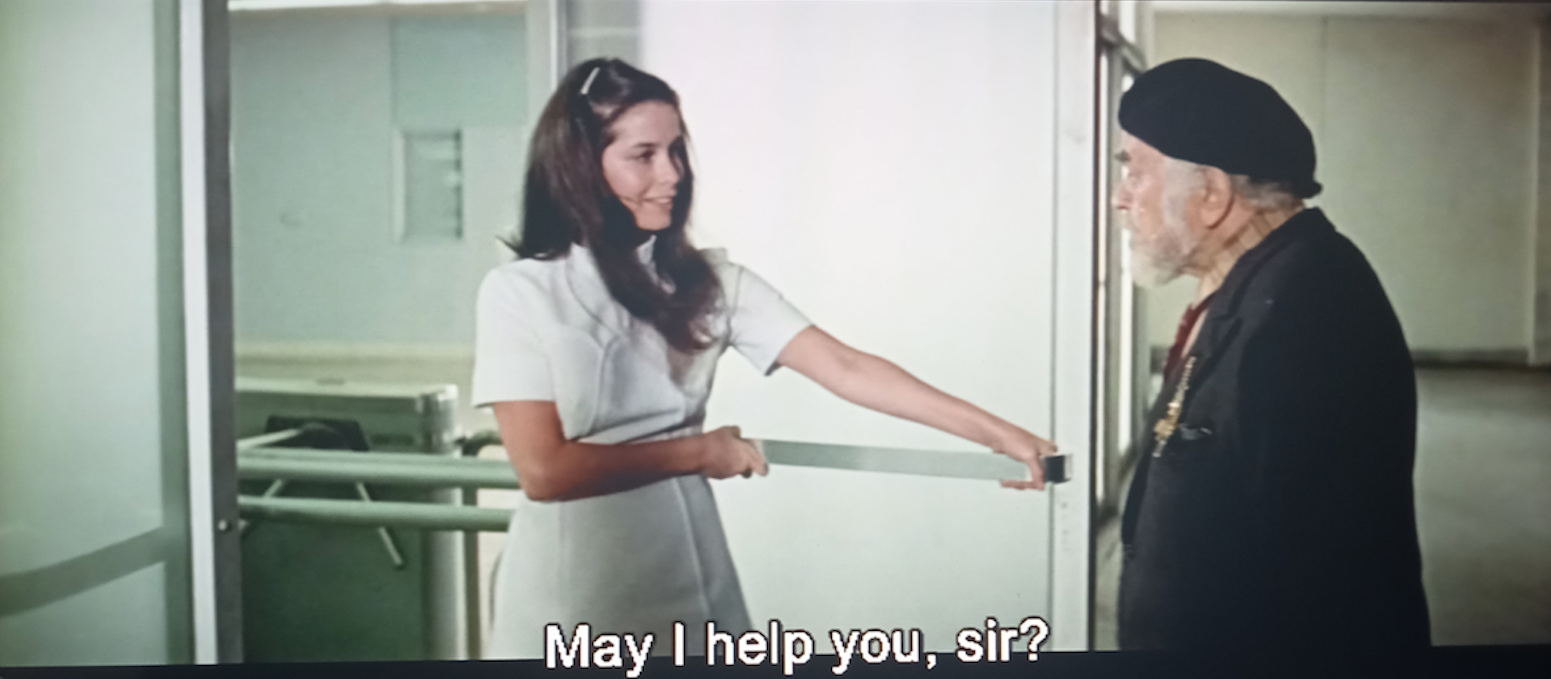
Although there are few white people in Mexico, I remember their mannerisms, and it fills me with great nostalgia to recall memories of women behaving like women!
Since my mind was formed in the 1960s and the first half of the 70s, I retained that image of women. So when I see for a few seconds the films made today, with extremely masculinized women and extremely feminized men—the opposite of the woman above or officer Thorn—, I feel such infinite repulsion that I not only stop watching the audio-visual monstrosity that the System puts in front of me, but I can’t even talk to those who enjoy such things!
The saddest thing of all is that people of my generation seem to have forgotten those traditional male-female roles (even though as kids they also saw films like Soylent Green on the big screen), and they jump on the Ship of Fools, watching and enjoying what is being done in the film industry today.
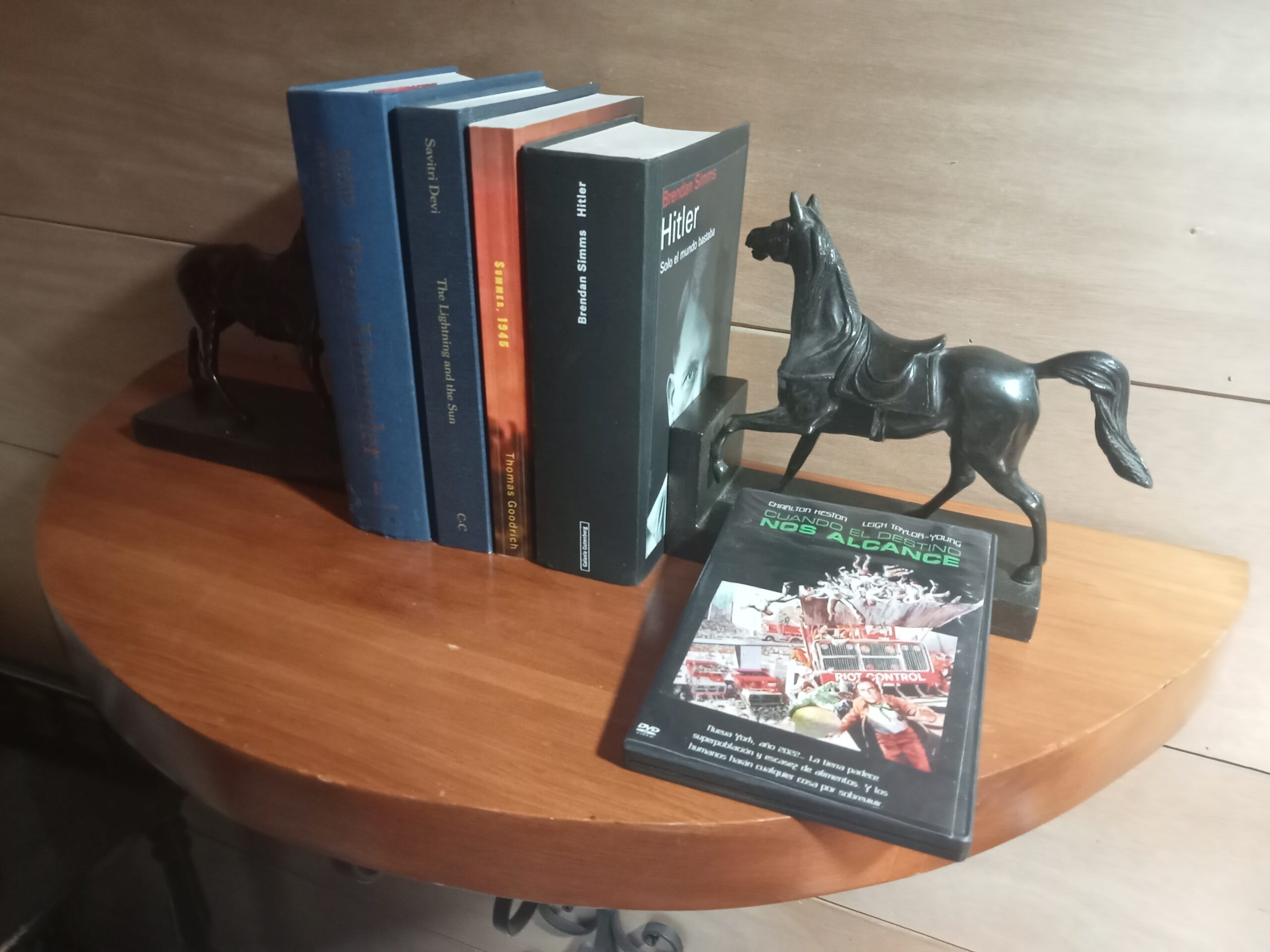
The DVD with the title they gave it in Spanish on a shelf in my studio.
In my day, there were cafes in Mexico City where some men, descendants of Spaniards, would go to chat in the afternoons. Now there’s nothing like that anymore. After my workday (basically proofreading my trilogy), it’s sad that I have to watch a movie like the one I saw yesterday because those cafes are gone and I can’t talk to anyone in this city of over twenty million inhabitants! And since I naturally don’t watch the FIFA World Cup 2026 matches (Mexico played against Korea yesterday), at least yesterday I could take refuge in one of the DVDs I have of movies I saw as a kid…