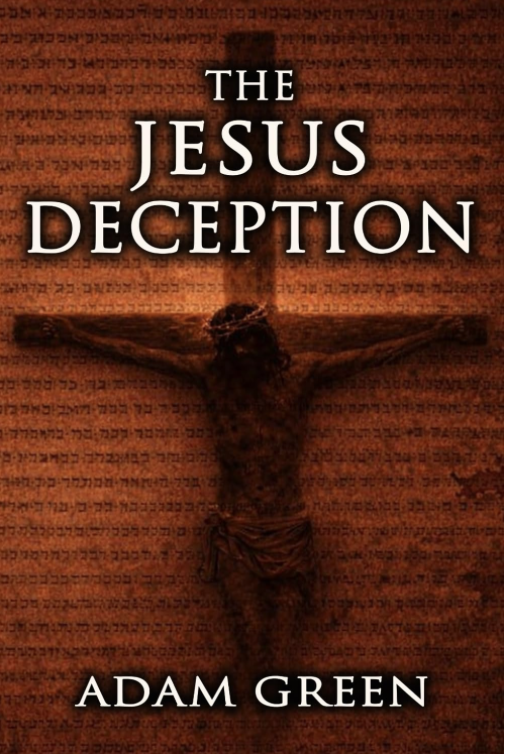
Below, selected quotes from the second chapter of Adam Green’s 2026 book The Jesus Deception: A Mystical Midrashic Myth:
Convincing the world that God chose one group of people to receive and speak with the authority of the one true God is no small feat. It elevates the Jewish people to a divine holy status, granting them immense religious cultural influence. Everyone who believes in Jesus and biblical prophecy is ultimately trusting in the legitimacy of the authors, placing their faith in the authority of ancient prophets and their God…
This vision of global religious submission is not subtle. The scriptures repeatedly declare that the nations will abandon their gods, destroy their idols, and fear the God of Israel…
All nations, all peoples, and all flesh are compelled to bow before the God of Israel. The imagery is not compassionate or benevolent; it reeks of domination. The nations are humiliated “licking the dust at Israel’s feet,” “trembling in fear of the Lord,” and trampled into submission as a “footstool beneath his feet.” [Green references these Biblical verses] Far from a vision of a universal utopia, these prophecies present a tyrannical dystopia of a global world order forged in fear, and absolute subjugation.
Fear…! When I lived in Spain, I learned that some older people feared eternal damnation. This is something that younger generations of Christians cannot understand, as the era of terrifying children with eternal fire is over. Because I was raised in the old-fashioned way, like those Spaniards I was the victim of an internal persecutor (fear of eternal torture) after my father abused me. I recount the details in the final chapter of my book.
This vision is not metaphorical. It is a theological program, a forecast of universal subjugation to the God of Israel. The prophets do not speak of religious tolerance or coexistence, they predict a singular religious future where every tongue glorifies Yahweh, and every nation bends the knee. This prophetic agenda forms the theological foundation of Judaism and sets the stage for Christianity to carry this vision to the Gentile world under the guise of fulfilled prophecy…
In one of the more remarkable prophetic passages of the Hebrew Bible, the Book of Isaiah envisions a time when Egyptians themselves will offer worship—including incense and sacrifices-to the God of Israel. This vision appears in Isaiah 19: 19-21, where it declares: “In that day shall there be an altar to the Lord in the midst of the land of Egypt, and a pillar at the border thereof to the Lord. And the Lord shall be known to Egypt, and the Egyptians shall know the Lord in that day, and shall do sacrifice and oblation.”
This prophecy envisions not merely the acknowledgment of Yahweh by foreign nations, but a full liturgical participation-altars, oblations, and vows offered within the geographic territory of Egypt itself. The theological implications were profound. Egypt, long cast as the archetypal enemy of Israel and symbol of bondage, is here transformed into a future sanctuary for Yahweh’s name. This vision would likely serve as a template for first century Jews looking for answers to their Roman occupation…
Judea against Rome! Those who haven’t read the masthead of this site, authored by a Spaniard, should read it now.
This prayer reflects the same triumphalist theology found in Christianity. The language of false gods being exterminated and all people accepting the yoke of Yahweh’s kingdom is a demand for global theological submission to the Messiah of Israel who will rule the world and establish an eternal kingdom in Jerusalem.
Let’s be honest with what we’re actually looking at. The prophecy found in the Bible is not some innocent spiritual mystery. It is a political tool disguised as divine insight. It is a plan for global religious domination, cloaked in the language of revelation. The prophets of Israel did not merely speak for God. They laid out a strategy. A plan to convert, conquer, or erase all competing gods, traditions, and belief systems. Yet for all its boldness, modern scholarship rarely confronts the nature of biblical prophecy head-on. Secular academics tiptoe around it, treating prophecy like a benign religious curiosity rather than the blueprint for global conquest. Why? Because to expose prophecy as a mechanism of psychological warfare and geopolitical ambition would shake the foundations of Western religious identity…
The prophecy agenda is not simply about what will happen. It is about what must be made to happen. And Jesus was the weapon forged to advance the plan…
Jesus prophecy
The scriptures and prophecies reviewed in this chapter formed the prophetic foundation that created the environment that birthed the Jesus myth. As we will explore further, the Hebrew Bible offered a vast reservoir of imagery: the Suffering Servant, the Son of Man, the Branch of David, the Rod, the Scepter, and the Star. These messianic motifs were woven together to fabricate a conquering redeemer destined to spiritually subdue the nations. Out of this prophetic framework emerged a new theological weapon: the mystical, midrashic Messiah named Jesus.
What began as a Jewish apocalyptic fantasy of global submission to Yahweh became the Christian gospel of the kingdom of Christ. Prophecies from Daniel, Isaiah, Zechariah, Psalms, and many more were reconfigured into Jesus, who would rule from Zion with the rod of his mouth and have dominion over the nations. Prophecy was not just a belief system; it became a strategic tool. Christianity spread not merely as faith, but as the execution of a Jewish apocalyptic blueprint, a sophisticated form of theological warfare masquerading as universal salvation. With billions of Gentiles now worshipping the God of Israel through the fabricated figure of Jesus, prophecy was fulfilled not by divine intervention, but by deliberate design…
The story of Jesus is a masterpiece of literary fiction. The Bible foretold that the Gentiles would one day worship the God of Israel. Christianity brought that vision to fruition. The nations believed in the prophecy, and by believing, they fulfilled the prophecy. Jesus is a mythical figure, crafted from scripture by Jews seeking to theologically conquer and spiritually subjugate the nations of the world.
And again, Isaiah says, “The Root of Jesse will spring up, one who will arise to rule over the nations; in him the Gentiles will hope.” – Romans 15:12
The motive behind this fabrication was domination. The goal was to destroy idol worship and impose a one-world religion under the subjugation of Yahweh. Christianity, which would become the dominant faith in much of the world, became the instrument for this agenda.
To fully understand how this prophetic vision materialized into Christianity, we must now step back and examine the historical and theological context from which it emerged. The next chapter will explore the social, political, and religious landscape of the Second Temple period. This was the environment that gave birth to apocalyptic Judaism, militant messianism, and the yearning for divine intervention through a promised redeemer. It is within this volatile context of Roman occupation, priestly power struggles, sectarian fragmentation, and prophetic expectation that the seeds of the Jesus deception were sown.
Bold type in the original Kindle version.
2 replies on “Adam, 2”
Hello, CT! This analysis is correct! I hope you are well.
Thank you, Denise. I hope you’re well too!