The modern man’s body beautification didn’t end with Cro-Magnon: it is a task that continued throughout later prehistory. In some passages from the final chapters of Them and Us, we read:
______ 卐 ______
The journal, Evolution and Human Behavior recently published a study by Canadian anthropologist Peter Frost, which claimed the genetic mutation in the hair colour gene that resulted in blonde hair occurred about 11,000 years ago and quickly spread through sexual selection. Researchers at Copenhagen University have identified the single point mutation in the OCA2 gene that is responsible for all the blue-eyed people alive today. They calculated the mutation happened between 6,000 and 10,000 years ago in Europe.
This genetic data supports NP theory’s argument that by 10,000 years ago, artificial selection and sexual selection of the nascent human phenotype was in full swing. […]
For example, so thoroughly had the genes for hairiness been expunged, rendered inoperative (turned into what are called pseudogenes) or silenced (which means they are no longer expressed) that today, anyone born with full body hair is considered a medical curiosity. Since records began in the Middle Ages, only about 34 cases of the condition, called congenital generalised hypertrichosis, have been described in the medical literature.
Because of its importance in differentiating the warring species, the Cro-Magnon human face received the full makeover. Faces became more symmetrical. Skin became wrinkle-free, clear and unblemished. The eye whites really were white, the lips fuller and the nose (petite by primate standards) protruded conspicuously from the face. Gone were the two forward-projecting gaping nostrils of the primate nose. Gone was the leathery skin. And gone too was the coating of protective body hair, even in hot tropical regions. Beauty became the prevailing guide to mate selection, and meant the opposite of what Neanderthals looked like.
Further accentuating the divide were mutational alleles for novel hair and eye colours. Amongst some Northern European groups the new lighter colours became highly-prized. From a distance nothing stamped a person one of us better than blue eyes and a coiffure of blonde, brunette or red hair, especially if it was well-groomed and decorated—something the others never did.
The 35,000-year-long process of genetic pruning was so comprehensive that it rendered Cro-Magnons almost unrecognisable from their former selves. They were now much smarter, more artistic, more creative… more human. Behaviourally though, it was a different story. There was still one step to go—one final transition before you’d let one of these Neolithic men date your daughter or sit down with you to discuss the economic meltdown over a decaf cappuccino. The last challenge was to curb—or at least control— hyper-aggression in young males. […]
Let ’s be logical about this
Hyper-aggression is derived from the emotional centres of the ‘reptilian brain.’ This means that Cro-Magnon fixed action patterns would have been inflexible, emotional responses. The non-cognitive nature of these behavioural responses is reflected today in psychological attitudes like racism, colourism, xenophobia, ethnocentrism, chauvinism, pack rape mentality, vigilantism, hooliganism and vandalism. For the most part, these are not specific behaviours. They are emotional states and psychological mindsets that, under certain circumstances, may predispose violent behaviour such as lynching, gang rapes and ethnic cleansing. Once they are triggered, these behaviours are normally resistant to cognitive constraint. […]
But despite the glacially slow progress, by 1790 the Declaration of the Rights of Man of the French Revolution was empowered in a genuine attempt to curb the devastation of barbarism, anarchy and mob rule.
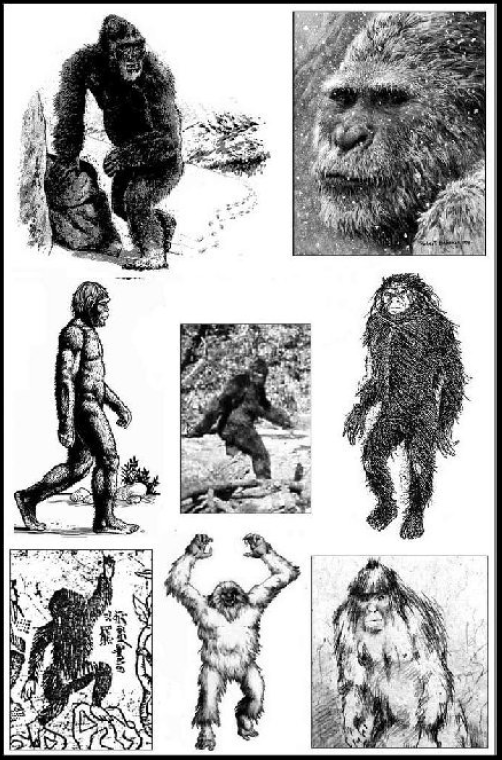
A motley collection of yetis, abominable snowmen and sasquatch from popular culture and mythology, all bear a striking similarity to Neanderthal physical characteristics.
The theory argues that all the great empires of antiquity—Phoenician, Persian, Greek, Roman, Mongol, Egyptian, Byzantine, Mogul and Aztec—engaged in expansionist re-enactments of the first great conquistadorial campaign by Cro-Magnons against the Neanderthals. Their strategies and techniques have uncannily mimicked Cro-Magnon tactics—classifying the alien enemy as inferior and sub-human; killing the men and raping the women; subjugating, pillaging and enslaving; occupying enemy lands; and showing no mercy. The same innate Neanderthal responses that find expression in ethnic cleansings and internecine conflicts have also been intuitively applied by dictators and unscrupulous politicians.
______ 卐 ______
Editor’s note: our gospel or good news
The trauma of Neanderthal predation and Cro-Magnon hyper-aggression shaped our psyches. This is such a significant revelation that I will need to modify the featured post of this site. For the priest of the sacred words the good news is that, under the right circumstances, the desire for extermination can be triggered today as Vendramini himself, a neochristian from our POV, acknowledges.
____________
N.B. You can read the first 35 pages of Vendramini’s book here.
“We have to fight to secure the existence and expansion of our race and of our people; to enable them to nourish their children and to preserve the purity of their blood; to secure the freedom of our Fatherland”.
—Hitler
Unlike the movies, the drama did not end with the extermination of the prehistoric Neanderthals. The rest of the hairy hominids that didn’t undergo the genetic changes that led to the ‘naked ape’ had to be exterminated.
Alas, after the passages quoted in the previous instalment (#10), Vendramini’s book falls apart. Like the normie Tom Holland, whose book Dominionhelped me understand how Christianity transmuted into neochristianity, Vendramini is also a slave to Christian/neochristian ethics. That is why in the final chapters, despite his professed atheism, Vendramini insists that contemporary humanity is one. In fact, Danny Vendramini had probably the most iconic last line in this book with saying “there is no them and us. It’s all an illusion. There is only us.”
To combat this claim, it is useful to familiarise oneself with Jared Taylor’s books on racial realism, and better still, with the first chapter of Pierce’s Who We Are. It is this first chapter, in which Pierce discusses prehistory, that serves us well in building a bridge between what we have seen so far in Them & Us and history.
Although Vendramini’s book has been truly wonderful up to this point, from the paragraph in which the last Neanderthal was exterminated onwards, the rest of his chapters must be taken with caution (“there is no them and us…”).
Even so, given that a priest of the sacred words longs to ensure the beauty of our females (the drive that motivated the prehistoric exterminators!), some subsequent passages in Vendramini’s book are relevant to understanding that the work of extermination only began with Cro-Magnon man. And had it not been for the greatest historical blunder committed by the Anglo-Americans, Himmler and the SS would have continued the work of eugenics in territories that shouldn’t belong to the Russians but to the Germans who would have fulfilled their Master Plan East.
In the chapter following the one in which, in southern Spain, the last Neanderthal suffered the fate of the dodo, Vendramini wrote:
______ 卐 ______
This hypothesis proposes that top of the hit list for eradication on six continents were deviants and those perceived to be the others. Theoretically, this could mean anyone who triggered a Neanderthal teem. Pragmatically though, it could include anyone who looked different. If your nose was too flat, your eyeballs not white enough, your pupils not circular enough or your lips too thin, you were at risk of being subconsciously perceived as a Neanderthal—and treated as such. In a world where first impressions were often a matter of life and death, coming across as dumb, crass, humourless or gruff was likely to get you killed. And because nothing creates a first impression better than posture, having a stooped (monkey-like) gait, hunched shoulders or a head that jutted forward on your shoulders was a recipe for a short life.
Because artificial selection was almost exclusively exercised by men, females would be more prone to scrutiny than males. If girls were considered too flat-chested, straight-waisted, wrinkled, thin-lipped, or if the labia protruded beyond the vulva, they would be less likely to pass on their genes.
It was as if these spontaneously self-forming death squads had all been issued with the same orders. And the same hit list. From Spain to eastern Mongolia, and from Alaska to Tierra del Fuego the same motley collection of ill-formed deviants became the target of this sustained campaign of lethal selection. Although it is sometimes argued that ‘death squads’ only emerged in the 1970s and 1980s in South America, they have existed under different guises since prehistoric times. The all too familiar lament of ‘the day men came with guns’ to rape, murder and pillage has its antecedents in the Mesolithic, when men came with flint-tipped spears—to line up the innocents and make their lethal selection. But had a CSI unit of forensic pathologists examined the bodies, they would have seen a pattern to the victims. The selection was anything but random. By this simple expedient, a unique homogeneous human physiology and behavioural repertoire began to emerge simultaneously around the world. This blunt, brutal but chillingly effective scenario is, along with mate selection derived from Neanderthal teems, the only evolutionary scenario that can explain how and why modern humans are today one species.
Learning to dance
As a result of this lethal form of artificial selection, behaviours that had previously provided little or no contribution to fitness (like the ability to dance, hold a tune or laugh at a joke) now assumed an adaptive function. When a Cro-Magnon raiding party descended on a community, the villagers’ ability to speak fluently, decorate their bodies or even crack a joke could mean the difference between living and dying. This brings new meaning to conformity—and to being ‘human’. If Neanderthals were thought of as an artless, humourless, crass bunch, then art, tattoos, music, dancing, laughter and singing would become reliable indicators of us.
This generated pressure for everyone to acquire these external identifying signifiers. Men and women began wearing jewellery, tattooing their bodies and painting them with red ochre because they found these cultural accruements to be like passports—facilitating free and safe movement.
Cro-Magnons invented musical instruments and played them as a stamp of their humanity. They told stories, brewed alcoholic drinks and sang songs around the campfire. And they painted pictures on cave walls and fashioned ivory into figurines. Back in the Mesolithic, ‘artistic’ was not an affectation or indulgence—it was a much admired survivalist skill that could very well save your life. Styling their locks, embellishing clothes, tools and weapons—in effect, ‘making a fashion statement’—became ingrained in the human psyche as an adaptive behaviour. In a very real sense, the Cro-Magnons were the first slaves to fashion.
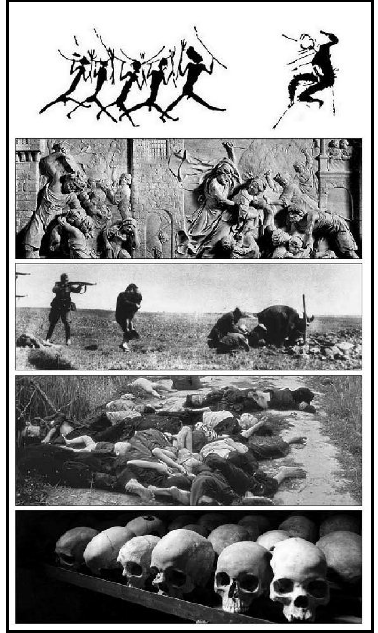
Intergroup violence is so pervasive in human history, we tend to take it for granted. (From top) a prehistoric drawing of archers and victim from a cave in Castellón, Spain; the biblical massacre of the innocents; the shooting of Kiev Jews by Nazis; the My-Lai massacre by American troops in Vietnam; and skulls of the victims of the Rwandan genocide.
Designer babies
There is every reason to believe that the relentless selection process included newborns. Neonates displaying atypical characteristics were ‘soft targets’ and infanticide was unquestionably the simplest, most cost effective application of artificial selection.
This tells us that the most dangerous time in the life of a Cro-Magnon was immediately after birth. That was when the males would inspect each baby and euthanise any infant they considered beyond the norm. This blunt policy of infanticide probably concentrated on conspicuous Neanderthaloid indicators such as the amount of body hair, facial wrinkles, head size and body fat.
For example, while birth is a challenge for most primate species because of the large size of the foetal head compared to the pelvis, the wide birth canal in chimps and gorillas and the small head size of their babies normally allows safe, unassisted delivery. This predicts that Neanderthal females also had wide hips and small-headed babies to make birth easier and safer.
Applying the differentiation hypothesis predicts that selection pressure would be generated for a larger head size in Cro-Magnon neonates. But even if a large head proclaimed to the tribe that a newborn was ‘one of us’, this reassurance came at a price. If the baby’s head was too big, neither mother or infant would survive. […]
Eliminating the competition
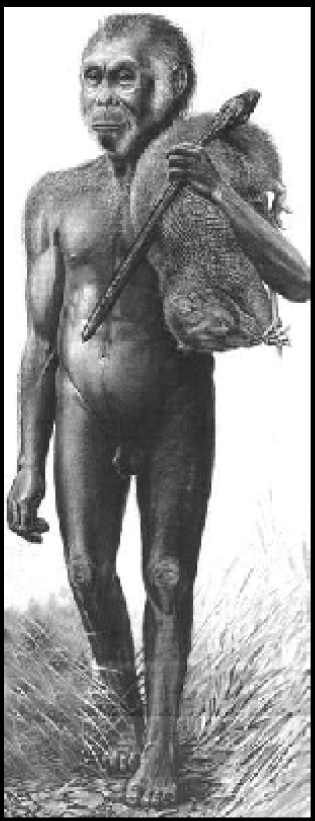
The theory that blind senseless violence—that most loathsome of human proclivities—has played a pivotal role in the emergence of modern humans by eradicating vestigial Neanderthaloid remnants from the Cro-Magnon genome, may be disagreeable. However, the model now goes even further. It predicts that as Cro-Magnons colonised Africa and Asia, they inevitably encountered ancestral hominid populations such as Homo floresiensis (below) and Homo erectus. The model proposes that the perceived deviancy of these indigenous people would also trigger them and us teemic responses, that would predispose Cro-Magnons to treat them as if they were Neanderthals, even though they had never seen a real Neanderthal. In other words, the hotchpotch campaign of sexual selection and artificial selection that they applied to one another would now be applied to other species of Homo they came across.
Once labelled generically as them, indigenous hominid species would be subject to the full force of Cro-Magnon aggression. With inevitable consequences.
Could this explain what happened to all those pre-existing populations of hominids and early modern humans spread across Asia, Africa and the Americas? The archaeological evidence certainly confirms that, while there were numerous hominid species living from Africa to Asia before the arrival of Cro-Magnons, once the Cro-Magnons arrived, they all disappeared. The first to vanish were two species of Homo erectus—one in China, the other in Indonesia.
Until then, erectus had been probably the most successful hominid species of all, a tenacious hunter-gatherer who had survived for 1.75 million years and colonised half the globe.
For ages, it was believed that Homo erectus—thought to be the first hominid species to leave Africa—became extinct long before modern humans arrived in their areas. But we now know this is not the case. Recent dating of fossilised bones and artefacts reveals one population of erectus held out on the isolated island of Java until as recently as 25,000 years ago. This coincides with the time humans reached Java. After that, Homo erectus disappears from the fossil record.
Their new cognitive capacity enabled Cro-Magnons to build seaworthy vessels and cross the Timor Sea to Australia. The earliest widely-accepted date for their arrival in Australia is around 38,000 years ago, but a recent review of the data suggests occupation as early as 42,000–45,000 years ago.
When Cro-Magnons arrived, there appears to have been at least one other hominid species already living in Australia—in the south of the continent. Known as the Kow Swamp people, they had relatively large and robust bodies and thick skulls indicating they were related to Homo erectus. It’s thought the Kow Swamp people arrived when there was still a land bridge between Australia and Asia.
The Kow Swamp people appear in the fossil record about 20,000 years ago, and then abruptly disappear. Given that Cro-Magnons entered Australia from the north and the isolated Kow Swamp lived in the south, it is conceivable that the two groups did not make contact for thousands of years. NP theory suggests that when they finally did, the humans promptly wiped them out.
Whether humans were also responsible for the extinction of the diminutive Homo floresiensis—the ‘Hobbits’—on the remote island of Flores in Indonesia about 13,000 years ago, is also impossible to confirm. But again, anthropologists Peter Brown, Michael Morwood and their Indonesian colleagues, who discovered and named floresiensis, argue that they were contemporaneous with modern humans on Flores. This makes them the longest-lasting hominid (apart from humans), outlasting the Neanderthals by about 12,000 years. It also highlights Peter Brown’s claim that these resilient species of the genus Homo may have been direct descendants of australopithecus (like ‘Lucy’), one of the earliest African hominids. If so, then these resilient little fellows managed to survive in a unbroken line for a whopping five million years. Until, that is, modern humans arrived on their island. Once humans arrived, floresiensis abruptly disappeared.
This represents only circumstantial evidence of genocide and requires more proof, but some points are unequivocal. Firstly, by 13,000 years ago, of the at least seven—and possibly dozens, or even hundreds—of different subspecies of hominids which had inhabited the world, there remained only one. Secondly, their disappearance occurred only after the arrival of modern humans. Thirdly, because all other species became extinct, everyone living today can trace their ancestry to the original population of Cro-Magnons in the Levant. In effect, this ‘purification’ of the gene line was evolution by genocide. As an instrument of artificial selection, it was systematic, methodical and extremely efficient. Modern humans owe their present homogeneity to the thoroughness of the genocidal eradication of anyone considered too deviant to fit into the Cro-Magnon culture.
____________
N.B. You can read the first 35 pages of Vendramini’s book here.
Despite the sporadic late flowering of Neanderthal culture, the last Châtelperron assemblages (at Arcy-sur-Cure and Quinçay, in France) vanish about 34,000 years ago. Among the last surviving populations of European Neanderthals are those from Gibraltar, dated to 28,000 years ago, but with some bone samples reliably dated as recently as 24,000 years ago. With them disappeared forever one of the toughest and most durable hominid species of all time.
The reason why the European Neanderthal population became extinct when the Levantine human population recovered after its own near-extinction event was, I think, because the persecution of European Neanderthals by Cro-Magnons was not based on dietary predation. When predation is simply about killing for food, prey species usually recover in number when they are no longer worth the time and effort to hunt.
But if the objective of Cro-Magnon aggression was not dietary, then the cyclical pattern that normally allows the prey species to recover its numbers would not occur. Because NP theory nominates genocide as the objective of the European territorial incursion, it predicts that successive generations of humans kept relentlessly hunting Neanderthals throughout their entire European habitat until they were eliminated.
While the genocide model may seem somewhat melodramatic to those who take an anthropocentric view of humanity, it is a lynchpin of NP theory. Ironically, it is also one of the few elements of NP theory that accords with conventional anthropological thinking. The idea that Cro-Magnons killed off the European Neanderthals is a view held by a sizable proportion of academics.
In anthropological terms, it is known somewhat euphemistically as the competitive replacement model, and it was first proposed by French palaeontologist Marcellin Boule (the first person to publish an analysis of a Neanderthal) in 1912.
Claudio Cioffi-Revilla, a computational social scientist from George Mason University in Virginia, calls the replacement a “large-scale violent eviction accompanied by purposive massacre” and defines it as history’s first genocide.
Another supporter of competitive replacement is Jared Diamond, who points out in his book The Third Chimpanzee that the genocidal replacement of Neanderthals by modern humans is similar to modern human patterns of behaviour that occur whenever people with advanced technology invade the territory of less advanced people.
The competitive replacement model is not, however, universally accepted and one of the reasons for this is that it does not explain why Cro-Magnons eradicated the Neanderthals. NP theory’s contribution to the competitive replacement model is to provide the all-important motive—the hatred of a former prey species of its erstwhile predator.
Another criticism of the competitive replacement model is a familiar one—that there are no mass graves or other unequivocal evidence of a genocide in either the Levant or Europe. We learn from watching shows like CSI that violent crimes usually leave some forensic evidence, so we half expect to unearth mass graves or other unequivocal forensic evidence. Realistically though, it cannot be expected that archaeologists will dig up a pile of 40,000-year-old Neanderthal bones from some long-forgotten massacre site, complete with Cro-Magnon arrowheads embedded in their ribs.
Usually, the only time we find fossilised hominid bones is when they’ve been purposely buried or thrown into a bog. Unlike modern massacres like Srebrenica, where an estimated 8000 men and boys were shot and buried during the Bosnian War, Cro-Magnons would not be concerned about burying their victims. It is more likely that Neanderthals would be left to rot at the kill site, or butchered and consumed for their meat. […]
Ultimately, the only certainty is that by 24,000 years ago, the Neanderthals had disappeared forever. […] The world had changed. After more than 75,000 years, the great struggle was over. For the first time—humans were alone. They were now the undisputed ‘masters of the universe’.
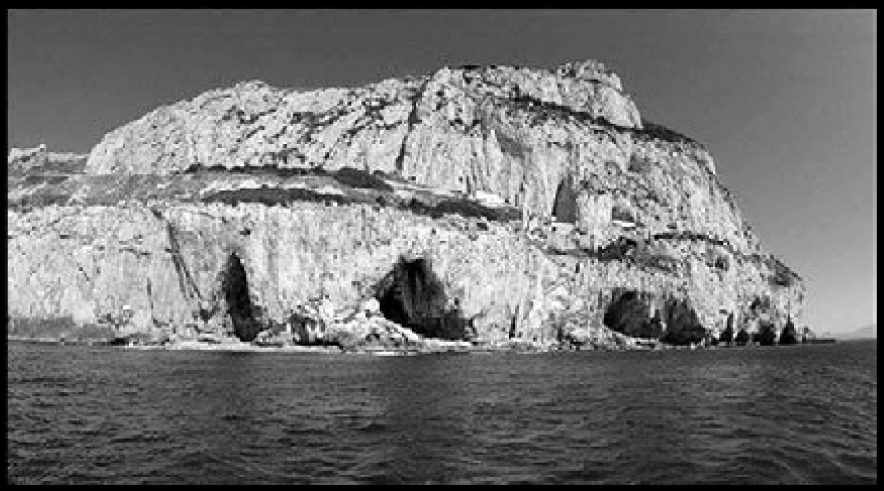
Gorham’s Cave (centre), Gibraltar. Although the water now laps at its entrance, when Neanderthals lived there the sea level was much lower. According to Clive Finlayson, this is where some of the last European Neanderthals held out, hunting seal, dolphin and fish.
____________
N.B. You can read the first 35 pages of Vendramini’s book here.
There is reason to believe that hyper-aggression included a sexual component. I proposed earlier that one method of achieving hyper-aggression in young Cro-Magnons males was by selecting for extremely elevated levels of serum testosterone. Testosterone also happens to be the primary male sex hormone, elevated levels of which predisposes increased sexual arousal and activity. This means that, not only were Cro-Magnon men hyper-aggressive compared to modern humans, they were almost certainly hyper-sexual as well.
If Cro-Magnon social groups resembled modern hunter-gatherer groups, they would ostensibly congregate in tribes close to fresh water and good hunting grounds. From there, the young men would launch hunting and gathering expeditions, sometimes lasting weeks, or even months. These bands of heavily-armed hyper-aggressive, hyper-sexual young men—genetically charged with a bevy of powerful hormones—posed a threat not only to Neanderthals but to other human populations.
As a hunting and fighting group, the Cro-Magnon men depended on each other for their survival. They hunted, fought, suffered and died together. And doubtlessly they celebrated their victories together. These emotionally shared experiences would create an indelible bond between the men, far more intense than today’s male bonding of football teams and fishing buddies. For Cro-Magnons, male bonding was not just social, it was a life and death issue. As such, it was a functional adaptation that directly contributed to their survival and reproductive success.
Also deeply ingrained in the Cro-Magnon psyche was the concept of them and us. For them, it represented more than a species divide. It was a life and death distinction, adaptive because it was plain and simple enough for them to understand at a visceral, intuitive level. It had almost nothing to do with rational thought and objective reasoning and everything to do with gut instinct—innate prejudices, sex and violence and deeply entrenched them and us mindsets.
There was no precise intellectual concept of them. The description applied to almost anyone and anything outside the group. Any mix of sex and violence could be meted out without the slightest remorse to anyone branded ‘them’. The Cro-Magnons were probably the most psychopathic humans who ever lived—but they were creatures of their time. With a job to do. And if they had not done their job, none of us would be here.
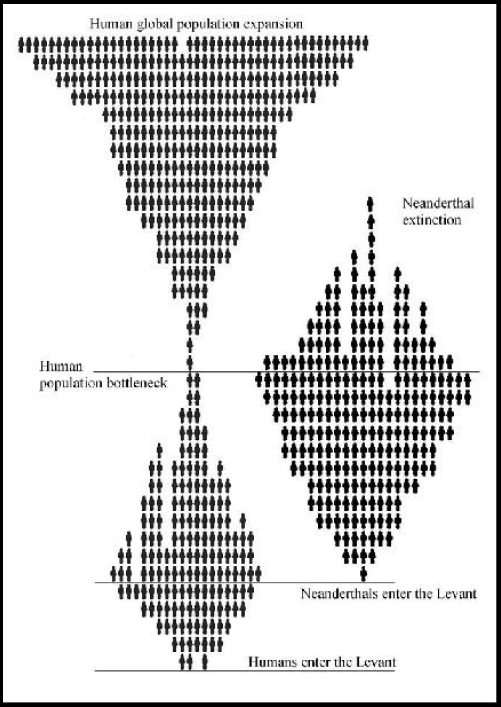
After the population bottleneck, the human population expanded and the Eurasian Neanderthal population plummeted towards extinction.
The first genocide
From a broader sociological perspective, it is immediately apparent what these nomadic bands of hyper-aggressive, hyper-sexed Cro-Magnons were doing. They were practising genocide. It was undirected, haphazard and certainly inefficient by today’s standards, but it was highly motivated. And over a few thousand years, the Cro-Magnons drove the Eurasian Neanderthals to extinction.
The genocide hypothesis fits with sociological studies of lethal aggression by male coalitions (modern armies) and with a long history of human warfare, xenophobia and genocide. In The Descent of Man, Charles Darwin has this to say on the propensity of humans to kill off those they considered inferior:
All that we know about savages, or may infer from their traditions and from old monuments, the history of which is quite forgotten by the present inhabitants, shew that from the remotest times successful tribes have supplanted other tribes.
More importantly, the theory that humans annihilated the Eurasian Neanderthals is consistent with the fossil record of the Levant that shows the Neanderthals disappeared just after the first appearance of the first Upper Palaeolithic humans in the Levant.
John Shea says:
Throughout Western Eurasia, the end of the Middle Palaeolithic period marks the last appearance of Neanderthals in the fossil record. Between 30–47 Kya, Upper Palaeolithic humans expanded their geographic range to include all the territory formerly occupied by the Neanderthals and other anatomically archaic humans. The Middle Palaeolithic period in the Levant was the last period in which modern humans had serious evolutionary rivals for global supremacy.
NP theory goes even further, predicting that a genocidal war took place, that it was successful, and that it was relatively quick. Why? Because the Cro-Magnons were not only militarily much more advanced than the Eurasian Neanderthals, they were socially bonded into a single massive military group that can only be described as an army—or at the very least a proto-army. This was the strategic application of the new socialisation process—a process that effectively united the disparate tribes of Syria, Israel, Palestine, Jordan and other areas of the Levant into a single combative force that swept all before it.
As the raggle-taggle proto-army grew, a tipping point was reached, and the tide began to turn. The Cro-Magnon campaign accelerated its onslaught into a blitzkrieg. Over time, this search and destroy operation became genetically encoded in testosterone-charged adolescent and young adult males and continued unabated—generation after generation—until not a single Neanderthal was left alive from northern Turkey to Egypt.
This view is supported by the archaeology. John Shea concludes in Modern Human Origins and Neanderthal Extinctions in the Levant, “that around 45,000–35,000 BP, Neanderthal fossils cease to occur in the Levant at exactly the point when Upper Palaeolithic industries first appear in Israeli and Lebanese cave sites.”
At the Amud Neanderthal cave, northwest of the Sea of Galilee in Israel, for instance, materials dated from the lowest levels of the cave reveals that Neanderthals first occupied the site 110,000 years ago (±8,000 years). The youngest date measured at the site comes from a single tooth from Level B1/6 which tells us the occupation ended 43,000 years ago (± 5000 years).
Until recently, it was generally assumed that the disappearance of Eurasian Neanderthals from the Levant was caused by a deterioration in the climate. But in April 2008, at a meeting of the American Association of Physical Anthropologists, Miriam Belmaker from Harvard University deftly demonstrated that the climate in the Levant at the time of their extinction was stable, ruling out climate change as a factor in their disappearance.
Power plays and mind games
If NP theory is correct and Cro-Magnons were a hyper-aggressive new transitional species, purpose-built by natural selection to kill Neanderthals, then it follows that even after the disappearance of the last Neanderthal, Levantine males would simply disperse further afield in search of more victims. They had spent several thousand years relentlessly hunting their ancestral foe—this is what young Cro-Magnon males did—and they were not going to stop now.
But NP theory and an understanding of human nature also predicts something else happened: the proto-army of the Levant began to fall apart, and ultimately turned against itself.
The alpha males who, by force of strength and aggression, had maintained cohesion within the group became besieged by eager and ambitious young males determined to assume their mantle. Here, I suggest, is the origin of that unique and ubiquitous pattern of human group dynamics, distinguished by male intergroup competition, power plays, political divisions, leadership challenges, Machiavellian intrigues, betrayals, ‘civil war’ and chaos. The techniques that had been so effective in conquering Neanderthals had found a fertile new outlet within Cro-Magnon society.
As the proto-army grew too large to be effectively managed, fed, organised and controlled, secondary leaders (beta males) saw an opportunity. Taking advantage of the increasing frustration, they agitated, conspired and aspired to be alpha males with access to all the fertile females. Leadership challenges became a constant fixture of the times. Retributions for unsuccessful coup attempts were swift and violent, and deposed leaders would be banished or killed. Dissent spread, disorder became the status quo and eventually some beta males broke away or were expelled, taking their warriors and their families with them. These smaller armies then spread out from the Levant to conquer and colonise their own territories.
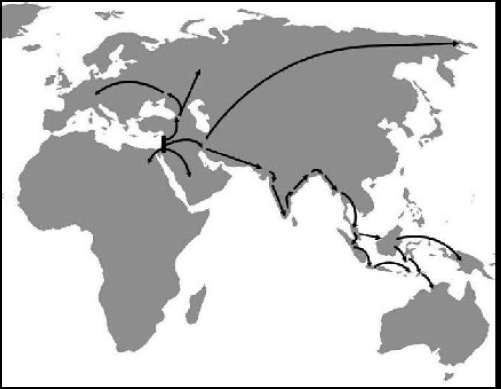
While this scenario is, at best, informed conjecture, it is supported by the genetic and archaeological evidence, which reveals the Levant human population did split into at least three large groups that eventually dispersed out of the Levant at precisely that time.
One group migrated east, around the coast of India into eastern Asia, and eventually across the Bering Plain (Beringia) to people the Americas.
A second group dispersed from the Levant to Europe, while a third migrated back to Africa. These migrations all date to between 45,000 to 40,000 years ago.
Suggesting that the third group of Levantine humans migrated south into Africa—their ancestral homeland—is at odds with the long-held assumption that the world-wide dispersal of modern humans began in Africa. Corroborative evidence for the back migration theory only emerged in December 2006, via a landmark study of mitochondrial DNA from ancient human fossils by an international team of 15 geneticists lead by Antonio Torroni from the University of Pavia in Italy. The study, published in Science, reports that between 40,000 to 45,000 years ago, a group of modern humans living in the Levant split into genetically separate groups. Torroni traces one group as it moved north into Europe, and another that moved back to Africa.
The global expansion of modern humans began in the Levant and dispersed to Europe, Africa, Asia, Australia and the Americas, via a coastal, island-hopping route.
By measuring the amount of genetic diversity in the mtDNA and on the Y (male) chromosome, Torroni’s group concludes, “the first Upper Palaeolithic cultures in North Africa (Dabban) and Europe (Aurignacian) had a common source in the Levant”, spreading by migration from a core area in the Levant.
The Upper Palaeolithic Levantine people that Torroni refers to (that first appeared 46,000 to 45,000 years ago) dispersed to south-eastern Europe via Turkey around 43,000 years ago.
The date of the dispersal from the Levant (45,000 to 40,000 years ago) agrees with the near-extinction hypothesis of NP theory and the emergence of a new human species as a consequence of Neanderthal predation.
The pace of this dispersal fits with my more nuanced view that Cro-Magnons, unlike their Middle Palaeolithic predecessors, were not averse to risk-taking, exploration or territorial expansion. It also supports NP theory’s proposal that the incursion into Europe was not a nonchalant nomadic migration in search of hunting and gathering opportunities, but a militaristic blitzkrieg by hyper-aggressive males inherently confident of their colonising and military capabilities. This indication of a new ‘conquistadorial’ component of human nature creates the impression that Cro-Magnons believed their technological and psychological superiority made them invincible—that nothing and no one could stand in their way. This was the first example of military expansionism, and it set the stage for the first real world war.
Chapter 20: The invasion of Europe
In Europe, the Cro-Magnons encountered the European species of Homo neanderthalensis for the first time. The narrative history of the two species proposed by NP theory predicts an inevitable outcome of this interaction: that from around 44,000 years ago, when they first entered Europe from the east, hyper-aggressive Cro-Magnon males threw themselves into a protracted campaign against a well-entrenched (and much larger) population of European Neanderthals. This first successful incursion into traditional Neanderthal territory had all the hallmarks of an invasion. Its intention was nothing less than the complete eradication of Neanderthals from their ancestral homeland.
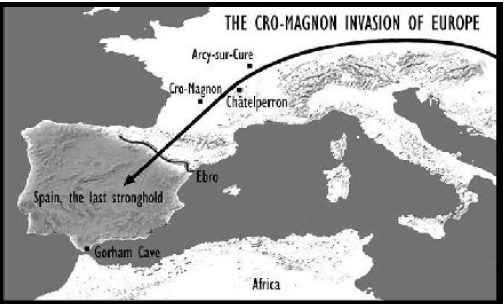
The archaeology shows that the euphemistically named ‘replacement’ began in the east and progressed in a westerly direction across continental Europe. The first Neanderthals to be replaced by Cro-Magnons were living in Eastern Europe, followed by those in France, Greece, Italy and finally Spain.
What the fossil record and carbon dating agree on is that in every individual case of replacement, the Neanderthals disappear from the fossil record only after modern humans have moved into their territory. Even though Neanderthals had survived in Europe for over 300,000 years—often in the most extreme climatic conditions—it was only once Cro-Magnons occupied their territory that they disappeared. In other words, Cro-Magnons swept across Europe in an east-west direction and Neanderthals became extinct in the same east-west direction at exactly the same time.
Although isolated regional populations of European Neanderthals survived in mountainous regions of Croatia and the Caucasus until about 29,000 years ago, the last remaining Neanderthals appear to have been pushed down the Iberian peninsula to Gibraltar on the southern tip of Spain.
This is not to say that the European Neanderthals were a pushover. They were a well-entrenched, formidable adversary, with exceptional hunting and tracking skills, knowledge of the terrain, superior physical strength and indomitable courage. And they were now fighting for their lives. The fact that the replacement began around 44,000 years ago and took 20,000 years to complete suggests the European Neanderthals put up one hell of a fight.
Another factor that almost certainly contributed to the protracted nature of the conflict was the size of the Neanderthals’ territory. When Cro-Magnons from the Levant invaded Europe, they could have had no idea that the enemy occupied an area of 10 million square kilometres. And in the Late Pleistocene, a few hundred thousand Neanderthals could easily disappear for long stretches, particularly in the forests and mountains, avoiding contact with the intruders.
____________
N.B. You can read the first 35 pages of Vendramini’s book here.
Despite defensive adaptations like xenophobia, changes in sexuality, raising wolves as guard dogs, becoming more athletic, developing a trauma-proof CNS [Central Nervous System], keeping to their own territory (and away from forests), plus a plethora of defensive teems,[1] the fossil record reveals the Levantine population continued to decline. It seems that the Skhul-Qafzeh humans were slowly losing the battle for survival—and heading inexorably towards extinction. But at this pointy end of the predation cycle, things started to change, radically.
To understand what happened next, we need only examine the situation through the prism of Darwinian theory. This predicts the extraordinary and dramatic events that unfolded as the human population plunged towards extinction. For a start, it tells us that all the weak, slow-moving, dim-witted, gullible humans went the way of the dodo—their genes eradicated from the gene pool.
______ 卐 ______
Editor’s note: This is what will happen to gullible Aryans: the fate of the Dodo!
______ 卐 ______
Then, as all but the most diehard survivors perished, it generated intense selection pressure for a new kind of adaptation. Why? Because the old defensive adaptations were no longer adaptive. Neanderthal predation was continuing to decimate the Skhul-Qafzeh population and make their lives a misery. What was needed was a radical new adaptation, one that didn’t just help humans evade or escape Neanderthals. To survive as a species and to be truly free of Neanderthals, humans needed to go on the offensive. This required a revolutionary new approach to the problem. And this is precisely what I theorise happened. The enormous selection pressure generated by Neanderthal predation gave birth to a completely new group of adaptations, which I call strategic adaptations.
Strategic adaptations are not defensive, they are offensive and, in the Levant, their blind objective was to empower the Skhul-Qafzeh humans to engage Neanderthals in combat and defeat them. Strategic adaptations were blindly aimed at the complete annihilation of the Eurasian Neanderthal. [Here and below, emphasis added by Ed.]
The emergence of strategic adaptations makes sound evolutionary sense. Defensive adaptations were useful, up to a point. But ultimately, the only way the Levantines could achieve continuity and security and be predation-free was to permanently remove Neanderthals as ecological competitors. Skhul-Qafzeh humans had to depose Neanderthals from the top of the food chain and take over the mantle of apex predator.
The enormity of the task was mind-blowing. For a timid prey species to turn the tables on the top predator on the planet would require the reversal of an ancient and well-established predator-prey interaction and would almost certainly have been
unprecedented in the animal kingdom. Humans had to evolve into a militaristic species, the likes of which had never been seen before. They would have to become more intelligent, ruthless, cunning, aggressive, cruel and determined than their lethal adversary—become a new super-warrior species with one specialist skill: to kill Neanderthals.
A superior killing machine
Skhul-Qafzeh humans born with offensive physical characteristics and aggressive teems—any kind of inheritable trait that allowed them to outcompete, kill, wound or chase off Neanderthals—lived to pass on their offensive genes along with their newly acquired Neanderthal battle teems. Strategic adaptations included any physical or behavioural adaptation that directly or indirectly contributed to Neanderthal extinction.
NP theory argues that, for the first time, a few humans didn’t run and hide when they saw Neanderthals approaching. Instead, they courageously stood their ground and engaged Neanderthals in combat. Bolstered by their newly-acquired strategic adaptations, the humans began to win a few victories. Initially, they would have lost a lot of men, but this only concentrated the strategic adaptations into a smaller group.
Because the human survivor population was so small at the time and the strategic adaptations were so adaptive, the genes that encoded the most aggressive adaptations spread to fixation very quickly. Soon, a new transitional human emerged. Natural selection was gradually evolving the ultimate killing machine—the most virulent hominid species by far—modern humans.
Once acquired, what humans did with these strategic adaptations is not in doubt. Charles Darwin, in The Descent of Man, provides a salutary reminder of what lay ahead for the Neanderthals:
We can see, that in the rudest state of society, the individuals who were the most sagacious, who invented and used the best weapons or traps, and who were best able to defend themselves, would rear the greatest number of offspring. The tribes, which included the largest number of men thus endowed, would increase in number and supplant other tribes.
The strategic adaptations which I propose played a pivotal role in humans gaining the upper hand over their historical enemy are a disparate lot. They include high intelligence, cruelty, male bonding and aggression, language capacity, the facility to interpret intention from behaviour, organisation, courage, guile, conjectural reasoning, a genocidal mindset, improved semantic memory, consciousness, competitiveness and the ability to form strategic coalitions, or proto-armies.
These adaptations included a raft of new aggressive them and us teems that unified the Levantine humans into a cohesive combative force (the first proto-army) that encouraged them not only to stand their ground but to attack Neanderthals and exterminate them without guilt or remorse.
A major plank of the hypothesis is that strategic adaptations emerged only towards the end of the period of Neanderthal predation (during the population bottleneck) sometime between 70,000 to 50,000 years ago. To prove the strategic adaptations hypothesis, it must be demonstrated that they all emerged because they helped humans kill Neanderthals, and that they all appeared between 70,000 and 50,000 years ago.
Because there are so many strategic adaptations it is not possible to make a detailed examination of them all in this book. Instead, my analysis is limited to a sample of the most important strategic adaptations:
Male aggression
Courage
Self-sacrifice
Tough-mindedness
Machiavellian intelligence
Language
Creativity
Organisation—the origins of human society
Gender differences
Division of labour.
Bloodlust teems
Courage, bravado and proactive aggression are normally anathema (or a last resort) to prey species. From a survivalist perspective, it makes more sense to be timorous and cautious. But, because killing Neanderthals would require hand-to-hand combat, getting into close contact required courage, audacity and even self-sacrifice. Gradually, timid defensive individuals lost out to a new breed of aggressive, courageous, tough-minded individuals.
It is not difficult to see how a ‘bloodlust teem’ could be encoded. If a group of Skhul-Qafzeh men came across a wounded or infirm Neanderthal, they might easily work themselves up into a highly agitated state and beat him to death before pounding his corpse to a pulp. This kind of frenzied excitement (observed so frequently among wild chimpanzees) could generate enough excitement in one individual to precipitate a directed (or teemic) mutation in an intron (the nonprotein-coding region of his DNA). If the affected intron happened to be on his Y (male sex) chromosome, the bloodlust emotions he experienced during the melee would be permanently encrypted into his ncDNA and subject to patrilineal descent. Once inherited by male descendents, the archived bloodlust emotions would remain unexpressed until triggered by the sight or sound of a Neanderthal. When expressed, the bloodlust emotions could precipitate the same kind of reckless and frenzied aggression.
Only in this specific and atypical ecological context were reckless daring, proactive aggression and self-sacrifice adaptive behaviours. When it came to fighting Neanderthals, risk-taking become both a laudable human attribute and a functional adaptation. In this context, foolhardy machismo and reckless bravado became laudable heroism. American anthropologist Joseph Campbell once said, “A hero is someone who has given his or her life to something bigger than oneself.” And, while the great cause was genocide, for those Skhul-Qafzeh humans it would have been a noble cause. Heroic males would not only be praised and appreciated as altruistic and self-sacrificing by the folk they defended, but would also be highly sought after as sexual partners by admiring females. Even today, research shows that when choosing a mate, women place significantly greater importance on altruistic traits than anything else.
Thus, the nascent genes for courage, altruism, self-sacrifice—indeed for heroism itself—dispersed through the community, transforming the Levantines from a timorous prey species into a proto-militaristic tribe.
The current anthropological model does not adequately explain the historic and cultural preoccupation with the hero’s struggle against the forces of evil. However, in the context of an adversarial struggle between two sibling species, it makes sound evolutionary sense.
It follows that the Skhul-Qafzeh attitude to killing also had to change. Early humans obviously killed other animals, but only for food. Now for the first time, they had to kill something they didn’t intend to eat, and another hominid to boot. And kill them without compunction, hesitation or guilt. This required a library of virulent new aggression teems.
These new teems were adaptable because, if early humans could not bring themselves to administer the coup de grâce to a wounded Neanderthal, then these soft-minded individuals risked retaliation, revenge and possibly their own lives. Selection favoured the cruel and the merciless. This was, after all, war before there was a notion of it—before civilisation, before even barbarism. There were no treaties, protocols, exchange of prisoners or rules of engagement. No field hospitals, no Red Cross and no POWs. In this context of quintessential savagery, mercy was not only maladaptive, it was not a practical option.
To dispatch Neanderthals efficiently and without pity, humans had to perceive them psychologically and emotionally in a new way. And this is where teems proved so functional. Teems can encode extreme antipathetic feelings into genetic sequences. Once encoded into ncDNA and inherited, Neanderthal hostility teems provided the emotions used to instinctively loath and dehumanise Neanderthals. They allowed the Levantines to perceive Neanderthals as sub-human, not even in the same category as animals. After all, the animals they regularly killed for food were not despised but were more likely revered for their speed, grace and life-force, and because they gave their lives so that humans could survive. This respect for prey (at times elevated to a spiritual relationship) is evident in every modern hunter-gatherer culture.
Neanderthals though, were a special case.
They were, in all probability, considered by humans as ‘worse than animals’, categorised metaphorically as pests, along with cockroaches, spiders and rats.
This would have served an important adaptive function. Seeing Neanderthals as subhuman allowed humans to slaughter them without guilt or remorse. Administering the coup de grâce to a wounded Neanderthal would be as easy as squashing a cockroach or crushing a rat with a rock.
The selection extended to favour men who were willing to give up their lives fighting Neanderthals. Under normal circumstances, male self-sacrifice would almost certainly be maladaptive, but in lethal combat with Neanderthals, this level of commitment and courage was obviously a strategic advantage that could turn the tide of a battle. Also, male bonding, pack mentality and obedience to the leadership would be eminently adaptive because discipline, organisation and hierarchy are essential elements of military success.
Within the context of the life and death struggle in the Levant between two adversarial sibling species, aggression, risk-taking, self-sacrifice, and the ability to exercise lethal violence without hesitancy (all derived from Neanderthal teems) were advantageous and essential to human survival.
Collectively, this disparate assortment of aggression traits in modern humans has been aptly described by psychologist Erich Fromm as ‘malignant aggression’, which he says is biologically nonadaptive. Considering that during the last century alone, 203 million people were slaughtered by other human beings, he’s got a point. But while malignant male aggression in today’s fully modern humans is unquestionably deleterious, back in the torrid days of Neanderthal predation, malignant male aggression was the lynch pin of Skhul-Qafzeh survival and renewal.
______ 卐 ______
Editor’s note: Note how Danny Vendramini—a normie, after all—fails to realise that, just as Neanderthals were the mortal enemies of our distant ancestors, Erich Fromm, a Jew who fled National Socialist Germany to take refuge in Mexico (the psychoanalyst who destroyed my life studied with Fromm) is the modern equivalent, along with other influential Jews, of the forgotten prehistoric crisis. From this angle, the final solution reached by our hominid ancestors is the same as the final solution devised by Heydrich at the Wannsee Conference. Today’s racialist conservatives do not want to see something so obvious because they have internalised, to the core of their souls, Judeo-Christian prohibitions.
Vendramini ends that section of the chapter with these words:
______ 卐 ______
The challenge to existing theories of human evolution is to explain how and why malignant aggression and its correlates—warfare, racism, and genocide—were initially selected, and what adaptive function they conferred. It is hard to imagine any situation, apart from Neanderthal predation, where such extreme levels of male aggression (levels that are still evident today) would be adaptive.
Footnote:
[1]Teems are inheritable packages of emotion, and provide only an emotional memory of a traumatic incident. Teems derived from Neanderthals and Cro-Magnons present only half the picture—and no details. They describe what the others felt like but not what they specifically looked like. To flesh out the details, Mesolithic and Neolithic humans had to use their imagination, or draw on their storytellers and mythographers (all aspects of culture) to give form to the demons, monsters and satanic creatures they believed lurked in the darkness beyond their walls. In other words, culture gives form to teems. Even today, when modern humans attempt to identify the source of residual anxieties, they too must draw on their imagination, just as their ancestors did, or project their feelings onto one of the monsters from mythology, literature or the movies.
If there is one phrase that captures my spirit, which is practically identical to Kalki’s spirit if we draw inspiration from the most revealing passages of Savitri Devi, it is to exterminate the obsolete versions of Homo sapiens.
Only those whom these Neanderthals have martyred in a truly bestial manner, and who have managed to survive—like Benjamin and me (for Ben’s autobiography see here; mine, here)—have reached level 10 on Mauricio’s scale. Those who have not been martyred by the System and survived won’t understand our passion for exterminating the primitive version of humans which for decades I have called, in my soliloquies, “Neanderthals”.
But oh surprise! That expression of mine from so long ago may have an equivalent in the Aryan collective unconscious. According to Jung, even very ancient events could be unconsciously contained within our psyches, and Danny Vendramini’s book, Them and Us: How Neanderthal predation created modern humans serves me wonderfully to explain myself.
Darwinian scholar Danny Vendramini.
It doesn’t matter if only thirty per cent of what Vendramini says has a genuine scientific basis and the rest is mere conjecture. The fact is that since the Jew Franz Boas, anthropology has become an anti-white ideology; and every time I watch videos on YouTube about prehistory I get extremely upset because this ideology permeates our view of our distant past to such an extent that not only does it portray the first Homo sapiens as Negroes, but these YouTubers have dared to depict cities of historical blondes, such as Sparta, with figures of mulattos among Caucasians and a few blondies: as if historical Greece were ethnically a replica of a modern-day American metropolis! (see, e.g., the first comment in the comments section).
In the prologue to his book, Vendramini tells us:
When I applied Teem theory to what had transformed humans from stone-age African hominids into fully modern humans, why we look and act the way we do, and even why we’re obsessed with sex and violence and good and evil, it proposed a single simple explanation that was both extraordinary and unexpected.
The result is a unified theory of human origins called Neanderthal Predation theory (or NP theory) which is based on a fundamental reassessment of Neanderthal behavioural ecology. Exciting new evidence reveals Neanderthals weren’t docile omnivores, but savage, cannibalistic carnivores—top flight predators who hunted, killed and cannibalised our archaic ancestors in the Middle East for 50,000 years. What’s more, Neanderthals were also sexual predators, who raided human camps to rape, and abduct young females, leaving a trail of half-cast ‘inbreds’.
This multi-faceted predation eventually drove our ancestors to the brink of extinction. Genetic evidence reveals that at one stage our entire ancestral population was reduced to as few as 50 people.
The only humans to survive the predation were those born with mutations for ‘survivalist adaptations’—modern human traits like language capacity, Machiavellian intelligence, coalition building, creativity, risk-taking and aggression. These traits effectively transformed them from a prey species to a virulent new hunter species—Homo sapiens.
Armed with these new attributes, the first modern humans systematically exterminated their former predators, firstly in the Middle East and then in a blitzkrieg invasion of Europe. They then spread out to colonise the world. Guided by an innate sense of them and us, hyper-aggressive men killed anyone who looked or behaved even remotely like a Neanderthal, including hybrids and other humans [emphasis added]. It was this lethal process of artificial selection that gradually unified human physiology and behaviour.
It’s a fairly radical theory, but its strength lies in its predictions and ability to explain aspects of human evolution, physiology and behaviour that have frustrated philosophers, biologists and anthropologists for centuries.
The book has been written for a general readership which has an interest in how we got here. I’ve included ‘boxes’ to explain peripheral subjects and there’s a glossary of ancillary terms at the end. But to help academics evaluate the theory, I’ve also included my references—all 800 of them.
Because the evolutionary events I am investigating happened so long ago, some aspects of the scenario I propose are speculative. For instance, I speculate on the psychological impact that Neanderthal predation had on our ancestors, how the menfolk felt seeing their women abducted and raped. I do this because the psychology of ancestral humans had a direct bearing on our evolution and needs to be considered as part of a holistic theory.
For some scholars, though, the use of speculation and the imagination are anathema—but historically there has always been a legitimate place for the imagination in science. A scientific model can be subjected to rational debate and analysis only once it exists in a tangible form. The day before Einstein conceived his theory of relativity, there was nothing to think about. It existed in a netherworld beyond deductive reasoning, and required an act of imagination to bring it into existence.
Einstein is famously quoted as saying, “Imagination is more important than knowledge” and he explains, “For while knowledge defines all we currently know and understand, imagination points to all we might yet discover and create.”
For radical, big-idea science, imagination isn’t just ancillary to the scientific process, it is an indispensable ingredient.
With human evolution, it could be argued that the reluctance of academics to imagine alternative evolutionary scenarios, or to encourage lateral thinking beyond the narrow pathways of orthodoxy, has hampered progress in this field.
While imagination played a role in the formulation of the NP theory, the resulting evolutionary scenario has, of course, been subjective to an exhaustive six-year process of scientific scrutiny and verification which involved sifting through 3000 scientific papers and other pieces of evidence. Ultimately, the theory’s credibility rests on the rigour of this process.
But let’s not fool ourselves. Although, unlike academics who study prehistory Vendramini uses his vivid imagination, this writer is a normie as revealed in the following passage of the first chapter:
Until we understand the evolutionary imperatives that subliminally drive universal human behaviours, xenophobia, superstition, sexism, war, racism [my emphasis], homicide, ecological vandalism, genocide and the nuclear arms race will continue to hold sway over humanity.
This reminds me of what I have said about Tom Holland’s Dominion: we can perfectly appropriate Holland’s conclusions, but at the same time revalue his Christian-sympathetic values.
Only an academy of the future, in an Aryan state whose academic fields are linked to archaeology, palaeontology and prehistorical geology, will evaluate the Neanderthal Predation theory and clarify the matter. But by then, the extermination of the Neanderthals—and here, unlike prehistory, I am using my historical metaphor (cf. Mauricio’s scale)—will already be underway, if not already complete.
What is valid about Vendramini and others’ NP theory is that prehistoric Orcs were exterminated by us in the real world, and that this process could potentially be repeated with those I call Neanderthals—although that would imply a complete reversal of Christian values to the values of our distant ancestors: the prehistoric exterminators.
____________
N.B. You can read the first 35 pages of Vendramini’s book here.
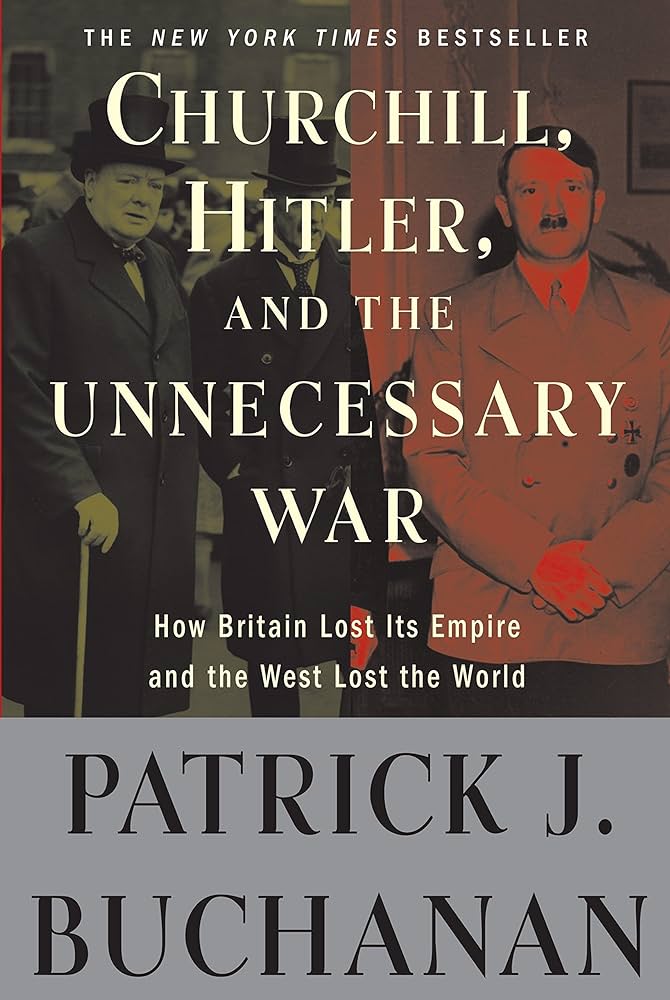
Seeing the discussion on the round table as far as implementing the final solution is concerned, at one point Heydrich mentions that the United States had entered the war. This reminds me of a famous passage in Pat Buchanan’s book, Churchill, Hitler, and the Unnecessary War: How Britain lost Its Empire and the West Lost the World (I bought it fourteen years ago), where Buchanan asserted that the destruction of Jewry in WW2 didn’t cause the war but was the consequence of the war (page 311).
Indeed: had it not been for the Anglo-Americans, the Jews would have been deported either to Madagascar or Palestine, without extermination programmes. In other words, without Churchill and Roosevelt, there would have been no holocaust.
On the other hand, one of the things I like about the film is that almost everyone at the round table doesn’t give a damn about genocide. This contrasts sharply with the American neo-Nazis, who have been preaching for many decades that the Nazis weren’t evil; that is, that they were incapable of planned genocide. As I said to Jamie in the morning, with these pseudo-men we will get nowhere. We need real men, like the SS officers who sat at this table, to solve the problems.
Of course: the Christian ethics that has conquered even the soul of the Western atheist doesn’t allow such planning. But by following those standards of morality one allows the people in power to exterminate the Aryans, which is what is happening. It is impossible not to be an exterminationist. Nowadays the zeitgeist is to exterminate the Aryan. At the SS officers’ table, the zeitgeist was to exterminate the enemy of the Aryan. It is not possible to coexist peacefully with Jews or say blacks because there will be cultural subversion or gradual extermination of the Aryan through interbreeding with the coloureds (as happened in Brazil).
In my previous post on this series, I said that from that day on I would’t drop names of those who belong to the racial right because sometimes I will need their favours.
Very well: without mentioning names, recently a highly respected dean of race realism mentioned in his video that the founding fathers of his country had stipulated that those who emigrated to America had to be ‘whites of good character’. But the dean ignores that, while that is true, the forces of Yankee Puritanism were to trump that between-the-lines pronouncement of the founders. There is no comparison between those lines with the Third Reich, where racism was as explicit as the old Indo-Aryan codes that created the caste society. But the Third Reich was infinitely better than Manu’s Law because of its exterminationism (the Indo-Aryans became mixed over the centuries precisely because they failed to exterminate the Indians). As far as I know, the only notable American who has dared to speak in such practical exterminationist terms, as the SS of the round table, was William Pierce in Who We Are.
One more thing. In the 25th minute of the film, an officer mentions the problem of mixed marriages. If you check the red letters in the long article ‘American racial history timeline’, you will see that long before the Jews had any influence in that country, there had already been several states in the US that repudiated anti-miscegenation laws! That would never, ever have happened in a triumphant Third Reich, for the simple fact that, unlike that between-the-lines pronouncement of the US founding fathers, it was an Aryan Reich designed specifically for what we now call the 14 words, not tainted by Christian bullshit (Protestantism) or neochristian bullshit (the ideals of the 1770s and 1780s that led to the founding of the American republic and the French Revolution).
Secular Christianity has thrown out god and Christ, but keeps the Christian ethics (inversion of values etc.). And the Christian ethics actually gets heightened and unfettered in Secular Christianity (I have written much about that in my blog). With Christ as part of the equation, the Christian ethics of the Gospels became balanced. Humans were seen as imperfect and it was Christ who covered for us with his self-sacrifice. In Secular Christianity each person has to be like Jesus himself, doing self-sacrifice, since there’s no other way to realize Christian ethics. On top of that, with the Industrial Revolution and the surplus it created in our societies, we came to the point where all the good deeds of Christian ethics could finally be executed by giving off our surplus to all the poor and weak foreign people around the world: food, Western medicine, and other aid.
And on pages 131ff of my Day of Wrath I introduced my readers to psychohistory, which includes this paragraph:
The culture that the Europeans brought included family violence. But unlike them, in the conquered people the anxieties that the children arose, based in turn on the abuses the natives had suffered as children, were enough to kill the source that triggered the anxiety. Children have been in the garbage bin where the adults dump the unrecognised parts of their psyches. It is expected that the child bin will absorb the ill moods of his custodians to prevent the adult feels overwhelmed by her anxieties. If I murder the soul of my son I thus kill the naughty child that once inhabited me.
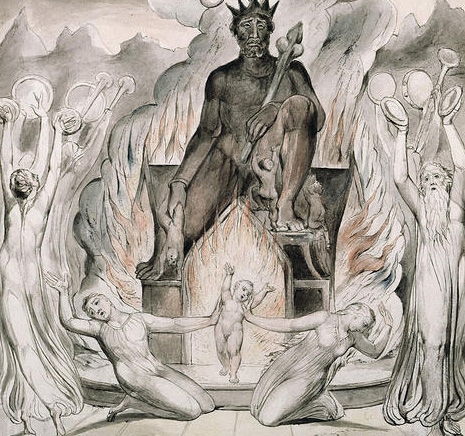
The Aryan neo-Christian, after WW2, always prefers self-sacrifice to his race. That is the defence mechanism that kills the source that triggered his anxiety after WW2 propaganda took hold of his psyche. He always chooses this new Moloch who used to make self-sacrifice by roasting his firstborn alive rather than perpetuating his race openly (perpetuating as the Germans of the Third Reich did).
Why do they make this sacrifice? Because their false self was structured with the new foundational myth after that war. But why this dominance of the false self if the white man before WW2 had a reasonable self-image? Why today’s zeitgeist always throws away the Aryan, sacrifices, annihilates and denies him and chooses the anti-Nazi fiction that covers the collective unconscious today?
Because the false self that virtually every Aryan has installed today is a Semitic malware, a parental deity in the collective unconscious since Constantine but only now fully triumphed. It is a Moloch that demands a tribute of Aryan blood, and the Aryans, including the white nationalists who continue to worship the god of the Jews, offer this blood constantly. (Remember that these nationalists are completely unable to distinguish between mudblood and Aryan precisely because of the Semitic malware that has taken hold of them.) And this Semitic Moloch demands not just one but an infinity of sacrifices, and won’t be satiated until the extinction of the white man is accomplished.
It all originated with our stupid Christian parents installing this Semitic malware in our psyches from our early childhoods. Secular liberalism in its Wokist phase is a missionary religion, like that of the Jew Saul (St Paul). Both Jewry and white Wokery try to convert others to sacrifice Aryan blood to this new Moloch and even the followers, once they fall into this cult, are sacrificed as they will leave no white offspring. Everything is done to fulfil the unquenchable, voracious thirst of this new Moloch whose strength is none other than the post-WW2 foundational myth.
This false self is the new God of the white man. It is the religion of the second part of the 20th century and the first part of the 21st century. It is a new divinity. The Aryan has to sacrifice himself to this new voracious God: sacrifice his true self. It is a human sacrifice: the false self (Wokism) replaces the true self (Nazism), and a new covenant is sealed between the Aryan and the Semitic god who wants to exterminate him. That covenant is perfectly antithetical to the covenant between the Semitic god and Abraham, who promised him and his descendants that their offspring would be as abundant as the stars (the old covenant). From the moment of the new covenant a religion was created: the religion of exterminating the Aryan on the initiative of the Aryan himself who always obeys the god of the Jews, including white nationalists.
Wokism (i.e. atheistic hyper-Christianity), I said, is a missionary religion. They try to convince you, Aryan man, that it is your duty to disappear from the face of the earth. Like the Muslims during their first conquests, they give you two choices: submit to the new religion or die.
When I first entered the forums supposedly defending the West from the invasion of migrants, I encountered a non-Jew counter-jihadist Christian who believed that Jewish tradition was the antidote to this Moloch claimant. False. As I wrote in Day of Wrath:
In the past, the shadow of infanticide covered the world, but the Phoenicians and their biblical ancestors, the Canaanites, performed sacrifices that turn pale the Mesoamerican sacrifices of children.
The Tophet, located in the valley of Gehenna, was a place near Jerusalem where it is believed that children were burned alive to the god Moloch Baal. Later it became synonymous with hell, and the generic name ‘tophet’ would be transferred to the sacrificial site of the cemetery at Carthage and other Mediterranean cities like Motya, Tharros and Hadrumetum, where bones have been found of Carthaginian and Phoenician children.
According to a traditional reading of the Bible, stories of sacrifice by the Hebrews were relapses of the chosen people to pagan customs. Recent studies, such as Jon Levenson’s The Death and Resurrection of the Beloved Son: The Transformation of Child Sacrifice in Judaism and Christianity have suggested that the ancient Hebrews did not differ much from the neighbouring towns but that they were typical examples of the Semitic peoples of Canaan. The cult of Yahweh was only gradually imposed in a group while the cult of Baal was still part of the fabric of the Hebrew-Canaanite culture. Such religion had not been a syncretistic custom that the most purist Hebrews rejected from their ‘neighbour’ Canaanites: it was part of their roots.
The god of the Jews, the god of the Carthaginians and Phoenicians, the god who sacrificed Jesus, is ultimately the same odious thing. What we really need is an infinite hatred of all things Semitic, starting with Judeo-Christianity: the Trojan horse that brought this infection into our collective unconscious.
I’m not finished with Counter-Currents because I find that webzine a real tidbit to show the principle of this site: that the value scale of white nationalists, who mistakenly perceive themselves as Jew-wise, isn’t wise at all in that it drags the tail of morality bequeathed to us by Judeo-Christianity.
Earlier I had quoted some more or less critical comments in the Counter-Currents comments section on Greg Johnson’s article ‘Palestinians & Jews, again’ where Johnson simply replied with flat statements; that is, he took Judeo-Christian morality so much for granted that he didn’t even bother to try to rebut his critics with arguments. Well, recently another C-C commenter posted a comment that demonstrates just what we have been saying, and in no uncertain terms:
Ahh, but isn’t this [Johnson’s stance—Ed.] merely a “Paretian” old Christian residue? I agree with your ethical position, but that is because a) I was raised Christian, and b) would someday like to become Christian again, provided I can resolve to my satisfaction the various philosophy-of-religion problems that originally led me away from the faith. In the meantime, I mostly hue to the old moral codes, first, because I’m psychologically and culturally oriented towards them, and second, because, in Pascalian fashion, I believe such a course would be pleasing to (and perhaps even required by) God, should He in fact exist.
As always, the fear of eternal damnation, with which our idiotic parents raised us (that’s why my autobiographical books are so important!), haunts the psyche of the Aryan to keep the commandments that the god of the Jews dictated for us Gentiles.
But if one does not believe in God, what is the meaningful ground of ethics? Eat or be eaten is the primordial law of life. Among animals, there is no ethics—and even that behavior which merely mimics human-understood ethics is limited to genetically similar creatures. Social animals, like chimps and humans, are tribal in nature. Such tribal structures mightily contribute to their members’ reproductive fitness. What imaginative philosophers might characterize as “ethical” behavior within such tribes are instinctively cooperative actions which strengthen the tribe as a whole, or else sanctions against ‘antisocial’ actions which weaken the tribe. Within a naturalistic metaphysics, from whence would be derived inter-tribal ethics?
And once again, Johnson responds with a flat, non-argumentative statement; though he now concedes that that is a discussion for another time:
No, I don’t think the only foundation of ethics is religion. Nor do I think Social Darwinism is a valid moral code. I think it is just post hoc rationalization for criminality. But that’s a conversation for another place.
Criminality? The only foundation of Western ‘ethics’ is the Judeo-Christian religion! The key is that, before Christianity, exterminationist genocide wasn’t considered criminal by the Aryans. That was malware that Constantine and his bishop minions (many of Semitic origin) began to implant in the Aryan psyche long ago. See the very important Neo-Christianity PDF of our featured post. Those new visitors who haven’t read it should read it now.
It seems to me intellectual quackery not to know that the morality with which we Westerners were all educated ultimately comes from a so-called new testament for Gentile consumption written by Jews. For now, I would just like to quote from page 83 of another of our PDFs, On Exterminationism:
What is certain is that the Holocaust would not have produced any debilitating psychological effect on non-Christian whites. (By Christianity I mean ‘Christian morality.’ Most atheists in the West are still Christian, even if they don’t believe in God or Jesus.) Being emotionally affected by the Holocaust presupposes that you think: (1) Victims and losers have intrinsically more moral value than conquerors and winners, (2) Killing is the most horrendous thing a human can do, (3) Killing children and women is even more horrendous and (4) Every human life has the same value.
None of these statements ring true to a man who has rejected Christian morality. Even if the Holocaust happened, I would not pity the victims or sympathise with them. If you told the Vikings that they needed to accept Jews on their lands or give them gold coins because six million of them were exterminated in an obscure war, they would have laughed at you!
What can the priest of holy words do in the face of so much Christian and neo-Christian swarming American white nationalism? Rather than despair, simply Troll Em All with Nietzsche’s maxim: Umwertuung aller Werte!
Yesterday I was shocked when Greg Johnson, the admin of Counter-Currents, banned a commenter for daring to propose a final solution to the JP. We can just imagine an Israeli nationalist these days banning from his online forum another Jew who proposed a final solution to the Palestinian problem!
Johnson’s behaviour represents a perfect paradigm to illustrate the central tenet of The West’s Darkest Hour: Christian ethics are killing us (and have been killing us since Constantine—see some of the books in the featured post). It is not the Jews who force Johnson to think that way: it is the tail end of the Christian education he received that has him trapped in the ethics of positively valuing all human life. I could now use the neo-Christian term I have used in those books. But for new visitors to this site, I think it is better to start using Gaedhal’s term which means the same: hyper-Christian atheist. The most conspicuous feature of neo-Christianity—that is hyper-Christian atheism—is anthropocentrism (see Savitri Devi’s book in the featured post). In his email statement today, Gaedhal told us:
The anthropocentrism of mainstream leftist politics proves to me that mainstream leftist politics is simply a godless version of Hyperchristianity. This is why I say that myself and my compatriots on the radical right should be making political hay with this. The overpopulation of the planet—especially in places like Sub-Saharan Africa—is a menace to this planet’s environment.
In a serious state, nincompoops with non-solutions like Mary Lou McDonald would not be the leader of the biggest political party in Ireland. This is another criticism I have of democracy: become too intelligent and too refined, and the mob won’t vote for you. As we see with Trump, democracy becomes idiocracy. In a serious country, the government would not be doing what is popular, would not be doing what the unthinking mob wants, would not be doing what will get them elected, but, instead what needs to be done.
What needs to be done to solve the Irish Housing crisis is simply to pursue global depopulation—especially in the third world—and to nationalise all empty properties. I am not anthropocentric. I say that Irish wild animals do have a right to their habitat, and that this right is superior to anthropoids needing even more housing. In my view, the rights of Irish wildlife to their habitat beats the supposed rights of foreigners and migrants to housing.
In his comment today in this forum, Gaedhal added:
As Alex Linder points out: evolution proceeds through genocide. The earth is overpopulated. The earth needs to be depopulated. The earth eventually, if left to itself, will depopulate itself of billions of anthropoid vermin… Humanity is a virus with shoes. The only question is who is going to be depopulated? I want the white race to survive the depopulations of the next couple of centuries and hopefully possess the entire planet. As I wrote in that anthology on exterminationism [does he refer to this one?—Ed.]: only a global exterminationist white Imperium counts as victory. I envisage a Globalist White Empire comprising petty vassal national states. Global problems require global solutions. In a technological age, practically all problems are global in scope. Anything short of a Global Exterminationist White Imperium is ultimate failure.
Global problems require global solutions? This reminds me of another of my grandmother’s sayings: ‘Para grandes males grandes remedios’ (For great evils great remedies!). And really: in a world with billions of what I call Neanderthals, and Gaedhal calls anthropoid vermin it should be obvious for every transvalued Aryan how to act.
Yesterday I quoted the first comment from an article in the atheistic but axiologically hyper-Christian racialist webzine Counter-Currents. Now I would like to quote a sentence from the first comment of a post today on the racialist webzine Occidental Dissent:
Our interests are served by preserving our own territory so that animals like this [Palestinians] aren’t able to murder us [Whites]. These brown people will not reciprocate our support or commiseration. They only care about themselves. Why is it so difficult for Western dissidents to understand that this is NATURAL and we should be doing the same [what Netanyahu does]? Is this more of this pervasive Christian guilt?
If one takes note of the response of the Christian admin of that webzine, ‘Israel has long wielded total control over our government’, one sees the lack of insight of the American racial right. Compare Wallace’s words, which represent what most white nationalists believe by using the acronym ZOG (Zionist Occupied Government), with what an American closer to our POV said: ‘There is not such a thing as Jewish domination, there is only white submissiveness’.
The amount of comments I get here, compared to what both the hyper-Christian atheist webzine Counter-Currents and the Christian Occidental Dissent get, is minuscule. Significantly, the post where I put the above quote in big letters received no comments except my own.
Let there be no doubt: racialists who have transvalued their values to the extent of embracing pro-Aryan exterminationism can be counted on the fingers of one hand! Nonetheless, I will still keep blogging as I believe that The West’s Darkest Hour is the only authentically post-Christian site among the racialist forums. I don’t mind not having so many commenters: just one who can receive the mantle after Time is done with my body will be enough…