web analytics
Categories
Conspiracy theories Parapsychology Pseudoscience Science Turin Shroud

On the Turin Shroud, 1

‘A love letter from God’

From personal experience I know that, when one is immersed in the dogma of a pseudoscience, the believer swears that it is real science.
A typical believer in a classical pseudoscience, such as the study of UFOs or parapsychology, ignores that there is a litmus test to distinguish between false and true science: the principle of the falsifiability of a hypothesis that Karl Popper devised in The Logic of Scientific Discovery. In short, for a hypothesis to be scientific it has to be refutable. Pseudoscientists follow the opposite methodology: they present their central hypotheses in such a way that they cannot be refuted. A typical case of pseudoscience from the Popperian point of view is sindonology, the study of the Shroud of Turin (Sindonology, from the Greek sindon: the word used in the gospel of Mark to describe the type of the burial cloth of Jesus).
Geoffroi de Charny, a French knight who died in 1356 at the Battle of Poitiers, was the first recorded owner of what later became known as ‘the Turin Shroud’. When in the late 1980s I was immersed in sindonology, I not only read a huge amount of literature on the subject where I learnt about the de Charny story, but contacted the ‘experts’ by mail, some personally. The late Dr. Enrique Rivero-Borrell, the foremost ‘expert’ on the shroud in Mexico, told me something I should mention.
I met him at a meeting of a group of Catholic sindonologists who believe that the image of the shroud is nothing more and nothing less than a late ‘love letter’ that God left behind in the 1st century as proof of the Resurrection for our scientific age!
The meeting with Rivero-Borrell, presided by Faustino Cervantes Ibarrola, a pleasant priest, was held in the aftermath of the carbon-14-dating tests results performed on the shroud in 1988. Rivero-Borrell, president of a sindonological organisation, was very confused. The tests, endorsed by the cardinal of Turin himself, revealed that the fabric dated from 1260 to 1380 CE. Keep in mind that the shroud is exactly about the size of an altar cloth; in no way resembles the several burial cloths used by Jewry. Since the shroud made its first appearance in a town in France, precisely in the times of de Charny, it could not be more significant that science corroborated that the cloth was manufactured in the 13th or 14th centuries.
However, I continued my investigation of the shroud because, at that time, I believed that the image remained mysterious. That was how I learned, a couple of years later that Rivero-Borrell left behind all his previous confusion of 1988. Very enthusiastically, he told me that the latest research had revealed that the carbon 14 tests had come out medieval because a fungus had covered the cloth, changing the molecular chemistry and the results turned out aberrant!
In other parts of the world, other sindonologists said that Jesus’ energy in the resurrection, which they call flash photolysis—the very moment when Jesus was resurrected!—not only left the miraculous imprint on the sheet, but changed its molecular chemistry. That’s why the results had come out medieval instead of the 1st century (a rather clumsy deity was this one who intended to leave behind ‘a love letter’ for us)!
The least absurd excuse among the sindonologists that I heard is that the piece of cloth to which they applied the carbon 14 tests was attached to the shroud; not a part of the original fabric.
All these excuses have something in common: they present us their central hypothesis—that the image of the Turin shroud is the result of a miraculous imprint at the very moment of Jesus’ resurrection—as an irrefutable hypothesis. And it is precisely the irrefutability of the central hypothesis of a field of study the most common feature in pseudosciences.
For example, those who study UFOs say that there is a conspiracy that involves all governments since 1947: government officials who have hidden evidence from the American people of extraterrestrial visitors. This is an irrefutable hypothesis insofar as, when a sceptic requests evidence that an alien ship exists in a top-secret hangar, the believer responds that everything is jealously guarded by sinister instances of the federal government. A massive conspiracy involving all presidencies from Truman to Trump, including the CIA and the FBI, and which continues today, cannot be refuted. Every time the sceptic complains that a massive conspiracy stresses the claim to the breaking point, the believer responds that the sceptic himself is a paid CIA agent! I’m not kidding: some ufologists used to say that about Philip J. Klass, the CSICOP specialist in UFOs, whom I met at a conference.
The same happens in the field of parapsychology. Parapsychologists say that extra-sensory perception (ESP) and psychokinesis (PK) exist, but that they are such erratic phenomena that it is very difficult to demonstrate them methodically and repeatedly in the laboratory. That is, there is no way to adequately submit the paranormal hypothesis to the protocol of refutability devised by Popper. That does not mean that ESP and PK do not exist (personally I doubt they exist). It means that the parapsychologists, who claim that they have reliable, empirical evidence of the existence of the paranormal, violate the principle of falsifiability by calling their field of study strictly ‘scientific’.
Such a pseudoscientific methodology is what the sindonologists also follow. Take for example the least insane of the above-mentioned excuses about why, according to believers, the carbon 14 tests did not come out of the century they expected: that researchers could have cut a cloth attached to the shroud, not the fabric where the image is.
If the proponents of the authenticity of the shroud were true scientists they would not be lucubrating such things. They would simply ask the Cardinal of Turin to allow another carbon 14 test on the cloth, this time from the area they consider appropriate. Meanwhile, the wise thing would be to suspend judgement until the cardinal approves another series of tests. Instead, what sindonologists do—who after the radiometric 1988 tests continue to claim that image is proof of the Resurrection—is a battery of secondary tests. Most of such tests are unrelated to the dating of the cloth; tests that purportedly show that the image remains mysterious.
That the image is not so mysterious can be seen in the research that Joe Nickell, a sceptic I met in 1994, has made of the shroud. But there is more to Nickell’s research: as we will see in the following entries on the subject.

Before finishing this post I would like to say something else. A white nationalist visiting this site might think that my interest in unmasking the gospels and the shroud buffs is a secondary issue. It is not. A few minutes ago of my writing this paragraph the bell of my house rang. Some Jehovah’s Witnesses gave me propaganda. I wrinkled it in anger and was about to throw it away when I saw the image of these blacks. Then it occurred to me to use it because in the background these neo-Christians put whites in a bucolic world where the races converge.
Christian ethics, so well captured in the propaganda I was given today, is a bigger factor than Jewish subversion, as without such ethics there would be no Jews (or blacks) empowered in the West. Aryans embracing a moral grammar based on the belief of a resurrected Jew is unhealthy, to say the least.

Categories
Art Bible Catholic Church Christendom Martin Luther Matt Koehl Protestantism Science

Faith of the Future, 3

by Matt Koehl


III. The Decline of Christianity


The imposition of Christianity on the Aryan peoples of Northern Europe had one lasting effect. It resulted in an inner tension, a disquiet—an angst—which has been a protruding feature of Western culture from its inception. Throughout the history of the West, there has always existed a soul struggle keenly felt by the more perceptive spirits of the race, occasioned by the contradiction between the inverted values and tenets of an Oriental/Semitic belief system on the one hand and the natural religious feeling of Nordic/Aryan man on the other.
If the former furnished the ideological matrix of the culture, it was the latter which provided the creative inspiration, the divine spark. Indeed, the greatest moments of Western culture as a manifestation of Aryan genius—whether expressed in a specifically Christian or extra-Christian form—occurred despite the stricture of Church dogma, rather than because of it. Dante, Chaucer, [Edmund] Spenser, Shakespeare, Milton, Goethe, Schiller, Shelley, Wordsworth, Keats, Byron, Leonardo, Michelangelo, Raphael, Botticelli, Dürer and Rembrandt all testify to this, no less than do Vivaldi, Bach, Handel, Haydn, Mozart, Beethoven, Wagner and Bruckner.
As we have seen, the external character of Christianity was greatly modified in its metamorphosis from a small Jewish cult into the mighty religion of the West. The medieval institution known as chivalry, in fact, with its refined honor code—which save for its Christian trappings more properly reflected the outlook and mores of a pre-Christian time—resulted from this very process, and provided a modus vivendi for opposing spiritual interests during the Middle Ages.
Thus, through a mutual accommodation of sorts was the underlying contradiction largely contained. And yet despite any institutional adjustment, the unease deriving from an alien idea remained latent within the fabric of the culture. The social and intellectual response to this inner tension varied. For their part, the kings, emperors and other secular rulers tended to treat the matter with cynical detachment, accommodating and offering resistance as political requirements dictated.
Among scholars and thinkers, on the other hand, there were those who, like Giordano Bruno, rose in open revolt against Church dogma. More often, however, the stirrings of disquiet were manifested in subtle attempts to orient Christian doctrine toward innate Aryan religiosity. This was particularly true of the mystics of the Middle Ages, like Scotus Erigena, Amalric of Bena and Meister Eckhart, who—going beyond the theology of the Church—looked inward into their own souls and to Nature itself to discover the kingdom of God.
It was with the Renaissance, however, that there appeared the most significant movement to challenge Church doctrine—a movement which would, in fact, set in motion an irreversible chain of events leading ultimately to the discrediting of that very doctrine as the core idea of a culture.
Now, for the first time, was the Promethean impulse able to break out of the clerical mold. Art came to express, not merely a sterile Semitic outlook, but the feelings of a Northern racial soul—a most notable development, which announced that creative vitality had stepped beyond the mythic prescriptions of the culture. The entire Judeo-Christian cosmology was called into question by new discoveries in the natural and physical sciences. Exploration across unknown seas commenced. Perhaps the most revolutionary single development of this time, however, was the discovery of movable type by Johannes Gutenberg, which enabled a much wider circulation of knowledge—knowledge other than that bearing an ecclesiastical imprimatur, knowledge transcending the basic ideology of the culture.

* * *

The most important consequence of the Gutenberg invention is to be seen in the Protestant Reformation, to which it was a contributing factor and whose development it greatly influenced. Up until the time of Martin Luther, the focus of Christian authority was the Papacy, whose word was unquestioned in matters of faith and dogma. Now, with the great schism in Christendom, a direct challenge was presented to ecclesiastical authority. It certainly was not, of course, die intent of Luther and the other dissenters to undermine or eliminate the Christian faith; rather the opposite. They merely wished to reform it. And yet, by challenging the one unifying institution of Christendom and causing a split in Christian ranks, they inadvertently opened the door to disbelief in the Christian mythos itself.
To replace papal authority in matters religious, Luther proposed to substitute the authority of the Book; and so, with the prospect of employing the Gutenberg invention, he undertook the prodigious task of translating obscure Hebrew scriptures into the German language—to the everlasting misfortune of Christianity.
It is ironic that in his quest for spiritual freedom, the Great Reformer should have rejected the despotism of the Papacy only to embrace the tyranny of the Torah and the ancient Jewish prophets. The arcane texts which had remained on musty shelves behind cloistered walls and accessible only to priests and theologians now became universal property. And now, instead of one single authority in matters of Christian exegesis, everyone—and no one—became an authority. Out of this there could be but one result: contradiction and confusion.
The effect on intelligent minds, of course, was devastating. For here it was now possible—in the best Talmudic fashion—to prove mutually exclusive points of view by reference to the same Semitic texts. Not only that, but critical examination of biblical literature gave rise to serious doubt concerning the veracity and validity of the subject matter itself, not to mention the peculiar mentality of its various authors. For the first time, perceptive minds could observe the obvious contradiction between empirical reality and what was claimed as holy writ.
Gradually there grew the inner realization that the faith itself was flawed, and creative genius began to look beyond the ideology of the Church for inspiration and direction. Even in those instances where Christian motifs continued to provide the external form for artistic expression—such as in the works of Bach, Corelli and Rubens, for example—the vital daemon which spoke was clearly extra-Christian and of a religious order transcending Church dogma.
And so even the Counter-Reformation, and the stylistic mode it inspired, succumbed to widening skepsis. A lessening of traditional belief had set in, and Aryan creativity now began to look increasingly in other directions for the divine. At the intellectual level, philosophy—which had long separated itself from theology—pursued its own independent quest for truth, while at the artistic level a succession of stylistic periods—impelled by irrepressible inner tension—sought ever newer forms of expression. Thus, the Baroque, having exploited all of its possibilities, gave way to the Rococo and the Classical, which in turn yielded to the Romantic of the last century and to the Impressionist, which has now been succeeded by the Modem era—which concludes the historical experience of the West.

* * *

Today, Christianity has reached its final stage. From both a spiritual and a scientific standpoint, its fundamental beliefs have become untenable. The advances of Aryan science have forever shattered the old Jewish myths. The cumulative impact of such figures as Copernicus, Galileo, Kepler, Newton and Darwin could not be eternally suppressed by ecclesiastical edict. When Church dogma, for example, insisted that the earth was the center of the universe and scientific investigation demonstrated otherwise, Aryan man was compelled by his innate regard for the truth to accept the latter at the expense of the former. In so doing, he came to question all other aspects of a once-sacrosanct belief system.
For the modem Church, this poses an impossible dilemma. The more it adheres to its fundamental doctrines, the more preposterous they must appear and the quicker will be its demise. On the other hand, once it attempts to reconcile itself with the findings of science by reinterpreting and redefining its basic tenets, it automatically concedes its moral position and its very reason for existence as an arbiter of truth.
The fact is that Christianity, as the dominant ideology of the West, has failed. It has exhausted all of its historical possibilities. No longer does it carry the emotional, mythic, polarizing force necessary to direct the spiritual life of a culture. Indeed, it is a spent cultural force no longer capable of adapting successfully to new organic realities.
All of this can be readily seen in the emptiness and sterility of modem cultural expression—reflecting the absence of any real spiritual values—as well as in the secularization of the Christian idea itself into liberal democracy and Marxism. Especially is this to be noted in the self-devaluation process of ecumenism and interfaith/inter-ideological dialogue, which constitutes the clearest concession by Christianity that it has failed and no longer has anything vital to offer. For once the Church admits that its doctrines are coequal with those of the nonbeliever, then what reason is there to be a believer?
It is not without significance that while the influence of Christianity is waning in the West, it is—through the sheer force of demographic pressure—gaining souls and expanding among nonwhites. Not only is this particularly true in Latin America, but also in Africa and—to a lesser extent—in Asia as well.
This development has, of course, not escaped the notice of the Church, which—with obsequious interracial posturing and attempts to divorce itself from its historical Western setting—has chosen to redirect the Christian appeal toward the colored world as the primary area of its interest and concern. In abandoning its Western role, however, Christianity has announced its conclusion as a cultural force. And so, whatever it may have traditionally represented for past generations of Europeans and North Americans no longer obtains.
Accordingly, it would be a mistake to assume that the Judeo-Christian idea has anything to offer the white peoples in their contemporary struggle for survival—that it might in any way be capable of addressing the vital needs and concerns of endangered Aryan life on this planet.
What now exists in the name of Christianity—apart from certain nostalgic, retrograde attempts to revive a historical corpse in a world of uncertainty and personal insecurity—is nothing more than fossil formalism and sterile nominalism without genuine vitality or substance, reflecting the marginal relevance of this particular ideology in today’s society. For in the face of modem realities, the Christian worldview simply has nothing more to say. It has fulfilled its historic role; it is now moribund. At best, it is irrelevant. At worst, it is an avowed enemy, a deadly menace to the Aryan race and its survival.
It may well be argued that the worst consequences of such ideological and spiritual error were far less conspicuous before the Second World War. Does the same hold true today, however, when the final effects of that error can be plainly seen? For well over a millennium now, Christianity has held a monopoly as the self-proclaimed custodian of the spiritual and moral well-being of an entire cultural order—for which one must reasonably assume that it has accepted concomitant responsibility.
What, then, are the fruits of its spiritual regime? We see them all around us. They are the symptoms of a diseased civilization: decadence, degeneracy, depravity, corruption, pollution, egoism, hedonism, materialism, Marxism and ultimately atheism. Yes, atheism. By destroying whatever natural religious feeling once existed in the hearts of our people and substituting alien myths and superstitions, it must now bear full responsibility for the diminished capacity for spiritual belief among our folk.
It will perhaps be objected that the Church itself is opposed to all of the above indesiderata. I am sorry: the responsibility for what has been claimed as a divine charge cannot be so easily evaded. Words aside, these happen to be the actual results of its earthly reign.
The Promethean spirit of Aryan man, for its part, must now look in other directions.

Categories
Eugenics Miscegenation Science

Eugenics and Race, 4

Today the law of survival of the fittest no longer holds good amongst human beings and some writers even claim it has been replaced by the law of survival of the unfittest…

Today, the poorer specimens of humanity have become protected beings, and the more capable are elected by scholarships and examinations to the levels of ‘professional’ society, in which their birth-rate falls below replacement level…

Selection—the elimination before the child-bearing stage of the unfit or the least fit—acts in the natural state not only on individuals within a given population, but also by the elimination of entire species. When two animal species compete for the same living area, the weaker species is usually exterminated, and this rule applied to the earlier tribes of man, and also to the spasmodic warfare between man and sub-man which eventually resulted in the virtual annihilation of sub-man in all parts of the world…

But such is not the situation in the artificial pattern of life that has been slowly built up by man since he left the ‘primitive’ stage in which he obeyed the dictates of nature. Nature still rules our lives—we are only flesh and blood, physico-chemical organisms—but in the luxury of our own power, the exultation of triumph and pride at our own prowess, we have forgotten that we are still subject to the laws of nature, and that nature often breaks as well as makes…

Mankind has deigned to ignore the knowledge which it has acquired of Nature’s methods, and has chosen to run counter to these laws. Only a handful of eugenicists and scientists, whose voice is never heard by the masses, remain to remind mankind that we are still subject to the laws of Nature, and these scientists are called ‘inhumane’ for their pains…

According to the law of evolution, species and subspecies (evolutionary adventures which have acquired considerable physical differentiation but which are still capable of inter-breeding) compete one with the other for survival. Thus the stronger, or the best suited, survive, and evolution takes yet another step forward. But this is not the case with modern man.

History tells a very different story: it tells of the conqueror enslaving the conquered, taking the womenfolk of the conquered into his own household, to become the mothers of his own offspring, it tells of the intermingling of civiliser with savage, of the perpetuation and survival of the conquered, and the annihilation by absorption, instead, of the conqueror.

This is the story of Egyptian, Sumerian, Greek, Roman, Persian, Arab, Turkoman and almost every conquering civilisation the world has known. Within a few generations of the conquest the original civilising stock has been swallowed up and absorbed by those whom they conquered, so that the civilisation staggers on without direction for a few more generations, and ultimately collapses due to weakness from within—from an inadequate supply of capable individuals to preserve what the earlier generations had built.

A study of eugenics soon convinces the reader of the danger to which modern man, with his reversed law of ‘survival of the fittest’, has exposed himself, and a study of history, of the rise and fall of civilisations and nations, only too readily confirms the teaching of the eugenicist. The concepts of eugenics and evolution are young as yet, they date from the last century, but they constitute the greatest discovery of mankind.

______________________

This is a passage from the fourth chapter of Eugenics and Race, a booklet now available at 50% off from Daybreak Publications (here).

Categories
Eugenics Science

Eugenics and Race, 2

Once a species becomes mixed, it will be seen from the foregoing that the genes themselves never blend, and no blending of species can take place, other than superficially by the dominance of certain genetic qualities, or materially, by the elimination of all individuals (possibly over a period of many generations) who may exhibit variant characteristics. Actually this latter process can scarcely be called a blend, since it implies the elimination of a specific part of the combined inheritance.

Amongst the lower animals, where the genetic pattern is simple, it is relatively easier, of course, to eliminate or isolate the individuals with mixed genes, and to breed only from those which represent one or other pure types. By such a careful eugenic process the Irish Wolfhound was actually bred back into existence after it had been extinct as a pure breed for several generations; but where mankind is concerned, the complexity is such that there is little possibility of such action, although it is possible to go far with the aid of the dominant-recessive pattern in this direction.

Theoretically, in fact, if a Hottentot were crossed with an Eskimo, pure Hottentot and pure Eskimo types could be produced from amongst the offspring, but the number of genetic variables in human beings is so great that the number of offspring required to produce, according to the laws of mathematics, one pure specimen of each sub-species would run into millions.

_________________

This is a passage from the second chapter of Eugenics and Race, a booklet now available from Daybreak Publications (here):

Categories
Kevin MacDonald Science

Diaspora Peoples


Editor’s preface

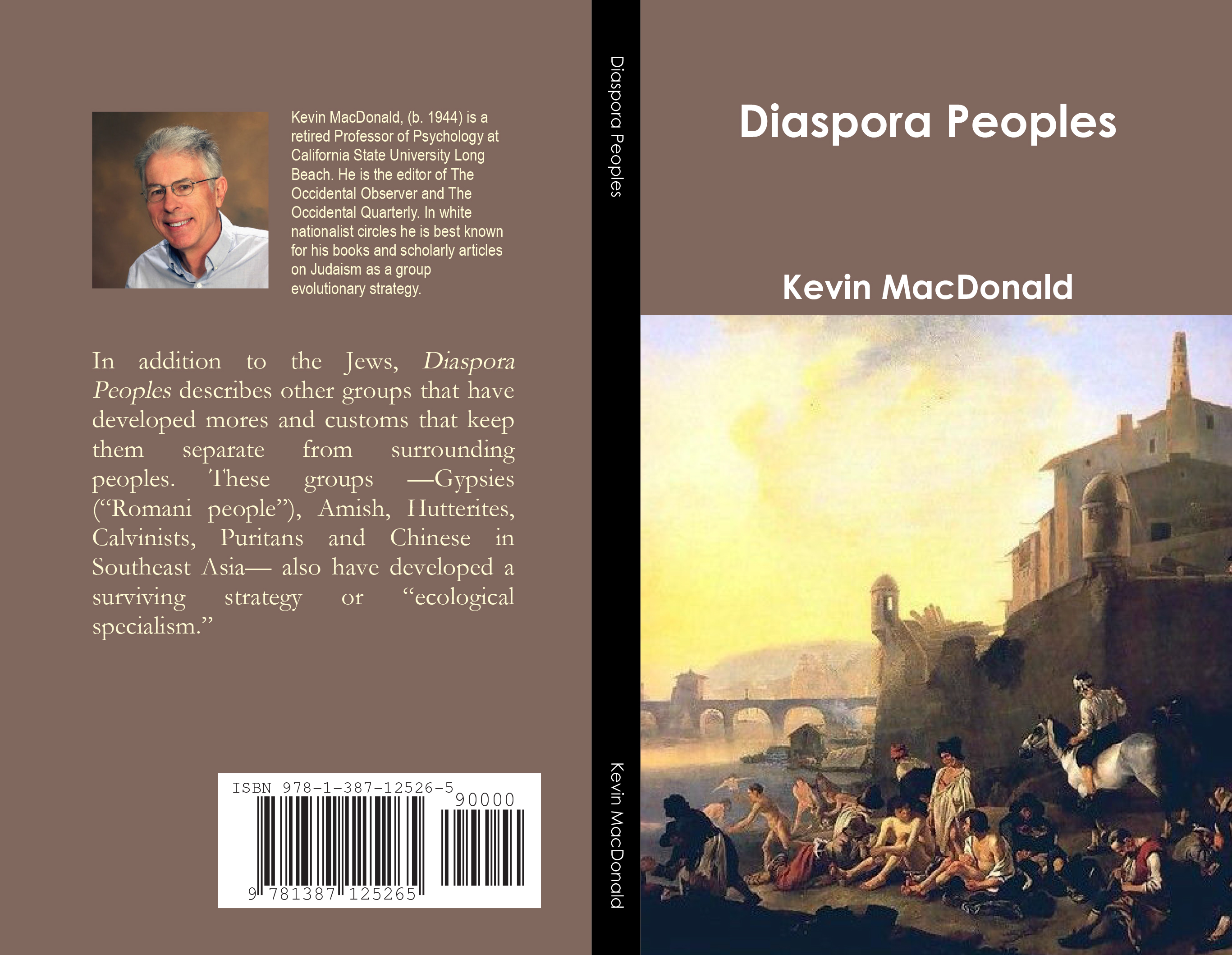
A People That Shall Dwell Alone: Judaism as a Group Evolutionary Strategy was originally published in 1994. It is the first book of Professor Kevin MacDonald’s trilogy of books on Judaism. Diaspora Peoples was published as a 2002 preface to the paperback edition of A People That Shall Dwell Alone.

When I started reading this paperback’s Diaspora Peoples in 2011, I realized that it reflected the thinking of the mature scholar. My impression was that it should be read after the trilogy, not as a prelude to it.

Prof. MacDonald has graciously allowed me to publish this academic study as an independent book for Daybreak Publications. As he explains in the following pages, in addition to the Jews, Diaspora Peoples describes other groups that have developed mores and customs that keep them separate from surrounding peoples. These groups—Gypsies (“Romani people” in today’s Newspeak), Amish, Hutterites, Calvinists, Puritans and Chinese in Southeast Asia—also have developed a surviving strategy or “ecological specialism.”

As the cover for this 2017 edition I have chosen Bathing Gypsies, an oil canvas in a Basel museum painted in the 17th century by the Dutch Johann Lingelbach.

For three sample passages of the content of this book, see: here, here and here.

To order a copy, click: here.

Categories
Blacks Eugenics Miscegenation Science

Eugenics and Race, 1

A passage from the first chapter of Eugenics and Race,
a booklet now available from Daybreak Publications (here):

This theory of an African origin is interesting as the African Negro remains the most ape-like in appearance of all the existing races of man…

With the improvement in climatic conditions he [Cro-Magnon man] started to roam the earth, and in Europe, in a few centuries, probably, he exterminated Neanderthal sub-man: the evidence of broken skulls would tend to suggest, at least, that the disappear-ance of the latter was due to his work. He exterminated them—all, that is, except the females, some of whom he definitely retained.

Like all conquering races of mankind, he would appear to have kept for his own use females from the tribes he conquered, for several fossils of this period show characteristics which point clearly towards an admixture of the two species, the one highly advanced, the other considerably lower on the scale; and isolated throw-backs to Neanderthal characteristics have ever since appeared amongst the various human races, admixture being greater in some areas such as Asia than in others.

Ever since man became more mobile, this retrogressive tendency towards the mixing of the sub-species has progressed with increasing rapidity, until we have the complex and generally blurred pattern which we know today.

Categories
Eugenics Racial studies Science

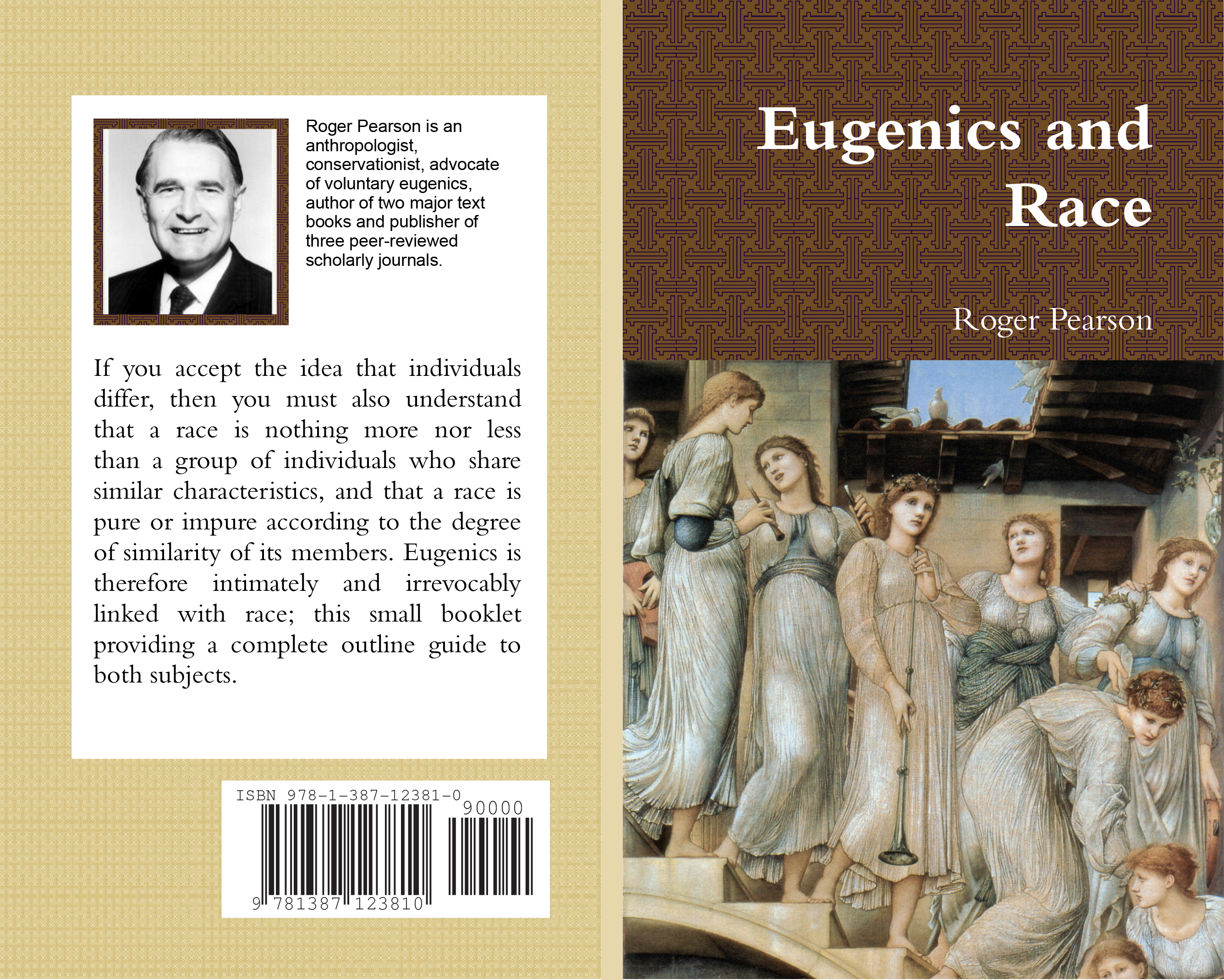
Eugenics and race

by Prof. Roger Pearson

Foreword

This booklet [first edition 1959, second and revised edition 1966] comprises a selection of articles from the pages of Northern World which between them broadly cover the field of eugenics and race, and help to show how these twin studies are both facets of the same subject: heredity.

There can be no guarantee of enduring progress until a thorough appreciation of the implications of heredity has been acquired by those who shape the policies of governments and the destinies of nations. Man is in no way exempt from the laws of biological inheritance which govern all species of the animal and plant kingdoms, and since affairs of heredity tend to be final and irrevocable, the sooner he learns to face up to the facts of nature, then the brighter will be the prospects for humanity.

Categories
G.L. Rockwell Intelligence quotient (IQ) Racial studies Science

Raciology, 7

After 1945

In April 1966, Alex Haley interviewed American Nazi Party founder George Lincoln Rockwell for Playboy. Rockwell justified his belief that blacks were inferior to whites by citing a study by G.O. Ferguson showing that the intellectual performance of black students was correlated with their percentage of white ancestry, stating “pure negroes, negroes three-fourths, mulattoes and quadroons have, roughly, 60, 70, 80 and 90 percent, respectively, of white intellectual efficiency.” Playboy published the interview but botched it with a pseudoscientific editorial note. The next year Rockwell was assassinated.

Today, the term “scientific racism” is used to refer to Raciology: research seeming to scientifically justify racist ideology. The accusation of scientific racism often is cast upon the raciologists that discovered quantifiable differences in intelligence among the races, especially if said differences are partly genetic in origin.

Post WW2 researchers include Arthur Jensen (1923-2012), Philippe Rushton (1943-2012), Chris Brand (1943-2017), Richard Lynn (1930-); and also Charles Alan Murray (1943-) and Richard Herrnstein (1930-1994), the authors of The Bell Curve, among others. These authors, while seeing their work as scientific, may dispute the term “racism” and may prefer terms such as “race realism” or “racialism”.

Presently Jared Taylor’s American Renaissance is internet’s premier race-realist site.

Categories
Judaism Kevin MacDonald Racial studies Science

Diaspora, 1

Food for thought from Kevin
MacDonald’s Diaspora Peoples:

 
Groups of Europeans are thus exactly the sort of groups modeled by Fehr and Gätcher: They are groups with high levels of cooperation with strangers. They are thus prone to market relations and individualism. On the other hand, Jewish culture and Chinese culture derive from the Middle Old World culture area, characterized by extended kinship networks and the extended family. They derive from cultures prone to ingroup-outgroup relationships in which cooperation is with the ingroup composed of extended family members…

Jews are at the extreme collectivist end of the individualism-collectivism continuum, so extreme that they are prone to martyrdom rather than abandoning the group. These people are obligated to remain in the group no matter what—even to the point of killing themselves and their own family members to prevent the possibility of becoming a member of the outgroup…

There has been essentially no conversion of Europeans to become mating members of the Ashkenazi gene pool. The very low levels of genetic admixture with Europeans may well have come from clandestine matings and rape…

Sephardic Jews were genetically distant from both Spaniards and North Africans despite having lived among them for centuries. Indeed, they remain very close to Kurdish Jews, a finding the authors attribute to genetic continuity with Jews exiled by the Assyrians in 723 B.C. and the Babylonians in 586 B.C. Kurdish Jews remained closer generically to Ashkenazi and Sephardic Jews than to Kurdish Muslims, a truly remarkable finding, since it indicates no detectable genetic admixture between Kurdish Jews and their hosts over approximately 2700 years.

Categories
Hans F. K. Günther Lothrop Stoddard Madison Grant Nordicism Racial studies Science

Raciology, 6

In the late 19th century, the Plessy v. Ferguson (1896) United States Supreme Court decision upheld the constitutional legality of racial segregation under the doctrine of “separate but equal.”

Eugenicists such as Harry H. Laughlin and Madison Grant sought to scientifically prove the physical and mental inadequacy of certain ethnic groups to justify compulsory sterilisation and restrict immigration, per the Immigration Act of 1924.

Lothrop Stoddard published many racialist books on what he saw as the peril of immigration, his most famous being The Rising Tide of Color Against White World Supremacy in 1920. In this book he presented a view of the world situation pertaining to race focusing concern on the coming population explosion among the coloured peoples of the world and the way in which white world-supremacy was being lessened in the wake of World War I and the collapse of colonialism.

Stoddard’s analysis divided world politics and situations into “white,” “yellow,” “black,” “Amerindian,” and “brown” peoples and their interactions. He argued that race and heredity were the guiding factors of history and civilisation, and that the elimination or absorption of the white race by coloured races would result in the destruction of Western civilisation.

Like Madison Grant, Stoddard divided the white race into three main divisions: Nordic, Alpine, and Mediterranean. He considered all three to be of good stock, and far above the quality of the coloured races, but argued that the Nordic was the greatest of the three and needed to be preserved by way of eugenics. Unlike Grant, Stoddard was less concerned with which varieties of European people were superior to others (nordicism), but was more concerned with what he called “bi-racialism,” seeing the world as being composed of simply coloured and white races.

In the years after the Great Migration and World War I, Grant’s racial theory would fall out of favour in the U.S. for a model closer to Stoddard’s. An influential publication was The Races of Europe (1939) by Carleton S. Coon, president of the American Association of Physical Anthropologists from 1930 to 1961. Coon was a proponent of multiregional origin of modern humans and divided Homo sapiens into five main races.
 
Racial policy of Nazi Germany

The Nazi Party and its sympathizers published many books on scientific racism, seizing on the eugenicist ideas with which they were widely associated, although these ideas had been in circulation since the 19th century. Books such as Rassenkunde des Deutschen Volkes (“Ethnology of the German People”) by Hans F. K. Günther and Rasse und Seele (“Race and Soul”) by Ludwig Ferdinand Clauss attempted to scientifically identify differences between the German, Nordic, or Aryan people and inferior groups. German schools used these books as texts during the Nazi era.

In the early 1930s, the Nazis used racialised scientific rhetoric based on social Darwinism to push their eugenic social policies. During the Second World War, raciology studies became anathema in the United States, and Boasians such as Ruth Benedict consolidated their institutional power.

After the war, the malicious propaganda by the Allied forces led most of the scientific community to repudiate the scientific support for racism.