web analytics
Categories
Ancient Rome Architecture Art Christendom Constantine Emperor Julian

Why Europeans must reject Christianity, 13

by Ferdinand Bardamu
 
Christianity: bringer of violence and bloodshed
Word of mouth is notoriously ineffective as a means of spreading religious propaganda. This explains why Christianity’s growth remained largely unspectacular until the early 4th century. Of course, the primary reason for the Christianization of the empire was the conversion of Constantine to the new religion. The influence of Christianity in the empire was continuously reinforced and strengthened by the imperially coercive legislation of his successors. Christianization also sanctioned acts of religious violence against pagans, which contributed significantly to the religion’s spectacular growth in numbers and influence. Christianity unleashed a wave of violence that nearly drowned Europe in an ocean of blood. Without Constantine, and the religious violence of his successors, Christianity would have remained just another competing religion in the provincial backwaters of the empire, like Mithraism or the Eleusinian Mysteries.
The imperial policy of Christianization was further aided by the religion’s intrinsic advantages over rival philosophical and religious belief systems, making it more palatable to the ignorant masses. This facilitated its rapid spread across the empire until, by the reign of Theodosius in the late 4th century, most urban areas were predominantly Christian. These advantages included the egalitarian ethos of the Christian church. Unlike Mithraism, which was elitist, Christianity accepted all potential recruits, regardless of ethno-linguistic or socio-economic difference. The Christians of the first three centuries practiced a form of primitive communism. This attracted the chronically indigent, as well as freeloaders. Another advantage was the child-like simplicity of Christian doctrine.
The Crisis of the 3rd century, where rival claimants fought each other for the title of Caesar, was an internecine conflict lasting for decades. It produced widespread economic instability and civil unrest. This disruption of daily life encouraged men and women to seek refuge in the mystery religions, but also Christianity, which offered easy answers in an increasingly chaotic and ugly world. The Christian religion promised life everlasting to those who successfully endured tribulation on earth.
Passage of the edict of Milan in 313 meant that Christians would go from being a persecuted minority to a persecuting majority. Although persecution of religious dissidents had occurred before Constantine, such events were comparatively rare. Roman “persecution” of Christianity was mild and sporadic. It was not even religious in nature, but political; Christians refused to swear loyalty to the state by offering the pinch of incense to the emperor’s genius. Christians were not so much persecuted as they were subjected to Roman police action for disobeying the laws of the land. In contrast, Christian persecution of pagans and heretics was entirely motivated by religious hatred. It combined the authoritarian anti-pagan legislation of the emperors with the bigotry of the clergy and the violence of the Christian mob.
The first repressive laws against paganism were passed by Constantine. In 331, he issued an edict that legalized the seizure of temple property. This was used to enrich church coffers and adorn his city of Constantinople. He redirected municipal funds from the curiae to the imperial treasury. The curiae used these funds for the construction and renovation of temples, as well as for pagan banquets, processions and festivals. The redirection of municipal funds significantly diminished the influence of paganism in the public sphere. Constantine also showed preference for Christians when considering prospective candidates for government posts. For the first time in the empire’s history, conversion to Christianity was considered an attractive proposition.
Pagan temples and statuary were first vandalized and destroyed under Constantine. Christians believed that this first wave of iconoclasm was in fulfillment of scriptural command: “Ye shall destroy their altars, break their images, and cut down their groves; . . . for the Lord, whose name is Jealous, is a jealous God” (Exod. 34.13f). The earliest Christian iconoclasm included the partial destruction of a Cilician temple of Asklepios and the destruction of temples to Aphrodite in Phoenicia (ca. 326 AD).
Constantine’s sons, Constans and Constantius II, followed in their father’s footsteps. In 341, Constans issued an edict banning animal sacrifice. In 346, Constans and Constantius II passed a law ordering the closure of all temples. These emperors were egged on by the Christian fanatic Firmicus Maternus who, in an exhortation addressed to both emperors in 346, called for the “annihilation of idolatry and the destruction of profane temples.” The fact that pagans continued to occupy important posts in the imperial administration made it difficult to legislate the active destruction of temples, statuary and inscriptions without alienating a large segment of the empire’s population. Nevertheless, Constantine’s sons turned a blind eye to private acts of Christian vandalism and desecration.
After the death of Constantius II, Julian was made emperor in 361. Having succumbed to the influence of pagan tutors in his youth, he developed a deep hatred for the “Galilean madness.” Accession to the throne allowed him to announce his conversion to Hellenism without fear of retribution. Julian set about reversing the anti-pagan legislation first enacted by his uncle. He re-opened the temples, restored their funding and returned confiscated goods; he renovated temples that had been damaged by Christian vandals; he repealed the laws against sacrifice and barred Christians from teaching the classics. Julian’s revival of pagan religious practice was cut short in 363, when he was killed in battle against the Persian Sassanids.
His successor Jovian revoked Julian’s edicts and re-established Christianity as most favored religion in the empire. The emperors who came after Jovian were too occupied with barbarian invasion to be concerned with internal religious squabbles; it was more expedient to simply uphold the toleration imposed on pagans and Christians alike by the Edict of Milan. Anti-pagan conflict again came to the forefront with Gratian. In 382 he angered pagans by removing the altar of Victory from the Senate. In the same year, Gratian issued a decree that ended all subsidies to the pagan cults, including priesthoods such as the Vestal Virgins. He further alienated pagans by repudiating the insignia of the pontifex maximus.
In 389, Theodosius began his all-out war on the old Roman state religion by abolishing the pagan holidays. According to the emperor’s decrees, paganism was a form of “natural insanity and stubborn insolence” difficult to root out, despite the terrors of the law and threats of exile. This was followed by more repressive legislation in 391, which re-instated the ban on sacrifice, banned visitation of pagan sanctuaries and temples, ended imperial subsidies to the pagan cults, disbanded the Vestal Virgins and criminalized apostasy. He refused to return the altar of Victory to the Senate house, in defiance of pagan demands. Anyone caught performing animal sacrifice or haruspicy was to be arrested and put to death. In the same year, the Serapeum, a massive temple complex housing the Great Library of Alexandria, was destroyed by a mob of Christian fanatics. This act of Christian vandalism was a great psychological blow to the pagan establishment.
Pagans, dissatisfied with the imperially-sponsored cultural revolution that threatened to annihilate Rome’s ancestral traditions, rallied around the usurper Eugenius. He was declared emperor by the Frankish warlord Arbogast in 392. A nominal Christian, Eugenius was sympathetic to the plight of pagans in the empire and harbored a certain nostalgia for pre-Christian Rome. He restored the imperial subsidies to the pagan cults and returned the altar of Victory to the Senate. This angered Theodosius, emperor in the east. In 394, Theodosius invaded the west and defeated Eugenius at the battle of Frigidus in Slovenia. This ended the last serious pagan challenge to the establishment of Christianity as official religion of the empire.
Apologists for Christianity argue that imperial anti-pagan legislation was more rhetoric than reality; their enforcement would have been difficult in the absence of a modern police state apparatus. This objection is contradicted by archaeological and epigraphic evidence. First, based on stratigraphic analysis of urban temples, cult activity had virtually ceased by the year 400, after passage of the Theodosian decrees. Second, temple construction and renovation declined significantly under the Christian emperors. In Africa and Cyrenaica, temple construction and renovation inscriptions are far more common under the first Tetrarchy than the Constantinian dynasty, when pagans still constituted a significant majority of the empire’s citizens. By the end of the 4th century, the authoritarian legislation of the Christian emperors had seriously undermined the strength and vitality of the old polytheistic cults.
The emperors did not stop with the closure of pagan religious sites. In 435 AD, a triumphant Theodosius II passed an edict ordering the destruction of all pagan shrines and temples across the empire. He even decreed the death penalty for Christian magistrates who failed to enforce the edict. The Code Justinian, issued between 529 to 534, prescribes the death penalty for public observance of Hellenic rites and rituals; known pagans were to seek instruction in the Christian faith or risk property confiscation; their children were to be seized by officials of the state and forcibly converted to the Christian religion.
Imperially mandated closure of all urban temples resulted in the privatization of polytheistic worship. This further exacerbated the decline of the pagan religious cults because of the object-dependent nature of ritual practice, which could not be fully realized in the absence of statuary, processions, festivals, lavish banquets and monumental building. In urban areas, imperial legislation was clearly effective. This was ruthlessly enforced by professional Christians and zealous magistrates, who used the additional muscle of the Roman army to get their own way, especially when preaching and public example failed.
Pagan rites and rituals were still observed at rural sanctuaries and temples for some time after the closure of urban centers of worship. These remained off the beaten track, so to speak, and were harder to shut down.
Churchmen like the fiery John Chrysostom, cognizant of this fact, exhorted the rich landowning class of the east to convert the heathen on their country estates. Those who allowed pagan worship on their rural properties were just as guilty of violating imperial anti-pagan legislation as the pagans themselves. Itinerant Christian evangelists, like Martin of Tours, fanned out across the countryside, winning souls for Christ through a campaign of intimidation, harassment and violence. In the end, aggressive evangelism, privatization of pagan religious practice and social marginalization ensured the death of paganism in rural areas.
Christianization of the empire was complete by 600 AD, although it is unclear to what extent Christ was considered just another deity to be worshipped alongside the old pagan gods.
Categories
Catholic Church Christendom Evil Free speech / association

Why Europeans must reject Christianity, 10

by Ferdinand Bardamu

 
Section IV: Christianity and the narrowing of the Western intellectual horizon
Christians declared all-out war on the secular foundations of the Roman state. In doing so, they inevitably attacked Rome’s tradition of great art and architecture, as well as the vast storehouses of scientific and technical knowledge that had been accumulated over the centuries. Christians who desired the total eradication of paganism had nothing viable with which to replace the secular culture of the late antique world.
Many Christians, conscious of the inferiority of their own religious traditions when compared to the majestic scientific and philosophical achievements of Western culture, attacked secular learning out of envy and spite. This intellectual poverty of the Christian religion induced a significant narrowing of Western intellectual horizons. The entrenchment and consolidation of the Nicene state religious cult obviated the necessity of a classical education for worldly success. Many pursued a religious vocation instead, an option that suddenly became attractive as the Christian church increased in power and influence.
The 4th century witnessed the dismantlement of the public education system by zealous Christians, who were disgusted with the paganism of the classical academic curriculum. The Christian emperors, unlike their pagan antecedents, did not patronize secular philosophy and science; the administrative apparatus responsible for disbursement of state funds, now controlled by an ecclesiastical bureaucracy, withheld them in the case of teachers who specialized in the classics. This angered many of the last remaining pagans of late antiquity, who bitterly complained about the role of Christianity in spreading a general lack of interest in pursuing a secular education.
A man with a classical education was no longer as highly esteemed as he once was before the age of Constantine. The leaders of the empire’s most powerful institution, the church, contemptuously dismissed their learning as mere “worldly wisdom.” In the eyes of the church, reliance on the faculty of reason alone was the mark of demonic possession, a path fraught with snares for lost souls on the way to eternal damnation in the fires of hell.
This made the educated man condescending and arrogant, as well as too sophisticated for the simple message of the gospels, which he derided as a collection of childish fables. An educated man would also question Christian doctrine, even embrace heresy, making him especially dangerous from an ecclesiastical point of view. The existence of the classical curriculum posed a significant obstacle to the imperial policy of Christianization. By downgrading and marginalizing the pursuit of a secular education, the church was able to gradually eliminate this threat, producing a more docile public, like the sheep in the parables of Jesus. From now on, Christians like Martin of Tours would have more important things to do than learn how to read and write.
The final triumph of orthodoxy over reason is enshrined in the church’s canon law, which forbade clergy and laity from reading the secular literature of antiquity. This canonical prohibition was famously enforced by Pope Gregory I, who severely reprimanded his bishops for instructing students in classical literature. “One mouth cannot praise both Christ and Jupiter at the same time,” thundered Gregory from the Papal See in Rome.
The Church controlled all medieval scriptoria in Europe. Advice to monks from church leadership, ordering them to despise all secular knowledge as “foolishness in the eyes of god,” exercised a damaging influence on the scribal transmission of classical literature, merely strengthening the clerical refusal to not copy works of pagan origin. What followed was the inevitable loss of the knowledge needed to run an advanced pre-industrial society.
This only worsened and prolonged the Dark Ages, reducing Europeans to a Neolithic existence in the process. Gregory’s hatred of Rome’s secular past was so fierce he was rumored to have personally hunted down and burnt every copy of Titus Livy’s History he could get his hands on. The Library of the Palatine Apollo, first established by Augustus in Rome, was burnt to the ground on his orders. This was to protect the faithful from being contaminated by the “poison” of secular Greek and Latin literature.
Isidore of Seville was the only real “intellectual” for 200 years of western European history. His Etymologies, the most popular and widely used textbook of the Middle Ages, was written in support of Christian “fundamentalism.” Although unsurpassed in topical comprehensiveness, Isidore’s intellectual depth and range of knowledge are considerably inferior to the Roman encyclopedists who preceded him.
Isidore lived in a geocentric universe enclosed within a rotating star-studded sphere, not unlike the cosmology of the ancient Hebrews. Between the flat earth and the outer sphere are seven concentric inner spheres. The concept of infinite space was completely alien to Isidore’s way of thinking; the universe is a small place with definite boundaries. The fact that all knowledge could be summarized in a single volume shows how drastically intellectual horizons had narrowed under Christian influence. Isidore regarded all pagan science and philosophy as heresy anathema to right-thinking Christians.
The church, using the Etymologies as a guide, censored and suppressed the pagan literature quoted in its pages. Isidore further denigrated intellectual curiosity as “dangerous” and “harmful.” Isidore’s widely influential Monastic Rule warned monks of the dangers of reading pagan literature; the rule stated that ideally monks should be completely ignorant of all secular knowledge. Isidore’s condemnation of secular knowledge reinforced the prevailing “fundamentalist” orthodoxy of the church, which demanded the censorship and suppression of all pagan science and philosophy.

Categories
Catholic Church Christendom Free speech / association

Why Europeans must reject Christianity, 9

by Ferdinand Bardamu

 
Section III: Censorship and the Christian War on Western Culture
The ecclesiastical decision to censor and suppress classical literature was influenced by militant Christian “fundamentalists,” bigoted anti-intellectuals like Ambrose and John Chrysostom. These men, because of their prominence in ecclesiastical affairs and importance for the patristic canon, were able to aggressively push for an agenda calling for the eradication of all pagan artistic, cultural and scientific achievement. The patristic attack on the intellectual foundations of the ancient world was continued by the medieval church. Isidore of Seville, the most influential and widely read author of the Dark Ages, repeatedly warned his flock of the spiritual dangers posed by reading secular philosophy and science. The canon law of the church had long prohibited Christians from reading secular literature, excluding clergy who consulted these writings to combat heresy and paganism.
The Christianization of 4th century Rome made the church sole inheritor of the great storehouses of ancient wisdom that had been accumulated throughout the centuries. As pagans dwindled in numbers and influence, the monastic scriptoria came to dominate textual transmission, especially after 400. Guided by ecclesiastical censure and canon law, the scriptoria, with few exceptions, ceased copying secular writings for over 300 years, severing medieval Europe from the great scientific and technological achievements of the ancient past. During the Dark Ages, nearly all Greco-Roman literature was removed from circulation and replaced with patristic, biblical and liturgical writings. Works of science and philosophy, some well ahead of their time, were discarded by ecclesiastical officials as rubbish. Sometimes they were re-used for mundane purposes; relics were once found wrapped in the pages of Livy’s Histories. Italian Renaissance scholar Pietro Bembo estimated that less than 1% of all Greek literature survived the turmoil and chaos of the Dark Ages. Modern scholars have made similar estimates for the survival of Latin literature.
Christian religionists allege barbarian invasion as a significant factor in the loss of Western scientific and technical knowledge; they neglect to mention that the barbarians who terrorized the western half of the empire were also Christians. At any rate, barbarian invasion played virtually no role in the destruction of the West’s literary heritage; the majority of Greek and Latin literature was still extant by 500 AD, as the age of Germanic migration was drawing to a close. Although there is no evidence of barbarians burning books or libraries, there is an abundance of evidence implicating Christians in the active destruction and censorship of an entire civilization’s repository of secular knowledge. After the Christian destruction of the Library of Alexandria, the second most destructive act of Christian literary vandalism was the burning of over 120,000 manuscripts by crusaders during the sack of Constantinople in 1204.
Apologists for Christianity emphasize the role of economic and material factors in the disappearance of Western culture during the Dark Ages. In their view, most pagan works simply disintegrated because they were written on papyrus, a fragile material. But this is a myth; papyrus is a highly durable medium, able to withstand the centuries under the right conditions. They cannot explain why the fragility of papyrus was never an issue for the transmission of classical texts until after late antiquity, when the Christian church was at the apogee of its power and influence in Europe. Other religionists speculate that the transition from papyrus to parchment in late antiquity made the copying of pagan literature a costly enterprise. This argument fails because the relative cost of papyrus and parchment cannot be ascertained from the available sources; cost is irrelevant anyway because parchment replaced papyrus in Egypt.
The Christian religionist unwittingly reveals another mode of ecclesiastical censorship and suppression: the refusal to recopy pagan works from papyrus to parchment, which happened during the large-scale replacement of papyrus with parchment in the early medieval period. Still, and embarrassingly enough for the Christian religionist, he cannot explain why Christian writings, whether patristic, liturgical or biblical, outnumber pagan writings by a staggering ratio of 25 to 1. Only widespread Christian censorship and suppression of pagan science and philosophy can adequately account for these glaring statistical discrepancies.
Apologists say Islamic conquest of Egypt in 642 disrupted trans-Mediterranean shipments of papyrus, which resulted in the loss of much ancient literature. However, the historical record reveals that the West’s barbarian rulers, as well as the Byzantine emperor, always had access to a steady supply of Egyptian papyrus. Although Egypt came under Moslem rule, papyrus manufacture remained a Christian enterprise, with Moslems now exporting it to Europe. The irony is that, although Byzantine rulers always had access to an abundant supply of papyrus, the Greek and Roman literature in their possession still gradually dropped out of circulation and vanished from library shelves.
In the Latin-speaking West, decline in papyrus as a writing material is related to large-scale abandonment of Roman forms of government. For example, the Code Justinian contains legislation mandating the use of papyrus for government documents. In keeping with Roman bureaucratic norms, the Merovingian chancery used papyrus until the late 7th century. This practice disappeared under the Carolingians, a dynasty originating in the Germanic east. Unlike the Romanized west, which was more urban and centrally administered, the Germanic east was decentralized and rural. For these reasons, parchment gradually supplanted papyrus in Europe.
In the Christian religious mind, Irish monasteries played an instrumental role in the “preservation” of Western scientific and technical knowledge, but this is a risible claim. What work of preservation was there when over 99% of all secular writings were either destroyed or suppressed by the Christian church? There was no preservation. What did manage to survive, did so in spite of Christianity, not because of it.
That almost nothing of this literature managed to survive shows that the Christian church conducted a remarkably successful campaign of censorship and suppression, the most successful in all history. This is further reinforced by statistical data on book production from 400 to 800 AD. In the fifth century, 27% of extant manuscripts copied were pagan, with the rest being works of a largely patristic, biblical or liturgical nature; this declined to 7% in the sixth century, 2% in the seventh century and 1% in the eighth century, out of a grand total of 834 extant Latin manuscripts.
Over a 400-year period, we see classical works being gradually removed from circulation. This is a pattern indicative of widespread and systematic literary censorship and suppression. If the steep decline in the number of classical texts copied had continued uninterrupted, all pagan scientific, technical and philosophical knowledge would have vanished from memory.
Contrary to the bigoted claims of Christian religionists, we do not see “preservation.” Careful examination of the historical record reveals that the Christian church bears sole responsibility for the destruction and suppression of over 99% of Greek and Latin literature.
Christianity’s eradication of the accumulated wisdom of the ages is one of the greatest crimes ever committed against the West. No act of censorship has been more destructive in world history than the one carried out by this institution. Without the life-giving knowledge of the ancient world, maintaining an advanced pre-industrial civilization became virtually impossible. Christian censorship and suppression of secular knowledge is the main reason behind Europe’s descent into the Dark Ages after the collapse of imperial rule in the West.
Apologists foolishly condemn all criticism of the church for suppressing the technical and scientific knowledge of antiquity as anachronistic. The fact of the matter is that progress, curiosity and reason are among Europeans’ most important inheritance from the classical world. Modern Western civilization would cease to exist without these values.
The decision of the scriptoria to discard works of science, mathematics, engineering and philosophy was a complete rejection of progress, intellectual curiosity and reason. It was the rejection of civilization in favor of a prehistoric existence as the Christian ideal. As a direct result of Christianization, the scriptoria nearly ceased copying the writings of antiquity for centuries; for the first time in history, Europe was in danger of losing her ancient storehouse of scientific, technical and philosophic knowledge that would be so crucial for the Renaissance and the Scientific Revolution.

Categories
Evil Free speech / association Porphyry of Tyre

Why Europeans must reject Christianity, 8

by Ferdinand Bardamu

 
Section II: Christian book burning and literary vandalism
There was widespread, active destruction of heretical and pagan writings through book burning. Although sometimes used by pagan magistrates to destroy subversive literature, it was only during the imperially coerced Christianization of Rome that book burning increased significantly in volume and frequency. Under the Nicene state religion, book burning became a prominent form of ritualized violence against heresy and paganism. The literature that was burned was chiefly of the magical, astrological, religious, philosophical or anti-Christian variety. People had their limbs amputated for copying heretical and other banned books.
According to the book of Acts, Christianity began its campaign of active literary destruction as early as the 1st century. A group of Ephesian converts, in response to a Jewish sorcerer’s failed exorcism, gathered together their religious and prophetic books and had them burnt. This act of religious violence is spoken of with approval as an example of how god’s word spread widely, gaining influence among the people. This served as one of the chief theological justifications for the many book burnings that were carried out in Christian Rome.
Legislation that prescribed the burning of heretical and pagan, especially magical and astrological, books was enacted by Constantine in the early 4th century. These included books by Arius, the priest who denied that Christ was consubstantial with the father, and the Neoplatonist philosopher Porphyry, who wrote a book attacking the Christian religion. The pagan Library of Antioch, which contained Julian’s extensive collection of Greek and Roman classics, was burnt to the ground in 363 by the Christian emperor Jovian, an act of retaliation against Julian for replacing Christianity with Hellenistic paganism.
Imperial legislation prescribing the burning of pagan books, specifically by magicians and astrologers, is found in the Codex Theodosianus. The burning of pagan books continued into the 6th century, where it is well-attested in contemporary sources associated with the reign of Justinian. Not only were the books of heretics such as Nestorius and the Manicheans to be consigned to the flames, but also books by the hated Porphyry and other pagan critics of Christianity. The laws of Theodosius II and Valentinian, ordering their inquisitors to burn the writings of Porphyry and any pagan work judged anti-Christian, was maintained by the Codex Justinian. The Digest grants the inquisitor considerable latitude in deciding which books were sufficiently heretical, magical or anti-Christian enough to warrant being consigned to the flames.
There was a systematic and empire-wide destruction of pagan literature through book burning under Justinian. The most spectacular book burnings were carried out by Christian officials in Constantinople and Asia. Amantius, the Byzantine inquisitor, ruthlessly hunted down pagans in Antioch. He smashed their idols, burned their books and confiscated their wealth by imposing exorbitant fines. Justinian even found it necessary to ban pagans from all teaching positions in the empire. This legislation is associated with Justinian’s closing of the Neoplatonic Academy in 529, a great deathblow to secular education in philosophy and the sciences.
How successful was the church’s war on Western culture through incineration of pagan texts? The entire ancient corpus of magical, astrological and religious literature was so thoroughly destroyed that nothing has managed to survive. We have none of the many scholarly writings that could have shed light on traditional Greco-Roman polytheistic worship, such as Varro’s monumental Antiquitates rerum humanarum et divinarum.
Christian officials diligently rounded up and burnt any work of philosophy written from a materialist perspective, like those by Epicurus and his followers. The fragmentary literary remains of Epicurus, a voluminous author who published over 300 books, is due to the zealous efforts of Christian book burners. Christians also successfully eradicated all pagan literature that openly criticized the Nicene state religion on both rational and philosophical grounds.
Of the most famous anti-Christians, only fragments of their prolific literary output survive. Pagan anti-Christian writings were considered so dangerous that even their Christian refutations had to be incinerated along with them. Of the anti-Christian works that bothered Christians the most, Porphyry was repeatedly singled out by imperial legislation for burning, followed by Julian’s diatribe against the “Galileans.” We know that many pagans wrote against Christianity, but the fact that barely any of this literature survives is a clear indication that what Christianity could not dispel through reasoned argument, it silenced through brute force.
The monastic scriptoria played a major role in the church’s eradication of all secular knowledge. The monks would recycle parchment from secular manuscripts by scraping off the ink with a mild acidic solution; a “washed” parchment was then re-used for the copying of Christian manuscripts. This was subsequently known as a palimpsest. For centuries, manuscripts overwritten with patristic, biblical and liturgical texts were almost always of pagan origin.
The systematic destruction of classical literature somewhat abated by the eve of the Carolingian “Renaissance,” but the secular writings of antiquity were still far more likely to be destroyed by Christians than any other body of literature.
That this was the case is further demonstrated by examination of the ratio of classical to Christian manuscripts. When extant manuscripts are considered, the ratio is 1:25 or 4%. A 7th century copy of the Vulgate, for example, is listed by Codices Latini Antiquiores (CLA) as a palimpsest with sheaves pilfered from the manuscripts of 9 different classical authors, including Livy, Cicero, and Seneca. Given the 4% ratio, the statistical likelihood of so many classical authors being used for a single manuscript because of fortuitous circumstance is so remote it borders on the impossible. This is made even more improbable given the fact that the libraries of the late antique and medieval periods were typically stocked with patristic, biblical and liturgical writings. The Vulgate manuscript would never have been assembled unless the church was deliberately targeting the ancient cultural patrimony of an entire civilization and people for systematic eradication.
The most notorious—and the most destructive—act of Christian cultural genocide was the deletion of Archimedes’ mathematical treatises. In their place was found a Byzantine liturgical manual. This is known as the famous Archimedes palimpsest. The most important of these manuscripts, the Method of Mechanical Theorems, reveals that Archimedes had a rudimentary understanding of the integral calculus; he was the first to calculate the area and volume of solid geometric figures using infinitesimal magnitudes. This was some 2000 years before Newton and Leibniz, the modern discoverers of the integral and differential calculus. If Christianity had not retarded scientific and technological development in ancient and medieval times, mankind would be far more advanced than he is now. Christianity was the single greatest impediment to material progress in the history of Europe.
Christians actively destroyed the writings of classical antiquity under the delusion that they were sanctifying a text formerly under demoniacal influence and reclaiming it for god. They believed that everything that had happened in the past was a mistake. Eradicating ancient civilization would reduce Europeans to a prehistoric existence, but it would free them from all worldly attachment. It would allow Europeans to focus exclusively on the redeeming work of god in Christ, the crucified Jew whose triumph over reason ushered in the Dark Ages.

Categories
Art Christendom Evil Libanius

Why Europeans must reject Christianity, 7

by Ferdinand Bardamu

 
Christianity: bringer of darkness
Section I: The Christian destruction of Europe’s artistic heritage
Theodosius was the first Christian emperor to systematically legislate paganism out of existence. He began by enacting a series of draconian measures, soon after his declaration that Nicene Christianity was the official state religion in 380 AD. Towards the end of his reign, legislation proscribing Hellenistic religion—the so-called Theodosian decrees—became increasingly harsh. This imperial program of cultural genocide descended into an orgy of violence and destruction in the final decades of the 4th century.
The coming storm was foreshadowed by the Christian fanatic Maternus Cynegius, appointed by Theodosius as praetorian prefect in 384. Under imperial orders to suppress pagan sacrifice and divination, he launched his own personal crusade against the Hellenistic religion. With the help of bishops, priests and an army of rampaging monks, Cynegius demolished some of the holiest sites in the Greek east. Many of these buildings housed antiquity’s greatest artistic treasures.
Archeological evidence, gathered from eastern Mediterranean sites, reveals significant temple destruction and desecration. This can be dated to the period of Cynegius’ activity in the east. Contemporary hagiographical sources, like the Vita Porphyrii, bear witness to the spectacular religious violence directed against the pagan shrines and temples of the Levant.
In 386, the pagan orator Libanius, an outspoken critic of Christian iconoclasm, begged Theodosius to preserve the temples and shrines of the empire. He spoke of armies of “black-robed monks,” gluttons and drunkards, who would

hasten to attack the temples with sticks and stones and bars of iron, and in some cases, disdaining these, with hands and feet. Then utter desolation follows, with the stripping of roofs, demolition of walls, the tearing down of statues and the overthrow of altars, and the priests must either keep quiet or die. After demolishing one, they scurry to another, and to a third, and trophy is piled on trophy, in contravention of the law. Such outrages occur even in the cities, but they are most common in the countryside. Many are the foes who perpetrate the separate attacks, but after their countless crimes this scattered rabble congregates and they are in disgrace unless they have committed the foulest outrage…

Christians not only vandalized temples, they also mutilated pagan statuary and defaced inscriptions. Violent destruction of pagan religious artifacts is archeologically well-attested in the Levant and Africa, where Christian iconoclasts were at their most active.
This pattern of destruction was empire-wide and can be seen in places as far away as North-western Gaul and Britain. Far more destructive than the temple destruction carried out by Christian zealots was the imperial anti-pagan legislation ending all subsidies to the once thriving polytheistic cults of the empire. Without subsidies from the imperial treasury, pagans were unable to maintain and repair their religious monuments. This was reinforced by additional legislation ordering the closure of all shrines and temples, threatening pagans with death if they continued to practice haruspicy and animal sacrifice. This condemned the empire’s major structures and artistic monuments to permanent disrepair and eventual ruin.
The widespread Christian vandalism of late antiquity was the largest campaign in world history to destroy an entire civilization’s artistic and architectural heritage. This campaign to erase the great monuments of antiquity from memory was significantly more destructive than the barbarian invasions of the 5th century. The Christians of the late empire were the ISIS or the Taliban of their day, although this may be an understatement as Christians were many times more destructive. Without this added ingredient of ritualized violence, Christianity would never have become the dominant religion of the ancient world.

Categories
Christendom New Testament

Why Europeans must reject Christianity, 6

by Ferdinand Bardamu

 
Christianity: bringer of ignorance
Christianity is dangerous because it elevates ignorance and stupidity over reason. In the gospel, Jesus encourages his followers to be like “sheep,” the stupidest and most docile of animals. Here, the ideal Christian is a character of low intelligence and little education. Jesus said that unless one becomes a child again one cannot enter the kingdom of heaven. In response to doubting Thomas, Jesus said: “Blessed are those who have not seen and yet have believed.” The apostle Paul echoed this point of view when he wrote “the wisdom of this world is foolishness in the eyes of god.” Through a program of religious indoctrination from cradle to grave, the church forced Europeans to accept these beliefs as so many divinely revealed truths from heaven. Widespread acceptance of these beliefs helped retard scientific and technological progress in Europe for over a thousand years.
The fathers of the church promoted “holy ignorance” as an ideal to be emulated. Tertullian is noted among patristic writers for his militant anti-intellectualism. Although one of the most prominent despisers of classical philosophy and science, he was by no means in the minority. His attitude is typical of ecclesiastical officials during the patristic and medieval periods. This long list of Christian bigots includes Tatian, a noted apologist who regarded all pagan scientific and philosophical achievement as worthless, even harmful to the Christian faithful. Clement of Alexandria, another prominent ante-Nicene writer, argued that education was not necessary for salvation. Origen donated his extensive collection of pagan literature because of the fundamental incompatibility between secular learning and Bible study. The 4th century Apostolic Constitutions, an early work of canon law considered authoritative in the east, commands the Christian believer to shun all pagan learning as “strange” and “diabolical.”
Basil of Caesarea advised the faithful: “Let us Christians prefer the simplicity of our faith to the demonstrations of human reason… For to spend much time on research about the essence of things would not serve the edification of the Church.” Ironically, Basil is considered an example of moderation by apologists for Christianity. He believed that the usefulness of pagan literature should depend on level of scriptural agreement, making philosophy and science a kind of second- or third-rate handmaiden of theology. Writings least in accord with the Bible, almost all secular philosophy and science, were to be consigned to the trash bin.
Athanasius of Alexandria scorned all secular wisdom as blasphemy against the crucified god. In his famous hagiography of St. Antony, the illiterate monk is portrayed as a wise man. Despite his illiteracy, Antony’s hermit-like existence is considered the “perfect pattern of anchoretic life.” Antony even asks visiting pagan philosophers to become just like him in his “wisdom,” even though he is ignorant of all worldly learning.
The homilies of John Chrysostom, a noted anti-intellectual of the 4th century, are filled with vile denunciations of philosophy and science. He even periodically exhorted the Christian faithful to empty their minds of all secular wisdom. John routinely spewed vitriol against the classical heritage, advocating its systematic eradication, but only to magnify the power and influence of the gospel in daily life. Preaching before an elite audience in Constantinople, John’s vision was of a radically pure and ascetic Christianity, one stripped of all pagan influence. Given his oratorical ability and considerable powers of invective, as well as high standing in the patristic canon, there can be no doubt that John’s great hatred of secular knowledge played an influential role in the church’s decision to censor and suppress the writings of classical antiquity.
John Cassian, the great spiritual guide of Latin Christendom, advised the monk to seek out the company of uneducated peasants for his own personal edification. The abbot Arsenius, a former imperial tutor, regarded his education in classical Greek and Latin as inferior to the “wisdom” of illiterate Egyptian monks. The 4th century Christian ascetic and theologian Evagrius Ponticus declared: “Blessed is the man who has attained infinite ignorance.” The 5th century Statuta Ecclesia Antiqua banned the clergy from reading pagan books, unless their anti-Christian and heretical opinions needed to be refuted. This was incorporated into the 12th century Decretum Gratiani, a source of canon law for the Roman church until 1918.
Although considered a text-based religion, Christian teachings were orally transmitted until Gutenberg’s invention of the printing press in 1440. Patristic and medieval Christianity viewed literacy in a negative light. Church tradition had always maintained that the first apostles lived in a state of “blessed ignorance.” In imitation of these men, Christians refused to teach their congregations how to read and write, especially during the first three centuries of the church’s existence.
The ante-Nicene church produced no translations of the bible for the indigenous populations of the provinces and frontiers, even though these populations were in regular contact with itinerant missionaries since the earliest days of primitive Christianity. The few patristic exhortations to Bible reading were aimed at a small minority of educated Christians. Centuries of theological controversy contributed to a view of Bible reading as a subversive undertaking. It was actively discouraged by the clergy, who ensured that the common people under their pastoral care would remain illiterate for generations. During the Middle Ages, church councils were convened to forbid the laity from having in their possession the Bible in Latin or any of the Romance languages. The penalty was burning at the stake for anyone caught translating the Bible into the vernacular.
Paideia suffered under the new ecclesiastical and Christian imperial bureaucracy. Officials of church and state had more important things to do then educate little children in the rudiments of Latin grammar and arithmetic. Illiteracy deepened and became more widespread under Christian influence. The anti-educational priorities of the church, increasing in virulence with the passage of time, discouraged more and more people from getting an education. This continued until literacy vanished from entire regions of post-Roman Europe. The Christian church’s deep-seated hostility to learning and scholarship, besides its positive estimation of ignorance and illiteracy, maintained western Europe at a prehistoric level of development for centuries.
The 4th century, which saw the triumph of Christianity, was a period of significant intellectual decline. There were no great figures in science, architecture or medicine. The 4th century could boast of no philosophers of the same caliber as Plotinus; there were no great writers or dramatists. Schools were closed, higher studies were abandoned, and the pagan libraries were sealed shut. The intellectual and artistic productions of the age were of little depth and substance. The all-pervasive Christian hostility to the life of the mind brought about this age of sterility.

Categories
Catholic Church Christendom Goths Kriminalgeschichte des Christentums (books)

Kriminalgeschichte, 56

Below, an abridged translation from the first volume of Karlheinz Deschner’s Kriminalgeschichte des Christentums (Criminal History of Christianity). For a comprehensive text that explains the absolute need to destroy Judeo-Christianity, see here. In a nutshell, any white person who worships the god of the Jews is, ultimately, ethnosuicidal.

 
The Ambrosian policy: archetype for the Church to the present
The same as Athanasius, Ambrose (in his post of 374-397)—according to Augustine’s testimony, ‘the best and most renowned bishop of Milan’—was not so much a theologian as a politician of the Church: equally inflexible and intolerant, although not so direct; more versed and ductile and acquainted with power since birth. His methods, more than those of Athanasius, remain to date an example for ecclesiastical politics.[1]
The agents of the saint are among the highest officials of the Empire. He acts skilfully from the background and prefers to let be that the ‘community’ does things, which he fanaticised with so much virtuosity that even the military proclamations directed against it fail.
Son of the prefect of Gaul, Ambrose was born about 333 or 339 in Trier. Orphaned at an early age he grew up, with two brothers, under the tutelage of Roman aristocrats. Having studied rhetoric and law he was appointed, around 370, administrator (consularis Liguriae et Aemiliae) in Milan. On December 7, 374 he would be consecrated bishop, barely eight days after his baptism and without even having the Christian knowledge of an educated layman.
Milan (Mediolanum), founded by the Gauls and a remarkable knot of communications, especially with important roads that lead to the alpine passes, was in the 4th century the capital of Italy and increasingly the imperial residence. Valentinian II sought to stay there as long as possible; Gratian still more, and Theodosius I remained there from 388 to 391, and also after his victory over Eugene (394).

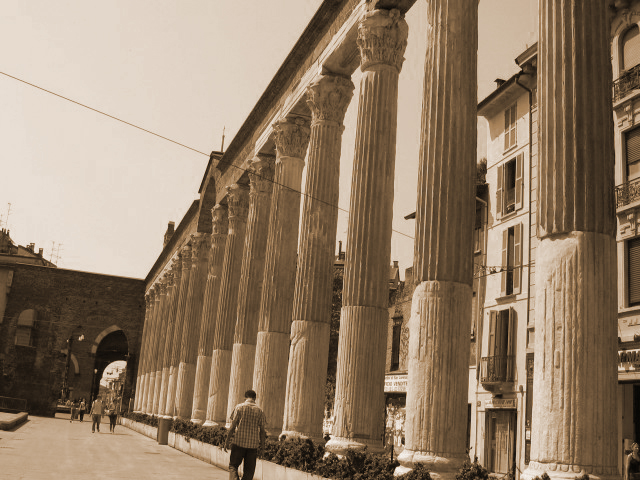
Roman columns in front of basilica di San Lorenzo
in what remains of Mediolanum, the ancient Milan.

Sometimes Bishop Ambrose saw the sovereigns daily. Since when Valentinian II was proclaimed Augustus (375) he was barely five years old, his tutor and half-brother Gratian had just turned sixteen and the Spanish Theodosius was at least a very determined Catholic, the illustrious disciple of Jesus could handle perfectly their majesties. Valentinian I died a few years after Ambrose’s inauguration. His son Gratian (375-383), of just sixteen years of age, succeeded him on the throne.
The emperor, blond, beautiful and athletic had no interest in politics. ‘I have never learned what it means to govern and be governed’ (Eunapius). He was a passionate runner, javelin thrower, fighter, rider, but what he liked most was killing animals. Neglecting the affairs of state, every day he killed countless of them, with an almost ‘supernatural’ ability, even lions, with a single arrow. In any case, he also prayed every day and was ‘pious and clean of hearing’, as Ambrose affirmed so that he would soon deliver biting hints: ‘His virtues would have been complete had he also learned the art of politics’ (Epit. de Caesaribus).[2]
However, this art was practiced by Ambrose for him. Not only did he personally guide the young sovereign, effectively since 378: he also influenced his government measures. At that time the sovereign had promulgated, by an edict, precisely tolerance towards all confessions, except a few extremist sects. However, Ambrose, who four years before was still unbaptized, hastened to write a statement, De fide ad Gratianum Augustum, which he quickly understood.
And as soon as Gratian himself arrived at the end of July 379 in Milan, neutral as he was from the point of view of religious policy, he annulled on August 3, after an interview with Ambrose, the edict of tolerance promulgated the year before. He decided then that only would be considered ‘Catholic’ what his father and he in numerous decrees had ordered eternal, but that ‘all heresies’ should ‘be muted for eternity’. He thus prohibited the religious services of the other confessions. Year after year, except for 380, he issued anti-heretic decrees, ordering the confiscation of meeting places, houses and churches; he dictated exiles and, as a fairly new means of religious oppression, repealed the right to make wills. He was also the first of the Christian emperors who got rid of the title of Pontifex Maximus (that the Roman monarchs used since Augustus), or rather, he refused to accept it, although the year is still the subject of discussions. The military under Sapor was ordered to ‘expel from religious facilities the Arian blasphemy as if they were wild animals and return them to the true shepherds and flocks of God’ (Theodoret). Tolerance towards paganism, which was common among his predecessors, also soon disappeared. In fact, his father still allowed the reparation of damaged temples, making the government pay the expenses. In 381, Gratian moved to northern Italy. In 382 he attacked the pagan cult of Rome, most probably advised by Ambrose; although sanitation of the State coffers may also have played an important role. He also persecuted the Marcionists and, like his father, the Manichaeans and the Donatists: whose communities in Rome had been dissolved without further ado, at the request of Pope Siricius (383-399), with state aid.[3]
Valentinian II (375-392), much younger still, had a remarkable influence on the saint. He habitually used him against the Senate of Rome, mostly pagan, and against the entire Council of the Crown. And the last Westerner on the throne of the East, the independent Theodosius (379-395), dictated in almost every year of his government laws against pagans or ‘heretics’. However, according to Father Stratmann, he was more tolerant than the bishop of the court, who encouraged him to take stricter measures on all sides against the pagans, the ‘heretics’, the Jews, and the extreme enemies of the Empire. The reason: ‘It is no longer our old life that we continue to live but the life of Christ, the life of maximum innocence, the life of divine simplicity, the life of all virtues’ (Ambrose).[4]
The way in which Ambrose lived the life of Christ, the life of maximum innocence, of divine simplicity and of all the virtues, manifests itself in multiple ways—for example, in his behaviour against the Goths. We will deal with them because the Goths played a very important role in the history of Europe, especially between the 5th and 6th centuries. The sources are better in this case than in the other tribes of eastern Germans, and richer is the historiography on them.[5]
 
_______________
Note of the translator: The footnotes still lack the general bibliography, which will be ready as I finish the abridgement of this first volume.
[1] August. conf. 5,13.
[2] Eunap. Excerpt. de Sent. 48. Auson. Grat. Act 64 f. Ammian. 27,6,15; 31,10,18 f. Soz. 7,25,11. Vict. Epit. de Caesaribus 47,5 f. Seeck, Untergang V 165. Dudden I 217 f.
[3] Ammian 30,9,5. Theodor. e.h. 4.24.2 f; 5.2; 5.21.3 f. Socr. 5.2; Cod. Theod. 13,1,11; 16.5.4 f. Cod. Just. 1,5,2. Soz. 7,1,3. Ambros. ep. 1 f; 7 f. Auson. Grat. Act. 14.63. Epistula Gratiani imperat. (CSEL 79.3 f). Zos. 4,36,5. Rauschen 47.49 f. RAC II 1228 f. Kraft, Kirchenväter Lexikon 27. Seeck, Regesten 252. The same, Untergang V 104 f, 137. Sesan 60 f. Stein, Vom römischen 304 f. Heering I 60 f. Dudden I 191 f. V. Campenhausen, Ambrosius 15, 36, 40 f. Alföldi, A Festival. According to this author, Gratian abandoned the title of Pontifex Maximus at the beginning of 379, p. 36. Kornemann, Römische Geschichte II 420. Ensslin, Die Religionspolitik 8 f. Lorenz 38. Diesner, Kirche und Staat 23. Maier, Verwandlung 53. Hornus 168 f. Widmann 59. Grasmück 131 f, 151 f. Lippold, Theodosius 16, 34 f. Kupisch I 91. Schneider, Liebesgebot 46. Aland, Von Jesus bis Justinian 224. Heinzberger 12, 227 Notes 37; here the corresponding bibliography. Thraede 95. Grant, Christen 177. – Chronology, as so often happens, is still subject to controversy. G. Gottlieb, who is not followed here, in his work of opposition to chair in Heidelberg fixed for the writing of the first part of ‘de fide’ not the 378 (or 379), that is, not as was done until the date immediately before (or shortly after) the battle of Adrianople, but a year later. Cf. G. Gottlieb, Ambrosius von Mailand und Kaiser Gratian, Zusammenfassung 83 f. G. discusses even any influence of Ambrose on Gratian’s legislation on matters of the Church and faith, 51 f, or at least explains that such influence ‘cannot be seen anywhere’ (87). Cf. in this regard also Gottlieb, Gratianus RAC VII 718 f, especially 723 f.
[4] Ambros. Über die Flucht vor der Welt 44. Heilmann, Texte II 396. Stein, Vom römischen 296 F. Stratmann III 76. V. Campenhausen, Ambrosius 166. Bloch 197. Aland, Von Jesus bis Justinian 225. Rubin I 27 speaks precisely of the ‘submission’ of Theodosius to Ambrose.
[5] Cf. recently Strzelczyck 1 f.

Categories
Alexandria Christendom Emperor Julian Kriminalgeschichte des Christentums (books)

Kriminalgeschichte, 54

Below, an abridged translation from the first volume of Karlheinz Deschner’s Kriminalgeschichte des Christentums (Criminal History of Christianity). For a comprehensive text that explains the absolute need to destroy Judeo-Christianity, see here. In a nutshell, any white person who worships the god of the Jews is, ultimately, ethnosuicidal.

 
Patriarch George, an Arian ‘wolf’, monopolist and martyr
George of Cappadocia, an ultra Arian, seized power in Alexandria. He was one of the followers of the sovereign who joined his ecclesiastical office with a surprising sense of finances.
Patriarch George raised a funerary monopoly, although apparently also acquired the one of the sodium carbonate and tried to buy the papyrus lagoons, along with the Egyptian salt mines. Among his favourite religious projects were the inheritances, a special field of the saviours of Christian souls throughout all the centuries. Bishop George not only tried to get the heirs to lose what their relatives had left them, but he even told the emperor that all the buildings of Alexandria were public property. In short, the Egyptian primate ‘took advantage of the ruin of many people’, so, as Ammianus writes, ‘everyone, without distinction, hated George’.[1]
Although he was ordained for Alexandria as early as 356, he did not start working until the end of February 357, with savage fury, ‘like a wolf or a bear or a panther’ (Theodoret). In front of a blazing bonfire, he caused Catholic widows and maidens to be beaten on the soles of their feet, apparently completely naked, with palm branches or to burn them on a low fire. He made ‘whipping in a totally new way’ (Athanasius) to forty men; many died. Athanasius reports of raids, assaults, the capture of bishops, who were chained; of imprisonments, the exile of more than thirty bishops ‘with such lack of consideration that some of them committed suicide on the road and others in exile’.
In the autumn of the year 348, Athanasius resorts to violence. Patriarch George is saved from an assassination attempt in the church and must flee. On November 26, 361 he returns, to his disgrace, without knowing the death of his protector Constantius. He is quickly locked up, on December 24, but Catholics and pagans take him out and, together with two very unpopular imperial officials, he is dragged through the streets and beaten until he dies.
However, shortly before Bishop George had called the strategist Artemius, military governor of Egypt, and with his help had also persecuted the pagans; destroyed the temple of Mithras, demolished statues and sacked the pagan shrines, of course for the benefit of the Christian churches that they wanted to build. (Julian had the temple destroyer Artemius decapitated in the year 362, for which he was venerated as an Arian martyr.)
Catholics and ‘idolaters’ walked the streets with Bishop George’s corpse on the back of a camel. For hours they raged with the dead man. Then they burned him and scattered his ashes, mixed with those of animals, by the sea.
And while the wild Arian wolf becomes a martyr, precisely at Christmas, Athanasius returned once more and, finally—after the pagan Julian again banished him in 362; the Catholic Jovian made him return in 363, and the Arian Valens will exile him for the last time in 365-366—, Athanasius slept in the Lord on May 2, 373, old and much appreciated.[2]
 
_______________
Note of the translator: The footnotes still lack the general bibliography, which will be ready as I finish the abridgement of this first volume.
[1] Epiphan. Haer 76,1,4 f. Ammian. 22,11,4 f. Grant, Christen 75 f.
[2] Ammian. 22,11,3 f. Theodor. 2,14; 3,4; 3,9. Socr. e.h. 3,2 f; 3,7; 4,1,14 f; 4,8,4; 4,13; 4,16. Soz. 4,9 f; 4,28,3 f; 5,7,3 f; 5.12; 5,15. Philostorg. 7,2. Athan. ad episc. Aeg. 7. Hist. Arian. ad mon. 48 f; 54 f; 59 f. Apol. de fuga sua 6 f; 24. syn. 37. Historia Acephala 5 f. Theodor. e.h. 2,14; 3,18,1. Rufin e.h. 10,34 f. Epiph. haer. 76,1. Greg. naz. or. 4,86; 21. Pallad, hist. Laus. c. 136. Chron. pasch. 546,4 f. Pauly I 626. RAC I 861. LThK 1st ed. I 706. Lecky II 159. Lippl XV f. Geffcken, Der Ausgang 119 f. Schuitze, Geschichte I 137 f. Bidez, Philostorgios III f. Stein, Vom römischen 236 f, 255 f, 270 f. Seel 175 f. V. Campenhausen, Griechische Kirchenväter 80 f. Dannenbauer, Entstehung I 76. Lacarrière 150 f. Jacob, Aufstände 152. Camelot, Athanasios 977. Poppe 50.

Categories
Ancient Greece Ancient Rome Christendom Eduardo Velasco Egalitarianism Evil Hadrian Islam Judaism Judea v. Rome Psychology

Apocalypse for whites • XXXVIII

by Evropa Soberana

 
In conclusion

Primitive Christianity was characterized by its intolerance and intransigence, and by considering itself as the only way of salvation for all men on the planet. These characteristics were inherited from Judaism, from which it came and which it imitated.

Christianity shows, paradoxically, that to consider all human beings equal is the worst form of intolerance: because it is assumed as a dogma of faith that the same religion or moral is valid and obligatory for all men, and therefore it is imposed, even against their will. This aspect was renewed later with the other great and virulent egalitarian doctrines: democracy and communism.

The Aryans, accepting the difference of peoples, also accepted that they worshiped gods other than their own and had different customs; and they would never have thought of preaching their religion or their morals outside of their town. It would have seemed ridiculous to preach Odin’s worship among blacks, for example; and it made no difference to them that the Semites worshiped Molech.

The tactic of the old European was always to dominate through military triumph, not to forcefully convert or manipulate thoughts. The reaction of Christianity, on the other hand, was to wipe out everything that could remind us our old beliefs and traditions. Any medicinal knowledge of plants or animals was branded as heresy and persecuted. In fact, any kind of knowledge that was not Judeo-Christian was persecuted conscientiously. Spiritual terror had made its appearance in Europe.

This is Christianity, and what came after: feints, collages, palimpsests and mixtures of it with paganism in unstable combinations that never finished curdling in the confused European collective unconscious. In those days the schizophrenia of the current West started: the debate between the heroic Greco-Roman heritage or the humanist Judeo-Christian heritage.

The founders and the great conquerors had wanted their peoples to triumph and be eternal on Earth. They did not achieve it in the long term, and all disappeared. The Romans, then, went to swell that macabre list. In the West, the future of millennia belonged to the Germans, who established throughout Western Europe feudal kingdoms where they rose as aristocracy.

I have listed facts that marked the end of Classical Antiquity with all its wisdom, and the beginning of the Dark Ages. This age used as a tool the Germans, but the Germans were not guilty. They only gave the coup de grâce to a decadent monster—and it was precisely the Germans who preserved Roman works of art from Christian destruction when they seized power (consider the case of King Theodoric).

The occultation would last in Europe until the time of Catharism; of the Vikings and Crusades in the 11th century: when the European knights discovered the tradition that the East had kept. Some friars devoted themselves to collecting natural knowledge such as medicine or botany. The Mesopotamian, Egyptian, Persian and to some extent Greek and Hindu legacies were preserved by the Islamic civilisation which, unlike Christianity, not only did not destroy the pagan legacy, but kept it.

The resurgence of European spirituality came from the warrior and chivalric castes. And the results, some cleaner than others, were the Holy Roman-Germanic Empire, the Vikings, the Occitan civilization, the Templars, the Italian Renaissance with its fascination for the Greco-Roman world, and the Spanish empire.

There are those who get themselves into a mess with the ‘Christian heritage’ of Europe. I do not. I see Europeans living with some customs and their natural rites, beautiful and harmonious, which automatically led to the most normal thing in the world, thus taking part in that immense orchestra that is the Earth.

I see a fanatical creed preached by Semitic fundamentalists from the East and Africa, who inflamed the spirits of the world’s scum against the good people; against the native Europeans, against the representatives of order and light. They said that our ancestral customs were abominations. They said that those who practiced them were sinners. They said that our science was demonic sorcery, and our art, blasphemy.
They said that whoever did not kneel before a strange new oriental god deserved the worst torments. They cursed the strong, the nobles, the fighters, the pure, the philosophers and the wise, and blessed the slaves, the sick, the trampled, the prostitutes, the ignorant and the cowardly.

They destroyed the legacy that we had accumulated for centuries. They killed our leaders. They put an end to an Empire that could well, under Germanic influence, spread throughout the world.

They plunged Europe into ignorance and banned knowledge. For centuries, they spread depression, guilt and the feeling of sin, introducing into Europe that cancer that is the Old Testament, and that castrating poison that is the New Testament.

If Europe could still thrive in these conditions, it was not thanks to Christianity but in spite of it, and thanks to the things that Christianity had not yet touched.

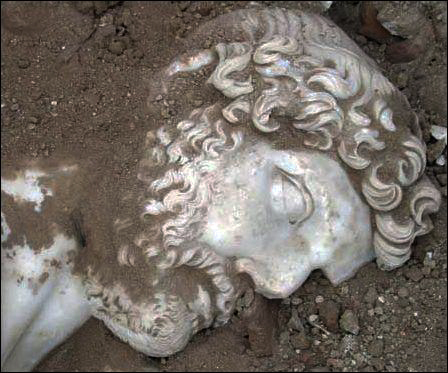
This piece is from a statue of the emperor Hadrian that should have measured about five meters, and was found in Sagalassos, present south-central Turkey, where Christianity took root early.

In short, Christianity was a subversive movement of agitation against Rome, against Greece and, ultimately, against the European world.

We have to assume that what has come down to us from the Greco-Roman world is only a tiny part of what was really there, and that it was taken away by the Judeo-Christian destruction.

Christianity, as a slave rebellion devised and led by Jews with the aim of destroying Roman power—and, ultimately, all European power—was and is a doctrine aimed at converting vigorous peoples into domesticated flock of sheep.

Categories
Alexandria Christendom Eduardo Velasco Evil Hypatia of Alexandria Judea v. Rome

Apocalypse for whites • XXXVI

by Evropa Soberana

 
The martyrdom of Hypatia as an example of Christian terrorism
Alexandria, Egypt, year 415. The protagonist is Hypatia (370-415), philosopher and mathematician instructed by her father, the also famous philosopher and mathematician Theon of Alexandria. Hypatia’s biographers say that in the morning she spent several hours in physical exercise, and that afterwards she took relaxing baths that helped her concentrate her mind to devote the rest of the day to the study of philosophy, music and mathematics.
Hypatia was virgin and chaste; that is, she was at the level of a priestess. She was, in short, a wise woman, ‘a perfect human being’, just as her father had wanted. Hypatia also ran a philosophical school from which women were excluded. (This is to give thought to the feminists who have tried to ‘feminize’ the figure of Hypatia in recent times.)
Hypatia, by Charles William Mitchell.
The bigwig of Alexandria during that time was Archbishop Cyril (370-444), nephew of the aforementioned Theophilus. He had the title of patriarch, an ecclesiastical honour that amounted almost to that of the pope, and which was held only by the archbishops of Jerusalem, Alexandria and Constantinople: that is, the most Jewish and Christian cities of the Roman Empire. During this time there was another mass rebellion; once again, street fights, tensions and settling of scores between Christians and Hellenists followed each other.
Archbishop Cyril had started a persecution of Alexandria scholars, twenty-four years after the library fire. This time, more radicalized, the Christians murdered anyone who refused to convert to the new religion. Hypatia, at that time director of the museum, where she dedicated herself to the philosophy of Plato, was one of those people, for which she was accused of conspiring against the archbishop.
Days after the accusation, friars called parabalani, fanatical monks in charge of the ‘dirty work’ of the archbishop and coming from the church of Jerusalem of St. Cyril,[1] kidnapped her from her carriage, beat her, stripped her and dragged her throughout the city, until they reached the church of Caesarea. There, at the orders of a lector named Peter, they raped her several times and then skinned her and ripped the flesh with sharp oyster shells.
Hypatia died raped, skinned and bleeding in atrocious pains. After this, they dismembered her corpse, took her pieces through Alexandria as trophies and then to a place called Cinarion, where they were burned. The archbishop who ordered his martyrdom is remembered by the Church as St. Cyril of Alexandria.
Only a crowd sick with resentment and hatred, and enraged by commissaries expert in the art of raising slaves, could carry out this act, which disgusts any person with a minimum of decency. Hypatia was the perfect victim for a ritual sacrifice: European, beautiful, healthy, wise, Hellenistic and virgin. And that is what excites slaves the most when sacrificing the innocence and kindness of the victim.
The cruelty shown, even in regard to the destruction of her corpse, indicates that the Christians greatly feared Hypatia and all that she represented. The death of the scientist, in addition to being perfectly illustrative of the atrocities committed by Christians at this time, inaugurated an era of persecution of Hellenistic priests in North Africa, especially directed against the Egyptian priesthood. Most of them were crucified or burned alive.
Hypatia’s atrocity is described here because it is well known; and it is shocking that it happened to an unarmed, defenceless and harmless woman, but let us not think of it as an isolated case. Many simple Hellenists who did not look for trouble were sacrificed in a similar or worse way, and would continue to be so for many centuries.
_______________
[1] Note from the Ed.: Probably ethnic Semites.