web analytics
Categories
Feminism Film Homosexuality

Downton Abbey (film)

All the films of the last decades contain bad messages, sometimes in a subtle way, even films that could be used as Aryan pride. From the second film of the LOTR trilogy filmed by Jackson, for example, the beautiful Éowyn is empowered as if she was simply another warrior. At least by the end it is implied that Éowyn is going to marry (and have children) with Faramir, fulfilling the traditional role of woman in any normal society. But in the novels of George R.R. Martin who respond to LOTR, Arya, the equivalent to Éowyn, is already a runaway feminist who won’t marry.

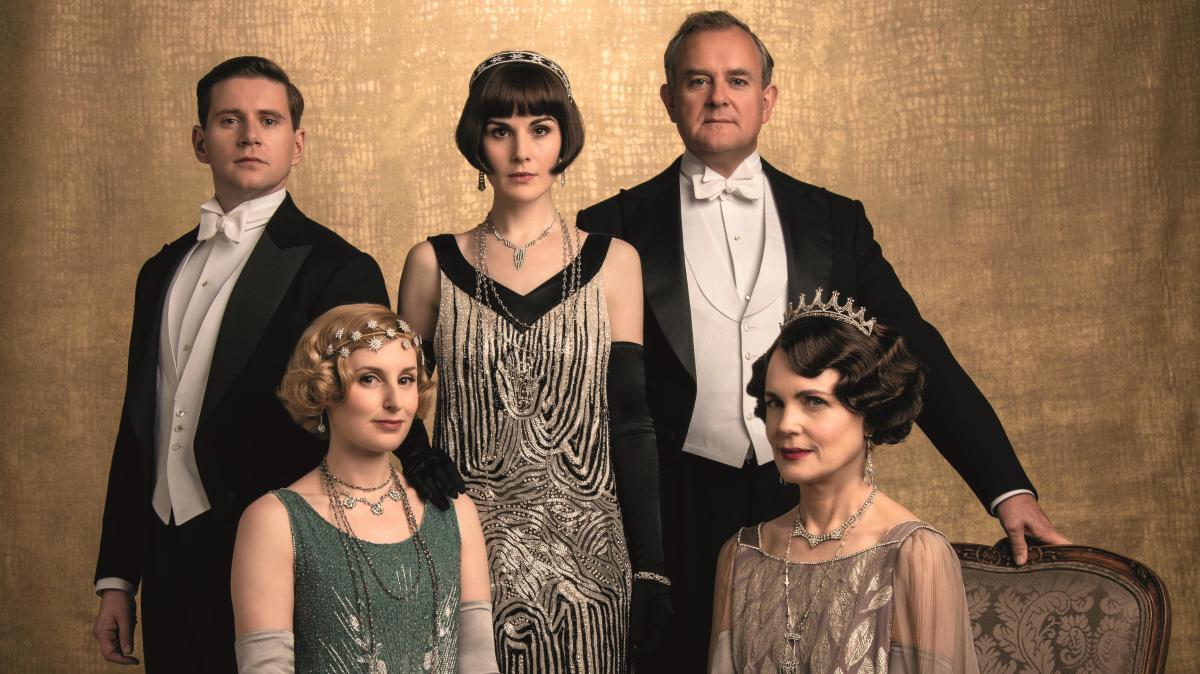
Both the television series and the Downton Abbey film contain subversive messages for Aryan preservation presented in a subtle, and sometimes not so subtle way. In Jane Austen’s England women could not inherit in order to force them to marry, depend on a man and have children. That began to change since the late 19th century. Even in the television series, Downton Abbey records the beginnings of the social changes resulting from the first feminist wave that hit England. And in last year’s movie, it is understood at the end that Lady Mary, not an Englishman, will inherit Downton Abbey.

A parenthesis: it’s precisely skinny English ladies like Lady Mary, who below appears at the centre, whom I fancy the most.

That’s not all. In the recent movie, which I saw a couple of days ago, the seeds of a future normalisation of homosexuality are sown. No wonder that Trevor Lynch (Greg Johnson) wrote a review of the film. He may have liked it, but what I saw in Downton Abbey is a description of the first mustard seeds that would grow big, like the evangelical parable about the kingdom of the Jewish god on gentile lands.

I have a hard rule when dealing with movies and television. Keep in mind that as a child I didn’t see non-whites playing leading roles, neither on the small screen nor on the big screen. My rule is: if I see a non-white (usually a black) I immediately change the channel. I do that even in the news (although it is harder to know if one of the anchors is Jewish).

If white nationalists were as purist as a priest of the 14 words, they would do the same. And they would write destructive reviews about products of mass consumption, even about comparatively benign movies such as LOTR and Downton Abbey.

Postscript

The parable of mustard seed is the only parable attributed to Jesus that has three independent attestations in the NT. From our POV, the moral of the story is to weed the tiny plant as soon as it appears: the exact opposite of what Johnson said in his movie review.

Categories
Film

The two popes

I’ve just watched The Two Popes. It is a typical product of the Netflix provider, with its eternal anti-white and anti-western motivations. However, it is a good film to illustrate what we have been calling ‘the Christian question’ (the CQ).

Countless times I have said it but it is worth repeating:

The current pope is not an anti-pope as the Christian forums of white nationalism claim. On the contrary: he is the first pope who tries to take the message of Jesus in all its purity to the real world. That’s why Jorge Bergoglio, whom I understand pretty well since we share the same mother tongue, chose Francis as his papal name: something that no one who sat in Peter’s chair had dared to do before.

So anti-western and anti-white is the film that it ends with black ‘refugees’ in the Sistine Chapel, and with the words of Francis sympathising with them. It was not the only bad message of the film. But the one that best represents the CQ.

Categories
Film

The Red Wedding

A couple of posts ago I said that in 2013 Game of Thrones’ Red Wedding caused a tremendous stir among fans of the series, especially in women. Today watching this clip I thought that the abyss that separates me from white women is abysmal:

The woman’s reaction was because she was seeing the moment when Robb Stark’s pregnant mudblood was stabbed in the belly as a punishment that Robb broke his pact to marry a younger and prettier girl (a completely Aryan girl by the way).

As you will remember, one of the guidelines of conduct that I have developed for the priest of the 14 words is: ‘Speak only with Aryan men’. We can already imagine if, instead of comforting this woman as her partner did in the clip above, I tried to reason with her by saying: ‘I stabbed her for you; so beauty like yours never get lost. I can’t let the pregnant mudblood leave brown offspring instead of Robb’s white skin. All the blood that I spill is spilled indirectly for you…’ Obviously the white woman would look at me with pure hatred; she would block herself before my reasons, and would embrace the most progressive anti-racism we can imagine.

Let’s face it: Women think with their emotions, which is not bad at all. It’s just their nature. Cold and ruthless reason is up to men. What the partner of this disconsolate woman did is the proper way to treat our women. It is absolutely delusional to believe that they are able to reason with the ruthless coldness with which we can reason.

My guideline remains and it is a disgrace that, except Andrew Anglin, the people of white nationalism haven’t come to realise that we come from Mars and they from Venus. And that it makes no sense to use reasons and good judgment to try to persuade the fair sex in martial matters.

Unlike feminist products that demoralise Aryan males such as The Rise of Skywalker, when civilisation collapses later in this century the bloodthirsty warriors who recover the West will belong to a Boys Only Club.

Categories
Film

The power to *see* the past

Recently I used the three-eyed raven symbol, a fictional character in A Song of Ice and Fire, to make a point. I would like to continue clarifying it.

Last week I mentioned three American junk culture fans who didn’t understand what Yezen wanted to convey about Game of Thrones. One of the criticisms of these guys refers to the penultimate season of GoT, the seventh, claiming that it was implausible that Sansa and Arya outwitted Littlefinger. The problem is that this season suppressed a crucial scene:

Bran Stark actor Isaac Hempstead Wright revealed in a past interview with Variety that he and his Game of Thrones co-star Sophie Turner, who plays Sansa, shot a sequence in which Sansa consults him ahead of Littlefinger’s trial. You see, Sansa was first convinced that her own sister, Arya, was out to murder her in attempts to become the Lady of Winterfell. Arya felt certain of the same—and it was all thanks to the master manipulator Littlefinger. Viewers were sweating buckets watching the season 7 finale, believing that one of the Stark girls would turn on the other and commit fratricide within the halls of their House’s ancestral seat. Sansa and Arya flipping the script and sentencing Littlefinger to death was a massive twist—and seemed to leave a wide plot hole that went completely unpatched. The deleted scene Hempstead Wright discussed with Variety would have stitched up the gap and detailed exactly how the Stark sisters knew what Littlefinger was up to and how they arrived at their plan to execute the former Master of Coin.

In the scene, Sansa consults Bran about what to do regarding the whole “I think our sister is going to kill me” dilemma. Using his newfound abilities as the Three-Eyed Raven, Bran peers into Littlefinger’s past and unearths every underhanded thing he’s done to secure power.

As Hempstead Wright describes it, “We actually did a scene that clearly got cut, a short scene with Sansa where she knocks on Bran’s door and says, ‘I need your help,’ or something along those lines. So basically, as far as I know, the story was that it suddenly occurred to Sansa that she had a huge CCTV department at her discretion and it might be a good idea to check with him first before she guts her own sister. So she goes to Bran, and Bran tells her everything she needs to know, and she’s like, ‘Oh, s***.’”

Though audiences can fill in the blanks without this scene, it makes Bran’s powers all the more real, and, frankly, terrifying. Nothing can be kept from him, and as a result, nothing can be kept from his family. There is no secret Bran cannot uncover—and the biggest skeleton he drew out of the proverbial closet was the truth behind Jon Snow’s birth. Bran knew of his brother-cousin Jon’s true parentage and real identity as Aegon Targaryen, the son of Rhaegar Targaryen and Lyanna Stark, and his rightful claim to the Iron Throne over the wannabe queen Daenerys Targaryen before others did. His knowledge spread to Samwell Tarly, then to Jon himself, and (spoiler alert) quickly made its way to Sansa and Arya themselves.

When I saw the scene of Season 7 when Littlefinger was executed after a summary trial, I filled the blank assuming they had consulted Bran. But apparently others did not fill it with their imagination, such as the aforementioned fans arguing with Yezen. But the point is that this fantastic story serves to explain the power of ‘seeing’ the past, the power of The West’s Darkest Hour (WDH).

The history of the West, as I have been saying, is as if the Night King had killed the three-eyed crows. (This is a title rather than a special person. Originally, the one who held the title was the old mummified guy among a tree’s roots. When he died his young pupil, Bran, inherited the title of the three-eyed raven—or ‘crow’ in George R.R. Martin’s novels.)

Unlike GoT, the real history of the West is tragic. It is as if Sansa, without consulting her brother Bran, would have gutted Arya by believing the apocryphal story of Littlefinger. This is so as, for more than a millennium, all westerners have believed the stories of martyrs, and that the Christianisation of southern Europe was peaceful. As we have seen on this site, it was actually a story as violent as the bloodthirsty conquest of India by Islam. Conversely, the Christian martyr stories are largely fictional. (In addition to Evropa Soberana’s essay of Judea against Rome in The Fair Race, see what Deschner says about the stories of martyrs in this book.) In other words, what the Aryans have believed about Christian history is an exact inversion of the facts, and the objective of inverting history in this way is for the Aryans to invert their values from these lies, as it tragically happened.

The metaphor makes sense. In this parallel GoT story, Arya (the Aryans) was killed by Sansa (her white sister) for believing the apocryphal story of Littlefinger (curiously, Littlefinger seemed like a Jew for a commenter on this site). The business of WDH is to set the record straight with respect to what happened in the 1st to 6th centuries of our era, when Christianity was imposed in southern Europe not through Jesus-like methods but through extremely violent and even genocidal methods. (Since I also mention the 1st century, I not only refer to the texts of Evropa Soberana or Deschner but also to what Richard Carrier wrote about the inexistence of Jesus.)

The problem is that not even the so-called anti-Semites of white nationalism believe Bran. They still believe Littlefinger so to speak. Who among them is interested in knowing what happened in the 1st to 6th centuries (this is one of the reasons I call them ‘Jew obeyers’)?

By the way, although on one occasion I identified myself with the three-eyed raven, since it is only a title, the identification is not absolute. On this continent, before me the crow was William Pierce, who died at 68, for having seen the past in Who We Are. And after I die the ‘title’ must pass to a younger pupil, a Bran so to speak.

I wouldn’t like to finish this symbolic post without the scene in which, thanks to Bran’s retrocognitive vision, his Stark House executes Littlefinger, the master of palatial intrigues and lies. In the real world, the equivalent would be for Westerners to take very seriously what Evropa Soberana (the ‘crow’ on the other side of the Atlantic) has written. The power to see the past as it happened has the potential to change the ethno-suicidal paradigm, and the first thing to do is to ‘execute’ the false story about early Christianity:

https://youtu.be/ExkPxHxcP3Q

Categories
Film

Andrei Rublev

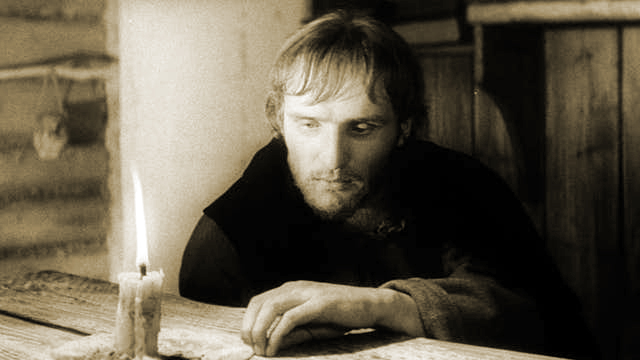
As in my central article this day I mention Andrei Rublev, as an introduction I would like to quote the words of a young YouTube film critic: ‘…Andrei’s personal struggle and what he eventually learns. Andrei loses his faith not in God, but in man, and in rejecting man, he is without an audience. He has no voice, no one to communicate to. His [vow of] silence is more than literal. Without empathy for those he minsters to, he cannot effectively minister’.
 

Saturday postscript:

Yesterday I saw, once again, the prologue of Andrei Rublev, the hot air balloon ride, and the first part that film, ‘The Jester’: scenes located in the year 1400 (tonight I’ll probably continue to watch other parts).

When I turned on the television, before, I got to see a few moments of Batman v Superman and a thought occurred to me that could perfectly cover a much longer article, but here I will try to summarise it.

When I was a child in the 1960s I saw TV series like Daniel Boone and Custer. Alas, Jerry Siegel, born in Ohio to a Jewish family, inaugurated a new genre by creating the fictional superhero Superman: a genre that seeped through the decades, including Adventures of Superman that I also used to watch as a child.

Historical figures Boone and Custer would be equivalent, on American soil, to the message of Rublev on Russian soil; with the difference that Russia, as a nation, is much older than the US and therefore has much deeper roots. Regardless of whether the US is a young nation, the Jew Siegel inaugurated a super-toxic genre that injured American consciousness about epics such as the conflict with the Indians in Boone and Custer: the realistic heroes before the ‘superheroes’ multiplied among fans. (Now you see that many YouTubers show hundreds of plastic miniatures of such ‘superheroes’ as the background of their shows!)

As I said, this could be the basis for writing a longer article. But the contrast between those minutes that I came to see of the toxic Batman v Superman and, immediately afterwards, the Russian film cannot better describe what I want to convey. I mean the corruption of the mentality of the American people from the Jewish quarter and, let’s face it, from the Americans themselves who swallowed the terrible poison that the ‘superheroes’ has represented to replace the heroes of their real history, such as Boone and Custer.

Using my words, and pace Trevor Lynch (Greg Johnson), the priest of the 14 words should never watch poisonous pop culture but movies depicting flesh and blood men, like Rublev.

Categories
Film Mainstream media

Joker: a destructive review

If the media and Hollywood are in the hands of the Jewish quarter, it is only justified to watch television programs or movies to indicate where the bad messages are, which was what I did with Game of Thrones, in addition to using the TV series to change the subject and talk about matters that interest me.

Exactly the same can be said of Joker, a film I used in the previous week to talk about my subjects, such as a model of the trauma of mental disorders. Regarding a film review per se, there is not much to talk about Joker except to point out the bad messages.

The most conspicuous is that the white Arthur Fleck apparently fancies a mulatto woman: the worst possible bad message for a white audience. In fact, it is not even necessary to try to find another bad message in Joker since miscegenation is the greatest conceivable self-betrayal.

Moreover, Joker’s final scene is a sort of disclaimer, as Richard Spencer was told in this video. This means the movie is not even valiant, as they have been saying on social media. Remember what a commenter recently said here, that almost all movies after 1969 must be destroyed in the ethnostate.

I would include Joker among them.

Categories
Civil war Film Real men

‘That we won’t werewolf…’


Dr. Sally: Oh, no, no, no. No, you can’t joke about that.

Murray Franklin: Yeah, that’s not funny, Arthur. That’s not the kind of humor we do on this show.

Joker: Okay. Yeah, I’m sorry. It’s just, you know, it’s been a rough few weeks, Murray. Ever since I killed those three Wall Street guys.

[Pause.]

Murray Franklin: Okay, I’m waiting for the punchline.

Joker: There is no punchline. It’s not a joke.

Murray Franklin: You’re serious, aren’t you? You’re telling us you killed those three young men on the subway?

Joker: Mm-hmm.

Murray Franklin: And why should we believe you?

Joker: I’ve got nothing left to lose. Nothing can hurt me anymore.

[He smiles.]

Joker: My life is nothing but a comedy.

Murray Franklin: Let me get this straight, you think that killing those guys is funny?

Joker: I do. And I’m tired of pretending it’s not. Comedy is subjective, Murray. Isn’t that what they say? All of you, the System that knows so much, you decide what’s right or wrong. The same way that you decide what’s funny or not.

Audience Member: Get him off!

Murray Franklin: Okay, I think, my understanding, that you did this to start a movement to become a symbol?

Joker: Come on, Murray. Do I look like the kind of clown that could start a movement? I killed those guys because they were awful. Everybody is awful these days. It’s enough to make anyone crazy.

Murray Franklin: Okay, so that’s it. You’re crazy. That’s your defense for killing three young men?

Joker: No. They couldn’t carry a tune to save their lives.

[The audience starts booing.]

Joker: Oh, why is everybody so upset about these guys? If it was me dying on the sidewalk, you’d walk right over me. I pass you everyday and you don’t notice me! But these guys, what, because [the very wealthy] Thomas Wayne went and cried about them on TV?

Murray Franklin: Do you have a problem with Thomas Wayne?

Joker: Yes, I do. Have you seen what it’s like out there, Murray? Do you ever actually leave the studio? Everybody just yells and screams at each other. Nobody’s civil anymore! Nobody thinks what it’s like to be the other guy. You think men like Thomas Wayne ever think what it’s like to be someone like me? To be somebody but themselves? They don’t. They think that we’ll just sit down and take it like good little boys! That we won’t werewolf and go wild!

Murray Franklin: You finished? I mean, there’s so much self-pity, Arthur, you sound like you’re making excuses for killing those young men.

Not everybody, and I’ll tell you this, not everyone is awful.

Joker: But you’re awful, Murray.

Murray Franklin: Me? I’m awful? Oh, yeah? How am I awful?

Joker: Playing my video. Inviting me on this show. You just wanted to make fun of me. You’re just like the rest of them.

Murray Franklin: You don’t know the first thing about me, pal. Look what happened because of what you did? What it led to. There are riots out there. Two policemen are in critical condition.

[Arthur starts to laugh.]

Murray Franklin: You’re laughing. You’re laughing. Someone was killed today because of what you did.

Joker: I know…

How about another joke, Murray?

Murray Franklin: No, I think we’ve had enough of your jokes.

Joker: What do you get…

Murray Franklin: I don’t think so.

Joker: …when you cross…

Murray Franklin: I think we’re done with the show. That’s it.

Joker: …a mentally ill loner with a society that abandons him and treats him like trash?!

Murray Franklin: Call the police, Gene. Call the police.

Joker: I’ll tell you what you get! You get what you fucking deserve!

[Suddenly Arthur Freck, the Joker, shoots Murray in the head and the audience starts running off in terror. After killing Murray, the Joker, goes to a camera and points it at himself.]

Joker: Goodnight. And always remember, that’s…

[He gets cut off as the show is cut. After Arthur murders Murray live on TV, as riots break out across Gotham, the Waynes leave a movie theater and a clown rioter follows them down an alley.]

Clown Rioter: Hey, Wayne. You get what you fucking deserve.

[Points his gun at Thomas…]

Thomas Wayne: No, pal!

[He shoots both Thomas and his wife, Martha, in front of young Bruce, the future Batman: protector of the System. LOL!]

Categories
Child abuse Film Psychiatry

Joker, Molyneux and CC

Or:

An opportunity to present the trauma model
 

In recent years I don’t usually go to the movies. If there is something I say to my nephews when I see them it is that, in the media and the cinema, all the messages are bad. But yesterday I broke my habit after watching Stefan Molyneux’s video about the Joker movie.

I am glad that, as Molyneux confessed in one of his latest videos, eighty percent of his audience dropped last year. Is it because of his dishonesty about the JQ? Whatever caused the drop, from alt-lite to neo-Nazism, passing through white nationalism, Molyneux is the only notable personality in our underworld who has consistently talked about child abuse.

As the visitors of this blogsite know, I spent more decades investigating child abuse than the single decade I’ve dedicated to investigating the darkest hour in the West: whose report, The Fair Race, now appears as a free PDF. Since my oldest specialty is the subject of child abuse I must say that what Molyneux tells us in his one-hour video is, in general terms, correct.

The video revolves around the character Arthur Fleck / Joker, a mentally-ill man who dreams to become a stand-up comedian but so disregarded by a hellish and diverse Gotham City that decides to become a criminal. Curiously, the actor Joaquin Phoenix did not look to previous Joker actors for inspiration: he simply read some reports about political assassinations.

Hollywood movies usually lack psychological realism. For example, in the 1989 Jack Nicholson movie the Joker origin story simply falls into a vat of acid. The 2019 movie, on the other hand, gives its central character a plausible origin. So plausible that the film has been described as reminiscent of mass shootings in the US, and the incel community loved it. What’s more, some people from the establishment have expressed concern that Joker could inspire real-world violence.

In a moment of the first minutes of his video, Molyneux confesses that he has received horrific verbal abuse just for mentioning the naked facts of his own childhood, and that hostility toward those who were abused as children or teenagers is not uncommon if the adult victim dares to open his mouth.

At this point I would like to distinguish between dysfunctional parents and schizogenic parents, that is, parents who literally murder their children’s souls. While almost everyone I know comes from family dysfunction in one way or another, the category of schizogenic parents simply does not exist in our society. Since the 1950s the Big Pharma has ensured that civil society does not find out that there is a trauma model to understand the mental disorder that competes with its profitable medical model.

But what does all this have to do with the recent film Joker? As can be deduced from Molyneux’s video, and regardless of the sinister motivation of its Jewish creators, the film could be used, by us, to present the trauma model to the public. I was the one who started this Wikipedia article on the trauma model, an academic text that appeals to the left hemisphere of our brains. He who wants to delve deeper into this research line, and in a more literary way, can read my book Day of Wrath. On the other hand, he who prefers a personal testimony that presents the trauma model appealing to our right hemisphere could read John Modrow’s touching autobiography, How to Become a Schizophrenic.

Furthermore, he who is unwilling even to read any the above literature, but willing to educate himself on the subject having some fun, could see the films Shine (1996), Monster (2003), The Piano Teacher (2001) and even Artificial Intelligence by Spielberg, which can be used to grasp what proponents of the trauma model call ‘the problem of attachment to the perpetrator’.

Although it may seem incredible, sometimes fairy tales portray the destructive interaction of parents with their children. In almost all fairy tales, including modern fairy tales like Kubrick/Spielberg’s A.I. or Harry Potter, the parental figure is substituted so as not to touch it directly. In the case of the Potter series the abusers are Harry’s uncle and aunt. As to David, the child robot in A.I., obviously he had no biological parents but Monica functions like a substitute mother. But sometimes the storyteller sneaks parents directly into the story as the villains who abandon their children (for example in Tom Thumb).

But there are more serious forms of abuse than abandoning your child in the woods, what also happened to David. What Molyneux says about not forgiving schizogenic parents is true. I would go as far as to claim that to forgive such parents is the most toxic thing for the mental health of the victim. Mine is an opposed claim to what the establishment wants us to believe.

Why is the forgiveness that religionists and therapists preach so toxic? Because it is the abusive parents and society the ones who are currently murdering young souls. As the Armenian lawyer said in Spotlight, which won the Academy Award for Best Picture in 2015: ‘This city, these people [Boston people] are making the rest of us feel like we don’t belong. But they’re no better than us. Look at how they treat their children. Mark my words, Mr. Rezendes [another Armenian]: If it takes a village to raise a child, it takes a village to abuse one’ (emphasis added).

For the victim, unilaterally forgiving the perpetrator or a society that never accepts its soul-murdering sins is simply a betrayal of oneself and the other adult victims, now suffering from mental stress and even disorders.

In addition to the first minutes of Molyneux’s video, using as a paradigm the Joker’s abusive interaction with his mother Penny in Gotham City, Molyneux advances ideas analogous to what I have known for a long time. Watch also the segments after minute 35 of his video: how female evil is still taboo in the film industry.

It is curious to note the chasm between those who, like Molyneux and I, have investigated child abuse due to our past, and those who did not have such destructive parenting.

Greg Johnson for example is a Batfan. In his recent review of Joker, which he writes under the penname of Trevor Lynch, Johnson prefers Heath Ledger’s Joker in the 2008 The Dark Knight than the Joker of the movie released this month. Johnson expresses very derogatory of this latest Joker: ‘You’d want to squash him like a bug’. ‘Ledger’s Joker launched a million memes, both because of his character and his lines. Phoenix’s Joker will have no such influence. He’s a pathetic nobody with nothing to say’. ‘Arthur [the Joker] is entirely absorbed in self-pity’. ‘Joker is a boring movie about a disgusting loser’.

Well, it didn’t look boring to me… But the commenters on Counter-Currents who opined about Johnson’s review said very similar things: ‘People like him deserve to get left behind by society, and the true tragedy of this movie is that successful, well-adjusted men like Thomas Wayne insist on trying to love the Arthur Flecks of the world and take care of them’. Really? The conservative commenter also said: ‘The defects like Arthur would be put in mental asylums and [eugenically] sterilized’. [1]

Such commenters remind me that, in the movie, Thomas Wayne, the billionaire father of the future Batman, labels those Gotham residents envious of the wealthy as ‘clowns’, not only the Joker. I don’t know how many viewers enjoyed the moment when, by the end of the movie, a rioter corners the Wayne family in an alley and murders Thomas and his wife sparing the child Bruce. Another commenter said: ‘One of the great things about Heath Ledger’s Joker in Christopher Nolan’s The Dark Knight is that he does not have an origin story’.

I dare not judge the Marvel universe as I feel deeply revolted by it. But in the real world, isn’t it good to know, say, the psychopathological motivations of those women in the Charles Manson family? But the commenters’ lack of elemental compassion is even noticeable about the previous Joker represented by Heath Ledger, an actor that incidentally has already passed away. In one of the dialogues the now dead Joker explains his scars. He said that his father ‘comes at me with a knife. “Why so serious?” He sticks a blade in my mouth. “Let’s put a smile on that face”.’

This father strikes me as ‘soul murderer’. Note this other phrase from the CC commenter: ‘Arthur [the Joker who’s alive] is far too damaged for any regular person to identify with him’.

How will a normie commenter identify with him if only one percent (or less) of Westerners have endured schizogenic parents?

Incidentally, last night, as I watched the psychological thriller, there were times when I laughed (as the character does in the film) when the audience was serious and nobody laughed. That happened to me, yesterday, in the climax of the film when the Joker kills the establishment character that Robert de Niro represented.

As I said, I usually don’t go to the movies now. But decades ago the same phenomenon occurred to me with some films by Luis Buñuel, whom I met personally, in which nobody laughed. It also happened to me when I watched Dr. Strangelove by Kubrick on the big screen. I laughed at the black humour in which the nuclear extermination of humanity was at stake while the hundreds of people watching the movie with me were quiet in the theatre. Only when I read a Kubrick biography by Vincent Lobrutto did I find out that Kubrick had a very black sense of humour. Then did I understand me and the non-laugher spectators of Dr. Strangelove!

Joker ends when Arthur laughs and tells a psychiatrist that she would not understand the joke…

_____________

[1] In the comments section on Joker in Counter-Currents Johnson shows how ignorant he is about psychiatry: a supposed branch of medicine with as little scientific basis as parapsychology or the study of UFOs, as shown in my writings (for example: here). Johnson wrote ‘If Arthur is adopted then his mental illness cannot be inherited from this mother’. This is a credulity stance regarding the psychiatric allegations that mental illness is genetic. Apparently, Johnson forgot what I said in one of my articles in which he himself corrected my syntax (see this piece which appears in my Hojas Susurrantes).

Categories
Film Gulag Archipelago (book) Red terror

Zero-budget movies about the Gulag

From minute 40 to 43 Michael Kingsbury explains exactly what we have been saying this month: Whites need a very specific story, and Kingsbury wisely states which story should it be: a tragic story, like the Gulag that killed dozens of millions of whites.

https://youtu.be/aHSsKXFNbhg

Decades ago I was very naïve. I could not figure out why, in the middle of the Cold War, Kissinger and Nixon did not ask Hollywood to make films about the Gulag in order to win the cultural war that was already taking place in the West. I knew nothing about the Jewish question, let alone that whites were behaving like accomplices of the Jews. (Recall the phone call between Nixon and Billy Graham in which they worried that the media was controlled by Jewry but, from the presidential chair and the pulpit, they did nothing to solve the problem.)

Now I know that both Christians and secular whites are involved not only in the empowerment of Jewry, but in the internalisation of a foundation myth that diabolises the white race. What I did not understand in the past, times when I told people that the media feeds us with ‘a hundred films and documentaries about the Holocaust and zero about the Gulag’, I understand now.

Kingsbury is right in what he says, as I pointed out above, from the 40th to the 43rd minutes. That is why I place so much emphasis on Hellstorm, a true holocaust of Germans that even the so-called white nationalists in North America don’t want to see, apparently because those facts put their dear nation at the level of the USSR of Stalin.

The white man, compassionate by nature, must radically change the story he tells himself. And what better way that, instead of Game of Thrones fantasies, tell stories about real events of the 20th century: events that the System has been hiding for a century (according to Alexandr Solzhenitsyn, the Gulag system started in 1918 and ended a couple of years before the year I was born).

No one wanted to sponsor Kingsbury for his Gulag films. The three films he made were practically zero-budget movies. It reminds me the conditions in which I am also forced to work.

Categories
Film

Don’t miss my point

The following was my today’s comment on yesterday’s thread, ‘Night King theme’. It still surprises me that visitors don’t get what I have been trying to say about the Game of Thrones phenomenon, whose finale millions watched on Sunday, a week ago.

______ 卐 ______

 
But don’t miss my point.

Whites are stupid. Jews are right: they’re just cattle and behave like cattle:

Linder is wrong. He believes that by solving the JP everything will be automatically all right. But he has not answered why, sans Jews, Iberian whites screwed big time in the Americas by polluting their blood, or why the Yankees fought for Lincoln against ‘evil’ racists, again sans Jewish press.

Whites (cattle) need a Fourth Reich so that the mythmakers will use (as Hitler dreamt) Germanic sagas to feed the proles instead of Judeo-Christian myths. Yes: prolefeed for the proles but with good messages; good stories instead of a show directed by two kikes and whose novels were authored by an extremely liberal goy.

Again: don’t miss the point of my dozen posts about the Game of Thrones craze. We need good stories. We need a sort of Game of Thrones TV show for mass consumption but this time directed by priests of the 14 words.