role in eroding ethnic consciousness
Categories
role in eroding ethnic consciousness

“There are two Hitlers, the real one and the Hollywood one. I write about the real Hitler, that’s why there is police at my door.”
—–David Irving
Beanstalk
The previous entry, “4 Words Explained!,” is fundamental. Together with the rephrased quotes from Francis Parker Yockey that appear in a post linked to the featured article, it reflects what it means to “transvalue all values.” These words are a Nietzschean formula that indicates the only path to saving the Aryan from the extinction it suffers throughout the West.
It is very illuminating to compare our POV with that of the granddaddy of the American racial right. In his recent article, Jared Taylor has realised that his nation’s project has failed. In fact, his article is titled “The American Experiment Has Failed (Adapted from remarks given at the American Renaissance conference, Nov. 15, 2025).” Taylor simply describes the bare facts of why the US has failed. But he ignores the aetiology of white decline:
I cannot foresee the political will to persuade or force 100 million citizens to bugger off. It wouldn’t be practical and in some cases I would argue it wouldn’t be moral. American Indians: where are they supposed to go? And we brought blacks here against their will.
This is Christian ethics. A Christian, Nick Fuentes, was once asked what book he would recommend. Since Nick isn’t a scholar he didn’t know what to say. I would say that the most important books to have come from the pen of an American are The Turner Diaries (fiction) and Who We Are (nonfiction): both by William Pierce. Let’s read another passage from Taylor, taken from his most recent lecture at AmRen:
I envy the simple choice our ancestors had: Kill the enemy or die trying. If the choice were that simple, every man in this room would do his duty, cheerfully.
Why is it that the racial right, unlike our ancestors—and unlike the Russians who are killing lots of Ukrainians right now!—no longer wants to kill the enemy?
Taylor’s article, originally published in AmRen, has been reposted on The Unz Review. As of this writing, I don’t see a single comment in the discussion threads of either forum reminding visitors of Pierce’s great novel, which in my opinion is the only way for white Americans to reclaim their territory: by exterminating all non-whites who refused to leave.
The problem with Taylor’s piece is that it describes the problem but doesn’t offer a deep analysis of why Aryans in general, and white Americans in particular, lost their Lebenskraft. Revilo Oliver said that if a race loses its thirst for life, that thirst can never be recovered; and all indications are that since 1945, whites have lost it around the world. I don’t know if I should be as pessimistic as Oliver because, unlike him, I believe that the energy devolution that will occur this century, and at the beginning of the next, will open one last window of opportunity for Aryans to redeem themselves from their ethnosuicidal sins.
Last month I was posting videos about how children’s stories had a completely different origin from the later fairy tales, and I gave the example of Snow White and Hansel and Gretel (in the original stories they were infanticidal mothers, not stepmothers: an important topic of my writings on child abuse at home). Now I’d like to talk about Jack and the Beanstalk.
The key symbol is the harp or the story to lull the white man to sleep (the rulers have offered their subjects a false story or worldview). But let’s take it one step at a time.
If my predictions are correct, Mother Nature (stealing the harp) will help the Jack of this century to seize the riches of the entire Jewish oligarchy and traitorous whites. In a video titled The Crash Course, originally published in October 2008, Chris Martenson, based on neo-Malthusian concepts, tries to explain energy devolution. A couple of years ago, Martenson developed these concepts into a book that can be purchased on Amazon.
The basic reason why the Aryan has lost his Lebenskraft (life force) is due to the incredible comfort of living, since the 1950s, in an environment of false abundance (peak oil), coupled with the Christian ethics that even atheists suffer from, and the current story or anti-Nazi “harp” to lull the white man to sleep.
Very well. Since oil will become increasingly scarce, if what the neo-Malthusians say is true, that means billions of humans will die unnatural deaths. At any event, all of them were born because of capitalist greed and the Christian ethics whose ideal is to help every coloured child. Nature will punish this white man’s sin of pride by exterminating the vast majority of humans, whom we here call “Neanderthals.”
Something of this kind happened in the Middle Ages. The Black Death of the 14th century was a devastating bubonic plague pandemic that swept through Eurasia and North Africa, reaching its peak between 1347 and 1353. It is estimated to have caused the death of between 80 and 200 million people, wiping out between 30 and 60 per cent of the European population.
This new plague, now in the form of an energy devolution, will be our great window of opportunity. Well, I won’t be around when billions die, but adding something of my own making to the video’s metaphor, there’s a difference between the harp and playing it.
The harp—billions dead in a century that will dwarf the Black Death of the 14th century—requires a musician. And that musician is the Aryan of the future, an SS Nazi redivivus. Playing the harp means repudiating Christian ethics, which is nothing more than stupidly following the commandments that some 1st-century Jews wrote for Gentile consumption, the so-called New Testament.
So if Nature itself will provide us with the harp that will kill billions, we also have to do our part and learn how to play it: kill the remaining non-whites (see, for example, what happened to all the Chinese by the end of The Turner’s Diaries).
This is something that Jared Taylor and his readers will never dare to say: we must sacrifice the religion of our parents, which is nothing more than a Jewish psyop so that the Aryan will immolate himself.
Editor’s Note: A visitor of this site sent me this some time ago:
______ 卐 ______
Germany and the United Kingdom are the two European countries where animal protection has undoubtedly had an earlier development. In the German case, though, the animal protection and nature conservation provisions, at the centre of the first legislative measures taken by the Nazi regime, were characterised by a non-negligible degree of detail and systematization. Indeed, the animal protection and nature conservation agenda was first developed in 1933, with Adolf Hitler’s ascension to power and the institution of the Reich’s Association for Animal Protection (Reichstierschutzbund). Undeniably, the resulting laws covered aspects that were only touched upon much later by similar EU legislation, such as welfare measures during transport or at the time of slaughter. This shows the validity and scientific character with which the Nazi animal legislation was planned.
Whilst Nazi symbology disappeared, dragged along by the damnatio memoriae of a regime that imposed a heavy burden on Germany’s international reputation, the animal protection legislation, although repealed like the rest of the laws enacted during the Nazi period, have proven as a foundation for the current animal protection laws of Austria and Germany. This constitutes a good proof that said laws were a faithful reflection of a mentality deeply rooted in the Germanic spirit.
______ 卐 ______
After the seizure of power by the National Socialists, new hopes aroused and German conservationists lobbied for new pieces of legislation to protect the Heimat (homeland), its animals, and its nature.
Indeed, in the first two years of the National Socialist regime, from 1933 to 1935, the government enacted a wide series of specific animal and nature protection laws. Extensive new legislation came into force in the fields of animal welfare, hunting and environmental law, while forest law has never been completed. These could be built on the existing legal bases at the level of state laws and local decrees, as well as on the draft laws of the Weimar Republic.
The first legislative steps of the Reich’s government aimed to finally settle the debate on animal protection with a comprehensive legal text. It is impressive, in terms of speed and promptness, that the Nazis were able to emanate three pieces of legislation regarding animal welfare and protection, namely the Law on the Slaughter of Animals (RGB1139/1933), the Amendment to the Criminal Provisions (RGB1 156/1933) introducing the provision on animal abuse, and the Reich’s Law on Animal Protection (RGBII 132/1933). Within less than a year, from April to November 1933, the Reich’s Cabinet ended the long lasting issue and promoted the new legislation with extensive propaganda measures.
Then in 1934, and again 1935, the legislator’s focus shifted from farm animals and pets to wildlife, as the main concern started to be the extinction in Germany of animals such as bears, wolves, bison and wild horses. In fact, unlike governments overseas and in other European countries, in 1934 Germany became the first nation in modern times to place the wolf under protection.
The objective was to create conservation and breeding programmes and pass new and more uniform laws on nature and species conservation, as well as hunting. This objective was met on July 3, 1934 and on June 26, 1935 when the Reich’s Law on Hunting (RGBI I 73/1934) and the Reich’s Law on Nature Conservation (RGB1 I 68/1935) came respectively into force.
German Romanticism
Of utmost importance for the construction of the German national identity were certain notions and theories regarding man’s connections to nature and animal life that were expressed by the German romantic poetry, music and social thought. Being at the height of Romanticism, the German Volk was longing for the absolute, ready to subordinate the welfare of the single individual in the battle for life.
Collective identification was conveyed throughout the cult of genius, the veneration of nature, nostalgia for the remote past, the exaltation of passion, the suspicion of science, and salvation through art. [emphasis by Ed.] These ideas shaped Nazi thinking. All late Romantics—from Charles Darwin, or better Ernst Haeckel in Germany, to Richard Wagner—had venerated nature as an inexorable power that produced storms and earthquakes that annihilated entire species and peoples; industrialisation reached that point where human beings began to claim such power for themselves. Rather than a social movement, nature conservation was to be considered a sentiment.
According to the German biologist and environmentalist Walther Schoenichen, member of the NSDAP since 1932 and Head of the Reich’s Office for Nature Conservation until 1938, “The idea of conservation is essentially an outgrowth of Romanticism.”
In this context, the thought of Friedrich Nietzsche was influential. His works had been adapted and selectively used by Nazism, especially his rejection of intellectual culture and the embrace of the animal instinct in humans. In particular, great importance on the animal origin and character of man, was placed on Nietzsche’s conception of the “blond beast” or Raubtier, namely of man as a predator. By celebrating the beast in man in a mythical way, as a type of “secret idol” with qualities like vitality, unscrupulousness, blind will, and obedience, the new Germans were to be part animal, rejecting a certain side of their humanity. The compassion normally reserved to humans was to be redirected toward animals [Wow! This sentence sums up my ethics in a nutshell! —Ed.], and the cold aggressiveness of animal instinct became the model rigorous German. This was, in fact, part of the intent of the animal protection laws.
Another important argument was the one regarding the moral status of animals—a preoccupation that influenced Nazi thinking, calling for a remedy to early wrongs towards animals and calling for the protection of nature as a moral imperative. To this extent, the critique of Ernst Haeckel —German biologist, zoologist, philosopher of the late 19th and early 20th century, and highly influential populariser of Social Darwinism (he wrote at a time when the application of Darwinism to psychological and social phenomena was still in its infancy)— “religion is emblematic to understanding the Nazi transposition of this idea.” Haeckel attacked primarily Christianity for putting man above animals and nature, and for isolating man from nature and generating disrespect towards animals. He believed that man and animals had the same natural and moral status and that much of human morality stemmed from animals. Furthermore, he maintained that humans had much to learn from animals, like using the laws of nature to reform human society, the function of which—like animal societies—was to survive and biological fitness was essential to both. Not surprisingly, he supported “racial hygiene” through euthanasia.
Clearly, Hitler and other exponents of National Socialism endorsed and adapted this, as well as other main theories of the so-called Social Darwinism. Heredity, struggle, and natural selection were fundamental to their conception of both the natural and the social realms. It was the task of Nazism to create a community in harmony with the eternal laws of nature. As Goebbels commented in his diaries:
Man should not feel so superior to animals. He has no reason to. Man believes that he alone has intelligence, a soul, and the power of speech. Has not the animal these things? Just because we, with our dull senses, cannot recognise them, it does not prove that they are not there.
A third significant Romantic concept, particularly expressed by philosophers such as Richard Wagner, promoted synthesis over analysis, unity and wholeness over disintegration and atomism, and Volk legend over scientific truth [compare Wagner’s approach with American “race realism” —Ed.]. According to this view, an organic unity should not be mentally analysed and physically dissected. Therefore, mechanistic science was perceived as destructive for dissolving the whole into fragments, thereby losing the invisible force that makes the whole more than just the sum of its parts.
By defining it as the “curse of vivisection”, Wagner urged the closing down of laboratories and the removal of scientists and as both evil and Jewish, and associated it to the capitalists torturing the proletariat.
Nazis assumed a critical attitude towards science and opposed to this particular approach to it, which was attributed to the Jews, because it represented the separation of man from his connections with nature and ultimately from his own spirit. As Arnold Arluke and Boria Sax state, Nazis wanted a science that was influenced more by Goethe than by Newton. A science closer to poetry and art:
As Man stands to Nature, so stands Art to Man. When Nature had developed in itself those attributes, which included the conditions for the existence of Man, then Man spontaneously evolved. In like manner, as soon as human life had engendered from itself the conditions for the manifestment of Art-work, this too stepped self-begotten into life.
Rejection of anthropocentrism
The Nazi traditions of nature preservation and their romantic longings can be recollected into one essential aspect, which explicitly characterised their strict provisions on animal protection, i.e. the rejection of the anthropocentric view [this is very important to grasp our religion of the four words! —Ed.]. Animals were not to be protected for the sake of human interests but for their own sake. However Nazi ideologues apparently replaced the anthropocentric conception with a hierarchical one, which not only met the Nazi requirements of organizational efficiency but was also a way of fitting into the cosmic order, a way of being part of a whole.
According to the Austrian biologist Ludwig von Bertalaffny’s philosophy of biology, organisms were, by definition, organised things. As the founder of the General Systems Theory (GST) and member of the NSDAP since 1938, Bertalaffny related his views to the totalitarian ideology of Nazism and to the Führerprinzip in particular.
More concretely, his theory developed a new scientific doctrine of “wholeness”, replacing the philosophical Theory of Categories. He considered it indisputable that sociological phenomena, thus the human society, should be ordered in a hierarchical manner, like nature. He also praised the law enacted by Hermann Göring, which placed all decisions regarding the administration of nature under total centralised control.
______ 卐 ______
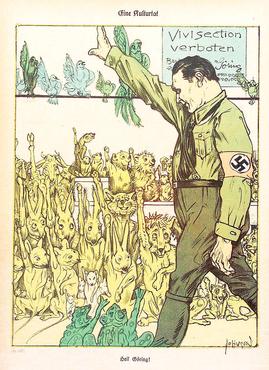
It is not a coincidence that in a famous caricature, Göring is portrayed as the liberator and leader of all lab animals that give him the Nazi salute in sign of gratitude. On this matter, he is remembered for another extreme political statement:
I […] will commit to concentration camps those who still think they can continue to treat animals as inanimate property […]. The fairy tales and sagas of the Nordic people, especially the German people, show the spirit of close contact, which all Aryan people possess, with the animals. It is the more incomprehensible, therefore, that justice, up to now, did not agree with the spirit of the people on this point as it did on many others. Under the influence of foreign [i.e., Jewish] conceptions of justice and a strange comprehension of law, through the unhappy fact that the exercise of justice was in the hands of people alien to the nation […] the animal was considered a dead thing under the law […]. This does not correspond to the German spirit and most decidedly does not conform to the ideas of National Socialism.
Editor's interpolated note: The hatred I feel when I hear a Judeo-Christian say that God (the nonexistent god of the Jews) put animals in the world for our benefit, makes me write my "four words".
Hitler once declared:
I have always known to be of the opinion that there is nothing better than being a lawyer for those who cannot defend themselves. In the Third Reich there must be no more animal cruelty.
______ 卐 ______
Their vision of the future included a world where animals would not be unnecessarily harmed. Hunting became a symbol of the past civilization, meat eating became a symbol of decayed peoples, and vegetarianism became a symbol of the new, pure civilization that was to be Germany’s future. We also know from direct testimonies, that Nazi leaders took pride in presenting themselves as friends of the animals; as Heinrich Himmler—the Reich’s Head of the SS (“Reichsführer-SS”)—stated, Germans were:
[…] the only nation of the world with a decent attitude towards animals.
Also Hermann Göring was of the same opinion, when he stated that:
The German people have always shown their great love of animals and the question of animal protection was always near their hearts. For thousands of years the German people have always looked upon their household and farmyard animals as their companions, in the case of horses as their fighting companions… To the German, animals are not merely creatures in the organic sense, but creatures who lead their own lives and who are endowed with perceptive facilities, who feel pain and experience joy and prove to be faithful and attached.
Indeed, the Holocaust itself may have depended on this unique cultural conception of what it meant to be human in relation to animals as a metaphor of what it meant to be Aryan in relation to other races. From this newly acquired perspective, one can conclude that what is considered to be as cruel and inhumane behaviour toward human beings by today’s standards, was seen by the Nazis as acceptable behaviour toward “subhumans”. What may be regarded as paradoxically humane behaviour toward animals, in light of the human tragedy, was seen in Nazi Germany as quite consistent given the belief of a common stem of certain higher humans and animals and their special bond with nature. Therefore, racial and eugenic laws on one side and the animal protection and nature conservation normative complex on the other, did indeed have a common denominator, which is mostly visible when studying the emanated laws in the context they were created in.
It is evident that the Nazi German identity relied on the blurring of boundaries between humans and animals, as well as constructing a unique phylogenetic hierarchy that altered conventional human-animal distinctions and imperatives. This blurring was visible, for example, in the abolishing of moral distinctions between animals and people, leading to the result that animals could be considered “higher” than some people. This was also apparent in the highly-debated concern for animals held by many prominent Nazi Germans.
On the one hand, animals were considered virtuous, innocent, and embodied ideal qualities absent in most humans, to the extent that to hunt or eat animals was defiling, a sign of decay and perversion. People, on the other hand, were seen with hatred, dread, and disappointment. In fact, to kill certain people was part of the quest for purity. Additionally, this blurring was evident in the Nazi alliance with animals, both portrayed as victims of their Jewish oppressors, i.e. the vivisectionists and slaughterers.
Finally, this blurring was visible in the animalization of German Nazis, in how they represented themselves as well as other humans. To cope with what they considered as the threat of genetic pollution of their pure, holistic, natural Volk, Germans were encouraged to fight with the same hard-headed determination as any other species in nature.
 “But if writers begin to describe their childhood, as has been happening more and more frequently in the past decade, then they will be confronted with the hostility of society, which sees the customs and rights it has enjoyed for thousands of years threatened” (Thou Shalt Not Be Aware, page 230).
My article on Freud, originally published in The Occidental Observer, has been republished in The Unz Review.
It has always been the case that it is not cruelty itself that arouses public indignation but rather calling attention to the cruelty. (Baudelaire described things everyone knew about, but as a result his book Fleurs du mal was initially banned by the official censors of the day.) The victimization of children is nowhere forbidden, what is forbidden is to write about it.
—Alice Miller
Here I begin to expose Society, which betrayed and drove my sister mad.
I’m uploading this series of videos because only broken people are capable of generating the right gravitas to understand what’s happening in the world.
Yesterday I tried to communicate with a Groyper on “X” but it was useless.
These people don’t read, as Greg Johnson complained.
They fail to understand that the mere bravado of guru Nick Fuentes is certainly good, but it lacks the depth of thought that William Pierce on this side of the Atlantic, or Savitri Devi on the other, possessed.
I told this Groyper that Nick had recently said that his Christian scruples prevented him from expelling the millions of non-whites who have come to the US in recent decades. Fuentes added that white Americans now have to adapt to that reality. I told the Groyper that such scruples didn’t appear in Pierce’s novel, and the guy (who could be half a century younger than me) replied that it was an academic discussion. Then he spoke rudely, and I cut him off for good.
It’s not an academic matter, but rather what I’ve said several times about our friend Joseph Walsh, who is now serving a seven-year sentence in the UK for thought crime. Walsh told me privately that all white people, including racialists, are committing suicide.
Why? Recall Walsh’s words in the featured article, “1945 was the year of the total inversion of Aryan values into Christian values.”
The point is that before 1945, white people were capable of exterminating entire populations of inferior humans, as they did in Cuba, Tasmania, and as the Germans planned to do in the Master Plan East. The aftermath of that fateful year represented a psychotic regression toward the purest evangelical message: a folie en mass of the Aryan collective unconscious, leading them to love every wingless biped (a psychological affliction even Fuentes suffers from).
These callow Groypers are incapable of engaging in a simple discussion on the matter because, like some teenagers, they are too arrogant. They think they can reinvent the wheel. I’ve said it before, and I’ll say it again: Without an ethnostate, even with several Groyper dictators in the US over the course of a century, the white race would become extinct because miscegenation is inevitable.
Walsh was right: All white people commit suicide, even racialists with very rare exceptions (those we call priests of the sacred words). In short, a devout Christian—and the Groypers are Christians—will never be capable of ethnic cleansing, as the Gods command. Unlike the Nazis, a Groyper obeys the commandment to love one’s “neighbour”: a commandment of the god of the Jews who wants to exterminate him.

Ultimately, a Groyper will still be a loser even if he becomes President of the US.
I just realized that the “X” that Elon Musk bought is politically correct, just like the other platforms.
When I saw a tweet asking “Describe Obama in one word,” I wrote the obvious (see the screenshot’s last word). And I just received this email from a bot:

Let’s now translate the whole text into English:
Hello, César Tort: Your post was detected by our systems, and its visibility was limited for violating our Rules. Specifically:
We determined that your post violated the rules prohibiting hate speech [emphasis added].
It is not permitted to threaten, harass, or incite violence against other people based on their race, ethnicity, nationality, sexual orientation, gender, gender identity, religion, age, disability, or illness.
That’s why I like Nick Fuentes: he uses the N-word all the time!