had won WW2…

…instead of the imbecile Western presidents supporting Israel in the war with Iran, this is what we would see on the streets of Europe.
had won WW2…
…instead of the imbecile Western presidents supporting Israel in the war with Iran, this is what we would see on the streets of Europe.
“Deep thinkers aren’t rejected because they are wrong, but because they are right too soon”—yes, but I disagree with a couple of things in this video:
Alan Turing, mentioned in the video, played a crucial role in deciphering the intercepted messages that allowed the Allies to defeat the Germans. This means that the normie who uploaded the video doesn’t know that the homosexual Turing was an agent of Evil.
The other issue is that sometimes intelligent people can’t find anyone to talk to about profound topics. Socrates had quorum but none hearken to Nietzsche’s voice.
In these videos by normies for a normie audience there’s still a certain naiveté in understanding what Savitri used to call “a Man against his time”.
The tragedy of Friedrich Nietzsche’s life was that it happened to be a one-man show, a monodrama wherein no other actor entered upon the stage: not a soul is at his side to succour him; no woman is there to soften by her ever-present sympathy the stresses of the atmosphere. Every action takes its birth in him, and its repercussions are felt by him alone. Not one person ventures to enter wholeheartedly into the innermost sanctum of Nietzsche’s destiny; the poet-philosopher is doomed to speak, to struggle, to suffer alone. He converses with no one, and no one has anything to say to him. What is even more terrible is that none hearken to his voice. —Stefan Zweig
Today, Benjamin sent me an email containing this paragraph: “I’m disappointed no one else even seems to have clicked my link to the page though (or if they have, from my analytics they haven’t stayed more than two minutes—odd with an easy-access layout one-page site containing many hours of content). Bar the psychiatry focus, and the veganism, I thought I was basically covering topics we talk about all the time on WDH. I don’t understand (my perennial problem: trying to analyse the apathetic) why they’re not interested. Maybe they haven’t got 6 quid. I hope not, or our movement is screwed”.
This is something that, in the past, has seemed like an extraordinary phenomenon to me, and I would like to respond to Benjamin in the second person singular:
As I’ve told you several times, even years before you found my site, when I posted quite insightful entries and thought some of them would have a large quorum, no one said a peep, and over time I invented a saying that I used to say to myself in soliloquies: “Here come the silent ones…!” in the sense that they left me talking to myself, over and over again.
 It was so exasperating that, occasionally, as I’ve also confessed to you, I let the insulting trolls’ comments slide because I preferred the insults to have the racialists apply what the Germans call “death by silence” tactic. (My family, relatives, friends, therapist and acquaintances “killed me with silence”. No one wanted to know anything about what was happening at home, and it was precisely because no one wanted to listen that I dedicated myself to writing about the family tragedy.)
As I told you by email, the silence of the visitors began several years ago, when it became clear that my criticisms of white nationalism were going to be incisive, constant, and persistent. That scared everyone away. And they are fundamental criticisms: I was trying, and am trying, to shift the paradigm from the JQ to the CQ. And I do this not because I side with the Jews: I believe they should be expelled to Madagascar, Hitler’s original idea (or to Israel, although that country has already become a precarious place, and the war with Iran could evolve into a regional war).
I suspect that the relative silence in the comments section is due to what Thomas Kuhn said about a paradigm shift. The old guard first ignores the new paradigm (admirably summarised in yesterday’s post, citing your book!). When it’s no longer possible to ignore the new paradigm, let’s say if voices like yours were to multiply (obviously, we’re not there yet), the old guard fiercely opposes the new paradigm. Finally, the new paradigm is accepted as the most natural thing, although that only happens with the biological death of the old guard who controlled the boundaries of discourse. The new generations are seeing that the old paradigm was wrong or at least incomplete: something that, to preserve their egos, the older generations were reluctant to concede.
It’s similar to what Scott Peck says about narcissistic parents who never admit that they might have made a mistake with one of their children. It also reminds me of the case of a girl diagnosed as schizophrenic in one of Ronald Laing’s books. Laing wrote that it was precisely because the mother was incapable of accepting an ounce of guilt that her daughter was so disturbed.
The same thing happens with white nationalists: they are incapable of accepting that our civilisation took the wrong path many centuries ago. These nationalists maintain a working hypothesis that resembles a religious dogma: Jewry is responsible for our misfortunes. We say: Jewry is very powerful in the West and very subversive: but whites empowered them by destroying the religion whose Gods represented the Aryan collective unconscious, replacing it with the Judeo-Christian collective unconscious. As Emperor Julian saw when the transition from one collective unconscious to another was underway, “Why were you so ungrateful to our Gods as to desert them for the Jews?”
Contrary to what Hitler privately confessed to his closest friends, today’s nationalists are like the mother of the schizophrenic woman: they don’t accept an iota of blame. Compared to intelligent people like William Pierce, who wrote Who We Are, or scholars like Revilo Oliver, the ideology of today’s nationalists, besides being simplistic, represents a giant step backwards. If we follow the Rubicon metaphor it’s as if, after two solid steps toward the other side of the river—racial realism and becoming aware of JQ—instead of moving forward, these racialists panic about what they begin to glimpse through the fog on the other side. Transvaluing implies genocidal actions against our enemies and, like a magnet pulling them toward Normieland due to their Christian programming, they begin to take steps backwards instead of forward to finally cross the river toward National Socialism.
We can’t do anything with these cowards. We must be very patient. If Kuhn was right, the older generations—in our case, the white nationalists—will have to die. Perhaps those who are now Aryan children, or even unborn minds will have a better chance of seeing things differently: of discovering this site and embracing the post-1945 National Socialist antichristian worldview. But trying to do so with the hundreds of conservatives who comment on, say, The Unz Review and other racialist forums is a fool’s errand.
Since I’m already in my sixties I hope that if death were to surprise me, our work wouldn’t disappear but that I could pass the mantle to someone younger, like you: someone who would maintain the content of this site, especially the PDFs where the vital information is condensed.
And when it comes to the havoc that abusive parents wreak on their offspring, the situation is even worse! The taboo is universal due to the “problem of the attachment with the perp”, a concept explained in my Day of Wrath. However, if it makes you feel better, I received an email today from a Panamanian who asked me to share the link to your site, which I did.
pages 97-107 of the December 2024 edition of Benjamin’s The Less Than Jolly Heretic:
______ 卐 ______
I’ve become very anti-Christian over the recent years, seeing this slavish faith-based ideology as perhaps the primary cause of European civilisational collapse, having read quite closely into the likes of Catherine Nixey’s The Darkening Age, Revilo P. Oliver’s The Origins of Christianity, Tom Holland’s Dominion, and Charles Freeman’s The Closing of the Western Mind, and some abridged translations of Christianity’s Criminal History by Karlheinz Deschner, reinforced by the historical Roman writings of Celsus, Porphyry of Tyre, and the Emperor Julian, and, as with Edward Gibbon, have considered Christianity’s responsibility for the fall of Rome (and the theocratic brutality of Byzantium and the Dark Ages that effectively ended European science for well over a millennium, torturing and exterminating those Europeans who tried to hold out against the impositions of countless generations of bloodthirsty, ignorant, perverted Christian regimes, Europe split for seventeen centuries by terrible Christian sectarian warfare).
I have also considered its post-Enlightenment transition into liberalism and that all-encompassing secular ‘Neochristianity’, in the inspirational words of César Tort. This value system has conditioned a knee-jerk egalitarianism and relativistic weakness, a morality that Friedrich Nietzsche famously derided as fit only for slaves, a racially suicidal, life-hating framework of passivity, submission, and out-group preference, in complete contrast to the master morality values of Republican Rome and the cohesive Indo-European civilisations of the ancient world.
Drawing from a translated summary of Demolish Them by Vlassis Rassias, provided in original form on the West’s Darkest Hour blog, we can chart the principal Christian moves to destroy the Classical world. It’s worth noting that Christians referred to European advocates of Greco-Roman civilisation as ‘Gentiles,’ a Semitic term, before transitioning into even more erroneous and derogatory descriptors.
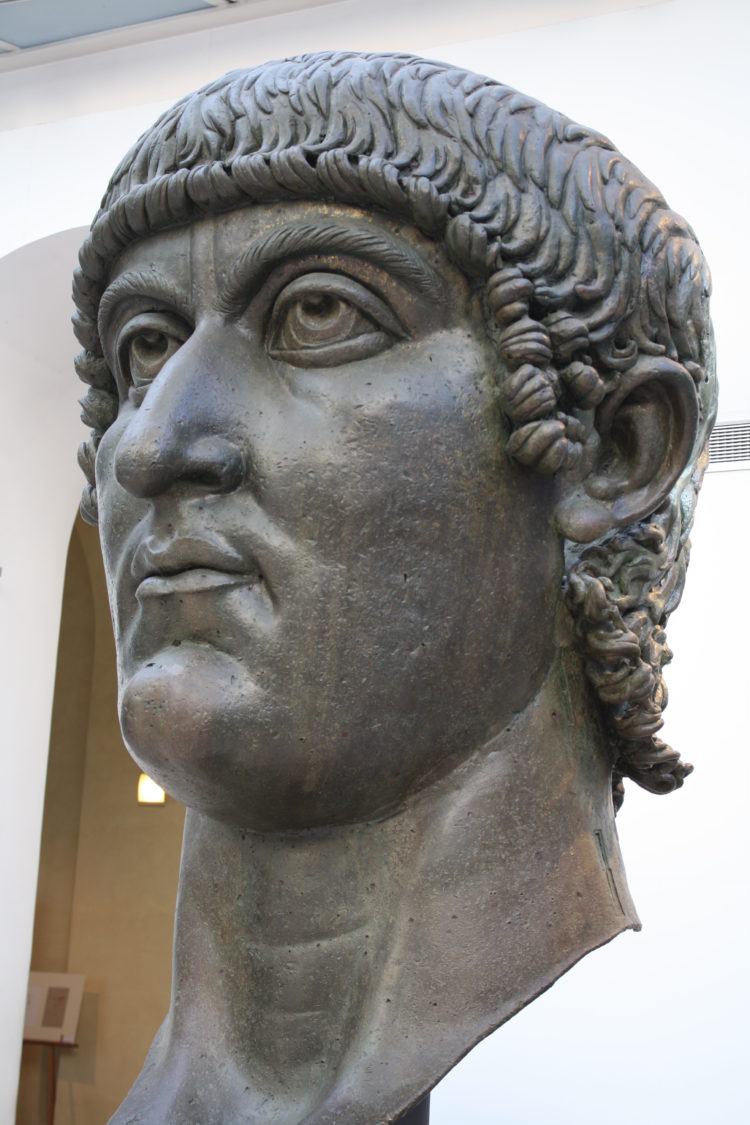 In 314, after the full legalisation of Christianity, the Christian church moved to attack the Gentiles. The Council of Ancyra denounced the worship of the Goddess Artemis. In 324, the Emperor Constantine declared Christianity as the only religion of the Roman Empire. At Dydima in Asia Minor, he sacked the Oracle of God Apollo and tortured its priests to death. He also evicted the Gentiles from Mt. Athos and destroyed all local Hellenic Temples. In 326, Constantine destroyed the Temple of God Asclepius in Aigeai in Celicia and many Temples of Goddess Aphrodite in Jerusalem, Aphaca, Mambre, Phoenice, and Baalbek. In 330, Constantine looted the treasures and statues of the Greco-Roman Temples of Greece to decorate his new capital of the empire, Nova Roma (the city of Constantinople), and in 335, went on to sack the Temples of Asia Minor and Palestine and ordered the execution by crucifixion of Gentile priests as “magicians and soothsayers” including the Neoplatonist philosopher Sopater of Apamea.
 In 341, Emperor Constantius, the son of Constantine, persecuted “all the soothsayers and the Hellenists,” imprisoning and executing many Gentile Hellenes. In 346, there were large-scale persecutions against the Gentiles in Constantinople, during which the famous orator Libanius was banished as a “magician.” In 343, an edict of Constantius ordered the death penalty for all kinds of worship through “idols,” and a new edict in 354 ordered the closing of all Greco-Roman Temples, some of them to be turned into brothels or gambling rooms, and their priests were executed. In various cities of the empire, libraries began to be burnt, and lime factories were built next to the closed Temples. A large part of sacred Gentile architecture was turned to lime. A further edit in 356 ordered the Temples destroyed altogether and the execution of all “idolators,” and in 357, Constantius outlawed all methods of Divination.
In 359, massive death camps were built in Skythopolis in Syria for the torture and execution of arrested Gentiles from all around the empire. In 361, a new, non-Christian Emperor, Julian, pronounced religious tolerance and called for the restoration of the various pre-Christian cults but was assassinated in 363. In 364, the Emperor Flavius Jovianus ordered the burning of the library of Antioch, an Imperial edict ordered the death penalty for all Gentiles who worshipped their ancestral Gods, and three separate further edicts ordered the confiscation of all properties of Temples and the death penalty for participation in Greco-Roman rituals, even in private. In 365, an Imperial edict forbade Gentile army officers to command Christian soldiers.
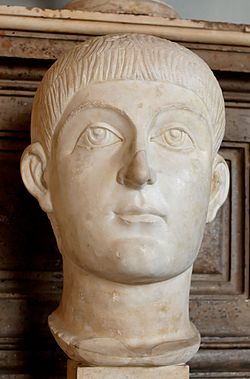 In 370, Emperor Valens ordered a tremendous persecution of Gentiles throughout the Eastern Empire. In Antioch, the ex-governor Fidustius, the priests Hilarius and Patricius, and many other non-Christian believers were executed. All friends of Julian, such as his personal physician Orebasius, the Greek medical writer, the Roman historian Sallustius, and Pegasius, the custodian of the Temple of Minerva, were persecuted, and the philosopher Simonides was burnt alive whilst the philosopher Maximus was decapitated. In 372, Emperor Valens ordered the governor of Asia Minor to exterminate the Hellenes and all documents of their wisdom.
In 373, there was a new prohibition on Divination and the introduction by Christians of the slang term “Pagan” (from the Late Latin word pagani, meaning “peasants,” by extension as “rustic,” “unlearned,” “yokel,” or “bumpkin.”) The Greco-Roman polytheists did not refer to themselves as Pagans. The ‘Pagans,’ driven from their places of learning and religious practice and fearing for their lives, had become increasingly rural and provincial relative to the Christian population. Subsequently, Christians denigrated Paganism as “the religion of the peasantry.”
In 375, the Temple of God Asclepius in Epidaurus in Greece was closed. Again in 380, an edict of Emperor Flavius Theodosius decreed Christianity the exclusive religion of the Roman Empire, requiring that “all the various nations, which are subject to our clemency and moderation, should continue in the practice of that religion, which was delivered to the Romans by the divine Apostle Peter.” Non-Christians were referred to as “loathsome, heretics, stupid and blind,” and in another edict, he referred to all those who did not believe in the Christian god as “insane” and outlawed all disagreements with the Church dogmas. Ambrosius, the Bishop of Milan, began to destroy all the Temples in his area, and Christian priests led the mob against the Temple of Goddess Demeter in Eleusis and tried to lynch the hierophants Nestorius and Priskus. The 95-year-old Nestorius ended the Eleusinian Mysteries and announced a predominance of mental darkness over the race.
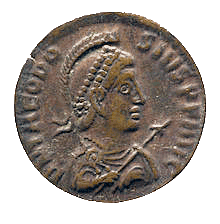 In 381, Emperor Theodosius removed all rights from any Christians who returned to the Greco-Roman religion. Throughout the Eastern Empire, more Temples and libraries were looted and burned down. Even simple visits to the Hellenic Temples were banned. In Constantinople, the Temple of Goddess Aphrodite was turned into a brothel, and the Temple of Sun and the Temple of Artemis were turned into stables.
Then, in 384, Theodosius ordered the devout Christian Praetorian Prefect, Maternus Cynegius, to cooperate with the local bishops of Northern Greece and Asia Minor to destroy more Hellenic Temples. From 385 to 388, “Saint” Marcellus and his armed gangs scoured the countryside, sacking and destroying hundreds of Hellenic Temples, shrines, and altars, including the Temple of Edessa, the Cabeireion of Imbros, the Temple of Zeus in Apamea, the Temple of Apollo in Dydima, and all the Temples of Palmyra. Many thousands more Gentiles were rounded up and sent to the Skythopolis death camps to be executed.
In 386, Theodosius outlawed the care of sacked Temples, and in 388 outlawed public talks on religious subjects. In 389 and 390, all non-Christian calendar systems were outlawed, and hordes of emboldened desert hermit fanatics flooded into the Middle Eastern and Egyptian cities, destroying statues, altars, libraries, and Temples and lynching the Gentile inhabitants. Theophilus, the Patriarch of Alexandria, began a heavy persecution of Gentiles and turned the Temple of Dionysos into a church, burnt down the city’s Mithraic Temple and then destroyed the Temple of Zeus, and mocked the priests as ludicrous before the laughter of the Christian crowd, before stoning them to death as the mob profaned their sacred images.
In 391, a new edict of Theodosius prohibited visits to Temples and the crime of merely looking at vandalised statues. In Alexandria, Gentiles led by the philosopher Olympius revolted, and street fights broke out before they locked themselves inside the fortified Temple of the God Serapis. Following a violent siege, the Christians occupied the building, demolished it, burnt its famous library, and profaned the Greco-Roman cult images.
In 392, Theodosius outlawed all non-Christian rituals as “Gentile superstitions.” The Mysteries of Samothrace were ended, and their priests slaughtered. In Cyprus, “Saint” Epiphanius and “Saint” Tychon destroyed almost all the Temples of the island and exterminated thousands more Gentiles. The local Mysteries of Goddess Aphrodite were ended. An edict by Theodosius declared, “The ones that won’t obey Pater Epiphanius have no right to keep living on the island.”
 In 393, the Pythian Games at Delphi, the Aktia of Nikopolis, and the Olympic Games were outlawed as “idolatry,” and Christians sacked the Temples of Olympia. In 395, two new edicts led to the persecution of Gentiles. The Emperor Flavius Arcadius directed hordes of baptised Goths led by Alaric and the Christian monks to sack and burn the Hellenic cities, including, among others, Dion, Delphi, Megara, Corinth, Pheneos, Argos, Nemea, Lycosoura, Sparta, Messene, Phigaleia and Olympia, and then slaughtered and enslaved the inhabitants, burning all Temples. They burnt down the Eleusinian Sanctuary and had all its priests burnt alive, including the hierophant Mithras Hilarius. In 396, Flavius Arcadius declared Paganism to be treated as high treason, and the few remaining priests and hierophants were imprisoned. Then, in 397, Flavius Arcadius ordered all Temples still erect to be demolished.
In 398, the Fourth Church Council of Carthage prohibited the study of Gentile books by all citizens, their bishops included. Porphyrius, the bishop of Gaza, demolished almost all Temples in his city, leaving only nine to continue functioning. In 399, a new edict from Flavius Arcadius ordered the last of the Temples, almost exclusive now to the depths of the countryside, to be immediately demolished, and, in 400, bishop Nicetas destroyed the oracle of God Dionysus in Vesai and baptised all Gentiles living in the area. In 401, the Christian mob of Carthage lynched Gentiles and destroyed “idols.” In Gaza, the new “Saint” Porphyrius sent his followers to lynch Gentiles and destroyed the remaining nine Temples still active in the city. The Fifteenth Council of Chalcedon ordered all Christians who still retained good family relations with their Gentile relatives to be excommunicated (even after the death of these relatives).
In 405, John Chrysostom sent hordes of grey-clad monks armed with iron bars and clubs to destroy the “idols” in all the cities of Palestine and, in 406, collected funds from rich Christian women to financially support the demolishment of Hellenic Temples. The Temple of Goddess Artemis was destroyed in Ephesus, and in Salamis in Cyprus, “Saint” Epiphanius and “Saint” Eutychius continued the total destruction of Temples and sanctuaries and the persecution of Gentiles. A new edict in 407 once more outlawed all non-Christian acts of worship.
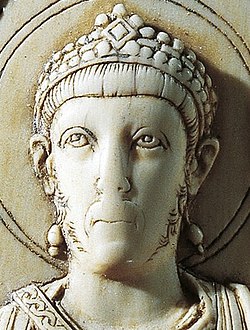 In 408, the Emperor Honorius of the Western Empire and the Emperor Flavius Arcadius of the Eastern Empire came together and ordered all Temple sculptures destroyed or confiscated. Private ownership of the statues was outlawed. The local bishops led new book-burning persecutions, and any judges showing pity for Gentiles were also persecuted. In Alexandria, a few days before the Judaeo-Christian festival of Pascha-Easter, bishop Cyrillis ordered the mob to attack and hack down the beautiful Neoplatonist philosopher Hypatia. The Christians paraded pieces of her body through the city and burnt them together with her books at a place called Cynaron. A fresh persecution started, and all Hellenic priests in North Africa were crucified or burnt alive.
In 416, the inquisitor Hypatius, “The Sword of God,” exterminated the last Gentiles of Bithynia. In Constantinople, all non-Christian army officers, public employees, and judges were dismissed. In 423, Emperor Theodosius II declared that all Gentile religion was nothing more than “demon worship” and ordered those who persisted in practicing it to be imprisoned and then tortured. In 429, the Parthenon on the Acropolis of Athens, holding the Temple of Goddess Athena, was sacked.
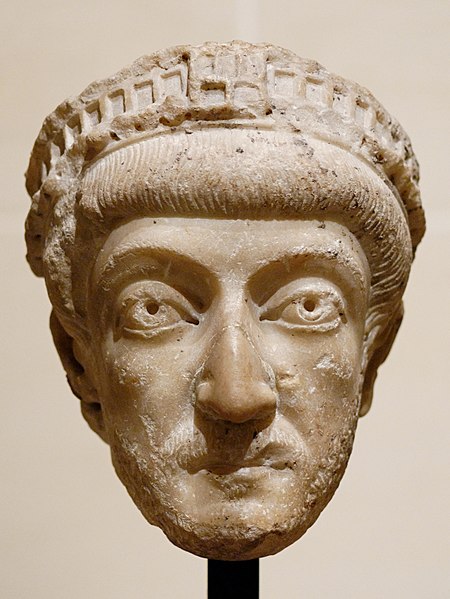 Then, in 435, a new edict of Emperor Theodosius II ordered the death penalty for all “heretics.” Judaism was considered the only legal and non-heretical non-Christian religion. In 438, Theodosius II’s new edict incriminated Gentile “idolatry” as the reason for a recent plague. Between 440 and 450, the Christians succeeded in demolishing all Temples, altars, and monuments in Athens and Olympia, and Theodosius II ordered all non-Christian books burned, and all the Temples of the city of Aphrodisias (the city dedicated to Goddess Aphrodite) were demolished. All libraries were burnt down, and the city was renamed Stauroupolis, “City of the Cross.”
Between 457 and 491, among others, the physician Jacobus and the philosopher Gessius of Petra were executed, whilst the Roman politician Severianus of Damascus, the Greek historian Zosimus, and the Greek mathematician and architect Isidorus of Miletus were tortured and imprisoned. The proselytiser Conon and his followers exterminated the last Gentiles on the island of Imbros in the North-East Aegean. The last worshippers of Lavranius Zeus were exterminated in Cyprus. The majority of the Gentiles of Asia Minor were exterminated, despite a desperate revolt against the Emperor and the Church between 482 and 488, and more Hellenic priests hiding ‘underground’ were arrested, publicly humiliated, and tortured, then executed.
By 515, baptisms had become obligatory, even among those who professed to already be Christian. The Emperor Anastasius of Constantinople ordered the massacre of Gentiles in the Arabian city of Zoara and the demolishing of the Temple of the local God Theandrites. In 528, Emperor Jutprada outlawed the alternative Olympian Games of Antioch and ordered the execution by fire, crucifixion, tearing to pieces by wild beasts, or cutting by iron nails of all who practiced “sorcery, divination, magic, or idolatry” and prohibited all teachings by “…the ones suffering from the blasphemous idolatry of the Hellenes”, then, in 529, he outlawed the Athenian Philosophical Academy and had all its property confiscated.
In 532, the fanatical inquisitor-monk Ioannis Asiacus led a crusade against the Gentiles of Asia Minor, put hundreds of Gentiles to death in Constantinople, and bloodily converted them to Christianity in Phrygia, Caria, and Lydia and in 556, inquisitor the Emperor Jutprada ordered Amantius to go to Antioch, to find, arrest, torture, and execute the last Gentiles and to burn all private libraries down. In 562, mass arrests, public humiliations, tortures, imprisonments, and executions were conducted in Athens, Antioch, Palmyra, and Constantinople. Within 35 years of Asiacus’ crusade, 99 churches and 12 monasteries had been built on the sites of demolished Temples.
Between 578 and 582, Christians tortured and crucified almost all the Gentiles around the Eastern Empire and exterminated the last Hellenes of Baalbek, now named Heliopolis. In Antioch, a secret Temple of Zeus was discovered and attacked, causing the priests to commit suicide. The captured Gentiles, including Vice Governor Anatolius, were tortured and sent to Constantinople to be fed to wild beasts and crucified when they were not devoured alive, their mutilated corpses dragged through the streets by Christians, and then thrown unburied in the city dump. Emperor Mauricius conducted further persecutions in 583, and in 590, Christian accusers ‘discovered Pagan conspiracies’ throughout the Eastern Empire, and a new wave of torture and executions erupted.
In 692, the Penthekte Council of Constantinople prohibited the last remains of Calends, Brumalia, Anthesteria, and other Hellenic Dionysian festivals. By 804, the last Gentiles living in Laconia in Greece had still resisted all attempts by Tarasius, the patriarch of Constantinople, to convert them, but they were, in the end, violently converted between 950 and 988 by the Armenian “Saint” Nikon.
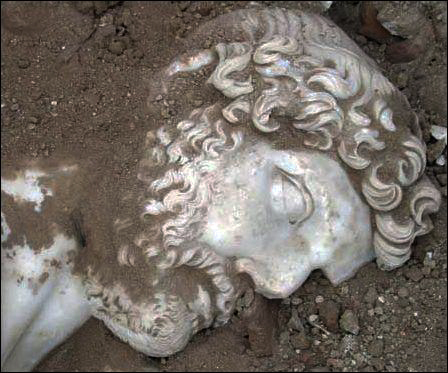
This piece from a statue of Emperor Hadrian, which must have measured around 5 meters, was found in present-day south-central Turkey, where Christianity took root early.
There are many more examples of this barbarity, but this provides a basic overview of why I hold my perspectives. The most important factor, beyond the beautiful architectural physicality of their Temples and statues being defiled and destroyed, and the amassed wisdom of their many libraries lost forever, is that the Europeans referred to as “Gentiles”, those massacred throughout this violent centuries-long campaign of anti-European terror—conducted by their fellow European citizens and their leaders from within the same civilisation under the same race of people—methodically severed the European citizens from their Aryan Gods and instead subjected them to a forced conversion to this god of a foreign enemy, and the holy teachings and writings originally compiled by that enemy.
The gospels were originally written by Jews after all, much as the entire Old Testament is a Jewish mythology, that Judaic archetype of Jesus subversively inverting the European values to the values of their racial enemy, and the additional values they designed ‘for export only’, so the newly radicalized cult of Europeans could further impose these alien values among their own race by obscene brutality and blind torments and misery, these traitorous egalitarian submission and pacifism values held now near-unanimously by Europeans in the 21st Century, and held subconsciously, unaware that, though they have—in the general public understanding—dropped that god for atheism, their unthinking moral axiology and puritanism is still entirely Christian (and it certainly is unthinking beyond any rationalizations they can attribute in aftermath), an ethical framework of far more profound significance than the standard assumption by atheist progressives that by Christian ethics we mean merely an organised opposition to pornography, abortion and homosexuality as displayed by American conservative evangelicals, and irrespective of a liberal humanist’s scepticism over the existence of the supernatural and of the divine aspects of Christian monotheism.
 The arbitrary value shift has been subsumed, and now, when one talks of being ‘good,’ or ‘moral’—or specifically obsesses over the moral value of an act at all, as Friedrich Nietzsche reminded us in his Twilight of the Idols—we can take it as read that they are in alignment with the morals presented to us in the Ten Commandments, and by the incoherent single-source literary subversions of a radical millenarian cult-leader archetype, the inverse of an Eliot Goldstein creation, this revolutionary fiction—as if morality had no other value-system, and as if nothing worthy had come before, or had been a mere barbarity of its own!—with us only able to view the pre-Christian Greco-Roman civilisation’s societal codes and cultural drives through a 2000-year post-revolutionary Christian moral lens, in unthinking retroprojection—our definitive modern paradigm—the Greco-Roman world now appearing alien to us, or somehow cruel.
As with the writings of Richard Carrier, David Fitzgerald, and David Skrbina, I am convinced that the character of Jesus is mythological, a subversive creation of Paul—and otherwise missing from the historical record (one cannot trust Flavius Josephus as a single external to the Bible source due to the likelihood of forgery)—invented for the purposes of irreversibly undermining an already weakened Roman Empire and to impede the maintenance of its grasp on Judea, manipulating the fundamental attitudes of his hated enemy to the point that their society would fall apart in revolution from the ground up, the universal egalitarianism of the Judaic doctrine of Christianity moulding the slave-classes into furious zealots, violently intolerant of the ‘paganism’ of the Greco-Roman tradition and the accepting pluralism of Roman religious belief, and their centuries of rational philosophy, mathematics, and analytical science, with their statues and sculptures vandalized and smashed, their ancient temples and monuments looted and destroyed, and their vast libraries holding centuries of accumulated wisdom and knowledge burnt to the ground, the precious works and advancements contained in them lost to history, and the people now weakened, tradition and social coherence obliterated, vulnerable to increasing miscegenation and the predations of hostile foreign outsiders, or to Christian-orchestrated purges and bloody mass executions. Ramsey Macmullen and J. N. Hilgarth elaborate on this violent, forced transition of Europeans to Christianity in the fourth to eighth centuries following Emperor Constantine’s proclamation that Christianity was now the one official religion of Rome.
Editor’s note: Below, some excerpts from pages 184-199 of the expanded, August 2024 edition of Benjamin’s The Less Than Jolly Heretic:
______ 卐 ______
 Dear César,
I hope you are well. Congratulations on the completion of the Savitri Devi book project. I’ve already downloaded a digital copy and read through it once. I was wondering if it was now possible to place an order for one of your home-bound editions? If you could tell me the full costs, I shall put the money through to you. I did not want to contact you until now as I wanted to make sure I was financially secure enough to afford the process and shipping costs…
I’m also aware that, sadly, the vast majority of “right-wing” individuals and the groups they cluster to are extremely hostile to manifestations of psychological pain, and ignorant over trauma, and with a particular recent drive to ridicule mental health for the purposes of ‘defeating’ their political ‘leftist’ rivals. As you wrote before, I consider them to be fakes. To be honest, you’re the only National Socialist I have ever encountered online who is at all understanding of madness…
I see nigh-on all these committed White political activists as just as much of a threat as everyone else. If there ever were to achieve substantial power, I would not expect them to impose an order in any way relatable to the worldview of National Socialism, or of any genuine intrinsic loyalty to the great vision of Adolf Hitler, or indeed the West itself…
Occasionally, I’ll check Counter Currents, maybe once every few months. I always regret it. Of all of them, I had expected more of ‘Morgoth’. I saw this today by Stephen Paul Foster. Immediately I was put off but decided to see what he had to say. I paused on the lines:
My friend, whose name was Bill, was not your typical loser who works himself into a violent temper and up and slays his defenseless girlfriend. This particular slayer turned out to be a man of advanced degrees, sophisticated tastes, serious books, and immense erudition. Fluent in four languages, the range and depth of his knowledge was phenomenal. He could converse insightfully about the influence of Kantian ethics on German legal positivism, help you fathom the aesthetics of Arnold Schoenberg’s atonalism, and substantively compare English translations of the pre-Socratic philosophers.
I knew he was hopelessly lost in relativism, ignorance and Christian moral outrage. Even culturally, we could do better than Schoenberg and Kant. Might as well be Bukowski, or at least their Hemmingway. He wrote:
In his trial for the second murder, to convince the jury that Bill’s torture and killing of his girlfriend was not a first degree (capital) murder, his attorneys summoned as defense witnesses “theorists of the mind”—psychologists—to compound the “assumptions” that would explain Bill’s evil; abstractions conjured out of the black box of “mental health” in the form of “disorders” .
Much as I don’t agree with the orthodox medical system or with the term “disorders” either, it seems like Stephen was unwilling to accept that Bill’s behaviour was in any way explainable beyond him being pure evil. I’m not sure how one could ever satisfactorily attempt to pass that off as an intelligent response. He even wrote immediately afterwards, using Poe as an authority, of all people:
By undue profundity, we perplex and enfeeble thought. — Edgar Allan Poe, The Murders in the Rue Morgue
He goes on:
The trial was a formal ritual of “undue profundity.” It attempted to factor in of all of Bill’s personal paraphernalia that had been relevant to the murder. But pondering his potential, intelligence, educational attainment, cultured charm, and his sick, unhappy childhood with divorced parents and a callous father was worse than useless as an effort to explain the elusive why he did what he did. Some people are just no good. It is that simple. They are unredeemable. They belong in Dante’s tenth and lowest circle of Inferno. The more assumptions introduced to explain it, the more confusing (perplexing) it becomes, and less satisfactory the results.
Considering what I said in my previous email, where I was pondering what the Dissident Right would be like in a position of power, this line troubled me:
Stupidity cannot be fixed; neither can evil. Yet, while everyone concedes that stupidity is impossible to remediate, many think that evil is an accident or a breakdown that can be repaired by “experts.”
Great, so first some people are just evil, fundamentally, and no further questions needed, and then we discover that they are also unable to repair from this. I am left wondering what they would propose to do, given this strange superstition. I can understand Bill’s sentencing, and I am not attempting to excuse the acts. However, I can see Stephen potentially applying this mantra further. He seems to be rationalizing for what is—in the near-synonymous to this wording of his own article—a fear of new knowledge. There is the voice of the Elizabethan witch-hunter in him. At what point does his pathetic Christian moralizing stop? What would prevent him expanding his definition of evil? I shudder to think how he would react to mental health in general. I was thinking of the case of Jeffrey Dahmer at the time, and the pieces you wrote on his case. [Editor's note: See e.g., here and here] It’s terrible, but now understandable. I am able to feel pity and sadness all round, knowing it was not dealt with in time.
After all, in the original entry in the un-updated blog he linked here Stephen wrote:
His personal history was indeed a remarkable departure from that of the typical slayer of ex-girlfriends: marks of social and economic privilege, impressive educational credentials, extraordinary intellectual attainment. Bill’s life had been considerably advantaged. His father was a highly successful attorney, first in St Louis, then in California.
He went on:
This man had been my friend for fifteen years. We met when he was a first year law student at St Louis University in 1982. I was a librarian at the law school, teaching part time and finishing a dissertation for a Ph. D. in philosophy. Bill worked as a student in the law school library and after a couple of initial encounters we became friends. Few friendships in my life formed so quickly and with such intensity, in part because we shared a passion for systematic and voracious historical and philosophical reading.
Additionally, I noted the sentence:
To me Bill had always appeared completely normal, even conservative in his personal habits, orientation and behavior.
Then, tellingly:
How could this extraordinary man I had known for so long and for whom I had so much affection, commit such horrible crimes? … How could I not over the years have seen any indications that he was capable of such murderous fits of rage? Did my friendship mean anything genuine to him, or was I a kind of social prop who served a darker pathological purpose? Was there a flaw in my character not to have recognized the malignancy in his?
I was vindicated when I read the lines:
…the attorneys also painted a picture of Bill for the jury that bore little resemblance to the person I had known for so many years. They said Bill was a socially inept, maladjusted loner, a man who had been irreparably damaged by an indifferent and emotionally distant father. About his upbringing I have no direct knowledge, but I do remember over the years how consistently he spoke with respect and admiration of his father
[emphasis by Ed. - cf. the Dahmer case], particularly his basic decency and integrity.
The conclusion I drew from this was that Stephen was awed by Bill’s intelligent and academic nature, which was in fact all that really seems to have interested him, and he did not indeed know Bill that well, or a great deal about Bill’s father either, bar more credentialism, having never had the compassion or emotional intelligence to notice any warning signs of repressed psychological pain. Rather than a fairy-tale “evil,” I am concerned reading that he is so overcome with righteous rage at the crimes against two women that he cannot bear to wonder more about Bill’s childhood experiences with his father.
All he notes is Bill’s successes and erudition. I find the presumption terrible. Given the way you have exposed in your writings and links how much abuse victims idolize their abusive parents, and how the self-repressive mentality of continuing to do so is a sure-fire route to them taking out their rage on others, I thought it was not unbelievable that this indeed was the cause of Bill’s horrific criminal actions.
Rather than soaking up facts about Schoenberg and feeling smug in having a charming token ‘highly intelligent friend,’ perhaps Stephen could have listened to him, or had the perception to see between the lines. Despite his PhD in philosophy, his argument seems to stem more from his livid social embarrassment at having been ‘caught out’, especially on account of the fact that he seems to have considered Bill a good catch, almost as a vicarious academic status booster, basking in the glow of his knowledge, and yet another very able scholar himself, perhaps observable now, given his protestive elucidation, this sounder moral quality, rising.
In a nutshell, this is generally the sort of reason I keep clear of Counter Currents and the Dissident Right. They infuriate me.
Well, I’m off to lift my weights and prepare some soup, I shall look forward to ordering your bound translation next week. I hope you have a good day.
15 March 2023
quotes from The Less Than Jolly Heretic: The Philosophy of Hurt Children and An Adult’s Transvaluated Moral Principle by Benjamin:
______ 卐 ______
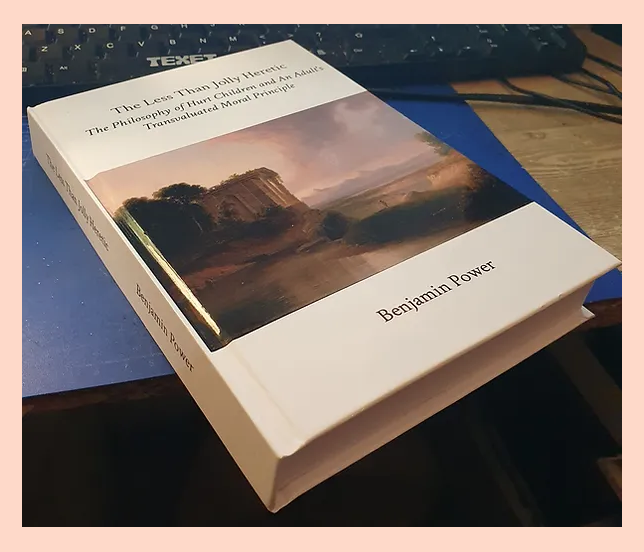 The term “Neochristian” is perhaps most appropriate. It is a slightly different consideration that takes European racial history into account in detail beyond mere latter-day political manipulation and propagandizing, an understanding that does not pass off this issue as mere leftist ‘brainwashing.’
After all, in the words of an anonymous commenter I discovered online through the West’s Darkest Hour blog in 2024 (a highly detailed and beautifully erudite online academic resource where one will, doubtlessly, have one’s core assumptions shaken), “liberalism itself, and its factional development into the likes of Marxism, Bolshevism, Fabian Socialism, and Fourierism is merely a repurposing of Christian ethical values, the ‘catholic,’ i.e., universalist dogmas of egalitarianism that inspired Boasian anthropology, and the genuflection, self-abnegation, and self-abasement that function as necessary prerequisites for spiritual purity, the public display of self-hate coupled to penitent virtue-signaling, the Christian doctrine of original sin synonymous with modern white guilt and the moralizing over privilege, and political correctness no different to judgments of heresy, witch-hunting, and ex-communication, with government replacing God as an omnipotent benefactor.”
He goes on, in my mild paraphrasing: “Even as the original religious belief in a supreme Jewish deity and an afterlife dies, the inverted value system remains, self-policing and condemning other tribal kin as heretics and infidels and working against their family interests, a meek, self-defeating, pacifist transvaluation of traditional moral values, replacing the pre-Christian aristocratic values that inspired a love of strength, pride, honour, loyalty, family, tradition, and race with weakness, mediocrity, conformity, and vulgarity, stripping all self-worth, severing connections to ancestry and genetic memory, rendering intellectual curiosity and critical thinking a sinful threat and stimulating a culture that holds contempt for learning, learned helplessness and conditioned group obedience, the slave-like underclass of society weaponized to resent, judge and police the behaviour of the warrior and aristocratic castes, and a hyper-political polarization.”
The commenter (whose extended quotation is sadly unlocated by me at the time of writing this so I am unable to provide a proper acknowledgement) ends his share of prudent wisdom with the acknowledgement that “Christianity itself has always been an institutionalized, self-regulating millenarian slave-morality system promoted as a religion, shaping the evolutionary group strategy of Europeans for almost two thousand years. These values are handed down from parents to children, and all modern patterns of perception, logic, speech, thought, action, and emotional response operate subconsciously within the dynamics of this system”, irrespective of an increasingly anti-theistic secularity since the 18th Century. [pages 10-11 of the Third Edition, 2024]
——- * * * ——-
I generally find I have absolutely nothing in common with those I observe and read who are designated “Far Right” by the establishment or, indeed, self-defined as “White Nationalists.” As examined at length above, then, I am vastly more interested in the close Nordic phenotypical similarities of the Cro-Magnon settlers who migrated to Europe from the Anatolian peninsula of Western Asia at the end of the Middle Palaeolithic than in rooting our racial origins in the early Bronze Age.
There’s the superficial appearance of a relationship with the dissident right, but it remains a shallow, lazy analysis. I have little interest in the right’s incessant and fallacious genetic determinism theorising. I find the political right appallingly crass, boorish, and ignorant in general, more an example of insincere, ratings-sensitive showmanship than a force for any active change, and I can’t imagine I’d integrate too well with any of their peer groups, even if I somehow wanted to. They seem to remain as rooted in the orthodoxy as every other branch of political activists across the spectrum, or indeed the apolitical citizen majority, the same insular, bourgeois attitudes, and those cruel moralizing values of what unfortunately amounts to the 99%. [Ibid., page 128]
——- * * * ——-
You might also have to come to terms with the uncomfortable realities of Nordicism. Suppose you can’t even admit that your recent ancestors ended the world and are to be held accountable for this. In that case, you’re going to have problems announcing that those of them before that violated your racial phenotypes also, corrupting your genetics through poor mate choices – and some considerable way back. Genetics (or archaeogenetics) is often a superficial excuse. Just look at your exterior forms, your faces and bodies, their minds and actions. You’re dung. There, I can see some conservative type getting offended at me now.
As I wrote before, I don’t relate well to White Nationalists and right-wing thinkers, the discrete ‘national supremacists’ of England and America, as I call them. I see the communistic Athenian democracy of their massed online alternative media forums, and I have no respect for – or interest in – their proud, cruel, egalitarian conservatism, that brutish bourgeois capitalism and psychiatric Neochristianity, always the resolute pacifism and the scolding of braver men. [Ibid., pages 194-195]
I want to expand on what I discussed yesterday with Benjamin about the trauma model of mental disorders because the topic is a universal taboo, including in the racialist community, to the point that catastrophes like those of William Pierce and Don Black’s children are incomprehensible. (My working hypothesis is that, had they been treated well as children, they would have followed in their parents’ footsteps instead of betraying their ideals.)
It all has to do with the omnipresent taboo, and I’d like to illustrate it with the first reading I ever did of a mental health professional who, unlike bio-reductionist psychiatry, which is pseudoscientific, was one of the pioneers in talking about parents who schizophrenized their children.
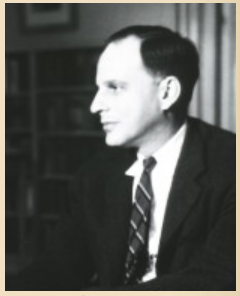
Theodore Lidz
It was 1983 when I was broke precisely because of the abuse I had suffered at home the previous decade. At the famous Gandhi Bookstore in Mexico City, I read the interview with Dr Theodore Lidz in the book Laing and Anti-Psychiatry, edited by Robert Boyers and Robert Orrill. Back then, there were no comfortable armchairs like those found in Barnes & Noble bookstores, and I had to read that long interview standing up because the subject fascinated me. It was the first time in my life I had read someone who came close to what I believed had happened in my family.
Seven years later, I managed to buy a copy of Boyers and Orrill’s book, translated into Spanish by Alianza Editorial of Madrid, which was the same edition I had read at the Gandhi Bookstore. Since I don’t have the original English version, I can’t quote a passage from the interview with Lidz verbatim, but I can restate its content.
When the interviewer asked if Lidz was surprised that books on schizophrenia, like those by Ronald Laing, had become popular among young people (this is a 1971 book and reflected the mood of the 1960s), Lidz replied that he was surprised that Laing wrote for the general public and not for a professional audience. What struck me as I reread that interview yesterday was that Lidz added that it wasn’t the public’s business to know what happens in these families, even though Laing might have altered the details to make his cases anonymous. Lidz added that, in his work on cases of schizogenic parents—that is, those who drive their children mad—he wasn’t able to publish the reports of most of the families because some of the parents were quite well-known, and even with pseudonyms, they could have been recognised. He added that some of the cases ran to 50 to 80 typewritten pages, ‘truly precious documents’, but that they couldn’t be published.
This struck me greatly because in my Letter to Mom Medusa, I cite a case in which Lidz violated what he said above: the case of Mrs Newcomb (a pseudonym) and her extremely passive husband, who helped me so much in understanding my parents.
On the next page I reread yesterday, Lidz, with whom I spoke on the phone in the 1990s when he was already quite old, surprised me again because he wrote that he didn’t believe the schizogenic parents had done anything wrong; that they hadn’t meant to harm the child, and that this contrasted with what Laing wrote, for whom the parents’ intentions were often malicious. Lidz added, and here I retranslate it again from my Spanish copy into English, that ‘parents do the best they can—they can’t be different from what they are’.
This goes against the thesis of my autobiographical books, where I say that my father could have chosen the good: not to be influenced by the lies his wife told about me, but rather should have communicated with me in my adolescence (cf. both the final pages of Hojas Susurrantes and the first chapter of ¿Me Ayudarás?).
It’s been forty-two years since I first read the very lucid interview with Lidz standing in the Gandhi Bookstore, an interview that was a turning point in the research I did on my parents. It’s only natural that after so many years, my thinking has matured, largely due to the work of Alice Miller: the first psychologist in history who, unlike her predecessors (like Lidz), unequivocally took the side of the victimized child. (Despite what Lidz said, Laing didn’t completely side with the victim either, as we see in the middle chapter of my Hojas Susurrantes.)
In the previous thread, Benjamin complained that the racial right couldn’t care less about the issue, to which I responded that the German woman who received the mantle after Alice Miller died said that blaming parents is the most potent taboo in the human psyche. I’m posting this entry because, I see now, the taboo was present even in the works of my admired mentors, whom I read decades ago. The abysmal difference between them and us is that, in siding with the victim, we don’t care about what Lidz and company feared: that the public would realise which families the clinical material refers to, those ‘truly precious documents’ he didn’t dare publish (and which would have done enormous good for our cause had they been published!).
Do you now understand the new literary genre that people like John Modrow, Benjamin and I want to inaugurate? By siding a hundred per cent with the victim, not only do we not care about people recognising the abusive families, but we write using their real names!
Only revenge heals the wounded soul, even though we’re talking about literary revenge.
‘The kind of society you want to create, Christianity makes impossible’.
—Alex Linder
in memory of the German war dead
 Only thanks to the help of an old friend, who offered me his house as storage, yesterday I managed to save the furniture that accompanied me in my home during my childhood and adolescence. Now I need to complete the long bureaucratic process to rent a modest flat in a decent area of the capital.
While I settle in, a helpful way to spend the time would be to listen to this poem, and also these audio clips from Benjamin’s books.
Being a ‘man against his time’ not only means revaluing the values regarding the heroic National Socialists who died in the war, but also inverting them equally when it comes to other lies accepted by society—such as psychiatry and what really causes mental disorders.
If the racialists understood what Benjamin and I have written in our autobiographical books, things like the grotesque betrayal of Don Black’s son, or the betrayal of William Pierce’s son, wouldn’t have happened; and I dare say David Irving’s daughter wouldn’t have become schizophrenic.
It’s time for contemporary racialists to stop believing the System’s lies (psychiatry is taught in every medical school). A good way to do so is to start familiarising onseself with the literature of those of us who have survived truly hellish adolescences.
by Gaedhal
Eradica used to have a saying: the daily outrage. Grifters such as Sargon of Akkad have found a way to monetise the daily outrage. Similarly with redpill and manosphere content: they have found a way to monetize the daily outrage. This is why I cut outrage-bait from my feed. However, new sources of outrage bait continually crop up, as baiting outrage is an extremely lucrative endeavour.
What is missed in all of this is that the Christian Churches in Ireland, North and South—when we subtract the Levantine Hocus Pocus and blood-magic Voodoo from them—are simply just government funded NGOs who advance the Great Replacement. It was the Roman Catholic Church and Sister Stan who set up the Irish Immigrants’ council. The Catholic angle in all of this is conveniently ignored by Catholic Nationalists such as John McGuirk and Niamh Nic Mathúna.
 GRIPT has links to Roman Catholic Youth Defence and the Catholic Nationalist family the McMahons—or, unpronounceably, the Mac Mathúnas. But the Roman Catholic Church is the biggest NGO, in Ireland, that is behind the plantation.
I personally, do not agree with “debates” such as this, as it sends out the signal that the 14 words are up to debate, that we can only advance the 14 words, if we “win” debates such as these. Similarly, I don’t agree with electioneering, as the 14 words does not depend upon a majority of the mob, in a rigged system, agreeing with us.
One of the reasons why I am not a democrat is just the effeminacy of the thing. Genocides—population displacement is genocide—and invasions such as these are not repelled by debates and electioneering. Voting harder has never once repelled a genocide or an invasion. Muh debates has never once repelled a genocide or an invasion. And if the white Irish are too stupid cowardly and effeminate to realise this then they deserve to go extinct. Ultimately nature is fair. Nature might be so cruel that it is impossible for any Classically theistic gods to exist, however Nature is fair.
Nature has given white men several opportunities in the past to adhere to the laws of nature and to dominate the entire planet. White men have squandered every single one of these opportunities. The white race has committed this sin against the Holy Ghost countless times, against nature, and yet nature is more forgiving than Rabbi Jesus, and instead of consigning us to the flames of total societal destruction, has forgiven us and given us more and more chances.
But even Nature’s patience will, one day, eventually wear out. Eventually White men will sin away their days of grace as far as nature is concerned, and nature will condemn Homo Sapiens Candidus to be one of the 99.9% of the species that went extinct… and do you know what? This will be fair. Nature, after consigning whites to extinction will then turn to the Jews, or the Chinese, and they will inherit the earth. As Dr. Robert Morgan points out: it is impossible to save a race that does not want to be saved. The white race has contracted toxoplasmosis—I argue that it contracted this toxoplasmosis from Christianity—and is doing everything in its power to bring about its own destruction.
We all know what has to be done.
Perhaps the reason why I feel such an affinity with Loyalism, these days, is because I recognise that Rome Rule is destroying the country. Carson, Craig et al. were correct to reject the Rome Rule of Ireland. The Roman Church is the primary instigator of population displacement in Ireland, and thus it is the primary genocider of the Irish.
P.S. Some of the sins against the Holy Ghost are obduracy in sin, presumption and opposing the known truth. All three of these sins against the Holy Ghost have been committed by the white race. Another sin against the Holy Ghost in preconciliar Catholicism is despair, but our Führer told us never to despair and to praise victory.