web analytics
Categories
Lightning and the Sun (book)

The Lightning

and the Sun, 5

Adolf Hitler’s leading emotion is obviously his ‘love beyond all measure’[1] for Germany and all that is German. ‘He lived in the German people; nothing counted for him, save they.’[2] These words, describing the future ruler’s feelings al-ready in early youth, are true at all stages of his life. And his main intellectual, or rather, spiritual, feature, is perhaps that inborn, baffling intuition of history in the broadest sense of the word — of history as our planet’s destiny, — which lifts him straight above all politicians, generals and actual kings, to the level of the great Seers, and gives his whole career that extraordinary, ‘dream-like’[3] character of which Hans Grimm so appropriately speaks. The originality of his genius lies in the fact that he lived his German patriotism from a cosmic point of view, giving both Germany and the history of our times their true significance in the light of not merely human but cosmic evolution.

I do not know whether Adolf Hitler would have been, at any period of his career, in a position to give a learned lecture about the cyclic conception of history according to ancient Wisdom. But I am absolutely sure that he felt, thought and acted, from beginning to end, in full consciousness of the eternal truth — both biological and metaphysical, — which this conception expresses. His writings — specially the general statements which he laid down in Chapter XI of the first part of Mein Kampf— his speeches before and after his rise to power, and more eloquently than anything, the great decisions of his life, prove that he did. The basic tenets and entire spirit of the National Socialist doctrine prove that he did. For what is the latter, if not a passionate denial of the wide-spread belief in the ‘dignity’ of ‘man’ as such (of any human creature of any race) and of the no less wide-spread and no less arbitrary idea of man’s ‘mastery’ over Nature, and of his illimited ‘progress’? The denial of these dogmas in favour of an aristocratic conception of the Universe and, in particular, of history, in the light of which the noble races (and, among them, in first rank, the Aryan, the noblest of all) are alone capable of bringing collectively into material fulfilment, the whole wealth of higher human possibilities? Their denial, also, in favour of the bold assertion that history is, — in fact, has always been, — a long process of more or less slow decay from original perfection to a final state of chaos out of which one rises once more not through regular, unbroken evolution, but abruptly, — i.e., through revolutionary methods — to the state of health, virtue and beauty, i.e., of earthly godhead, which marks the springtime (all the successive spring-times) of Creation?

Considered in its essence, it is, indeed, that, before anything else. More so: the fact that it is that governs, as we shall see, its attitude, — determines its position, — with regard to the various ‘questions’ of our times, from the all-important, worldwide Jewish problem (which is anything but ‘modern’) to those affairs which, at first sight, seem to concern Germany alone. (And there lies precisely the hidden but actual source of its unpopularity in this Dark Age.)

Years before he came to power; nay, years before he started his political career, — Adolf Hitler was vividly aware of that incompatibility between this Age, this world as we see it, and the healthy, glorious world of his dreams. And he sought the reality of the latter, when not in the historical Golden Age of our Time-cycle — so far behind us and so different from all we know that it is practically unthinkable, — at least in as remote a past as his imagination could reach: in the legendary Age before the dawn of recorded German history; the Age pictured in the old Germanic sagas. He did not study that age, as a student of archaeology would have. He lived in it through his own visionary’s intuition and through the magic of Richard Wagner’s music, which he loved. And far from being the mere product of an ephemeral youthful enthusiasm, that consciousness of the World of the Sagas was precisely that which, more decisively than anything else, ‘conditioned his historical and political views.’[4] It was the consciousness of the world ‘to which he felt he actually belonged.’ And ‘all through his life, he found nothing for which he could stand with such pious devotion as he did for that world, which the Sagas of the German heroes had opened to him.’[5]

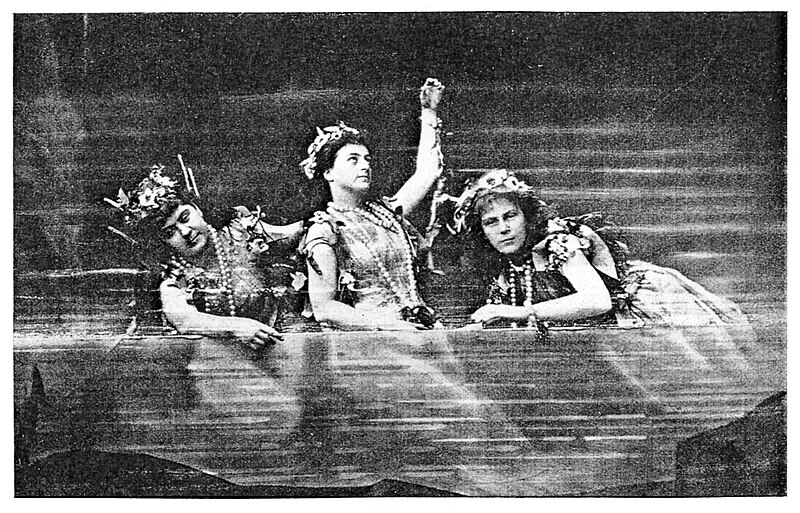
The Rhinemaidens in the first Bayreuther Festspiele production in 1876.

In other words, it is the healthy, strong, beautiful Germans of the heroic Age who, in his eyes, represented real Germany; eternal Germany. Maybe they have, historically, lived only a few millenniums before the beginning of the present Dark Age (in what the Sanskrit authors call the Dwapara Yuga; the third of the four great Ages) maybe, already within this present Age of Gloom itself (I mean, in the very first part of it).

That is not the point. The point is that, faithful in fact to Tradition, Adolf Hitler believed in the existence of earthly perfection as a reality both of the future and of a very, very remote past. The point is that, whatever might have been the epoch in which they — or their historical prototypes — actually lived, the men and women of the hallowed ‘world of the Sagas’ signified, symbolised, for him, that earthly perfection, that humanity without a flaw for which he yearned with all the ardour of his heart and nearer and nearer to which one reaches to the extent one follows Time further and further upstream.

There is more. Strange as this statement may seem to the European, nay to the German reader himself, Adolf Hitler’s ‘immeasurable love’ for his people is something greater than usual patriotism. It is, no doubt, rooted in that natural feeling of blood — solidarity which binds most individuals — and certainly all Germans, — to their countrymen. But it is, at the same time, the immediate outcome of a staggering intuitive knowledge; the expression of actual insight into the nature, meaning and destiny of Germany as the privileged Nation among all those of the same blood: the most gifted; the most conscious; the most fit to rule; in one word, the most objectively valuable section of Aryan mankind. It is, in spite of what many may think, nay, in spite of the judgement passed upon it by such a prominent figure of the National Socialist regime as Konstantin Hierl,[6] anything but the German counterpart of the British chauvinist’s attitude rendered in the well-known motto: ‘My country, right or wrong!’

True, Adolf Hitler himself has written in Mein Kampf that, had he ‘been French,’ and had France’s greatness meant to him all that Germany’s in fact did, he ‘could not and would not have acted any differently from Clemenceau.’[7] But, if one is to consider him, and to try to interpret his historical career in the light of Ancient Wisdom, (and subsequently, in connection with the destiny of the whole world) one is forced to say: he could not have been French — nor English; nor even Scandinavian. He could not have been anything else but German, nay, anything else but a frontier German, doubly aware of the tragic injustice of man-made frontiers and of the natural unity of the Reich beyond and in spite of them-and of the natural unity of the Aryan race beyond and in spite of the boundaries of the Reich. More still: one is bound to admit that, far from exalting Germany merely because he was a German, it is, on the contrary, he who chose to be born a German because of the predestined — God-ordained — part that Germany has played and is more and more called to play on the side of the eternal Forces of Light and Life in their struggle against the Forces of disintegration, now, as the end of this Dark Age is drawing nigh; because, objectively speaking, the earthly salvation of the Aryan race — the regeneration of higher mankind — can only come from and through Germany: the one Aryan Nation in which the race is still sufficiently pure to be, under given circumstances, capable of total regeneration, while, at the same time it has, through the unbroken experience of danger, remained sufficiently awake to be fully awakened, and sufficiently warrior-like to carry on, to its end, the struggle against Dark Age conditions: the perennial Struggle ‘against Time,’ for integral Truth.

In other words, both the quality of her biological substance and the particular stamp which history has left upon her, have made Germany the one Nation capable of taking the lead of Western Aryandom (when not also of Aryandom as a whole) in the last life and death struggle — the struggle for the survival and rule of the best, who are the predestined founders of the next Golden Age; the last phase of the perennial Struggle ‘against Time,’ marking the end of the present Age of Gloom. And the inspired Man ‘against Time’ who was, at the beginning of that phase, to act on behalf of the Forces of Light and Life, was bound to be a German, nay, the very embodiment of eternal Germany. And Adolf Hitler was that Man. And he knew it in the depth of his heart. He was perfectly conscious of the fact that his policy, both at home and abroad, was the only real German policy, and therefore the only conceivable one in the interest of Aryan mankind as a whole and — consequently — of the whole realm of Lift the only conceivable one ‘in the interest of the Universe,’ to quote the words of the Book of books. For alone regenerate Aryan man can and will save what is, in spite of all, worth saving in this doomed world, and build a new earth — open a new Time-cycle — on the basis of principles eternally true. Adolf Hitler has repeatedly said so in his speeches. And repeatedly expressed in Mein Kampf the same fact, namely that he was acting ‘in the spirit of the almighty Creator’ and struggling ‘for the Lord’s own work’[8] i.e. for Truth upon this earth: earthly Perfection; and that his ‘new ideas’ are ‘in harmony with the primeaval meaning of things.’[9]

What August Kubizek relates of his life in Linz and Vienna from 1904 to 1908, shows how early the future ruler had acquired a clear conception of his ultimate aim — the ‘ideal State’ — and become aware of the spirit of the whole programme he was, one day, to set forth and to work out, with the help of enthusiastic millions of people; how early he knew what his policy would be (what, in fact, any policy in accordance with truth, i.e. with Nature, can only be): — at the same time national and socialistic; nay, socialistic because it was to be — is too be — national in the full sense of the word, first in the sense of racial; and national in that sense because that Godhead within us which is real Godhead, is nothing else but the latent glory of our race in its original perfection.

To urge the German and, beyond the pale of the Reich, the Aryan in general — the youngest race of our Time — cycle, destined to the lordship of the divine Beginning of the next cycle — to yearn for and to strive with all his enlightened might towards that perfection on all planes, and to bring it, here and now, collectively as well as individually, into being (to the extent this is exceptionally possible, already during the Dark Age); to urge him to be, now, against the prevailing spirit of general contamination and general decay — against the current of Time, — the witness and the herald of the coming Dawn, and that, on a national, or rather on a racial scale, such is and remains the actual goal of National Socialism, the Hitler faith, however astounding this may yet appear to most people, to-day, in Year 22[10] after ‘the first Seizure of power.[11] Important as they may have been after 1918 — or as they may be now after 1945, — the immediate political aims which could not and cannot be separated from the persecuted Weltanschauung are mere steps towards that one great positive, permanent goal.

_______________

[1] Kubizek, Adolf Hitler, mein Jugendfreund, p. 292.

[2] Ibid., p. 115.

[3] Traumhaft is the word Grimm repeatedly uses in Warum? Woher? Aber Wohin?

[4] Kubizek, p. 99.

[5] Ibid.

[6] Hierl, In Dienst für Deutschland.

[7] Mein Kampf, p. 766.

[8] Ibid., p. 76.

[9] Ibid., p. 440.

[10] These words were written in 1955.

[11] Machtübernahme—which took place on the 30th Jan. 1933.

Categories
Lightning and the Sun (book)

The Lightning

and the Sun, 4

The ideal in the name of which Adolf Hitler constantly rebelled against practically all he saw in living life — already as an adolescent, and then more and more as a young man and as a man thirty and over thirty — was nothing less than that which I have described in this book as ‘a Golden Age ideal’; the inner vision of a healthy, beautiful and also peaceful (necessarily peaceful) world; of thereal earthly paradise, faithful image of cosmic perfection, in which righteousness prevails as a matter of course. There can be no doubt about it if one reads not only that interesting story of his youthful years which his friend A. Kubizek has written, but also all that he wrote and said himself in later, active life. And in an epoch such as that in which we are now living — when, all over the world, every possible attempt is made to present him not merely as ‘a war monger’ but as the ‘war criminal’ number one, — it is not superfluous to stress the fact that Adolf Hitler was, not only at the dawn of his awakening as a ‘Man against Time’ but all his life, ‘a bitter enemy of war’[1] as such; the fact that he was by nature ‘gifted with deep sensitiveness, and full of sympathy for others’[2]; that his programme was essentially a constructive one, his struggle, the struggle for an exalted, positive aim, his aim: the regeneration of higher mankind, of the only section of mankind worth saving […]

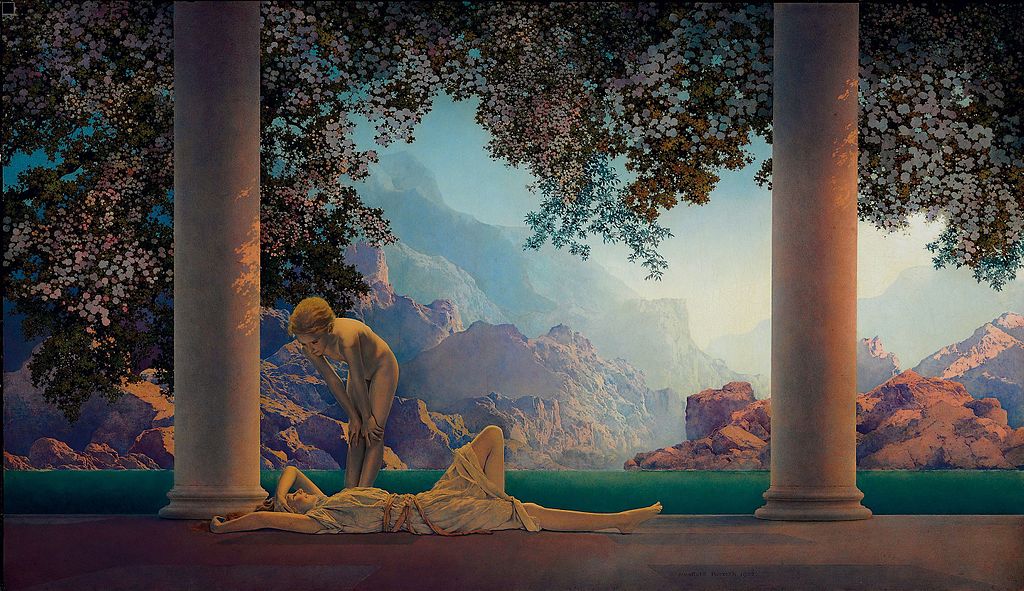
Editor’s interpolated note: My emphasis! Remember the Parrish painting emblematic of our ideals from the first incarnation of The West’s Darkest Hour, when I was blogging on Blogspot.

[…] and, ultimately, through the survival of regenerated higher mankind, the restoration of the long-destroyed harmony between the cosmic Order and the sociopolitical conditions on earth, i.e., the restoration of Golden Age conditions; the opening not merely of a ‘new era’ for Germany, but of a new Time-cycle for the whole world.

It is not superfluous, in times like ours, to remind the reader of all the Führer’s efforts to avoid the Second World War, even at the price of heavy concessions, and then, (when this had proved impossible) to stop it, while it could yet be stopped. It is not superfluous to recall the words he addressed his old friend Kubizek on the 23rd of July 1940, i.e. when, from a military standpoint, all seemed to be going on splendidly; when the Swastika Flag was fluttering over public buildings in the capitals of seven conquered States, — ‘This war thrusts us years back in our constructive work. It is deplorable. I have not indeed become the Chancellor of the Greater German Reich in order to conduct war!’[3] Not only was he against war for war’s sake (or for the sake of worthless motives) but he was against any form of useless violence, not to speak of ‘useless cruelty,’ which was, under the Third Reich, according to law and (whenever detected) also in fact, a severely punishable offence.[4] The news of even such an understandable outburst of broad-scale revengefulness as that which took place during the ‘Kristall Nacht’ (8th-9th of November 1938) — attacks on Jews and Jewish property, and burning down of synagogues in answer to repeated Jewish provocation, — brought him ‘to the pitch of indignation.’[5]

That inborn reluctance to wanton violence is a trait common to all those whom I have called men ‘above Time’ (such as King Akhnaton, the Buddha, or Jesus Christ) and to the great fighters ‘against Time,’ Founders of new religious and cultural eras, such as Lord Krishna or, nearer to our times, the Prophet Mahomet, the only men with whom Adolf Hitler can be compared if one feels at all the necessity of drawing historical parallels.

Editor’s interpolated note: I will talk about Akhenaten at the end of this series on Savitri’s book. For now, I would just like to say that Savitri lived when historiographical criticism of many of the supposed founders of religions had not yet been done. Nowadays, some scholars have come to question the historicity of Krishna, Buddha, Jesus, and even Mohammed.

It is one of the signs that his ultimate aim remained — like theirs — a state of deep-rooted, lasting, (more-than-human) harmony, not of conflict among men; in other words, I repeat, a restoration of the original Golden Age conditions upon earth, the only conditions under which absolute health — which means: perfection, — ever prevailed. Considered in the light of such an aim, every necessary violence is a ‘deplorable’ necessity (to quote once more Adolf Hitler’s own words about, the Second World War in 1940). Every unnecessary violence is a denial of the spirit of such a struggle ‘against Time’ as that of National Socialism for power; a foolish provocation of the Dark Forces that stand in the way of its success, and. therefore a sin against the Cause of Truth. And that is the real, deep meaning of the Führer’s bitter words, addressed to Dr. Goebbels at the news of the ‘Kristall Nacht’: ‘You people have thrust back National Socialism, and spoilt my work for many years when not for good, through this nonsense!’[6]
 

_______________

[1] August Kubizek, Adolf Hitler, mein Jugendfround [Adolf Hitler, Friend of my Youth] (Leopold Stocker Verlag, 1953), p. 294.

[2] Ibid., p. 44.

[3] Ibid., p. 345.

[4] It is a fact, for instance, that Martin Sommer was, in 1943, i.e. under the N.S. regime and by a N.S. tribunal, sentenced to three years imprisonment for ill-treating internees in the Buchenwald concentration Camp.

[5] Konstantin Hierl, In Dienzt für Deutschland, 1918-1945 [In Service of Germany] (Heidelberg: Vowinckel, 1954), p. 138.

[6] Hans Grimm, Warum? Woher? aber Wohin? [Why, Whence? but Whither?] (Lippoldsberg: Klosterhaus, 1954), p. 184.

Categories
August Kubizek Lightning and the Sun (book) Racial right

The Lightning

and the Sun, 3

There are, to my knowledge, — unfortunately, — no records of Adolf Hitler’s childhood. And, enlightening as it surely is, the little one can gather about it from a conversation with his most sympathetic old tutor, Herr Mayrhofer, (who is still living in Leonding, near Linz, and whom I met twice) and the little he mentions himself in Mein Kampf (which is not an autobiography) is not enough to buttress such a definite (and unusual) view of him as the one put forth in the present study. The one apparently authoritative picture of the future ruler’s life and character, years before he ‘decided to become a politician,’ is to be found in the very good book in which August Kubizek — the one friend he had in early youth, — has related the story of his four years’ friendship with him, namely from 1904 to 1908.[1]

In those years — i.e., when he was over fifteen, less than nineteen, — Adolf Hitler’s main traits of character were already fixed, and visible at every step of his: in all he said or did. His scale of values was already that one which was, in later years, to set him apart from every political leader of our times. And the psychological (the real) basis of his philosophy the source of his unshakable faith in it, and the key to his whole career, — was already definite. In other words, the man he was to be — the Man he could but be, under the given circumstances, — had already taken shape and was, with the sureness of instinct, with a mysterious, inner knowledge, a logic of his own that baffled all human calculations, invincibly following the path of his tremendous destiny. And the features of the rapidly awakening personality were unmistakably those, and the unfailing, baffling logic, that, of a Man of the type I have, in this book, characterised as ‘against Time’: of an inspired, ruthless and realistic — extraordinarily far sighted — fighter for a Golden Age ideal, in the depth of our Dark Age.

And, were we able to trace the history of Adolf Hitler’s evolution further into those very early years which he describes as providing (from the standpoint of events) ‘little to remember,’[2] it is not only probable but certain that we would find, in him, up to the very beginning of his life, the self-same, deeply distinctive traits of character, the self-same fundamental aspirations — the same person. Such men as he are not, as so many people seem to think, the ‘product of circumstances,’ but predestined beings who use the given circumstances to the utmost, for a purpose which far exceeds the obvious, immediate aim of their action, or, to speak the language of ancient Wisdom, — and one is, ultimately, compelled to speak that language, — great free Souls,[3] no longer bound by the law of birth and rebirth, who choose to be born in the environment (within the race, the country, the social stratum) in which, and to grow into leading men and to struggle as such under the circumstances under which they are to act the most efficiently, in the highest interest of Creation. They are children and adolescents ‘against Time’ before leaving in history the mark of their passage as Men ‘against Time.’

One of the most noticeable traits of people ‘against Time’ — no less than of those I have described as ‘above Time’ — is that they fit nowhere in the world as it is; that their moral and aesthetic — and practical — standards: their conception of happiness and unhappiness, their idea of ‘success’ and failure, and of usefulness, in one word their values, and its, have nothing in common. And, from all that his friend A. Kubizek relates about Adolf Hitler’s adolescence in Linz, that appears precisely to have been the case of the future master of Germany, at that time a no doubt remarkably gifted but, in the estimation of cool-minded grown-ups, ‘unpractical’ youth, who had recently left the middle-school without completing the course of his studies, and nourished the ambition of becoming a great artist — a painter, or perhaps an architect — with little material prospects of fulfilling it, and who lived on his widowed mother’s meagre pension, and roamed about the streets — or the countryside — and occasionally went to the theatre (taking admittedly the cheapest seats,) and made gigantic plans and spoke — already — with compelling eloquence, — of things that interested nobody but himself, while other boys earned their living and helped their families, or were learning something ‘useful.’ ‘He just fitted into no social frame whatsoever,’ concludes A. Kubizek, after having tried to, analyse the reasons why his friend, despite capacities by far above the average, failed, even in subsequent years, to ‘get on’ professionally. ‘He had not the slightest ambition of securing himself a livelihood’ and of being comfortable. He did not wish to be ‘comfortable.’ He did not — and never was to — think in terms of comfort or of personal ‘happiness.’ What others called ‘enjoying life’ was something absolutely foreign to him. Nor could he ‘take things as they came’ and live lightly, free of worry, entirely within the present. He was, at a very early age, intensely aware that things were wrong in the world round him — wrong in every walk of life, in every domain of thought and action, from A to Z, — and he felt himself duty-bound to change them; not to change this or that in them, leaving the rest untouched, but to change them ruthlessly and radically, for they were radically wrong, and to build everything anew, according to principles different from those that had prevailed up till then.

And this was not a mere wish, a more or less vague desire or day-dream. It was a purpose that he pursued with ‘deadly seriousness’ and unfailing consistency, busying himself long before hand with the most minute details of his plans in every particular case, without for all that ever losing sight of the spirit and general lines of his creation as a whole, so much so that that ‘extraordinary seriousness’ and consistency — and merciless radicality — struck all those who knew him as the main trait of his character. He pursued it — nay, already in those years in which he was not yet politically active; already while he himself still believed that art would remain, throughout life, his first and foremost concern — with that feverish impatience which finds its expression in the words: ‘Now, or never’; with the haste inherent in all earnest action ‘against Time.’ And that impatience — that tragic awareness that ‘tomorrow will be too late’ — was to stamp his whole career as a ruler and as the Founder of the last true civilisation within the Dark Age. In it, in fact, lies the source and the explanation of Adolf Hitler’s most drastic — and most criticized — steps in later life and the sign that National Socialism, that most heroic of all reactions against our Dark Age, historically still belongs to this Age, while transcending its spirit.


______ 卐 ______


Editor’s two cents:

…he himself still believed that art would remain, throughout life, his first and foremost concern….

It is here that the gulf between us and American white nationalism becomes apparent. As far as I know, the only American racialist who sensed any of this was Michael O’Meara: who wrote that only a new myth could save us. His readers in a racialist webzine didn’t understand a whit of this, believing that only by smearing data to the normies about race realism or the JQ could one modify the Aryan collective unconscious.

That is not possible for those who know how the mind works!

To use Jungian language, it is all about ‘touching the Self.’ And the royal path toward that direction is through art. Remember how Hitler loved Wagner’s art, or how Parrish’s paintings produced, in me, the eureka moment: This is what Creation (the Big Bang) was for!

The Greco-Romans also knew that displaying the Aryan nude on public thoroughfares through majestic sculptures manifested the Self in the form of the majestic Gods.

The Anglo-Saxon racial right, children of Bentham and not of sculptors, painters or poets, has no idea that what we need is a new religion: a new myth accompanied by a new art! Precisely for this reason all anti-art is a curse for producing the new Aryan awakening, which is why I don’t listen to racialist podcasts that start with degenerate music (to her credit, Uncle Adolf’s other admirer, Carolyn Yeager, never used degenerate music at the beginning or end of her podcasts).

____________

[1] August Kubizek, Adolf Hitler, mein Jugendfround [Adolf Hitler, Friend of my Youth] (Leopold Stocker Verlag, 1953.)

[2] Mein Kampf, p. 2.

[3] In Sanskrit, Mukta Purusha.

Categories
Lightning and the Sun (book)

The Lightning

and the Sun, 2

CHAPTER XIII

THE STRUGGLE FOR TRUTH

Whether alive or dead in the flesh, the predestined Child of Braunau — Adolf Hitler, — lives forever in National Socialism, his creation and integral expression. To understand the latter is to understand him: to see him in the proper light and to place him — whether one be, personally, attracted to him or not, — on the proper level and in the proper class among the galaxy of exceptionally great men. And that is precisely what most National Socialists, even those who remained after 1945, irreproachable in their profession of faith — even ‘fanatical’ ones — (let alone our enemies, and the world at large, which lies for the last ten years under their influence), apparently fail to do, out of lack off, feeling for cosmic realities and, in particular, out of lack of awareness of the rhythm of Time which explains all laws of history, when not also all great happenings.

One should carefully distinguish the ephemeral N.S.D.A.P., — the National Socialist German Workers Party;[1] an organisation in view of precise aims, which have their place in German and European history, — from the everlasting National Socialist Idea.

The Party came (officially) into existence on the 24th of February 1920; in fact, already in 1919. It was a revolutionary body determined to win power for its Leader — and for its members, — to rid Germany of the enslavement and shame resulting from the Versailles Treaty, and — for the first time in the history of the West, — to apply, on a broad scale, solid — eternal — biological principles to social and to political life. It had, however, the characteristics of even the very best organisations of our Dark Age: their inherent clumsiness; their all-too-human short-comings. There were all sorts of people — fearless idealists and time-servers; heroes, nay, demi-gods, and an immense majority of irresponsible, sheep-like creatures, and a few influential traitors — among the thirteen million members it had at the height of its glory. It achieved a lot, and yet it failed. It has, since 1945, ceased to exist as a body, and even if it be, one day, destined to rise again under its old name and everlasting Sign, will never be restored exactly as before. Cannot be; for it belongs to Time, and in Time nothing is ever restored. Should not be; for restoration would mean stagnation, whence incapacity to face new circumstances and overcome new dangers.
 

______ 卐 ______

 
Editor’s interpolated note: We shouldn’t take texts like Mein Kamp or Alfred Rosenberg’s The Myth of the Twentieth Century as an infallible New Testament as fundamentalists take the Bible; rather, NS is continually developing and refining its basic and fundamental principles (for example, what we say in ‘The Wall’ about the historical non-existence of Jesus of Nazareth).
 

______ 卐 ______

 
The National Socialist Idea is not the Party. Not only was it in existence — ‘in the air’ — more or less in its present-day garb, before the Party (the Proclamation of Friedrich Lange’s ‘Deutsches Bund,’ in Heidelberg, on the 9th of May 1894 — when Adolf Hitler was five years old — has all the traits of a National Socialist Manifesto; and so have Hans Krebs’ declarations in 1904), but it is, in its essence, as old as the oldest contact and first clash between the Germanic race and the outer world. Fundamentally, it is nothing else but the expression of the collective will of the race to survive and to rule; of its readiness to combat and eradicate all that which, from without or from within, stands in the way of its survival and expansion; of its healthy consciousness of itself — of its strength; of its youth; — and of Godhead within itself: a biological reality stressed in political and in social life, rather than a ‘political’ idea. One could say that Theodoric the Great acted in the true National Socialist spirit when, fourteen hundred years before the famous ‘Nüremberg Laws,’ he did all he possibly could to prevent marriages between his Goths and the racially less pure — less Aryan — people of conquered Italy, let alone people of altogether non-Aryan stock.

______ 卐 ______

Editor’s interpolated note: Old time Nordicism! Those who haven’t read William Pierce’s book Who We Are should read it now.

______ 卐 ______

 
And I have many times and in different writings pointed out that there is no difference in purpose and in standpoint between the National Socialist attitude to life and that of the ancient, warrior-like Aryans, worshippers of Light, who were conquering North-West India, setting the caste-system, conceived on a racial basis, between themselves and the conquered people, and praying the Vedic Gods for ‘many sons,’ prosperous flocks, and ‘victory over the dark-skinned Dasyus’ — for Lebensraum — several thousands of years before 1919, 1933, or 1935.

One could go a step further and state that, in its essence, the National Socialist Idea exceeds not only Germany and our times, but the Aryan race and mankind itself and any epoch; that it ultimately expresses that mysterious and unfailing Wisdom according to which Nature lives and creates: the impersonal Wisdom of the primaeval forest and of the ocean-depth, and of the spheres in the dark fields of Space; and that it is Adolf Hitler’s glory not merely to have gone back to that divine Wisdom, — stigmatising man’s silly infatuation for ‘intellect,’ his childish pride in ‘progress’ and his criminal attempt to enslave Nature, — but to have made it the basis of a practical regeneration-policy of world-wide scope, precisely now, in our over-crowded, over-civilised, and technically over-evolved world, at the very end of the Dark Age.

In other words, it is impossible to understand National Socialism unless one integrates it into the cyclic conception of history as suggested by Tradition, i.e., unless one sees in it not a political system among many others, — not an ephemeral ‘ism,’ product of ephemeral circumstances, — but the last, (or, as we shall see, the one before the last) effort of the permanent and more-than-human Forces of Life within this Time-cycle, against the accelerated current of degeneracy characteristic of any advanced development in Time, or, in one sentence, unless one sees in it the effort ‘against Time’ at the very end of the last Age of our present Cycle.

Seen in this light, the whole well-known struggle to free Germany from the enslavement to which the Versailles Treaty had reduced her, — the National Socialist struggle for ‘freedom and bread’ (and far space); for the German people’s right to thrive in healthy creative activity, — is the last (or, rather, as we shall see, the one before the last) phase of the perennial Struggle for Truth within the present Time-cycle the form which that perennial Struggle was bound to take at our epoch, i.e., at the end of the Dark Age. And Adolf Hitler is the most heroic of the heroes who, in the course of history, stood in the way of the world’s fated downward rush towards its doom; the One Who comes back, in His last desperate attempt to save that which is still worth saving, before it is too late, — the typical Man ‘against Time.’ He embodies that eternal Nature-wisdom to which I have alluded in the former paragraph — the only wisdom that deserves the name of divine, and opposed it, — not human arguments, — to the false science, and false religion and false morality and, of course, also false political conceptions of our decadent Age, and made Germany’s struggle for freedom the occasion of a broader systematic struggle for the liberation of higher mankind from the chains of the Dark Age. And made the Sign of the Sun — the Sign of Health[2] — the Symbol of both German and Aryan regeneration, and Germany, the holy Land of the West — the Stronghold of regenerate Aryandom.

Considered as the twentieth century expression of the age-old yearning of Aryan mankind to free itself, here and at once, from the appalling determinism of decay, National Socialism begins before Adolf Hitler’s political career. Its unrecorded but real evolution as an incarnate Idea, — its true history — starts with the future German Führer’s gradual awakening to the consciousness of his own scale of values, of his fundamental aspirations and repulsions, and of his mission: the awakening of the Man ‘against Time,’ as such.

_________

[1] Nationalsozialistische Deutsche Arbeiter Partei.

[2] The Swastika, ‘Swasthi,’ Sanskrit, meaning: ‘health,’ ‘well-being.’

Categories
Lightning and the Sun (book)

The Lightning

and the Sun, 1

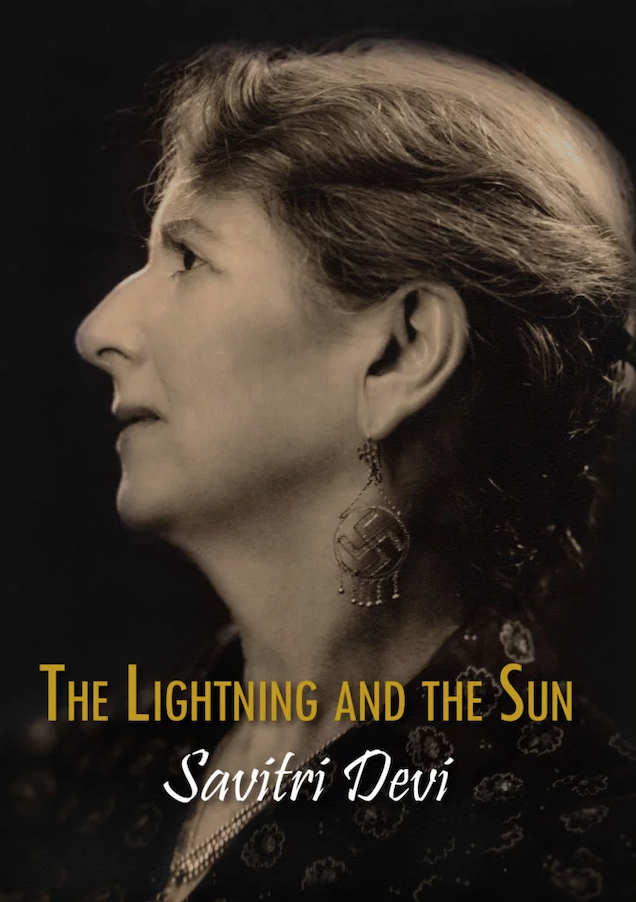
I will start adding my aggregations to some passages from Savitri Devi’s most famous book. The priestess was a sort of female counterpart of what I now call ‘priest of the sacred words’.

I refer to two sentences of four words each, one in Latin, and one in Spanish (I came up with the last one): Gens alba conservanda est—‘The white race must be preserved’—and Eliminemos todo sufrimiento innecesario—‘Let us eliminate all unnecessary suffering’: aesthetics and ethics.

Savitri Devi published The Lightning and the Sun the year I was born. Like her, I believe that National Socialism, as devised by Hitler, is not a fixed religion but a continually developing one. For example, in quoting early passages from Brendan Simms’ book on this site I published young Adolf’s first political testimony: a letter in which he blames Jewry for his country’s ills. However, when one reads the mature Adolf one discovers that, in addition to this insight, Hitler mentioned Christianity more when looking for culprits (e.g. in his after-dinner talks).

Just as Hitler evolved over the years, I will be offering my opinion on matters that, decades after Savitri wrote her book, I differ slightly from her.

The Lightning and the Sun runs on this premise: The lightning to overwhelm everything in its path, including genocides and holocausts the likes of which history had never seen, is represented by Genghis Khan. The sun of metaphysical understanding, on the other hand, is represented by the Egyptian king Akhenaten. A combination of lightning and sun would be the modern avatar that will save the Aryan! I will be using the hardback edition published in 2015 by Counter-Currents.

The first page of chapter 12, ‘The Late-Born Child of Light’, contains this paragraph:

Especially for the past hundred years, i.e., since the outbreak of the French Revolution, Europe had been sinking, more speedily than ever, under the influence of international Jewry and of its cunning agents: Free Masonry, and the various so-called ‘spiritual’ secret bodies directly or indirectly affiliated to it. Centuries of erroneous [emphasis added] application of Christianity—an essentially other-worldly creed—to worldly affairs, had prepared the ground for the triumph of the most dangerous superstitions: the belief in the ‘equal rights’ of ‘all men’ to life and ‘happiness’ [page 211]…

I added emphasis because I think Savitri is wrong to say that historical Christian praxis was ‘erroneous’. It wasn’t. While Savitri was hostile to Christianity, the priestess didn’t yet have the perspective we now have (see for example Eduardo Velasco’s masterful essay on Rome and Judea in The Fair Race). In other words, there are no redeemable esoteric aspects in Christianity (regardless of the exoteric aspects).

On that first page of that first chapter on Hitler—the previous eleven chapters were devoted to Genghis Khan and Akhenaten—Savitri includes a footnote worth quoting:

I say ‘over two millenniums’ meaning that the disintegrating influence of Jewry upon the Aryan race began before the advent of Christianity. The disastrous new scale of values drawn from the misapplied other-worldly religion, and the spreading of the creed itself, were the consequences of Jewish influence, not its causes.

‘This disastrous new scale of values’ she wrote. Can you see why Savitri seems to me to be my perfect kindred spirit? But she wrote at a time when what we now know about the criminal history of the first Christian millennium hadn’t been popularised (see Deschner’s books in our featured post).

And colonialism was at its height, and Christian missionary activity also. Which means that, after having given herself up to the forces of disintegration, Europe was rapidly handing the rest of the world over to them; preparing the very last phase of the Dark Age: the state of biological chaos which is the preliminary condition of the rule of the worst and the systematic annihilation of any surviving human élite of blood and character.

At that time, an elderly, honest and hard-working Customs officer lived with his wife and family in Braunau, a pretty little town on the river Inn, on the border of Austria and Germany. The town, with its main square, on one side of which an old fountain, dominated by a stone statue of Christ, is still to be seen; with its old houses and churches, its old streets—clean, but often narrow—and the four-storied ‘tower’—Salzburger Turm—that already separated the main square from ‘the Suburb’ [Die Vorstadt]…

His wife, Clara, was pretty: blonde, with magnificent blue eyes. Aged twenty-nine only (she was his third wife) she was of an ardent, thoughtful and self-possessed nature; as imaginative and intuitive as her husband was unromantically painstaking; as loving as he was dutiful; and capable of endless sustained sacrifice. She respected him deeply; he was her husband…

The Child was christened Adolf… the incarnate collective Self of superior mankind… His even greater task, namely that of awakening the Western Aryan Soul to its own natural wisdom. Aryan Wisdom, in its conscious, warrior-like form, in opposition to all the traditional values of Christianity, was unknown in the Western world of the time, let alone in Braunau on the Inn—unknown, at least, to all but a few lonely thinkers such as Friedrich Nietzsche…

Written in Emsdetten in Westfalen
on the 14th of August, 1954
.

It is already seventy years since Savitri wrote those words. I will be quoting other excerpts from her book throughout the rest of the year.

Categories
Racial right

Heydrich, 3

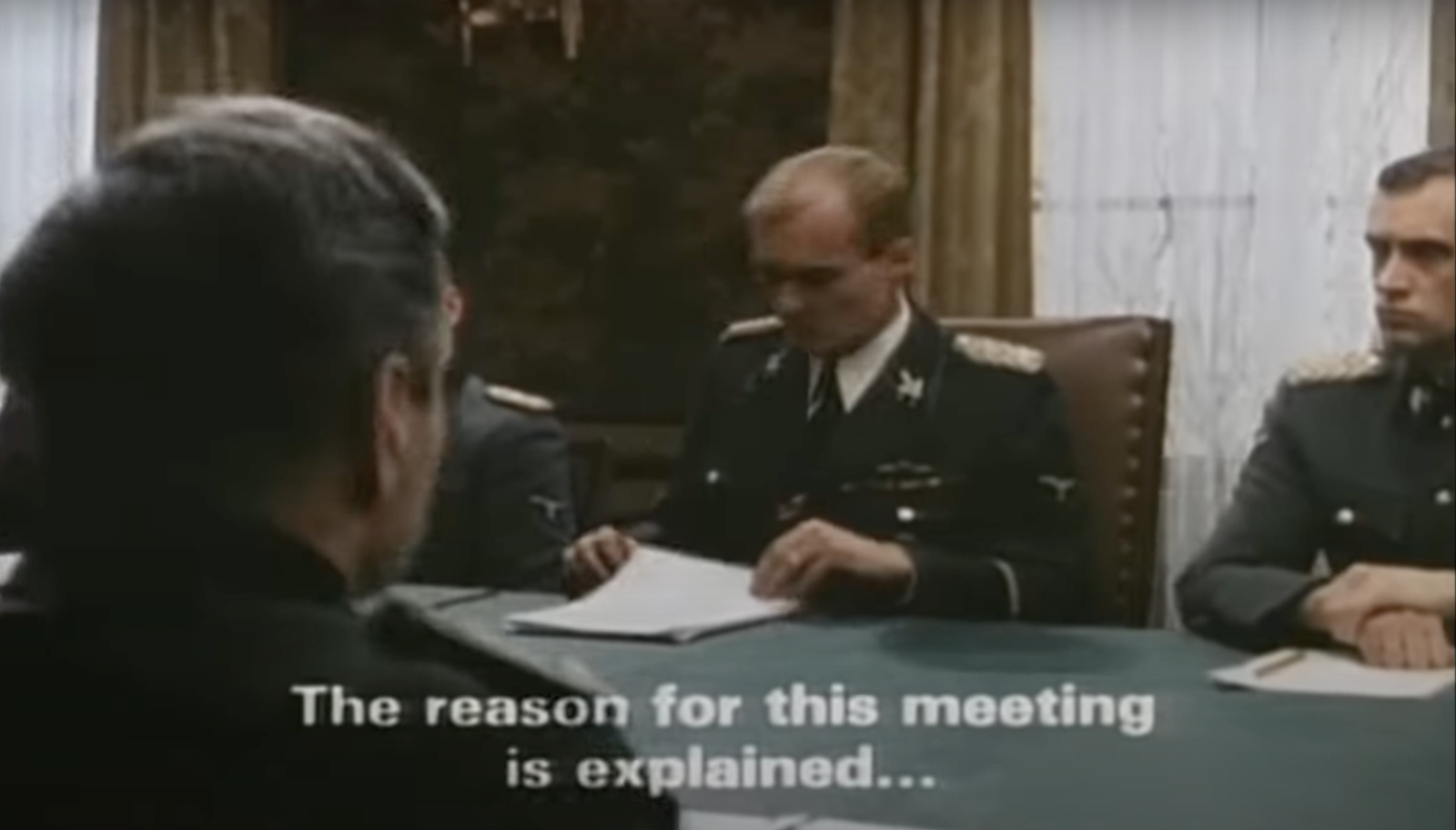
In the film, the meeting that starts at this moment makes me think…

Had it not been for the Anglo-Americans, these are the kind of meetings that would exist today in the centre of a Europe completely conquered by the Third Reich instead of the meetings where the Russians now have the power over the destiny of Europe.

If the white race is to survive, sooner or later the English and Americans will have to make a truly astronomical humility cure—i.e, swallow their pride—and do a centuries-long penance for the blunder their ancestors committed in the 20th century (and 21st century by continuing to defame Hitler).

Incidentally, as far as my Tuesday post about the impostor is concerned, I learned a lesson.

I shouldn’t drop names when criticising the racial right because, sometimes, I will need their favours. For example, the moderator of Counter-Currents did me the courtesy of clarifying, in the comments thread, that the impostor who in various racialist forums has been trolling me for six years was a troll and not the real César Tort. Like it or not, from now on I won’t drop names because I have had the experience that some moderators of other racialist forums have been so susceptible to my criticisms that they continued to let the comments of that impostor pass, under my name, even after I repeatedly informed them by email that the impostor wasn’t me.

So from now on my criticisms of the racial right will omit the names of the specific persons, so as not to unnecessarily hurt their susceptibilities.

In any case, the regular visitor to this site is well aware that my ideological difference with them lies precisely in the fact that they don’t think like Heydrich and his SS gang, as we see at the round table in the film. The racial right still lives under the sky of Christian morality, and we want to practice genocides like Genghis Khan for the simple fact that we must comply with the four words (‘eliminate all unnecessary suffering’). And if humans are the devils of the animals on earth, to save them we must dispatch them. Always keep in mind that the first measures taken by the Nazis when they came to power were precisely to prohibit vivisection and many other unnecessary sufferings of our cousins!

Those who do not feel such compassion for animals will never understand National Socialism, and I would suggest that they stop visiting racialist forums and read instead Savitri Devi’s Impeachment of Man, which touches on the issue of unnecessary cruelty to animals.

In the next post of this series, I will see if it is worth quoting some specific words of these SS officers at the round table…

Categories
Audios

After Carolyn…

In the penultimate podcast of the Manifest Destiny Series in Volkish site, ‘Show 101: She’s Back’ (I already said something about Show #100 and have yet to listen to #102) the participants talk, once again, about my favourite author: Savitri Devi. I was pleased that they mentioned Counter-Currents (CC) in a derogatory way because only Hitler saves, not the bourgeois racialists on this side of the Atlantic.

After Carolyn Yeager fell ill and discontinued her National Socialist sympathetic podcasts, Manifest Destiny is the only NS podcast I know of. It is curious that the bourgeois Greg Johnson, the editor-in-chief of CC who is also the custodian of the Savitri archive, has published Savitri Devi’s Gold in the Furnace. Curious, I say, because his ‘racialist’ ideology is at the very antipodes of Savitri’s.

In podcast 101, I was surprised that a few seconds before the 28th minute Jake (was it him?) mentioned my ‘four words’ in the sense of avoiding unnecessary suffering of the victims executed in the so-called holocaust. I didn’t expect that! (Himmler himself forbade unnecessary cruelty in his ethnic cleansing campaigns). Also, unlike Carolyn and the commenters who used to comment on her website, those at Manifest Destiny are aware of the Christian Problem and what we have called here the Christian inversion of Aryan values.

Incidentally, I just modified a couple of tags: Jewish Question (JQ) is now called Jewish Problem (JP), and Christian Question (CQ) is now called Christian Problem (CP).

There was something that pleased me after the first hour of discussion: the beautiful is the good and true, an idea that dates back to Socrates. Like David Lane, I cannot conceive of how to save the Aryan race without the cult of the beauty of their physiques, which is why I have insisted so much on images of English roses on this site.

At around 1:35 the participants spoke about something I consider fundamental. They used the word ‘duty’ as a quality of overmen. Savitri had already spoken of this in the first chapter of her Memoirs when she coined the phrase ‘the religion of the strong’. Duty is something that naturally radiates from a personality that, to use Jungian language, has already touched the ‘Self’ with its ego. There is hardly anyone like this in the world today, true National Socialists; it seems that in the Second World War they were all killed.

Before 1:40 one of the participants mentioned that Savitri said that National Socialism would eventually be reborn in Germany. When I see the resounding failure of American white nationalism, so incapable of breaking away from bourgeois and Christian values, it seems to me that this woman might be right.

We shall see what happens now that European leaders, including the German Chancellor, are beating the war drums to start a hotter war against Russia. To continue relentlessly with such strident rhetoric will only end with Berlin, Paris and London under well-deserved nuclear mushrooms. One thing is certain: with or without nuclear war it is a win-win situation for us! A territorial bite at eastern Ukraine when Russia wins, even without a nuclear exchange, will destroy NATO and the European Union…

April 20th

To the god-like Individual of our times;
the Man against Time;
the greatest European of all times;
both Sun and Lightning:

ADOLF HITLER,

as a tribute of unfailing love and loyalty, for ever and ever.

—Savitri Devi

Categories
'Hitler' (book by Brendan Simms) French Revolution

Hitler, 33

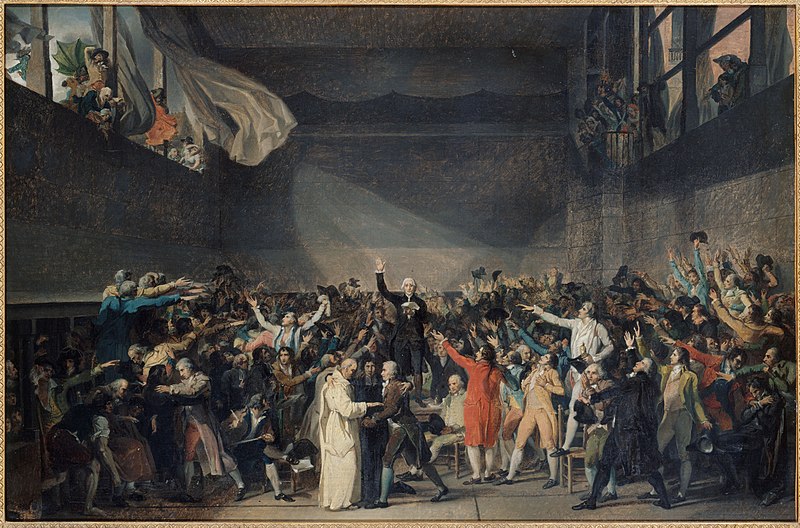
Le Serment du Jeu de paume by Jacques-Louis David (c. 1791), depicting the Tennis Court Oath.

More immediately relevant to Germany’s predicament were the dramatic recent examples of national revival, where peoples had bounced back from decline or catastrophic defeat. Perhaps surprisingly, Hitler was open to inspiration from France. ‘The French Revolution was national and constructive,’ he argued, ‘whereas the German one wanted to be international and to destroy everything.’ Hitler took a similarly positive view of later French radicalism. ‘When France collapsed at Sedan,’ he wrote, ‘one made a revolution to rescue the sinking tricolour!’ ‘The war was waged with new energy,’ he continued, and ‘the will to defend the state created the French Republic in 1870’, thus restoring ‘French national honour’. This shows that Hitler’s fundamental objection was not to the ‘ideas of 1789’, which he hardly ever mentioned. His real trauma—to which we will return later—was the fragmentation of Germany beginning with the Treaty of Westphalia in 1648.

The way I quote from Brendan Simms’ book may seem strange. I read through it and, when I come across a passage that requires comment, I pause and comment on it here.

The passage above, for example, strikes me as remarkable because it shows us a young Adolf who was unaware that the egalitarian ideas of 1789 were already symptomatic of a cancer in which Christian ethics were secularised to be metastasised in subsequent centuries. Recall that the French had been inspired by the American Revolutionary War of 1775-1783 and that in turn these American ideals were inspired by Protestant ethics (those who haven’t read Tom Holland’s Dominion should at least read our excerpts now). The young Hitler, naturally, didn’t have all this in mind. He was first and foremost a politician, not exactly a philosopher and certainly not, to use my metaphor, a visionary who sees the remote past in a cave north of the Wall (for example, to realise that Protestantism is behind today’s mass psychosis if we psychoanalyse the West from the remote past).

One of the things that distinguishes me compared to the American organisation founded by George Lincoln Rockwell is that, unlike the Commander, I am convinced that National Socialism must be understood as an organism in continuous development. And NS is developing even in the darkest age of the West in which Savitri Devi used the metaphor of ‘gold in a furnace’, in the sense that all the chaff burns in the burning furnace and only the element gold, which being a chemical element cannot burn there, will survive it.

Although Savitri came up with this metaphor at a time when the denazification of Germany was in full swing, in our time it could be said that the fire of that furnace has already burnt up all the chaff, except for people like us who continue to believe in Uncle Adolf’s ideals.

But Uncle Adolf couldn’t have known what we now know! His untimely death in 1945 prevented him from realising the levels of anti-white delirium to which the white man would fall after the decades-long process of trying to demonise NS throughout the West!

A mature NS man has to take into account the darkest hour for the white man and explain it. One oblique way to do this is to realise that American white nationalism has gone astray. It is at a dead end, as I said this morning in this thread.

It is high time to be humble; to retrace our steps from that alley, and return to the main avenue leading us to a National Socialism of the 21st and 22nd centuries. But I don’t see that humility anywhere on the racial right…

Categories
Racial right

Against my time

Speaking of this site and the comparatively little traffic I get, Tyrone, who I spoke of last month when referring to his imprisonment in the UK for thoughtcrime, once said that Jared Taylor was a man ‘of his time’, and I, a man ‘against his time’ (Taylor gets a lot of visitors as can be seen from the amount of commenters on American Renaissance).

You have to read the early chapters of Savitri’s book to understand the concept of a man against his time. It was also Tyrone who drew my attention to the apocalypse with which the West will be punished in Savitri’s philosophy, and indeed I began to read her because of him.

When I met Tyrone in London, we didn’t take a picture. We might as well have taken it when we went with Chris, his friend also imprisoned for thoughtcrime. In this post, I could now show the photo of Tyrone, Chris and me when we went to the pub with BNP protesters. But we didn’t take one (out of caution before the State, it is not very common for European racialists to take photos of themselves).