web analytics
Categories
Currency crash Lord of the Rings Racial right Richard Wagner Rudolf Hess Souvenirs et réflexions d'une aryenne (book)

Reflections of an Aryan woman, 80

It is impossible to say to what extent the Thüle Gesellschaft [a German occultist and Völkisch group] was in possession of this priceless heritage, coming from the depths of the ages. Certainly some of its members were—Dietrich Eckart, Rudolf Hess, and the Führer himself had it. One of the traits of the initiate would be the ability to feign anger, madness, imbecility, or any other human state whenever he deemed it appropriate for his purposes. The Führer forced himself, as he said,[1] to ‘appear tough’.

And his all-too-famous fits of rage—the existence of which the enemy pounced on with delight, as if they were a source of ridicule, exploitable ad infinitum—were, according to Rauschning, ‘carefully premeditated’ and ‘intended to disconcert those around him and force them to capitulate’.[2] Hermann Rauschning, who at the time of writing his book hated his former master, had no reason to destroy, as he does, with the stroke of a pen, the legend that aimed to discredit him in the eyes of more than one well-meaning man. Or rather, if he had a reason, it could only be, despite everything, a remnant of intellectual honesty.

As for Rudolf Hess, the comedy of ‘amnesia’ that he played so masterfully at the Nuremberg trial has fooled the most experienced psychiatrists. And the ‘normal’, sometimes even playful, tone of his letters to his wife and son[3]—tone that disconcerts the reader, in a man who was captive for more than thirty years—would be enough to prove his superhumanity. Only an initiate can write, after three decades in a cell, in the light-hearted and detached manner of a husband and father on holiday from his family for three weeks.

The Führer apparently outgrew his masters in the Thule Society (or elsewhere), and escaped the influence that some of them—one will never be clear which ones—would have wanted to have on him. He had to do it, being sovereign, being one of the visages of the One Who Returns.

And if, suddenly, the war took a wrong turn; if, to say the least, the point of no return was Stalingrad, which according to some, was the very site of the ancient Asgard, the fortress of the Germanic Gods, it is undoubtedly because, for some hidden reason, it had to be so. And hadn’t the young Adolf Hitler had that revelation under the night sky, on the summit of Freienberg, at the gates of his beloved city of Linz, at the age of sixteen?

The immediate material cause, or rather the occasion of the fatal turn, must have been not a strategic error on the part of the Führer—it is acknowledged that he never made a mistake in this area—but some sudden and unfortunate stiffening in his attitude towards the adversary. Siegfried, the superman, once showed pride of the same magnitude by refusing, so as not to appear to give in to the threat, and therefore to fear, to return to the Daughters of the Rhine the Ring which was theirs by right.

This gesture would have saved Asgard and the gods. The hero’s refusal precipitated its downfall. The new Siegfried, undoubtedly, also not to appear ‘weak’, although no challenge had been thrown at him, refused to exploit, as he certainly could, the goodwill of these people of Ukraine—anti-communists, aspiring to their autonomy—who had initially received his soldiers as liberators.

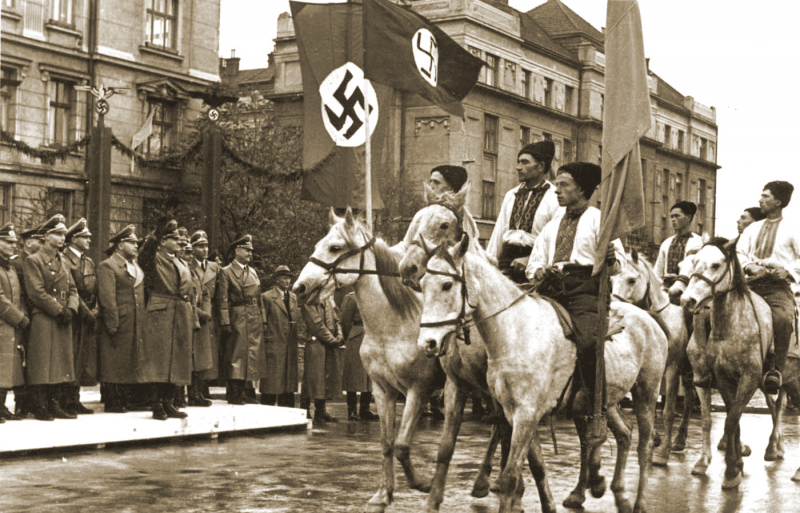
(March in Ukraine, historical; SS-Volunteer Division.) Did he do so knowingly, realising that the loss of the war, inscribed in the stars from all eternity, was a necessary catastrophe for Germany and the entire Aryan world, which only the trial by fire could one day purify? Only the gods know. The speed with which Germany, in the first years after the war, took the bait of material prosperity without any ideals, shows how much, despite the enthusiasm of the great National Socialist rallies, it was only incompletely freed from its comfortable humanitarian moralism, and only superficially armed against the Jewish influence, both ‘political’ and profound—that is, in the field of values.
 

______ 卐 ______


Editor’s note: This is central.

A few years ago, I used to say that the primary cause of the Aryan decline was that they succumbed to the One Ring, obviously referring to Wagner’s magnum opus, his Tetralogy (see for example: here).

And last year, when I promised myself that I would learn German and started to study it hard, I gave up when I discovered, just by reading the German grammar book I was reading, that the Germans betrayed themselves horrendously after the Second World War. What is the point of learning the language of the Nazis if German speakers are now anti-Nazis?

On this site I have been saying some very harsh things about the Americans. But however flawed their patriotic racialism may be (like what I recently said about Jared Taylor), they at least represent a firm step over the psychological Rubicon in the sense that American white nationalists are no longer in Normieland. They just need to finish crossing it, and The West’s Darkest Hour provides the stepping stones to do so.

What have the Germans done after their Fuhrer lost the war? The traitors donned one of the surrogate rings of the One Ring and have now become wraiths of what they were! I have already said it but it bears repeating:

In Tolkien’s universe, the Ringwraiths, the nine fallen kings or black riders, became the dreaded ring-servants of the Dark Lord Sauron. These Ringwraiths are Great Britain, France, Italy, Germany, Sweden, the other Nordic countries, Australia, Canada, and New Zealand. All of these wimp countries of the American Empire consider the anti-white wars that occurred in the 1860s and the 1940s to be good.

The fiat currencies of the Ringwraiths are pegged to the dollar. When the One Ring is destroyed—when the US dollar crashes—, like Sauron, the kings of these reigns will also lose their power. Mordor’s power comes from the One Ring, from the privilege that its banknotes have become the world’s reserve currency. Since the ring will fall into the Mount Doom lavas in the not-too-distant future, such a milestone will mark the beginning of the fall not only of Mordor, but of the nine Ringwraiths.

If after such a catastrophe the Aryan race manages to survive, it is not clear which Indo-European language will be adopted by the survivors.

________

[1] Rauschning, Hitler m’a dit, page 34.

[2] Ibid., page 84

[3] Frau Ilse Hess published two collections of letters of her captive husband: London, Nuremberg, Spandau and Prisoner of Peace.

Categories
Hinduism Souvenirs et réflexions d'une aryenne (book)

Reflections of an Aryan woman, 79

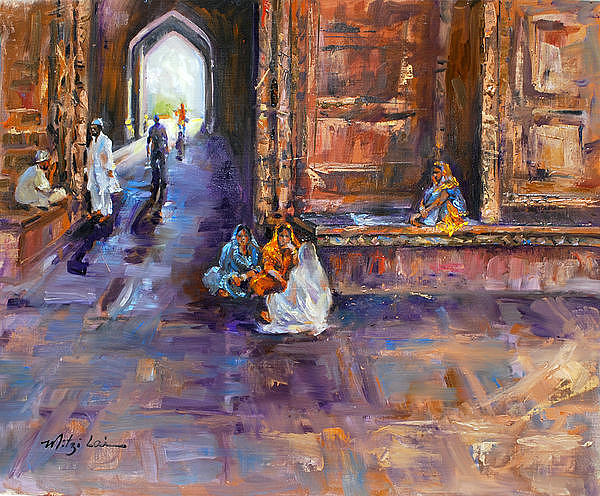
But that is still nothing. What is most extraordinary is that this cult of the Führer survived, in this country, the collapse of the Third Reich. I found it alive during my stay in India from 1957 to 1960, and I found it again, to my joy, and despite intensified Communist propaganda, in 1971, and this, I repeat, especially in the circles most faithful to Tradition.

In the book she devoted to India, in the collection Petite Planète, the orientalist Madeleine Biardeau, herself clearly hostile to our Weltanschauung, is obliged to note this with regret, not to say with bitterness. ‘In no country’, she writes, ‘have I heard more praise for Hitler. Germans are praised for no other reason than that they are his countrymen’. [1] And she is also forced to admit that Hindu resentment of British rule—now finished anyway—isn’t enough to account for this worship. The scholar has, underhandedly as one would expect it, an explanation that is suitable for her. The Hindu, she says, feels and honours the presence of the Divine in all that is ‘great in evil’. In other words, he is free from the moral dualism that still underlies, almost invariably, the value judgements of Western man.

This is certainly true. But it does not suffice as an explanation. The only justification for the praise of an Aryan leader who is a stranger to India lies not in the fact that the Hindu easily transcends moral dualism, but in the reason for this fact.

This reason is to be found in the Hindu’s attachment to Tradition, not elsewhere; in his acceptance of sacred knowledge with full confidence, even if he has not acquired it himself.

It is in the name of this more-than-human science that he finds it natural that, under certain conditions, what on the average human scale would seem ‘evil’ is not.

It is in the light of the doctrine of necessary violence, exercised without passion ‘in the interest of the Universe’—i.e., of Life, not of ‘man’—it is in the light of the venerable Bhagawad-Gita that proclaims the innocence of violence of this nature, that the orthodox Hindu can see in the Master of the Third Reich—despite all the propaganda of concentration camps that have saturated all the rest of the men on this Earth for several decades—something other than ‘the incarnation of evil’.

Moreover, it is impossible not to be struck by the similarity of spirit between Hitlerism and, not, certainly, the philosophies of non-violence, which have broken away from the Brahmanical trunk, or the dissident Hindu sects, but the most rigorous and ancient Brahmanism. Both are centred on the idea of purity of blood, and the indefinite transmission of wholesome life—especially the life of the racial elite; the life from which can emerge the man whose self-mastery raises him to the rank of a God. Both exalt war in an attitude of detachment—‘war without hatred’ [2] —because ‘nothing better can happen to the Kshatriya’—or the perfect SS warrior—‘than a righteous combat’[3]. Both establish on the Earth, as do all traditional doctrines, a visible order modelled on cosmic realities and the very laws of life.

This worship of the Führer, surviving in India despite so much enemy propaganda well beyond the disaster of 1945 is, moreover, a proof—if one needed one—that Hitlerism, stripped of its contingent German expression, is also indeed attached to the primordial—Hyperborean—tradition of which Brahminism seems to be the most ancient living form.

It is undoubtedly related to it by what has, despite the imposition of Christianity, survived in Germany of a very old and properly Germanic traditional form, deriving from a common source of the holy ‘Arctic fatherland’ of the Vedas and the Edda.

_____________

[1] Madeleine Biardeau, L’Inde, collection Petite Planète.

[2] This is the subtitle of a post-war book on the career of Feldmarschall Rommel.

[3] The Bhagawad-Gita, Chant II, verse 31.

Categories
Hinduism Souvenirs et réflexions d'une aryenne (book) Third Reich

Reflections of an Aryan woman, 78

I have always, however, been pleasantly struck by the understanding I have encountered, as a Hitlerite, among orthodox Hindus of all castes.

I related at the beginning of these talks the episode of the young Shudra, with the beautiful historical name of Khudiram, who showed more sense of true values—and a more accurate appreciation of Adolf Hitler’s role—than all the Democrats of Europe and America put together. I have also quoted Satyananda Swami, the founder of the Hindu Mission, for whom, however, the creation of a common Hindu front against the clutches of Islam, Christian missionaries, and Communism, counted even more than strict observance of orthodoxy. The latter held our Führer to be ‘incarnation of Vishnu—the only one in the West’.

I could, on this subject, multiply my recollections and recall for example that admirable Brahmin of Poona, Pandit Rajwadé, so versed in the work of Nietzsche as in the sacred texts (which he commented on, twice a week, before a narrow circle of disciples) and who professed the deepest admiration for ‘the chakravarti king [universal ruler] of Europe’ who had come to ‘re-establish the true order’ in a world adrift. I could relate the words of another unusual man—less literate perhaps, but gifted with a strange power of clairvoyance—whom I met at the beginning of the war in a friendly family, of which he was the guru or spiritual master. This wise man said to me: ‘Your Führer can only be victorious because the gods themselves dictate his strategy. Every night he divides himself into two and comes here to the Himalayas to receive instructions’.

I wondered what Adolf Hitler would have thought of this unexpected explanation of the German army’s victories. I then said to the holy man:

‘It is, in this case, unquestionable that he will win the war.’

‘No’ he replied, ‘for there will come a time when his generals will reject his divine inspiration and disobey him—will betray him!’

And he added: ‘It cannot be otherwise; if he is an Incarnation, he is not the supreme Incarnation—the last of this cycle’—Alas!

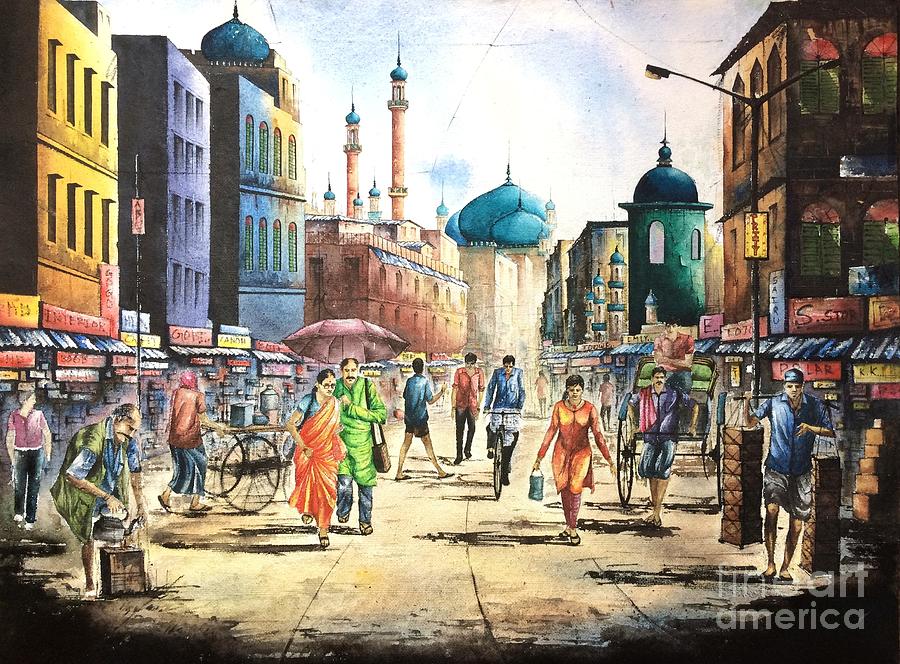
(City of joy: Calcutta by Samir Barman.) But that’s not all. How could I forget the atmosphere of the orthodox Hindu families with whom I am most familiar? That, for instance, of the house of one of my brothers-in-law, then still living, and a physician at Medinipur, [1] with whom I was staying during the Norwegian and early French campaigns? They all enthusiastically accepted my suggestion to go to the temple of the Goddess Kali—to the ‘House of Kali’ as we say in Bengali—to give thanks to the One who both blesses and kills for the triumphal advance of the soldiers of great German Reich.

We went in procession, carrying offerings of rice, sugar, flour, fruit, garlands of scarlet flowers—in the absence of the bloody sacrifice which the family rejected as much as I did. I can still see myself, surrounded by young people who were also proud of their Aryan ancestry, standing before the terrible Image with the curved sword. Inhaling the smoke of the incense, lulled by the haunting musicality of Sanskrit liturgical formulas, I sometimes closed my eyes to better see in my mind’s eye, like a grandiose fresco, the parade of German armoured vehicles along the roads of Europe.

I lived intensely my role as a link between the oldest living Aryan civilisation in the East and this Aryan West that Adolf Hitler was conquering to return it to itself and regenerate it. Then I looked at my nephews and nieces, and the young Brahmins, their neighbours and fellow students, who had accompanied me. And I dreamed of the day when I would finally see the new Emperor—the eternal Emperor—of the Twilight Lands [Abendland = West], awake and rising from his mysterious cave, and when, greeting him with my outstretched arm, I would say to him, ‘Mein Führer, I bring you the allegiance of the elite of India!’

It didn’t seem an impossible dream then…

How could I forget the general joy in Calcutta—and no doubt in the rest of the peninsula too—at the news of Adolf Hitler’s troops entering Paris or, some twenty months later, at the announcement of the lightning advance of our allies the Japanese to the Assam border and beyond?

The kids themselves, newspaper sellers, their faces radiant, triumphantly threw to the public the names of the captured cities—every news day: Kuala Lumpur, Singapore, Rangoon, Mandalay, Akyab, Imphal in Indian territory—one after the other. The colonial government had banned listening to German radio. People who could hear German were listening to it illegally.

I know Hindus who listened to it without understanding a word just to hear the voice of the Führer. They felt that the One who spoke to the Aryan world in an ‘Indo-European’ language unknown to them was also speaking to them—at least to the racial elite of their continent.
 

______ 卐 ______

Editor’s note:

Compare this holy euphoria with the way the Americans and the British people reacted to Hitler’s divine voice! Compare it with the red letters in our very long post yesterday (‘American racial history timeline—Or—On Jared Taylor’s cherries’)!

It needs to be said a million times until it is understood: Christianity fried the brains of the Aryan man to the extent that, after WW2, the Aryan man handed over their Abendland to the Jews!

To save the white race from the anti-White war of extermination that the entire Abendland is suffering, it is an absolute categorical imperative to repudiate, with all our being, the accursed religion of our imbecilic parents.

If the Aryans of India had conquered Abendland with their religion, during WW2 Westerners, including the American and English people, would have been as euphoric at the German advance in Europe, and beyond, as these children untainted with a lethal Semitic-Christian poison.

___________

[1] Still often written as Midnapore: a city in West Bengal.

Categories
Exterminationism Jesus New Testament On the Historicity of Jesus (book) Richard Carrier

Jesus – triple homonym

The impossibility of speaking with normies about Hitler lies in the fact that the word ‘Hitler’ is, in reality, a double homonym. When we use it we refer to the ‘historical Hitler’ (cf. David Irving’s books). The normie, on the other hand, believes in the ‘Hitler of dogma’: a propaganda figure created by Anglo-Americans and Jews after World War II to demoralise the Aryan. One need only glance at the book I quoted in my previous post to realise that the Hitler of dogma never existed.

This is best illustrated by the figure through whom our civilisation betrayed itself: Jesus of Nazareth. But here we encounter not a double but a triple homonym!

For the ordinary Christian, Jesus rose from the dead. To the ordinary secular man, Jesus was a mortal whose ethical system, despite the mythical miracles attributed to him, remains exemplary. But to the priest of sacred words Jesus not only didn’t exist. The ethical system sold to us by the imaginative writer who created this fictional character, the evangelist Mark, was the apple of discord whose ingestion brought about the downfall not only of the Roman Empire, but of the white race. (Remember that, according to Jung, an archetype can literally take possession of human souls. If I could relaunch Daybreak Press, I would publish another book collecting several entries on the Christian question.)

If the word ‘Hitler’ is a double homonym, from this angle the word ‘Jesus’ is a triple homonym in the sense that the word ‘bank’ is also a triple homonym: it can mean (1) a financial institution, (2) land at river’s edge, or (3) a panel in the sense, for example, that ‘the bank of switches for controlling the lighting is over there’.

Let’s now imagine a room with three men: a traditional Christian, a secular humanist and a priest of the sacred words. Common sense might lead us to believe that both the atheist and I could team up against the Christian. But this is not so. The Christian and the atheist will team up against me as soon as they learn that, in my scale of values, exterminationism à la Turner Diaries are the new tablets of law. And it is exactly at this point that we see that the expression ‘secular Christian’ or ‘neochristian’ is most apt to refer to today’s ‘atheists’.

Pre-Christian Aryans would have gladly used technological weapons of mass destruction to exterminate their enemies. It was Christian ethics that inculcated the notion of the sanctity of human life. An example from the country where I live will exemplify this.

In the summer of 1990, shortly after the fall of the Berlin Wall and a few months before the dissolution of the USSR, an extraordinary event took place in Mexico City: intellectuals from all over the world gathered to talk about it. I was following them closely, although at the time I was a normie of the secular humanist type. A few years ago, in the comments section of The Occidental Observer, I put the list of the participants in the various panel discussions at that event, which lasted a couple of weeks, but there is no need to put it here. Suffice it to say that, at the panel discussion ‘Nationalist and religious tensions’, the Mexican Octavio Paz—a secular humanist who would go on to win that year’s Nobel Prize for literature—concluded the discussion with these words (my translation):

We owe religions the inquisitors, we owe them many wars, we owe them many crimes, crusades, human sacrifices. But we also owe them essential things that we cannot renounce: for example Christ, for example Buddha. Thank you. [see YouTube clip: here]

Octavio Paz (1914-1998), who had repudiated his mother’s Catholicism at an early age, was in fact a typical neochristian. If it were possible to locate the three men of our example geographically, the Christian and the atheist would be almost side by side. The real eccentric would be the priest of the sacred words, who would be far removed from the Christian and the atheist insofar as the scale of values is concerned. (I am more like the Romans who left no stone unturned of the Semitic civilisation of Carthage than like the secular whites who are still under the spell of the Jesus archetype.)

There is indeed a gulf not only in believing that Jesus didn’t exist, but—contra Paz & secular company—in openly proclaiming that the message of this mythical ‘Christ’ is pure poison for the fourteen words: a psyop by Mark and his Semitic followers Matthew, Luke and eventually John, to brainwash the white man.

Although Richard Carrier is, like Octavio Paz, a typical neochristian, to racially conscious conservatives who still cling to the religion of their parents I suggest that they, at least, read the Amazon Books starred reviews of On the Historicity of Jesus.

Categories
Heinrich Himmler Souvenirs et réflexions d'une aryenne (book)

Reflections of an Aryan woman, 72

Hitler also admired the great Hohenstaufen emperors, especially Frederick Barbarossa, the one who should come back and who had come back in him (alas, for a short time!), and Frederick II, Stupor Mundi (Wonder of the World) in whom so many of his contemporaries had thought they saw the Antichrist—as men nowadays, blinded by propaganda, see in the founder of the Third Reich the embodiment of evil. He admired Frederick II of Prussia, Bismark, and all those in whom the conquering spirit of the German people had found expression, whose cultural mission—and much more than cultural—he didn’t doubt about.

And Heinrich Himmler himself, while paying a brilliant tribute to the Saxon warriors, martyrs of the ancient national faith in Verden in the year 782 of the Foreign God, professed a veritable adoration of Emperor Henry I and exalted the Knights of the Teutonic Order—not because they had brutally forced the Slavs (and eventually the Prussians[1]) to accept Christianity, but because they had, by the sword, ‘prepared the way for the German plough’, making possible the German colonisation of vast territories in the east.
 

______ 卐 ______

 
Editor’s Note: Given that in 1930s Germany no one could suspect that if Germany waged and lost the war all the whites of the world would go into an ethnosuicidal zeitgeist (cf. what I wrote yesterday), Himmler’s sympathy for the Teutonic Knights is understandable.

One of the reasons I have become so passionate about Savitri’s post-1945 texts is that the innocence of pre-1945 NS men, including Hitler and Himmler, should no longer be maintained. It is now clear that the quote on the sidebar (‘1945 was the year of the total inversion of Aryan values into Christian values’) reflects the tragedy of the West. And the only way to save the white race is to settle accounts with Judeo-Christianity, and thus with how we write history about Charlemagne and the Teutonic Knights.

If we hadn’t entered the darkest hour for the fair race, I wouldn’t have been so polarised against Judeo-Christianity following in Nietzsche’s footsteps. Manu Rodriguez’s letter to me comes to mind now.
 

______ 卐 ______

 
What was eternal in the warrior religion of Wotan and Thor, and before that in the immemorial Nordic religion of Heaven, Earth and the ‘Son’ of both, which Dr Hermann Wirth studied and was to survive in Christian esotericism and in esotericism itself? The latter has, in parallel with the teaching of the Churches, continued throughout history to have its initiates, fewer and fewer in number, no doubt, but always present and sometimes very active. One counts, among them, immortal creators such as the great Dürer and later Goethe, Wagner, and to a certain extent, Nietzsche. And it is known that Frederick II, ‘the Great’, King of Prussia—the hero par excellence of the Führer—was Grand Master of the Old Prussian Lodges.

The deep significance of the ancient Irminsul, the Axis of the World, isn’t different from that of the Cross detached from all Christian mythology, that is, from the history of the torture of Jesus considered as a fact in time. The point of the venerable Germanic symbol is aimed at the North Star, which represents the ‘One’ or supreme principle, and its curved branches are supposed to support the circle of the Zodiac, symbolising the Cycle of manifestation, moving around its immobile centre. There are in some very old churches in Germany even ‘crucifixions’ in which the cross itself has the curved branches of the ‘pagan’ Irminsul, the whole suggesting as it does the fusion of the two religions in their highest and most universal symbolism.

On the other hand, according to Professor von Moth of Detmold, the Fleur de Lys, linked as is well known to the idea of royal or imperial power is, in its form, a somewhat stylised replica of the Irminsul or Pillar of All, having a polar and axial significance. All legitimate power comes from On-high. And the Swastika, also ‘essentially the sign of the Pole’,[2] thus of the ‘rotational movement that is achieved around a centre of an immutable axis’ and of ‘the vivifying role of the Principle concerning the cosmic order’[3], is connected thereby to the Irminsul and the cross.

What was important, therefore, was to exalt everything that had contributed, or could contribute, to strengthening the German will to power: the condition for the universal ‘recovery’ that only a regenerated Germany could initiate. On the other hand, it was to keep alive the deposit of traditional truth, that is to say, of more than human (cosmic) truth, transmitted from the depths of the ages. The expression of this heritage could vary from one period to another according to political fluctuations, but the substance remained the same and explained the supreme beauty of the old Nordic sagas and the music, eminently Christian in inspiration, of Johann Sebastian Bach and, it goes without saying, of the entire artwork, musical and literary, also initiatory, of Richard Wagner.
 

______ 卐 ______

 
Editor’s Note: Once more, due to our anti-Christian POV we have some reservations on this point. See what Albus and I say about Wagner and Bach.

______ 卐 ______

 
This deposit, more precious than anything else, came from the mysterious Hyperboreans and the original homeland of the ‘transparent men’, sons of the ‘intelligences of beyond’: the Hyperboreans whose capital was Thule.

__________

[1] The Prussians were still ‘pagans’, i.e. faithful to their Germanic gods, as late as the 14th century.

[2] René Guénon: Symboles fondamentaux de la Science sacrée, page 89.

[3] Ibid., page 90.

Categories
Monologe im Führerhauptquartier

Monologe im Führerhauptquartier, 2

Führerhauptquartier

Juli 1941, 11.30 – 1.50 H/Fu.

Gespräch mit v. Below[1] darüber, ob wir nicht gut tun, jetzt einmal zur moralischen Erschütterung des Gegners Bilder des noch nicht gezeigten Großkaliber-Geschützes zu veröffentlichen.

Langes allgemeines Gespräch über Auto-Motoren: die ersten und die späteren Wagen des Führers.

Die Schönheit der Krim, uns erschlossen durch eine Autobahn: der deutsche Süden. Kreta – heißwaldlos; schön wäre Zypern; aber: die Krim erreichen wir auf dem Landweg: Kiew. Dazu als Reiseland für uns: Kroatien. »Ich glaube, nach dem Krieg wird eine große Freude kommen.«

Mehr als die Eisenbahn – sie ist etwas Unpersönliches – wird der Kraftwagen die Völker verbinden. Welch’ ein Faktor auf dem Wege zum neuen Europa! Wie die Autobahn die innerdeutschen Grenzen hat verschwinden lassen, werden die Grenzen der europäischen Länder überwunden.

Auf die Frage, ob es genug sein werde, bis zum Ural als Grenze vorgedrungen zu sein: zunächst sei es genug, die Grenze bis dahin hinausgerückt zu haben; der Bolschewismus müsse ausgerottet werden; wenn nötig, werde man zu dem Zweck von dort aus dahin vorstoßen, wo immer ein neuer Herd sich bilde; Moskau als Sitz dieser Lehre werde vom Erdboden verschwinden, sobald die wertvollen Güter weggebracht sind; mit den Russen der dortigen Fabriken zu arbeiten sei uns nicht möglich. St. Petersburg [Leningrad] als Stadt sei unvergleichlich viel schöner als Moskau. Die Kunstschätze der Eremitage würden diesmal wohl nicht – wie im Weltkrieg – in den Kreml, sondern in Schlösser auf dem Lande überführtworden sein, wenn man sie nicht in die Städte ostwärts von Moskau oder zu Wasser weggebracht hat.

________

[1] Nicolaus von Below, Luftwaffenadjutant Hitlers, zuletzt im Range eines Generalmajors.

Categories
Charlemagne Heinrich Himmler Schutzstaffel (SS) Souvenirs et réflexions d'une aryenne (book)

Reflections of an Aryan woman, 71


Chapter 10

Hitlerian esotericism & the tradition

‘The fools scorn Me when I take on human form;
My essence, supreme source of beings, escapes them.’

Bhagavad-Gita, 9, verse 2

 
There were, of course, echelons among the elect. Curiously, the name of this elite of physical health and beauty, of warlike courage and, more or less, of secret knowledge, whose initials are known only to the vast public, means, as I said above, ‘echelons of protection’.

I believe I also mentioned this about the Ordensburgen (Order Castles), in which the military training, political and, to some extent, metaphysical education of the SS, and especially of its cadres, took place because Hitler’s Weltanschauung is inseparable from the metaphysics that underlies it. This is so true that a critic of National Socialism and René Guénon’s work could say that the latter was ‘Hitlerism minus the armoured divisions’,[1] and this without the Cairo insider ever having written a word about ‘politics’.

Not all the candidates—I should say ‘novices’—of the SS were trained and educated in the same Ordensburg. And not everyone in the same Ordensburg was taught the same way, especially in the higher echelons. It depended on the tasks for which they were considered suitable within the elite itself.

For the elite consisted of several organisations, from the most visible, Waffen (Armed) SS—the most famous one too, because of the superhuman heroism it demonstrated so many times during the Second World War—to the most secret one, the Ahnenerbe (Heritage of the Ancestors), founded in 1935, and all the more difficult to know because many of its documents (also secret, it goes without saying) were destroyed ‘before the arrival of the Allies in Germany’, and because ‘the members of this organisation who survived the collapse of the Third Reich… remain silent with a strange resolution’.[2]

It is at least logical to think that it was probably the Ahnenerbe which, in Adolf Hitler’s ‘Black Order’, was the repository of Tradition—and more particularly, certain sections of the Ahnenerbe, for it included many, including fifty-two scientific sections[3] dealing with research, although not necessarily in the spirit and with the methods used in the experimental sciences. According to Wolfram Sievers’ statements before the victors’ tribunal in Nuremberg, to which we owe this precision, the same Institute ‘carried out or commissioned more than one hundred large-scale research missions’.[4]

The nature of some of these investigations reveals a clear interest in esoteric matters. Thus, the symbolism of the harp in Ireland was studied, as well as the question of the survival of true Rosicrucians: in other words, of initiatory groups still possessing the integral tradition of the Knights Templar (from which the first Rosicrucians are said to have inherited). Thus, the Bible and the Kabbalah were reconsidered, trying to derive their hidden meaning; asking, in particular, what role the symbolism of numbers might play in both. It was in this way that the physical and mental structure of human specimens of different races was studied—that of the Nordics, with the special care that one can guess—to ensure that the concept of heredity and race, so fundamental in Hitlerism, was given its full value. Thus, systematic and sustained efforts were made in all research aimed at revealing to the Germans the glory of their own historical or pre-historical antiquity, their Middle Ages, and at highlighting the importance of the corresponding sites.

Without denying that there is a part of esoteric truth in Christianity and Judaism itself, and in all religions or philosophies that are closely or even distantly related to Tradition, the emphasis was on the traditional form of the Germanic peoples. Traces of this can be found in the symbols engraved on rock from the earliest prehistoric times and, after the bloody eradication of the cult of Wotan by Charlemagne and his immediate successors, even in certain rites practised in the Middle Ages the Chivalric Orders or the Holy Vehm. It would be interesting to know whether the latter, which has not ceased to exist as a secret organisation, has, or has had at any time, any connection with the Thule Society.

Heinrich Himmler, the head of the SS and the man whose career, so much decried outside Hitlerian circles, is marked more than any other by this detached violence that signifies a higher quality of being, albeit ‘in a veiled way’,[5] in his speech of January 1937, which contains his only public or semi-public reference to the Ahnenerbe, extols the high importance of archaeological discoveries by the Institute of that name in Altchristenburg, East Prussia: the uncovering of several layers of ancient Germanic fortifications, refuting the view that East Prussia was a Slavic land.

But there is more: he advocates the ‘restoration’ and ‘maintenance’ of cultural centres dedicated ‘to German greatness and the German past… in every region where there is an SS company’[6] and he gives examples of such centres. One is the Sachsenhain near Verden, where 4,500 boulders, each transported from a Saxon village, had been erected one after the other, on either side of the paths in the middle of the forest, in memory of the four and a half thousand Saxons who were beheaded there, on the banks of the Aller, in 782, by order of Charlemagne because they persisted in refusing to accept the foreign god he wanted to impose on them.

The other is the site of the Externsteine, impressive vertical rocks marking one of the world’s great spiritual centres near Horn, and the sacrosanct place of worship for the ancient Germans. On the top of the highest of the rocks, in place of the ancient golden Irminsul torn down in 772 by the soldiers of the same Christian conqueror, there now flew, victorious, liberating, a symbol of the reconciliation of all the opposing aspects of German history in the consciousness of its profound unity: the red, white and black swastika flag of the Third Reich.

And the examples show that it was not only a question of ‘culture’, but of knowledge, or, for the German in general, of national culture; and for the initiates of the SS Order and in particular of the Ahnenerbe, secret knowledge of the great cosmic truths, apprehended through the traditional symbolism such as the Germanic peoples knew it, and such as a silent minority has preserved it. For, and this is a point worth noting, despite the very strong ‘pagan’ current underlying Hitlerism, manifesting itself above all in the unreserved rejection of all anthropocentrism such as the whole personal God, there was never any question of rejecting or even underestimating anything in the ancestral German and European heritage which did honour to the Aryan genius.

The Führer had, says André Erissaud, ‘the feeling’—I myself would say, the certainty—that ‘everything in the most recent West that had taken the form of a religion, and the Christian religion in particular… pertains to the all too human’, and therefore had little to do with truly transcendent values and ‘offered a general climate scarcely compatible with its dispositions and vocation, situated beyond the truths and dogmas of the faith proposed to ordinary man’.[7] However, the whole of Western civilisation is at the same time ‘recent’ and ‘Christian’. We must never forget this.

That did not, however, prevent Adolf Hitler, who was impartial, as is necessary for any sage (and even more so for any human expression of the divine), from admiring Charlemagne: the Sachsenschlüchter or ‘terminator of the Saxons’, as Alfred Rosenberg, Johann von Leers, Heinrich Himmler, and a good number of other great dignitaries, thinkers and men of action of the Third Reich called him. He saw in him the conqueror with the immense will to power, and above all the first unifier of the German people; the one who, alone at that time, had had the idea of the Reich even if he had used the artificial unity of ‘faith’ to impose it, and if this ‘faith’ was the Christian faith, i.e. a foreign faith. It will be remembered that Adolf Hitler insisted on the dissolving action of Christianity on the Greco-Roman world, and that he called it ‘pre-Bolshevism’. But it does not matter what this faith was (and still is), if it was the cement of a conquering Germanic Empire and, later, the occasion for the whole flowering of art that we know. Insofar as this art is beautiful it presupposes, in any case, a certain knowledge of what is eternal. The Führer thus accepted with respect, as a German heirloom, a replica of the sword of the Emperor of West.
 

______ 卐 ______

 
Editor’s note:

I distinctly remember the first time I read Hitler’s Table Talk in an Ostara Publications edition. This was the only point on which I differed with the Führer.

Precisely Ostara has published a book, which I own, that shows that we could rate Charlemagne—as historian Arthur Kemp Kemp, publisher of Ostara told me—within the evilest characters of European history. We recommend Thomas Hodgkin’s The Life of Charlemagne to those who have swallowed the Christian version of this man that imposed a Semitic cult on the noblest race on Earth.

In a previous instalment, Savitri said that Hitler was closer to Wagner than to Nietzsche. That is quite true. If he had been closer to the philosopher than the musician, he would have realised the danger posed by the Anglo-Americans, so foolish in their Christian morality that they destroyed a miraculous revival of paganism: a 20th-century reincarnation of Charlemagne’s misdeeds!

As I have said, after I finish with Savitri’s book I’ll continue posting Deschner’s Christianity’s Criminal History. We shall see that even after the destruction of Greco-Roman culture by Christians, there were still many Germanic tribes who refused to worship the god of the Jews. Charlemagne forced these uncontaminated Nordids to worship the enemy god: a historical milestone related to the darkest hour we suffer today (see for example my post yesterday, ‘Liberalism as a heretical movement’).

____________

[1] Louis Pauwels and Jacques Bergier: Le Matin des Magiciens, ed. Gallimard, 1960, p. 326.
[2] Brissaud: Hitler et l’Ordre Noir, page 283.
[3] Ibid., page 285.
[4] Ibid.
[5] Ibid., page 283.
[6] Ibid., page 284.
[7] Ibid, page 111.
Categories
Henry Picker Martin Bormann

The Führer’s monologues (iii)

Picker (pic left) pointed out in the introduction to the edition of his Table Talk that, apart from short walks, Hitler ‘only found the necessary mental and spiritual relaxation in private conversation at his table, i.e. in talking in a personal, convivial atmosphere’.[1] This purpose was best achieved the further the respective topic of conversation led away from the pressing tasks and decisions of the day. Since every effort and concentration was to be avoided, the guests refrained from deepening or continuing a topic by asking questions or raising objections. In addition, the commander-in-chief, who was cut off from many contacts and isolated from the people in his headquarters, also monologued to gain clarity for himself. He found it particularly helpful when the guests were open-minded and joined in. During the war, the small dinner party replaced the population, whose response Hitler had always so urgently needed for his decisions and whom he could not entirely do without.

The need for communication became even more obvious at the nightly teatimes. Hitler didn’t retire after the evening briefing to relax or reflect on current events, but invited a few confidants to his bunker, which also served him as a workroom, to shed the burden of the day and gain new energy. He attached particular importance to the presence of his secretaries, because he felt stimulated by this, but at the same time the informal atmosphere was preserved. Very different topics were often discussed than in the conversations in the larger circle.
 

______ 卐 ______

 
Editor’s Note: This is what those who do a detailed analysis of Mein Kampf fail to understand: the real Hitler is the one of his after-dinner talks. The other is the ‘PR Hitler’ for the masses.
 

______ 卐 ______

 
When assessing Hitler’s monologues, these aspects will always have to be taken into account. It corresponded to the need for relaxation and repression that in the winter months of 1941/42 the serious crisis on the Eastern Front, the hardships of the population in the increasingly severe war, the supply difficulties and the looming weakness of Italy weren’t mentioned at all. No less visible is the need for recreation in the reminiscences of a special past, the reports of interesting encounters and experiences, and discussions about questions of art. This is often matched by the style of relaxed chit-chat, whereby the topics changed quickly and easily and undoubtedly not every word and every opinion should be weighed on the gold scales.

Hitler sought contact with his aides and collaborators when fundamental questions of worldview and politics moved him and he wanted to gain clarity about his course of action, especially about the possibilities and limits he had for his actions during the war. The frequent discussions on questions of faith, the vitality of Christianity in Germany and Europe, the position of the churches on National Socialism and politics in the occupied territories of Eastern Europe belong in this context; and the same for his remarks on the administration of justice and the special problems of the penal system under the exceptional conditions of war. Hitler sensed in his conversations with the few people around him in the Führer’s headquarters that the readiness to take tougher and more uncompromising action against outsiders or enemies of the regime grew the more severe as the war unfolded, and the sacrifices it demanded. Even in the seclusion of his headquarters, he still had a feeling for the mood in the country and the state of consciousness of the individual groups and classes. Hence his repeated harsh criticism of the administration and its schematism, which was shared by parts of the population, his mockery of the concerns and objections of the experts in all areas of public life, and his anger at the Germans who showed fear and disgust given the deportations of Jews and the persecution measures in the occupied territories.
 

______ 卐 ______

 
Editor’s Note: This reminds me of American racialists that falter over the exterminationist measures that William Pierce fantasized about in both fiction and his story of the white race.
 

______ 卐 ______

 
Now, admittedly, the records convey only an inadequate picture of Hitler’s remarks. Heim did take notes at lunchtime and in the evening during the talks in the larger circle ‘to have a basis for the most important details’. But even then, after the board had been removed, he was only able to summarise on a few pages what sometimes had been discussed in great detail. For the very long monologues during the nightly teatimes, he had to rely entirely on his memory.

Furthermore, Bormann’s adjutant, who was interested in problems of art, refrained from the outset from ‘recording statements on military and questions of technology’ because he wasn’t competent and knowledgeable in this regard. He did this in wise self-restraint, although conversations about these topics at the table took up a great deal of space and Hitler had considerable knowledge in these areas. But beyond that, Heim didn’t jot down anything unless he was sure ‘that he had grasped the gist of it’. When reading these notes it must always be borne in mind that they contain by no means everything that concerned Hitler and what he talked about.

Nevertheless, the transcripts presented here are of great value because the man who made them, as a convinced National Socialist, tried to capture the ‘train of thought and the quintessence’ of what he heard. Particularly short, striking statements and remarks on ideological and political issues, that were familiar to Heim as an old party comrade, stuck with him. When talking about less familiar topics or events that were off the beaten track, on the other hand, sentences were sometimes recorded that no longer allow a full reconstruction of the course of the conversation and the train of thought.

No matter how hard Heim tried to convey the words of his leader as faithfully and accurately as possible, they remain subjectively filtered. Here, too, what Baroness Spitzemberg noted in her diary about a long conversation with Bismarck in Friedrichsruh after his resignation is true: ‘In writing all this down immediately after hearing it, with no other intention than to entrust the great man’s words to this book, I realise how inevitable the errors are… When I read over what has been written, I am well aware that I have not written anything wrong; but some things have nevertheless been left out, through the different order or it doesn’t appear as it was intended. Perhaps I put a different meaning in the prince’s words!’[2]

To leave no doubt that it was always only a summary of Hitler’s remarks, Heim introduced each interview note with a sentence such as: ‘According to the meaning, the chief expressed himself in approximately the following lines of thought’, or: ‘Among other things, according to the meaning, the chief expressed himself as follows…’ This practice was also adhered to by Bormann’s adviser, who recorded the few statements from the years 1943/44. His notes always began with the formula: ‘Today the Führer said roughly the following…’ This makes it clear that it is merely a reproduction, that long discussions were summarised, and that occasionally less important or very specific statements were omitted.

This finding must be particularly emphasized because Picker described Heim’s 36 conversation recordings, which he included in his edition of the Tischgespräche, as ‘original shorthand’.[3] This claim may be in private interest—shorthand notes are not protected by copyright to the same extent as memorial transcripts and memos, but it doesn’t serve the needs of science and the interested public at all. After all, there is a serious difference between a verbatim reproduction of Hitler’s remarks and a summary of his monologues.

Moreover, Picker’s assertion that he had received the express permission of Hitler and Bormann to take his own and some selected notes of Heim’s must also be questioned. According to Heim, Hitler knew nothing at all about his notes. He can therefore—at least in the case of Heim’s texts—hardly have had material at his disposal of which he had no knowledge. Furthermore, it is not evident why Bormann treated the Führer’s talks as a ‘secret’ party matter and carefully kept them safe, if at the same time he expressly released them as a private work.

For the evaluation of the source, it is of great importance whether Hitler carefully checked his statements in the knowledge of the transcripts and only said what was allowed to become known, or whether he was able to speak freely and relaxedly in a circle of confidants about questions that shouldn’t leak out, to which he didn’t yet have a clear answer. All the information suggests that the latter was the case. In any case, Hitler didn’t expect that what he said at the nightly meetings in his study would be recorded in writing. In this relaxed atmosphere he expressed himself more openly and informally than at the lunch and dinner table. Picker was well aware of this, because during his work on Bormann’s staff he mainly procured copies of these notes. Of the 36 notes he took from Heim’s inventory into his edition, 13 alone refer to the nightly teatimes, to which he was never asked.

___________

[1] Picker, Hitlers Tischgespräche, p. 24.

[2] Das Tagebuch der Baronin Spitzemberg. Ausgewählt und herausgegeben von Rudolf Vierhaus (The Diary of Baroness Spitzemberg. Selected and edited by Rudolf Vierhaus). Göttingen 1976, p. 291.

[3] Picker, Hitlers Tischgespräche, p. 33.

Categories
Schutzstaffel (SS) Souvenirs et réflexions d'une aryenne (book) Third Reich Welfare of animals

Reflections of an Aryan woman, 70

As I noted above, the particular restrictions he had been able to impose on himself up to that point, in a spirit of asceticism, became unnecessary. And if he continued to observe some of them; if among other things, he obstinately abstained from alcoholic beverages and tobacco, it was out of natural disposition rather than out of a concern for discipline. And if he also refused to eat any meat, it was because deep down he—the artist and friend of animals—had a deepening disgust with the ugliness and horror of the slaughterhouse and the butchery. That said, he lived from then on as a harmoniously balanced man, mingling, without embarrassment or astonishment, with the most refined society if he deemed it necessary for his work or if, after hours of contact with his rough SA and the people, he found there a source of relaxation.

He enjoyed the company of women and, like Siegfried, the prophet Mohammed, Krishna, the incarnate God, and other illustrious fighters ‘against Time’, he knew love, sporadically at least, it seems, when he had the time! Above all, he lived for all the satisfactions that art in all its forms could give him; art that he placed so high that he didn’t admit that a man who was insensitive to it should ever take over the leadership of a National Socialist state. People who, like the French writer Malraux—who certainly cannot be suspected of any bias toward him!—met him at social gatherings and embassy dinners, admit that he was ‘witty’, even ‘humorous’ and that he ‘knew how to dance’ in the sense of Nietzsche’s definition of the term.

But at the same time, he remained first and foremost a man of his fight. And he seems to have been increasingly aware of the need for those who led this struggle under him and in collaboration with him to have a share in the secret knowledge of more than human origin. Hence his dream of a hierarchical German Empire—and beyond it, a hierarchical world according to the spirit of Tradition: a ‘caste system on a planetary scale’ to use the expression of a Hindu, an intelligent admirer of the German Third Reich.

Hence, too, his efforts to create the Order: ‘a veritable lay priesthood’ as Rauschning wrote, which was to be the guardian of Tradition at the top of the social pyramid of the Great Reich and, after the inevitable collapse, at the top of that of the faithful survivors.

This Order, as I have said, was the Schutzstaffel or ‘Echelons of protection’, commonly referred to by its initials—SS—which the Führer wanted to be both ‘militant’ and ‘triumphant’ in the sense in which these terms are applied to the Church in Catholic theology; that is to say, warlike and concerned above all with the defence and expansion of the Aryan elite’s strongholds in this world, and having attained at least a certain degree of being, separating it from the rest of mankind as the ‘chosen ones’ are separated from the ‘world’, the initiated from the uninitiated, in all traditional societies.

Without the existence of such an Order, the reversal of false values on all planes, including the material plane, was inconceivable.

Categories
Buddhism Degenerate art Richard Wagner Souvenirs et réflexions d'une aryenne (book)

Reflections of an Aryan woman, 69

It is known that at one point Beatrice steps aside before St. Bernard to guide Dante in the final stages of his ascent to the summit of the successive paradises.[1] One wonders who, after Stephanie, helped Adolf to climb the highest rungs of secret knowledge and when he climbed them. Was he still living in Vienna? Or in Munich? Or shortly after his decision, upon the announcement of Germany’s surrender in 1918, to ‘become a politician’?—as was the case with at least one other world-changing initiate, namely Christ himself, around the age of thirty? Or earlier? Or later? It is almost impossible to answer this question with any certainty.
 

______ 卐 ______

 
Editor’s Note: For a priestess of the sacred words (or priest) to use honorific titles like ‘Christ’ for a fictitious character from the pen of a resentful Semite just after the destruction of the Temple in Jerusalem, is a mistake. It is as if a follower of the 14 words were to call the Semite Muhammad ‘The Prophet’: a mistake that many esotericists often make. Note that although I consider myself a priest of the same religion as Savitri, I am not an esotericist but belong to another generation of the same priesthood.
 

______ 卐 ______

 
Two things, however, are beyond doubt. The first is that throughout his life the Führer continued to bathe in the spiritual atmosphere of Wagner—even more so than that of Nietzsche—and to draw inspiration from it. ‘I know all of Wagner’s thoughts inside out. At the various stages of my life I always return to him’[2] he once told Hermann Rauschning while he found that, in Nietzsche, although this thinker had ‘already glimpsed the overman as a new biological variety, everything is still floating’.[3] I repeat: Wagner, himself initiated to the highest degree—his work is proof of this—was, through this work, the true spiritual master of Adolf Hitler.
 

______ 卐 ______

 
Editor’s note: One of the things I have noticed about today’s neo-Nazis is that they are completely insensitive to Wagner’s greatness: it is an art they simply do not understand because many, including some European racialists, have degenerated musically.

To understand Hitler one has to (1) be repulsed by all degenerate music and (2) feel Wagner. That task is virtually impossible in the West today, as the degenerate milieu surrounds the white man like a fish in water. But it is possible if someone crosses the Wall and undergoes an initiation of years inside the cave of the three-eyed raven.
 

______ 卐 ______

 
The second certainty is that, either directly through the Thulegesellschaft or before his first contacts with it—in Vienna perhaps—with those having the same concerns, dreams and above all knowledge of the same order, Adolf Hitler knew the old hyperborean tradition: according to Guénon, the source of all others within which he received his supreme initiation. For the fact that he was one of the ‘descents’ on earth (in Sanskrit: avatara) of the One who returns, in every age of tragic decadence, to fight against the tide of Time and attempt ‘a recovery’, didn’t exempt him from the secret teaching of the masters of a particular form of the eternal tradition. Regarding these masters, from whose tutelage he could easily escape as André Brissaud suggests,[4] it wasn’t for granted that he would never enter into conflict; they had their part to play in his awakening. Other very great figures of the past, who have left their mark on history—among others, the Buddha himself, considered in Hinduism as an incarnation of Vishnu—have had masters even if they quickly surpassed them.

______ 卐 ______

 
Editor’s Note: Savitri is wrong again. We could say the same thing about ‘Buddha’ as we said about ‘Christ’ and ‘The Prophet’ because universalist Buddhism was ethnosuicide for the remaining Aryans in India, as Revilo Oliver knew.
 

______ 卐 ______

 
One would have to have been a member of the Thule Society to be able to say exactly what distinguished its teaching from that of other initiatory organisations or those claiming to be such. This is not so important if, as Brissaud seems to think, Hitler very quickly freed himself from the influence of any master or masters he might have had (apart, of course, from that of Wagner, whose music, both epic and initiatory, underpinned his entire life and even accompanied him beyond death).[5] What is important is to realise that he did indeed—it is not clear when, but certainly before the takeover—receive the supreme initiation that placed him above the contingencies of this world and above good and evil. In other words, he ‘awakened’ completely and definitively to what he was from all eternity and remains absolutely.
___________

[1] René Guénon: L’ésotérisme de Dante.
[2] Rauschnmg: Hitler m’a dit, page 257.
[3] Ibid., page 273.
[4] Brissaud: Hitler et l’Ordre Noir, page 109.
[5] After the announcement of the Führer’s tragic death in 1945, German radio played the last part of Richard Wagner’s Götterdämmerung.