by Tom Goodrich
All wars are bad. All wars are evil. All wars are inherently bad and evil. And World War Two was the most inherently bad and evil of all wars. No matter what some desk-bound Jewish propagandist might scribble, and no matter what some Christian nightly news reader might mumble, there is no such thing as a “Good War” and there was no such thing as a “Greatest Generation.” War unleashes pent hate. War lends a degree of legitimacy to the basest instincts in man. War is organized savagery. And never was this on uglier display than in World War Two. And never has the term “hell on earth” come closer to an actual manifestation than on the Eastern Front.
As momentum swung to the Soviet Union late in the war, the Red Army turned viciously on the crippled German Wehrmacht. First through Russia, then through Poland, the Soviets ruthlessly pursued the German army until by January, 1945, the communists were on the very borders of the Reich itself. When the final push for Berlin began, and when Soviet forces finally rolled across Germany, it caused widespread panic among German civilians.
The following is from my books, Rape Hate—Sex & Violence in War & Peace, and Hellstorm–The Death of Nazi Germany, 1944-1947. It is not a pretty picture to paint. For over 70 years the world has been told only one side of that terrible war–the side that won. To this very day, unfortunately, these books and a handful of others remain the only books which actually attempt to describe what the war looked like to those who lost it. My hope when I began writing these books–my hope then, my hope now–was to tell the story as accurately and honestly as possible; to let the world know what actually occurred during that so-called “Good War,” not simply what we were told occurred. My hope then, my hope now, is that if enough people of good will read the books, understand the books, act upon the books, then the day will soon come when the world will rise up and with a united voice declare that nothing like this will ever happen again, not in their names, not in their times, not to them… not to anyone.
Unfortunately, and as horrible as the ensuing pages are, the reader should keep in mind that the following deals with only one nightmarish component of a war filled with Allied war crimes–terror bombing, torture, starvation, massacre, enslavement—crimes that are even now, after over 70 years, still largely unknown. Taken together, the ugly things that were done to the defeated Germans by the victorious Allies remain to this day the darkest and best-kept secret in human history.

Although millions of Germans were on the roads in full flight, millions more remained at their farms, villages and towns. Despite the rumors of Bolshevik savagery and the reality of Nemmersdorf the previous autumn, many Germans were determined to ride out the red storm, refusing to believe the situation was as bad as Nazi propaganda would have them believe
“About one thousand inhabitants defied danger and remained in Schoenwald,” ran a typical account. “[T]hey did not really believe that the Russians were as cruel and inhuman as they were reputed to be, but hoped to win over the latter by welcoming them and being hospitiable.”
“Things never turn out either as well or as badly as one expects,” explained an old German adage, an adage that those who remained now desperately embraced. Nevertheless, as a precaution, many in Schoenwald and elsewhere took time to bury valuables, hang out white flags and hide their liquor in cellars. When these last safety measures were taken, there was little the people could do but watch, wait and pray to God their decision had been correct. For many, an answer came soon enough. Wrote a priest from the city of Lauban:
In the evening I climbed up onto the roof of the church and gazed at the countryside around me. Without being a prophet I realized that disaster was about to overtake us—a terrible disaster, for the heathens were rapidly approaching.
I could see the reflection of a fire on the horizon. It seemed to be moving… It was as though a wind of destruction and desolation swept the countryside…
It was as though there were a sinister warning in the very air. The whole sky was ablaze and the air seemed to vibrate with the rumble of the Soviet tanks, as they came nearer and nearer.
For the next several days, the fight for Lauban went on. “Shells and artillery fire rent the air and the concentrated fire of the tanks grew fiercer and fiercer,” the priest continues. “The thunder of the cannon which continued without pause was deafening. There was a stifling smell of sulfur.”
[A]bout noon some German soldiers came to the convent and told us that the Russians were likely to arrive in about an hour’s time… The tumult and commotion overhead grew louder and louder. We could hear soldiers tramping about overhead, but we could not tell whether they were Germans or Russians…
[B]efore we had a chance to get out of the cellar the first lot of Russians appeared. They stood at the entrance to the cellar and were obviously very surprised to find human creatures down here. They soon disappeared again, however. They did not look as bad as we had expected and most of us were rather relieved.
In numerous other towns and villages, frightened German civilians were also “rather relieved” upon their initial encounter with the Red Army. “[T]he first Russian troops entered the village from the east,” remembered one witness from Schoenwald. “This went off quite peacefully, no shots were fired, the Germans served food and drink to the Russians, and the latter were very amiable. Any misgivings, which some of the inhabitants of the village might have had, vanished.”
“One moment the streets were deserted, and the next moment they were full of Russians,” added a little girl from another village. “I was in our bedroom upstairs at the time, watching from a corner window partly facing the street. I thought I’d carefully lift a corner of the blanket covering that window to take a peek… I was spotted by an old Russian soldier sitting in the front of a covered wagon pulled by two enormous horses. He smiled at me and waved.”
“Most of them were of strong and sturdy build,” a resident of Kunzendorf observed. “And all of them, as they confronted us, were armed to the teeth—with revolvers and pistols of every type… They were attired in dirty, brownish, padded trousers and jackets, and on their heads they wore fur-caps.”
Composed largely of White Russians and Ukrainians, many Germans were shocked that the enemy often looked, sounded, and acted, much like themselves. Recalled Lali Horstmann:
There was a loud hammering on the door, which echoed through the house. When my husband opened the door, a tall, fair-haired officer… stood on the doorstep… When he entered the room, the Russian Army itself was in our home, taking possession. As always, reality differed from anticipation, for it was not he who was violent, but Bibi who flew at his legs before we could stop her, while the soldier made a friendly gesture towards the outraged little dog… He talked in the serious tones of a kindly grown-up soothing frightened children, and helpless though we were, we had a mutual respect for each other’s unalterable position. He stalked through the rooms in a formal search for German deserters. Then, his duty done, he gravely saluted with great dignity and departed, leaving us speechless and trembling.
Unfortunately, the fact that one Russian like the above might display proper conduct did not guarantee that the next would. The lack of consistency or a predictable policy among Soviet front line troops was one of the most confusing and paralyzing aspects of the Russian occupation. From a rural estate, Renate Hoffman wrote:
[W]e saw a Russian ride through the main gate on a horse. He must have been drunk because he fell off. A second Russian came, then a third. They staggered and reeled their way to the door and entered the house. It was worse than we had ever imagined. One of them went straight to the telephone, ripped it off the wall, and threw it on the floor… Another Russian went to the radio and threw that on the floor, making sure we no longer heard any more news broadcasts. More men came in. They raged through the house, going from room to room. They stormed into the kitchen and demanded the cook make them something to eat. There must have been about forty soldiers.
I took the children outside and hid them behind some bushes. Inside, we ran from one corner to the other, not knowing what to do. A man from the nearby village passed by and reported that the Russians were acting like animals everywhere… After hours of this, a Russian officer showed up with an interpreter… He was wearing a perfectly tailored uniform, an impressive looking man, and also wearing white gloves! This officer told us, through his translator, that he was confiscating the house and was giving us five minutes to leave the estate.
Continues a witness from Kaltwasser:
When the shelling ceased we ventured out of the cellar once more, but we had only got as far as the stairs when we saw… a Pole, coming towards us with a Russian officer and another man. We hoped for the best, but the interpreter promptly demanded our watches and rings. In fact, he actually tore my watch off its chain, and made the women remove all their rings, bracelets, and necklaces. We were horrified when the Russian officer and the interpreter seized hold of Mrs. M. and my aunt and dragged them off. When they eventually came back we went to the vicarage. The house was full of Russians and they had already wrought havoc in all the rooms. Some of them had ransacked the pantry and were gorging the food they had found there. Others had opened all the drawers and cupboards and thrown the contents onto the floor… Russians continued to raid the house all day long. They played the mouth-organ and the harmonium and set the gramophone going. There was a bottle of pure alcohol in the house and they drained it undiluted. They swarmed into the pantry and ate all the preserves… When it grew dark they set fire to the school. We did not dare go to bed as one lot of soldiers after another kept raiding the house… At about three o’clock in the morning a savage-looking Russian appeared and searched us. We had already been searched innumerable times by other Russians… In the course of their searches one of them opened the wardrobe and slashed all the garments to pieces with his dagger.
Traumatic as first encounters were, when the shock troops moved off many Germans would concur that the experience had not been as bad as feared. While rapes had occurred and while many German men of military age had been marched east or shot on the spot, the front line soldier was more concerned with fighting and survival than with loot, rape and revenge. Not so with those who followed. In numerous instances, before Red combat officers and men pushed on they turned to the helpless civilians with stone-like faces: “The Mongols are coming… Very bad men. You go quick. Go quick.”
Composed largely of Mongols and other Asians, as well as convicts and Jewish commissars, these men who formed the second wave of troops were regarded, even by their own comrades, as utterly merciless. Terrified by the news, many Germans did attempt to flee and move in the wake of the first Soviet wave. Most, however, found themselves trapped and could do little more than hide young girls and once again pray that their worst fears were unfounded. After a wait of sometimes days, but normally only hours, the dreaded second wave arrived. There were no preliminaries.
Unlike storm troops, who cautiously entered towns and villages and slipped nervously from door to door, the rear echelons burst noisily into communities atop trucks, tanks or peasant carts crammed high with loot. Often wildly drunk, many wore a bizarre array of stolen clothes and gaudy jewelry. Adding to the chaos were herds of bellowing cattle and sheep.
“It was almost like a scene from the Middle Ages—a migration, no less,” said one stunned observer.
Soon after the “carnival columns” halted in a German town, hell on earth was unleashed. “It seemed as though the devil himself had come,” a witness from Silesia wrote. “The ‘Mongol barbarism of the Asiatic plains’ had come not in a propaganda phrase but in the flesh.
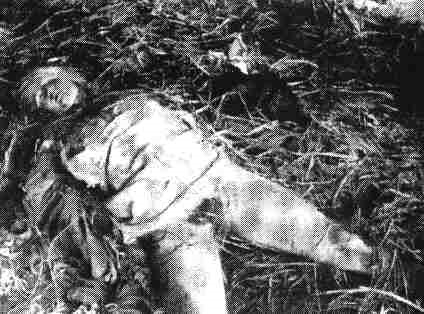
“The Monghols are coming!”
While flames shot up from different corners of the towns and gunfire erupted as citizens were murdered in the streets, the invaders soon began kicking in doors to homes, shops and churches. “[A] whole horde of Asiatic-looking fellows appeared and started searching the cellar,” recalled one priest. “The place was a dreadful sight by the time they had finished. The room was already full of smoke and I begged one of the Russians to let us out… Were they going to let us be burnt to death? After a while, however, a more civilized-looking Russian appeared and I repeated my request. He led us out to… the courtyard of the convent. The noise was deafening—the raucous shouts of the Russians, the crackling of the flames, the crashing of beams and brickwork.”
Many horrified Germans tried to greet with a smile their strange visitors. Revealed one woman from a boarding house in Berbitz:
As a precaution, the landlord, Mr. Grebmann, had lined the vestibule with liquor bottles in the naive hope that his house might thereby be spared from ransacking. To the succeeding troop of slant-eyed Mongolians, the tenants brought their jewelry and watches. Hysterical, Mrs. Friedel embraced one of the greasy Kirgis and drank with him from the same bottle, and the elderly Mr. Grebmann patted them familiarly on the back… One of the Mongolians held up my Tom’s tall leather boots triumphantly, the other one put my rings into his pants pocket…
Scarcely had this second detachment left the house and we were beginning to breathe freely, when fists once more thundered at the door: thus it kept up the whole day. The house doors were not permitted to be locked any more. Each took what he wanted either in a more or less harmless or in a malicious way. Soon we and the Russians were wading knee-deep in thrown-around clothing, laundry and bits of smashed dishes…
As soon as a new detachment of Russians entered the house noisily, we squatted trembling about the round table in Grebmann’s living room. One of the soldiers sat at the table with us with pistol disengaged and demanded schnapps or vodka, while the others rummaged around the house… [N]o one dared to speak. We women sat with downcast eyes and lowered head. Someone had told us never to look a Russian in the eye, otherwise we would be lost…
Before long the inside of the house looked as if a band of robbers had lived there… The fellows had cut the beds up into little pieces, slit open the upholstered chairs, thrown furniture around; had slashed pictures, despoiled books, cracked eggs against the wall; had poured liqueur over the rugs, torn curtains down, and scattered the entire contents of all the closets and drawers all over.
One of the most painful shocks for me was to see how two of the ruffians with their heavy boots kicked the chest in which I had my beautiful porcelain wrapped in tissue paper and cotton wadding. They were all treasured pieces… My most beautiful piece… was used by one of them as a toilet.
As a rule, the Soviets generally sought out gold and jewelry first, with an especial eye for “uri,” or wristwatches. It was not unusual to see Red troops laden with necklaces and gold chains or sporting as many as a dozen watches on each arm. When the people had been plucked clean of valuables, interest usually turned to liquor. In their mad quest for “wodka,” soldiers greedily imbibed everything from fine wines and champagne to rubbing alcohol and perfume. Red troops, observed one woman, were “crazy for anything even smelling of alcohol.”
And then…
“Rape was a word that [had] occurred again and again in [our] conversation,” admitted Lali Horstmann. “It was an expression which caused no pang of fear in our times for its meaning was purely figurative—‘to be ravished’ belonged to the realm of lyrical poetry. Now its original sense was terrifyingly restored and brought us face to face with a new peril.”
“Suddenly the door of the room we were in was opened and some soldiers entered,” a frightened boy recalled as he sat huddled with a group of women in a dark room. “One or two matches were struck and I saw that there were about eight Russians in the room who were obviously looking for women.”
The child continues:
As I crouched there in my corner I saw one of the Russians coming towards me. The match he held in his hand went out. I felt, rather than saw, a hand reach out towards me. I had a fur cap on my head, and suddenly I felt fingers tracing curl-like movements on my temple. For a brief moment I did not know what to make of this, but the next instant, when a loud “No” resounded through the room, I thanked God with all my heart that I was not a woman or a girl. Meanwhile the beasts had spotted their victims and shared them out. Then they suddenly started shooting at random. But it was dark in the room and no one could see where the shots were being fired or who was hit. I heard wails and groans and voices calling out to me to help, but there was nothing I could do. Right next to me poor defenseless women were being ravished in the presence of their children.
Merely because a female had been raped once was no guarantee she would not be assaulted again and again. “Many of the girls were raped as often as ten times a night, and even more,” said a witness from Neustadt.
“There was never a moment’s peace either by day or at night,” added another victim:
The Russians were coming and going the whole time and they kept eying us greedily. The nights were dreadful because we were never safe for a moment. The women were raped, not once or twice but ten, twenty, thirty and a hundred times, and it was all the same to the Russians whether they raped mere children or old women. The youngest victim in the row houses where we lived was ten years of age and the oldest one was over seventy… I am sure that wild and hungry animals would not have behaved any differently.
Wrote one girl from Posen who desperately clung to a cousin for safety:
When we were lying in bed at night we kept hearing steps coming up the stairs… They beat on the door with their rifle-butts, until it was opened. Without any consideration for my mother and aunt, who had to get out of bed, we were raped by the Russians, who always held a machine pistol in one hand. They lay in bed with their dirty boots on, until the next lot came. As there was no light, everything was done by pocket torches, and we did not even know what the beasts looked like.
Like hunted prey leading predators from their young, some mothers instinctively sacrificed themselves. Recorded one little girl, ten-year-old Mignon Fries:
[S]he told us in a stern voice to go outside to play and under no circumstances to come back in. No matter what we heard, until she herself would come for us, no matter how long it took. Fearfully we looked at her even though we didn’t know exactly what we were afraid of… We went outside and stood around for awhile not knowing what to do, just listening to the noise in the apartment. My mother had just closed all the windows but we could still hear the soldiers talking, laughing and shouting. Then the music started and before long the soldiers were singing…
The day gave way to evening, it got rather chilly and still we were outside and the “party” got noisier. Every once in a while a soldier would open a window and throw an empty vodka bottle outside. Sometimes the music would stop for a while, but the singing and shouting continued. As it got later and later we became very hungry and cold, but having been raised in an atmosphere of strict obedience we didn’t dare go back in the house against our mother’s orders and just huddled against the wall of the shed in the garden trying to keep each other warm… The music and the singing broke off as suddenly as it had started… Within minutes it was all over and all the soldiers left the house… But it was a long time before our mother finally came out to get us. She was very pale and hugged both of us very tightly for a long time and we could feel her body shaking.
If front-line troops had displayed unpredictability regarding rape, the second wave did not. “All of us, without exception, suffered the same,” revealed one victim.
“And to make matters worse,” added a witness from Neisse, “these atrocities were not committed secretly or in hidden corners but in public, in churches, on the streets, and on the squares… Mothers were raped in the presence of their children, girls were raped in front of their brothers.”
“They… raped women and girls… in ditches and by the wayside, and as a rule not once but several times,” echoed another viewer. “Sometimes a whole bunch of soldiers would seize hold of one woman and all rape her.”
For those Germans who had naively imagined that they might “win over” the Soviets with kindness and courtesy, they now understood, too late, that Nazi propaganda had in this instance grossly understated the threat, rather than exaggerated it. “[T]he atrocity reports in the newspapers were harmless, compared to reality,” one incredulous victim revealed.
While many upright Russian officers courageously stepped in and risked their own lives to stop the murders and rapes, their efforts were little more than a drop of water to a forest fire.
“[A]ll of us knew very well that if the girls were German they could be raped and then shot,” admitted Alexander Solzhenitsyn. “This was almost a combat distinction.”
“There will be no mercy—for no one,” ran one Russian general’s order to his men. “It is pointless to ask our troops to exercise mercy.”
“Kill them all, men, old men, children and the women, after you have amused yourself with them,” urged the Jewish propagandist, Ilya Ehrenberg, in his flaming leaflets that were showered down from airplanes. “Kill. Nothing in Germany is guiltless, neither the living nor the yet unborn… Break the racial pride of the German women. Take her as your legitimate booty. Kill, you brave soldiers of the victorious Soviet Army.”
Springing from house to house and victim to victim “like wild beasts,” the drunken horde was determined to embrace such words as the above at their literal worst.
“When the Russians eventually tired of looting, robbing, murdering, and ill-treating the women and girls, they set fire to a considerable part of the village and razed it to the ground,” said a survivor of Schoenwald, the small community that had dismissed rumors of Russian ruthlessness and opted to welcome them instead.
Much like Schoenwald, one town after another was swiftly enveloped by the howling red storm… with the same results.
“And as we were then hauled out of the cellar,” recalled a woman who, along with her mother and grandmother had been raped repeatedly, “and as they stood there with their machine guns, my mother said, ‘Well, now we’ll probably be shot.’ And I said, ‘It’s all the same to me.’ It really was all the same to me.”
You can imagine Asian cruelty. “Frau, come,” that was the slogan. “Frau, come.” And I was so furious, because I’d had it up to here… [H]e had me in such a clinch I couldn’t free myself; with my elbow I hit him in the pit of his stomach. That definitely hurt him, and he yelled, “You, I shoot.” And he was brandishing this kind of machine gun around my nose and then I said, “Then shoot.” Yelled it, yelled it just like he did. “Then shoot.”
Though this woman miraculously lived, many who offered even token resistance did not. Wrote a witness from Bauschdorf:
Emilie Ertelt… wanted to protect her fifteen-year old daughter, who had been raped sixteen times on one and the same day. Holding a lighted candle in her hand, Mrs. Ertelt, and all those present in the room began to pray for her daughter… [F]our shots were suddenly fired at us. After a few moments some more Russians appeared and started shooting at Mrs. Ertelt, wounding her in the head. The blood streamed down her face, and the nuns who were present went to her assistance and bandaged her head. Soon afterwards another Russian appeared, a brutal-looking fellow… and fired a shot at close range. Mrs. Ertelt was killed instantaneously.
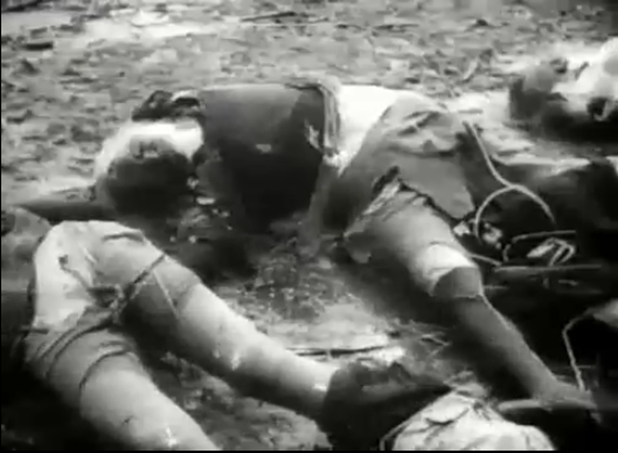
German victims of Red Army savages
Surrounded by Soviets, flight was simply not a sane option for females—and yet, some tried. One young teacher from Kriescht ran terror-stricken into the nearby woods. The woman was soon found, however, and, according to a chronicler, “they drove her out on the road stark naked, and many soldiers used her one after the other. She reached her village crawling on hands and knees along the ditch, through mud and snow.”
Another group of females found temporary haven in a barn near Schoeneiche. But again, the refuge was swiftly discovered. Remembered one who was there:
They burst in, drunk with vodka and with victory, looking for women. When they saw only older women and children hiding behind a pile of carpets, they must have suspected that somewhere younger bodies were being concealed, and they started to ram their bayonets into the carpets. Here and there first and then systematically… Nobody knows how many young girls were killed instantly that night. Eventually, the muffled cries of anguish and pain gave the hiding places away, and the victors started unrolling their prey. They chased those girls that had remained unhurt through the barn… By then the barn looked like a battle field with wounded women on the floor right next to screaming and fighting victims forced to endure repeated and violent acts of rape.
Faced by relentless assaults, with flight out of the question, females tried a variety of stratagems to save themselves. “Some of us tried to make ourselves as unattractive as possible by rouging the tips of our noses, putting gray powder on our upper lips to look like mustaches, and combing out our hair wildly,” revealed Lali Horstmann. Others placed pillows under their dresses and hobbled with sticks to appear like hunchbacks. One crazed woman, clad in an alluring night gown, left her door open purposely to attract soldiers to where she was lying in bed, in the hope of finding a protector.
“Two Russians, who had entered for a moment stood speechless. Then both spat in disgust, using a coarse word, shocked to the core by a woman who could offer herself to them. They went on to the room next door, from where soon came cries for help from the girl’s grandmother, aged sixty-nine. Her valiant defense of her honor had made her more attractive than the pretty, too willing girl.”
Regarding “willing” women such as the above as “unclean,” Red troops were as likely as not to kill on the spot such individuals. Many frantic females mistakenly assumed a house of God would provide protection. In fact, churches were usually the rapists’ first stop. Agonized a priest from Neisse:
The girls, women and nuns were raped incessantly for hours on end, the soldiers standing in queues, the officers at the head of the queues, in front of their victims. During the first night many of the nuns and women were raped as many as fifty times. Some of the nuns who resisted with all their strength were shot, others were ill-treated in a dreadful manner until they were too exhausted to offer any resistance. The Russians knocked them down, kicked them, beat them on the head and in the face with the butt-end of their revolvers and rifles, until they finally collapsed and in this unconscious condition became the helpless victims of brutish passion, which was so inhuman as to be inconceivable. The same dreadful scenes were enacted in the hospitals, homes for the aged, and other such institutions. Even nuns who were seventy and eighty years old and were ill and bedridden were raped and ill-treated by these barbarians.
Those women pregnant, on their menstrual cycle, or enduring diarrhea, suffered like all the rest. Nothing, it seemed—not age, ailment or ugliness—could repel the Red rapist. Even death was no defense.
“I… saw some twenty Red Army men standing in line before the corpse of a woman certainly beyond sixty years of age who had been raped to death,” one sickened witness recorded. “They were shouting and laughing and waiting for their satisfaction over her dead body.”
As the above viewer went on to add, and as numerous examples attest, such ghoulish depravities were not isolated events.