‘It is always more difficult to fight
against faith than against knowledge’.
—Hitler
‘It is always more difficult to fight
against faith than against knowledge’.
—Hitler
‘I use emotion for the many
and reserve reason for the few’.
—Hitler
‘Hate is more lasting than dislike’.
—Hitler
‘He alone, who owns the youth, gains the future’.
—Hitler
‘The day of individual happiness has passed.’
—Hitler
‘Universal education is the most corroding and disintegrating poison that liberalism has ever invented for its own destruction’.
—Hitler
‘Words build bridges into unexplored regions’.
—Hitler
‘Strength lies not in defence but in attack’.
—Hitler
Despite the bravado, Hitler trod very carefully. Shortly after his release, Hitler had two meetings with the Bavarian minister president, Heinrich Held, at which he assured him that he would not attempt another putsch. He toned down some of the rhetoric in Mein Kampf, the second volume of which he was writing in the calm of his mountain retreat at Berchtesgaden, the use of which had been given to him by a well-wisher.
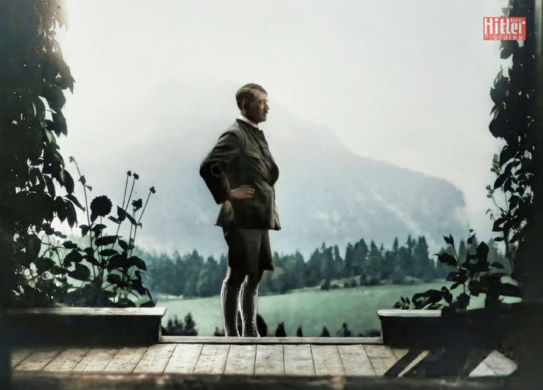
Hitler also moved to sort out his national status, which acquired renewed importance after the speaking ban. In early April 1925, he wrote to the authorities in Linz requesting his ‘release from Austrian citizenship’. Hitler also had a long discussion with the Austrian consul in Munich and expressed his desire to surrender his nationality. On 30 April 19 25, the Austrian authorities finally stripped him of the citizenship he had never accepted. This did not mean that Hitler had established his right to stay in Germany beyond all doubt—he was now formally ‘stateless’—but he had at least ensured that it would be more difficult to deport him somewhere else. The threat of removal, however, remained, and the Bavarian authorities reminded him of it from time to time…
Hitler avoided confrontation, partly in order to concentrate on the completion of Mein Kampf. ‘Not a word from Hitler,’ Goebbels noted right at the end of 1924, ‘Oh this sly fox with the political instinct.’ A fortnight later, he asked anxiously, ‘What will Hitler do? That is the anxious question every day. Hopefully he will not go over to the camp of reaction.’ Hitler’s reticence annoyed some of the rank and file, who complained that it would be better for him to sort out the ‘problems’ in the movement than to work on a ‘high political work’. The Bavarian police, which kept a close eye on Hitler after his release, also reported that he seemed to be absorbed by Mein Kampf, which was concerned ‘exclusively with Marxism and Jewry’. This was, as we shall see, by no means a completely accurate summary…
Hitler gave thirty-eight speeches in 1925, and fifty-two in the following year. This gave him limited traction, however, partly because the numbers attending were substantially lower than during his heyday in 1923, and partly because he was still banned from appearing in public in much of Germany. Hitler was thus forced to speak to closed party meetings, in salons, or at private events. Nor could he put too much reliance on his personal magnetism…
Hitler would have to work with the people he had rather than the people he would like to have had. He knew that the party needed to transcend his own person. Personal loyalty was not enough; he needed party cadres to obey not just him but their immediate superiors. The Führer principle was thus extended beyond the Fuhrer himself. More talented and trained speakers were needed, so that the entire strain of communicating the message did not fall on him and a few others. ‘We need speaker schools,’ he announced in March 1925, ‘because to this day this mass movement has only 10-12 good speakers.’ In other words, Hitler was learning not to hog his charisma, but to spread it around. His speeches and instructions increasingly referred not just to the Führer in the singular, but to the plural Führers upon whom the leadership of the movement depended.
Central to this was the establishment of a proper party bureaucracy. Here the Social Democrats explicitly served as a model. Hitler spoke grudgingly of the SPD as a party ‘organized like the SA’. Despite shortage of funds, the NSDAP moved to new premises in the Schellingstrasse in Munich in the summer of 1925, and Hitler signalled his plan to build a dedicated ‘Party Headquarters’ in Munich paid for by the membership…
Hitler also resurrected the Sturmabteilungen, not as a paramilitary formation, as it had developed in the months preceding the Putsch, but as an organization dedicated to ‘strengthening of the bodies of our youth, bringing them up on discipline and dedication to the common great ideal [and] training in the marshalling and reconnaissance service of the movement’.There should be no weapons, either carried openly or stored in depots. Anybody who violated that rule was to be expelled. Hitler’s concern here was to avoid being dragged into illegality by armed hotheads. The immediate effect of this ruling was to precipitate a breach with Röhm, for whom the paramilitary aspects of the SA remained central. He resigned and eventually emigrated to South America . That same month Hitler created the ‘Protective Squadron’ soon known simply as the SS, a personal protection squad whose first leader, Josef Berchtold, placed particular stress on ideological purity. In a critical assertion of authority, Hitler had established a monopoly of violence within the movement.
and the Sun, 8

There are, in the records of mankind, few things as beautiful as the early history of the National Socialist Movement.
The tremendous will-power, kindled through despair, out of which the latter had sprung, was, as I just said, nothing less than the divine Will to Perfection in its last (or one before last) effort to lead the best up-stream against the fated current of Time and to save through them whatever is yet worth saving in this doomed Creation. The material and moral condition under which the Movement took shape—the miserable, smoky room[1] in which six unknown German workmen sat and discussed with the superman who was soon to guide them, and millions of others, to the reconquest of national greatness these men’s utter poverty, their utter insignificance in the eye of the wide world and specially of those well-spoken of, comfortable politicians and party-leaders whom they were, within few years, to thrust into oblivion; their burning faith and which is more, the fact that their Leader—Adolf Hitler—was in possession of cosmic truth—are highly symbolical. All life begins in darkness. All everlasting things are born in silence and away from the lime-light of publicity; in faith and in truth. And whatever is not born in such a manner, does not last. However noisy and wide-spread be its success, it will not stand the test of time and that of persecution, let alone the terrible impact of the storm in which a Time-cycle comes to its end.
The very early growth of National Socialism as an active, incarnate Idea, was like the growth of a corn-seed within the snow-bound earth; it was like the slow rise of molten rock within the depth of a slumbering volcano: unnoticed and irresistible. It was the outcome of a natural Force, in fact, of the oldest and mightiest of all natural Forces: of Life’s inherent instinct of self-preservation in presence of the Powers of death—the Force that links every Time-cycle to the following one, over almost total destruction. Started in 1919, officially founded in early 1920, it owes that divine Force its impulse which nothing,—not even the disaster of 1945—was able to break.
Throughout the wide world, governments representing sheer finance interests looked with satisfaction upon their latest handiwork: the Versailles peace-treaty, up till then the most infamous official document in history, intended to enslave Germany for all times. And the sheep followed their shepherds. And the parrots repeated the nonsense—and lies—which they had been taught: ‘This Treaty seals the victory of those who fought this war in order to put an end to all wars!’—while frenzied crowds demonstrated in the streets of the French towns howling ‘Germany must pay!’ Never had there been so many speeches, so many sermons, so many articles and books—such a ‘hullabaloo’—about ‘peace.’ And never had victors yet behaved with such calculated barbarity.
In the inconspicuous little room at the back of a café in Munich, however, Adolf Hitler—the Man ‘against Time,’—spoke to the tiny group of German workmen; to the rough men of pure blood and solid virtues, sons of the people among which he—He, the One Who comes back,—had chosen (this time) to be born. And his words were—and his whole life was—the answer to the lies of this advanced Dark Age. They cannot have been much different from those one reads in Mein Kampf although these were written five years later. He said:
For me, as for every true National Socialist, there is only one doctrine: people and fatherland.
We have to fight to secure the existence and expansion of our race and of our people; to enable them to nourish their children and to preserve the purity of their blood; to secure the freedom of our Fatherland, so that our people may be in the position to fulfil the mission appointed to them by the Creator of the Universe.[2]
He said:
Whoever speaks of a mission of the German people on this earth must know that such a mission can only lie in the formation of a State which holds it to be its highest task to preserve and to promote the noblest of all elements which have, in our people, nay, in the whole of mankind, remained unspoilt.[3]
He said:
The German Reich should, as a State, comprise all Germans, and set itself the task not merely to gather and preserve the most valuable original racial elements in that people, but to raise them slowly and surely to a ruling position.[4]
He said:
Men do not go to ruin through lost wars, but through the loss of that power of resistance that lies in pure blood alone.[5]
He was aware of the downfall of the whole of mankind—including Germany—in the present Age. ‘Unfortunately,’ said he, ‘our German people are no longer racially homogeneous.’[6] And aware of the primary cause of downfall: racial mixture, the result of forgetfulness of Nature’s truth. And aware of that truth, expressed in the oldest Book of Aryan Wisdom, the Bhagavad-Gita: ‘Out of the corruption of women proceeds the confusion of races; out of the confusion of races, the loss of memory; out of the loss of memory, the loss of understanding; and out of this, all evil.’[7] He was aware of it, not because he had read the Book, (it is doubtful whether he had, at least as early as 1919) but because the impersonal Wisdom of the most ancient Aryans lived in him; because he was He Who has spoken in the Book—the One Who comes back. And he knew that the Wisdom which he preached as the key to earthly salvation ‘corresponds entirely to the original meaning of things’;[8] and that the way he preached—return to that primaeval, cosmic Wisdom in individual and in collective life, in thought and in deed,—was—is—the only way through which the chosen few can survive the last impact of the forces of disintegration and become the founders of the new Age of Truth. And that those chosen few are the best elements of the youngest great Race of our Time-cycle: the Aryan. He knew that too. And while he stressed in his speeches the necessity of freeing Germany, at once, from the immediate consequences of the Versailles Treaty—inflation; unemployment; growing misery,—his ultimate aim remained to raise her to that organised power which, in the light of traditional Wisdom, can only be termed as a ‘State against Time’—nay, the ‘State against Time,’ enabling the best to carry both their privileged biological substance and their unmarred Golden Age ideal through and beyond the last storms of this Dark Age.
He spoke with the compelling eloquence of faith, knowing that he was right—that the endless future of the Universe (not merely of Germany and Europe) would glaringly prove how right he was. He spoke with the wild eloquence of emergency, knowing also that the struggle he was about to start had to take place then or never; that there was not an hour to waste.
And the sombre faces of the hungry, embittered men, who had fought and suffered, and yet lost, gazed at him with that unconditional admiration and confidence that is the essence of worship—the faces of the six, and, soon, of many more; of; hundreds, in ever broader meeting-halls, always too small to contain them; of hundreds of thousands under the open sky.
‘Men do not go to ruin through lost wars…’ The magic words—these, and others, meaning the same,—rang throughout defeated Germany. And the hundreds of thousands no longer felt defeated. They now knew they had been betrayed. And they roared against the traitors and against the dark powers at the back of them—the dark powers that they (the German people) would one day crush. They felt strong; they felt young;—invincible and immortal. They felt what the best among them really were—had been, from the beginning of Aryan history, appointed to become—the masters of an unheard-of future; the proud founders of a new world (Only they did not—yet—know through what a terrible Via dolorosa they actually were to fulfil that staggering destiny). They gathered, more and more numerous, round the Man whose inspired speech quickened in them the highest possibilities of joyous heroism—and made them see old forgotten truths in a glaring new light; whose magic radiance filled them with self-assurance: whose love for them was limitless and gratuitous, like the love of a God. They beheld in him the Leader, the Avenger, the Saviour—the living embodiment of their unvanquished collective Self, which indeed he was. And they followed him blindly. Their love carried him to power; their love, and their hatred for those whom he rightly pointed out to them as the promoters of the humiliation of 1918 and of all the subsequent misery: the Jews, and the servants of Jewry, agents of the Dark Forces by nature or by choice, Germany’s—and the world’s—real enemies.
__________
[1] Mein Kampf, p. 240 and following.
[2] Ibid., p. 234.
[3] Ibid., p. 439.
[4] Ibid., p. 439.
[5] Ibid., p. 324.
[6] Ibid., pp. 436-437.
[7] The Bhagavad-Gita, I, verse 41 and following.
[8] Mein Kampf, p. 440.
______ 卐 ______
The Lightning & the Sun by Savitri Devi (Counter-Currents Publishing, 2014, unabridged edition) can be ordered here.