web analytics
Categories
Homer New Testament Richard Carrier

Mark transvaluing Homer

Note of the Editor:

Those familiar with the critical literature of the New Testament know that there is only one original gospel, that of Mark. Luke and Matthew copied and pasted a bunch of verses from Mark’s gospel to add even more literary fiction from the pen of these two Synoptics (John the Evangelist would later do the same).
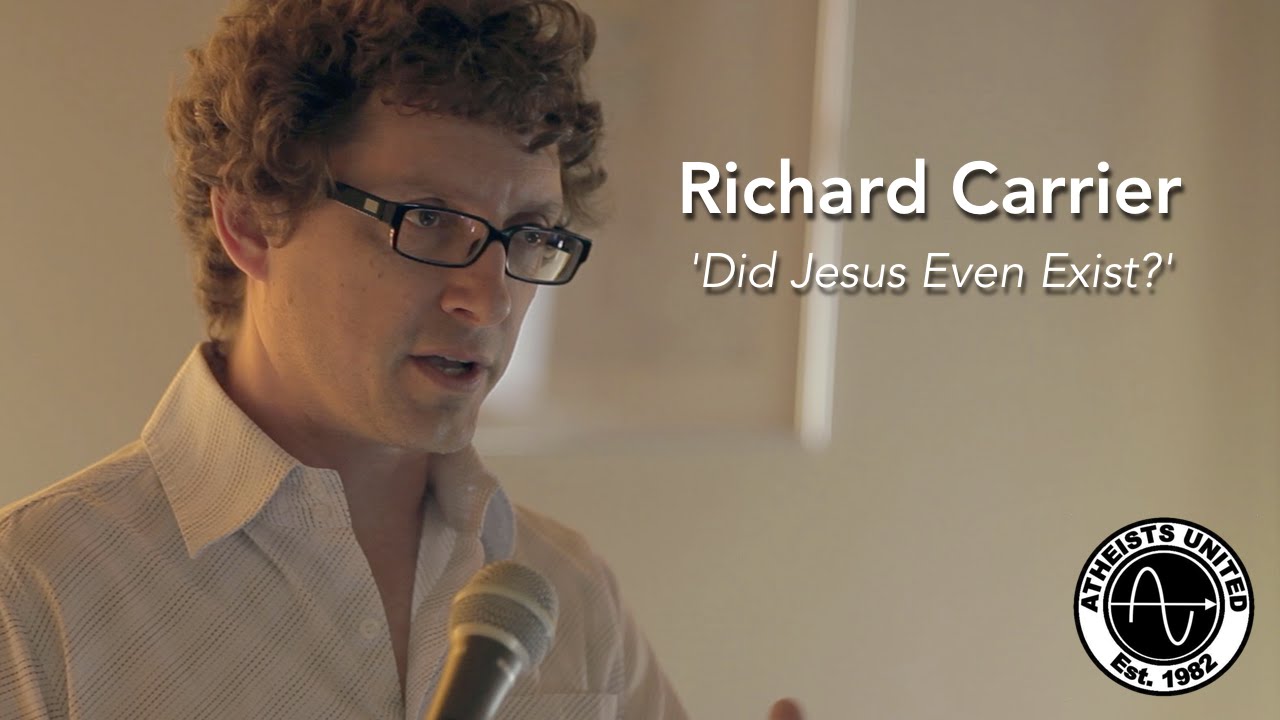
Richard Carrier needs no introduction on this site. The new visitor who is unfamiliar with his work can consult the links about Carrier on the sidebar. Precisely because Carrier is a typical left-wing scholar, the exact opposite of post-Nietzscheans like us, I am struck by how he talks about how the evangelist Mark transvalued—the word he uses—the axiology of the Greco-Roman world.

In his most recent debate, uploaded this morning, with Dennis R. MacDonald, the author of the book he reviews below, Carrier used again the word transvaluation a couple of times right at the beginning of the YouTube debate (just don’t pay attention to the degenerate music that their host chose).

The following is Carrier’s ‘Review of The Homeric Epics and the Gospel of Mark’, a book-review of the MacDonald book, Yale University, 2000 (bold-type added by me):


______ 卐 ______
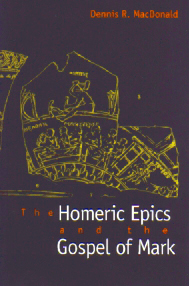
 

This is an incredible book that must be read by everyone with an interest in Christianity. MacDonald’s shocking thesis is that the Gospel of Mark is a deliberate and conscious anti-epic, an inversion of the Greek ‘Bible’ of Homer’s Iliad and Odyssey, which in a sense ‘updates’ and Judaizes the outdated heroic values presented by Homer, in the figure of a new hero, Jesus (whose name, of course, means ‘Savior’). When I first heard of this I assumed it would be yet another intriguing but only barely defensible search for parallels, stretching the evidence a little too far-tantalizing, but inconclusive. What I found was exactly the opposite. MacDonald’s case is thorough, and though many of his points are not as conclusive as he makes them out to be, when taken as a cumulative whole the evidence is so abundant and clear it cannot be denied. And being a skeptic to the thick, I would never say this lightly. Several scholars who reviewed or commented on it have said this book will revolutionize the field of Gospel studies and profoundly affect our understanding of the origins of Christianity, and though I had taken this for hype, after reading the book I now echo that very sentiment myself.

 
Background and purpose of Mark

MacDonald begins by describing what scholars of antiquity take for granted: anyone who learned to write Greek in the ancient world learned from Homer. Homer was the textbook. Students were taught to imitate Homer, even when writing on other subjects, or to rewrite passages of Homer in prose, using different vocabulary. Thus, we can know for certain that the author of Mark’s Gospel was thoroughly familiar with the works of Homer and well-trained in recasting Homeric verse into new prose tales. The status of Homer in basic education remained throughout antiquity, despite the fact that popular and intellectual sentiment had been sternly against the ethics and theology of his epics since the age of Classical Greece. Authors from Plato (400 b.c.e) to Plutarch (c. 100 c.e.) sought to resolve this problem by ‘reinterpreting’ Homer as allegory, or by expunging or avoiding offensive passages, neither of which was a perfect solution.

For the Latin language, the opportunity was afforded for Virgil to solve this problem by recasting the Homeric epic into Roman form, exhibiting Roman ideals and creating more virtuous heroes and gods. Likewise, borrowing and recasting from Homer is evident in numerous works of fiction, which often had a religious flavour, and were proliferating in the very same period as the Gospels. One prominent example (mentioned but not emphasised by MacDonald) is the Satyricon of Petronius, which can be decisively dated prior to 66 A.D. and thus is most likely earlier than any known Gospel, and since this novel was in Latin (and a satire), it is almost certain that many undatable Greek novels, which surely originated the form, long precede this. So rewriting Homer to depict new religious ideas and values was a standard phenomenon. In MacDonald’s words, ‘Homer was in the air that Mark’s readers breathed’ (p. 8), and all the more so among Mark’s Gentile audience. But to smartly recast Homer into a new Greek form, reflecting contemporary Graeco-Jewish ideals, was a task simply waiting to be done. If MacDonald is right, this is what Mark set out to do. So much is clear: the motive, ability, and inspiration were certainly present, and MacDonald rapidly presents all the evidence, backing it up with copious and scholarly endnotes in chapter 1.

Why? In MacDonald’s words, Mark ‘thoroughly, cleverly, and strategically emulated’ stories in Homer and the Old Testament, merging two great cultural classics, in order ‘to depict Jesus as more compassionate, powerful, noble, and inured to suffering than Odysseus’ (p. 6), and hence ‘the earliest evangelist was not writing a historical biography, as many interpreters suppose, but a novel, a prose anti-epic of sorts’ (p. 7). In particular, the differences between Mark and Homer need no explanation: the differences are the point, the very objective of the later author. Some of those differences are also the obvious result of a change of scene from the ancient Mediterranean to near-contemporary, Roman-occupied Judaea, or of literary borrowing from Jewish texts. Some may reflect some sort of traditional or historical core story, though it is almost impossible to tell when. Instead, it is the similarities that ‘cry out for explanation’, and contemporary apologists must now begin to address this issue.

Of particular use, for all those who want to develop (or attack) theories of literary borrowing—in the Gospels or elsewhere—is the set of six criteria for identifying textual influence outlined by MacDonald at the end of his first chapter, and demonstrated quite effectively on a passage in Acts. Though no one of these criteria alone carries very much weight, the more criteria that are met in a single instance, the stronger the case. However, one caveat MacDonald does not provide is in regard to his criterion of order. In many cases, matching sequences of passages or themes is indeed significant. However, some cases of matching sequence are such that any other sequence would be logically impossible. Therefore, correlation of this kind can in some cases be coincidence. Nevertheless, even engaging this caution, the sequential evidence MacDonald presents is very often, taken as a whole, not coincidental. Likewise, it should be known that much of Mark’s use of Homer is to shape and detail an otherwise non-Homeric story, and the task of deciding what that core story is, or whether this core story in any given case is a Biblical emulation, or a historical fact, or a legend, or something of the author’s deliberate creation, or any combination thereof, is not something MacDonald even intends to undertake in this book, although he makes some suggestions in his concluding paragraphs.

 
Modeling Odysseus

The Odyssey is rife with the theme of the suffering hero, and MacDonald builds a solid case in chapter 2 for the philosophical veneration of Odysseus as the best example of a man. If Jesus could be made to one-up and even replace Odysseus, Mark would achieve a literary and moral coup. And there are in the overall story obvious if not overly-telling similarities: ‘Both [men] faced supernatural opposition… Each travelled with companions unable to endure the hardships of the journey, and each returned to a home infested with rivals who would attempt to kill him as soon as they recognised him’, and ‘both heroes returned from Hades alive’ (p. 17). Some parallels are a little more startling but less significant to the historian than to the literary critic: the parable of the Wicked Tenants (Mk. 12:1-12), and the passage capturing the famous phrase ‘for you do not know when the master of the house will come’ (Mk. 13:34-5), both evoke the image of Odysseus returning in disguise to surprise the suitors who have turned his house into a den of sin (MacDonald develops this theme further in chapter 5, and again in chapter 14, and in the conclusion). Do not be like them, Mark is saying to his readers. But of course Jesus himself could have said that, intending the very same allusion. Examples like these can make good material for sermons, and serve well the connoisseurs of visionary prose, yet don’t really prove whether Mark has himself deliberately crafted the story. But in conjunction with what follows, this becomes part of a cumulative case for Mark’s inversion of Homer.

Who knew, for instance, that Odysseus was also a carpenter? The companions are another general link with the Odyssey. MacDonald points out how Mark is the harshest evangelist in his treatment of the disciples, while the others sometimes go out of their way to omit or alter this disparagement when they borrow from Mark. Why were the disciples such embarrassing nitwits, ‘greedy, cowardly, potentially treacherous, and above all foolish’ (p. 20)? As history, it is hardly credible. As a play on Homer, it makes perfect sense: for the companions of Odysseus were exactly like this. Homer cleverly employed the ineptitudes of the crew to highlight the virtues of Odysseus, making him appear even more the hero, enhancing his ‘wisdom, courage, and self-control’ (p. 23). MacDonald briefly explores five other general similarities between the two ‘entourages’ in chapter 3, including the fact that in the one story we have sailors, while in the other, fishermen-who do a lot of going about in boats, even though the vast majority of Judaea is dry land.

Chief among these similarities is the comparison between Peter and Eurylochus. Both spoke on behalf of all the followers, both challenged the ‘doomsday predictions’ of their master to their own peril, both were accused by their leader of being under the influence of an evil demon, and both ‘broke their vows to the hero in the face of suffering’—in effect, both ‘represent[ed] the craven attitude toward life’ (p. 22-3). Again, this could be a mere veneer woven through an otherwise true story by Mark, and some of MacDonald’s ideas (such as developed in chapter 4) are intriguing but too weak to do much with. But it is true that both epics announce from the start a focus on a single individual, both center on a king and his son reestablishing authority over a kingdom, both involve an inordinate amount of events and travel at sea. Both works begin by summoning their own Muse: Homer, the Muse herself; Mark, the Prophet Isaiah. In both stories, the son’s patrimony is confirmed by a god in the form of a bird, and this confirmation prepares the hero to face an enemy in the very next scene: Telemachus, the suitors; Jesus, Satan. And eventually the odd links keep accumulating, and compel one to question the whole thing.
 

Stark examples

‘Once the evangelist linked the sufferings of Jesus to those of Odysseus, he found in the epic a reservoir of landscapes, characterisations, type-scenes, and plot devices useful for crafting his narrative’ (p. 19). Of course, all throughout MacDonald points out coinciding parallels with the Old Testament and other Jewish literature, but even these parallels have been moulded according to a Homeric model in every case he examines. Consider two of the many mysteries MacDonald’s theory explains, and these are even among the weakest parallels that he identifies in the book:

Why do the chief priests need Judas to identify Jesus in order to arrest him? This makes absolutely no sense, since many of their number had debated him in person, and his face, after a triumphal entry and a violent tirade in the temple square, could hardly have been more public. But MacDonald’s theory that Judas is a type of Melanthius solves this puzzle: Melanthius is the servant who betrays Odysseus and even fetches arms for the suitors to fight Odysseus—just as Judas brings armed guards to arrest Jesus—and since none of the suitors knew Odysseus, it required Melanthius to finally identify him. MacDonald also develops several points of comparison between the suitors and the Jewish authorities. Thus, this theme of ‘recognition’ stayed in the story even at the cost of self-contradiction. Of note is the fact that Homer names Melanthius with a literary point in mind: for his name means ‘The Black One’, whereas Mark seems to be maligning the Jews by associating Melanthius with Judas, whose name is simply ‘Judah’, i.e. the kingdom of the Jews, after which the Jews as a people, and the region of Judaea, were named.

Why does Pilate agree to free a prisoner as if it were a tradition to do so? Such a practice could hardly have been approved by Rome, since any popular rebel leader who happened to be in custody during the festival would always escape justice. And given Pilate’s reputation for callous ruthlessness and disregard for Jewish interests, it is most implausible to have him participating in such a self-defeating tradition—a tradition for which there is no other evidence of any kind, not even a precedent or similar practice elsewhere. But if Barabbas is understood as the type of Irus, Odysseus’ panhandling competitor in the hall of the suitors, the story makes sense as a clever fiction. Both Irus and Barabbas were scoundrels, both were competing with the story’s hero for the attention of the enemy (the suitors in one case, the Jews in the other), and both are symbolic of the enemy’s culpability.

Of course, Barabbas means ‘son of the father’ and thus is an obvious pun on Christ himself. He also represents the violent revolutionary, as opposed to the very different kind of saviour in Jesus (the real ‘Saviour’). On the other hand, Irus was a nickname derived from a goddess (Iris), and MacDonald fails to point out that her name means ‘rainbow’, which to Mark would have meant the sign from God that there would never again be a flood (Ge. 9:12-13). Moreover, Irus’ real name was Arnaeus, ‘the Lamb’. What more perfect model for Mark? The Jews thus choose the wrong ‘son of the father’ who represents the Old Covenant (symbolised by the rainbow, and represented by the ideal of the military messiah freeing Israel), as well as the scapegoat (the lamb) sent off, bearing the people’s sins into the wilderness, while its twin is sacrificed (Lev. 16:8-10, 23:27-32, Heb. 8-9). MacDonald’s own analysis is actually confirmed by this additional parallel that he missed, and that is impressive.

MacDonald goes on to develop many similar points that not only scream of Homer being on Mark’s mind, but also explain strange features of Mark. The list is surprisingly long:

Why did Jesus, who nevertheless taught openly and performed miracles everywhere, try to keep everything a secret? Why did Jesus stay asleep in a boat during a deadly storm? Why did Jesus drown two thousand pigs? Why does Mark invent a false story about John the Baptist’s execution, one that implicates women? Why are the disciples surprised that Jesus can multiply food even when they had already seen him do it before? Why does Jesus curse a fig tree for not bearing fruit out of season? How does Mark know what Jesus said when he was alone at Gethsemane? What is the meaning of the mysterious naked boy at Jesus’ arrest? Why does Jesus, knowing full well God’s plan, still ask why God forsook him on the cross? Why does Mark never once mention Mary Magdalene, or the other two women at the crucifixion, or even Joseph of Arimathea, until after Jesus has died? Why is the temple veil specifically torn ‘top to bottom’ at Jesus’ death? Why is Joseph of Arimathea able to procure the body of a convict so soon from Pilate? Why do we never hear of Joseph of Arimathea again? Why does Jesus die so quickly? Why do the women go to anoint Jesus after he is buried? Why do they go at dawn, rather than the previous night when the Sabbath had already ended?

All these mysteries are explained by the same, single thesis. This is a sign of a good theory. With one theoretical concept, not only countless parallels are identified, but numerous oddities are explained. That is very unlikely to be due to chance. And there is evidence of so many plausible connections, that even though any one of them could perhaps with effort be argued away, the fact that there are so many more makes it increasingly unlikely that MacDonald is seeing an illusion. Finally, his entire theory is plausible within the context of what we can deduce to have been Mark’s cultural and educational background.

 
Crescendo of doom

MacDonald’s book is built like a crescendo: as one reads on, the cases not only accumulate, they actually get better and better, clearer and clearer. In the story of the Gerasene swine (Mk. 5:1ff) MacDonald finds that 18 verses have thematic parallels in the Odyssey, 13 of those in exactly the same order! And even with some of those out of order the order is not random but is inverted, and thus a connection remains evident. In the story of Salome and the execution of John, MacDonald finds seven thematic parallels with the Murder of Agamemnon, all of them in the same order, and on top of that he details two other general parallels. And the two food miracles, forming a doublet in Mark, contain details that match a similar doublet of feasts in the Odyssey, and contain them in the same respective order: ‘Details in the [first] story of Nestor’s feast not found in the [second] story of Menelaus appear in the [first] feeding of the five thousand and not in its twin’ while ‘details in the [second] story of Menelaus not found in the [first] story of Nestor appear in the [second] feeding of the four thousand and not in the first story’ so that ‘the chances of these correspondences deriving from accident are slim’ (p. 85).
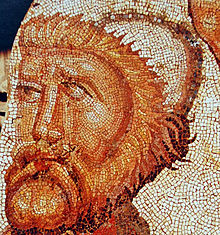
(Editor’s interpolated note: A mosaic depicting Odysseus, from the villa of La Olmeda, Pedrosa de la Vega, Spain, late 4th-5th centuries c.e. Both he and Homer are always depicted as whites.)

These examples of a connection between Mark and Homer are far denser than the two examples I detailed earlier, and cannot be explained away even by the most agile of thinkers. Consider the last case, which even has the fewest parallels relative to the other two: in the first feasts, the main characters go by sea, but in the second, by land; in the first, only men attend (even though there is no explanation in Mark of why this should be), but in the second there is no distinction; in the first, the masses assemble into smaller groups, and lie on soft spots, but not in the second; more attend the first than the second (and the numbers are about the same: 5000 in Mark, 4500 in Homer).

On the other hand, in the second feasts, unlike the first, someone asks the host a discouraging question and yet the host shows compassion anyway—in Mark, this is particularly strange, since after the first miracle the disciples have no excuse to be surprised that Jesus can multiply food, so the doubting question can only be explained by the Homeric parallel; finally, in the second feasts, as opposed to the first, there are two sequential courses—bread, then meat. In both authors, the feasts serve an overt educational role: in the one case to educate the hero’s son about hospitality, in the other to educate the disciples about Jesus’ power and compassion, drawing attention to the difference in each story’s moral values. There are even linguistic parallels—Homer’s feasts were called ‘symposia’ (drinking parties) even though that word usually referred to smaller gatherings; likewise, Mark writes that the first feast was organised by ‘symposia’, despite the fact that only food is mentioned, not water or wine. Several of these details in Mark, as noted, are simply odd by themselves, yet make perfect sense when we see the Homeric model, and therein again lies the power of MacDonald’s thesis.

MacDonald does similar work illuminating the Transfiguration, the healing of Bartimaeus, the Hydropatesis (water-walk), the Marcan Apocalypse, the Triumphal Entry, the Anointing, the Passover Feast (including a definite connection with cannibalism that offers a possible ideological origin for the Eucharist as a transvaluation of Homer), the Prayer and Arrest at Gethsemane, the Crucifixion, the Burial, and some details of the Empty Tomb narrative. His theory provides an excellent reason to suppose that the naked boy at Jesus’ arrest is the same as the boy the women find in the empty tomb—and he is a marker of resurrection: a type of the ill-fated Elpenor. Likewise, his theory puts a serious damper on the historicity of Joseph of Arimathea and the burial account in Mark: Joseph is a type of Priam, who rescued the body of Hector for burial in a similar way.

What I found additionally worthwhile is how MacDonald’s theory illuminates the theme of ‘reversal of expectation’ which so thoroughly characterises the Gospels—not only in the parables of Jesus, where the theme is obvious, but in the very story itself. Though MacDonald himself does not pursue this in any detail, his book helped me to see it even more clearly. James and John, who ask to sit at the right and left of Jesus in his glory, are replaced by the two thieves at Jesus’ crucifixion: Simon Peter, Jesus’ right-hand man who was told he had to ‘deny himself and take up his cross and follow’ (8:34), is replaced by Simon of Cyrene when it comes time to truly bear the cross; Jesus is anointed for burial before he dies; and when the women go to anoint him after his death, their expectations are reversed in finding his body missing.

Later Gospels added even more of these reversals: for instance in Matthew Jesus’ father, Joseph, is replaced by Joseph of Arimathea when the duty of burial arose—a duty that should have been fulfilled by the father; likewise, contrary to expectation, the Mary who laments his death and visits his tomb is not Mary his mother, but a prostitute; and while the Jews attack Jesus for healing and doing good on the Sabbath, they in turn hold an illegal meeting, set an illegal guard, and plot evil on the Sabbath, and then break the ninth commandment the next day. This theme occurs far too often to have been in every case historical, and its didactic meaning is made clear in the very parables of reversal told by Jesus himself, as well as, for instance, his teachings about family, or hypocrisy, and so on. These stories were crafted to show that what Jesus preached applied to the real world, real events, ‘the word made flesh’.
 

Death and resurrection

MacDonald’s book concludes with an analysis of how Jesus as a character in Mark is also an inversion of Hector and Achilles in the Iliad. Both Jesus and Achilles knew they were fated to die and spoke of this fate often, but whereas Achilles chose his fate in exchange for ‘eternal fame’, and for himself alone, Jesus chose it in exchange for ‘eternal life’, for all humankind. This is one among many examples of how Mark has updated the values in Homer, highlighting this fact by crafting his narrative in deliberate imitation of Homer’s epics. In a similar fashion, while the death of Hector doomed Troy to destruction, Jesus’ death doomed the Temple to destruction. According to MacDonald, these themes and others guide Mark’s construction of the passion narrative, and though borrowing from the Old Testament and other Jewish texts in the passion account is far more prevalent than anywhere else in his Gospel, there is still a play on the Iliad evident in various details.

For example, MacDonald finds more than 11 parallels between Mark’s account of the crucifixion and the death of Hector, all but one of those in the same order (and that one exception is in inverted order), and 11 more parallels between Mark’s account of the burial of Jesus and Homer’s account of the burial of Hector, all in the same order. It is notable that resurrection, anastasia, was a theme in the Iliad: the concept appears three times, twice in declarations of its impossibility, once in a metaphor for Hector’s survival of certain death. It thus contained a fitting challenge that Mark was happy to answer with a simple prose epic that everywhere flaunted the fact that anastasia was indeed possible, and real. While Hector, Elpenor, and Patroclus were all burned and buried at dawn, the tomb of Jesus was empty at dawn; while the Iliad and Odyssey were epics about mortality, the Gospel was an epic about immortality.

 
The ending of Mark

I have one point of criticism for chapter 21, where MacDonald diverges from his central thesis to explain why Mark ends his Gospel as he does. MacDonald proposes an explanation from the historical context of the author. It is quite likely that many Christians were killed, and the original Jerusalem church destroyed, in the Jewish War of 66-70 A.D. MacDonald in several places relates how Mark most likely wrote his Gospel after the conclusion of the war (there are, to be sure, ample references that assume this, as well as that the world would end soon thereafter—cf. especially MacDonald’s third appendix). So Mark, MacDonald argues, was faced with explaining why Jesus had not forewarned his disciples to evacuate Judaea. Mark’s explanation, so the theory goes, is that Jesus did warn them, but they never heard the warning—in particular, they were supposed to go to Galilee after the resurrection to see Jesus, but the women failed to report this to the disciples and so they never went (and this tactic also allows the disciples to get off the hook: those at fault were mere fickle women).

The problem with this theory should be obvious: it is not the fact that it fails to explain how Mark could know the story if no one told it—for this did not stop him from relating what Jesus said in private when no witnesses were at hand, nor did it stop Matthew from relating secret conversations of the Jews; rather, the problem is that it fails to explain how Christianity started. Even assuming Mark is inventing this account apologetically, how did Mark imagine that the resurrection ever began to be preached if no one was ever told about the empty tomb and no one saw the risen Jesus, even in visions or dreams? Since the earliest accounts, in Paul, clearly suggest post mortem sightings of Jesus, and even tie these to the origin of the Gospel itself (and I have in mind the revelation to Paul mentioned in Galatians, and the visions to Peter and the others mentioned in 1 Corinthians), it does not seem plausible for Mark to expect his readers to reject this tradition, as would be required for his alleged hidden point even to be noticed, much less understood. I thus cannot buy MacDonald’s theory on this point.

(Editor’s interpolated note: An icon of Saint Mark the Evangelist, 1657. Note that he’s depicted as swarthy.)

My own hypothesis is that Mark ended the Gospel thus in order to set up a pretext for why little of his particular story had been heard in the Christian community until he wrote it down. If we suppose that the resurrection as preached by Paul was of a spiritual nature, and therefore had nothing to do with empty tombs, then to suddenly disseminate such a story would raise eyebrows unless the author were ready with an explanation. And by building an explanation into his story he essentially covers himself. It is possible that Mark originally concluded his tale with an assertion that the women later reported the story to him, an ending that would be struck out and replaced to suit the new physicalist Christology that would follow, as well as in support of the new reliance on apostolic authority which seems never to have been a concern for Mark.

But it is also possible that this would not have mattered. The faithful would not necessarily be too bothered about Mark’s sources, since Revelation itself could always provide (in his letter to the Galatians, Paul himself claimed he learned the Gospel through direct revelation from God). Even if they were to ask, Mark or the sellers of his story could easily have provided persuasive oral explanations to satisfy any believer, who would be more than ready to believe anything that agreed with their values and doctrine and glorified and magnified the power of their beloved Lord. Ultimately, if Mark invented the empty tomb, he may also have inadvertently caused the invention of a physical resurrection—since an empty tomb, though meant as a symbol, if taken as a fact could imply a physical resurrection, leaving room for future evangelists to spin the yarn further still.

 
Conclusion

What is especially impressive is the vast quantity of cases of direct and indirect borrowing from Homer that can be found in Mark. One or two would be interesting, several would be significant. But we are presented with countless examples, and this is as cumulative as a case can get.

In the end, I came away from this book with a new appreciation for Mark, whose Gospel tends to be derided as the work of a rather poor, simple Greek author. Though Mark’s Greek is extremely colloquial, not at all in high literary style, this itself is surely a grand and ingenious transvaluation of Homer: whereas the great epics were archaic and difficult, only to be mastered by the educated elites, only to be understood completely by those with access to glossaries and commentaries and marked-up critical editions, Mark not only updated Homer’s values and theology, but inverted its entire character as an elite masterpiece, by making his own epic simple, thoroughly understandable by the common, the poor, the masses, and lacking in the overt pretension and cleverness of poetic verse, written in plain, ordinary language. The scope of genius evident in Mark’s reconstruction of Homeric motifs is undeniable and has convinced me that Mark was no simpleton: he was a literary master, whose achievement is all the greater in his choice of idiom-his ‘poor Greek’ was deliberate and artful, as was his story.

Another theme that becomes apparent throughout this book is how quickly Christians lost touch with this allegorical meaning. Even the other Evangelists, when borrowing from Mark, stripped out the key and telling details and thus obviously missed the point; and only one other author, that of the Acts of Andrew, did anything overtly comparable in comprehensively recrafting Homer. By itself, this might be evidence against such a meaning actually being in Mark. But the evidence that this meaning is present is overwhelming on its own terms, and we can only conclude of early Christian ignorance, instead, that the real origins and message of the earliest Christians was all but lost even to the second or third generation. By the time there was a church in a significant sense, Christianity had been radically changed by the throngs of its converts, and, amidst the din of outsiders who stole the reigns, the very essence of that original Church of Jerusalem faded, powerless to survive under the mass of superstition and arrogance.

Having read this book, I am now certain that the historicity of the Gospels and Acts is almost impossible to establish. The didactic objectives and methods of the authors have so clouded the truth with literary motifs and allusions and parabolic tales that we cannot know what is fact and what fiction. I do not believe that this entails that Jesus was a myth, however—and MacDonald himself is not a mythicist, but assumes that something of a historical Jesus lies behind the fictions of Mark. Although MacDonald’s book could be used to contribute to a mythicist’s case, everything this book proves about Mark is still compatible with there having been a real man, a teacher, even a real ‘miracle worker’ in a subjective sense, or a real event that inspired belief in some kind of resurrection, and so on, which was then suitably dressed up in allegory and symbol.

However, the inevitable conclusion is that we have all but lost this history forever. The Gospels can no longer support a rational belief in anything they allege to have occurred, at least not without external, unbiased corroboration, which we do not have for any of the essential, much less supernatural details of the story. And if Alvar Ellegård is right (Jesus: One Hundred Years Before Christ, Overlook, 1999), Mark was almost entirely fiction, written after the sack of Jerusalem to freeze in symbolic prose the metaphorical message of Christianity, a faith which began with a Jesus executed long before the Roman conquest, who then appeared in visions (like that which converted Paul) a century later, in the time of Pilate, to inspire the new creed.

What is important is not that this can be decisively proven—nothing can, as our information is too thin, too scarce, too unreliable to decisively prove anything about the origins of Christianity. What is important is that theories like Ellegård’s can’t be disproven, either—it is one among many distinctly possible accounts of what really happened at the dawn of Christianity, which MacDonald’s book now makes even more plausible. And so long as it remains possible, even plausible, that the bulk of Mark is fiction, the contrary belief that it is fact can never be secure.
Categories
Homer Richard Carrier

That tiny mustard seed…

‘Traditional Christianity is mature viper venom that has settled, whereas liberal, enlightened Christianity is recycled and of equal effect’. —Albus

Neochristianity, or following Jesus through secular self-immolation—e.g., white fans of BLM—is today’s religion. But how did such florid psychosis originate? How did the tiny mustard seed grow into such a huge weed that it’s now covering the West? Let’s take a good look at the smallest seed…

Watch this homey interview of Richard Carrier.

At 14:48 Carrier comments about the intention of the evangelist Mark (the other evangelists built upon him): ‘It’s all part of the gospel’s model reversing the order of society’.

23: 10: ‘Homer is the Bible, essentially, of the pagans… So what they want to do is called transvaluation. “I am taking stories from the Homeric tales”, rewrite them so that the value message is the value Mark wants to sell, not the value message you get from Homer, so that this book would even replace Homer… for this new society they want to create’.

28:30: ‘And it is political for them [early Christians], but subversively political’.

Later, Carrier talks about why in New Testament studies, replete of Christians, it is so hard that the most parsimonious hypothesis—the nonexistence of Jesus—is taken seriously.

Many critics of Christianity focus on the Apostle Paul, but the one who really brought this Semitic folly to the Gentile quarter was Mark’s literary genius, even if it was all pure literary fiction from his pen.

Categories
Charles Darwin Racial right Richard Carrier Richard Weikart William Shakespeare

The two Richards

In my previous posts I said that I have been counter-signalling white nationalists because they maintain Judeo-Christian tails, and at the same time I have been citing Richard Carrier’s work on the nonexistence of Jesus. But Carrier is a typical liberal, as can be seen from the debate I heard yesterday between him and Richard Weikart on YouTube:

Hitler is often claimed to have been an atheist or a Christian by believers and skeptics eager to put the dictator in the other’s camp. Christian historian Richard Weikart argues he was neither in his new book Hitler’s Religion: The twisted beliefs that drove the Third Reich. Richard Carrier is an atheist historian who has researched Hitler’s purported anti-Christian statements often quoted by apologists in his book Hitler, Homer, Bible, Christ. He says that Hitler was anti-Catholic but thought of himself as a “positivist” Christian. In contrast Weikart argues Hitler was a pantheist who personally despised Christianity and only used it in public to aid his rise to power.

Everything sharp and forceful that Carrier had in debating (and refuting) the historicists of Jesus collapses when he speaks of Hitler. He is suddenly transmuted into a completely dishonest fellow. In that 2017 debate, you can tell that Carrier overstates his case when he wants to force his view that a Christianity similar to Christian Identity (‘Positive Xtianity’) was always behind Hitler. What would Carolyn Yeager say about such claim?

Weikart repeatedly replied that Hitler used the word ‘Christianity’ in his criticisms, that Hitler was not only referring to Catholicism or the Church. But Carrier, with that alchemy that he refutes in the fundamentalists, transmutes everything that Hitler said about Christianity as if he supposedly referred only to Catholicism. A case of self-delusion, and big time!

The nadir of the debate occurred in the final segment, where Carrier became as dense as those NPCs that Black Pigeon Speaks was making fun of a month ago. I mean: Carrier criticised Trump claiming that what Trump was doing was ‘demonizing Muslims and Hispanics’. Really? Why did Carrier see nothing about Muslim terrorism, and that Trump only wanted to restrict the migration of the seven countries that produce the most terrorists?

This demonstrates once again that intelligence can be accompanied by very serious character flaws that remind me of my favourite Hamlet quote (cited below). Intelligence is of no use if people voluntarily surrender themselves to self-deception. And Carrier does it. For example, in his discussion with Weikart he sugars the pill about Charles Darwin, claiming that his Darwinism was human and sensitive to other races! Does Carrier ignore that according to Darwin niggers were to be exterminated?

Both Carrier and Weikart regurgitate the widespread myth that Hitler wanted to exterminate the Jews ‘because they were an inferior race’. At this point, Weikart surprises me more than Carrier, as the latter is not a Hitler scholar, only a Jesus scholar. Is it possible that none have read Esau’s Tears, a 1997 book with an academic imprimatur and good reviews among normies, authored by a Jew who showed the depredations of the Jewish quarter in the 19th century (which caused the German reaction in the 20th century)?

White nationalism has a point. What could we possibly do with these two Richards, a typical Christian and a typical liberal, without the incredibly detailed analysis of the JQ in WN?

You must understand the POV of this site: if I criticise white nationalists, it is because they maintain a tail of Judaism in the sense of Judeo-Christian axiology, so toxic to the Aryan cause. But I don’t criticise white nationalism for its general vision of the JQ. And if there is something in which the two Richards are absolute ignorant it is the JQ. I wonder if any of them know the work of Kevin MacDonald, if they have even looked at The Occidental Observer?

The debate linked above only corroborates something that my female friend told me: that men—including myself—tend to worship the intellect at the expense of character, in the sense that there may be very intelligent people whose moral flaws eclipse their virtues, the Hamlet quote:

So oft it chances in particular men
That for some vicious mole of nature in them,
By the o’ergrowth of some complexion,
Oft breaking down the pales and forts of reason,
Or by some habit grown too much; that these men–
Carrying, I say, the stamp of one defect,
Their virtues else — be they as pure as grace,
Shall in the general censure take corruption
From that particular fault.

Categories
On the Historicity of Jesus (book) Richard Carrier

Unhistorical Jesus, 7

Or:

How (((Luke))) transvalued an Aryan value

But even if we accede to that hypothesis, it then only confirms the same point: that Luke is not writing history, but myth. He or his sources are simply making everything up. His tales are told for their meaning and rhetorical effect, not because they were researched or came from witnesses. I’ll close with one more example of this, the Emmaus narrative of Luke 24, a resurrection-appearance tale found in no other Gospel and thus distinctive of Luke’s style of invention.

Here Luke tells the story of a man named Cleopas (along with an unnamed friend) who journeys by road from Jerusalem to nearby Emmaus, after they learn the corpse of Jesus has vanished. On the way, the resurrected Jesus appears to them (albeit in disguise) and explains the secrets of the kingdom (which happens to be a spiritual kingdom, not a physical one), then vanishes, and Cleopas recognizes who he was and goes on to proclaim what he was told. Conveniently, the name Cleopas means ‘tell all’, in other words, ‘proclaim’. The story thus has several telltale markers of myth: a name invented or selected for its meaning to the tale rather than any historical truth; an absurdly ahistorical narrative (never heard of from any earlier source [Mark or Matthew – Ed.]) of a disguised divine visitor; an unrealistic conversation with a complete stranger; a miraculous vanishing; and an all-too-convenient rhetorical purpose for all of it. This is the Vanishing Hitchhiker legend—ancient Roman style.

As it happens, the founding myth of Rome, then famously known everywhere and celebrated in annual passion plays, is almost the exact same story: a man named Proculus (archaic Latin for ‘Proclaimer’ or ‘He Who Proclaims’, thus not only again a fictional name designed for the story but essentially the same name as Cleopas) journeys by road from nearby Alba Longa to Rome, after the Roman people learn the corpse of Romulus has vanished; and on the way, the resurrected Romulus appears to him (not in disguise but this time in glorious form) and explains the secrets of the kingdom (literally: how to conquer and rule the world), then ascends into heaven (as Luke eventually has Jesus do as well), and Proculus recognizes who he was and goes on to proclaim what he was told. I’ve already demonstrated the extent to which the Gospels have borrowed this Romulan resurrection tale for Jesus (see Chapter 4, §1, and Element 47). Mark had already fashioned his passion account in light of it, and Matthew embellished it even more in accord. So it is not unexpected that Luke would take the same model further.

And indeed he has. Not only in the ways I have already pointed out in previous chapters but also here, in the tale of Cleopas on the road to Emmaus. lf we accept the identification of Luke’s intended Emmaus as the Ammaus mentioned by Josephus as a town nearby Jerusalem, then in both Luke’s narrative and the Romulan tale the Proclaimers are journeying from a city on a mountain to a city in a valley, roughly the same direction (east to west, like the sun), and roughly the same distance (seven to twelve miles).

But the changes are the point. While Proculus receives his gospel on the road to Rome, Cleopas receives his gospel on the road from Jerusalem: so while the old story suggests ‘all roads lead to Rome’, the new story suggests all roads lead from Jerusalem. While Romulus appears in awesome glory, befitting the awesome glory of Rome’s dominion and the very visible empire he promises, Jesus appears in disguise, hidden, just as the kingdom he promises is hidden, and which, like Jesus, becomes visible (and thus knowable) only in the communion of believers. Luke has thus transvalued the Romans’ founding myth: unlike the Romans, their resurrected hero promises a hidden spiritual kingdom originating from Jerusalem on high. And just as the glorious visage of Romulus is what confirmed to Proculus that what he said was true, so it is the powerful word of the gospel that confirms to Cleopas that what Jesus said was true. Luke thus rewrites the story to communicate how Christian values differ from mainstream Roman values. This is a classic hallmark of mythmaking. [1]

______________

[1] Pages 480-482 of Carrier’s book. Italics in the original but bold-type added by Ed. For more on the Romulus parallels and reversals in the Emmaus narrative see Arnold Ehrhardt, ‘The Disciples of Emmaus’, New Testament Studies 10 (January 1964), pp. 182-201, and Francis Gerald Downing, ‘A Rival to Romulus’, in Doing Things with Words, pp. 133-51.

Categories
Emperor Julian On the Historicity of Jesus (book) Ovid Richard Carrier Romulus Tacitus

Unhistorical Jesus, 6

This is an update on what I have been saying about how the Christians transvalued Greco-Roman values through stealing vital elements of the Romulus story. I have resumed reading Carrier’s book and on pages 302-303 I came across this:

Later in the third century the Neoplatonist Porphyry wrote his own fifteen-volume treatise Against the Christians, which again does not survive, except for diverse scattered quotations in later Christian authors. A century after that Emperor Julian (the last pagan emperor, himself taking the throne only after a long line of Christian emperors) wrote Against the Galileans, his own critique of the religion that had transformed the empire he inherited. Once again, this does not survive; all we have are portions of Cyril of Alexandria’s treatise Against Julian. Eunapius then wrote in the year 414 a History against the Christians (perhaps not literally named that, but it was regarded as such by later Christians), an extensive critique of Christian ‘versions’ of historical events from 270 to 404 CE. This, too, does not survive; his otherwise inoffensive Lives of the Sophists was preserved instead. The only reason we know of his anti-Christian work is that before it faded into oblivion, many later historians, including Christians, employed it as a source.

I didn’t know the following until today:

Again, these are just the ones we know about: Which would be a fraction of what there was. All of it was tossed out or destroyed. Instead, we get to read only what medieval Christians wanted us to read. Another example of this phenomenon is that of the ‘mysterious lacuna’. Several texts that were preserved have sections removed. Sections whose disappearance seems convenient for Christians. Now, a lot of ancient literature, indeed arguably most, has missing material. This is typically a result of carelessness and accident, multiplied by time. But in some cases the precision and location of what was lost is a bit more peculiar than chance accident would suggest.

Carrier illustrates this with Refutation of all Heresies by the Christian scholar Hippolytus in the 3rd century. Remember that the Christians were so thorough that sometimes they even destroyed the ‘refutations’ authored by Christians so that not even what the pagan said about Christianity remained, even as ‘refuted’ quotes! (Some passages of Celsus survived simply because they didn’t dare to destroy the work of Origen, one of the early fathers of the Church.) Carrier continues:

But the second and third volumes are missing. The text skips directly to volume 4, which begins his discourse on astrology. This does not look like an accident. Some Christian or Christians decided to destroy those two volumes—for some reason fearing their contents. The resulting loss in our knowledge of the mystery religions is beyond considerable.

The below paragraph is what moved me to post this entry:

Another strange loss concerns the annual festival of Romulus in which his death and resurrection were reenacted in public passion plays (see Chapter 4, §1). That festival was held on the 7th of July. At the beginning of the first century Ovid wrote an elaborate poem, the Fasti, describing all the festivals throughout the year at Rome and what went on in them and why. This only survives in its first half, covering January to June, the remaining months are lost. It seems strange that the text cuts off precisely before the month in which a passion play [of Romulus] is described that was the most similar to that of Jesus Christ.

The fact that we have other descriptions of this festival (albeit none as complete as Ovid’s would have been) does mean there was no organized conspiracy to doctor the record (except when it came to controlling faith literature, for which we have clear evidence of Christians actively eliminating disapproved Gospels, for example), but this along with all the other cases (above and below) indicates a common trend among individual Christians to act as gatekeepers of information, suppressing what they didn’t like.

Ovid! And this even happened to Plutarch and Tacitus!:

Another example along similar lines is a mysterious gap in the text of Plutarch’s Moralia, a huge multivolume library of treatises on diverse subjects. In one of these, the Tabletalk, Plutarch is discussing the equivalence of Yahweh and Dionysus, and linking Jewish theology to the mystery religions, when suddenly the text is cut off. We have no idea how much is missing, although the surviving table of contents shows there were several sections remaining on other subjects besides this one. If an accident, this seems like a very convenient one.

A similar mysterious gap is found in the Annals of Tacitus. The text of the Annals survives in only two manuscript traditions, one containing the first half, the other the second half, with a section in between missing—and thus its loss is explicable. But there is another gap in the text that is harder to explain: two whole years from the middle of 29 CE to the middle of 31. That the cut is so precise and covers precisely those two years is too improbable to posit as a chance coincidence. The year 30 was regarded by many early Christians as the year of Christ’s ministry and crucifixion (see Element 7).

Robert Drews analyzed all the gaps in the Annals and concluded that this one has no more plausible explanation than that Christians excised those two years out of embarrassment at its omission of any mention of Jesus or associated events (like the world darkness reported in the Synoptic Gospels). Tacitus digresses on Christianity in his coverage of the year 64, in such a way that guarantees he made no mention of it earlier (if the passage there is authentic: see §10)—although Tacitus surely must have discussed other events under Pontius Pilate. So we can be certain Christians weren’t trying to hide anything embarrassing said about Jesus. But the embarrassment of saying nothing was evidently enough to motivate their targeted destruction of the corresponding text.

To understand the censor who eliminated those chapters so that posterity would remain in the dark, let us remember that St. Augustine also struggled with an omission. Seneca de Younger wrote On Superstition between 40 and 62. Carrier again: ‘that lambasted every known cult of Rome, even the most trivial and obscure—including the Jews—but never mentioned Christians’.

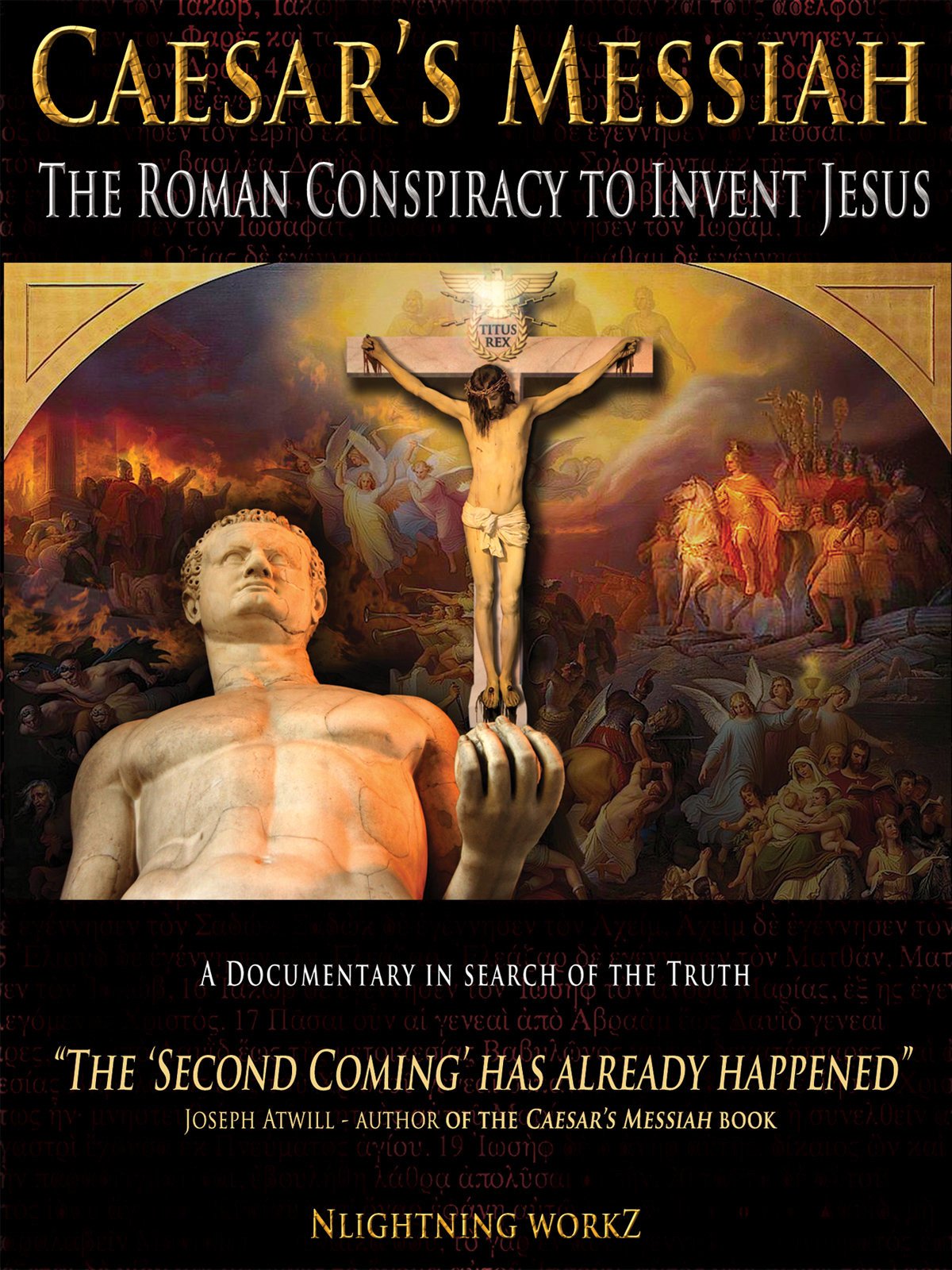
It is increasingly clear: Not only Jesus of Nazareth did not exist. The authors of the gospels (Semites, I suppose) stole the myth of the Aryan god Romulus for incredibly subversive purposes (see red letters: here).

That is why they tried to erase any hint of the Romulus festivals when they destroyed almost all the books in Latin, from the fourth to the sixth century (see Catherine Nixey’s words in bold type: here).

Categories
Christian art Richard Carrier

Our patron saint

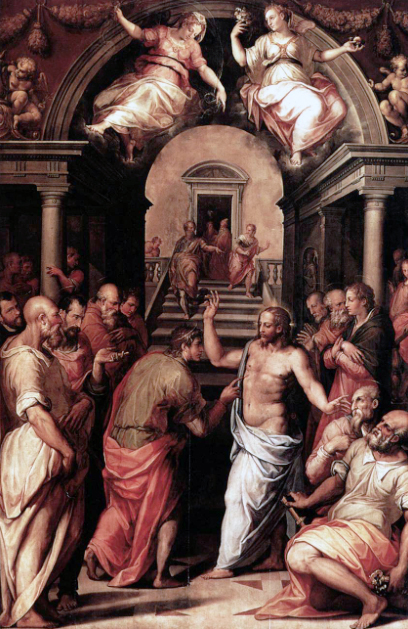
The Incredulity of Saint Thomas is titled this painting by Vasari, in the Florentine church of Santa Croce. The composition and treatment of the figures reveal the spirit of the late Renaissance.

With the tools of exegesis of our century it is not only possible to doubt, like Thomas, that Jesus rose from the dead. It is even possible to doubt that the guy existed, as readers of Richard Carrier know. Even so, sceptics of the New Testament narrative sarcastically consider Thomas as their ‘patron saint’.

Categories
Christian art Richard Carrier

Who guilt-tripped us?

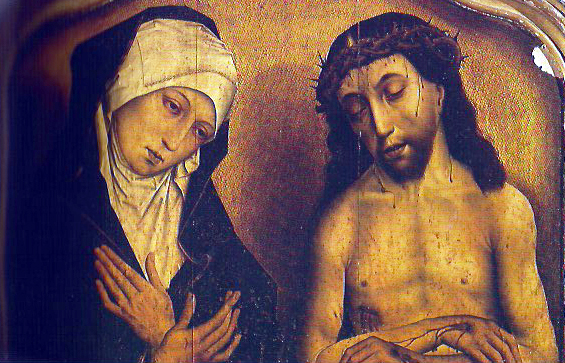
This Pieta by Early Netherlandish painter Gerard David is the central part of a triptych that is preserved in the Cagliari Cathedral Museum. The Jewess Mary, mother of Jesus, with her demurred piety contemplates the wounds that adorn the hands of the Jew martyred by evil Romans.

We can already imagine the guilt trip that, for the Aryan psyche, represented the centuries through which all whites were forced to abandon their proud Gods and ‘golden haired’ heroes, as Homer described them, to worship a rather ugly and unattractive deity of the Semites.

Who could have invented Christianity, a perfect prolefeed for us gentiles? ‘All of the evidence we have’, says Richard Carrier, ‘strongly supports the conclusion that there were actually literal rabbis that originated the sect [Christianity]’.

Categories
On the Historicity of Jesus (book) Richard Carrier

Unhistorical Jesus, 5

Editor’s note: Here I continue quoting some passages from Richard Carrier’s book On the Historicity of Jesus: Why We Might Have Reason for Doubt (Sheffield Phoenix Press, 2014).
 

______ 卐 ______


Element 48: Finally, the most ubiquitous model ‘hero’ narrative, which pagans also revered and to which the Gospel Jesus also conforms, is the fable of the ‘divine king’, what I call the Rank-Raglan hero-type, based on the two scholars who discovered and described it, Otto Rank and Lord Raglan. This is a hero-type found repeated across at least fifteen known mythic heroes (including Jesus)—if we count only those who clearly meet more than half of the designated parallels (which means twelve or more matches out of twenty-two elements), which requirement eliminates many historical persons, such as Alexander the Great or Caesar Augustus, who accumulated many elements of this hero-type in the tales told of them, yet not that many.

The twenty-two features distinctive of this hero-type are:

  1. The hero’s mother is a virgin.
  2. His father is a king or the heir of a king.
  3. The circumstances of his conception are unusual.
  4. He is reputed to be the son of a god.
  5. An attempt is made to kill him when he is a baby.
  6. To escape which he is spirited away from those trying to kill him.
  7. He is reared in a foreign country by one or more foster parents.
  8. We are told nothing of his childhood.
  9. On reaching manhood he returns to his future kingdom.
  10. He is crowned, hailed or becomes king.
  11. He reigns uneventfully (i.e., without wars or national catastrophes).
  12. He prescribes laws.
  13. He then loses favor with the gods or his subjects.
  14. He is driven from the throne or city.
  15. He meets with a mysterious death.
  16. He dies atop a hill or high place.
  17. His children, if any, do not succeed him.
  18. His body turns up missing.
  19. Yet he still has one or more holy sepulchers (in fact or fiction).
  20. Before taking a throne or a wife, he battles and defeats a great adversary (such as a king, giant, dragon or wild beast).

and

  1. His parents are related to each other.
  2. He marries a queen or princess related to his predecessor.

Many of the heroes who fulfill this type also either (a) performed miracles (in life or as a deity after death) or were (b) preexistent beings who became incarnated as men or (c) subsequently worshiped as savior gods, any one of which honestly should be counted as a twenty-third attribute. Of these qualifying features, Jesus shares all three. Likewise, many who fit this hero type ‘fulfilled prophecy’, and although that was commonly the case for heroes generally (far beyond the specific hero-type described here), it is another feature Jesus shares in common with them, and which honestly should be counted as a twenty-fourth attribute. But I shall work from the traditional twenty-two.

The fifteen people who score more than half of those twenty-two features, in order of how many they score (from most to least) is as follows:

  1. Oedipus (21)
  2. Moses (20)
  3. Jesus (20)
  4. Theseus (19)
  5. Dionysus (19)
  6. Romulus (18)
  7. Perseus (17)
  8. Hercules (17)
  9. Zeus (15)
  10. Bellerophon (14)
  11. Jason (14)
  12. Osiris (14)
  13. Pelops (13)
  14. Asclepius (12)
  15. Joseph [i.e., the son of Jacob] (12)

This is a useful discovery, because with so many matching persons it doesn’t matter what the probability is of scoring more than half on the Rank-Raglan scale by chance coincidence. Because even if it can happen often by chance coincidence, then the percentage of persons who score that high should match the ratio of real persons to mythical persons. In other words, if a real person can have the same elements associated with him, and in particular so many elements (and for this purpose it doesn’t matter whether they actually occurred), then there should be many real persons on the list—as surely there are far more real persons than mythical ones.

The number of real persons in the course of antiquity must number in the hundreds of millions, whereas the number of mythical persons invented over that same course of time will be in the thousands at most. Certainly, by any calculation the latter could not possibly outnumber the former—and even if they were equally numerous, then half the names on the list should be actual persons. But this is not the case. No known historical persons are on the list (for Moses and Joseph, see references in earlier note). Only mythical people ever got fitted to this hero-type. Yet every single one of them was regarded as a historical person and placed in history in narratives written about them.

Therefore, whether fitting more than half the Rank-Raglan criteria was always a product of chance coincidence or the product of causal influence, either way we can still conclude that it would be very unusual for any historical person to fit more than half the Rank-Raglan criteria—because if it were not unusual, then many historical persons would have done so. But not even one did. We might not know the cause of this fact, but a fact it is nonetheless, and a fact we can make use of (as I will in §3 of the next chapter).

Jesus scores twenty out of twenty-two, according to Matthew ‘s Gospel (and whether these attributes were original or lately appended to his legend won’t matter, as I’ll explain in §4 of the next chapter; but note that even in Mark’s Gospel, Jesus scores a 14, and even that would place him well above the bottom of the list).

The first nineteen hardly require defense (e.g. his father is the heir of King David; he is seized by the authorities, abandoned by his followers, and driven from Jerusalem to his execution; strange things happen at his death, and the death itself is a strangely sudden expiration; he dies atop the hill named Golgotha; etc.). The remaining hit (number 20) may not be as obvious, but he scores it: just as Oedipus confronts and defeats the riddling Sphinx, Jesus confronts and defeats the temptation s of the Devil (also known as the Adversary, and as a Serpent or Dragon, and ‘Prince of the World’), in both cases before going to claim their kingdom (of course, even in earliest Christian tradition Satan is the power whom Jesus most decisively defeats so as to effect the salvation of the faithful ever after).

The only two elements Jesus does not score are the last I’ve listed: we cannot establish (21) that his parents were originally imagined as related or (22) that he ever married (much less the daughter of his predecessor). However, the peculiar absence of that last element practically advertises the fact that he does merit that element allegorically: from the earliest time Jesus was imagined to have taken the ‘church’ as his bride, which was indeed understood to be the ‘daughter ‘ of his predecessor (the nation of Israel). So in all honesty we could assign him that element as well. But as it is not ‘literal’ I will leave his score at twenty.

Nevertheless, even then he is nearly the highest scoring person in history, next only to Oedipus; and if we granted that last element, he would be tied even with him for highest score. Jesus might even have outranked Oedipus. A later tradition held that indeed his parents were relatives, and it is possible that had been a tradition from very early on that just wasn’t recorded in our Gospels.

However, by the time we hear of this detail, Jesus was being transformed into a different character. For example, Infancy Gospels were then being written about him, introducing narratives of his childhood. If we scored on attributes all the way into the late second century, this would remove one element (‘we hear nothing of his childhood’), and add another (‘his parents were related to each other’), keeping his score the same. However, since the infancy Gospels clearly are discordant with the early mythology of Jesus and are an entirely new phenomenon, whereas the possibility of his parents being related might actually have been imagined much earlier, he might have scored the full twenty-two points, making him a better fit for the Rank-Raglan hero-type than any other man in history. And even without these assumptions, he still ranks among the highest. That is a stunning fact, which must be considered, and accounted for.
 
Conclusion

The point of this and the previous chapter has been to summarize all the facts we must take into account, as being in our total background knowledge, when assigning all probabilities going forward.

In my experience, a great deal of what has been surveyed up to this point remains unknown even to many experts in the study of Jesus. This is why I took the trouble to survey so much. Because all of it must be taken into account by anyone who wishes to reconstruct the historical Jesus or the origins of Christianity. It is equally crucial to understanding how to evaluate and interpret the evidence for or against the historicity of Jesus—and how to estimate the prior probability of either. And to that question I now turn.

Categories
On the Historicity of Jesus (book) Richard Carrier Romulus

Unhistorical Jesus, 4

Editor’s note: Here I continue with some passages from Richard Carrier’s book On the Historicity of Jesus: Why We Might Have Reason for Doubt, especially a follow-up of what Carrier says in my first instalment of the series.

It really looks like the authors of the Gospels, presumably Semites, thoroughly plagiarised the foundational myth of Rome in order to sell us another myth (compare this with what my sticky post’s hatnote links about toxic foundation myths). This new myth did not only involve replacing an Aryan hero (Romulus) for a Jewish hero (Jesus). It did something infinitely more subversive. As Carrier wrote, which I highlighted in bold in my first instalment of the series:

Romulus’ material kingdom favoring the mighty is transformed into a spiritual one favoring the humble. It certainly looks like the Christian passion narrative is an intentional transvaluation of the Roman Empire’s ceremony of their own founding savior’s incarnation, death and resurrection [reddish colour added].

On pages 225-229 of On the Historicity of Jesus: Why We Might Have Reason for Doubt we read (scholarly footnotes omitted):
 

______ 卐 ______


Element 47: Another model hero narrative, which pagans also revered and to which the Gospel Jesus also conforms, is the apotheosis, or ‘ascension to godhood’ tale, and of these the one to which the Gospels (and Acts) most conform is that of the Roman national hero Romulus. I discussed this already in Chapter 4 (§1), and the points made there should be considered a component of the element here.

The more general point is that this narrative concept of a ‘translation to heaven’ for a hero (often but not always a divine son of god) was very commonplace, and always centered around a peculiar fable about the disappearance of their body. All these fables were different from one another, and therefore those differences are irrelevant to the point: all still shared the same core features (see my discussion of how syncretism works in Element 11). And when it comes to the Romulus fable in particular, the evidence is unmistakable that Christianity conformed itself to it relatively quickly—even if all these attributes were accumulated over time and not all at once.

Romulus, of course, did not exist. He was invented, along with legends about him (largely put together from previous Greek and Etruscan mythology), much later in Roman history than he is supposed to have lived. His name was eponymous (essentially an early form of the word ‘Roman’), and his story was meant to exemplify ideal Roman aspirations and values, using a model similar to Greek tragedy, in which the hero sins in various ways but comes to self-understanding and achieves peace by the time of his death. He otherwise exhibits in his deeds the ‘exemplary qualities’ of Rome as a social entity, held up as a model for Roman leaders to emulate, such as ending ‘the cycle of violence’ initiated by his sin and pride by religiously expiating the sin of past national crimes in order to bring about a lasting peace. His successor, Numa, then exemplified the role of the ideal, sinless king, a religious man and performer of miracles whose tomb was found empty after his death, demonstrating that he, too, like his predecessor Romulus, rose from the dead and ascended to heaven.

The idea of the ‘translation to heaven’ of the body of a divine king was therefore adaptable and flexible, every myth being in various ways different but in certain core respects the same. But the Gospels conform to the Romulus model most specifically. There are twenty parallels, although not every story contained every one. In some cases that may simply be the result of selection or abbreviation in the sources we have (and therefore the silence of one source does not entail the element did not then exist or was not known to that author); and in some cases elements might have been deliberately removed (or even reversed) by an author who wanted to promote a different message (see discussion in Chapter 10, §2, of how myth­making operated in antiquity). For example, the ‘radiant resurrection body’ (probably the earlier version of Christian appearance narratives) was later transformed into a ‘hidden-god narrative’ (another common trope both in paganism and Judaism) as suited any given author.

But when taken altogether the Romulus and Jesus death-and-resurrection narratives contain all of the following parallels:

1. The hero is the son of God.
2. His death is accompanied by prodigies.
3. The land is covered in darkness.
4. The hero’s corpse goes missing.
5. The hero receives a new immortal body, superior to the one he had.
6. His resurrection body has on occasion a bright and shining appearance.
7. After his resurrection he meets with a follower on a road from the city.
8. A speech is given from a summit or high place prior to ascending.
9. An inspired message of resurrection or ‘translation to heaven’ is delivered to a witness.
10. There is a ‘great commission’ (an instruction to future followers).
11. The hero physically ascends to heaven in his new divine body.
12. He is taken up into a cloud.
13. There is an explicit role given to eyewitness testimony (even naming the witnesses).
14. Witnesses are frightened by his appearance and/or disappearance.
15. Some witnesses flee.
16. Claims are made of ‘dubious alternative accounts’ (which claims were obviously fabricated for Romulus, there never having been a true account to begin with).
17. All of this occurs outside of a nearby (but central) city.
18. His followers are initially in sorrow over the hero’s death.
19. But his post-resurrection story leads to eventual belief, homage and rejoicing.
20. The hero is deified and cult subsequently paid to him (in the same manner as a god).

Romulus, of course, was also unjustly killed by the authorities (and came from a humble background, beginning his career as an orphan and a shepherd, a nobody from the hill country), and thus also overlaps the Aesop/­Socratic type (see Element 46), and it’s easy to see that by combining the two, we end up with pretty much the Christian Gospel in outline (especially when we appropriately Judaize the result: Elements 3-7, 17-20, and 39-43). Some of the parallels could be coincidental (e.g. resurrected bodies being associated with radiance was itself a common trope, both within Judaism and paganism), but for all of them to be coincidental is extremely improbable. The Christian conception of Jesus’ death and resurrection appears to have been significantly influenced by the Roman conception of Romulus’s death and resurrection.

Even if we discounted that for any reason, the Romulus parallels definitely establish that all these components were already part of a recognized hero-type, and are therefore not surprising or unusual or unexpected. The story of Jesus would have looked familiar, not only in the same way all translation stories looked familiar even when different in many and profound ways, but also in the very specific way that among all such tales it looked the most like the story of Romulus, which was publicly acted out in passion plays every year. And this was the national founding hero of the Roman Empire. What better god’s tale to emulate or co-opt?

Categories
On the Historicity of Jesus (book) Richard Carrier

Unhistorical Jesus, 3

Editor’s note: Today I changed the subtitle of this site from ‘Two lies are murdering the white race’ to ‘The Jewish Question and Christianity are one and the same’. In the excerpts reproduced below from chapter 5 of Richard Carrier’s magnum opus, he wrote:

Thus it should not surprise us that Christianity converted all the military imagery of popular messianism into spiritual metaphor, to represent what we would now call a culture war.

Emphasis appears in the original. In the next page he added:

That the Christians and the Zealots both may have come from the same sectarian background, and pursued collectively the only two possible solutions to the problem facing the Jews at the time, reveals Christianity to be more akin to something inevitable than something surprising.

Definitively, Carrier’s On The Historicity of Jesus: Why We Might Have Reasons for Doubt contains key passages that substantiate the content of the masthead of this site, the Rome vs. Judea essay, linked in the sticky post above.

These are the first paragraphs of the chapter “Background Knowledge (Context)”:


______ 卐 ______


The previous chapter surveyed the background knowledge directly relating to the Christian religion (origins, beliefs and development) that we must take into account when evaluating any hypothesis regarding the historical existence of Jesus. This chapter will survey the most important background knowledge regarding the context in which Christianity began (political, religious and literary), as well as its most pertinent scientific and historical analogs.

Elements of Political Context

The origin of Christianity makes sense only within the peculiar political context that produced it, and in light of analogous movements throughout history.

Element 23: The Romans annexed Judea to the imperial province of Syria in 6 CE, bringing the center of the Holy Land under direct control of the Roman government, ending Jewish sovereignty over Jerusalem and the temple of the Most High God, along with most of the Holy Land that had been promised by God to the Jews.

In fact, God had promised that the Jews would not only rule their own land, city and temple, but subjugate all peoples and rule the whole world as the chosen people of God (Zech. 14.9-18; Psalm 2), which was also a common feature of messianic belief (Elements 3 and 4), one timetable for which predicted this outcome was imminent (Element 7). The Roman annexation contradicted all of this, which would have inevitably produced cognitive dissonance between what Jews expected (the fulfillment of God’s promise) and what happened (the Jews lost their sovereignty and became a subject people). The result was a permanent state of violent tension between the Roman occupation and Jewish rebellion that concluded in three devastating wars (against Nero in 66-70 CE, against Trajan in 115-117 and against Hadrian in 132-136) and countless smaller rebellions (beginning with Judas the Galilean in 6 CE), all of which the Jews consistently lost.

Element 24: (a) Owing to their vastly greater resources (in materials, money and manpower) and superior technical ability (in the training, equipping and supplying of their armies) the Romans were effectively invincible and could never be expelled from Judea by force or diplomacy. (b) This fact was so empirically evident and publicly tested and demonstrated on such a wide scale that it had to have been evident to at least some Jews, even while many either didn’t see it, denied it even when seen, or imagined celestial aid would redress the imbalance.

In other words, the traditional messianic hope (of a conclusive military victory over all of Israel’s neighbors) was a doomed hope, and that would have been obvious to at least some Jews. History would of course decisively prove this, as messianic movements were either wiped out quickly (Element 4) or led to the utter defeat and destruction of Jerusalem and the entire Jewish polity (already in the Neronian War of the 60s; even more so in the subsequent wars under Trajan and Hadrian: Element 23). This had happened before, most infamously to both Carthage and Corinth in the same year (146 BCE), which any educated observer would know about. In fact, up to the time Christianity began, Roman victory was always the outcome, without exception, for every nation that ever stood against any concerted Roman conquest and occupation.

For example, even the infamous defeat of Varus by the Germans in 9 CE was decisively redressed by Germanicus only a few years later, illustrating the futility even of a victory against the Romans. This was a phenomenon so consistently repeated that it had already become a popular joke by the time of Christ, which is called even still a ‘Pyrrhic victory ‘, from the legend, widely circulated in antiquity, that in the third century BCE the Greek upstart Pyrrhus had won his victories against the Romans at such cost that he declared ‘one more victory and I’m done for’ (or words to that effect), which prophecy was fulfilled in short order. After centuries of history repeating itself like this without fail, only a fool would bank on a future rebellion against the Romans having any other outcome. And though fools were always to be found, not all men are fools.

It would therefore be extremely improbable if no early-first-century Jews could foresee this (even if most, evidently, did not). Predicting this outcome would have been all the easier for anyone aware of recent analogous events, from the fates of Carthage and Corinth to the early Jewish rebellions described by Josephus, which were so quickly and easily suppressed that the reality must have become apparent to some. It would have been a simple matter to put two and two together: Roman military might plus Jewish military messianism equals the inevitable destruction of the Jews.

Element 25: The corruption and moral decay of the Jewish civil and temple elite (regardless of to what extent it was actual or merely perceived) was a widespread target of condemnation and often a cause of factionalizing among Jewish sects. This is evident throughout the narrative of Josephus regarding the causes and outcomes of the Jewish War, as well as in the literature recovered at Qumran (e.g. 4Q500), and in much of the apocryphal, apocalyptic and pseudepigraphical literature produced or popularized by first-century Jews. It is also a persistent theme in the Christian Gospels, which in that context do not seem aberrant in this respect but in fact typical.

Element 26: For many Jews in the early first century (in accord with the previous element) the Jewish elite became the scapegoats for God’s failed promises (in accord with Elements 23 and 24): the reason God withheld their fulfillment (and instead allowed the Romans to rule) was imagined to be the Jewish elite’s failure to keep God’s commandments and govern justly. God would come through only when all sin had ended and been atoned for (Dan. 9.5-24). The Dead Sea Scrolls, for example, repeatedly denounce the Jewish civil and temple elite as responsible for the evil that has befallen the land, in terms similar to those found in the Christian Gospels. […]

Element 27: (a) The temple at Jerusalem was the central focus of most Jewish messianic hopes (as, for the Samaritans, was Mount Gerizim), which entailed that as long as the ‘corrupt’ Jewish elite control led it, God would continue Israel’s ‘punishment’ (in accord with Elements 25 and 26); and as long as the Romans remained in power, they would maintain the corrupt Jewish elite’s control of the temple. Accordingly, (b) Jewish religious violence often aimed at seizing physical control of the temple and its personnel.

Element 28. […] But if any Jews had realized that such a reconquest was impossible (as some must, in accord with Element 24) but still sought a means to escape their cognitive dissonance (in accord with Element 23) without denying the evident facts or abandoning deep-seated religious beliefs, then for them only one solution remained: to deny the physical importance of the temple at Jerusalem itself. […]

Therefore, if any religious innovator had proposed that God had arranged a supreme sacrifice capable of cleansing all sins once and for all (such as, e.g., through the ritual atoning sacrifice of his firstborn son: Element 10), and further arranged that God’s spirit would, as a result, dwell forever within each individual who pledged himself to him (and thus no longer dwell, or dwell only, with in the temple at Jerusalem: Element 18), then his message would resonate among many Jews as an ingenious and attractive solution to the problem of Jewish elite corruption and Roman invincibility (Elements 23-26), by eliminating the relevance of the temple to messianic hopes, and thus eliminating the basis for any doomed military conflict with Rome […].

The basic Christian gospel—imagining that the death of a messiah had conclusively atoned for all sins, and that by joining with him God would dwell in us (instead of the temple)—would thus be recognized by many Jews as an ingenious and attractive idea. […]

The only sacred space this doctrine required one to physically control was one’s own body, a notion already popularized by philosophical sects such as the Stoics, who taught that nothing external can conquer a man who in his wisdom remains internally free. Not death, nor imprisonment, nor torture represented any victory over him. This was therefore a battle one could always win, even against the ‘invincible’ Romans. One merely had to believe it, to feel it was true, that God now lived in you. No other evidence was required. Thus it should not surprise us that Christianity converted all the military imagery of popular messianism into spiritual metaphor, to represent what we would now call a culture war. […]

The relevance of this observation is that the earliest Christian gospel makes far more sense as a product of its political context than it does when completely divorced from that context, and in consequence, theories of historicity [of Jesus] that ignore that fact are unlikely to have any objective merit. The centrality of the temple was a continual problem for the Jews. A physical location requiring political control entailed military domination. So long as the Romans had the latter, the Jews would never have the former. The Zealots took the logical option of attempting to remove the Romans and restore Jewish control. But the Christians took the only other available option: removing the temple from their entire soteriological (or ‘salvation’) scheme.

Christians could then just await God’s wrath to come from heaven (in accord with Element 10), while in the meantime, God’s promise could be delivered unto the kingdom they had spiritually created (Rom. 14.17-18; I Cor. 4.19-20), first in an anticipatory way (in the moral and ‘supernatural’ success of the Christian community), and then in the most final way (in the apocalypse itself: e.g. I Cor. 15.24, 50; 6.9-10; Gal. 5.19-25; 1 Thess. 4.10- 5.15). That the Christians and the Zealots both may have come from the same sectarian background, and pursued collectively the only two possible solutions to the problem facing the Jews at the time, reveals Christianity to be more akin to something inevitable than something surprising.