web analytics
Categories
Film

Exactly…

two years ago the finale of Game of Thrones, ‘The Iron Throne’, was released. Below, a transcription of Yezenirl’s video ‘The Power of Stories: How Bran the Broken was Always the Ending’ which can be seen on YouTube:
 

______ 卐 ______


‘Now is the winter of our discontent, made glorious summer by this son of York’. —Richard III

Tyrion: ‘All hail Bran the Broken, First of his Name, King of the Andals and the First Men, Lord of the Six Kingdoms, Protector of the Realm’ [Editor’s note: in Yezen’s video these italicised words are brief audiovisual clips of different scenes; the sentences between the brackets are mine].

I do get it. David Benioff and D.B. Weiss aren’t great writers. The ending was rushed, Season Eight was sloppy, and frankly I thought Season Six and Seven felt like fan-fiction. So it should come as no surprise that there’s a lot of complaints and confusion about the ending.

Still, Tyrion was right about one thing: stories are powerful. There’s nothing like a good story. And now, it seems there’s nothing like a bad one either. Yet, somehow Game of Thrones managed to be both. For years now it shocked us, captivated us, angered us and brought us together. And for all the flaws of the final season, this is the story we got. Books aside, all we can do now is to decide what to make of what the show gave us.

I know for many that means dissecting where the writers went wrong, and I’ll eventually get to that, but as for right now, I’m not interested in just joining the chorus of fanboy rage. Instead, as a guy who did call King Bran [Yezen was the only one who correctly predicted who would become king in the finale], let me try to explain why this was always the direction the story was headed, and try to make sense of just what the ending meant, as broken as it may have been.

Bran was always meant to climb to the top. And it’s pretty clear upon re-reading the first book that this was always the plan. Personally, I figured this several years ago, when George R.R. Martin’s editor Anne Groell revealed that Bran’s end point was the only one she knew.

Obviously, certain things will differ in the books. I expect how he’s chosen will be a little bit different, as well as how he acts, and book-Bran will probably rule from Harrenhal, not King’s Landing. But the question most people have is, what does this mean? Why write this tale of handsome princes and beautiful conquerors only to end with a crippled King?

One reason why King Bran is so controversial is that he’s probably the most poorly understood major character in the story. Bran’s character arc, at its core, is pretty straightforward: he’s a reference to Bran the Blessed, Frodo Baggins, and Rainbow Crow. It’s the tale of a boy who was deemed so broken by a society that he’s even mocked for not killing himself. So, believing the world will never have a place for him, he struggles to see value in his own life, eventually going beyond the Wall in search of purpose, merging with a godhood [the old religion] and fighting against the apocalypse [the white walkers]. Much like the audience, the Seven Kingdoms doesn’t really understand what Bran has become, or how he helped save the world.

Yet, when Bran returns, the Kingdom was broken just like him. And all of the things that once made him useless to the militaristic culture of Westeros, now make him the ideal Fisher King: an incorruptible figurehead to help usher in a new system. And thus, Bran the Broken is immortalised as a story around which the Kingdoms of Westeros can unite. The bittersweet irony is that when Bran is finally celebrated, he’s too consumed by godhood to feel his own triumph.

Bran: ‘You shouldn’t envy me. Mostly, I live it in the past’.

Bran’s emotional distance from the audience is very much the point. And so is the abruptness of his coronation. Bran’s arc doesn’t move towards Kingship; it’s the arc of the Seven Kingdoms that moves toward Bran the Broken. Essentially, the message here is one of humility—a reminder that each of us is bound by blessed and cursed fates. A once ridiculed woman (Brienne) can become the truest of knights [transcriber’s note: this is bullshit feminism], a despised imp (Tyrion) can be a brave hero, an exiled girl (Dany) can become a great liberator—and a great liberator (also Dany) can become an unstoppable tyrant. The capacity of outcasts to rise and fall means that we must learn to see value in everyone, including the cripples, bastards and broken things.

Of course, the big question about King Bran is whether he planned it all out. Was Bran a puppet master, or was he a puppet who could see the strings? Did the Three-Eyed Raven manipulate events to put itself into power?

Bran: ‘Why do you think I came all this way?’

Well, maybe?

The former Three-Eyed Raven [Ser Brynden Rivers in Martin’s novels, called Lord Bloodraven] seemed to know that Bran would eventually be Lord of the Seven Kingdoms, and hinted at it back in Season Six:

‘You won’t be here forever. You won’t be an old man in a tree’.

But in Season Seven, Bran seemingly doesn’t see it, and often admits to not knowing things.

Bran: ‘I can never be Lord of Winterfell. I can never be Lord of anything’ [words to Sansa in Season 7].

Bran: ‘I don’t know. No one’s ever tried’ [words of season 8, episode 2].

Bran: ‘His last name isn’t really Snow. It’s Sand’ [words to Sam in season 7, episode 7].

Bran: ‘I need to learn to see better’ [words to Sansa under Winterfell’s weirwood tree].

So, it’s likely that if the Three-Eyed Raven did set things up, then for Bran it’s something like a half-remembered dream. That said, in Jon’s final dialogue, we do get one last hint that the Three-Eyed Raven was in fact the Lord of Light.

Jon: ‘I’m sorry I wasn’t there when you needed me’.

Bran: ‘You were exactly where you were supposed to be’.

This interaction references several conversations about characters serving the Lord’s purpose. And thus seems to imply that the Lord of Light’s plan was also the Three-Eyed Raven’s plan. So, Jon was in fact there for Bran all along, as a soldier in the Three-Eyed Raven’s war, which provides the closest thing we can get to an answer over that burning question: Did Bran do anything, or did Bran do everything? [Transcriber & editor’s notes: Here follows a few words we won’t quote that Yezen apparently picked up from an episode in Futurama where God speaks to the main character.]

By leaving Bran’s actions ambiguous, the story actually upholds the choices made by the characters. After Hodor, Bran seemingly learns to never again violate another human being’s autonomy. So, regardless of whether the characters were playing the Raven’s game, or whether this universe is just random, each of them had free will and made their own choices.

The big misconception here is the idea that the problem of ruling has been resolved by a god, when in actuality Bran doesn’t solve the problem of ruling. He’s mostly a figurehead who subtly empowers people to fix the world themselves. The problem of ruling is left to Tyrion and his council of former outcasts.

Which brings me to the third element that needs to be discussed, which is the small thing Bran does bring to the table. In my prediction video [see our transcript: here] I talked about Bran’s wisdom as capacity for understanding. But the ending, rushed as it was, suddenly brought up another thing which I really hoped it would. And that is the nature of justice. Throughout the episode, there’s the dilemma presented about what justice really means. Can we forgive those who have done us wrong? Is the world we need one of mercy?

If you recall, Game of Thrones begins with Bran going to see his first execution: a man has deserted the Night’s Watch. As is the law, Lord Eddard Stark hears his last words and executes him. Afterwards, Ned prompts Bran that one day this justice will fall to him. And in the end, it does. But where the story opens on an act of retributive justice—a form of justice framed around punishment—Bran’s first act as King is to shift his Kingdom towards a justice that is more restorative, as in, justice which focuses on rehabilitating the offender and reconciling with the community.

Grey Worm: ‘This man is a criminal. He deserves justice’.

Bran: ‘He just got it. He’s made many terrible mistakes. He’s going to spend the rest of his life fixing them’.

Justice for Tyrion is to fix the problems he’s brought upon Westeros, by becoming Hand of the King. Justice for Jon is to return to the place he functioned best and act as King-beyond-the-Wall. Once again, Bran puts Jon exactly where he’s supposed to be. And while the show explore these ideas so sloppily that it’s hard to register, there’s really nothing we can do about that. The time where internet rage [the fans hated this season as Yezen explains: here] could have shifted the direction of the show’s writing is long gone. And I understand why that’s a frustrating reality for so many: especially those who’ve invested a ton of time and thought into this story. But all we can do now is try to make the most of the ending we got. Maybe I’m a little number to this because I’ve not been a fan of the writing for the past three seasons. For me, I’ve mainly looked at the show as a spoiler-filled preview of books that may never come.

Sam: ‘A Song of Ice and Fire’.

And you know, from that perspective, there’s a lot to be hopeful for about the ending. King Bran feels so true for Martin’s philosophy that I can no longer see how the ending could have been anything else. So although the Kingdoms of Westeros have been broken by war, it seems they may have learned a little something along the way. And you know? Hopefully we did too.

Jon: ‘It doesn’t feel right’.

Tyrion: ‘Ask me again in ten years’.

Anyways I got more content coming… In the meantime I’m also kind of sad that the ending turned out being so unpopular. And I hope this helped. Peace out. Thanks for watching.

Categories
Film

The last of the Starks

‘The Last of the Starks’ is the fourth episode of the eighth season of HBO’s fantasy television series Game of Thrones, and the 71st overall.

As I said in the previous instalment of this series, ‘The Long Night’ is so exciting that the anticlimax is unwatchable. If I had directed the show, in addition to removing feminism from it; the soft-porn scenes, Arya’s psycho traits, and putting Theon as the late hero instead of an heroine, I would’ve ended the series by filming, in this episode, Bran’s coronation after Jon led a mass cremation funeral for the dead (the latter we do see in the HBO series).

In that way the series wouldn’t have ended in the eighth season but in the seventh, in 2017: this eleventh episode being the anticlimax (something common in masterpieces of literature).

If you look at the popularity statistics for Game of Thrones, after Arya killed the monarch of the white walkers and the wights, the Night King, the fan acceptance plummeted. On the one hand I am pleased, although anti-feminism wasn’t the cause of the repudiation of this season but the blunder of squeezing all the complex plots pending in a couple of episodes.

The feminist messages that continue in this episode are not worth describing further, except that while watching ‘The Last of the Starks’ tonight I counted two of them.

Categories
Feminism Film

The long night

‘The Long Night’ is the third episode of the eighth season of HBO’s fantasy television series Game of Thrones, and the 70th overall. Below, the most beautiful moment of the episode according to Yezen (including the music I’d add) in his video ‘Why Theon should have killed the Night King’.

I have said that Martin didn’t finish the last two novels of his epic when D&D were filming the series. If I had been the director, instead of what the D&D Jews did—trying to compact what Martin had confessed to them in a few episodes—I would have devised the script differently so as not to spoil the plot, as D&D spoiled it. I simply would have forgotten about the game of thrones, or the war between the two bitches, and focused solely on the threat that the army of the dead posed to Westeros once the Night King’s dragon brought down the Wall.

From that angle, the long night in the sense of the long battle that was fought at Winterfell would have appeared at the end of the last season. And instead of the ultra-feminist scene that D&D came up with—the girl Arya kills the Night King in this episode—I would have chosen Theon to be ‘The Hero of Winterfell’. That way we wouldn’t have seen packed together, in just six episodes, a complex plot—or rather plots—that should have been filmed over several seasons.

It’s no excuse that the directors have run out of Martin’s latest novels. If they had been good artists they would have simplified the plot, guillotining any war between Dany and Cersei from the script—that is, the ‘game of thrones’—so that the show would look more like ‘a song of ice and fire’. The Night King, the white walkers and the army of the dead live on ice on the north side of the Wall; and fire is represented by the character most loved by fans, Jon, who lives on the south side of the Wall. As we saw, in previous episodes it’s revealed that Jon is Aegon Targaryen, and in Martin’s universe the Targaryens represent fire.

Without Martin’s latest novels, that would have been the compromise a good screenwriter would have made.

In many respects, ‘The Long Night’ is the culmination of the entire series. The following episodes, # 71, # 72 and # 73 represent a huge anticlimax that disappointed the fandom. And while the battle against the army of the dead in this episode is the most exciting of all seasons, I suspect that the feminist agenda finally stretched the show’s credibility to breaking point (as we said above Theon, not a girl, should have killed the Night King).

Categories
Feminism Film

Winterfell

‘Winterfell’ is the eighth season premiere episode of HBO’s fantasy television series Game of Thrones, and the 68th overall. It aired in 2019 and the previous season in 2017. What happened in 2018?

I have said several times that the slogan of contemporary cinema seems to be ‘everything for the eye, nothing for the mind’. Well, the show’s technicians spent all of 2018 doing the complicated CGI effects on the dragons for the final season. It was such a laborious task that they skipped an entire year leaving the eager audience in a long two-year wait!

Unsurprisingly, this ‘all for the eye, nothing for the mind’ practice, and in just six episodes for what should have been six more seasons, ruined the series from the point of view of a plausible narrative. However, from our point of view the series was already ruined from the first episode of the first season due to its bad messages.

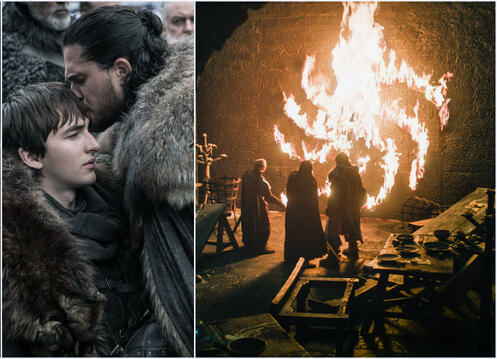
If there is something ‘for the mind’ that the show left us, it is its feminist trickery. True, from a cinematic point of view, the opening scene of the eighth season is superb: from when we see a boy running in the first seconds until Jon kisses Bran on the forehead (Jon had not seen Bran since he left him comatose and his life hanging by a thread in the first season). George Lucas visited the set where the opening scene was filmed, in which Dany and Jon arrive at Winterfell with an impressive army.

But already in the great hall of Winterfell with the gathered lords we see the first ultra-feminist scene when the Mormont girl, who still doesn’t menstruate because of how young she is, reprimands Jon in front of everyone. At the time of the reprimand Jon is sitting in the hall flanked by two other women: Sansa and Dany. With these TV messages, should we be surprised that adolescent girls have become so insolent?

As is typical of the show, we then see Bronn sexually ridden by a woman (a prostitute), flanked by two other naked women. Politically correct directors seem to be reluctant to film a man riding a woman: their mission is to reverse reality even in bed.

Then we see a third feminist scene when Theon rescues Yara from Euron’s ship and, instead of thanking him Yara headbutts her brother (was it because he didn’t help her at the exact moment when Euron kidnapped her)? Already setting sail, Theon tells Yara that she is his queen, and that he will do what she orders, before a goodbye hug.

This is what fans waited patiently, for two years, to finally see…

Categories
Feminism Film

Beyond the Wall

‘Beyond the Wall’ is the sixth and penultimate episode of the seventh season of HBO’s fantasy television series Game of Thrones, and the 66th overall. Here we see Beric talking to Jon on the other side of the Wall.

From this episode until the grand finale we began to see problems of another kind. Since George R.R. Martin didn’t finish the last two novels of his epic when they were filming the last two seasons, the producers rushed the story to levels that spoiled the rhythm of the series.

Many fans of the novels are furious with Martin because even today he has not finished the last two novels of A Song of Ice and Fire. I feel a little more empathy for the writer. Writing is a thankless task that is done in solitude, in the writer’s home. Most writers can’t even make a living from their craft. When the miracle happens, as it happened to Martin when HBO decided to bring his most ambitious work to the small screen, it is natural that with the river of money flowing towards the writer he changes his lifestyle, doing the writing in the bedroom more difficult, especially due to Martin’s advanced age.

But the mistake of this episode and others of the following season is that Martin was right in asking the creators of the HBO series David Benioff and D. B. Weiss that the series should run for about fourteen seasons. That would mean that filming would be roughly halfway through by now. If we assume one season per year, the eighth season should have been released in 2018; the ninth in 2019, the tenth in 2020 and this month that I write the fans would be watching the eleventh.

Benioff and Weiss went their own way by taking a shortcut, narrowing down the remaining seven seasons in episodes 66 to 73. And unlike previous seasons that had ten episodes each, the seventh season only has seven. The following season, the eighth and last, only six episodes. That’s far from the adequate pace, although it was only until the middle of the eighth season that fans were very disappointed by this rush.

But still, in this rushed episode 66, we see two conversations between the Stark sisters in which Arya tells Sansa that since she was a child she wanted to become a knight, though there are still no female knights in Westeros; and that she wanted to break the rules. (Worse still, the writers recast this Arya girl with psychopathic traits as we see when she talks to Sansa.) But feminism doesn’t end there. Near the end of the episode the king of the north, Jon, promises Dany that he will bend the knee before her.

Categories
Feminism Film Henry VIII

Battle of the bastards

‘Battle of the Bastards’ is the ninth and penultimate episode of the sixth season of HBO’s fantasy television series Game of Thrones and its 59th episode overall. This episode is emblematic of the series. It starts with a very easy victory for Dany, much easier than Caesar’s Veni, Vidi, Vici after the Masters invade Meereen with their fleet.

Later we see the Battle of the North—the best melee battle I’ve ever seen from a cinematic point of view. Unlike Dany and the fire of her dragons that burn the invading fleet, in the Battle of the Bastards you can see the ruthless rawness of what war really is, which is reflected in this image of the poor men under the command of the bastard Jon that are about to fight in numerical disadvantage against the army of the bastard Ramsay.

Dany, on the other side of the world in Martin’s fiction, is so powerful that she’s even capable of thinking in exterminationist terms. At the pyramid, which is being bombarded from the ships in the bay, she says to Tyrion: ‘I will crucify the Masters. I will get their fleets afire, kill every last one of their soldiers and return their cities to the dirt. That is my plan’.

The contrast between the Battle of Meereen Bay and the Battle of the Bastards couldn’t be greater. While the men on Jon’s side struggle to remain alive in a battle very realistic thanks to special effects (it is difficult to film a great carnage of horses during direct combat), the SJW Dany is granted everything thanks to the fire of her dragons. It was a great blunder to put both battles in the same episode because it shows how grotesque all this feminism is where the conquering woman appears as ultra-privileged in her warrior powers while the men have to fight every inch of the ground with blood and iron, as two armies fought in the open fields of yesteryear.

In the discussion with Tyrone, her advisor, Dany, before riding her dragon, tells him that she’s completely different from her father, who wanted to burn King’s Landing including men, women and children, even those loyal to the mad king. Tyrion replies: ‘You’re talking about destroying entire cities. It’s not entirely different’.

Another infuriating thing about many episodes, including this one, is the stupid little music they play when Dany rides her dragon and everything comes out smooth and easy—really irritating, especially compared to the eerie music they play right before the Battle of the Bastards is fought. In addition, we must take into account that all this war of Dany against the Masters is due to the latter refusing to abandon the slave system. We can already imagine what fantastic cinema would be like today if the Confederates had won the American Civil War!

Just as in the pyramid of Meereen Dany wants to become genocidal and Tyrone begs her for restraint, in the gloomy north we also see a discussion after the war council in Jon’s tent: another argument between woman and man before the battle, and also with the roles reversed. Sansa says such obvious things to Jon about elemental strategy that it is sad to see the man’s naivety. Sansa also alerts Jon about the psyops Ramsay will use on the battlefield. As we’ll see later, Jon fell flat on one of those tricks, and had it not been for the unexpected intervention of the Knights of Vale at the last minute he would have lost the Battle of the Bastards.

The script is pure rubbish although the battle, as I said, is worth watching. But before it the scriptwriters inserted a scene that reminds me of what I said in ‘On Beth’s cute tits’ although now I’m not referring to breasts but the buttocks of a woman.

Theon and Yara arrive in Meereen and ally with Dany, offering their fleet in exchange for help in overthrowing Euron and acknowledging Yara’s claim on the Iron Islands. This happens after Dany won the battle in the bay thanks to her dragons. There is a memorable phrase in the dialogue of these two women. Yara said to Dany: ‘We’d like you to help us murder an uncle [Euron] or two who don’t think a woman’s fit to rule’. That happens when we look at the image below (from left to right, Tyrion, Dany, Yara, and Theon).

Sometimes it is necessary to introduce our most intimate insights to make a point. When the episode aired on June 19, 2016, I thought how incongruous it was. In this image those who have power are women: Tyrion, the queen’s adviser, is a dwarf and Theon was literally castrated by Ramsay. When I saw the scene in 2016, I thought that we were getting the spectacle of the buttocks of the hyper-masculinised Yara, who negotiates with Dany, but they show us her buttocks in a phallic way.

A few years ago I visited the Tower of London and saw Henry VIII’s armour. I was surprised by the large metallic bulge in the genital area of the armour. Whoever was directing the tour spoke of it as a psychological weapon or psyop. But here, and I’m following my soliloquy from years ago when the episode premiered, it is Yara’s buttocks that we see, who is not only a dyke but wants to be the first queen of the Iron Islands after killing Euron. The emasculated Theon who really has the right to rule the islands once again supports, now in front of Dany, Yara’s claim and in the end these two women reach an agreement right there, in the enclosure of the pyramid that we see above.

Anyone who remembers what I said in my article about Beth’s tits will see that a creature whose buttocks seduce us cannot be a great warrior that beats us too (or a world chess champion, in Beth’s case). This topic is so important that that essay of last November will give the title to the book of my next collection of articles, although this time the central theme will be feminism. What I noticed when I saw the episode for the first time is how the language of the images seduces us: how they put Yara in tight pants so that her buttocks are drawn next to the humble Theon, the broken man.

Women have bigger buttocks than us. Years before I had already noticed this trick and also by another pair of Jewish directors, the Wachowski brothers. I’ll never forget how in The Matrix we see very well drawn the buttocks under the pants of another woman, Trinity, when she is about to board a helicopter immediately after receiving a brief course to pilot it. In cinematic language, they used a low shot by showing us this brave female warrior from behind. But this time the psyop was not the armour protrusion for Henry VIII’s balls, but Trinity’s elegant buttocks in a nonsexual scene.

Categories
Film

Kill the boy

‘Kill the Boy’ is the fifth episode of the fifth season of HBO’s fantasy television series Game of Thrones, and the 45th overall. A healthy world in which the good guys won the war of the previous century wouldn’t present us with a romance between two mulattoes like the one we see in this episode. Worse still, in her efforts to pacify the civil war in Meereen, the blonde Dany proposes to a high-born mulatto from that city.

Regardless of those toxic messages for the mental health of the Aryans, there are strong cinematographic flaws in the episode. Remember what I said about the silly scenes of violence when Bran and company reached their destination? Something similar happens in this episode, and precisely in another mysterious area that required calm and tranquillity, like the movies of yesteryear. I mean the scene that immediately follows when Tyrion spots Drogon in the sky, in awe. The scriptwriters spoiled the entire magical setting with an attack by some kind of lepers: a scene that completely broke the rhythm of the film, just as they broke it when Bran reached the outskirts of Bloodraven’s cave.

This is a problem with modern cinema, so ready to abuse special effects at the cost of the plot. When I was a child at least some films made us reflect, occasionally with artistic masterpieces. Nowadays, the multi-million dollar productions can be summed up in a formula: All for the eye, nothing for the mind. That is why, when Martin apparently advised something ‘for the mind’ in the grand finale the fans didn’t get it.

Two years ago I wrote on this site several posts about how it was that the idiotic fans of today’s cinema didn’t get it. But let’s go back to the present episode. In the scene that precedes the silly scene of the ‘lepers’ attackers, Tyrion deduces that Jorah is taking a shortcut through Valyria. The shots when they enter the smoky sea are well thought out and set us in a mysterious place.

Valyria, also called Old Valyria, was a city in Essos and the former capital of the Valyrian Freehold. In times of the internal chronology of Martin’s novels, what we now see on the screen is in ruins, consumed by time. It had been destroyed along with the entire empire by a cataclysm known as the Doom of Valyria, more than four centuries before.

Categories
Film Stanley Kubrick

Stanley Kubrick

In his recent review of Kubrick’s most disgusting film, under the pen name of Trevor Lynch, Greg Johnson said: ‘A Clockwork Orange is obscene in the literal sense of the word: it should not be watched’.

He is right. The film only shows that the most talented film director of his time, Stanley Kubrick, after his masterpiece 2001: A Space Odyssey made an extremely toxic film for the mental health of whites: a typical psyop of non-gentiles like him.

But the perennial problem is white people who consume these things greedily, to the point of having crap like this on their list of cult movies. Most Hollywood movies should be forbidden in the ethnostate but, alas, even some white nationalists love A Clockwork Orange, as can be seen in the comments section of Johnson’s webzine. What’s the difference between them and the degenerate fans of Game of Thrones?

Categories
Film Miscegenation

The laws of gods and men

‘The Laws of Gods and Men’ is the sixth episode of the fourth season of HBO’s fantasy television series Game of Thrones, and the 36th overall. In the image we see Stannis at the beginning of the episode, at the Iron Bank, asking for money for a new attempt to recover the crown. But the absolutely repulsive thing is that, after that scene, in the spas of Braavos, the director of that episode, Alik Sakharov, has filmed naked blacks, mulattos and swarthy men with very white women, also naked.

If in a previous post I said that Game of Thrones fans were the worst dung since prehistory, it’s precisely due to their lack of rebellion against scenes like this. If white males don’t rebel against the ongoing miscegenation, even what we openly see on the street (such as what I saw a few years ago in London) the race is lost. Ultra-feminist scenes follow with Yara wanting to rescue her brother. But the single scene described above is enough to make me disgusted and reluctant to comment on anything about the rest of the episode.

I don’t think I should have spent my money buying the entire seasons of this series on Blu-ray. But maybe it’s time to say something important.

If there is something that irritates me greatly when watching the videos of the fans on YouTube, it is that some among them seem to know by heart each page that Martin has written with all the subplots, stories that precedes what we saw in Game of Thrones (as we also see in the LOTR appendix from the pen of J.R.R. Tolkien), names, geographic locations and much more.

If the worst generation wasn’t the worst, they would instead know in detail the history of the West, and especially what really happened in World War II.

Fiction has the magic of captivating us. In contrast, the harsh and heartless facts of real life, say what can be read in The Gulag Archipelago, are so disturbing that we tend not to go beyond the first pages. That’s why in the only comment on my new sticky post I keep announcing Goodrich’s book as the first of my required readings. In the real world the bad guys win, as opposed to fiction for the masses.

Next time I’m willing to spend what I spent buying the entire series, instead of some other Jewish-produced stupidity for the worst gentile dung in history I’ll buy David Irving’s books, or Wagner’s operas videos with subtitles to English. But at least there’s something good that came out of this purchase: it forced me to criticise every episode, which I will continue to do until I get to the finale in May.

Categories
Film

Breaker of chains

‘Breaker of Chains’ is the third episode of the fourth season of HBO’s fantasy television series Game of Thrones, and the 33rd overall.

A scene from the episode that we see right in the place of the photo above, when Tywin and his grandson Tommen leave it, caused an incredible hysteria among the cretinous fandom of the series.

Right there, on the floor below Joffrey’s corpse, Jaime almost rapes Cersei: a mortal sin for woke people, although the real sin of the siblings Jaime and Cersei had been to engender, incestuously, former king Joffrey and the future king Tommen (something that Tywin ignores). Even more serious is what Cersei said before the lustful Jaime jumped on her. Without any proof, this evil woman said that Tyrion had been the one who poured poison in Joffrey’s cup (in fact, it was Littlefinger in collusion with Olenna Tyrell). But that unfounded accusation didn’t scandalise the cretinous fandom.

I don’t want to focus on the fandom’s hysteria that caused the purported rape scene in this episode, but on the dialogue between grandfather and grandson. Less than a year ago I said that the philosophical problem of who should govern arose from the times of Plato’s The Republic, and that in popular culture only Martin apparently has dealt with the idea of the philosopher-king as we can watch in this scene, transcribed below:

Tywin: ‘Your brother is dead. Do you know what that means?’

Tommen: ‘It means I’ll become King’.

Tywin: ‘Yes, you will become King. What kind of King do you think you’ll be?’

Tommen: ‘A good King?’

Tywin: ‘Huh. I think so as well. You’ve got the right temperament for it. But what makes a good king, hmm? What is a good King’s single most important quality?’

Tommen: Holiness?

Tywin: Hmmm… Baelor the Blessed was holy. And pious. He built this Sept [the cathedral in Martin’s universe seen in the above image]. He also named a six-year-old boy High Septon [a kind of Pope in Martin’s world] because he thought the boy could work miracles. He ended up fasting himself into an early grave because food was of this world and this world was sinful.

Tommen: Justice.

Tywin: Huh. A good king must be just. Orys the First was just. Everyone applauded his reforms. Nobles and commoners alike. But he wasn’t just for long. He was murdered in his sleep after less than a year by his own brother. Was that truly just of him? To abandon his subjects to an evil that he was too gullible to recognise?

Tommen: What about strength?

Tywin: Hmmmm… strength. King Robert was strong. He won the rebellion and crushed the Targaryen dynasty. And he attended [only] three small council meetings in seventeen years. He spent his time whoring and hunting and drinking until the last two killed him.

So, we have a man who starves himself to death; a man who lets his own brother murder him, and a man who thinks that winning and ruling are the same thing. What do they all lack…? [rhetorical pause]

Tommen: Wisdom.

Tywin: Yes! But what is wisdom, Hm?

Last month I mentioned Yezen and below I quote from his video ‘Why Bran Stark will be King’, which was uploaded twenty days before the grand finale. Note that Yezen’s words were uttered in YouTube during the show’s eighth and final season, and that he was the only fan of Game of Thrones who correctly predicted who would become king at the end of the series:

On a fundamental level, Game of Thrones is an exploration of power, and different characters coming to power convey different messages about what it takes to rise up in the world.

The rise of Daenerys [called ‘Dany’ by her lover Jon] emphasises strength and justice and ambition. Jon champions honour and righteousness. Someone like Littlefinger, deception and opportunism, while Cersei emphasises ruthlessness and vanity. Meanwhile, King Brandon would convey a more mysterious meaning that, although strength, lineage, deception and ruthlessness each play a part, all of them are bound up by fate.

This ending would serve as a strange marriage of idealism and cynicism. In many ways, Bran begins the story as the most powerless character, lacking even basic bodily autonomy. And as fate would have it, Bran ends up the most powerful. Yet that power comes at the cost of isolating Bran from his own humanity, and never gives him the thing that he really wanted.

And look, I know you probably still don’t buy it, or you still think it’s gonna be Jon [crowned king in the finale], and you really might be right about that, but hear me out just a little longer, because there is a glimmer of idealism to this ending.

Though many will die, and the wheel [Dany’s metaphor for the feudal system] might not break, Bran just might make a good king after all. Despite having lost so much of himself to the Three-eyed Raven [see my posts about this character: here], Bran, perhaps more than any other character, has grasped one of the most essential lessons of the story, which is the importance of empathy.

Despite their history, Bran is able to look at Jaime Lannister, the man who once shattered his life, and to see good in him, to see Jaime as a man who was protecting the people he loved. And to not only forgive him, but to protect him. This simple act of understanding demonstrates what the war-torn kingdoms of Westeros have been so lacking: not strength, or cunning, or even honour, but real wisdom.

For a world that’s been so damaged by people’s inability to see from one another’s perspective, maybe a broken boy is the right ruler to heal a broken kingdom. Maybe not the one you want, certainly not the one we’d expect, but the one the ending needs.

The only problem is, Martin hasn’t published the last two novels in his series. And while he did tell the producers how his A Song of Ice and Fire saga would end, it would still be better to have Martin’s books if he ever does finish them. As we’ll be seeing in future posts this is the topic I’m passionate about Game of Thrones, not what the cretinous fandom cares about: whether or not Jaime raped Cersei in this episode.