web analytics
Categories
Schutzstaffel (SS) Souvenirs et réflexions d'une aryenne (book)

Reflections of an Aryan woman, 56

I recalled above the encouragement given by the Führer to the German birth rate. The German people, at once the most gifted in the West, the most disciplined and the toughest in war, were to be the main reservoir of the future European aristocracy.

Hadn’t it already been the reservoir of the continent’s ancient aristocracy, the people from whom, along with the Franks, all the lords of medieval Europe had emerged (except for those of Scandinavian origin, who are also, by the way, Germanic)?

This reservoir had to remain inexhaustible. Now, ‘the exceptional being in a family is often the fifth, seventh, tenth or twelfth child’[1] and the limitation of births leads, in the more or less long term, to the downfall of the strongest peoples—just as it had, remarked the Führer,[2] brought about the end of the Ancient World by numerically weakening its patrician houses in favour of a plebeian population that unceasingly multiplied and provided more and more faithful followers to levelling Christianity. It was therefore necessary to honour the mothers of large families.

But it doesn’t follow that, like our friends of man, Adolf Hitler contemplated with satisfaction the idea of an Earth indefinitely exploited by an indefinitely increased population. Far from it! Even in Germany, the systematic encouragement of the birth rate and the protection of the healthy, good-bred child was coupled with a severe selection policy which, even before the seizure of power, the circulation of Mein Kampf had revealed to the public.[3] The law of the Third Reich, which was the very expression of this policy, provided for the sterilisation of the incurably ill, the sick, the deficient, and Germans of mixed non-Aryan blood—Jewish or otherwise—who were in danger of transmitting their physical or mental infirmities or their racial inferiority to their descendants. It formally prohibited, under penalty of forced labour, any marriage or extra-marital sexual relations between Jews and Germans or people of ‘related [artverwandt] blood’.[4]

Strict, as we can see for the people as a whole, it was even more so for the members of this elite corps—a true Nordic aristocracy, from all points of view—represented by the SS. They were required to marry. This was a duty to the race, and also an order from the SS Reichsführer, Heinrich Himmler.[5] And they were asked to have as many children as possible. But they could only choose a wife with the permission of the SS Bureau of Races (SS Rassenamt) which examined the girl’s family tree with the utmost rigour, as well as her state of health and that of her antecedents.

And if they had to give life profusely, they also had to be lavish with their own blood on every battlefield. They were entrusted with the missions that demanded the most sustained courage, the most superhuman endurance, the most total disregard for suffering and death. It is enough to compare the losses suffered by these men on all fronts, but especially on the Eastern Front, with those of other German military units and the best foreign armies, to feel how little the life of an elite individual, and a fortiori that of any individual, counted in National Socialist Germany when it came to serving the Reich.

It is true that the birth rate was encouraged, and all the more so because the physical and psychological quality of the parents was more perfect. It was true that no pure-blooded German man or woman should try to deceive nature by using contraceptives, and thus risk depriving the race of an exceptional subject. ‘Do we know what we lose as a result of limiting births? The man who was killed before his birth is the riddle’.[6]

But, on the other hand, war, that the Führer foresaw, even ‘after victory’, would remain almost permanent on the edges of the conquered territories, as it had been on the shifting borders of the Roman Empire: war, ‘the natural state of man’[7] as he put it, took charge and would continue to take charge of limiting the number of adults, so much so that an SS family could only foresee the probability of survival… if it had at least ‘four sons’.[8]

In other words, to the dream of perpetual peace in a stunted world, where Man would have made Nature the servant of his pleasures and health, Adolf Hitler opposed the dream of permanent struggle, of ‘perpetual revolution’, both the joy and the duty of the Strong, standing alone amid universal decay. To the comfortable law of the least effort, he opposed the old Law of the Jungle: the ideal of life both overflowing and precarious; of life in danger. To the formula that a ragged, emptied, pretentious and lousy youth was soon to diffuse in the nightmarish world that followed the collapse of the Reich (‘Make love! Don’t make war!’) he supported the law of the old English aristocratic law: ‘To breed, to bleed, to lead’—procreate, shed blood, be the leaders.

__________

[1] Libres propos sur la Guerre et la Paix, page 74.

[2] Ibid., page 254.

[3] Mein Kamp, especially pages 279-280 of later editions (1935, 1936, etc.).

[4] Nuremberg Laws of September 1935.

[5] Order No. 65 of 31 December 1931.

[6] Words spoken by Adolf Hitler in a table talk on 19-20 August 1941.( Libres propos sur la Guerre et la Paix, page 29).

[7] Rauschning, Hitler told me (op. cit.), page 22.

[8] Libres propos, page 74.

Categories
Eugenics Nature Neanderthalism Souvenirs et réflexions d'une aryenne (book) Welfare of animals

Reflections of an Aryan woman, 55

Chapter IX

The reversal of anthropocentric values

Awaken, shake your chained forces
Let the sap flow in our dry furrows
Make sparkle, under the flowering myrtles
An unexpected sword, as in the Panathenaea

—Leconte de Lisle (‘L’Anathème’, Poèmes Barbares)

Demographic growth is, as I have tried to show above, both a consequence and an ever-renewed cause of the development of techniques: a consequence of the preservation, thanks to the perfection of medicine and surgery, of an ever greater number of people who normally should not be living; and a cause of the efforts of inventive minds to create means of satisfying the needs, real or supposed, of a population that is multiplying, often dispite the absence of protective hygiene, and all the more so if such hygiene is widespread.

It is a vicious circle, and all the more tragic because it can probably only be broken on a global scale. It would be criminal to encourage, among the noblest and most gifted peoples, a decline in birth rate which would expose them, on equal terms (or simply in the fatal peace of a ‘consumer society’ indefinitely extended as technical progress) to give away to human varieties qualitatively inferior to them, but dangerously prolific, and whose demography is out of control.

No one was more aware of this fact than Adolf Hitler, and he gave it a place in his politics that it had never had under any regime, even a racist one, in the past. And it is perhaps in this more than in anything else that the blatant opposition of the Third German Reich to the leading trends of the modern world appears.

These tendencies are expressed in the hundred thousand times repeated precept ‘Live and let live’ applied (and this is to be emphasised) to men of all races as well as of all degrees of physical or mental health or illness, but to man alone. It is the contrary precept that our protectors of the sacrosanct two-legged mammal apply to quadrupeds, cetaceans, reptiles, etc., as well as to the winged gentry and the forest. Here, it is a question of ‘letting live’ at most what doesn’t hinder the indefinite expansion of any variety of man, and even, at the limit, only what favours this expansion. This seems to be the case in Communist China, where only ‘useful’, that is to say exploitable, animals have the ‘right to live’.

The eternal glory of Adolf Hitler—and perhaps the most striking sign that he was, par excellence, the man ‘against Time’: the man of the last chance for recovery, no longer partial but total—is that he transvalued this order of things. It is his glory forever to have, even in a country during the war, ‘let Nature live’: protect as far as possible the forests and their inhabitants; take a clear stand against vivisection; rejecting for himself all meat products and dreaming about gradually abolishing the slaughterhouses ‘after victory’, when he would have had his hands free. [1]

It is his glory that he has, in addition, mocked the misplaced zeal of lovers of ‘pedigree’ dogs, cats or horses, indifferent to the purity of their own offspring. He applied this time to man, in the name of the human elite, the very principle that had, for millennia, regulated man’s behaviour towards the beast and the tree: ‘Let live’ only that what didn’t hinder the flourishing of this elite; ultimately, only what favoured it—or at least he did all that was materially possible in this sense in a world where, despite his power, he still had to reckon with constant opposition.

__________

[1] Statement by Adolf Hitler to J. Goebbels, 26 April 1942.

Categories
Léon Degrelle Souvenirs et réflexions d'une aryenne (book) Technology

Reflections of an Aryan woman, 54

I mentioned above Adolf Hitler’s interest in modern technology—especially, and for good reason, war tec! This is not to say that the dangers of the mechanisation of life, and especially of excessive specialisation, escaped him. Even in this particular field of strategy where he, the former corporal, moved with an ease that even geniuses can hardly explain, he was sceptical of specialists and their inventions, and, in the final analysis, relied only on the supra-rational vision of the true leader without, of course, rejecting the use of any invention as it represented an effective means to victory.

‘What is’, he said to Rauschning, ‘the invention that has so far been able to revolutionise the laws of warfare in a lasting way? Each invention is itself followed, almost immediately, by another which neutralises the effects of the previous one’. And he concluded that all this conferred ‘only a momentary superiority, and the decision to go to war always depends on men’ rather than on material, however important the latter may be.[1]

It was not, therefore, the technique itself that put him off. A universal spirit, he was at ease in this field as in so many others, and he recognised its place in modern combat. What irritated him to the point of revolt was the effect that technical training and the handling of precision equipment and statistical data can have, and almost always do have, on man, even the ‘well-trained’ one who specialises in them. It is the observation that they kill, in him, the flexibility of mind, the creative imagination, the initiative, the clear vision amid a labyrinth of unforeseen difficulties; the faculty of grasping, and of grasping in time—immediately, if possible—the relationship between a new situation and the effective action which must be taken to deal with it; in a word, the exact intuition: according to him, the superior form of the intelligence. ‘It is always outside of technical circles that one meets creative genius’, he said. [2]

And he advised his collaborators—and this all the more strongly as they occupied positions of greater responsibility—to take their decisions ‘by pure intuition’ relying ‘on their instinct’, never on bookish knowledge or on a routine which, in difficult cases, often lags behind the requirements of action. He advised them to ‘simplify the problems’ as he himself simplified them; to ‘make light of everything that is complicated and doctrinaire’.[3] And he kept saying that ‘technicians never have an instinct’, entangled as they are in their theories ‘like spiders in their webs’ and ‘incapable of weaving anything else’.[4] And Hermann Rauschning himself, whose malice towards him is obvious, is forced to agree that ‘this gift of simplification was the characteristic power that ensured Adolf Hitler’s superiority over those around him’.[5]

To prove it, it would be enough to reread, in Léon Degrelle’s Hitler for a Thousand Years, the luminous pages which relate to the French and Russian campaigns, in particular to the latter, about which so many people, and not even those whose job it is to fight wars, reproach the Führer for having stubbornly refused to listen to the technicians of strategy.

The great soldier who was the leader of the Waffen S.S. Wallon Legion brilliantly shows that Adolf Hitler’s refusal to be convinced by these famous specialists who, in the winter of 1941-1942, called for a withdrawal of one or two hundred kilometres, ‘saved the army’ because ‘a general retreat through these endless white and devouring deserts would have been a suicide’.[6] ‘Against his generals, Hitler was right’, he insists, and not only during the seven months of the dreadful Russian winter of 1941-42, but also in January 1943, when he insisted that von Paulus, surrounded at Stalingrad, should try, as best he could, to throw himself towards the armoured troops of General Hoth, under Field Marshal von Manstein, whom he had sent to his rescue and who were only a few kilometres away.

According to Degrelle, von Paulus ‘could have saved his men in forty-eight hours’[7] but ‘a theoretician incapable of working in the field confused by his meticulous mania for paper-based groupings’[8] didn’t do so preferring to capitulate, even though ‘salvation was under his nose, forty-eight kilometres away’.[9] He didn’t do it because, in him, a meticulous study had taken the place of instinct; because he lacked the gift of simplifying problems and of going intuitively to the essential. It was undoubtedly his nature. But these deficiencies must have been singularly reinforced by the fact that ‘almost all his life von Paulus had spent it among the bureaucracy of the general staff’[10] in front of his maps, within the narrow confines of his speciality.

Of course, specialists are needed—in their place. Unfortunately, in certain exceptional circumstances, one is sometimes forced to call on them outside the realm of their routine, and ask them for more than they can give.

And the more life, in all its aspects, becomes mechanised thanks to the applications of science, the more there are and the more there will be from the top to the bottom of the social scale specialised technicians. And fewer and fewer of them will be those who, while having in their particular capacity the maximum of knowledge, will be able to dominate it retaining the vision and inspiration and the invaluable qualities of character, which make the superior man.

The Third Reich had such men: ‘modern’ men in material terms (military or civilian); on the other hand, equal to the greatest figures of the past, like a Guderian, a Skorzeny; a Hans-Ulrich Rudel, a Hanna Reitsch or a Doctor Todt: people strong enough to think and act big while using the machines of our time and subjecting themselves to the precise manipulations they require; the Western counterpart of those Japanese warriors of the same Second World War who combined the intelligent handling of the most modern weapons with fidelity to the code of bushido and, more often than one thinks, the practice of some immemorial spiritual discipline.

The Führer would have liked the best of his Germans to become, more or less, these new ‘masters of fire’ capable of dominating our end of the cycle where technology is, with all its drawbacks, essential to whoever wants to survive in an overpopulated world. He knew that this role could and will only ever be played by a minority. And it is this minority, tested in combat, which was to constitute the warrior aristocracy of the new world: a world against the tide of universal decadence which he dreamed of building and in which, moreover, ‘after victory’ (once the urgency of total war had disappeared) the mechanisation of life would gradually cease and in which the traditional spirit, in the esoteric sense of the word, would take root more and more.

____________

[1] Rauschning, Hitler m’a dit (op. cit.), page 21.

[2] Ibid, page 22.

[3] Ibid, page 209.

[4] Ibid, page 210.

[5] Ibid.

[6] Léon Degrelle, Hitler pour 1000 ans, published by Editions de la Table Ronde in 1969, page 129.

[7] Ibid., page 130.

[8] Ibid., page 174-175.

[10] Ibid., page 170.

Categories
Nature Souvenirs et réflexions d'une aryenne (book)

Reflections of an Aryan woman, 53

What he reproached most of all, it seems, was the fact that Christianity alienated his followers from Nature; that it inculcated in them a contempt for the body and, above all, presented itself to them as the ‘consoling’ religion par excellence: the religion of the afflicted; of those who are ‘toiled over and burdened’ and don’t have the strength to bear their burden courageously; of those who cannot come to terms with the idea of not seeing their beloved ones again in a naïvely human Hereafter. Like Nietzsche, he found it to have a whining, servile rotundity about it, and considered Christianity inferior to even the most primitive mythologies, which at least integrate man into the cosmos—all the more inferior to a religion of Nature, ancestors, heroes and of the national State such as this Shintoism, whose origin is lost in the night of prehistory, and which his allies, the Japanese, had had the intelligence to preserve, by adapting it to their modern life.[1]

And in contrast, he liked to evoke the beauty of the attitude of his followers who, free of hope as well as fear, carried out the most dangerous tasks with detachment. ‘I have’, he said on December 13, 1941 in the presence of Dr Goebbels, Alfred Rosenberg, Terboven and others, ‘six SS divisions composed of men who are absolutely indifferent in matters of religion. This doesn’t prevent them from going to their deaths with a serene soul’.[2]

Here, ‘indifference in matters of religion’ just means indifference to Christianity and, perhaps, to all religious exotericism; certainly not indifference to the sacred. Quite the contrary! Because what the Führer reproached Christianity, and no doubt any religion or philosophy centred on the ‘too human’, was precisely the absence in it of that true piety which consists in feeling and adoring ‘God’—the Principle of all being or non-being, the Essence of light and also of Shadow—through the splendour of the visible and tangible world; through Order and Rhythm and the unchanging Law which is its expression: the Law which melts opposites into the same unity, a reflection of unity in itself. What he reproached them for was their inability to make the sacred penetrate life, all life, as in traditional societies.

And what he wanted—and, as I shall soon try to show, the SS must have had a great role to play here—was a gradual return of the consciousness of the sacred, at various levels, in all strata of the population. Not a more or less artificial resurgence of the cult of Wotan and Thor (the Divine never assumes again, in the eyes of men, the forms it once abandoned) but a return of Germany and the Germanic world in general, to Tradition, grasped in the Nordic manner, in the spirit of the old sagas including those which, like the legend of Parsifal preserved, under Christian outward appearances, the unchanged values of the race; the imprint of eternal values in the collective soul of the race.
 

______ 卐 ______

 
Editor’s note: Last year I wrote: ‘Musically, I think Parsifal is Wagner’s most accomplished work. The overtures of each of the three acts, as well as the magnificent music when Gurnemanz takes Parsifal into the castle in the first act; the background music and the voices by the end of the discussion between Parsifal and Kundry in the second act, and let’s not talk about the Good Friday music in the third act, are the most glorious and spiritual I have ever listened. No wonder why Max Reger (1873-1916) confessed: “When I first heard Parsifal at Bayreuth I was fifteen. I cried for two weeks and then became a musician”.’
 

______ 卐 ______

 
He wanted to restore to the German peasant ‘the direct and mysterious apprehension of Nature, the instinctive contact, the communion with the Spirit of the Earth’. He wanted to scrape off ‘the Christian varnish’ and restore to him ‘the religion of the race’ [3] and, little by little, especially in the immense new ‘living space’ which he dreamed of conquering in the East, to remake from the mass of his people a free peasant-warrior people, as in the old days when the immemorial Odalrecht, the oldest Germanic customary law, regulated the relations of men with each other and with their chiefs.

It was from the countryside, which, he knew, still lived on, behind a vain set of Christian names and gestures, pagan beliefs from which he intended one day to evangelise those masses in the big cities: the first victims of modern life in whom, in his own words, ‘everything was dead’. (This ‘everything’ meant for him ‘the essential’: the capacity of man, and especially of the pure-blooded Aryan, to feel both his nothingness as an isolated individual and his immortality as the repository of the virtues of his race, his awareness of the sacred in everyday life.)

He wanted to restore this sense of the sacred to every German—to every Aryan—in whom it had faded or been lost over the generations through the superstitions spread by the churches as well as by an increasingly popularised false ‘science’. He knew that this was an arduous and long-term task from which one could not expect spectacular success, but whose preservation of pure blood was the sine qua non of accomplishment—because, beyond a certain degree of miscegenation (which is very quickly reached) a people is no longer the same people.

___________

[1] Ibid., p. 141

[2] Libres propos sur la Guerre et la Paix, translation, p. 140.

[3] H. Rauschning, Hitler m’a dit, treizième édition française, p. 71.

Categories
Neanderthalism Souvenirs et réflexions d'une aryenne (book)

Reflections of an Aryan woman, 52

It is certain that the decision of the young corporal Hitler, of the 16th Bavarian infantry regiment, to ‘become a politician’ [1] —a decision taken at the announcement of the capitulation of November 1918 in the tragic circumstances of which everyone knows[2]—isn’t enough to explain the extraordinary career of the man who was one day to become the master of Germany, if not of Europe.

Moreover ‘politics’, paradoxical as it may seem, had never been for the Führer the main issue. In a talk on the night of 25 to 26 January 1942, he confessed that he had devoted himself to it ‘against his will’ and saw it as ‘only a means to an end’.[3] This ‘end’ was the mission to which I referred above. Adolf Hitler spoke of it in Mein Kampf and in many speeches, such as the one he gave on 12 March 1938 in Linz where he said, among other things: ‘If Providence once called me out of this city to lead the Reich, it was because it had a mission for me in which I believed, and for which I lived and fought’.

His confidence to act, driven by an impersonal Will, both transcendent and immanent, of which his individual will was only the expression, was pointed out by all those who approached him from near or from afar. Robert Brasillach mentioned the ‘divine mission’ with which the Führer felt invested. And Hermann Rauschning said that he ‘saw himself as a prophet whose role exceeded that of a statesman by a hundred cubits’. ‘No doubt’, he adds, ‘he takes himself quite seriously as the herald of a new humanity’.[4] This is in line with the statement of Adolf Hitler himself, also reported by Rauschning: ‘He who understands National Socialism only as a political movement knows little about it. National Socialism is more than a religion: it is the will to create the overman’.

Moreover, despite his political alliance with Mussolini’s Italy, the Führer was perfectly aware of the abyss separating his biologically based Weltanschauung from Fascism, which remained alien to the ‘stakes of the colossal struggle’ that was about to begin, that is, the meaning of his mission. ‘It is only we National Socialists and we alone’, he said, ‘who have penetrated the secret of the gigantic revolutions that are coming’.
 

______ 卐 ______

 
Editor’s note: This is so true that it reminds me of yesterday’s post on this site, in which we saw how a scholar well versed in NS fails to cross the axiological river. The greatness of the NS men is noticeable in that in the last century Himmler’s select group had already crossed it. And the main shortcoming of white nationalism on the other side of the Atlantic, eighty years later, is that they continue to resist crossing it because of Christian ethics.
 

______ 卐 ______


‘And that is why we are the only people, chosen by Providence, to make our mark on the coming century’.[5] In fact, few German National Socialists had penetrated this secret. But it was enough that he, Adolf Hitler, the leader and soul of Germany, had penetrated it to justify the ‘choice’ of the forces of life, for a people is in solidarity with its leader, at least when he is racially one of its sons. In other words, Germany’s priority was, in this case, a consequence of the lucidity of its Leader, of the ‘magic vision’—of the consciousness of the initiate living in the eternal Present—which, alone of all the politicians and generals of his time, he possessed.

It is in this vision that we must seek the source of the Führer’s hostility towards the modern world—both capitalist and Marxist—and its institutions. There is no need to return to the process of the superstition of equality, parliamentarianism, democracy, etc., which is nothing more than the superstition of ‘man’ applied to politics: a trial which the founder of the Third Reich made again and again, in Mein Kampf as in all his speeches, before the multitudes, as well as before the few. Adolf Hitler also attacks features of our time which, while not at the root of this superstition (which is infinitely older) nevertheless reinforces its tragic character. These are, in particular, the rapid disappearance of the sense of the sacred, the resurgence of the ‘technical spirit’, and above all perhaps the disordered proliferation of man in inverse proportion to his quality.

While knowing that they could only be, in the name of Christian anthropocentrism, his worst adversaries, Adolf Hitler was careful not to attack the churches openly, let alone ‘persecute’ them. He did so out of political skill, and also out of fear of depriving the people of an existing faith before another had penetrated deeply enough into their souls to replace it advantageously.

This didn’t prevent him from observing that the time of living Christianity was over; that the Churches represented nothing more than a ‘hollow, fragile and deceptive religious apparatus’[6] which was not even worth demolishing from the outside, since from the inside it was already crumbling of its own accord, and cracking on all sides. He didn’t believe in a resurrection of the Christian faith. In the German countryside it had always been a ‘veneer’, a ‘shell’ which had kept intact the old piety under it. And it was now a question of reviving and directing it. In the urban masses he saw nothing that revealed any awareness of the sacred. He realised that ‘where everything is dead, nothing can be relighted’.[7]

In any case, Christianity was, in his eyes as in ours, nothing but a foreign religion imposed on the Germanic peoples, and fundamentally opposed to their genius. Adolf Hitler despised those responsible men who had been able for so long to content themselves with such childishness as those that the Churches taught the masses. And he was never short of sarcasm when, before those few to whom he knew he could confess the least popular aspect of his thinking, he spoke of Christianity as ‘an invention of sick brains’.[8]

___________

[1] ‘Ich aber beschloss, Politiker zu werden’, Mein Kampf, ed. 1935, p. 225.

[2] Adolf Hitler, gas-gnawed, threatened with blindness, learned the news at Pasewalk Military Hospital where he had been evacuated.

[3] In the presence of Himmler, Lammers, Zeitzler—Libres Propos, (op. cit.) p. 244.

[4] Hermann Rauschning, Hitler m’a dit, 13th French edition, 1939.

[5] Ibid., p. 147.

[6] Ibid., p. 69.

[7] Ibid. p. 71.

[8] Free Remarks on War and Peace (op. cit.), p. 141.

Categories
August Kubizek Kali Yuga Philosophy of history Salvador Borrego Souvenirs et réflexions d'une aryenne (book)

Reflections of an Aryan woman, 51

The Tischgespräche, the Führer’s table talks with a few senior party officials, senior SS officers or foreign guests[1], are instructive in this respect. Even more instructive, perhaps, are certain reports that are hostile to Hitlerism, all the more virulent because their authors are angrier at having initially followed Adolf Hitler in the wrong direction, and at having felt themselves to be fools in retrospect—wrongly, no doubt, for it must have been very difficult to grasp the true thinking of the Master before being part of the narrow circle of people who enjoyed his confidence.

Such is, for example, the book by the former President of the Senate of the Free City of Danzig, Hermann Rauschning, Hitler Told Me which had, in its time, some notoriety since in 1939 the thirteenth French edition of it was already published: an excellent book, despite of the aggressiveness that pierces every line. The fact that Rauschning himself seems to be completely unaware of the cyclical conception of history and, in general, of the supra-human truths which are the basis of all ancient wisdom, makes the judgements he believes he is making against the Führer all the more eloquent by accusing him (without knowing it) of waging his struggle precisely in the name of these truths. Finally, nothing can shed light on certain aspects of Hitlerism like Hans Grimm’s book Warum? Woher? aber Wohin?, a work by an impartial non-Hitlerite, or the account given by Auguste Kubizek, a man with no political allegiance whatsoever, of his years of friendship with the future Führer, then aged between fifteen and nineteen, in his book Adolf Hitler, mein Jugendfreund.[2]

The first thing that strikes one on reading these various texts is Adolf Hitler’s awareness of the speed with which everything is falling apart in our time, and of the total reversal of values that the slightest recovery would mean. It is also the very clear feeling he seems to have had that his action represented the last chance of the Aryan race as well as the last (at least theoretical) possibility of recovery, before the end of the present cycle.

This sentiment was coupled with the conviction that he himself was not ‘the last’ fighter against the forces of disintegration; not the One who would usher in the glorious ‘Golden Age’ of the next cycle. Five years before the seizure of power, the Führer said in all simplicity to Hans Grimm: ‘I know that someone must appear, and face our situation. I have been looking for this man. I have not been able to find him anywhere, and that is why I have arisen, to carry out the preparatory task, only the urgent preparatory task, for I know that I am not the One who is to come. And I also know what I lack. But the Other remains absent, and no one is there, and there is no more time to waste’.[3]

There is even reason to believe that he sensed—if not knew; I will come back to this point—the inevitability of disaster and the need for him to sacrifice himself. But just as his vision was centred on the German people but went far beyond Germany, so his defeat was to be a catastrophe on a planetary scale (which it was, indeed) and his sacrifice was to take on an unsuspected significance.
 

______ 卐 ______


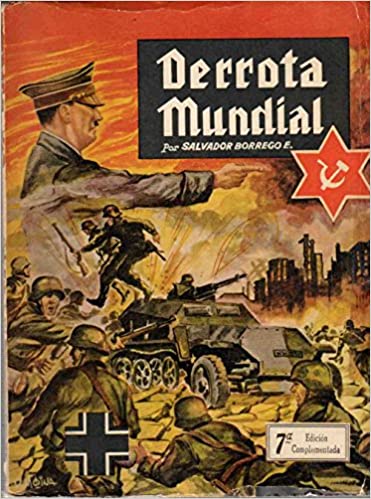
Note of the Editor: In 1955 the notable Mexican José Vasconcelos (see my 2011 article: here) wrote a preface for Salvador Borrego’s main work, Derrota Mundial [World Defeat], in which Borrego argues that the world lost with the defeat of Germany. In 2015, on Borrego’s 100th birthday, David Duke, Ernst Zündel and Mark Weber visited him in Mexico. The four of them can be seen in this photograph; Weber appears to the far left; Zündel in the middle.
 

______ 卐 ______

 
He told Hermann Rauschning: ‘If we fail to win, we will drag half the world down with us, and no one will be able to rejoice in a victory over Germany’ and: ‘He could not otherwise accomplish his mission’, notes this author, without apparently realising the significance of such an assertion.[4]

So what was this ‘mission’, so imperious although He who knew he was in charge of it could, at times, foresee its failure? It was that of all those beings, both human and more than human—in India they are called avatars or descents of the divine Spirit in the visible and tangible world—who, from age to age, have fought against the tide of Time, for the restoration of a material order in the image of the eternal Order: that of the God Krishna, that of the Prophet Mohammed, and, in Germanic legend, truer than history: that of the hero Siegfried, like them both initiate and warrior.

Such a mission always implies the destruction of the decadent world, without which the restoration of a hierarchical society according to eternal values would be unthinkable. It therefore implies the recognition of the reign of evil, of the ‘triumph of injustice’[5] that is, what is contrary to the divine Order, at the time of the combatant—and the exaltation of combat. Undoubtedly, people who militate by violence against an already bad established order, in favour of a ‘new world’ even worse from the viewpoint of natural hierarchies, are also dissatisfied people who aren’t afraid of armed struggle. But, as I have tried to show above, it is the nature of their dream, not the methods employed for its realisation, which places them exactly opposite the fighters against time.

There are reckless, irresponsible fighters—both in the direction of temporal evolution and against it. There are millions of people of ‘goodwill’—liberals, individualists, pacifists, ‘friends of man’ of all stripes—who, mostly through sheer ignorance or laziness of mind, follow the deceptive suggestions of the agents of the Dark Forces, and contribute, with the most generous intentions in the world, to accelerating the pace of universal degeneration.

There are also people perfectly unconscious of the eternal laws of the visible as well as the subtle Universe, who militate enthusiastically for selection in battle, for the segregation of races, and, in general, for an aristocratic conception of the world, by instinct—simply out of horror of the physical and moral ugliness of men, and out of hatred of the prejudices and institutions which encourage its generalisation. Many of us are among them. Nobler than the former, since they are centred on beauty which, in its essence, merges with Truth, they are, despite everything, just as unresponsible in the strong sense of the word, because they are just as attached to the realm of impression, that is to say, to the subjective.

But it is different with leaders… all the more so with the founders of new times.

The real initiator of a subversive movement in the sense I have given above, can only be a man in possession of some degree of undeniable knowledge. But he uses it in reverse: for purposes contrary to the spirit of true hierarchies, therefore contrary to those which a wise man’s action should take. On the other hand, the founder and leader of a faith ‘against Time’—as Adolf Hitler was—can only be one of those men whom I have, in another book,[6] called ‘above Time’: a sage, an initiate in union with the Divine and simultaneously a warrior—and perhaps also a ‘politician’—ready to employ, at the level of the contingencies of the visible world, all the means he knows to be effective, and judging a means only by its effectiveness.

He can only be a man both above Time, as regards his being, and against Time, as regards his action in the world; in other words, a warrior (or a politician, or both) fighting against the order, institutions and powers of his time, with whatever weapons he can muster, with a view to an (at least temporary) ‘recovery’ of society, inspired by a Golden Age ideal: a will to bring the ‘new’ order into accord with the Eternal Order.

Now, I repeat: the texts, the facts, the whole history and atmosphere of National Socialism become fully comprehensible only if, once and for all, one admits that Adolf Hitler was such a man: the most recent manifestation, among us, of the One who returns from age to age ‘for the protection of the righteous, for the destruction of those who do evil, for the firm establishment of the order according to the nature of things’.[7]

_________

[1] Translated into French under the title Libres propos sur la Guerre et la Paix, by R. d’Harcourt.

[2] A (shortened) French translation was published by Gallimard.

[3] Hans Grimm, Warum? Woher? aber Wohin? published by Klosterhaus Verlag, Lippoldsberg, in 1954; page 14.

[4] Hermann Rauschning, Hitler m’a dit, 13th French edition, 1939, pages 142 & 279.

[5] Bhagawad-Gîta, IV, verse 7.

[6] The Lightning and the Sun, written from 1948 to 1956, published in Calcutta in 1958.

[7] Bhagawad-Gîta, IV, verse 8.

Categories
Democracy Monarchy Souvenirs et réflexions d'une aryenne (book) Sturmabteilung (SA) Third Reich

Reflections of an Aryan woman, 50

There is no shortage of opponents of Marxism. They range from those who condemn all violence and are frightened by the known episodes of ‘class struggle’ in Russia and China, to those who reproach the Communists for their atheism and materialism, to those who own some property and are afraid of losing it if they have to live under the sign of the Sickle and Hammer.

Many oppose it in the name of some political doctrine, usually embodied in a ‘party’, which, if it attacks the ‘subversive’ character of Marxism, is itself no less subversive, and for the same deep reasons. This is the case with the adherents of all democratic parties, whose common denominator is to be found in the belief in the ‘equality in law’ of all men, and hence the principle of universal suffrage, of power emanating from the majority. These people don’t realise that Communism is in its infancy in this very principle, as it was already in Christian anthropocentrism (even if it is a question of the value of human souls in the eyes of a personal God who infinitely loves all men). They don’t realise that it is and can only be so, for the reason that the majority will always be the mass—and increasingly so, in an overpopulated world.

Only those who are faithful to any adequate expression of immemorial Tradition, and in particular to any true religion or to any Weltanschauung capable of serving as a basis for a true religion—any worldview which is ultimately based on the knowledge of the eternal and on the will to make it the principle of the socio-political order—, are fundamentally opposed to Marxism.

Now, disregarding the apparent paradox of such an assertion, twenty-five years after the collapse of the Third German Reich I dare to repeat that the only properly Western doctrine which (after the very old Nordic religions which Christianity persecuted and gradually killed between the 6th and 12th centuries) fulfils this condition is Hitlerism.

______ 卐 ______
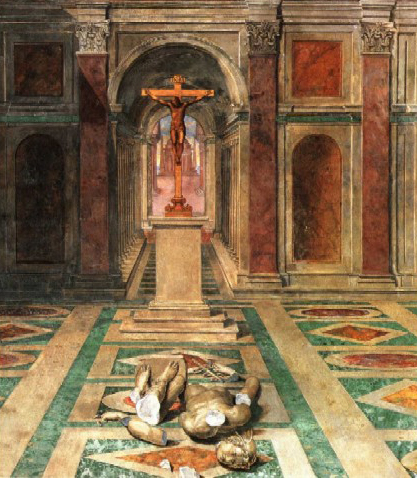
 
Note of the Editor: Once more, Savitri didn’t know about the apocalypse of whites that also represented, in the 4th and 5th centuries, the violent destruction of the classical world by fanatic Christians. We cannot blame her. Books like this one had not been published! More recently than Savitri’s time, even Mauricio didn’t know about the blackest page of ancient history, as he commented yesterday.

______ 卐 ______

 
This is the only Weltanschauung infinitely more than ‘political’ that is clearly ‘against Time’ in accordance with the eternal. It is the only worldview which, in the long run, will triumph both over Marxism and the general chaos to which it will have led the world—and this, no matter how great the material defeat of its followers may have been yesterday, and no matter how hostile millions of men may be about it today. Only a total recovery can succeed a total subversion: a glorious beginning of the cycle at a lamentable end of it.

But our opponents won’t fail to draw everyone’s attention to the eminently ‘anti-traditional’ character of more than one aspect of National Socialism, both during the Kampfzeit, before 1933, and after the seizure of power. If it is ‘subversive’ from the viewpoint of eternal values to preach the ‘class struggle’ with a view to the ‘dictatorship of the proletariat’. But wasn’t it equally subversive to rise to power democratically thanks to universal suffrage, by relying on a succession of electoral campaigns (on the protection of young fighters, for the most part as ‘proletarian’ in their behaviour, as the Communists whose attacks they repelled during meetings and whom they overcame in street battles)? Wasn’t it to be so, to keep this power, which came from the people—the masses—and to omit the reestablishment of the old monarchy despite the last and fervent recommendation of Marshal von Hindenburg, President of the Reich?

On the other hand, didn’t several German banks[1] as well as industrial magnates[2] subsidised the NSDAP, thus making the success of the National Socialist Revolution depend, in part, on the power of money and running the risk of making it considered, despite its popular appearance, the supreme defence of the ‘capitalist’ order as it already existed—that is to say, a society extremely distant from the traditional ideal?

Finally, it may be said, how can it be denied that, even after the seizure of power the Third German Reich was far from presenting the appearance of an organism inspired from top to bottom by the vision of the cosmic hierarchy? The famous author Hans Günther himself, apparently disillusioned, wrote to me in 1970 that he had, unfortunately, seen in it ‘an ochlocracy’ rather than the aristocratic regime he had dreamed of. And one cannot categorically reject without discussion this judgement of one of the most prominent theorists of Hitler’s racism before the disaster of 1945. The judgement, while undoubtedly excessive, must, in more than one particular case, certainly express some regrettable reality.

Let’s never forget that we are approaching the end of a cycle, and that the best institutions can therefore only exceptionally have a semblance of the perfection of the past. For everywhere, and the post-war period has amply proved this, there are more and more two-legged mammals and fewer and fewer men in the strongest sense of the word. No doctrine should therefore be judged by what has been accomplished in the visible world in its name.

The doctrine is true or false depending on whether or not it is in unison with that direct knowledge of the universal and eternal which only a steadily diminishing minority of sages possesses. It is true—it cannot be repeated often enough—regardless of the victory or defeat of its followers, or so-called followers on the material plane, and regardless of their weaknesses, foolishness, or even crimes. Neither the atrocities of the Holy Inquisition, nor the scandals attached to the name of Pope Alexander VI Borgia, take anything away from the truth of the vision of the ‘intelligible world’ that a Master Eckhart, for example, or some initiated Templar, may have had through Christian symbolism. And the same is true of all doctrines.

We must therefore be careful not to impute to Hitlerism the faults, weaknesses or excesses of people with power, to any degree whatsoever, under the Third Reich or during the period of struggle (Kampfzeit) from 1920 to 1933, and especially the faults or excesses committed against the spirit of the Weltanschauung and the Führer’s dream, as there seemed to be so many. In German society, as it was under the growing influence and effective rule of the Führer during the Kampfzeit and afterwards, we must see only the Führer’s efforts to mould it according to his dream, or to prevent it from evolving against that same dream. We must try to understand what he wanted to do.

Already in the official National Socialist texts addressed to the general public—in the Twenty-five Points, which form the basis of the Party programme; and above all in Mein Kampf where the great philosophical directives of the latter are traced out even more clearly—it is visible that the Movement was directed against the most cherished ideals and the most characteristic customs of the eminently decadent society, which had grown out of the Liberalism of the 18th and 19th centuries.

Lending at interest, financial speculation, and any form of gain alien to a creative endeavour, as well as the exploitation of vice or silliness in a press, literature, cinema or theatre envisaged above all as a means of making a profit, are condemned with the utmost rigour. Moreover, the very principles of modern Western civilisation—the equality of all men and all races in law, the idea that ‘law’ is the expression of the will of the majority, and ‘nation’ the community of those who, whatever their origin, ‘want to live together’; the idea that perpetual peace in abundance, the fruit of man’s ‘victory over nature’ represents the supreme good—are attacked, ridiculed and demolished in a masterly manner.

Natural law, the law of the struggle for life, is recognised and exalted on the human level as on all other levels. And the primordial importance of race and personality—the two pillars of the new faith—is proclaimed on every page. Finally, this new faith, or rather this new conception of life (neue Audassung) for the Führer and the few, is not a question of ‘faith’ but true knowledge. It is characterised as ‘corresponding to the original meaning of things’[3] which says a lot, this ‘original meaning of things’ being none other than that which they take on in the light of Tradition.

We can therefore, without going any further, affirm that everything in the history of the National Socialist Party that doesn’t seem to coincide with the spirit of a struggle ‘against Time’ is a matter of the tactics of the struggle, not its nature or purpose. It was under the pressure of hard necessity, and only after he had failed on 9 November 1923 in his attempt to seize power by force that Adolf Hitler, released from his Landsberg prison but now deprived of all means of action, had recourse—reluctantly to be sure—to the slow and long ‘legal way’, that is to say, to the repeated appeal to the voters and the gradual conquest of a majority in the Reichstag. It is well known that his first move after taking power ‘by democratic means’ was to replace the authority of the many with that of one, namely his own at all levels; in other words, to abolish democracy: to bring the political order into line with the natural order as far as possible.

It was under the pressure of a no less compelling material necessity—that of meeting the enormous expenses involved in the struggle for power in a parliamentary system with its inevitable election campaigns—that he had to accept the help of the Hugenbergs, the Kirkdorfs, the Thyssens, Dr Schacht and later Krupp, as well as of a host of industrialists and bankers.

Without it, he couldn’t have risen to power fast enough to block the road to the most dangerous forces of subversion: the Communists. For money is, more than ever, in a world which it increasingly dominates, the ‘sinews of war’ and politics. Does this mean that the Führer was subservient to money or to those who had given him money during the Kampfzeit? Does it mean that he made any concessions to them after taking power?

Far from it! He allowed them to get rich insofar as, in so doing, they served the national economy effectively and gave the working masses what he had promised them: abundance through work insofar as, subject to his authority, they continued to help the Party, i.e. the state, in peace and war. He kept them in their place and their role—like a king and the merchant ‘caste’ in a traditional society—thus showing both his realism and wisdom.

On the other hand, the (at least partial) ‘ochlocracy’ that has so often been attributed to National Socialism was, in fact, only the inevitable corollary of Adolf Hitler’s obligation to come to power by relying, quite democratically, on the majority of the electorate. It wouldn’t have existed if the putsch of 9 November 1923 had succeeded and had given him free rein to remake Germany according to his immense dream. It wouldn’t have existed because he wouldn’t have needed the collaboration of hundreds of thousands of young people ready to do anything: to strike blows as well as to receive them, to maintain in the vicinity of his massive propaganda meetings, and in the halls themselves, an order constantly threatened by the physical attacks of the most violent and implacable elements of the Communist opposition.

To conquer Germany ‘democratically’ he had to show himself, to be heard, hundreds and hundreds of times to convey to the public his message: part of his message, at least that which would induce the masses to vote for his party. The message was irresistible but it had to be communicated. And that would have been impossible without the wolf pack, the SA[4], who ruled the streets and who, at the risk of their own lives, ensured the Führer’s silence and safety amid his audience.

Adolf Hitler loved his young beasts, madly attached to his person, eager for both violence and adoration, many of whom were former Communists who had been won over to the holy cause by the fascination of his words, his looks, his behaviour and his doctrine in which the son of a proletarian saw something more outrageous, more brutal, and therefore more exalting than Marxism.

He loved them. And he loved the latest of their supreme leaders of the Kampfzeit, under whose orders he himself had once fought in the war: Ernst Röhm, who had returned from Bolivia, from the end of the world, at his call in 1930. He willingly turned a blind eye to his deplorable morals and saw in him only the perfect soldier and genius organiser.

And yet… he resigned himself, despite everything, to having this old comrade killed, or to let him be killed—almost the only man in his entourage who was on a first-name basis with him[5]—as soon as he was convinced that the turbulence of this troop, so faithful though it was, its spirit of independence and especially the growing opposition which was emerging between it and the regular German army could only lead precisely to ochlocracy, if not to civil war; in any case, only to the weakening of Germany.

One could compare this tragic but apparently necessary purge of June 30, 1934 with the most Machiavellian settlements of accounts in history; for example, the execution without trial of Don Ramiro di Lorqua on the orders of Caesar Borgia—with this crucial difference, however: that, while the Duke of Valentino had in mind only power for himself, the Führer aimed infinitely higher. He wanted power to try, in a desperate effort, to reverse the march of Time against itself, in the name of eternal values. There was nothing personal in his struggle at any stage.

And if, despite the fervent desire of Field Marshal and Reich President von Hindenburg, he rejected any idea of restoring the monarchy, it was not out of ambition either. It was because he was aware of the vanity of such a step in terms of values and true hierarchies. The monarchy ‘by divine right’, the only normal one from the traditional point of view[6] had, for centuries already, lost all meaning and justification in Europe.

The Führer knew this. It was not a question of trying to restore a shaky order by reinstalling a parliamentary monarchy presided over (there is no other word) by William II or one of his sons. He wanted to build a new order, or rather to resurrect the oldest order: the ‘original’ order in the strongest and most durable form it could take in this century.

And he knew that, by the choice of those forces of life which, throughout any cycle of time, untiringly oppose the ineluctable current of dissolution, he—the eternal Siegfried, both human and more than human—held both the legitimate power in this visible world and the legitimate authority emanating from beyond: the ‘power of the two Keys’. With him at the top, the pyramid of earthly hierarchies was to gradually resume its natural position, once again depicting in miniature, first in Germany, then throughout Europe and the Aryan world: the invisible Order which the Cosmos depicts in large.

It was in the name of this grandiose vision of ideal correspondences that he rejected, with equal vigour, Marxism: a doctrine of total subversion; Parliamentarism in all its forms, always based on the same superstition of quantity; and ochlocracy, a source of disorder, and therefore of constant instability.

But the traditional character of his wisdom is to be sought even more in the few texts that give us his secret, or at least intimate, talks, his open-hearted confidences in front of a few selected people, than in his writings or speeches addressed to the general public.

__________

[1] The Deutsche Bank, the Commerz und Privat Bank, the Dresdener Bank, the Deutsche Credit-Gesellschaft, etc.

[2] E. Kirkdorf, Fritz Thyssen, Voegler, Otto-Wolf von Schröder, then Krupp.

[3] ‘…unsere neue Auffassung, die ganz dem Ursinn der Dinge entspricht…’ (Mein Kampf, 1935 edition, page 440).

[4] Sturmabteilungen or Storm Troops.

[5] With some of his other early collaborators, such as Gregor Strasser.

[6] The elective kingship of the ancient Germans, that of the Frankish warrior raised to the flagstaff by his peers, was also ‘of divine right’ if we admit that the ‘divine’ is none other than the pure blood of a noble race.
Categories
Degenerate art Egalitarianism Kali Yuga Souvenirs et réflexions d'une aryenne (book)

Reflections of an Aryan woman, 49

As the present Cycle is much nearer its end than its bright beginning, it is probably not the first time that such an undertaking has taken place. I mentioned above the Revolution of 1789, which, in the name of the idea of equality ‘in law’ of all men of all races, led in France, de facto, to the usurpation of power by the bourgeoisie, and, in the geographically much more distant West, to the creation of the grotesque negro republic of Santo Domingo.

I could have mentioned Christianity itself, despite the undeniable, but visibly limited, part of true universal symbolism it may contain. Didn’t its dissemination—in the name of this same idea, as subversive as it is erroneous of equality—consummated the disintegration of the Greco-Roman world (already begun, it is true, in the Hellenistic period)? And its outrageous anthropocentrism makes it, in any case, an incomplete religion.

The European aristocracy, that is to say Germanic, and the Byzantine or Byzantinized Slavic aristocracy, came to terms with it out of policy, using it as a ready-made pretext for proselytising conquests and as a unifying force for the conquered peoples; while some of their members, and the most eminent ones at that, sometimes welcomed in it the opportunity for pure spiritual masochism, if not physical masochism as well.[1] All in all, and despite the inspiration that so many artists have drawn from it, this work has been, practically as well as in the absolute sense of the word, more subversive than constructive.
 

______ 卐 ______

 
Editor’s Note: This letter to me has been the most radical approach to this subject I have ever read.
 

______ 卐 ______

 
I could have mentioned any of these wisdoms, always more or less truncated, that Nietzsche calls ‘slave religions’. For all of these, even and perhaps especially those that most ostensibly place themselves ‘above Time’, by the mere fact that they deny hierarchy even if only in society and not in itself, and take no account of race on the pretext that the visible is of little importance, result in practice in the encouragement of a levelling down[2] and thus constitute (in practice, always) disintegrating factors acting in the direction of Time. They all contribute to the vast work of subversion, in the true sense of the word: of turning the ideal order upside down which continues, and intensifies, throughout the cycle.

I will say more. Undoubtedly there is a ‘subversion’ of this principial order whenever a man, or a natural group of men—a caste, a race—moved by a false estimate of his ‘rights’ or even of his ‘duties’, usurps or tries to usurp the normal place of another; whenever, for example, a prince rejects the spiritual authority to which his kingdom, and perhaps his civilisation, owes its link—however remote and tenuous—with the highest and most hidden sources of Tradition. It is a crime of this nature of which Philip the Fair, otherwise a great king, seems to have been guilty in destroying, with the connivance of a pope who was more of a politician than a priest, the Order of the Knights Templar. But all this only prepares and prefigures, by far or by near, the ultimate subversion: that which consists in calling the mass—and the mass of all races: the ‘world proletariat’—to power and what is worse is the claims to derive from it, and from it alone, the principle and justification of power.

This subversion, which Guénon calls ‘the reign of Soudra’, is the worst of all those who have succeeded one another in the course of the ages. It is the worst not because a non-Marxist would find himself subjected to more inconveniences under a communist regime than under another, but because it is no longer a question of arbitrary changes, contrary to the spirit of the true hierarchy within visible society, but of a complete reversal of ideal situations and essential values.

The result is that this society, instead of tending, as it should, to reflect what it can of the eternal order, reflects, symbolises, concretises in the world of manifestation exactly the opposite. The pyramid which, in the supra-rational vision of the wise man, represents the organic arrangement of the ideal society, the image of the hierarchical states of cosmic existence, visible and invisible, is, in the sacrilegious dream of the Marxist, completely turned upside down. It is planted in balance—oh, how unstable!—on what should be, on what, from the viewpoint of formal correspondences, is its summit. And it is its natural base that serves as its artificial summit: a ‘summit’ that is not a summit because it is, precisely, mass, a formless and heavy mass: a crushing mass overflowing everything and not a point.

It is from the metaphysical point of view that Marxism is nonsense, no matter how deceptively subtle the arguments on which its founder, Mardoccai, a.k.a. Marx, tried to support from economic and political considerations concerning production, the employer’s profit, the worker’s wage, ‘surplus value’, etc.

No dialectic can bring a doctrine into line with cosmic truth, if it is not already so. And, in the practical domain this time, no force of coercion or persuasion or conditioning can in the long run stabilise a particular state of deterioration in a cycle. The social pyramid cannot remain precariously balanced on its top with its base in the air indefinitely. Either a ‘partial recovery’ will tend to put it back on its feet—with an increasingly illusory success, and less and less durable as the cycle approaches its end—or the pyramid, dragged down by the very inertia of the mass which it was intended to be the ‘summit’, will collapse, disintegrate, fall apart. And it will be chaos, complete anarchy succeeding the reverse order. It will be—to imitate the colourful, Hindu-tinged language of the author of The Crisis of the Modern World—the reign of the Chandala succeeding the reign of the Soudra: the end of the cycle.

Perhaps we still have sporadic glimpses of this in some manifestations of gregarious eccentricity and boisterous nihilism, such as those of the ‘Existentialists of Saint-Germain-des-Prés’, the young people of the ‘New Left’, or ‘hippies’ of all stripes: anarchists out of laziness, pacifists out of laziness, drug addicts, unwashed, uncombed, noisy, ragged individualists and tolerant as long as the individuality of their neighbours doesn’t bother them, preaching: ‘Make love; don’t go to war!’ and ready to jump on the first one who prefers to make war, or both.

________

[1] As could well be the case of Elisabeth of Thuringia, princess of Hungary, who was flogged by Conrad of Marburg, her director of conscience.

[2] I have tried to show this in a long passage in my book Gold in the Furnace, 1951 edition, Calcutta, pages 212ff.

Categories
Souvenirs et réflexions d'une aryenne (book)

Reflections of an Aryan woman, 48

I have already insisted on the untruth at the root of Marxism, namely the assertion that man is reduced to what his economic environment makes of him. I won’t come back to this. I need only emphasise the unnatural character—against the fundamental law of all manifestation—of the approach which consists in presenting a being as the product of something external to him and which, in any case, is only interested in what is in him less essential, less specifically ‘his’ metaphysically speaking, less permanent: his physical needs and comfort.

From the point of view of the universal order, such an approach would be just as absurd about the animal, or the plant, as it is concerning man. No being can be reduced to its appearance and material functions, and even less to the result of the action of the economic environment, that is to say, in the final analysis, of the possibilities of nutrition, appearance and functions. The last of the herbs derives its existence from what is permanent in the seed from which it emerged. The environment can, of course, help it to develop, or on the contrary prevent it from developing; it cannot make it become what it is not: turn a buttercup into a dandelion or vice versa any more than it can destroy what is, in the visible world and beyond, permanent in a man: his physical and psychic heredity, his race.

No one is so foolish as to deny the influence of environment on a man’s life: his occupations, the opportunities he has or doesn’t have. But to reduce the being of the latter to the ‘result of the influence of the environment’ and especially of the ‘economic’ environment and to build on this real reversal of the process of passage from essence to existence a whole political philosophy, is a reversal of the original and impersonal cosmic wisdom. It is, therefore, an anti-traditional enterprise.

If proof were needed the few words which sum up, with blinding clarity, the method and aim of the Marxists are ‘class struggle’, and ‘dictatorship of the proletariat’.

Certainly, in the advanced epoch of the Dark Age, in which we have been living for a long time now, ‘classes’ have lost their meaning. They have lost their meaning insofar as they no longer correspond to castes. They represent less and less the real differences in character and aptitudes between the people who compose them, differences linked to heredity. It is therefore not at all bad, but highly desirable, that they should disappear in a total overhaul of societies—an overhaul that would tend to restore the ideal order, as far as possible. It is, for anyone who wants to oppose the general decadence which only the fanatics of ‘progress’ refuse to see all around us, especially urgent to put an end to the scandal of purchasable privileges.

This state of affairs is not new. It seems to have been established in Western Europe—in France at least—in the 16th century, with the very first acquisitions of titles of nobility for money. It was sanctioned, and reinforced, by the Revolution of 1789, made in part by the people, but for the benefit of the bourgeoisie and under its direction: a Revolution whose result was to substitute, for the power emanating from birth alone, the power granted by money alone.

______ 卐 ______


Editor’s Note: This is extremely important! See this post that is already eight years old on this site.
 

______ 卐 ______

 
Nothing could be more urgent than to change this. It is not that the rich are condemnable in themselves because they have become rich, or because their rich fathers have passed on a fortune to them. It is by no means so, provided, of course, that their money hasn’t been acquired through the exploitation of misery or vice, at the expense of the community. But he becomes one as soon as he imagines that this money gives him rights other than those which derive from the qualities and capacities inherited with his blood, and therefore inherent in his very being. He becomes one if he imagines that he can legitimately buy everything with this money, including the responsibility of command and the obedience of his compatriots.

In a word, there is no need to ‘fight’, let alone suppress, the bourgeoisie, or the aristocracy, or the working or peasant class. All have their raison d’être and their role. It is only necessary to ensure that every man is truly in his place, and remains there.

From the point of view of this ideal order, which reflects and symbolises the intangible hierarchy of the states of Being from the point of view of the eternal, the idea of ‘class struggle’ having political power is nonsense. Power should be in the hands of the best, the aristoi, those worthy and capable of exercising it. And if the fact of losing it always reveals some lack or failure, or even, sometimes, some deep indignity in the one who has it snatched from him, it doesn’t follow that it is enough to usurp it to become worthy of it.

The ‘class struggle’ is only conceivable at a time when these ‘classes’ are no longer distinguishable from each other, except by what they possess, and not by what they are. It is, in other words, only conceivable when it is property alone, or property above all, which determines the factitious ‘being’ of each class instead of the true being of the class, that is, the physical and psychic heredity of its members which determines what they are entitled to possess; when, I repeat, the ‘classes’ no longer correspond to the respective castes.

‘Struggle’, ‘combat’—I shall come back to this later in connection with anything other than Marxism—then becomes the only means of establishing a certain order in a society that no longer has any connection with eternal principles. There is necessarily violence or struggle when these principles are disregarded in the visible world. This has been the case since the end of the age of truth.[1] This is the meaning given to this struggle, for or against the ideal order, that ultimately justifies or condemns it.

Now, for Marxists, it must lead to what they call the ‘dictatorship of the proletariat’, in other words, to the passage of power into the hands of the masses: that is to say, of the people who are the least qualified to exercise it. It therefore tends towards a complete overthrow of the social hierarchy as it was in all the periods when it reflected, even from a distance, the eternal order. This alone should suffice to characterise Marxism as a backwards philosophy. Its effort to eradicate the existing elites and to reduce the masses themselves to the state of a human ragbag which is increasingly easy to ‘condition’ and guide in the direction of exclusively economic production, is a seemingly a diabolical undertaking.

________

[1] The Satya Yuga of the Sanskrit scriptures.

Categories
Democracy Julian (novel) Souvenirs et réflexions d'une aryenne (book)

Reflections of an Aryan woman, 47


Chapter VIII

The two great modern movements and tradition

 
Whenever justice is in danger, O Bharata, and
injustice is exalted, so I myself come back. For the
protection of the good, for the destruction of the wicked, and for
the establishment of a reign of justice, I am reborn from age to age.

Bhagawad-Gîta, IV, verses 7 and 8.

The difference in ‘style’, as well as in spirit, which separates the great collective demonstrations of Hitler’s faith under the Third Reich from the parallel expressions of Marxism in Russia (or China) and, even more so, from the orderless processions of the scruffy youths of the ‘New Left’, on the one hand, and the official parades of the liberal plutocracies, conceals a fundamental opposition in nature: the opposition between Tradition and Anti-tradition, to use the language of René Guénon or Evola.

I have tried to show that a visibly ‘political’ doctrine can sometimes serve as the basis of a religion, provided that it is associated with rituals, that is, with symbolism, and that it becomes an object of faith for all its adherents. But I recall that it can only serve as a foundation for a true religion if the propositions on which it is based are the expression of eternal truths, or are justified only in the light of such truths; in other words, are legitimately linked to Tradition.

A true religion is the set of beliefs and symbolic gestures—rites and customs, linked to these beliefs—which in a traditional civilisation give expression to the consciousness of the sacred. On the other hand, a traditional civilisation is, according to René Guénon, ‘that which rests on principles in the true sense of the word, that is to say, where the intellectual order dominates all the others, where everything proceeds from it directly or indirectly and, whether it is a question of sciences or social institutions, is, in the final analysis, nothing but contingent, secondary and subordinate applications of intellectual truths’.[1] And it is worth adding that what the sage means here by ‘purely intellectual truths’ and ‘intellectual order’ are the very laws of universal existence, manifest or unmanifest, and the permanent order behind all that passes: the eternal.

It is hardly necessary to point out that the ‘values’ and ‘truths’ nominally exalted in the civil solemnities of the western democracies—even in the secular education given to the youth—fit into a particular form of Tradition but don’t even possess, even as mere words, enough resonance to give rise to the outline of any powerful anti-traditional system—let alone a ‘false religion’, a religion based on a deliberate negation of Tradition: a counter-initiation. If an ever more relentless encroachment of technology brings the world of plutocracies and the world of communism so close together that one can, theoretically at least, say that there is nothing to choose between the two, there is, nevertheless, a difference between them. The world of the plutocracies—and their satellites—has no faith, and is not attached, and has not been for a long time, to any vision beyond the sensible and the transient.

If a few individuals or groups of individuals still possess a knowledge of the Eternal, they no longer have any influence over society as a whole; they remain silent, and wait, striving at most to remain faithful to themselves and recognise each other.
 

______ 卐 ______

 
Editor’s note:

The novel I have recommended most on this site is Julian by Gore Vidal. Those who have read it will recognise what Savitri says here on the last page of Julian.
 

______ 卐 ______

 
The masses are left to scatter in the grey of small daily worries and pleasures. They are not involved at all. On the other hand, all they have retained from the old faith of their churches is a veneer of conformity that is increasingly crumbling, and that anthropocentrism common to all teaching devised by Jews for Aryan consumption. The elites, or so-called elites, have, apart from a few individuals, hardly retained more.

The West lives on its gains but for how long?

Emptied of all will to power, refusing all risk, cursing all aggressiveness (except that which it deployed from 1939 to 1945 and beyond—in its efforts to ‘denazify’ Germany—against the only people and the only faith that could have led it into a prodigious recovery), it slips into comfortable decay, it gets stuck in a precarious welfare, becomes mechanised, Americanised, proletarianized until what it falls one day on its own, as a result of increasing infiltration of ideas and agents who are all the more effective for being more silent, under the dependence of the communist world, or that it becomes, by right of conquest, an integral part of it.

But, if it is true that while liberal democracy—with its superstitions of universal suffrage, of compulsory primary (and soon, secondary!) education, and of generalised vaccination, in other words, with its cult of equality and quantity—leads straight to Marxism, it is not Marxism. The decadence over which it presides is, to be sure, all pervaded by a distinctly anti-traditional spirit—all decadence is: this is its very essence. But it is a natural process, a sign of senility encouraged at most by certain conscious agents of the Dark Forces, working in a muted way in high places in the direction of anti-tradition. It is not linked to a systematic, long and coldly coordinated, and masterly directed effort of deliberate subversion of the traditional order, as is that which the zealots of Marxism have, if not provoked, at least accelerated in all the countries where they have taken power.

In other words there are between the so-called ‘free’ world—the elites and multitudes aspiring only to easy happiness and immediate success—and the communist world with its fiercely disciplined masses dominated by leaders (some of whom such as Lenin, Stalin or Mao-Tsé-Tong will leave an indelible mark on history), about the same analogy as between a man who lets himself live, without faith, without any impulse whatsoever beyond the realm of the senses, without participation in any rite, and a man who attends black masses.

This is the difference between the absence of any velocity of initiatory development, and real counter-initiation. And it is precisely for this reason that ‘the small margin of material freedom that the world of democracy still grants in some activities… to those who don’t allow themselves to be internally conditioned… would certainly disappear under a communist regime’.[2] A society without order is, of course, less intolerant in practice than a society built on a reverse order or one whose structure reflects true Order.

____________

[1] R. Guénon, Orient et Occident, p. 150.

[2] Julius Evola, Chevaucher le tigre.